A Relational Syntax-Semantics Interface Based on Dependency Grammar
Ralph Debusmann Denys Duchier∗ Alexander Koller Marco Kuhlmann Gert Smolka Stefan ThaterSaarland University, Saarbrücken, Germany ∗LORIA, Nancy, France
{rade|kuhlmann|smolka}@ps.uni-sb.de, [email protected], {koller|stth}@coli.uni-sb.de
Abstract
We propose a syntax-semantics interface that realises the mapping between syntax and se-mantics as a relation and does not make func-tionality assumptions in either direction. This interface is stated in terms of Extensible De-pendency Grammar (XDG), a grammar formal-ism we newly specify. XDG’s constraint-based parser supports the concurrent flow of informa-tion between any two levels of linguistic rep-resentation, even when only partial analyses are available. This generalises the concept of under-specification.
1 Introduction
A key assumption of traditional syntax-semantics interfaces, starting with (Montague, 1974), is that the mapping from syntax to semantics is functional, i. e. that once we know the syntactic structure of a sentence, we can deterministically compute its se-mantics.
Unfortunately, this assumption is typically not justified. Ambiguities such as of quantifier scope or pronominal reference are genuine semantic am-biguities; that is, even a syntactically unambigu-ous sentence can have multiple semantic readings. Conversely, a common situation in natural language generation is that one semantic representation can be verbalised in multiple ways. This means that the relation between syntax and semantics is not func-tional at all, but rather a true m-to-n relation.
There is a variety of approaches in the litera-ture on syntax-semantics interfaces for coping with this situation, but none of them is completely sat-isfactory. One way is to recast semantic ambiguity as syntactic ambiguity by compiling semantic dis-tinctions into the syntax (Montague, 1974; Steed-man, 1999; Moortgat, 2002). This restores function-ality, but comes at the price of an artificial blow-up of syntactic ambiguity. A second approach is to assume a non-deterministic mapping from syntax to semantics as in generative grammar (Chomsky, 1965), but it is not always obvious how to reverse the relation, e. g. for generation. For LFG, the oper-ation of functional uncertaintainty allows for a re-stricted form of relationality (Kaplan and Maxwell III, 1988). Finally, underspecification (Egg et al.,
2001; Gupta and Lamping, 1998; Copestake et al., 2004) introduces a new level of representation, which can be computed functionally from a syntac-tic analysis and encapsulates semansyntac-tic ambiguity in a way that supports the enumeration of all semantic readings by need.
In this paper, we introduce a completely rela-tional syntax-semantics interface, building upon the underspecification approach. We assume a set of linguistic dimensions, such as (syntactic) immedi-ate dominance and predicimmedi-ate-argument structure; a grammatical analysis is a tuple with one component for each dimension, and a grammar describes a set of such tuples. While we make no a priori function-ality assumptions about the relation of the linguistic dimensions, functional mappings can be obtained as a special case. We formalise our syntax-seman-tics interface using Extensible Dependency
Gram-mar (XDG), a new grammar formalism which gen-eralises earlier work on Topological Dependency Grammar (Duchier and Debusmann, 2001).
The relational syntax-semantics interface is sup-ported by a parser forXDGbased on constraint pro-gramming. The crucial feature of this parser is that it supports the concurrent flow of possibly partial in-formation between any two dimensions: once addi-tional information becomes available on one dimen-sion, it can be propagated to any other dimension. Grammaticality conditions and preferences (e. g. se-lectional restrictions) can be specified on their nat-ural level of representation, and inferences on each dimension can help reduce ambiguity on the oth-ers. This generalises the idea of underspecifica-tion, which aims to represent and reduce ambiguity through inferences on a single dimension only.
2 Extensible Dependency Grammar
This section presents Extensible Dependency Grammar (XDG), a description-based formalism for dependency grammar. XDG generalizes previ-ous work on Topological Dependency Grammar (Duchier and Debusmann, 2001), which focussed on word order phenomena in German.
2.1 XDGin a Nutshell
XDG is a description language over finite labelled graphs. It is able to talk about two kinds of con-straints on these structures: The lexicon of anXDG
grammar describes properties local to individual nodes, such as valency. The grammar’s principles express constraints global to the graph as a whole, such as treeness. Well-formed analyses are graphs that satisfy all constraints.
An XDG grammar allows the characterisation of linguistic structure along several dimensions of description. Each dimension contains a separate graph, but all these graphs share the same set of nodes. Lexicon entries synchronise dimensions by specifying the properties of a node on all dimen-sions at once. Principles can either apply to a single dimension (one-dimensional), or constrain the rela-tion of several dimensions (multi-dimensional).
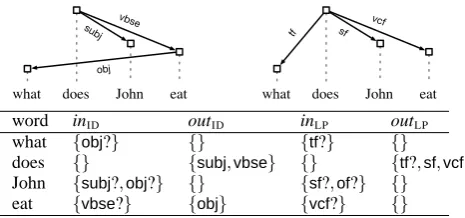
Consider the example in Fig. 1, which shows an analysis for a sentence of English along two dimen-sions of description, immediate dominance (ID) and linear precedence (LP). The principles of the under-lying grammar require both dimensions to be trees, and theLPtree to be a “flattened” version of theID
tree, in the sense that whenever a node v is a tran-sitive successor of a node u in the LP tree, it must also be a transitive successor of u in theIDtree. The given lexicon specifies the potential incoming and required outgoing edges for each word on both di-mensions. The word does, for example, accepts no incoming edges on either dimension and must there-fore be at the root of both theIDand theLPtree. It is required to have outgoing edges to a subject (subj) and a verb base form (vbse) in the ID tree, needs fillers for a subject (sf) and a verb complement field (vcf) in the LP tree, and offers an optional field for topicalised material (tf). All these constraints are satisfied by the analysis, which is thus well-formed.
2.2 Formalisation
Formally, an XDG grammar is built up of dimen-sions, principles, and a lexicon, and characterises a set of well-formed analyses.
A dimension is a tuple D= (Lab,Fea,Val,Pri)of a set Lab of edge labels, a set Fea of features, a set
Val of feature values, and a set of one-dimensional
subj vbse
obj
what does John eat
sf vcf
what does John eat
tf
word inID outID inLP outLP
what {obj?} {} {tf?} {}
does {} {subj,vbse} {} {tf?,sf,vcf}
John {subj?,obj?} {} {sf?,of?} {}
eat {vbse?} {obj} {vcf?} {}
Figure 1:XDGanalysis of “what does John eat”
principles Pri. A lexicon for the dimension D is a set Lex⊆Fea→Val of total feature assignments (or
lexical entries). A D-structure, representing an anal-ysis on dimension D, is a triple(V,E,F)of a set V of nodes, a set E⊆V×V×Lab of directed labelled
edges, and an assignment F : V →(Fea→Val)of lexical entries to nodes. V and E form a graph. We write StrD for the set of all possible D-structures. The principles characterise subsets of StrDthat have further dimension-specific properties, such as being a tree, satisfying assigned valencies, etc. We assume that the elements of Pri are finite representations of such subsets, but do not go into details here; some examples are shown in Section 3.2.
AnXDGgrammar((Labi,Feai,Vali,Prii)ni=1,Pri, Lex) consists of n dimensions, multi-dimensional principles Pri, and a lexicon Lex. AnXDGanalysis
(V,Ei,Fi)ni=1is an element of Ana=Str1× · · · ×Strn where all dimensions share the same set of nodes V . Multi-dimensional principles work just like one-dimensional principles, except that they specify subsets of Ana, i. e. couplings between dimensions (e. g. the flattening principle betweenIDandLP in Section 2.1). The lexicon Lex⊆Lex1× · · · ×Lexn constrains all dimensions at once. AnXDGanalysis
is licenced by Lex iff(F1(w), . . . ,Fn(w))∈Lex for every node w∈V .
In order to compute analyses for a given input, we model it as a set of input constraints (Inp), which again specify a subset of Ana. The parsing prob-lem for XDG is then to find elements of Ana that are licenced by Lex and consistent with Inp and
Pri. Note that the term “parsing problem” is
tradi-tionally used only for inputs that are sequences of words, but we can easily represent surface realisa-tion as a “parsing” problem in which Inp specifies a semantic dimension; in this case, a “parser” would compute analyses that contain syntactic dimensions from which we can read off a surface sentence.
2.3 Constraint Solver
2003) on finite sets of integers; well-formed anal-yses correspond to the solutions of this problem. The transformation, whose details we omit due to lack of space, closely follows previous work on ax-iomatising dependency parsing (Duchier, 2003) and includes the use of the selection constraint to effi-ciently handle lexical ambiguity.
We have implemented a constraint solver for thisCSPusing the Mozart/Oz programming system (Smolka, 1995; Mozart Consortium, 2004). This solver does a search for a satisfying variable assign-ment. After each case distinction (distribution), it performs simple inferences that restrict the ranges of the finite set variables and thus reduce the size of the search tree (propagation). The successful leaves of the search tree correspond to XDG anal-yses, whereas the inner nodes correspond to partial
analyses. In these cases, the current constraints are
too weak to specify a complete analysis, but they already express that some edges or feature values must be present, and that others are excluded. Partial analyses will play an important role in Section 3.3.
Because propagation operates on all dimensions concurrently, the constraint solver can frequently infer information about one dimension from infor-mation on another, if there is a multi-dimensional principle linking the two dimensions. These infer-ences take place while the constraint problem is be-ing solved, and they can often be drawn before the solver commits to any single solution.
Because XDG allows us to write grammars with completely free word order,XDG solving is anNP -complete problem (Koller and Striegnitz, 2002). This means that the worst-case complexity of the solver is exponential, but the average-case complex-ity for the hand-crafted grammars we experimented with is often better than this result suggests. We hope there are useful fragments ofXDGthat would guarantee polynomial worst-case complexity.
3 A Relational Syntax-Semantics Interface Now that we have the formal and processing frame-works in place, we can define a relational syntax-semantics interface for XDG. We will first show how we encode semantics within the XDG frame-work. Then we will present an example grammar (including some principle definitions), and finally go through an example that shows how the rela-tionality of the interface, combined with the con-currency of the constraint solver, supports the flow of information between different dimensions.
3.1 Representing Meaning
We represent meaning within XDG on two dimen-sions: one for predicate-argument structure (PA),
every student reads a book subj
det
obj
det
every student reads a book ag
arg
pat
arg
i.ID-tree ii.PA-structure
s
every student reads a book s
r
r s
every student reads a book
s
r r
iii. scope trees
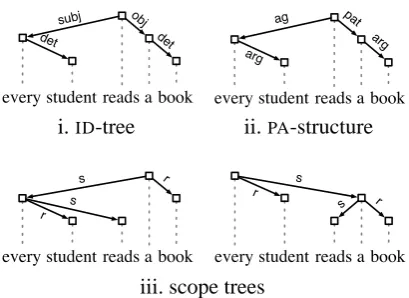
Figure 2: Two analyses for the sentence “every stu-dent reads a book.”
and one for scope (SC). The function of the PA di-mension is to abstract over syntactic idiosyncrasies such as active-passive alternations or dative shifts, and to make certain semantic dependencies e. g. in control constructions explicit; it deals with concepts such as agent and patient, rather than subject and ob-ject. The purpose of theSC dimension is to reflect the structure of a logical formula that would repre-sent the semantics, in terms of scope and restriction. We will make this connection explicit in Section 4. In addition, we assume an ID dimension as above. We do not include anLPdimension only for ease of presentation; it could be added completely orthogo-nally to the three dimensions we consider here.
While oneIDstructure will typically correspond to onePAstructure, eachPAstructure will typically
be consistent with multiple SC structures, because of scope ambiguities. For instance, Fig. 2 shows the unique ID and PA structures for the sentence “Ev-ery student reads a book.” These structures (and the input sentence) are consistent with the two possi-bleSC-structures shown in (iii). Assuming a
David-sonian event semantics, the two SCtrees (together with thePA-structure) represent the two readings of the sentence:
• λe.∀x.student(x)→ ∃y.book(y)∧read(e,x,y)
• λe.∃y.book(y)∧ ∀x.student(x)→read(e,x,y)
inID outID inPA outPA inSC outSC DET {subj?,obj?,pcomp?} {det!} {ag?,pat?,arg?} {quant!} {r?,s?,a?} {r!,s!}
CN {det?} {prep∗} {quant?} {mod?} {r?,s?,a?} {}
PN {subj?,obj?,pcomp?} {prep∗} {ag?,pat?,arg?} {mod?} {r?,s?,a?} {r?,s!}
TV {} {subj!,obj!,prep∗} {} {ag!,pat!,instr?} {r?,s?,a?} {}
PREP {prep?} {pcomp!} {mod?,instr?} {arg!} {r?,s?,a?} {a!}
link codom contradom
DET {quant7→ {det}} {quant7→ {r}} {}
CN,PN {mod7→ {prep}} {} {mod7→ {a}}
TV {ag7→ {subj},pat7→ {obj},instr7→ {prep}} {} {ag7→ {s},pat7→ {s},instr7→ {a}}
PREP {arg7→ {pcomp}} {} {arg7→ {s}}
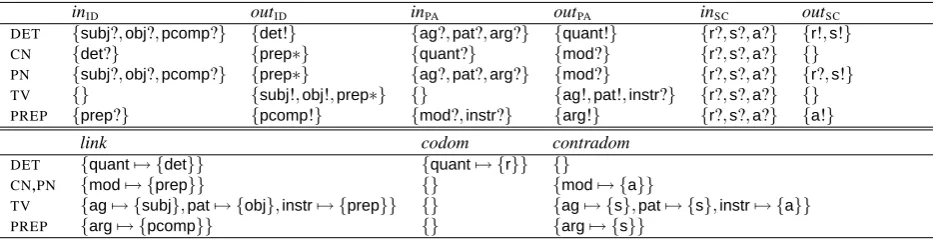
Figure 3: The example grammar fragment
with the principles that use them.
The ID dimension uses the edge labels LabID= {det,subj,obj,prep,pcomp} resp. for determined common noun,1 subject, object, preposition, and
complement of a preposition. The PA dimension
uses LabPA ={ag,pat,arg,quant,mod,instr}, resp.
for agent, patient, argument of a modifier, common noun pertaining to a quantifier, modifier, and instru-ment; andSCuses LabSC={r,s,a}resp. for
restric-tion and scope of a quantifier, and for an argument. The grammar also contains three one-dimen-sional principles (tree, dag, and valency), and three multi-dimensional principles (linking, co-dominance, and contra-dominance).
Tree and dag principles. The tree principle re-stricts ID and SC structures to be trees, and the dag principle restricts PA structures to be directed acyclic graphs.
Valency principle. The valency principle, which we use on all dimensions, states that the incom-ing and outgoincom-ing edges of each node must obey the specifications of the in and out features. The possi-ble values for each feature ind and outd are subsets of Labd× {!,?,∗}. `! specifies a mandatory edge with label`,`? an optional one, and`∗zero or more.
Linking principle. The linking principle for di-mensions d1,d2 constrains how dependents on d1
may be realised on d2. It assumes a feature linkd1,d2
whose values are functions that map labels from
Labd1 to sets of labels from Labd2, and is specified
by the following implication:
v→l d1v0 ⇒ ∃l0∈linkd1,d2(v)(l): v
l0 →d2 v0
Our grammar uses this principle with the link fea-ture to constrain the realisations ofPA-dependents in theIDdimension. In Fig. 2, the agent (ag) of reads must be realised as the subject (subj), i. e.
1We assume on all dimensions that determiners are the
heads of common nouns. This makes for a simpler relationship between the syntactic and semantic dimensions.
reads→agPAevery ⇒ reads subj →IDevery
Similarly for the patient and the object. There is no instrument dependent in the example, so this part of the link feature is not used. An ergative verb would use a link feature where the subject realises the patient; Control and raising phenomena can also be modelled, but we cannot present this here.
Co-dominance principle. The co-dominance principle for d1,d2relates edges in d1to dominance
relations in the same direction in d2. It assumes a
feature codomd1,d2 mapping labels in Labd1 to sets
of labels in Labd2 and is specified as
v→l d1 v0 ⇒ ∃l0∈codomd1,d2(v)(l): v
l0 → →∗d
2v
0
Our grammar uses the co-dominance principle on dimension PA and SC to express, e. g., that the propositional contribution of a noun must end up in the restriction of its determiner. For example, for the determiner every of Fig. 2 we have:
everyquant→ PAstudent ⇒ every→ →r ∗
SCstudent
Contra-dominance principle. The contra-domi-nance principle is symmetric to the co-domicontra-domi-nance principle, and relates edges in d1 to dominance
edges into the opposite direction in d2. It assumes
a feature contradomd1,d2 mapping labels of Labd1 to
sets of labels from Labd2 and is specified as
v→l d1 v
0 ⇒
∃l0∈contradomd1,d2(v)(l): v
0→ →l0 ∗
d2v
Our grammar uses the contra-dominance principle on dimensionsPAandSCto express, e. g., that pred-icates must end up in the scope of the quantifiers whose variables they refer to. Thus, for the transi-tive verb reads of Fig. 2, we have:
reads→agPAevery ⇒ every s
→ →∗SCreads reads→patPAa ⇒ a→ →s ∗
Mary saw a student with a book ag pat
quant arg
quant
Mary saw a student with a book
s s r s r
Mary saw a student with a book subj obj
det
arg
det
prep
Mary saw a student with a book ag pat
quant arg
quant
Mary saw a student with a book
s r
s r
Mary saw a student with a book subj obj
det
arg
det
instr
a s
Mary saw a student with a book ag pat
arg
arg quant
Mary saw a student with a book
s s r
s r
Mary saw a student with a book subj obj
det
arg det
mod prep
a
i. Partial analysis ii. verb attachment iii. noun attachment
ID
PA
SC
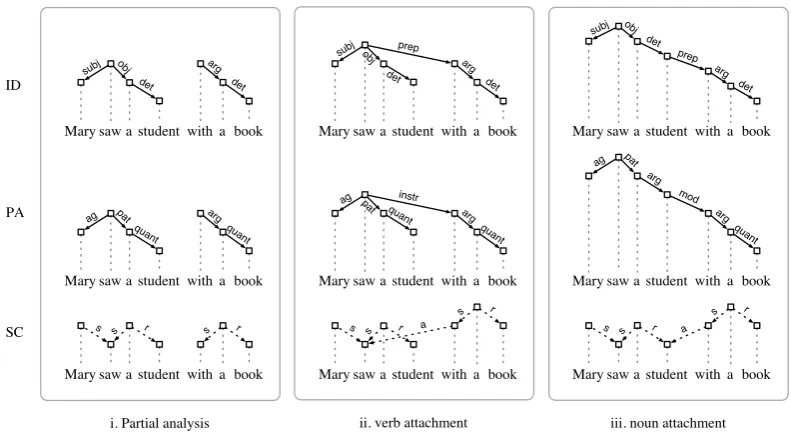
Figure 4: Partial description (left) and two solutions (right) for “Mary saw a student with a book.”
3.3 Syntax-Semantics Interaction
It is important to note at this point that the syntax-semantics interface we have defined is indeed re-lational. Each principle declaratively specifies a set of admissible analyses, i. e. a relation between the structures for the different dimensions, and the anal-yses that the complete grammar judges grammatical are simply those that satisfy all principles. The role of the lexicon is to provide the feature values which parameterise the principles defined above.
The constraint solver complements this relation-ality by supporting the use of the principles to move information between any two dimensions. If, say, the left-hand side of the linking principle is found to be satisfied for dimension d1, a propagator will infer
the right-hand side and add it to dimension d2.
Con-versely, if the solver finds that the right-hand side must be false for d2, the negation of the left-hand
side is inferred for d1. By letting principles interact
concurrently, we can make some very powerful in-ferences, as we will demonstrate with the example sentence “Mary saw a student with a book,” some partial analyses for which are shown in Fig. 4.
Column (i) in the figure shows the state after the constraint solver finishes its initial propagation, at the root of the search tree. Even at this point, the va-lency and treeness principles have conspired to es-tablish an almost completeID-structure. By the link-ing principle, thePA-structure has been determined similarly closely. TheSC-structure is still mostly un-determined, but by the co- and contra-dominance principles, the solver has already established that some nodes must dominate others: A dotted edge with label s in the picture means that the solver
knows there must be a path between these two nodes which starts with an s-edge. In other words, the solver has computed a large amount of semantic in-formation from an incomplete syntactic analysis.
Now imagine some external source tells us that
with is amod-child of student onPA, i. e. the anal-ysis in (iii). This information could come e. g. from a statistical model of selectional preferences, which will judge this edge much more probable than an instr-edge from the verb to the preposition (ii). Adding this edge will trigger additional inferences through the linking principle, which can now infer that with is aprep-child of student onID. In the other direction, the solver will infer more dominances on
SC. This means that semantic information can be used to disambiguate syntactic ambiguities, and se-mantic information such as selectional preferences can be stated on their natural level of representation, rather than be forced into theIDdimension directly. Similarly, the introduction of new edges on SC
could trigger a similar reasoning process which would infer newPA-edges, and thus indirectly also
newID-edges. Such new edges on SCcould come from inferences with world or discourse knowledge (Koller and Niehren, 2000), scope preferences, or interactions with information structure (Duchier and Kruijff, 2003).
4 Traditional Semantics
Our syntax-semantics interface represents seman-tic information as graphs on thePA andSC
traditional representations. We devote the rest of the paper to demonstrating that a pair of aPA and aSC
structure can be interpreted as a Montague-style for-mula, and that a partial analysis on these two di-mensions can be seen as an underspecified semantic description.
4.1 Montague-style Interpretation
In order to extract a standard type-theoretic expres-sion from anXDG analysis, we assign each node v
two semantic values: a lexical valueL(v) represent-ing the semantics of v itself, and a phrasal value
P(v) representing the semantics of the entire SC -subtree rooted at v. We use theSC-structure to de-termine functor-argument relationships, and thePA -structure to establish variable binding.
We assume that nodes for determiners and proper names introduce unique individual variables (“in-dices”). Below we will writehhviito refer to the in-dex of the node v, and we write ↓` to refer to the node which is the`-child of the current node in the appropriate dimension (PAorSC). The semantic lex-icon is defined as follows; “L(w)” should be read as “L(v), where v is a node for the word w”.
L(a) =λPλQλe.∃x(P(x)∧Q(x)(e))
L(book) =book0
L(with) =λPλx.(with0(hh↓argii)(x)∧P(x)) L(reads) =read0(hh↓patii)(hh↓agii)
Lexical values for other determiners, common nouns, and proper names are defined analogously. Note that we do not formally distinguish event variables from individual variables. In particular,
L(with) can be applied to either nouns or verbs, which both have typehe,ti.
We assume that no node in theSC-tree has more than one child with the same edge label (which our grammar guarantees), and write n(`1, . . . , `k)to in-dicate that the node n hasSC-children over the edge labels `1, . . . , `k. The phrasal value for n is defined (in the most complex case) as follows:
P(n(r,s)) =L(n)(P(↓r))(λhhnii.P(↓s))
This rule implements Montague’s rule of quan-tification (Montague, 1974); note that λhhnii is a
binder for the variable hhnii. Nodes that have no s-children are simply functionally applied to the phrasal semantics of their children (if any).
By way of example, consider the left-hand SC -structure in Fig. 2. If we identify each node by the word it stands for, we get the following phrasal
@
@
every λ
@
@
a λ
@
@
read var var
student book
r
s s
r
every student reads a book r
r
s s
every student reads a book ag
arg
pat arg
Figure 5: A partialSC-structure and its correspond-ing CLLS description.
value for the root of the tree:
L(a)(L(book))(λx.L(every)(L(student) (λy.read0(y)(x)))),
where we write x forhhaii and y forhheveryii. The arguments of read0 are x and y because every and
a are thearg andpat children of reads on the PA -structure. After replacing the lexical values by their definitions and beta-reduction, we obtain the fa-miliar representation for this semantic reading, as shown in Section 3.1.
4.2 Underspecification
It is straightforward to extend this extraction of type-theoretic formulas from fully specified XDG
analyses to an extraction of underspecified seman-tic descriptions from partialXDGanalyses. We will briefly demonstrate this here for descriptions in the
CLLS framework (Egg et al., 2001), which sup-ports this most easily. Other underspecification for-malisms could be used too.
Consider the partialSC-structure in Fig. 5, which could be derived by the constraint solver for the sentence from Fig. 2. We can obtain a CLLS con-straint from it by first assigning to each node of theSC-structure a lexical value, which is now a part
of the CLLS constraint (indicated by the dotted el-lipses). Because student and book are known to ber -daughters of every and a onSC, we plug their CLLS constraints into the r-holes of their mothers’ con-straints. Because we know that reads must be dom-inated by thes-children of the determiners, we add the two (dotted) dominance edges to the constraint. Finally, variable binding is represented by the bind-ing constraints drawn as dashed arrows, and can be derived fromPAexactly as above.
5 Conclusion
This new grammar formalism offers the grammar developer the possibility to represent different kinds of linguistic information on separate dimensions that can be represented as graphs. Any two dimen-sions can be linked by multi-dimensional principles, which mutually constrain the graphs on the two di-mensions. We have shown that a parser based on concurrent constraint programming is capable of in-ferences that restrict ambiguity on one dimension based on newly available information on another.
Because the interface we have presented makes no assumption that any dimension is more “basic” than another, there is no conceptual difference be-tween parsing and generation. If the input is the sur-face sentence, the solver will use this information to compute the semantic dimensions; if the input is the semantics, the solver will compute the syntactic dimensions, and therefore a surface sentence. This means that we get bidirectional grammars for free.
While the solver is reasonably efficient for many (hand-crafted) grammars, it is an important goal for the future to ensure that it can handle large-scale grammars imported from e.g. XTAG (XTAG Research Group, 2001) or induced from treebanks. One way in which we hope to achieve this is to iden-tify fragments of XDG with provably polynomial parsing algorithms, and which contain most useful grammars. Such grammars would probably have to specify word orders that are not completely free, and we would have to control the combinatorics of the different dimensions (Maxwell and Kaplan, 1993). One interesting question is also whether dif-ferent dimensions can be compiled into a single di-mension, which might improve efficiency in some cases, and also sidestep the monostratal vs. multi-stratal distinction.
The crucial ingredient of XDG that make rela-tional syntax-semantics processing possible are the declaratively specified principles. So far, we have only given some examples for principle specifi-cations; while they could all be written as Horn clauses, we have not committed to any particular representation formalism. The development of such a representation formalism will of course be ex-tremely important once we have experimented with more powerful grammars and have a stable intuition about what principles are needed.
At that point, it would also be highly interest-ing to define a (logic) formalism that generalises bothXDGand dominance constraints, a fragment of CLLS. Such a formalism would make it possible to take over the interface presented here, but use dom-inance constraints directly on the semantics dimen-sions, rather than via the encoding intoPA andSC
dimensions. The extraction process of Section 4.2 could then be recast as a principle.
Acknowledgements
We thank Markus Egg for many fruitful discussions about this paper.
References
K. Apt. 2003. Principles of Constraint Programming. Cambridge University Press.
N. Chomsky. 1965. Aspects of the Theory of Syntax. MIT Press, Cambridge, MA.
A. Copestake, D. Flickinger, C. Pollard, and I. Sag. 2004. Minimal recursion semantics. an introduction.
Journal of Language and Computation. To appear.
D. Duchier and R. Debusmann. 2001. Topological de-pendency trees: A constraint-based account of linear precedence. In ACL 2001, Toulouse.
D. Duchier and G.-J. M. Kruijff. 2003. Information structure in topological dependency grammar. In
EACL 2003.
D. Duchier. 2003. Configuration of labeled trees un-der lexicalized constraints and principles. Research
on Language and Computation, 1(3–4):307–336.
M. Egg, A. Koller, and J. Niehren. 2001. The Constraint Language for Lambda Structures. Logic, Language,
and Information, 10:457–485.
V. Gupta and J. Lamping. 1998. Efficient linear logic meaning assembly. In COLING/ACL 1998.
R. M. Kaplan and J. T. Maxwell III. 1988. An algorithm for functional uncertainty. In COLING 1988, pages 297–302, Budapest/HUN.
A. Koller and J. Niehren. 2000. On underspecified processing of dynamic semantics. In Proceedings of
COLING-2000, Saarbrücken.
A. Koller and K. Striegnitz. 2002. Generation as depen-dency parsing. In ACL 2002, Philadelphia/USA. J. T. Maxwell and R. M. Kaplan. 1993. The interface
between phrasal and functional constraints.
Compu-tational Linguistics, 19(4):571–590.
R. Montague. 1974. The proper treatment of quantifica-tion in ordinary english. In Richard Thomason, editor,
Formal Philosophy. Selected Papers of Richard Mon-tague, pages 247–271. Yale University Press, New
Haven and London.
M. Moortgat. 2002. Categorial grammar and formal se-mantics. In Encyclopedia of Cognitive Science. Na-ture Publishing Group, MacMillan. To appear. Mozart Consortium. 2004. The Mozart-Oz website.
http://www.mozart-oz.org/.
G. Smolka. 1995. The Oz Programming Model. In
Computer Science Today, Lecture Notes in Computer
Science, vol. 1000, pages 324–343. Springer-Verlag. M. Steedman. 1999. Alternating quantifier scope in
CCG. In Proc. 37th ACL, pages 301–308.