Abstract
Global ranking, a new information re-trieval (IR) technology, uses a ranking model for cases in which there exist re-lationships between the objects to be ranked. In the ranking task, the ranking model is defined as a function of the properties of the objects as well as the relations between the objects. Existing global ranking approaches address the problem by “learning to rank”. In this paper, we propose a global ranking framework that solves the problem via data fusion. The idea is to take each re-trieved document as a pseudo-IR sys-tem. Each document generates a pseu-do-ranked list by a global function. The data fusion algorithm is then adapted to generate the final ranked list. Taking a biomedical information extraction task, namely, interactor normalization task (INT), as an example, we explain how the problem can be formulated as a global ranking problem, and demon-strate how the proposed fusion-based framework outperforms baseline me-thods. By using the proposed frame-work, we improve the performance of the top 1 INT system by 3.2% using the official evaluation metric of the BioCreAtIvE challenge. In addition, by employing the standard ranking quality measure, NDCG, we demonstrate that
* Corresponding author
the proposed framework can be cas-caded with different local ranking models and improve their ranking re-sults.
1
Introduction
Information Retrieval (IR) involves finding documents that are relevant to a given query in a large corpus. The task is usually formulated as a ranking problem. When a user submits a query, the IR system retrieves all documents that contain at least one query term, calculates a ranking score for each of the documents us-ing a rankus-ing model, and sorts the documents according to the ranking scores. The scores represent the relevance, importance, and/or diversity of the retrieved documents. Thus, the quality of a search engine can be determined by the accuracy of the ranking results.
Recently, a machine learning technology called learning to rank has been applied exten-sively to the task. Several state-of-the-art ma-chine learning-based ranking algorithms have been proposed, e.g., RankSVM and RankNet. These algorithms differ substantially in terms of the ranking models and optimization tech-niques employed, but most of them can be re-garded as “local ranking” approaches in the sense that each model is defined on a single document without considering the possible relations to other documents to be ranked. In many applications, this is only a loose approx-imation as there is always relational informa-tion among documents. For example, in some cases, users may prefer that two similar docu-ments have similar relevance scores; even
Global Ranking via Data Fusion
Hong-Jie Dai
1,2Po-Ting Lai
3Richard Tzong-Han Tsai
3*Wen-Lian Hsu
1,2*1
Department of Computer Science, National Tsing-Hua University,
2Institute of Information Science, Academia Sinica,
3Department of Computer Science & Engineering, Yuan Ze University
[email protected]
[email protected]
[email protected]
though one of the documents is not as relevant to the given query as the other; this problem is similar to Pseudo Relevance Feedback (Kwok, 1984). In other cases, web pages from the same site form a sitemap hierarchy in which a parent document should be ranked higher than its child documents (referred to as Topic Dis-tillation at TREC (Chowdhury, 2007)). To util-ize all available information, more advanced ranking algorithms define a ranking model as a function of all the documents to be ranked, i.e., a global ranking model (Qin et al., 2008a; Qin et al., 2008b).
Unlike conventional ranking and learning to rank models, such as BM25 and RankSVM, whose ranking functions are defined on a query and document pair, global ranking mod-els utilize both content information and rela-tion informarela-tion. Qin et al. (2008) proposed the first supervised learning framework for the global ranking problem. They formulated the problem as an optimization problem that in-volves finding an objective function to minim-ize the trade-off between local consistenceand global consistence and implemented it on SVM. Subsequently, they defined the global ranking problem formally in (Qin et al., 2008) and solved it by employing continuous condi-tional random fields (CRF).
In this paper, we propose a new framework for the global ranking problem. The major dif-ference between our work and that of Qin et al. (2008a; 2008b) is that we do not compile a feature vector of relational information directly to construct a new machine-learned ranking model for global ranking. Instead, we use the ranking results generated by the original rank-ing model and then employ an algorithm with the relational information to transform the global ranking problem into a data fusion prob-lem; that is also known as a rank aggregate problem. The proposed framework is flexible and can be cascaded with conventional ranking models or learning to rank models.
The remainder of this paper is organized as follows. In Section 2, we present a formal finition of global ranking. In Section 3, we de-scribe the proposed framework and consider three fusion algorithms that can be used with our framework. We also explain how the algo-rithms can be adapted to solve the global rank-ing problem. In Section 4, we introduce a
bio-medical text mining task called the interactor normalization task (INT) (Krallinger et al., 2009) and show why it should be formulated as a global ranking problem. In Section 5, we report extensive experiments conducted on the
INT dataset released by BioCreAtIvE
(Krallinger et al., 2009). Section 6 contains some concluding remarks.
2
Global Ranking Problem
The global ranking problem was first defined formally by Qin et al. (2008). In this paper, we propose a new global ranking framework based on their definition. Although we devel-oped the framework independently, we adopt Qin et al.’s terminology.
Let denote a query. In addition, let
denote the
docu-ments retrieved by , and let
denote the ranking scores
assigned to the documents. Here,
represents the number of documents retrieved by . Note that the numbers of documents va-ries according to different queva-ries. We assume that is determined by a ranking model.
If a ranking model is defined on a single document, i.e., in the form of
, it is called a “local ranking” model.
Let
be a set of
real-value functions defined on , , and
( ). The functions
represents the relations between documents. Equation 2 is defined according to the re-quirements of different tasks. For example, for the Pseudo Relevance Feedback problem, Qin et al. (2008) defined Equation 2 as the similari-ties between any two documents in their CRF-based model.
If a ranking model takes all the documents as its input and exploits both local and global information (Equation 2) in the documents, i.e., in the form of
,
it is called a “global ranking” approach.
(1)
3
Fusion-based
Global
Ranking
Framework
It is usually difficult to develop a global rank-ing algorithm that can fully utilize all the local and global information in documents to pro-duce a document rank and also consider the score ranks. One example of a global ranking algorithm that satisfied these criteria is the one proposed in (Qin et al., 2008) in which the modified CRF algorithm handles context (local) features and relational (global) features in the documents. Without solving a ranking problem directly, however, the modified CRF algorithm is more like a regression algorithm since it op-timizes the CRF parameters in a maximum likelihood estimate without considering the score ranks. With respect to the ranking feature, in this section, we describe our framework based on the idea of data fusion for solving the global ranking problem.
3.1 Framework Description
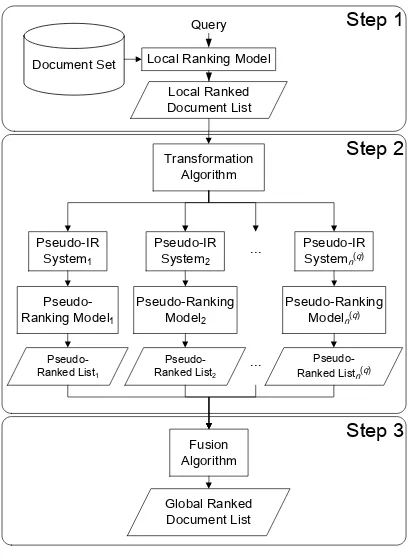
The flow chart of the proposed framework is illustrated in Figure 1. The first step is the same as that of the traditional local ranking
model. Given a query, the local ranking model
defined in Equation 1 is used to calculate the ranking score for each document, and re-turn a document list sorted according to the local scores.
The second step transforms the global rank-ing problem into a data fusion problem. Our idea is to take each retrieved document as a pseudo-IR system, and the pseudo-ranking model, , used by each system is the func-tion defined in Equafunc-tion 2. For each pseudo-IR system, , the pseudo-ranking model for a
document is defined as follows:
.
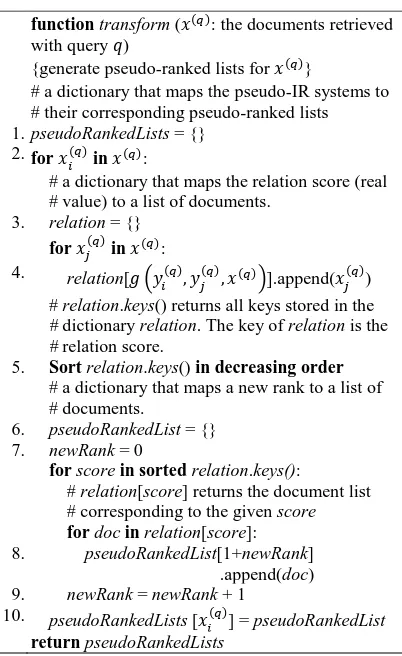
There are totally pseudo-IR systems, which generate pseudo-ranked lists. As a result, the global ranking problem is trans-formed into a data fusion problem, that is to aggregate the pseudo-ranked lists. Figure 2 shows the steps of the transformation algo-rithm.
The final step is to adapt fusion algorithms to aggregate the pseudo-ranked lists. A canoni-cal data fusion task is canoni-called meta-search
(Aslam and Montague, 2001; Fox and Shaw, 1994; Lee, 1997; Nuray and Can, 2006), which aggregates Web search query results from sev-eral engines into a more accurate ranking. The origin of research on data fusion can be traced back to (Borda, 1781). In recent years, the process has been used in many new applica-tions, including aggregating data from micro-array experiments to discover cancer-related genes (Pihura et al., 2008), integration of re-sults from multiple mRNA studies (Lin and Ding, 2008), and similarity searches across datasets and information merging (Adler et al., 2009; Zhao et al., 2010).
Liu et al. (2007) classified data fusion tech-nologies into two categories: order-based fu-sion and score-based fufu-sion. In the first catego-ry, the orders of the entities in individual rank-ing lists are used by the fusion algorithm. In the second category, the entities in individual ranking lists are assigned scores and the fusion algorithm uses the scores. In the following sub-sections, we adapt three fusion algorithms
Step 3 Step 2 Step 1
Local Ranking Model Document Set
Query
Local Ranked Document List
Transformation Algorithm
Pseudo-IR
System1 Pseudo-IR System2 ... Pseudo-IR Systemn(q)
Fusion Algorithm
Pseudo-Ranked List1
Pseudo-Ranked List2
Pseudo-Ranked Listn(q) ...
Global Ranked Document List
Pseudo-Ranking Model1 Pseudo-Ranking Model2 Pseudo-Ranking Modeln(q)
Figure 1. The Proposed Framework for Global Ranking.
for the proposed framework. The first is the Borda-fuse model (Aslam and Montague, 2001), an order-based fusion approach based on an optimal voting procedure. The second is a linear combination (LC) model (Vogt and Cottrell, 1999), which is a score-based fusion approach.
3.2 Borda-fuse
The Borda-fuse model (Aslam and Montague, 2001) is based on a political election strategy called the Borda Count. For our framework, the rationale behind the strategy is as follows. Each pseudo-IR system is an analogy for
a voter; and each voter ranks a fixed set of documents in order of preference (Equation 3). For each voter, the top ranked document is given points, the second ranked document is given - points, and so on. If some doc-uments left unranked by the voter, the remain-ing points are divided equally among the
un-ranked documents. The documents are un-ranked in descending order of the total points.
In our framework, we implement two Bor-da-fuse-based models. The first is the modified Borda-fuse (MBF) model. In MBF, the number of points given for a voter's first and subse-quent preferences is determined by the number of documents they have actually ranked, rather than the total number of ranked. Because the ranking model, , used by the pseudo-IR system may only retrieve documents where is smaller than , we penalize systems that do not rank a full document set by reduc-ing the number of points their vote distributes among the documents. In other words, if there are ten documents, but the pseudo-IR system only retrieves five, then the first document will only receive 5 points; the second will receive 4 points, and so on.
The second is the weighted Borda-fuse (WBF) model. The original Borda-fuse model reflects a democratic election in which each voter has equal weight. However, in many cas-es, we prefer some voters because they are more reliable. We employ a simple weighting scheme that multiplies the points assigned to a document determined by system by a weight .
3.3 LC Model
The LC model has been used by many IR re-searchers with varying degrees of success (Bartell et al., 1994; Knaus et al., 1995; Vogt and Cottrell, 1999; Vogt and Cottrell, 1998). In our framework, it is defined as follows. Given a query , a document , the weights
for individual pseudo-IR systems, and jth pseudo-IR sys-tem’s ranking score , the LC model cal-culates the ranking score of against all pseudo-IR systems as follows:
This score is then used to rank the documents. For example, for two pseudo-IR systems, this reduces to:
Compared with MBF, Equation 4 requires both relevance scores and training data to
de-functiontransform ( : the documents retrieved
with query )
{generate pseudo-ranked lists for }
# a dictionary that maps the pseudo-IR systems to # their corresponding pseudo-ranked lists 1. pseudoRankedLists = {}
2. for
in :
# a dictionary that maps the relation score (real # value) to a list of documents.
3. relation = {} for in : 4. relation[
].append(
)
# relation.keys() returns all keys stored in the
# dictionary relation. The key of relation is the
# relation score.
5. Sort relation.keys() in decreasing order
# a dictionary that maps a new rank to a list of # documents.
6. pseudoRankedList = {} 7. newRank = 0
for score in sorted relation.keys():
# relation[score] returns the document list # corresponding to the given score
for doc in relation[score]:
8. pseudoRankedList[1+newRank] .append(doc) 9. newRank = newRank + 1 10. pseudoRankedLists [
] = pseudoRankedList
return pseudoRankedLists
Figure 2. The Dependent Ranked List Gen-eration Algorithm (represented using python syntax).
termine the weight given to each pseudo-IR system.
4
Case Study
In this section, we describe the task examined in our study. We also explain how we formu-late the task as a global ranking problem. The experiments results are detailed in Section 5.
4.1 Interactor Normalization Task
The interactor normalization task (INT) is a complicated text mining task that involves the following steps: (1) It recognizes gene men-tions in a full text article. (2) It maps the rec-ognized gene mentions to corresponding unique database identifiers which is similar to the word sense disambiguation task in compu-tational linguistics. (3) It generates a ranked list of the identifiers according to their impor-tance in the article and their probability of playing the interactor role in protein-protein interactions (PPIs). Such ranked lists are useful for human curators and can speed up PPI data-base curation.
Dai et al. (2010) won first place in the Bio-CreAtIvE II.5 INT challenge (Mardis et al., 2009) by using a SVM-based local ranking model in which they treat gene mentions’ iden-tifiers in an article as the document set, and the query is a constant string “interactor”. Based on their feature sets and evaluation results, we can find that their local ranking model tends to rank focus genes higher (Dai et al., 2010). However, the primary objective of INT is to generate a ranked list of interaction gene iden-tifiers. According to (Jenssen et al., 2001), co-mentioned genes are usually related in some way. For example, if two gene mentions fre-quently occur alongside each other in the same sentence in an article, they probably have an association and influence each other’s rank. Take a low-ranked interactor that is only men-tioned twice in an article as an example. If both mentions are next to the highest-ranked interactor in the article, then the low-ranked interactor’s rank should be boosted significant-ly. Therefore, the ranking task for each article can be formulated as a global ranking problem; the global ranking algorithm should consider both the local information from Dai et al.’s
model and the global information from the as-sociations among identifiers.
4.2 Global Ranking in INT
Let be a constant “interactor.” The identifier set generated by an INT system for a full-text article is analogous to the document set
. Here denotes the number of identifiers. Note that the number of identifiers varies for different articles. Let
denote the ranking scores assigned to the identifiers given by a local ranking model. In this study, we used the INT system and SVM-based local ranking model released by (Dai et al., 2010) to gener-ate the identifier set and ranking scores.
To obtain the global information, we con-sider the co-occurrence of identifiers and em-ploy mutual information (MI) to measure the association between two identifiers as follows:
.
In the above formula, the identifier probabili-ties and are estimated by counting the number of occurrences in an article norma-lized by , i.e., the number of sentences con-taining identifiers. The joint probability,
, is estimated by the number of times co-occurs with in a window of words normalized by . Note that, in practice, other advanced approaches can be used to calculate the association score.
For the proposed framework, each identifier
is a pseudo-IR system with MI as its
pseudo-ranking model . The identifiers
that co-occur with become candidates on
’s pseudo-ranked list.
5
Experiments
5.1 Dataset
We used the BioCreAtIvE II.5 Elsevier corpus released by BioCreAtIvE II.5 challenge in the experiments. The corpus contains 1,190 full-text journal articles selected mainly from FEBS Letters. Following the same format as the BioCreAtIvE II.5 INT challenge, we used articles published in 2008 (61 articles) as our training set and articles published in 2007 or earlier (61 articles) as our test set.
5.2 A Fusion-based Global Ranking Framework for INT
Before applying the proposed framework, we preprocess the articles in the dataset to identify all gene mentions, and map them to their cor-responding identifiers. After preprocessing, each full-text article is associated with a list of identifiers (Step 1 in Figure 1). The transform and fusion algorithm is then applied on each article (Steps 2 and 3 in Figure 1).
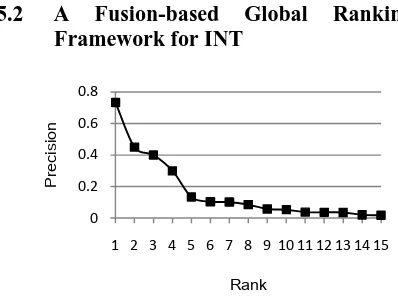
To apply the WBF and LC models, we need to determine the weight assigned to each pseu-do-IR system. To obtain the weight, we calcu-late the precision of each rank of the ranked lists generated by Dai et al.’s INT system. Fig-ure 3 shows the precision of ranks 1 to 15 cal-culated by applying three-fold cross validation on the INT training set. We observe that the precision declines as the rank increases, which implies that the higher ranks predicted by their SVM-based local ranking model are more reli-able than the lower ranks.
5.3 Evaluation Metrics
Our evaluations focus on two comparisons: the first compares the ranking of the proposed framework with the original local ranking model by using the area under the curve of the
interpolated precision/recall (iP/R) curve. This is the evaluation metric used in the BioCreA-tIvE II.5 challenge and is a common way to depict the degradation of precision as one tra-verses the retrieved results by plotting interpo-lated precision numbers against percentage recall. The area under the iP/R function is
defined as follows:
,
where is the total number of correct identifi-ers and is the highest interpolated precision for the correct identifier at , the recall for that hit. The interpolated precision is calcu-lated for each recall by taking the highest precision at or any .
In the second comparison, we use a standard quality measure in IR to estimate the ranking performance of local ranking models and the proposed framework. We adopt Normalized Discounted Cumulative Gain (NDCG) to measure the performance. The NDCG score of a ranking is computed based on DCG (Dis-counted Cumulative Gain) as follows:
,
where is the rank position, and
is the relevance grade of the th identifier in the ranked result set. In our experiment,
corresponds to an interaction iden-tifier, and corresponds to other iden-tifiers. NDCG is then computed as follows:
,
where denotes the results of a perfect ranking. The NDCG values for all articles are averaged to obtain the average performance of the proposed framework.
5.4 INT Test Set Performance
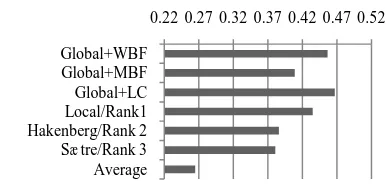
Figure 4 shows the Area_iPR scores of four configurations. In the baseline configuration (Local/Rank1), the SVM-based local ranking model released by Dai et al. is employed. In the configuration Global+LC, Global+MBF, and Global+WBF, the proposed global ranking framework is cascaded with the local ranking model and with three data fusion models: the LC model, the modified Borda-fuse (MBF) model, and the weighted Borda-fuse model. The figure also shows the Area_iPR scores of Figure 3. Precision of Different Ranks.
0 0.2 0.4 0.6 0.8
1 2 3 4 5 6 7 8 9 10 11 12 13 14 15
P
re
cis
ion
the top three teams and the average Area_iPR
score of all BioCreAtIvE II.5 INT participants (Average).
The results show that under the global rank-ing framework, Area_iPR performance is im-proved in addition to Global+MBF. The high-est Area_iPR (Global+LC: 46.7%) is 3.2% higher than the Rank 1 score in the BioCreA-tIvE II.5 INT challenge. According to our analysis, before global ranking, identifiers whose feature values rarely appear in the train-ing set are often ranked incorrectly because their feature values are under-estimated by the ranking model. However, if the identifiers co-occur with higher-ranked identifiers whose feature values appear frequently, the proposed framework is very likely to increase their ranks. This results in an improved Area_iPR score.
5.5 Global Ranking Performance
To illustrate the effectiveness of the proposed global ranking framework and assess its per-formance when it is cascaded with other con-ventional ranking models, we implement a simple term frequency-based ranking function, which is based on the identifier frequency in an article as another local ranking model. If two or more identifiers have the same frequen-cy, two heuristic rules are employed sequen-tially to rank them: (1) the identifier with the highest frequency in the Results section of the
article, and (2) the identifier mentioned first in the article.
Table 1 shows the NDCG percentage gain of different ranking models. It compares the ranked list generated by our global ranking framework and by the local ranking models. We observe that (1) irrespective of whether the local ranking model is a conventional model or a learning to rank model, Global+LC and Global+WBF models achieve NDCG gains over the original rankings of the local ranking models; (2) the results show that our global ranking framework can improve the perfor-mance by only exploiting MI analysis. Howev-er, it is expected that employing more ad-vanced relation extraction methods to deter-mine the global information (Equation 3) would yield more reliable pseudo-ranked lists and lead to a further improvement in the final ranking; and (3) similar to the results in Sec-tion 5.4, the performance of Global+MBF does not improve. Global+MBF has a negative NDCG gain and the Area_iPR decreases by 2.61%. We believe this is due to MBF gives equal weight to each pseudo-IR system. As mentioned in Section 4.1, the document set in INT is comprised of the identifiers of the gene mentions derived by Dai et al.’s system. Un-fortunately, there must be incorrect identifiers (the errors may be due to their gene mention recognition or identifier mapping processes). As in the meta-search, the best performance is often achieved by weighting the input systems unequally. Reasonable weights allow the algo-rithm to concentrate on good feedback from pseudo-IR systems and ignore poor feedback. As shown by the average precision results in Figure 3, the identifiers (corresponding to the pseudo-IR systems in our framework) in the higher ranks are more reliable; however, MBF cannot use this information, which leads to a negative NDCG gain and a lower Area_iPR
score.
6
Conclusion
We have presented a new global ranking framework based on data fusion technology. Our approach solves the global ranking prob-lem in three stages: the first stage ranks the document set by the original local ranking model; the second stage transforms the
prob-Based on Global Ranking NDCG1 NDCG3 NDCG5 Local Ranking
/Rank1
Global+LC +0.908 +1.323 -0.003 Global+MBF -3.279 -1.034 -0.020 Global+WBF -0.016 +3.630 +2.071 Freq Global+LCf +1.639 +3.152 +2.817
Global+MBFf -6.860 -4.275 -4.839
Global+WBFf +2.549 +2.390 +3.043
Table 1. The NDCG Gain (%) of Different Ranking Models.
Figure 4. The Area_iPR Results of Different Ranking Models
0.22 0.27 0.32 0.37 0.42 0.47 0.52
lem into a data fusion task by using global in-formation, and the final stage adapts fusion algorithms to solve the ranking problem. The framework is flexible and it can be combined with other mature ranking models and fusion algorithms. We also show how the BioCreA-tIvE INT can be formulated as a global ranking problem and solved by the proposed frame-work. Experiments on the INT dataset demon-strate the effectiveness of the proposed frame-work and its superior performance over other ranking models.
In our future work, we will address the fol-lowing issues: (1) the use of advanced data fusion algorithms in the proposed framework; (2) assessing the performance of the proposed framework on other tasks, such as Pseudo Re-levance Feedback and Topic Distillation; and (3) design an advanced supervised learning relation extraction algorithm to replace MI in INT to evaluate the system performance.
References
Adler, P., R. Kolde, M. Kull, A. Tkachenko, H. Peterson, J. Reimand and J. Vilo (2009). Mining for coexpression across hundreds of datasets using novel rank aggregation and visualization
methods. Genome Biology 10(R139).
Aslam, J. A. and M. Montague (2001). Models for
metasearch. Proceedings of the 24th annual
international ACM SIGIR conference on Research and development in information
retrieval, New Orleans, Louisiana, United States,
ACM.
Bartell, B. T., G. W. Cottrell and R. K. Belew (1994). Automatic combination of multiple
ranked retrieval systems. Proceedings of the
17th annual international ACM SIGIR
conference on Research and development in
information retrieval, Dublin, Ireland
Springer-Verlag New York, Inc.
Borda, J. (1781). Mémoire sur les élections au
scrutin. Histoire del'Acad´emie Royale des
Sciences 2: 13.
Chowdhury, G. (2007). TREC: Experiment and
Evaluation in Information Retrieval. Online
Information Review 31(5): 462.
Dai, H.-J., P.-T. Lai and R. T.-H. Tsai (2010). Multi-stage gene normalization and SVM-based ranking for protein interactor extraction in
full-text articles. IEEE TRANSACTIONS ON
COMPUTATIONAL BIOLOGY AND
BIOINFORMATICS 14 May. 2010. IEEE
computer Society Digital Library. IEEE Computer Society.
Fox, E. A. and J. A. Shaw (1994). Combination of
Multiple Searches. 1994, Proceedings of the
Second Text REtrieval Conference (TREC 2) Jenssen, T.-K., A. Lagreid, J. Komorowski and E.
Hovig (2001). A literature network of human genes for high-throughput analysis of gene
expression. Nature Genetics 28(1): 21-28.
Knaus, D., E. Mittendorf and P. Schäuble (1995). Improving a basic retrieval method by links and
passage level evidence. NIST Special
Publication 500-225: Overview of the Third Text
REtrieval Conference (TREC-3).
Krallinger, M., F. Leitner and A. Valencia (2009).
The BioCreative II.5 challenge overview.
Proceedings of the BioCreative II.5 Workshop
2009 on Digital Annotations, Madrid, Spain.
Kwok, K. L. (1984). A document-document similarity measure based on cited titles and probability theory, and its application to
relevance feedback retrieval. SIGIR'84.
Lee, J. H. (1997). Analyses of multiple evidence
combination. Proceedings of the 20th annual
international ACM SIGIR conference on Research and development in information
retrieval, Philadelphia, Pennsylvania, United
States, ACM.
Lin, S. and J. Ding (2008). Integration of Ranked Lists via Cross Entropy Monte Carlo with
Applications to mRNA and microRNA Studies.
Biometrics 65(1): 9-18.
Liu, Y.-T., T.-Y. Liu, T. Qin, Z.-M. Ma and H. Li (2007). Supervised rank aggregation. Proceedings of the 16th international conference
on World Wide Web, Banff, Alberta, Canada,
ACM.
Mardis, S., F. Leitner and L. Hirschman (2009). BioCreative II.5: Evaluation and ensemble
system performance. Proceedings of the
BioCreative II.5 Workshop 2009 on Digital
Annotations, Madrid, Spain.
Nuray, R. and F. Can (2006). Automatic ranking of
information retrieval systems using data fusion.
Inf. Process. Manage. 42(3): 595-614.
rank aggregation approach Genomics 92(6): 400-403
Qin, T., T.-Y. Liu, X.-D. Zhang, D.-S. Wang and H. Li (2008). Global Ranking Using Continuous
Conditional Random Fields. Proceedings of the
Twenty-Second Annual Conference on Neural
Information Processing Systems (NIPS 2008),
Vancouver, Canada.
Qin, T., T. Liu, X. Zhang, D. Wang, W. Xiong and H. Li (2008). Learning to rank relational objects
and its application to web search, ACM.
Vogt, C. and G. Cottrell (1999). Fusion via a linear
combination of scores. Information Retrieval
1(3): 151-173.
Vogt, C. C. and G. W. Cottrell (1998). Predicting
the performance of linearly combined IR systems.
Proceedings of the 21st annual international ACM SIGIR conference on Research and
development in information retrieval, Melbourne,
Australia ACM.
Zhao, Z., J. Wang, S. Sharma, N. Agarwal, H. Liu and Y. Chang (2010). An Integrative Approach
to Identifying Biologically Relevant Genes.
Proceedings of SIAM International Conference