Sentence Compression Beyond Word Deletion
Trevor Cohn and Mirella Lapata School of Informatics
University of Edinburgh
{tcohn,mlap}@inf.ed.ac.uk
Abstract
In this paper we generalise the sen-tence compression task. Rather than sim-ply shorten a sentence by deleting words or constituents, as in previous work, we rewrite it using additional operations such as substitution, reordering, and insertion. We present a new corpus that is suited to our task and a discriminative tree-to-tree transduction model that can naturally account for structural and lexical mis-matches. The model incorporates a novel grammar extraction method, uses a lan-guage model for coherent output, and can be easily tuned to a wide range of compres-sion specific loss functions.
1 Introduction
Automatic sentence compression can be broadly described as the task of creating a grammatical summary of a single sentence with minimal in-formation loss. It has recently attracted much at-tention, in part because of its relevance to appli-cations. Examples include the generation of sub-titles from spoken transcripts (Vandeghinste and Pan, 2004), the display of text on small screens such as mobile phones or PDAs (Corston-Oliver, 2001), and, notably, summarisation (Jing, 2000; Lin, 2003).
Most prior work has focused on a specific instantiation of sentence compression, namely word deletion. Given an input sentence of words, w1, w2. . . wn, a compression is formed
by dropping any subset of these words (Knight
c
2008. Licensed under the Creative Commons Attribution-Noncommercial-Share Alike 3.0 Unported li-cense (http://creativecommons.org/licenses/by-nc-sa/3.0/). Some rights reserved.
and Marcu, 2002). The simplification renders the task computationally feasible, allowing efficient decoding using a dynamic program (Knight and Marcu, 2002; Turner and Charniak, 2005; McDon-ald, 2006). Furthermore, constraining the problem to word deletion affords substantial modeling flex-ibility. Indeed, a variety of models have been suc-cessfully developed for this task ranging from in-stantiations of the noisy-channel model (Knight and Marcu, 2002; Galley and McKeown, 2007; Turner and Charniak, 2005), to large-margin learn-ing (McDonald, 2006; Cohn and Lapata, 2007), and Integer Linear Programming (Clarke, 2008). However, the simplification also renders the task somewhat artificial. There are many rewrite opera-tions that could compress a sentence, besides dele-tion, including reordering, substitudele-tion, and inser-tion. In fact, professional abstractors tend to use these operations to transform selected sentences from an article into the corresponding summary sentences (Jing, 2000).
Therefore, in this paper we consider sentence compression from a more general perspective and generate abstracts rather than extracts. In this framework, the goal is to find a summary of the original sentence which is grammatical and con-veys the most important information without nec-essarily using the same words in the same or-der. Our task is related to, but different from, paraphrase extraction (Barzilay, 2003). We must not only have access to paraphrases (i.e., rewrite rules), but also be able to combine them in order to generate new text, while attempting to produce a shorter resulting string. Quirk et al. (2004) present an end-to-end paraphrasing system inspired by phrase-based machine translation that can both ac-quire paraphrases and use them to generate new strings. However, their model is limited to lexical substitution — no reordering takes place — and is
lacking the compression objective.
Once we move away from extractive compres-sion we are faced with two problems. First, we must find an appropriate training set for our ab-stractive task. Compression corpora are not natu-rally available and existing paraphrase corpora do not normally contain compressions. Our second problem concerns the modeling task itself. Ideally, our learning framework should handle structural mismatches and complex rewriting operations.
In what follows, we first present a new cor-pus for abstractive compression which we created by having annotators compress sentences while rewriting them. Besides obtaining useful data for modeling purposes, we also demonstrate that ab-stractive compression is a meaningful task. We then present a tree-to-tree transducer capable of transforming an input parse tree into a compressed parse tree. Our approach is based on synchronous tree substitution grammar (STSG, Eisner (2003)), a formalism that can account for structural mis-matches, and is trained discriminatively. Specifi-cally, we generalise the model of Cohn and Lapata (2007) to our abstractive task. We present a novel tree-to-tree grammar extraction method which ac-quires paraphrases from bilingual corpora and en-sure coherent output by including a ngram lan-guage model as a feature. We also develop a num-ber of loss functions suited to the abstractive com-pression task. We hope that some of the work de-scribed here might be of relevance to other gen-eration tasks such as machine translation (Eisner, 2003), multi-document summarisation (Barzilay, 2003), and text simplification (Carroll et al., 1999). 2 Abstractive Compression Corpus A stumbling block to studying abstractive sentence compression is the lack of widely available corpora for training and testing. Previous work has been conducted almost exclusively on Ziff-Davis, a cor-pus derived automatically from document abstract pairs (Knight and Marcu, 2002), or on human-authored corpora (Clarke, 2008). Unfortunately, none of these data sources are suited to our prob-lem since they have been produced with a sin-gle rewriting operation, namely word deletion. Al-though there is a greater supply of paraphrasing corpora, such as the Multiple-Translation Chinese (MTC) corpus1and the Microsoft Research (MSR)
Paraphrase Corpus (Quirk et al., 2004), they are also not ideal, since they have not been created 1Available by the LDC, Catalog Number LDC2002T01,
ISBN 1-58563-217-1.
with compression in mind. They contain ample rewriting operations, however they do not explic-itly target information loss.
For the reasons just described, we created our own corpus. We collected 30 newspaper articles (575 sentences) from the British National Corpus (BNC) and the American News Text corpus, for which we obtained manual compressions. In or-der to confirm that the task was feasible, five of these documents were initially compressed by two annotators (not the authors). The annotators were given instructions that explained the task and de-fined sentence compression with the aid of exam-ples. They were asked to paraphrase while preserv-ing the most important information and ensurpreserv-ing the compressed sentences remained grammatical. They were encouraged to use any rewriting opera-tions that seemed appropriate, e.g., to delete words, add new words, substitute them or reorder them.
Assessing inter-annotator agreement is notori-ously difficult for paraphrasing tasks (Barzilay, 2003) since there can be many valid outputs for a given input. Also our task is doubly subjective in deciding which information to remove from the sentence and how to rewrite it. In default of an agreement measure that is well suited to the task and takes both decisions into account, we assessed them separately. We first examined whether the an-notators compressed at a similar level. The com-pression rate was 56% for one annotator and 54% for the other.2 We also assessed whether they
agreed in their rewrites by measuring BLEU (Pap-ineni et al., 2002). The inter-annotator BLEU score was 23.79%, compared with the source agreement BLEU of only 13.22%. Both the compression rate and BLEU score indicate that the task is well-defined and the compressions valid. The remain-ing 25 documents were compressed by a sremain-ingle an-notator to ensure consistency. All our experiments used the data from this annotator.3
Table 1 illustrates some examples from our cor-pus. As can be seen, some sentences contain a sin-gle rewrite operation. For instance, a PP is para-phrased with a genitive (see (1)), a subordinate clause with a present participle (see (2)), a passive sentence with an active one (see (3)). However, in most cases many rewrite decisions take place all at once. Consider sentence (4). Here, the conjunc-tion high winds and snowfalls is abbreviated to
2The term “compression rate” refers to the percentage of
words retained in the compression.
3Available from http://homepages.inf.ed.ac.uk/
1a. The future of the nation is in your hands. 1b. The nation’s future is in your hands.
2a. As he entered a polling booth in Katutura, he said. 2b. Entering a polling booth in Katutura, he said. 3a. Mr Usta was examined by Dr Raymond Crockett, a
Harley Street physician specialising in kidney disease. 3b. Dr Raymond Crockett, a Harley Street physician,
ex-amined Mr Usta.
4a. High winds and snowfalls have, however, grounded at a lower level the powerful US Navy Sea Stallion helicopters used to transport the slabs.
4b. Bad weather, however, has grounded the helicopters transporting the slabs.
5a. To experts in international law and relations, the US action demonstrates a breach by a major power of in-ternational conventions.
[image:3.595.75.288.74.247.2]5b. Experts say the US are in breach of international con-ventions.
Table 1: Compression examples from our corpus; (a) sen-tences are the source, (b) sensen-tences the target.
bad weather and the infinitive clauseto transport to the present participletransporting. Note that the prenominal modifiers US Navy Sea Stallion and the verbused have been removed. In sentence (5), the verb say is added and the NP a breach by a major power of international conventions is para-phrased by the sentence the US are in breach of international conventions.
3 Basic Model
Our work builds on the model developed by Cohn and Lapata (2007). They formulate sentence com-pression as a tree-to-tree rewriting task. A syn-chronous tree substitution grammar (STSG, Eisner (2003)) licenses the space of all possible rewrites. Each grammar rule is assigned a weight, and these weights are learnt in discriminative training. For prediction, a specialised generation algorithm finds the best scoring compression using the gram-mar rules. Cohn and Lapata apply this model to ex-tractive compression with state-of-the-art results.
This model is appealing for our task for several reasons. Firstly, the synchronous grammar pro-vides expressive power to model consistent syn-tactic effects such as reordering, changes in non-terminal categories and lexical substitution. Sec-ondly, it is discriminatively trained, which allows for the incorporation of all manner of powerful fea-tures. Thirdly, the learning framework can be tai-lored to the task by choosing an appropriate loss function. In the following we describe their model in more detail with emphasis on the synchronous grammar, the model structure, and the prediction and training algorithms. Section 4 presents our ex-tensions and modifications.
Grammar The grammar defines a space of
tree pairs over uncompressed and compressed
sen-Grammar rules:
hS, Si → hNP1 VBD2 NP3, NP1 VBD2 NP3i
hS, Si → hNP1 VBD2 NP3, NP3 was VBN2 by NP1i hNP, NPi → hhe, himi
hNP, NPi → hhe, hei hNP, NPi → hhe, Peteri hVBD, VBNi → hsang, sungi hNP, NPi → ha song, a songi
Input tree:
[S [NP HeNP[VP sangVBD[NP aDTsongNN]]]
Output trees:
[S [NP He] [VP sang [NP a song]]] [S [NP Him] [VP sang [NP a song]]] [S [NP Peter] [VP sang [NP a song]]]
[S [NP A song] [VP was [VP sung [PP by he]]]] [S [NP A song] [VP was [VP sung [PP by him]]]] [S [NP A song] [VP was [VP sung [PP by Peter]]]] Figure 1: Example grammar and the output trees it licences for an input tree. The numbered boxes in the rules denote linked variables. Pre-terminal categories are not shown for the output trees for the sake of brevity.
tences, which we refer to henceforth as thesource
andtarget. We use the grammar to find the set of sister target sentences for a given source sentence. Figure 1 shows a toy grammar and the set of possi-ble target (output) trees for the given source (input) tree. Each output tree is created by applying a se-ries of grammar rules, where each rule matches a fragment of the source and creates a fragment of the target tree. A rule in the grammar consists of a pair of elementary trees and a mapping between the variables (frontier non-terminals) in both trees. Aderivationis a sequence of rules yielding a target tree with no remaining variables.
Cohn and Lapata (2007) extract a STSG from a parsed, word-aligned corpus of source and tar-get sentences. Specifically, they extract the mini-mal set of synchronous rules which can describe each tree pair. These rules are minimal in the sense that they cannot be made smaller (e.g., by replac-ing a subtree with a variable) while still honourreplac-ing the word-alignment.
Decoding The grammar allows us to search
for all sister trees for a given tree. The decoder maximises over this space:
y∗= arg max
y:S(y)=xΨ(y) (1)
where Ψ(y) =X
r∈y
hφ(r, S(y)), λi (2)
Here x is the source (uncompressed) tree, y
is a derivation which produces the source tree, S(y) =x, and a target tree,T(y),4andris a
gram-mar rule. TheΨfunction scores the derivation and 4Equation 1 optimises over derivations rather than target
is defined in (2) as a linear function over the rules used. Each rule’s score is an inner product between its feature vector,φ(r,yS), and the model
parame-ters,λ. The feature functions are set by hand, while the model parameters are learned in training.
The maximisation problem in (1) can be solved efficiently using a dynamic program. Derivations will have common sub-structures whenever they transduce the same source sub-tree into a target sub-tree. This is captured in a chart, leading to an efficient bottom-up algorithm. The asymptotic time complexity of this search isO(SR)whereS is the number of source nodes andRis the number of rules matching a given node.
Training The model is trained using
SVMstruct, a large margin method for structured
output problems (Joachims, 2005; Tsochantaridis et al., 2005). This training method allows the use of a configurable loss function, ∆(y∗,y), which measures the extent to which the model’s predic-tion, y, differs from the reference, y∗. Central to training is the search for a derivation which is both high scoring and has high loss compared to the gold standard.5 This requires finding the
maximiser ofH(y)in one of:
Hs = (1− hΨ(y∗)−Ψ(y), λi)∆(y∗,y)
Hm= ∆(y∗,y)− hΨ(y∗)−Ψ(y), λi (3)
where the subscripts s and m denote slack and
marginrescaling, which are different formulations of the training problem (see Tsochantaridis et al. (2005) and Taskar et al. (2003) for details).
The search for the maximiser of H(y) in (3) requires the tracking of the loss value. This can be achieved by extending the decoding algorithm such that the chart cells also store the loss param-eters (e.g., for precision, the number of true and false positives (Joachims, 2005)). Consequently, this extension leads to a considerably higher time and space complexity compared to decoding. For example, with precision loss the time complexity isO(S3R)as each step must considerO(S2) pos-sible loss parameter values.
4 Extensions
In this section we present our extensions of Cohn and Lapata’s (2007) model. The latter was de-signed with the simpler extractive compression in mind and cannot be readily applied to our task.
5Spurious ambiguity in the grammar means that there are
often many derivations linking the source and target. We fol-low Cohn and Lapata (2007) by choosing the derivation with the most rules, which should provide good generalisation.
Grammar It is relatively straightforward to
extract a grammar from our corpus. This grammar will contain many rules encoding deletions and structural transformations but there will be many unobserved paraphrases, no matter how good the extraction method (recall that our corpus consists solely of 565 sentences). For this reason, we ex-tract a grammar from our absex-tractive corpus in the manner of Cohn and Lapata (2007) (see Section 5 for details) and augment it with a larger gram-mar obtained from a parallel bilingual corpus. Cru-cially, our second grammar will not contain com-pression rules, just paraphrasing ones. We leave it to the model to learn which rules serve the com-pression objective.
Our paraphrase grammar extraction method uses bilingual pivoting to learn paraphrases over syntax tree fragments, i.e., STSG rules. Pivoting treats the paraphrasing problem as a two-stage translation process. Some English text is translated to a foreign language, and then translated back into English (Bannard and Callison-Burch, 2005):
p(e0|e) =X
f
p(e0|f)p(f|e) (4)
where p(f|e) is the probability of translating an English string e into a foreign string f and p(e0|f)the probability of translating the same for-eign string into some other English stringe0. We thus obtain English-English translation probabili-tiesp(e0|e)by marginalizing out the foreign text.
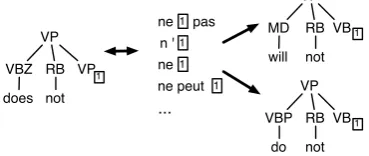
Instead of using strings (Bannard and Callison-Burch, 2005), we use elementary trees on the En-glish side, resulting in a monolingual STSG. We obtain the elementary trees and foreign strings us-ing the GKHM algorithm (Galley et al., 2004). This takes as input a bilingual word-aligned corpus with trees on one side, and finds the minimal set of tree fragments and their corresponding strings which is consistent with the word alignment. This process is illustrated in Figure 2 where the aligned pair on the left gives rise to the rules shown on the right. Note that the English rules and for-eign strings shown include variable indices where they have been generalised. We estimate p(f|e) and p(e0|f) from the set of tree-to-string rules and then then pivot each tree fragment to produce STSG rules. Figure 3 illustrates the process for the [VP does not VP] fragment.
Modeling and Decoding Our grammar is
se-S
NP VP
VBZ
does RB
go
He not
ne pas
Il va
PRP VP
NP
He Il
PRP
go va VP
VP
VBZ
does RB
not
ne pas
VP
S NP VP
1 2 1
1
[image:5.595.88.276.73.156.2]1 2
Figure 2: Tree-to-string grammar extraction using the GHKM algorithm, showing the aligned sentence pair and the resulting rules as tree fragments and their matching strings. The boxed numbers denote variables.
VP
VBZ
does RB
not
ne pas
VP
n ' ne ne peut ...
VP
MD
will RB
not VB
VP
VBP
do RB
not VB
1
1 1 1
1
1
1
Figure 3: Pivoting the [VP does not VP] fragment.
lection we incorporate a ngram language model (LM) as a feature. This requires adapting the scor-ing function,Ψ, in (2) to allow features over target ngrams:
Ψ(y) =X
r∈y
hφ(r, S(y)), λi+ X
m∈T(y)
hψ(m, S(y)), λi
(5) where m are the ngrams and ψ is a new fea-ture function over these ngrams (we use only one ngram feature: the trigram log-probability). Sadly, the scoring function in (5) renders the chart-based search used for training and decoding intractable. In order to provide sufficient context to the chart-based algorithm, we must also store in each chart cell the n−1 target tokens at the left and right edges of its yield. This is equivalent to using as our grammar the intersection between the original grammar and the ngram LM (Chiang, 2007), and increases the decoding complexity to an infeasible O(SRL2(n−1)V)whereLis the size of the lexicon.
We adopt a popular approach in syntax-inspired machine translation to address this problem (Chi-ang, 2007). The idea is to use a beam-search over the intersection grammar coupled with the cube-pruning heuristic. The beam limits the number of items in a given chart cell to a fixed constant, re-gardless of the number of possible LM contexts and non-terminal categories. Cube-pruning further limits the number of items considered for inclu-sion in the beam, reducing the time complexity to a more manageableO(SRBV)whereB is the beam size. We refer the interested reader to Chiang (2007) for details.
Training The extensions to the model in (5)
also necessitate changes in the training proce-dure. Recall that training the basic model of Cohn and Lapata (2007) requires finding the maximiser ofH(y)in (3). Their model uses a chart-based al-gorithm for this purpose. As in decoding we also use a beam search for training, thereby avoiding the exponential time complexity of exact search. The beam search requires an estimate of the qual-ity for incomplete derivations. We use the margin rescaling objective, Hm in (3), and approximate
the loss using the current (incomplete) loss param-eter values in each chart cell. We use a wide beam of 200 unique items or 500 items in total to reduce the impact of the approximation.
Our loss functions are tailored to the task and draw inspiration from metrics developed for ex-tractive compression but also for summarisation and machine translation. They are based on the Hamming distance over unordered bags of items. This measures the number of predicted items that did not appear in the reference, along with a penalty for short output:
∆hamming(y∗,y) =f+max (l−(t+f),0) (6)
where t and f are the number of true and false positives, respectively, when comparing the pre-dicted target, y, with the reference, y∗, and l is the length of the reference. The second term pe-nalises short output, as predicting very little or nothing would otherwise be unpenalised. We have three Hamming loss functions over: 1) tokens, 2) ngrams (n≤3), or 3) CFG productions. These losses all operate on unordered bags and there-fore might reward erroneous predictions. For ex-ample, a permutation of the reference tokens has zero token-loss. The CFG and ngram losses have overlapping items which encode a partial order, and therefore are less affected.
In addition, we developed a fourth loss func-tion to measure the edit distance between the model’s prediction and the reference, both as bags-of-tokens. This measures the number of insertions and deletions. In contrast to the previous loss func-tions, this requires the true positive counts to be clipped to the number of occurrences of each type in the reference. The edit distance is given by:
∆edit(y∗,y) =p+q−2
X
i
min(pi, qi) (7)
[image:5.595.92.277.211.289.2]hADJP,NPi → hsubject [PP to NP1], part [PP of NP1]i (T)
hADVP,RBi → has well, alsoi (T)
hADJP,JJi → htoo little, insufficienti (P)
hS,Si → hS1 and S2, S2 and S1i (P)
hNP,NPi → hDT1NN2, DT1 NN2i (S)
[image:6.595.313.521.72.226.2]hNP,NPi → hDT1NN2, NN2i (S)
Table 2: Sample grammar rules extracted from the training set (T), pivoted set (P) or generated from the source (S). 5 Experimental Design
In this section we present our experimental set-up for assessing the performance of our model. We give details on the corpora and grammars we used, model parameters and features,6the baseline
used for comparison with our approach, and ex-plain how our system output was evaluated.
Grammar Extraction Our grammar used
rules extracted directly from our compression cor-pus (the training partition, 480 sentences) and a bilingual corpus (see Table 2 for examples). The former corpus was word-aligned using the Berke-ley aligner (Liang et al., 2006) initialised with a lexicon of word identity mappings, and parsed with Bikel’s (2002) parser. From this we extracted grammar rules following the technique described in Cohn and Lapata (2007). For the pivot grammar we use the French-English Europarl v2 which con-tains approximately 688K sentences. Again, the corpus was aligned using the Berkeley aligner and the English side was parsed with Bikel’s parser. We extracted tree-to-string rules using our implemen-tation of the GHKM method. To ameliorate the ef-fects of poor alignments on the grammar, we re-moved singleton rules before pivoting.
In addition to the two grammars described, we scanned the source trees in the compression cor-pus and included STSG rules to copy each CFG production or delete up to two of its children. This is illustrated in Table 2 where the last two rules are derived from the CFG production NP→DT NN in the source tree. All trees are rooted with a distin-guished TOP non-terminal which allows the ex-plicit modelling of sentence spanning sub-trees. These grammars each had 44,199 (pivot), 7,813 (train) and 22,555 (copy) rules. We took their union, resulting in 58,281 unique rules and 13,619 unique source elementary trees.
Model Parameters Our model was trained
on 480 sentences, 36 sentences were used for de-velopment and 59 for testing. We used a variety of syntax-based, lexical and compression-specific
6The software and corpus can be downloaded from
http://homepages.inf.ed.ac.uk/tcohn/paraphrase.
For every rule:
origin of rule
for each origin,o:logpo(s, t),logpo(s|t),logpo(t|s) sR, tR, sR∨tR
s, t, s∨t, s=t
bothsandtare pre-terminals ands=tors6=t
number of terminals/variables/dropped variables ordering of variables as numbers/non-terminals non-terminal sequence of vars identical after reordering pre-terminal or terminal sequences are identical number/identity of common/inserted/dropped terminals source is shorter/longer than target
target is a compression of the source using deletes
For every ngram :
[image:6.595.76.297.77.156.2]logp(wi|wi−1 i−(n−1))
Table 3: The feature set. Rules were drawn from the training set, bilingual pivoting and directly from the source trees.sand
tare the source and target elementary trees in a rule, the sub-scriptRreferences the root non-terminal,ware the terminals
in the target tree.
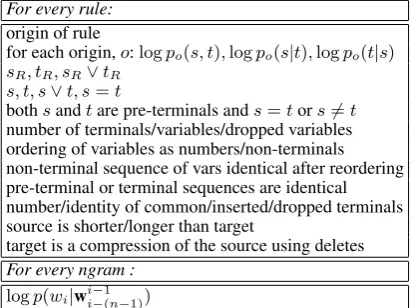
features (196,419 in total). These are summarised in Table 3. We also use a trigram language model trained on the BNC (100 million words) using the SRI Language Modeling toolkit (Stolcke, 2002), with modified Kneser-Ney smoothing.
An important parameter in our modeling frame-work is the choice of loss function. We evaluated the loss functions presented in Section 4 on the de-velopment set. We ran our system for each of the four loss functions and asked two human judges to rate the output on a scale of 1 to 5. The Ham-ming loss over tokens performed best with a mean rating of 3.18, closely followed by the edit dis-tance (3.17). We chose the former over the latter as it is less coarsely approximated during search.
Baseline There are no existing models that
can be readily trained on our abstractive com-pression data. Instead, we use Cohn and Lapata’s (2007) extractive model as a baseline. The latter was trained on an extractive compression corpus drawn from the BNC (Clarke, 2008) and tuned to provide a similar compression rate to our sys-tem. Note that their model is a strong baseline: it performed significantly better than competitive approaches (McDonald, 2006) across a variety of compression corpora.
Evaluation Methodology Sentence
Models Grammaticality Importance CompR
Extract 3.10∗ 2.43∗ 82.5
Abstract 3.38∗ 2.85∗† 79.2
Gold 4.51 4.02 58.4
Table 4: Mean ratings on compression output elicited by hu-mans;∗: significantly different from the gold standard;†: sig-nificantly different from the baseline.
sentences were compressed automatically by our model and the baseline. We also included gold standard compressions. Our materials thus con-sisted of 90 (30×3) source-target sentences. We collected ratings from 22 unpaid volunteers, all self reported native English speakers. Both studies were conducted over the Internet using a custom built web interface.
6 Results
Our results are summarised in Table 4, where we show the mean ratings for our system (Abstract), the baseline (Extract), and the gold standard. We first performed an Analysis of Variance (ANOVA)
to examine the effect of different system compres-sions. The ANOVA revealed a reliable effect on
both grammaticality and importance (significant over both subjects and items (p <0.01)).
We next examined in more detail between-system differences. Post-hoc Tukey tests revealed that our abstractive model received significantly higher ratings than the baseline in terms of impor-tance (α <0.01). We conjecture that this is due to the synchronous grammar we employ which is larger and more expressive than the baseline. In the extractive case, a word sequence is either deleted or retained. We may, however, want to re-tain the meaning of the sequence while rendering the sentence shorter, and this is precisely what our model can achieve, e.g., by allowing substitutions. As far as grammaticality is concerned, our abstrac-tive model is numerically better than the extrac-tive baseline but the difference is not statistically significant. Note that our model has to work a lot harder than the baseline to preserve grammatical-ity since we allow arbitrary rewrites which may lead to agreement or tense mismatches, and selec-tional preference violations. The scope for errors is greatly reduced when performing solely deletions. Finally, both the abstractive and extractive out-puts are perceived as significantly worse than the gold standard both in terms of grammaticality and importance (α <0.01). This is not surpris-ing: human-authored compressions are more fluent and tend to omit genuinely superfluous informa-tion. This is also mirrored in the compression rates shown in Table 4. When compressing, humans
em-O: Kurtz came from Missouri, and at the age of 14, hitch-hiked to Los Angeles seeking top diving coaches. E: Kurtz came from Missouri, and at 14, hitch-hiked to Los
Angeles seeking top diving coaches.
A: Kurtz hitch-hiked to Los Angeles seeking top diving coaches.
G: Kurtz came from Missouri, and at 14, hitch-hiked to Los Angeles seeking diving coaches.
O: The scheme was intended for people of poor or moderate means.
E: The scheme was intended for people of poor means. A: The scheme was planned for poor people.
G: The scheme was intended for the poor.
O: He died last Thursday at his home from complications following a fall, said his wife author Margo Kurtz. E: He died last at his home from complications following a
fall, said wife, author Margo Kurtz.
A: His wife author Margo Kurtz died from complications after a decline.
G: He died from complications following a fall.
O: But a month ago, she returned to Britain, taking the chil-dren with her.
E: She returned to Britain, taking the children. A: But she took the children with him.
[image:7.595.304.531.70.317.2]G: But she returned to Britain with the children.
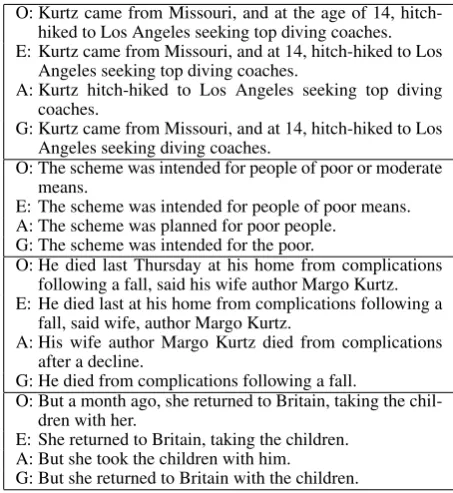
Table 5: Compression examples including human and system output (O: original sentence, E: Extractive model, A: Abstrac-tive model, G: gold standard)
ploy not only linguistic but also world knowledge which is not accessible to our model. Although the system can be forced to match the human compres-sion rate, the grammaticality and information con-tent both suffer. More sophisticated features could allow the system to narrow this gap.
We next examined the output of our system in more detail by recording the number of substitu-tions, deletions and insertions it performed on the test data. Deletions accounted for 67% of rewrite operations, substitutions for 27%, and insertions for 6%. Interestingly, we observe a similar ratio in the human compressions. Here, deletions are also the most common rewrite operation (69%) fol-lowed by substitutions (24%), and insertions (7%). The ability to perform substitutions and insertions increases the compression potential of our system, but can also result in drastic meaning changes. In most cases (63%) the compressions produced by our system did not distort the meaning of the orig-inal. Humans are clearly better at this, 96.5% of their compressions were meaning preserving.
poor is now modifyingpeoplerather than means. In the third example, our system applies multi-ple rewrites. It deleteslast Thursday at his home, moveswife author Margo Kurtz to the subject po-sition, and substitutes fall with decline. Unfortu-nately, the compressed sentence expresses a rather different meaning from the original. It is not Margo Kurtz who died but her husband. Finally, our last sentence illustrates a counter-intuitive substitution, the pronounheris rewritten ashim. This is because they share the French translationlui and thus piv-oting learns to replace the less common word (in legal corpora) her with him. This problem could be addressed by pivoting over multiple bitexts with different foreign languages.
Possible extensions and improvements to the current model are many and varied. Firstly, as hinted at above, the model would benefit from ex-tensive feature engineering, including source con-ditioned features and ngram features besides the LM. A richer grammar would also boost perfor-mance. This could be found by pivoting over more bitexts in many foreign languages or making use of existing or paraphrase corpora. Finally, we plan to apply the model to other paraphrasing tasks in-cluding fully abstractive document summarisation (Daum´e III and Marcu, 2002).
Acknowledgements
The authors acknowledge the support of EPSRC (grants GR/T04540/01 and GR/T04557/01). Special thanks to Phil Blunsom, James Clarke and Miles Osborne for their insightful suggestions. References
C. Bannard, C. Callison-Burch. 2005. Paraphrasing with bilingual parallel corpora. In Proceedings of
the 43rd ACL, 255–262, Ann Arbor, MI.
R. Barzilay. 2003. Information Fusion for Multi-Document Summarization: Praphrasing and
Gener-ation. Ph.D. thesis, Columbia University.
D. Bikel. 2002. Design of a multi-lingual, parallel-processing statistical parsing engine. InProceedings
of the HLT, 24–27, San Diego, CA.
J. Carroll, G. Minnen, D. Pearce, Y. Canning, S. Devlin, J. Tait. 1999. Simplifying text for language impaired readers. InProceedings of the 9th EACL, 269–270, Bergen, Norway.
D. Chiang. 2007. Hierarchical phrase-based transla-tion. Computational Linguistics, 33(2):201–228. J. Clarke. 2008. Global Inference for Sentence
Com-pression: An Integer Linear Programming Approach.
Ph.D. thesis, University of Edinburgh.
T. Cohn, M. Lapata. 2007. Large margin synchronous generation and its application to sentence compres-sion. InProceedings of the EMNLP/CoNLL, 73–82, Prague, Czech Republic.
S. Corston-Oliver. 2001. Text Compaction for Dis-play on Very Small Screens. InProceedings of the
NAACL Workshop on Automatic Summarization, 89–
98, Pittsburgh, PA.
H. Daum´e III, D. Marcu. 2002. A noisy-channel model for document compression. In Proceedings of the
40th ACL, 449–456, Philadelphia, PA.
J. Eisner. 2003. Learning non-isomorphic tree map-pings for machine translation. In Proceedings of
the ACL Interactive Poster/Demonstration Sessions,
205–208, Sapporo, Japan.
M. Galley, K. McKeown. 2007. Lexicalized Markov grammars for sentence compression. InProceedings
of the NAACL/HLT, 180–187, Rochester, NY.
M. Galley, M. Hopkins, K. Knight, D. Marcu. 2004. What’s in a translation rule? InProceedings of the
HLT/NAACL, 273–280, Boston, MA.
H. Jing. 2000. Sentence reduction for automatic text summarization. InProceedings of the ANLP, 310– 315, Seattle, WA.
T. Joachims. 2005. A support vector method for multi-variate performance measures. InProceedings of the
22nd ICML, 377–384, Bonn, Germany.
K. Knight, D. Marcu. 2002. Summarization be-yond sentence extraction: a probabilistic approach to sentence compression. Artificial Intelligence, 139(1):91–107.
P. Liang, B. Taskar, D. Klein. 2006. Alignment by agreement. InProceedings of the HLT/NAACL, 104– 111, New York, NY.
C.-Y. Lin. 2003. Improving summarization perfor-mance by sentence compression — a pilot study. In
Proceedings of the 6th International Workshop on
Information Retrieval with Asian Languages, 1–8,
Sapporo, Japan.
R. McDonald. 2006. Discriminative sentence com-pression with soft syntactic constraints. In
Proceed-ings of the 11th EACL, 297–304, Trento, Italy.
K. Papineni, S. Roukos, T. Ward, W.-J. Zhu. 2002. BLEU: a method for automatic evaluation of ma-chine translation. In Proceedings of the 40th ACL, 311–318, Philadelphia, PA.
C. Quirk, C. Brockett, W. Dolan. 2004. Monolin-gual machine translation for paraphrase generation.
InProceedings of the EMNLP, 142–149, Barcelona,
Spain.
A. Stolcke. 2002. SRILM – an extensible language modeling toolkit. InProceedings of the ICSLP, Den-ver, CO.
B. Taskar, C. Guestrin, D. Koller. 2003. Max margin Markov networks. InProceedings of NIPS 16. I. Tsochantaridis, T. Joachims, T. Hofmann, Y. Altun.
2005. Large margin methods for structured and in-terdependent output variables. Journal of Machine
Learning Research, 6:1453–1484.
J. Turner, E. Charniak. 2005. Supervised and unsu-pervised learning for sentence compression. In
Pro-ceedings of 43rd ACL, 290–297, Ann Arbor, MI.