Chinese Term Extraction Using Minimal Resources
Yuha
School of C
Science and Technology,
Harbin In
Techn
Harbin 15
Qin L
Department of Computing,
The Hon
Polytechn
Hong Ko
du.
Tieju
School of C
Science and Technology,
Harbin In
Techn
Harbin 1
.
ct
This pap
term extraction nimal resources. A term candidate extraction algorithm is proposed to i tures of the
1
Ter st
fun domain. Term
ng Yang
omputer
stitute of
ology,
0001, China
u
g Kong
ic University,
ng, China
hk
n Zhao
omputer
stitute of
ology,
50001, China
cn
Abstra
er presents a new approach for using mi
dentify fea
relatively stable and domain independent term delimiters rather than that of the terms. For term verification, a link analysis based method is proposed to calculate the relevance between term candidates and the sentences in the domain specific corpus from which the candidates are extracted. The proposed approach requires no prior domain knowledge, no general corpora, no full segmentation and minimal adaptation for new domains. Consequently, the method can be used in any domain corpus and it is especially useful for resource-limited domains. Evaluations conducted on two different domains for Chinese term extraction show quite significant improvements over existing techniques and also verify the efficiency and relative domain independent nature of the approach. Experiments on new term extraction also indicate that the approach is quite effective for identifying new terms in a domain making it useful for domain knowledge update.
Introduction
ms are the lexical units to represent the mo damental knowledge of a
© 2008. Licensed under the Creative Commons Attribution-Noncommercial-Share Alike 3.0 Unported
license ( http://creativecommons.org/licenses/by-nc-sa/3.0/). Some rights reserved.
extraction is knowledge acq
an essential task in domain uisition which
lexicon update, domain onto etc. Term extraction involves tw
tes by unithood calculation s a valid term. The second
endent features of domain ter
s. Ot
can be used for logy construction, o steps. The first step extracts candida
to qualify a string a
step verifies them through termhood measures (Kageura and Umino, 1996) to validate their domain specificity.
Existing techniques extract term candidates mainly by two kinds of statistic based measures including internal association (e.g. Schone and Jurafsky, 2001) and context dependency (e.g. Sornlertlamvanich et al., 2000). These techniques are also used in Chinese term candidate extraction (e.g. Luo and Sun, 2003; Ji and Lu, 2007). Domain dep
ms are used in a weighted manner to identify term boundaries. However, these algorithms always face the dilemma that fewer features are not enough to identify terms from non-terms whereas more features lead to more conflicts among selected features in a specific instance.
Most term verification techniques use features on the difference in distribution of a term occurred within a domain and across domains, such as TF-IDF (Salton and McGill, 1983; Frank, 1999) and Inter-Domain Entropy (Chang, 2005). Limited distribution information on term candidates in different documents are far from enough to distinguish terms from non-term
her researches attempted to use more direct information. The therm verification algorithm,
TV_ConSem, proposed in (Ji and Lu, 2007) for Chinese calculate the percentage of context words in a domain lexicon using both frequency information and semantic information. However, this technique requires a large domain lexicon and relies heavily on both the size and the quality of the lexicon. Some supervised learning
approaches have been applied to protein/gene name recognition (Zhou et al., 2005) and Chinese new word identification (Li et al., 2004) using
SVM classifiers (Vapnik, 1995) which also require large domain corpora and annotations, and intensive training is needed for a new domain. Current term extraction techniques (e.g. Frank et al., 1999; Chang, 2005; Ji and Lu, 2007) suffer from three major problems. The first problem is that these algorithms cannot identify certain kinds of terms such as the ones that have less statistical significance. The second problem is their dependency on full segmentation for Chinese text which is particularly vulnerable to ha
idates and the sentences in domain sp
s (terms for short) are more likely to be domain substantives. Words immediate before s, called predecessors and
es
conne . These predecessors and Ch
ndle domain specific data (Huang et al., 2007). The third problem is their dependency on some a priori domain knowledge such as a domain lexicon making it difficult to be applied to a new domain.
In this work, the proposed algorithm extracts candidates by identifying the relatively stable and domain independent term boundary markers instead of looking for features associated with the term candidate themselves. Furthermore, a novel algorithm for term verification is proposed using link analysis to calculate the relevance between term cand
ecific corpus to validate their domain specificity.
The rest of the paper is organized as follows. Section 2 describes the proposed algorithms. Section 3 explains the experiments and the performance evaluation. Section 4 is the conclusion.
2
Methodology
2.1 Delimiters Based Term Candidate Extraction
Generally speaking, sentences are constituted by substantives and functional words. Domain specific term
and after these term
succ sors of the terms, are likely to be either functional words or other general substantives
cting terms
successors can be considered as markers of terms, and are referred to as term delimiters in this paper. In contrast to terms, delimiters are relatively stable and domain independent. Thus, they can be extracted more easily. Instead of looking for features associated with terms as in other works, this paper looks for features associated with term delimiters. That is, term
delimiters are identified first. Words between delimiters are then taken as term candidates.
The proposed delimiter identification based algorithm, referred to as TCE_DI (Term Candidate Extraction – Delimiter Identification), extracts term candidates from a domain corpus by using a delimiter list, referred to as the DList. Given a DList, the algorithm TCE_DI itself is straight forward. For a given character string CS (CS = C1C2…Cn) shown in Figure 1, where Ci is a inese character. Suppose there are two delimiters D1 = Ci1…Cil and D2 = Cj1…Cjm in CS where D1 ∈DList and D2∈DList. The string CS is then segmented to five substrings: C1…Cib,
Ci1…Cil, Cia…Cjb, Cj1…Cjm, and Cja…Cn. Since
Ci1…Cil and Cj1…Cjm are delimiters, C1…Cib,
Cia…Cjb, and Cja…Cn are regarded as term candidates as labeled by TC1, TC2 and TC3 in Figure 1, respectively. If there is no delimiter contained in CS, the whole string C1C2…Cn is regarded as one term candidate.
Figure 1. Paradigm of Term Candidate Extraction
DList can be obtained either from a delimiter training corpus or from a given stop w rd ist. o l Given a delimiter training corpus, CorpusTraining, normally a domain specific corpus, and a domain lexicon Lexicon, DList can be obtained based on the following algorithm, referred to as DList_Ext
St
withou
a stop experts or from a
ge
(DelimiterList Extraction Algorithm).
ep 1: For each term Ti in Lexicon, mark Ti in
CorpusTraining as a non-divisible lexical unit.
Step 2: Segment remaining text in CorpusTraining.
Step 3: Extracts predecessors and successors of all Ti as delimiter candidates.
Step 4: Remove delimiter candidates that are contained in a Ti in Lexicon.
Step 5: Rank delimiter candidates by frequency and the top NDI number of items are considered delimiters.
The DList_Ext algorithm basically use known terms in a domain specific Lexicon to find the delimiters. It can be shown in the experiments later that Lexicon does not need to be comprehensive. Even if a small training corpus,
CorpusTraining, is not available in a language t sufficient domain specific NLP resources, -word list produced by
2.2 Link Analysis Based Term Verification
In a domain corpus, some sentences are domain relevant sentences which contain more domain specific information whereas others are general sentences which contain less domain information. A domain specific term is more likely to be contained in domain relevant sentences, which means that domain relevant sentences and
ai
, w(pn) l numb
dom n specific terms have a mutually reinforcing relationship. A novel algorithm, referred to as TV_LinkA (Term Verification – Link Analysis) based the Hyperlink-Induced Topic Search (HITS) algorithm (Kleinberg, 1997) originally proposed for information retrieval, is proposed using link analysis to calculate the relevance between term candidates and the sentences in domain specific corpora for term verification.
In TV_LinkA, a node p can either be a sentence or a term candidate. If a term candidate TermC is contained in a sentence Sen of the corpus
CorpusExtract where the candidates were extracted, there is a directional link from Sen to TermC. This way, a graph for the candidates and the sentences in CorpusExtract can be constructed and the links between them indicate their relationships. A good
hub in CorpusExtract is a sentence that contains many good authorities; a good authority is a term candidate that is contained in many good hubs. Each node p is associated with a non-negative authority weight
w
(
p
)
A and a non-negative hub weightw
(
p
)
H . Link analysis in TV_LinkAmakes use of the relationship between hubs and authorities via an iterative process to maintain and update authority/hub weights for each node of the graph. the tota er of sentences and the total number of term candidates. Given weights VA and
VH with a directional link p→q, the I operation(an in-pointer to a node) and the O operation(an out-pointer to a node) update w(q)A and w(p)H as
e calculated as follows.
For i
Let k be the iteration termination parameter and z
be the vector (1, 1, 1,…, 1) , and VA and VH are
In sExt , term candidates with high authority in
dom terms wh
high uments are m
likel
on this observation, the termhood of each candidate term TermC, denoted as TermhoodC, is calculated according to formula (3) defined be
obtain Vi .
eturn (VkA, VkH)
Corpu ract H
a few documents are likely to be ain specific ereas candidates with authority in many doc ore y to be commonly used general words. Based
low. the total number of documents in which TermC occurs. Term s
termhood val
C are then ranked according to their ues TermhoodC, and the top ranked
NTCListcandidates are considered terms. NT
an algorithm parameter to be determined entally
e two sets of non-overlapping academic papers in the IT domain and CorpusIT_Small is identical to the corpus used in
TV_ConSem(Ji and Lu, 2007). CorpusLegal_Small is a complete set of official Chinese criminal law articles. CorpusLegal_Large includes the complete set CList is
experim .
3
Performance Evaluation
3.1 Data Preparation
To evaluate the performance of the proposed algorithms for Chinese, experiments are conducted on four corpora of two different domains as listed in Table 1. CorpusIT_Small and
of ficial Chinese constitutional lof aw articles and
d
Economics/Finance law articles (http://www.law-lib.com/). Three domain lexicons used in the experiments are detailed in Table 2. LexiconIT is obtained according to the term extraction algorithm (Ji and Lu, 2007) with manual verification. LexiconLegal is extracted from
CorpusLegal_Small by manual verification too. Because legal text covers a lot of different areas such finance, science, advertisement, etc., the actually legal specific terms are relatively small in size. LexiconPKU contains a total of 144K manually verified IT terms supplied by the Institute of Computational Linguistics, Peking University. LexiconPKU, is used as the standard term set for evaluation on the IT domain.
CorpusIT_Small and LexiconITare used to obtain the delimiter list of IT domain, DListIT.
CorpusLegal_Small and LexiconLegal are used to obtain the elimiter list of legal domain,
DListLegal. CorpusIT_Large and CorpusLegal_Large are used as open test data to evaluate the proposed algorithms in IT domain and legal domain, respectively.
Corpus Domain Size Text type
CorpusIT_Small IT 77K Academic
papers
CorpusIT_Large IT 6.64M Academic
papers
Corpus
Legal_Small
Legal 344K Law article
Corpus
Legal_Large
Legal 1.04M Law article Table 1. Different Corpora Used for Experiments
Lexicon Domain Size Source
LexiconIT IT 3,337 Corpus
IT_Small
LexiconLegal Legal 94 3 Corpus Legal_Small
LexiconPKU IT 144K PKU
Table 2. D rent Le se xperime
rify that the approach works with a op word list without delimiter extraction, rd list, , is d a ence
the 494 general purpose stop words
web www n) thou
.
in the IT
alua e
follow formula: iffe
E
xicons U nts
d for
To ve simple st
a stop wo DListSW also use s refer by taking
downloaded from a Chinese NLP resource site (
ion
.nlp.org.c wi t any modificat
The performance of the algorithm
domain is ev ted by precision according to th
TCList New Lexicon+N TE
N N
recis =
where tes in
term candidate xtracted by an ev
e verification of all the new terms is
arked them as correct terms. As there is no reasonably large standard l
list available, the evaluation of the leg
p ion (4)
NTCListis the number of term candida list TCList e
aluated algorithm, NLexicon denotes the number of term candidates in TCList contained in
LexiconPKU, NNewdenotes the number of extracted term candidates that are not in LexiconPKU, yet are considered correct. Thus, NNew is the number of newly discovered terms with respect to
LexiconPKU. Th
carried out manually by two experts independently. A new term is considered correct if both experts m
egal term al domain in terms of precision is conducted manually. No evaluation on new term extraction is conducted.
To evaluate the ability of the algorithms in identify new terms in the IT domain, another measurement is applied to the IT corpus against
LexiconPKU based on the following formula:
TCList New NTE
N N
R = (5)
where TCList and NNew are the same as given in formula (4). A higher RNTE indicates that more extracted terms are outside of LexiconPKU and are thus considered new terms. This is similar to the measurements of out of vocabulary (OOV) in Chinese segmentation. A higher RNTE indicates the algorithm can be useful for domain knowledge update including lexicon expansion.
3.2 Evaluation on Term Extraction
For comparison, a statistical based term candidate extraction algorithm, TCE_SEF&CV
with the best performance in
using both internal association and external
e
; one is a
(Ji and Lu, 2007)
strength, is used as the reference algorithm for the evaluation of TCE_DI. A statistics based term verification algorithm, TV_ConSem (Ji and Lu, 2007) using semantic information within a context window is used for the evaluation of
TV_LinkA. LexiconPKU is also used in
TV_ConSem. Two popular methods integrated without division of candidate extraction and verification steps are used for comparison. Th first one is based on TF-IDF (Salton and McGill, 1983 Frank et al., 1999). The second
supervised learning approach based on a SVM
classifier, SVMlight (Joachims, 1999). The features used by SVMlight are shown in Table 3. Two training sets are constructed for the SVM
(LexiconLegal) and 28,051 negative examples extracted from CorpusLegal_Small.
No. Feature Explanation 1 Percentage of the Chinese characters
occurred in LexiconDomain
2 Frequency in the domain corpus 3 Frequency in the general corpus 4 Part of speech
5 The length of Chinese characters in the candidate
6 The length of non-Chinese characters in the candidate 7 Contextual evidence
Table 3. Features Used in the SVM Classifier perfor
Figure 2 shows the mance of the
proposed TCE_ for term
ex tio s
for IT do IT
TCE_DIl tracted
de iter NDI =
50 esp SW
word list
DI and TV_LinkA
trac n compared to the reference algorithm main using CorpusIT_Large. TCE_DI and egal indicate TCE_DI using ex lim lists DListIT and DListLegal with
I simply uses the stop 0, r ectively. TCE_D
DListSW.
0 1000 2000 3000 4000 5000
40 45 50 55 60 65 70 75 80 85 90 95 100
Precisio
n
Extracted Terms (N
TCList)
TCE_DI
IT+TV_LinkA
TCE_DI
Legal+TV_LinkA
TCE_DI +TV_L
SW inkA
TCE_SEF&CV+TV_LinkA TCE_DI
IT+TV_ConSem
TCE_SEF&CV+TV_ConSem TF-IDF
SVM
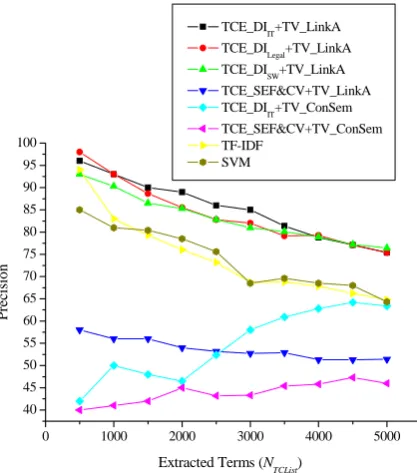
Figure 2 Performance of Different Algorithms on IT Domain
As shown in Figure 2, term extraction based on TCE_DIIT combined with TV_LinkA gives the best performance. It achieves 75.4% precision when the number of extracted terms NTCList reaches 5,000. The performance is 9.6% and 29.4% higher in precision compared to TF-IDF
and TCE_SEF&CV combined with TV_ConSem,
respectively. These translate to improvements of ver 14.8% and 63.9%, respectively. When applying the same TV_LinkA algorithm for term verification, TCE_DI using different delimiter lists provide 24% better performance on average compared to the TCE_SEF&CV
algorithm which translates to improvement of over 47%. The result from using delimiters of legal domain (DListLegal) to data in IT domain (as shown in TCE_DIlegal) is better on average than using a simple general stop word list. It should be ver, that TCE_DISW still performs much better than the reference algorithms, which means that delimiter based term candidate extraction algorithm can improve performance even without any domain specific training. When applying the same TCE_DIIT algorithm in term candidate extraction, TV_LinkA provides 10% higher performance compared to the TV_ConSem
TV_LinkA using o word list without
an
of
precision of o
noted, howe
algorithm which translates to improvement of over 15.3%. It is important to point out that
nly the stop
y domain specific knowledge performs better than TV_ConSem using a large domain lexicon. In other words, delimiter based extraction with link analysis use much less resources and still improve performance of TV_ConSem.
The performance of TCE_DIIT or
TCE_SEF&CV combined with TV_ConSem have an upward trend when more terms are extracted which seems to be against intuition. The principle the TV_ConSem algorithm is that a candidate is considered a valid term if a majority of its context words already appear in the domain lexicon. General words are more likely to be ranked on top because they are commonly used which explains the low performance of
TV_ConSem in the lower range of NTCList. When
NTCList increases, more domain terms are included. Thus, there is an upward trend in precision. But, the upward trend reverts at around 4,500 because the measurement in percentage is too low to distinguish valid terms from non-term candidates. It is also interesting to point out that the simple
TF-IDF algorithm which was rarely used in Chinese term extraction performs as well as the
statistics. Thus it does not perform as well as the proposed TCE_DI and TV_LinkA algorithms.
ac
Figure 3 shows that the proposed algorithms achieve similar performance on the legal domain.
TCE_DILegal combined with TV_LinkA perform the best. The result from using IT domain delimiters (DListIT) in legal domain as shown in
TCE_DIIT is better on average than using the general purpose stop list. This further proves that extracted delimiter list even from a different domain can be more effective than a general stop word list. When applying the same TV_LinkA
algorithm for term verification, TCE_DI using different delimiter lists are better than all the reference algorithms. Without large lexicon in Chinese legal domain, the TV_ConSem algorithm does not even work. TV_LinkA using no prior domain knowledge for term verification still
hieves similar improvement compared to that of the IT domain where a comprehensive domain lexicon is available.
70 80 90 100
0 1000 2000 3000 4000 5000 40
50 60
Extracted Terms (NTCList)
P
re
cision
TCE_DIIT+TV_LinkA TCE_DILegal+TV_LinkA TCE_DISW+TV_LinkA TCE_SEF&CV+TV_LinkA TF-IDF
SVM
Figure 3. Performance of Different Algorithms on Legal Domain
There are three main reasons for the performance improvements of the proposed
TCE_DI and TV_LinkA algorithms. Firstly, the delimiters which are mainly functional words (e. g. “在”(at/in), “或”(or)) and general substantive (e.g. “是”(be), “采用”(adopt)) can be extracted easily and are effective term boundary markers since they are quite domain independent and stable. Secondly, the granularity of domain specific terms extracted the proposed algorithm is much larger than words obtained by word segmentation. This keeps many noisy strings out of the term candidate set. Thus, the proposed
delimiter based algorithm performs much better over segmentation based statistical methods. Thirdly, the proposed approach is not as sensitive to term frequency as other statistical based approaches because term candidates are identified without regards to the frequencies of the candidates. In the TV_LinkA algorithm, terms are verified by calculating the relevance between candidates and the sentences instead of the distributions of terms in different types of documents. Terms having low frequencies can be identified as long as they are in domain relevant sentences whereas in the previous approaches including TF-IDF, terms with less statistical significance are weeded out. For example, a long IT term “层次化存储系统” (Hierarchical storage system) with a low frequency of 6 is extracted using the proposed approach. It cannot be i
information is is term cannot be extracte
dentified by TF-IDF since the statistical not significant. Th
d by the segmentation based algorithms either because general segmentor split long terms into pieces making them difficult to be reunited using term extraction techniques.
It is interesting to know that the proposed approach not only achieves the best performance for both domains, it also achieves second best when using extracted delimiters from a different domain. The results confirm that delimiters are quite stable across domains and the relevance between candidates and sentences are efficient for distinguishing terms from non-terms in different domains. In fact, the proposed approach can be applied to different domains with minimal training or no training if resources are limited.
3.3 Evaluation on New Term Extraction
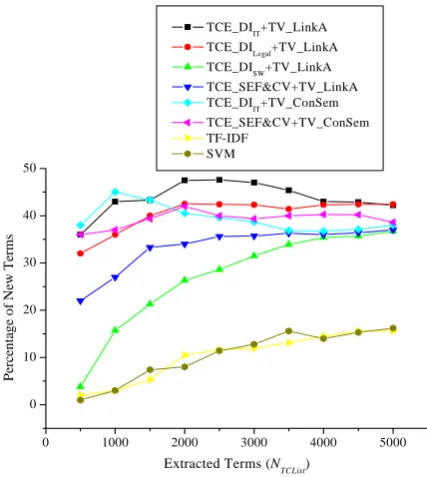
As LexiconPKU is the only ready-to-use domain lexicon,the evaluation on new term extraction is conducted on CorpusIT_Large only. Figure 4 shows the evaluation of the proposed algorithms compared to the reference algorithms in terms of
RNTE, the ratio of new terms among all identified terms.
It can be seen that the proposed algorithms
TCE_DIIT combined with TV_LinkA is basically the top performer throughout the range. It can identify 4% (with respect to TCE_SEF&CV +TV_ConSem) to 27% (with respect to TF-IDF) more new terms when NTCList reaches 5,000 which translate to improvements of over 9% to 170%, respectively. The second best performer is
compared to TCE_DIIT. When NTCList reaches 5,000, their performance is basically the same. However, the TCE_DISW algorithm using s
context words occur in the domain lexicon than that of other terms. Thus, new terms are actually ranked higher than other terms in TV_ConSem
which explains its higher ability to identify new terms in the low range of NTCList. However, its performance drops in the high range of NTCList because the influence of context words diminishes in terms of percentage in the domain lexicon to distinguish terms from non-terms. Figure 4 also shows that TF-IDF and SVM
perform the worst in new term extraction compared to other algorithms. TF-IDF has relatively low ability to identify new terms since new terms are not widely used and they do not repeat a lot of times in many documents. As
SVM is sensitive to training data, it is naturally not adaptive to new terms.
All current Chinese term extraction algorithms rely on segmentation with comprehensive lexical knowledge and y
a
problem. T xtraction
pa top wo
in
mi ion
a rds performs much worse than using extracted delimiter lists as shown for TCE_DIIT and
TCE_DIlegal. In the TCE_DI algorithm, character strings are split by delimiters and the remained parts are taken as term candidates. Generally speaking, if a new term contains a delimiter or a stop word as its component, it cannot be identified correctly. Consequently, if a new term contains a stop word as its component, it cannot be extracted correctly using TCE_DISW. However, new terms are less likely to conta deli ters because the delimiter extract algorithm DList_Ext would not consider component as a delimiter if it is contained in a term in LexiconDomain. Consequently, TCE_DISW is less adaptive to domain specific data compared to TCE_DIIT and TCE_DIlegal. That is also why
TCE_DISW picks up new terms much more slowly.
0 1000 2000 3000 4000 5000
0 10 20 30 40 50
Pe
rc
enta
g
e o
f Ne
w
Te
rm
s
Extracted Terms (NTCList)
TCE_DI +TV_LinkAIT
TCE_DILegal+TV_LinkA
TCE_DISW+TV_LinkA
TCE_SEF&CV+TV_LinkA TCE_DIIT+TV_ConSem
TCE_SEF&CV+TV_ConSem TF-IDF
SVM
Figure 4. Performance of Different Algorithms for New Term Extraction
It is interesting to know that TCE_DIIT combined with TV_ConSem identifies more new terms in the low range of NTCList. In the
TV_ConSem algorithm, the major information used for term verification is the percentage of the context words appear in the domain lexicon. As discussed earlier in Section 3.2, TV_ConSem
ranks commonly used general words higher than others which leads to the low precision of
TV_ConSem for term extraction. A new term faces a similar scenario because more of its
et Chinese segmentation lgorithms have the OOV (out of vocabulary)
his makes Chinese term e
rticularly vulnerable to new term extraction. The proposed approach, on the other hand, is based on delimiters which is more stable, domain independent, and OOV independent. Figure 4 shows that TCE_DI and TV_LinkA using minimal training from different domains can extract much more new terms than previous techniques. In fact, the proposed approach can serve as a much better tool to identify new domain terms and can be quite effective for domain lexicon expansion.
4
Conclusion
In conclusion, this paper presents a robust term extraction approach using minimal resources. It includes a delimiter based algorithm for term candidate extraction and a link analysis based algorithm for term verification. The proposed approach is not sensitive to term frequency as the previous works. It requires no prior domain knowledge, no general corpora, no full segmentation, and minimal adaptation for new domains.
different domain also achieves the second best performance which indicates that the delimiters are quite stable and domain independent. The proposed approach still performs much better than the reference algorithms when using a general purpose stop word list, which means that the proposed approach can improve performance well even as a completely unsupervised approach without any training. Consequently, the results demonstrate that the proposed approach can be applied to different domains easily even without he proposed approach is
R
August 2002.
a. 2002. A measure of term ed on the number of
co-inese Word Segmentation: Tokenization, Character
n, or Wordbreak Identification. In
Ka K., and B. Umino. 1996. Methods of
Kl
onment. In Proceedings of the 9th
Ji
2 – 74.
Lu
Measures. In
M
e Identification and Semantic
Na
Sc rafsky D. 2001. Is Knowledge-free
So
ord
Vl
Zh
training. Thirdly, t
particularly good for identifying new terms so that it can serve as an effective tool for domain lexicon expansion.
Acknowledgements
This work was done while the first author was working at the Hong Kong Polytechnic University supported by CERG Grant B-Q941 and Central Research Grant: G-U297.
eferences
Chang Jing-Shin. 2005. Domain Specific Word Extraction from Hierarchical Web Documents: A First Step toward Building Lexicon Trees from Web Corpora. In Proceedings of the Fourth SIGHAN Workshop on Chinese Language Learning: 64-71.
Chien LF. 1999. Pat-tree-based adaptive keyphrase extraction for intelligent Chinese information retrieval. Information Processing and Management, vol.35: 501-521.
Eibe Frank, Gordon. W. Paynter, Ian H. Witten, Carl Gutwin, and Craig G. Nevill-Manning. 1999. Domain-specific Keyphrase Extraction. In
Proceedings of 16th International Joint Conference on Artificial Intelligence IJCAI-99: 668-673.
Feng Haodi, Kang Chen, Xiaotie Deng , and Weimin Zheng, 2004. Accessor variety criteria for Chinese word extraction. Computational Linguistics, 30(1):75-93.
Hiroshi Nakagawa, and Tatsunori Mori. 2002. A simple but powerful automatic term extraction method. In COMPUTERM-2002 Proceedings of the 2nd International Workshop on Computational Term: 29-35. Taiwan,
Hisamitsu T., and Y. Niw representativeness bas
occurring salient words. In Proceedings of the 19th COLING, 2002.
Huang Chu-Ren, Petr ˇSimon, Shu-Kai Hsieh, and Laurent Pr´evot. 2007. Rethinking Ch
Classificatio
Proceedings of the ACL 2007 Demo and Poster Sessions: 69–72. Joachims T. 2000. Estimating the Generalization Performance of a SVM Efficiently. In Proceedings ofthe International Conference on Machine Learning, Morgan Kaufman, 2000.
geura
automatic term recognition: a review. Term
3(2):259-289.
einberg J. 1997. Authoritative sources in a hyperlinked envir
ACM-SIAM Symposium on Discrete Algorithms: 668-677. New Orleans, America, January 1997.
Luning, and Qin Lu. 2007. Chinese Term Extraction Using Window-Based Contextual Information. In
Proceedings ofCICLing 2007, LNCS 4394: 6
Li Hongqiao, Chang-Ning Huang, Jianfeng Gao, and Xiaozhong Fan. The Use of SVM for Chinese New Word Identification. In Proceedings of the 1st International Joint Conference on Natural Language Processing ( IJCNL P2004): 723-732. Hainan Island, China, March 2004.
o Shengfen, and Maosong Sun. 2003. Two-Character Chinese Word Extraction Based on Hybrid of Internal and Contextual
Proceedings of the Second SIGHAN Workshop on Chinese Language Processing: 24-30.
cDonald, David D. 1993. Internal and External Evidence in th
Categorization of Proper Names. In Proceedings of the Workshop on Acquisition of Lexical Knowledge from Text, pages 32--43, Columbus, OH, June. Special Interest Group on the Lexicon of the Association for Computational Linguistics.
sreen AbdulJaleel and Yan Qu. 2005. Domain Term Extraction and Structuring via Link Analysis. In Proceedings of the AAAI '05 Workshop on Link Analysis: 39-46.
Salton, G., and McGill, M.J. (1983). Introduction to Modern Information Retrieval. McGraw-Hill.
hone, P. and Ju
Induction of Multiword Unit Dictionary Headwords a solved problem? In Proceedings of EMNLP2001.
rnlertlamvanich V., Potipiti T., and Charoenporn T. 2000. Automatic Corpus-based Thai W Extraction with the C4.5 Learning Algorithm. In
Proceedings of COLING 2000.
adimir N. Vapnik. 1995. The Nature of Statistical
Learning Theory. Springer, 1995.
ou GD, Shen D, Zhang J, Su J, and TanSH. 2005. Recognition of Protein/Gene Names from Text
using an Ensemble of Classifiers. BMC