Instance-Based Ontology Population
Exploiting Named-Entity Substitution
Claudio Giuliano
Fondazione Bruno Kessler Trento, Italy
Alfio Gliozzo
Laboratory for Applied Ontology Italian National Research Council
Rome, Italy
Abstract
We present an approach to ontology popu-lation based on a lexical substitution tech-nique. It consists in estimating the plausi-bility of sentences where the named entity to be classified is substituted with the ones contained in the training data, in our case, a partially populated ontology. Plausibility is estimated by using Web data, while the classification algorithm is instance-based. We evaluated our method on two different ontology population tasks. Experiments show that our solution is effective, out-performing existing methods, and it can be applied to practical ontology population problems.
1 Introduction
Semantic Web and knowledge management appli-cations require to populate the concepts of their domain ontologies with individuals and find their relationships from various data sources, including databases and natural language texts. As the ex-tensional part of an ontology (the ABox) is often manually populated, this activity can be very time-consuming, requiring considerable human effort. The development of automatic techniques for on-tology population is then a crucial research area. Natural language processing techniques are natu-ral candidates to solve this problem as most of the data contained in the Web and in the companies’ intranets is free text. Information extraction (IE) is commonly employed to (semi-) automate such a task.
c
2008. Licensed under the Creative Commons Attribution-Noncommercial-Share Alike 3.0 Unported li-cense (http://creativecommons.org/licenses/by-nc-sa/3.0/). Some rights reserved.
Current state-of-the-art IE systems are mostly based on general purpose supervised machine learning techniques (e.g., kernel methods). How-ever, supervised systems achieve acceptable accu-racy only if they are supplied with a sufficiently large amount of training data, usually consisting of manually annotated texts. Consequently, they can be only used to populate top-level concepts of on-tologies (e.g., people, locations, organizations). In fact, when the number of subclasses increases the number of annotated documents required to find sufficient positive examples for all subclasses be-comes too large to be practical. As domain ontolo-gies usually contain hundreds of concepts arranged in deep class/subclass hierarchies, alternative tech-niques have to be found to recognize fine-grained distinctions (e.g., to categorize people as scientists and scientists as physicists, mathematicians, biol-ogists, etc.).
In this paper, we present an approach to the clas-sification of named entities into fine-grained onto-logical categories based on a method successfully employed in lexical substitution.1In particular, we predict the fine-grained category of a named en-tity, previously recognized, by simply estimating the plausibility of sentences where the entity to be classified is substituted with the ones contained in the training data, in our case, a partially populated ontology.
In most of the cases, ontologies are partially populated during the development phase and af-ter that the annotation cost is practically negligi-ble, making this method highly attractive in many applicative domains. This allows us to define an instance-based learning approach for fine-grained
1Lexical substitution consists in identifying the most likely alternatives (substitutes) of a target word given its con-text (McCarthy, 2002).
entity categorization that exploits the Web to col-lect evidence of the new entities and does not re-quire any labeled text for supervision, only a par-tially populated ontology. Therefore, it can be used in different domains and languages to enrich an existing ontology with new entities extracted from texts by a named-entity recognition system and/or databases.
We evaluated our method on the benchmark pro-posed by Tanev and Magnini (2006) to provide a fair comparison with other approaches, and on a general purpose ontology of people derived from WordNet (Fellbaum, 1998) to perform a more ex-tensive evaluation. Specifically, the experiments were designed to investigate the effectiveness of our approach at different levels of generality and with different amounts of training data. The results show that it significantly outperforms the base-line methods and, where a comparison is possible, other approaches and achieves a good performance with a small number of examples per category. Er-ror analysis shows that most of the misclassifica-tion errors are due to the finer-grained distincmisclassifica-tions between instances of the same super-class.
2 Lexical Substitutability and Ontology Population
Our approach is based on the assumption that en-tities that occur in similar contexts belong to the same concept(s). This can be seen as a special case of the distributional hypothesis, that is, terms that occur in the same contexts tend to have similar meanings (Harris, 1954).
If our assumption is correct, then given an in-stance in different contexts one can substitute it with another of the same ontological type (i.e., of the same category) and probably generate true statements. In fact, most of the predicates that can be asserted for an instance of a particular cate-gory can also be asserted for other instances of the same category. For instance, the sentence “Ayr-ton Senna is a F1 Legend” preserves its truthful-ness when Ayrton Senna is replaced with Michael Schumacher, while it is false when Ayrton Senna is replaced with the MotoGP champion Valentino Rossi.
For our purposes, the Web provides a simple and effective solution to the problem of determining whether a statement is true or false. Due to the high redundancy of the Web, the high frequency of a statement generated by a substitution usually
pro-vides sufficient evidence for its truth, allowing us to easily implement an automatic method for fine-grained entity classification. Following this intu-ition, we developed an ontology population tech-nique adopting pre-classified entities as training data (i.e., a partially populated ontology) to clas-sify new ones.
When a new instance has to be classified, we first collect snippets containing it from the Web. Then, for each snippet, we substitute the new in-stance with each of the training inin-stances. The snippets play a crucial role in our approach be-cause we expect that they provide the features that characterize the category to which the entity be-longs. Thus, it is important to collect a sufficiently large number of snippets to capture the features that allow a fine-grained classification.
To estimate the correctness of each substitution, we calculate a plausibility score using a modified version of the lexical substitution algorithm intro-duced in Giuliano et al. (2007), that assigns higher scores to the substitutions that generate highly fre-quent sentences on the Web. In particular, this technique ranks a given list of synonyms accord-ing to a similarity metric based on the occur-rences in the Web 1T 5-gram corpus,2which spec-ify n-grams frequencies in a large Web sample. This technique achieved the state-of-the-art perfor-mance on the English Lexical Substitution task at SemEval 2007 (McCarthy and Navigli, 2007).
Finally, on the basis of these plausibility scores, the algorithm assigns the new instance to the cat-egory whose individuals show a closer linguistic behavior (i.e., they can be substituted generating plausible statements).
3 The IBOP algorithm
In this section, we describe the algorithmic and mathematical details of our approach. The instance-based ontology population (IBOP) algo-rithm is an instance-based supervised machine learning approach.3 The proposed algorithm is summarized as follows:
Step 1 For each candidate instancei, we collect
the first N snippets containing i from the Web. For instance, 3 snippets for the candidate instance Ayrton Senna are “The death of Ayrton Senna at
2http://www.ldc.upenn.edu/Catalog/
CatalogEntry.jsp?catalogId=LDC2006T13.
the 1994 San Marino GP”, “triple world cham-pion Ayrton Senna”, and “about F1 legend Ayrton Senna”.
Step 2 Then, for each retrieved snippetqk (1 6
k 6 N), we derive a list of hypothesis phrases by replacingiwith each training instance j from the given ontology. For instance, from the snippet “about F1 legend Ayrton Senna”, we derive “about F1 legend Michael Schumacher” and “about F1 legend Valentino Rossi”, assuming to have the for-mer classified as F1 driver and the latter as Mo-toGP driver.
Step 3 For each hypothesis phrasehj, we
calcu-late the plausibility scoresj using a variant of the
scoring procedure defined in Giuliano et al. (2007). In our case, sj is given by the sum of the
point-wise mutual information (PMI) of all the n-grams (1 < n 6 5) that contain j divided by the self-information of the right and left contexts.4 Divid-ing by the self-information allows us to penalize the hypotheses that have contexts with a low infor-mation content, such as sequences of stop words. The frequency of the n-grams is estimated from the Web 1T 5-gram corpus. For instance, from the hypothesis phrase “about F1 legend Michael Schumacher”, we generate and score the following n-grams: “legend Michael Schumacher”, “F1 leg-end Michael Schumacher”, and “about F1 legleg-end Michael Schumacher”.
Step 4 To obtain an overall scorescfor the
cat-egory c, we sum the scores obtained from each training instance of categorycfor all snippets, as defined in Equation 1.
sc=
N
X
k=1
M
X
l=1
sl, (1)
where M is the number of training instances for the categoryc.5
Step 5 Finally, the instanceiis categorized with
that concept having the maximum score:
c∗=
(
argmax
c sc ifsc>θ;
∅ otherwise. (2)
4The pointwise mutual information is defined as the log of the deviation between the observed frequency of a n-gram and the probability of that n-gram if it were independent and the self-information is a measure of the information content of a n-gram (−logp, wherepis the probability of the n-gram).
5Experiments using the sum of average or argmax score yield worst results.
Where a higher value of the parameterθincreases precision but degrades recall.
4 Benchmarks
For evaluating the proposed algorithm and com-paring it with other algorithms, we adopted the two benchmarks described below.
4.1 Tanev and Magnini Benchmark
Tanev and Magnini (2006) proposed a benchmark ontology that consists of two high-level named entity categories (i.e., person and location) both having five fine-grained subclasses (i.e., mountain, lake, river, city, and country as subtypes of loca-tion; statesman, writer, athlete, actor, and inventor are subtypes of person). WordNet and Wikipedia were used as primary data sources for populating the evaluation ontology. In total, the ontology is populated with 280 instances which were not am-biguous (with respect to the ontology). We ex-tracted the training set from WordNet, collecting 20 examples per sub-category, of course, not al-ready contained in the test set.
4.2 People Ontology
The benchmark described in the previous section is clearly a toy problem, and it does not allow us to evaluate the effectiveness of our method, in par-ticular the ability to perform fine-grained classifi-cations. To address this problem, we developed a larger ontology of people (called People Ontol-ogy), characterized by a complex taxonomy hav-ing multiple layers and containhav-ing thousands of in-stances. This ontology has been extracted from WordNet, that we adapted to our purpose after a re-engineering phase. In fact, we need a formal specification of the conceptualizations that are ex-pressed by means of WordNet’s synsets, and, in particular, we need a clear distinction between in-dividuals and categories, as well as a robust cate-gorization mechanism to assign individuals to gen-eral concepts.
Figure 1: The taxonomy of the People Ontology extracted from WordNet 1.7.1. Numbers in brackets are the total numbers of individuals per category. Concepts that have less than 40 instances were removed.
synsets are then regarded as concepts, collected in the setC. Then, is a relations between synsets are converted into one of the following standard OWL-DL constructs:
X subclass of Y if X is a Y andX ∈CandY ∈C
X instance of Y if X is a Y andX ∈IandY ∈C The formal semantics of both subclass of
and instance of is formally defined in OWL-DL. subclass of is a transitive relation (i.e.,
Xsubclass ofY and Y subclass ofZ implies
Xsubclass ofZ) and the instance of relation has the following property: Xinstance ofY and
Y subclass ofZ impliesXinstance ofZ. To define the People Ontology, we selected the sub-hierarchy of WordNet representing peo-ple, identifying the corresponding top-level synset
X = {person, individual, someone, somebody, mortal, soul}, and collecting all the classesY such thatY is a subclass of X and all the instances I
such that I is an instance of Y. We discovered that many concepts in the derived hierarchy were empty or scarcely populated. As we need a suffi-cient amount data to obtain statistically significant results, we eliminated the classes that contain less than 40 instances from the ontology. The derived ontology contains 1627 instances structured in 21 sub-categories (Figure 1). Finally, we randomly split its individuals into two equally sized subsets. The results reported in the following section were evaluated using two-fold cross-validation on these two subsets.
5 Evaluation
In this section, we present the performance of the IBOP algorithm on the evaluation benchmarks de-scribed in the previous section.
5.1 Experimental Setting
For each individual, we collected 100 entity men-tions in their context by querying GoogleTM. As most of them are names of celebrities, the Web provided sufficient data.6
We approached the population task as a stan-dard categorization problem, trying to assign new instances to the most specific category. We mea-sured standard precision/recall figures. In addition, we evaluated the classifier accuracy at the most ab-stract level, by inheriting the predictions from sub-concepts to super-sub-concepts. For example, when an instance is assigned to a specific category (e.g., Musician), it is also (implicitly) assigned to all its super-classes (e.g., Artist and Creator). This op-eration is performed according to the extensional semantics of the description logic, as described in the previous section. Following this approach, we are able to evaluate the effectiveness of our algo-rithm at any level of generality. The micro- and macro-averagedF1have been evaluated by taking
into account both specific and generic classes at the same time. In this way, we tend to penalize the
0.3 0.4 0.5 0.6 0.7 0.8
10 20 30 40 50
Micro-F
1
Number of examples
Figure 2: Learning curve on the People Ontology.
gross misclassification errors (e.g., Biologist vs. Poet), while minor errors (e.g., Poet vs. Drama-tist) are less relevant. This approach is similar to the one proposed by Melamed and Resnik (2000) for a similar hierarchical categorization task.
5.2 Accuracy
Table 1 shows micro- and macro-averaged results of the proposed method obtained on the Tanev and Magnini (2006) benchmark and compares them with the class-example (Tanev and Magnini, 2006), IBLE (Giuliano and Gliozzo, 2007), and class-word (Cimiano and V¨olker, 2005) methods, respectively. Table 2 shows micro- and macro-averaged results of the proposed method obtained on the People Ontology and compares them with the random and most frequent baseline methods.7 In both experiments, the IBOP algorithm was trained on 20 examples per category and setting the parameterθ= 0in Equation 2.
For the People Ontology, we performed a dis-aggregated evaluation, whose results are shown in Table 3, while Figure 2 shows the learning curve. The experiment was conducted setting the param-eterθ= 0.
System Micro-F1 Macro-F1
IBOP 73 71
Class-Example 68 62
IBLE 57 47
Class-Word 42 33
Table 1: Comparison of different ontology popula-tion techniques on the Tanev and Magnini (2006) benchmark.
7The most frequent category has been estimated on the training data.
System Micro-F1 Macro-F1
IBOP 70.1 62.3
Random 15.4 15.5
Most Frequent 20.7 3.3
Table 2: Comparison between the IBOP algorithm and the baseline methods on the People Ontology.
Class Prec Recall F1
Scientist 84.4 73.3 78.4
Physicist 63.0 39.3 48.4
Mathematician 25.0 67.5 36.5
Chemist 44.2 52.0 47.7
Biologist 62.5 13.2 21.7
Social scientist 43.1 30.1 35.5
Performer 76.5 66.9 71.4
Actor 67.5 67.9 67.7
Musician 68.1 48.9 56.9
Creator 70.6 84.5 76.9
Film Maker 52.9 68.7 59.7
Artist 72.8 85.5 78.6
Painter 74.4 86.1 79.8
Musician 68.9 81.6 74.7
Comunicator 76.4 83.1 79.6
Writer 78.6 76.6 77.6
Poet 67.4 61.2 64.1
Dramatist 65.0 70.7 67.7 Representative 84.8 76.7 80.6 Business man 47.2 40.5 43.6 Health professional 29.3 25.0 27.0
micro 69.6 70.7 70.1
macro 62.3 70.7 62.3
Table 3: Results for each category of the People Ontology.
5.3 Confusion Matrix
Table 4 shows the confusion matrix for the People Ontology task, in which the rows are ground truth classes and the columns are predictions. The ex-periment was conducted using 20 training exam-ples per category and setting the parameter θ = 0. The matrix has been calculated for the finer-grained categories and, then, grouped according to their top-level concepts.
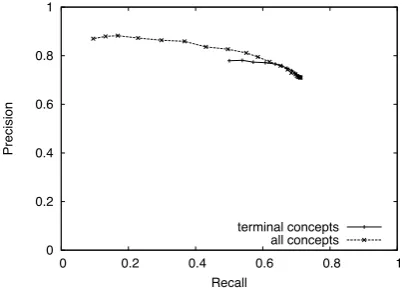
5.4 Precision/Recall Tradeoff
Figure 3 shows the precision/recall curve for the People Ontology task obtained varying the param-eter θ in Equation 2. The experiment was con-ducted using 20 training examples per category.
5.5 Discussion
enti-Scientist Performer Creator Communicator Business Health Phy Mat Che Bio Soc Act Mus Fil Pai Mus Poe Dra Rep man prof
Phy 68 40 25 3 11 2 0 0 3 1 7 1 7 2 3
Mat 3 27 1 0 0 0 0 1 0 0 4 0 2 1 1
Che 12 10 53 2 7 3 1 2 2 0 1 0 4 4 1
Bio 4 12 13 10 3 3 0 1 5 2 4 1 11 2 5
Soc 6 3 4 1 22 4 0 2 2 3 4 1 12 0 9
Act 3 1 2 0 0 106 6 20 0 3 2 4 7 1 1
Mus 1 1 2 0 0 16 64 5 2 28 2 2 7 0 1
Fil 0 0 0 0 0 7 0 46 0 4 1 1 4 3 1
Pai 2 1 0 0 1 1 1 2 93 3 1 0 2 1 0
Mus 1 0 0 0 0 1 16 2 3 142 1 3 2 1 2
Poe 1 2 1 0 1 2 3 3 6 12 93 20 6 1 1
Dra 0 2 1 0 0 3 0 2 2 3 9 65 1 2 2
Rep 0 6 7 0 3 6 1 0 3 2 5 0 189 1 0
Bus 3 3 6 0 0 0 1 1 0 1 2 0 6 17 2
[image:6.595.78.520.70.249.2]Hea 4 0 5 0 3 3 1 0 4 2 2 2 10 0 12
Table 4: Confusion matrix for the finer-grained categories grouped according to their top-level concepts of the People Ontology.
0 0.2 0.4 0.6 0.8 1
0 0.2 0.4 0.6 0.8 1
Precision
Recall
terminal concepts all concepts
Figure 3: Precision/recall curve on the People On-tology.
ties, almost 60 examples per category, whereas we achieved the same result with around 10 examples per category. On the other hand, as Table 2 shows, the IBOP algorithm is effective in populating a more complex ontology and significantly outper-forms the random and most frequent baselines.
An important characteristic of the algorithm is the small number of examples required per cate-gory. This affects both the prediction accuracy and the computation time (this is generally a common property of instance-based algorithms). Therefore, finding an optimal tradeoff between the training size and the performance is crucial. The learn-ing curve (Figure 2) shows that the algorithm out-performs the baselines with only 1 example per category and achieves a good accuracy (F1 ≈
67%) with only 10 examples per category, while it reaches a plateau around 20 examples (F1 ≈
[image:6.595.78.282.312.458.2]70%), but leaving a little room for improvement. Table 4 shows that misclassification errors are largely distributed among categories belonging to the same super-class (i.e., the blocks on the main diagonal are more densely populated than others). As expected, the algorithm is much more accurate for the top-level concepts (i.e., Scientist, Commu-nicator, etc.), where the category distinctions are clearer, while a further fine-grained classification, in some cases, is even difficult for human anno-tators. In particular, results are higher for fine-grained categories densely populated and with a small number of sibling categories (i.e., Painter and Musician). We have observed that the results on sparse categories can be made more precise by increasing the training size, generally at the ex-pense of a lower recall.
We tried to maximize precision by varying the parameter θ in Equation 2, that is, avoiding all assignments where the plausibility score is lower than a given threshold. Figure 3 shows that the precision can be significantly enhanced (∼ 90%) at the expense of poor recall (∼ 20%), while the algorithm achieves80% precision at around50% recall.
however, the test set contains many entities that are classified in more than one category. For instance, Bertolt Brecht is both poet and dramatist and the system classified him as dramatist. Another inter-esting case is the presence of two categories Musi-cian, one is subclass of Performer and the other of Artist, in which, for instance, Ringo Starr is a per-former while John Lennon is an artist, while the system classified both as performers.
6 Related work
Brin (1998) defined a methodology to extract in-formation from the Web starting from a small set of seed examples, then alternately learning extrac-tion patterns from seeds, and further seeds from patterns. Despite the fact that the evaluation was on relation extraction the method is general and might be applied to entity extraction and catego-rization. The approach was further extended by Agichtein and Gravano (2000). Our approach dif-fers from theirs in that we do not learn patterns. Thus, we do not require ad hoc strategies for gen-erating patterns and estimating their reliability, a crucial issue in these approaches as “bad” patterns may extract wrong seeds instances that in turn may generate even more inaccurate patterns in the fol-lowing iteration.
Fleischman and Hovy (2002) approached the ontology population problem as a supervised clas-sification task. They compare different machine learning algorithms, providing instances in their context as training examples as well as more global semantic information derived from topic signature and WordNet.
Alfonseca and Manandhar (2002) and Cimiano and V¨olker (2005) present similar approaches re-lying on the Harris’ distributional hypothesis and the vector-space model. They assign a particu-lar instance represented by a certain context vec-tor to the concept corresponding to the most simi-lar vector. Contexts are represented using lexical-syntactic features.
KnowItAll (Etzioni et al., 2005) uses a search engine and semantic patterns (similar to those de-fined by Hearst (1992)) to classify named entities on the Web. The approach uses simple techniques from the ontology learning field to perform extrac-tion and then annotaextrac-tion. It also is able to perform very simple pattern induction, consisting of look-ing atnwords before andnwords after the occur-rence of an example in the document. With
pat-tern learning, KnowItAll becomes a bootstrapped learning system, where rules are used to learn new seeds, which in turn are used to learn new rules. A similar approach is used in C-PANKOW (Cimi-ano et al., 2005). Compared to KnowItAll and C-PANKOW, our approach does not need hand-crafted patterns as input. They are implicitly found by substituting the training instances in the con-texts of the input entities. Another key difference is that concepts in the ontology do not need to be lexicalized.
Tanev and Magnini (2006) proposed a weakly-supervised method that requires as training data a list of terms without context for each category un-der consiun-deration. Given a generic syntactically parsed corpus containing at least each training en-tity twice, the algorithm learns, for each category, a feature vector describing the contexts where those entities occur. Then, it compares the new (un-known) entity with the so obtained feature vec-tors, assigning it to the most similar category. Even though we used a significantly smaller number of training instances, we obtained better results on their benchmark.
More recently, Giuliano and Gliozzo (2007) proposed an unsupervised approach based on lexi-cal entailment, consisting in assigning an entity to the category whose lexicalization can be replaced with its occurrences in a corpus preserving the meaning. A disadvantage is that the concepts in the ontology have to be lexicalized, as they are used as training examples. Our approach is based on a similar idea, but with the main difference that an instance is substituted with other instances rather than with their category names. Considering that, in most of the cases, ontologies are partially popu-lated during the development phase, and hence the annotation cost is marginal, our approach is a re-alistic alternative for practical ontology population problems.
7 Conclusions and Future Work
The experimental results show that, where a com-parison is possible, our method outperforms previ-ous methods and it can be applied to different do-mains and languages to (semi-) automatically en-rich an existing ontology.
Future work will address the definition of a hi-erarchical categorization strategy where instances are classified in a top-down manner, in order to ef-ficiently populate very large ontologies, since we plan to apply this method to extract structured in-formation from Wikipedia. Furthermore, we will investigate how co-reference resolution might well benefit from our ontology classification. Finally, we plan to exploit the IBOP algorithm for ontol-ogy mapping and multilingual alignment of lexical resources.
Acknowledgments
Claudio Giuliano is supported by the X-Media project (http://www.x-media-project. org), sponsored by the European Commission as part of the Information Society Technologies (IST) program under EC grant number IST-FP6-026978.
References
Agichtein, Eugene and Luis Gravano. 2000. Snowball: extracting relations from large plain-text collections. InDL ’00: Proceedings of the fifth ACM conference on Digital libraries, pages 85–94, New York, NY, USA. ACM.
Alfonseca, Enrique and Suresh Manandhar. 2002. Ex-tending a lexical ontology by a combination of
dis-tributional semantics signatures. InEKAW ’02:
Pro-ceedings of the 13th International Conference on Knowledge Engineering and Knowledge Manage-ment. Ontologies and the Semantic Web, pages 1–7, London, UK. Springer-Verlag.
Brin, Sergey. 1998. Extracting patterns and
rela-tions from the world wide web. In WebDB
Work-shop at 6th International Conference on Extending Database Technology, EDBT’98.
Cimiano, Philipp and Johanna V¨olker. 2005. Towards large-scale, open-domain and ontology-based named
entity classification. InProceedings of RANLP’05,
pages 66– 166–172, Borovets, Bulgaria.
Cimiano, Philipp, G¨unter Ladwig, and Steffen Staab. 2005. Gimme the context: Context-driven automatic semantic annotation with C-PANKOW. In Ellis,
Al-lan and Tatsuya Hagino, editors,Proceedings of the
14th World Wide Web Conference, pages 332 – 341, Chiba, Japan, MAY. ACM Press.
Etzioni, Oren, Michael Cafarella, Doug Downey, Ana M. Popescu, Tal Shaked, Stephen Soderland, Daniel S. Weld, and Alexander Yates. 2005. Un-supervised named-entity extraction from the web:
An experimental study. Artificial Intelligence,
165(1):191–134.
Fellbaum, Christiane. 1998. WordNet. An Electronic
Lexical Database. MIT Press, Cambridge, MA. Fleischman, Michael and Eduard Hovy. 2002. Fine
grained classification of named entities. In
Proceed-ings of the 19th International Conference on Com-putational Linguistics, Taipei, Taiwan.
Gangemi, Aldo, Roberto Navigli, and Paola Velardi. 2003. Axiomatizing WordNet glosses in the
On-toWordNet project. InProocedings of the Workshop
on Human Language Technology for the Semantic Web and Web Services at ISWC 2003, Sanibel Island, Florida.
Giuliano, Claudio and Alfio Gliozzo. 2007. In-stance based lexical entailment for ontology
popu-lation. InProceedings of the 2007 Joint Conference
on Empirical Methods in Natural Language Process-ing and Computational Natural Language LearnProcess-ing (EMNLP-CoNLL), pages 248–256.
Giuliano, Claudio, Alfio Gliozzo, and Carlo Strappar-ava. 2007. Fbk-irst: Lexical substitution task
ex-ploiting domain and syntagmatic coherence. In
Pro-ceedings of the Fourth International Workshop on Semantic Evaluations (SemEval-2007), pages 145– 148, Prague, Czech Republic, June.
Harris, Zellig. 1954. Distributional structure. WORD,
10:146–162.
Hearst, Marti A. 1992. Automatic acquisition of
hy-ponyms from large text corpora. InProceedings of
the Fourteenth International Conference on Compu-tational Linguistics, Nantes, France, July.
McCarthy, Diana and Roberto Navigli. 2007. Semeval-2007 task 10: English lexical substitution task. In Proceedings of the Fourth International Workshop on Semantic Evaluations (SemEval-2007), pages 48– 53, Prague, Czech Republic, June.
McCarthy, Diana. 2002. Lexical substitution as a task
for WSD evaluation. In Proceedings of the
ACL-02 workshop on Word Sense Disambiguation, pages 109–115, Morristown, NJ, USA.
Melamed, I. Dan and Philip Resnik. 2000. Tagger
eval-uation given hierarchical tag sets. Computers and
the Humanities, pages 79–84.