Korektor
– A System for Contextual Spell-checking and
Diacritics Completion
Michal RICHTER
∗Pavel STRA ˇ
NÁK
∗Alexandr ROSEN
† ∗Charles University in Prague, Faculty of Mathematics and Physics†Charles University in Prague, Faculty of Arts
{richter,stranak}@ufal.mff.cuni.cz, [email protected]
A
BSTRACTWe presentKorektor– a flexible and powerful purely statistical text correction tool for Czech that goes beyond a traditional spell checker. We use a combination of several language models and an error model to offer the best ordering of correction proposals and also to find errors that cannot be detected by simple spell checkers, namely spelling errors that happen to be homographs of existing word forms. Our system works also without any adaptation as a diacritics generator with the best reported results for Czech text. The design ofKorektor contains no language-specific parts other than trained statistical models, which makes it highly suitable to be trained for other languages with available resources. The evaluation demonstrates that the system is a state-of-the-art tool for Czech, both as a spell checker and as a diacritics generator. We also show that these functions combine into a potential aid in the error annotation of a learner corpus of Czech.
T
ITLE ANDA
BSTRACT INC
ZECHKorektor – systém pro kontextovou opravu pravopisu a
do-plnˇení diakritiky
Pˇredstavujeme Korektor – flexibilní statistický nástroj pro opravu ˇceských text˚u, jehož schopnosti pˇresahují tradiˇcní nástroje pro kontrolu pravopisu.Korektorvyužívá kombinace jazykových model˚u a chybového modelu jak k tomu, aby setˇrídil poˇradí nabízených náhrad pro neznámé slovo podle pravdˇepodobnosti výskytu na daném místˇe v textu, tak také, aby nalezl i pˇreklepy, které se nahodile shodují s existujícím ˇceským slovním tvarem. Prostou náhradou chybového modelu náš pracujeKorektortaké jako systém pro doplnˇení diakritiky („oháˇckování textu“) s nejvyšší publikovanou úspˇešností. Systém neobsahuje žádné významné jazykovˇe specifické komponenty s výjimkou natrénovaných statistických model˚u. Je tedy možné jej snadno natrénovat i pro jiné jazyky. Ukážeme, jakých zlepšení náš systém dosahuje v porovnání se stávajícími ˇceskými korektory pravopisu i systémy pro doplnˇení diakritiky. Ukážeme také, že kombinace tˇechto schopností pomáhá pˇri anotaci chyb v korpusu ˇceštiny jako druhého jazyka.
K
EYWORDS:
spellchecking, diacritics completion, language model, error model.1 Introduction
The idea of using context of a misspelled word to improve the performance of a spell checker is not new (Mays et al., 1991), moreover, recent years have seen the advance of context-aware spell checkers such asGoogle Suggest, offering reasonable corrections of search queries. Errors detected by such advanced spell checkers have a natural overlap with those of rule-based grammar checkers – grammatical errors are also manifested as unlikely n-grams.
Methods used in such spell checkers usually employ thenoisy-channelorwinnow-basedapproach (Golding and Roth, 1999). The system described here also belongs to thenoisy-channelclass. It makes extensive use of language models based on several morphological factors, exploiting the morphological richness of the target language.
The purpose of this work was to implement a flexible system, capable of performing diverse tasks such as spelling correction, diacritics completion and abbreviated text expansion by simple module replacement. Rather than presenting a scientific prototype we aimed at a practical system providing a better spell-checking for Czech than systems currently available. Section 2 introduces the statistical models used here and describes their application to the tasks of spell-checking and diacritics completion. In Section 3 results of performance evaluation are presented. Section 4 discusses the system’s performance, while Section 5 provides conclusions and outlines our plans for the future.
2 Statistical Model
The task of context-sensitive spelling correction and diacritics completion can be seen as a problem of sequence decoding, which is often formulated in terms of the noisy-channel model. A transmitter sends a sequence of symbols to a receiver. During the transfer, though, certain symbols of the transmitted sequence are garbled due to the deficiencies of the transmission channel. The receiver’s goal is to reconstruct the original sequence using the knowledge of the source(i.e. how a Czech sentence looks like) and the transmission channel properties.
2.1 Source Modeling
Several feature functions1were used to model the source:
• Word forms featureFf – based on language model probabilityP(fi|fi−2,fi−1), wherefi denotes the next word form andfi−2andfi−1are the previous word forms.
• Morphological lemma featureFl– based on language model probabilityP(li|li−2,li−1)
and emission model probabilityP(fi|li), wherelistands for the next lemma,li−1,li−2are the previous lemmas andfiis the next word form.
• morphological tag featureFt– which is, analogically to the morphological lemma feature, based onP(ti|ti−2,ti−1)andP(fi|ti).
The source feature functions are task independent. Their role is to approximate grammaticality of the output sentence. The probability measures were estimated on the basis of n-gram
1For the convenience of the reader, the feature functions are based on trigram statistic in the descriptions. However,
counts collected from a training corpus, using interpolated Kneser-Ney (Kneser and Ney, 1995) smoothing.
A large text corpus was needed in order to produce well-estimated language models and word emission models. This need was met by theCzech Web Documents Collection(henceforth WebColl) (Marek et al., 2007), a 111 million words resource consisting of 223,000 articles, downloaded from news servers and on-line archives of Czech newspapers, lemmatized and tagged with detailed morphological tags as described in the paper. N-gram counts for each morphological factor and counts ofform-lemmaandform-tagcombinations were collected. For the word forms and lemmas, n-grams up to order 3 were collected. For morphological tags, 4-grams were collected as well.
2.2 Channel Modeling
A single channel featureFchestimates the probabilityP(f|f′)of word formf′being transferred as word formf. The channel feature links the input and the output words. The score is assigned according to the similarity of the output words to the input words according to the task specific similarity measure – for the spelling correction problem, it takes into account the probabilities of specific typing errors. Transmission channel for the diacritics completion is constructed in such a way that it assigns a uniform cost to all variants of an output word with diacritics and the infinite cost to all other words.
2.3 Log-linear Model and Viterbi algorithm
A log-linear model (Jurafsky and Martin, 2008) was used to combine all feature functions into a single statistical model. The search space of the model is enormous –|V||S|, where|V|is the
vocabulary size and|S|is the sentence length. However, since all the features use only limited history, we could use Viterbi algorithm (Viterbi, 1967) to find the optimal hypothesis.
2.4 Error Model For Spelling Correction
The error model used in this work is based on the model of (Church and Gale, 1991). They con-sider only candidate words obtained by a single edit operation – insertion, deletion, substitution, or swap. This model is a good fit for Czech language. Since Czech has mostly phonetic spelling, the errors tend to be local, limited to one of these operations. Edit operations have their distinct probabilities, i.e. the probability of the letter substitutions→dmay differ from the probability ofe→a. Letter insertion and deletion probabilities are also context-conditioned.
These probabilities were estimated from the large text corpus. They considered each word that did not appear in the dictionary and was not farther than one edit operation from a word included in the dictionary as a spelling error, and built their error corpus out of such words. First, they set the probabilities of all edit operations uniformly. Later on, they iteratively spell-checked their error corpus, found the best correction for each word and updated the edit probabilities according to the proposederror→suggestionpairs.
This method of finding spelling errors was tested on theWebCollcorpus (see Section 2.1), but turned out to be useless. The reason was that the vast majority of words identified as spelling errors were correct words or colloquial word forms.
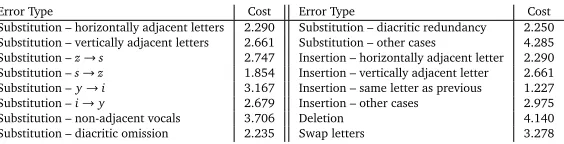
Error Type Cost Error Type Cost
Substitution – horizontally adjacent letters 2.290 Substitution – diacritic redundancy 2.250
Substitution – vertically adjacent letters 2.661 Substitution – other cases 4.285
Substitution –z→s 2.747 Insertion – horizontally adjacent letter 2.290
Substitution –s→z 1.854 Insertion – vertically adjacent letter 2.661
Substitution –y→i 3.167 Insertion – same letter as previous 1.227
Substitution –i→y 2.679 Insertion – other cases 2.975
Substitution – non-adjacent vocals 3.706 Deletion 4.140
[image:4.420.53.335.69.141.2]Substitution – diacritic omission 2.235 Swap letters 3.278
Table 1: Spelling Error Types together with their costs (−logof their probabilities)
right, otherwise the spelling error is not added to the error corpus. More specifically, both bigrams(wi−1,s)and(wi+1,s), wherewi−1is the predecessor of a misspelled worde,wi+1 is the successive word andsis the correction suggestion, must be present in the language model, otherwise the error-correction paire→sis not included in the error corpus. Recall of this method is rather small, but the precision is quite satisfactory and most of the recognized error-correction pairs were correct. This method identified 12,761 words out of 111,000,000 words inWebCollas spelling errors. A classification of these errors is shown in Table 1. The granularity of spelling error types being distinguished is much smaller than in (Church and Gale, 1991).
2.5 Letter Language Model For Diacritics Completion
It may happen that for a given word of the input sentence, no candidate word is found. An example of such a word isnemeckofrancouzsky‘German-French’, which remains untouched with-out any added diacritics. However, an error, here a missing hyphen, is very likely. The present example should receive diacritics as innˇemeckofrancouzský(adjective) ornˇemeckofrancouzsky (adverb).
In order to cut down the number of errors made on unknown words, a custom implementation of the Viterbi decoder was provided. The states on the underlying HMM are tuplets of letters and the transition probabilities are given by a letter n-gram language model (it estimates the probability of next letter on the basis of previous letters). The aim of this Viterbi decoder is to find the most probable letter sequence given the input letter sequence. The only substitutions allowed are the substitutions that add diacritics. Using this approach, diacritics can be added correctly even to the unknown words.
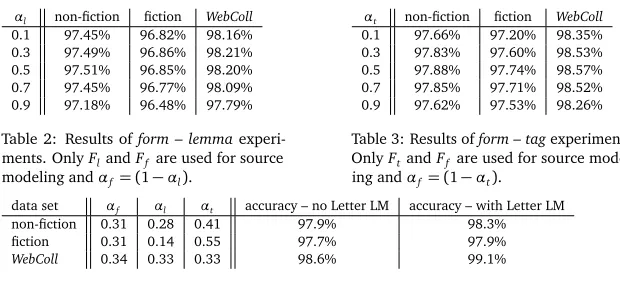
Given that the vocabulary of letter n-gram language model is extremely small (the size of the alphabet), it is possible to train letter LMs of a very high order. In this work, letter LMs of the order up to 7 were trained. The letter LMs were trained on the training part ofWebColl. During the evaluation the contribution of using letter LMs was examined. Table 4 shows a significant accuracy improvement when this feature is used.
3 Evaluation
3.1 Diacritics Completion Results
αl non-fiction fiction WebColl
0.1 97.45% 96.82% 98.16%
0.3 97.49% 96.86% 98.21%
0.5 97.51% 96.85% 98.20%
0.7 97.45% 96.77% 98.09%
[image:5.420.60.370.67.208.2]0.9 97.18% 96.48% 97.79%
Table 2: Results ofform – lemma experi-ments. OnlyFlandFf are used for source modeling andαf = (1−αl).
αt non-fiction fiction WebColl
0.1 97.66% 97.20% 98.35%
0.3 97.83% 97.60% 98.53%
0.5 97.88% 97.74% 98.57%
0.7 97.85% 97.71% 98.52%
0.9 97.62% 97.53% 98.26%
Table 3: Results ofform – tagexperiments. OnlyFtandFf are used for source model-ing andαf= (1−αt).
data set αf αl αt accuracy – no Letter LM accuracy – with Letter LM
non-fiction 0.31 0.28 0.41 97.9% 98.3%
fiction 0.31 0.14 0.55 97.7% 97.9%
WebColl 0.34 0.33 0.33 98.6% 99.1%
Table 4: The best accuracy values achieved on each testing set.
results wece compared to the originals.
The main parameters are the weightsαf,αlandαtof featuresFf,FlandFt.
First, the contributionsFl andFtwere examined separately. In these experimentsαf was ranging from 0 to 1 and the weight (1−αf) was given eitherFlorFt, all the language models used were trigrams. The results of such experiments are shown in Tables 2, 3. It is clear from the plots that both featuresFl,Ftimprove the system performance. However the contribution ofFtis more significant. Surprisingly, it seems to be better to give all the weight toFtthan to give all the weight toFf.
The performance boost achieved by usingFtis most visible on a comparison of results achieved on history domain and fiction domain data. For baseline setup (αf=1,αt=0), the accuracy is 97.39% on non-fiction data and 96.74% on fiction data, which means that the error rate is 25% bigger on fiction data. Nevertheless, by increasing the weight ofFtthe difference in performance was becoming less significant and for the best parameter settings (αf =0.4,αt=0.6), the error rate on fiction data was only 7% bigger (97.72% accuracy on fiction data and 97.89 on non-fiction data).
Next, the estimation of the best parameter setting for each data set was done using a simple hill-climbing algorithm (see (Russell and Norvig, 2003) for details). As the starting point, all the weights were set equally. The resulting parameters and the accuracy values are shown in the Table 4. Experiments with the letter LM feature turned on were made also for the particular settings. It can be seen that the use of letter LM for the completion of unknown words improves the results significantly.
Results of the diacritics completion provided byKorektorwere compared with those of CZACCENT2, the diacritics completion tool developed by the NLP Center of Masaryk Uni-versity in Brno, using the non-fiction data set. The accuracy achieved byCZACCENTwas 95.85%, while the accuracy achieved byKorektorreached 98.3%. The error rate ofKorektoris thus almost 2.5 times smaller.
2http:
3.2 Spell-checking Results
The quality of spell checkers is usually measured by the spelling correction error rate (i.e., the probability that the first given suggestion is correct, or that the correct suggestion is included in the list of first three suggestions, etc.). If a context-sensitive spell checker is considered and the ability of recognizing the real-word errors is to be tested,F-measurebased onprecisionand recallcan be used. It is a good indicator of a quality of a classifier.
During the evaluation of spelling correction, the optimal parameter settings (weights of distinct feature functions), estimated for the diacritic completion task, were used on the assumption that the featuresFf,FlandFtare task independent and that their weighting obtained for one task will perform well for other tasks as well. The reason why we made no separate parameter tuning was that the size of available annotated spelling error data was too small. The weights were set according to the optimal setting for diacritics completion on non-fiction, i.e.αf =0.31, αl=0.28 andαt=0.41. Channel featureFchwas set to the weightαch=1.0, which assigns the same importance to both the source and the channel models.
For the evaluation of spell-checking, three different data sets were used: 1.Chyby– an error corpus (Pala et al., 2003); 2.Audio– transcription of an audio book; 3.WebColltest set – semi-automatically recognized spelling errors in the part ofWebCollnot used during the training. 4.CzeSL– a corpus of short essays written by learners of Czech as a foreign language The error corpusChyby(Pala et al., 2003) is a collection of essays written by students of Brno University of Technology, annotated for errors including spelling, morphological, syntactic and stylistic errors. Spell checking was tested on spelling and morphological errors since these types of errors are potentially recognizable by the system. There were 744 such errors, 321 of them were real-word errors. The high ratio of real-word errors show that most of the student works were already spell-checked.
TheAudiotest set, including the total of 1371 words, has 218 spelling errors, 12 of them real-word errors. The data set was built by transcribing an audio version of Jaroslav Hašek’s novelOsudy dobrého vojáka Švejka‘The Good Soldier Švejk’.3 The transcribed text was not post-corrected and the spelling error rate in the resulting text is relatively high.
TheWebColltesting set was extracted from the part ofWebCollnot used during the system training. Spelling errors were collected semi-automatically usingKorektor. Words identified by the spell-checker4as spelling errors were examined manually and the words that were flagged as spelling errors by mistake were filtered out. The result was a set of sentences containing spelling errors authorized by a human. The golden standard data were created manually in the next step. This approach made the collection of errors in theWebColltesting data feasible, but all real-word errors were missed (they were ignored, because they were not flagged as spelling errors by the spell checker in the first step). Thus, only the evaluation of suggestion accuracy could be done for this data.
The results of spelling correction accuracy evaluation forChyby,AudioandWebCollare shown in Table 5 and the results of real-word error detection evaluation are shown in Table 6. For 3The audio extracts can be downloaded for free from the website of the Czech Radio:http://www.rozhlas.cz/
ctenarskydenik.
4The spell checker made look-up for the out–of–vocabulary words easier. The correction suggestions provided by the
Number of suggestions WebColl Chyby1 Chyby2 Audio(Korektor) Audio(MS Word)
1 91.4% 73.5% 82.3% 91.6% 71.2%
2 95.1% 80.1% 80.9% 97.2%
-5 96.3% 80.9% 90.5% 98.6%
-Table 5: Spelling correction rates achieved on the different data sets. For theChybycorpus, two measurements were taken. InChyby 1, all spelling errors are considered. ForChyby 2, only those spelling errors for which an appropriate correct version is in the lexicon are taken into account.
Chyby Audio(Korektor) Audio(MS Word)
Precision 0.41 1.0 0.5
Recall 0.24 0.77 0.08
F-measure 0.31 0.87 0.14
Table 6: Real-word error correction statistics forAudiodata set andChybycorpus.
theAudiodata set, comparison with theMicrosoft Word 2007spell checker with grammar checking features turned on was made. ForMS Wordspell checker only the accuracy on the first suggestion was considered since there is no API that would allow to do the evaluation automatically. We are not certain how exactly the MS system works, since as far as we know no details have been published. However, we think that it is a conventional spell checker without any statistical model (for Czech) and a rule based grammar checker. Since the components seem to be separate, the grammar checker assumes the text has already been spell checked. This assumption, combined with what looks like a minimum edit distance algorithm to pick the first suggestion of the spelling module provides a disadvantage for MS Word system in the fully automated setting.
The results suggest thatKorektorhas a much higher accuracy on a single suggestion and ability to detect real-word spelling errors. The cases when theMS Wordspell checker marked a grammar error were all because of capitalization problems, which suggests that there is no statistical real-word error detection in the Czech version ofMS Word5 Significantly lower spelling correction rate on theChybycorpus can be caused by the fact that the properties of the texts in this corpus (technical topics) differ significantly from the training data properties (newspapers).
Finally,Korektor’s performance was tested on a sample fromCzeSL, a learner corpus consisting of texts produced by learners of Czech as a second or foreign language. A part of the corpus is manually annotated in two stages with correct versions of deviant forms and relevant error codes. The annotators are instructed to correct both non-words (stage/Tier 1) and real-word errors (stage/Tier 2) to arrive at a grammatically correct sentence.6
In a pilot study of 67 short, doubly-annotated essays,Korektorwas used to see whether automatic correction of learner texts is viable as a way to assist the annotator or even as a fully automatic annotation procedure.
Among the total 9,372 tokens, 918 (10%) were not recognized by a tagger (Spoustová et al., 2007) we used to find incorrect word forms. Even more forms were judged as faulty by the 5However, theMS Wordspell checker for Czech is equipped with other capabilities thatKorektordoes not possess,
such as punctuation checking.
[image:7.420.63.363.71.107.2]annotators: 1,189 (13%) were corrected in the same way by both annotators at Tier 1 (T1) and 1,519 (16%) at Tier 2 (T2). Results ofKorektorwere compared with those of the tagger and with forms at T1 and T2, provided both annotators were in agreement. In the case of the tagger Korektorwas deemed to be successful if it agrees with the tagger in the correct/incorrect status
of the form. The results in terms of F-measure show 0.86 in comparison with the tagger, 0.72 in comparison with T1 and 0.53 in comparison with T2. The results support the idea to integrate Korektorinto the learner corpus annotation workflow, either as suggestions to the annotator or as a solution to obtain fully automatic large-scale annotation at the cost of a higher error rate. In fact, the entireCzeSLcorpus (2 mil. words, including unannotated parts) has been processed byKorektorto help querying the corpus.
4 Discussion
The results for spelling correction accuracy are not as good as those reported in (Brill and Moore, 2000) – around 95% on the first suggestion. However, those results were achieved for English and are not directly comparable. Czech with its rich morphology may be more challenging. For theChybycorpus, significantly lower performance (73% on the first suggestion) may be caused by the heavy usage of technical terminology, such as names of software products, including their inflected forms. On the other hand, the fact thatKorektorclearly outperformed the spell checker integrated inMicrosoft Word 2007indicates the qualities of the system.
5 Conclusion and Future Work
We have designed and implemented a context-sensitive method of spell-checking and diacritics completion. The result is a spell checker that is freely available and ready for use.
Our primary concern was a robust, purely statistical, language-independent design. As a result, the system can be re-trained for any language. The only limitation is the availability of an annotated error corpus to train the error model, the availability of a general corpus to train the language model, and (depending on the language) a lemmatizer/POS tagger.
As for the spell-checking task, we focussed on the ability of the system to recognize real-word spelling errors and also to suggest the most likely corrections of spelling errors. In the spell-checking evaluation,Korektorachieved much better performance than theMS Word 2007spell checker.
Diacritics completion module was implemented on top of the spell checker. The accuracy of diacritics completion was about 98% with training and test data coming from different domains. Such performance is acceptable for many tasks, the best reported for Czech so far, and among the best reported for any language.
References
Brill, E. and Moore, R. C. (2000). An improved error model for noisy channel spelling correction. InACL ’00: Proceedings of the 38th Annual Meeting on Association for Computational Linguistics, pages 286–293, Morristown, NJ, USA. Association for Computational Linguistics.
Church, K. and Gale, W. (1991). Probability scoring for spelling correction. Statistics and Computing, 1(7):93–103.
Golding, A. R. and Roth, D. (1999). A winnow-based approach to context-sensitive spelling correction.Machine Learning, 34:107–130. 10.1023/A:1007545901558.
Hana, J., Rosen, A., Škodová, S., and Štindlová, B. (2010). Error-tagged learner corpus of Czech. InProceedings of the Fourth Linguistic Annotation Workshop, Uppsala, Sweden. Association for Computational Linguistics.
Jurafsky, D. and Martin, J. H. (2008). Speech and Language Processing: An Introduction to Natural Language Processing, Computational Linguistics and Speech Recognition. Prentice Hall, second edition.
Kneser, R. and Ney, H. (1995). Improved backing-off for M-gram language modeling. In Acoustics, Speech, and Signal Processing, 1995. ICASSP-95., 1995 International Conference on, volume 1, pages 181–184 vol.1.
Marek, M., Pecina, P., and Spousta, M. (2007). Web page cleaning with conditional random fields. In Fairon, C., Naets, H., Kilgarriff, A., and de Schryver, G.-M., editors,Proceedings of the 3rd Web As a Corpus Workshop, Incorporating CLEANEVAL, pages 155–162, Louvain-la-Neuve, Belgium. UCL Pressess Universitaires de Louvain.
Mays, E., Damerau, F. J., and Mercer, R. L. (1991). Context based spelling correction. Information Processing & Management, 27(5):517 – 522.
Pala, K., Rychlý, P., and Smrž, P. (2003). Text corpus with errors. InTEXT, SPEECH AND DIALOGUE, volume 2807/2003 ofLecture Notes in Computer Science, pages 90–97. Springer.
Russell, S. and Norvig, P. (2003).Artificial Intelligence: A Modern Approach. Prentice-Hall, Englewood Cliffs, NJ, 2nd edition edition.
Spoustová, D., Hajiˇc, J., Votrubec, J., Krbec, P., and Kvˇetoˇn, P. (2007). The best of two worlds: Cooperation of statistical and rule-based taggers for Czech. InProceedings of the Workshop on Balto-Slavonic Natural Language Processing 2007, pages 67–74, Praha, Czechia. Association for Computational Linguistics.