Collocation Extraction Based on Modifiability Statistics
Joachim Wermter Udo Hahn
Computerlinguistik, Friedrich-Schiller-Universit¨at Jena F¨urstengraben 30, D-07743 Jena, Germany
Abstract
We introduce a new, linguistically grounded measure of collocativity based on the property of limited modifiability and test it on German PP-verb combinations. We show that our mea-sure not only significantly outperforms the stan-dard lexical association measures typically em-ployed for collocation extraction, but also yields a valuable by-product for the creation of col-location databases, viz. possible structural and lexical attributes. Our approach is language-, structure-, and domain-independent because it only requires some shallow syntactic analysis (e.g., a POS-tagger and a phrase chunker).
1 Introduction
Natural language is an open and very flexible com-munication system. Syntax, of course, imposes con-straints, e.g., on word order or the occurrence of par-ticular phrasal types such as PPs or NPs, and lexi-cal semantics imposes, e.g., selectional constraints on conceptually permitted sorts or types within the context of specific verbs or nouns. Nevertheless, natural language speakers usually enjoy an enor-mous degree of freedom to express the content they want to convey in a great variety of linguistic forms. There is, however, a significant subset of expres-sions which do not share this rather free combinabil-ity, so-called collocations. From a linguistic per-spective, they can be characterized by at least three recurrent and prominent properties (Manning and Sch¨utze, 1999):
Non-(or limited) compositionality. The mean-ing of a collocation is not a straightforward composition of the meanings of its parts. For example, the meaning of ‘red tape’ is pletely different from the meaning of its com-ponents.
Non-(or limited) substitutability. The parts of a collocation cannot be substituted by seman-tically similar words. Thus, ‘gut’ in ‘to spill gut’ cannot be substituted by ‘intestine’ (see also Lin (1999)).
Non-(or limited) modifiability. Many collo-cations cannot be supplemented by additional lexical material. For example, the noun in ‘to kick the bucket’ cannot be modified as ‘to kick the
holey/plastic/water bucket’.
Considering these observations, from a natu-ral language processing perspective, collocations should not enter, e.g., the standard syntax-semantics pipeline so as to prevent compositional semantic readings of expressions for which this is absolutely not desired. Hence, collocations need to be identi-fied as such and subsequently be blocked, e.g., from compositional semantic interpretation.
In computational linguistics, a wide variety of lexical association measures have been employed for the task of (semi-)automatic collocation identifi-cation and extraction. Almost all of these measures can be grouped into one of the following three cate-gories:
frequency-based measures (e.g., based on ab-solute and relative co-occurrence frequencies)
information-theoretic measures (e.g., mutual information, entropy)
statistical measures (e.g., chi-square, t-test, log-likelihood, Dice’s coefficient)
The corresponding metrics have been extensively discussed in the literature both in terms of their mathematical properties (Dunning, 1993; Manning and Sch¨utze, 1999) and their suitability for the task of collocation extraction (see Evert and Krenn (2001) and Krenn and Evert (2001) for recent eval-uations). Typically, they are applied to a set of can-didate lexeme pairs which were obtained from pre-processors varying in linguistic sophistication.1 The selected measure then assigns an association score
1
to each candidate pair, which is computed from its joint and marginal frequencies, thus expressing the strength of the hypothesis stating whether it consti-tutes a collocation or not.
While these association measures have their sta-tistical merits in collocation identification, it is in-teresting to note that they have relatively little to do with the linguistic properties (such as those men-tioned at the beginning) which are typically associ-ated with the notion of collocativity. Therefore, it may be interesting to investigate whether there is a way to implement a measure which directly incor-porates linguistic criteria in the collocation identifi-cation task, and even more important, whether such a linguistically rooted approach would fare better in comparison to some of the standard lexical associa-tion measures.
In the following study, we will introduce such a linguistic measure for identifying PP-verb colloca-tions in German, which is based on the property of non- or limited modifiability. To the best of our knowledge, this is the first work to use this kind of linguistic measure to acquire collocations auto-matically. By contrasting our method to previous studies which use the standard lexical association measures, we intend to emphasize a more linguis-tically inspired use of statistics in collocation min-ing. Section 2 motivates our definition of the notion of collocation and Section 3 describes our methods, in particular the linguistically grounded collocation extraction algorithm, and the experimental setup de-rived from it. In Section 4 we present and discuss the results of our experiments.
2 Kinds of Collocations
There have been various approaches to define the notion of ‘collocation’. This is by no means an easy task, especially when it comes to defining the de-marcation line between collocations and free word combinations (modulo general syntactic and seman-tic semanseman-tic constraints). We favor an approach which draws this line on the semantic layer, viz. the compositionality between the components of a lin-guistic expression.
For this purpose, we distinguish between three classes of collocations based on varying degrees of semantic compositionality of the basic lexical enti-ties involved:
1. Idiomatic Phrases. In this case, none of the lexical components involved contribute to the overall meaning in a semantically transpar-ent way. The meaning of the expression is metaphorical or figurative. For example, the
literal meaning of the German PP-verb combi-nation ‘[jemanden] auf die Schippe nehmen’ is ‘to take [someone] onto the shovel’. Its figura-tive meaning is ‘to lampoon somebody’.
2. Support Verb Constructions/Narrow Colloca-tions. This second class contains expressions in which at least one component contributes to the overall meaning in a semantically transpar-ent way and thus constitutes its semantic core. For example, in the support verb construction ‘zur Verf¨ugung stellen’ (literal: ‘to put to avail-abilty’; actual: ‘to make available’), the noun ‘Verf¨ugung’ is the semantic core of the expres-sion, whereas the verb only has a support func-tion with some impact on argument structure, causativity or aktionsart. There are, however, also narrow collocations in which the basic lex-ical meaning of the verb is the semantic core: For example, in ‘aus eigener Tasche bezahlen’ (‘to pay out of one’s own pocket’) the verb ‘bezahlen’ is the semantic core. What unifies these two types is the fact that they function as predicates.
3. Fixed Phrases. Here, all basic lexical mean-ings of the components involved contribute to the overall meaning in a semantically much more transparent way. Still, they are not as completely compositional as to classify them as free word combinations. For example, all the basic lexical meanings of the different lex-ical components in ‘im Koma liegen’ (literal: ‘to lie in coma’; actual: ‘to be comatose’) contribute to the overall meaning of the ex-pression. Still, this is different from a com-pletely compositional free word combination, such as ‘auf der Strasse gehen’ (‘to walk on the street’).
Our goal is to consider all three types of col-locations as a whole, i.e., we will not distinguish between the three different kinds of collocations. However, in order to focus our experiments, we will concentrate on a particular surface pattern in which they occur, viz. PP-verb collocations.
3 Methods and Experiments
both developed at the Text Knowledge Engineer-ing Lab at Freiburg University, on the POS-tagged corpus. From the XML-marked-up tree output, PP-verb complexes were automatically selected in the following way: Taking a particular PP node as a fixed point, either the preceding or the follow-ing siblfollow-ing V node was taken.2 From such a PP-verb combination, we extracted and counted both its various heads, in terms of Preposition-Noun-Verb (PNV) triples, and all its associated supplements, i.e., here in this case any additional lexical material which also occurs in the nominal group of the PP, such as articles, adjectives, adverbs, cardinals, etc.3
The extraction of the associated supplements is es-sential to the linguistic measure described in sub-section 3.3 below.
In order to reduce the amount of candidates for evaluation and to eliminate low-frequency data, we only considered PNV-triples with frequency
. This was also motivated by the well-known fact that collocations tend to have a higher co-occurrence frequency than free word combina-tions.4 Table 1 contains the data for the correspond-ing frequency distributions.
frequency PP-verb combinations candidate tokens candidate types
all 1,663,296 1,159,133
279,350 8,644
Table 1:Frequency distribution for PP-Verb tokens and types for our 114-million-word newspaper corpus
3.2 Classification of the Testset
Three human judges manually classified the PP-verb candidate types with
in regard to whether they were a collocation or not. For this purpose, they used a manual, in which the guide-lines included the linguistic properties as described in Section 1 and the three collocation classes identi-fied in Section 2.
Among the 8,644 PP-verb candidate types, 1,180 (13.7%) were identified as true collocations. The inter-annotator agreement was 94.8% (with a stan-dard deviation of 2.1).
2The verbs in this study are restricted to main verbs and are
reduced to their base form after extraction.
3It should be noted that both heads and associated
supple-ments may of course vary depending on the particular linguistic
structure targeted for collocation extraction.
4Cf. also Evert and Krenn (2001) for empirical evidence
justifying the exclusion of low-frequency data.
3.3 The Linguistic Measure
The linguistic property around which we built our measure for collocativity is the non- or limited mod-ifiabilty of collocations with additional lexical ma-terial (i.e., supplements). The underlying assump-tion is that a PNV triple is less modifiable (and thus more likely to be a collocation) if it has a lexical supplement which, compared to all others, is par-ticularly characteristic. We express this assump-tion in the following way: Let be the number of distinct supplements of a particular PNV triple ( ). The probability of a particular sup-plement !#"%$&$(' , )+*-,
/.
10, is described by its fre-quency scaled by the sum of all supplement frequen-cies:
324657&896;:;<=* (1)
24657&896;:< >@?
ACB
24DE657&896FG<
with >? HACB
24I957J86FG<@* 24K<. 5
Then the modifiability LNMPO of a PNV triple can be described by its most probable supplement:
LNMPOQ24IR<TS* (2)
UWVYX[Z\UW]
324657&896;:;<
.
)3*^, /.
10
To define a measure of collocativity _`MbaTa for a candidate set, some factor regarding frequency has to be taken into account. Thus, besides LNMPO , we take the relative co-occurrence frequency for a spe-cific PNV triple 324cER< (d being the number of candidate types (here, 8,644))
324eDIR<TS*
24DE<
>
f
ACB
24I4g;<
(3)
and incorporate it as a second factor to_hMbaia :
_`MbaTa[24eDIR<iS* (4)
LNMPOQ24eDIR<@jk 324K<
3.4 Methods of Evaluation
Standard procedures for evaluating the goodness of collocativity measures usually involve identifying the true positives among the -highest ranked candi-dates returned by a particular measure. Because this is rather labor-intensive, is usually small, rang-ing from 50 to several hundred. Evert and Krenn
5
(2001), however, point out the inadequacy of such methods claiming they usually lead to very super-ficial judgements about the measures to be exam-ined. In contrast, they suggest examining various -highest ranked samples, which allows plotting stan-dard precision and recall graphs for the whole can-didate set.
We evaluate the _hMbaia measure against two widely used standard statistical tests (t-test and log-likelihood) and against co-occurrence frequency. The comparison to the t-test is especially interesting because it was found to achieve the best overall pre-cision scores in other studies (see Evert and Krenn (2001)). Our baseline is defined by the proportion of true positives (13.7%; see subsection 3.2), which can be described as the likelihood of finding one by blindly picking from the candidate set.
4 Experimental Results and Discussion 4.1 Precision and Recall for Collocation
Extraction
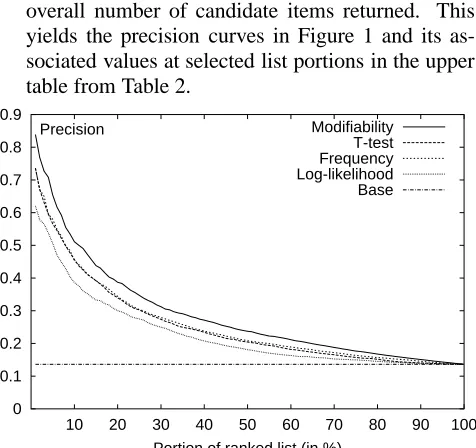
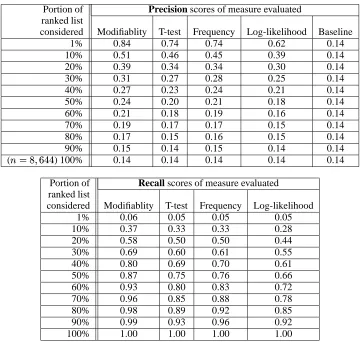
In the first experiment, we incrementally examined parts of the -highest ranked candidate lists re-turned by the each of the four measures we consid-ered. The precision values for various were com-puted such that for each percent point of the list, the proportion of true positives was compared to the overall number of candidate items returned. This yields the precision curves in Figure 1 and its as-sociated values at selected list portions in the upper table from Table 2.
0 0.1 0.2 0.3 0.4 0.5 0.6 0.7 0.8 0.9
10 20 30 40 50 60 70 80 90 100
Portion of ranked list (in %)
Precision Modifiability
T-test Frequency Log-likelihood Base
Figure 1: Precision for Collocation Extraction
First, we observe that all measures outperform the baseline by far and, thus, all are potentially use-ful measures of collocativity. Of the statistical mea-sures, log-likelihood (the most complex one) per-forms the worst, whereas t-test and frequency, al-most indistinguishable, share the middle position, with frequency measurements having a very slight
edge at six rank points. This is in contrast to the findings reported by Krenn and Evert (2001), which gave the t-test an edge.6
As can be clearly seen, however, our linguis-tic modifiability measure substantially outperforms all other measures at all points in the ranked list. Considering 1% (
), its precision value is ten percentage points higher than for t-test and fre-quency, and even 22 points higher compared to log-likelihood. Until 50% ( ) of the ranked list is considered, modifiability maintains a three to five percentage point advantage in precision over t-test and frequency. In the second half of the list, all curves and associated values start converging to-wards the baseline.
We also tested the significance of differences for our precision results, both between modifiability and frequency and between modifiability and t-test. Because in both cases the ranked lists were taken from the same set of candidates, viz. the 8,644 PP-verb candidate types, and hence constitute depen-dent samples, we applied the McNemar test (Sachs, 1984) for statistical testing. We selected 100 mea-sure points in the ranked list, one after each incre-ment of one percent, and then used the two-tailed test for a confidence interval of 99%. Table 3, which lists the number of significant differences for 10, 50 and 100 measure points, shows that almost all of them are significantly different.
# of significance # of signicant differences measure points comparing modifiability with
frequency t-test
10 9 9
50 49 49
100 96 97
Table 3: Significance testing of differences using the two-tailed McNemar test at 99% confidence interval
The recall curves in Figure 2 and their corre-sponding values in the lower table from Table 2 measure which proportion of all true positives is identified by a particular measure at a certain part of the ranked list. In this sense, recall is an even bet-ter indicator of a particular measure’s performance. Again, the linguistically motivated collocation ex-traction algorithm outscores all others, even more pronounced than for precision. When examining
20% (
&< , 30% ( ) and 40%
6
Portion of Precision scores of measure evaluated
ranked list
considered Modifiablity T-test Frequency Log-likelihood Baseline
1% 0.84 0.74 0.74 0.62 0.14
10% 0.51 0.46 0.45 0.39 0.14
20% 0.39 0.34 0.34 0.30 0.14
30% 0.31 0.27 0.28 0.25 0.14
40% 0.27 0.23 0.24 0.21 0.14
50% 0.24 0.20 0.21 0.18 0.14
60% 0.21 0.18 0.19 0.16 0.14
70% 0.19 0.17 0.17 0.15 0.14
80% 0.17 0.15 0.16 0.15 0.14
90% 0.15 0.14 0.15 0.14 0.14
(
) 100% 0.14 0.14 0.14 0.14 0.14
Portion of Recall scores of measure evaluated
ranked list
considered Modifiablity T-test Frequency Log-likelihood
1% 0.06 0.05 0.05 0.05
10% 0.37 0.33 0.33 0.28
20% 0.58 0.50 0.50 0.44
30% 0.69 0.60 0.61 0.55
40% 0.80 0.69 0.70 0.61
50% 0.87 0.75 0.76 0.66
60% 0.93 0.80 0.83 0.72
70% 0.96 0.85 0.88 0.78
80% 0.98 0.89 0.92 0.85
90% 0.99 0.93 0.96 0.92
100% 1.00 1.00 1.00 1.00
Table 2:Precision and Recall Scores for Collocation Extraction at Major Portions of the Ranked List
(
) of the ranked list, modifiability, respec-tively, identifies almost 60%, 70% and 80% of all true positives, holding a ten percentage point lead over t-test and frequency at each of these points. When 50% ( ) are considered, this differ-ence reaches eleven and twelve points (compared to frequency and t-test, respectively).
0.0 0.1 0.2 0.3 0.4 0.5 0.6 0.7 0.8 0.9 1.0
10 20 30 40 50 60 70 80 90 100
Portion of ranked list (in %) Recall
Modifiability T-test Frequency Log-likelihood
Figure 2: Recall for Collocation Extraction
Even more strikingly, for the identification of 90% of all true positives, modifiability only needs to look at 55% (
) of the ranked list. Fre-quency, on the other hand, needs to examine 75% (
) and t-test even 85% (
) of the ranked list to reach this high level of recall.
4.2 Modifiability Revisited
PNV Triple NP Supplement Frequency
‘in Griff bekommen’ den/ART Griff/NN 459
‘to get under control’ Griff/NN 2
den/ART gewerkschaftlichen/ADJA Griff/NN 1 den/ART dramatischen/ADJA Griff/NN 1 den/ART erz¨ahlerischen/ADJA Griff/NN 1
‘unter Druck geraten’ Druck/NN 560
‘to get under pressure’ politischen/ADJA Druck/NN 6 erheblichen/ADJA politischen/ADJA Druck/NN 5 teilweise/ADV lebensgef¨ahrlichen/ADJA Druck/NN 1 wachsenden/ADJA Druck/NN 1 noch/ADV st¨arkeren/ADJA Druck/NN 1 schweren/ADJA Druck/NN 1
Table 4:Collocational PNV Triples with Associated Noun Phrase Supplements
0.001 0.01 0.1 1 10 100
1 10 100 1000
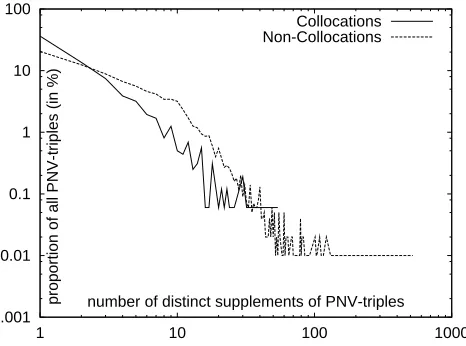
proportion of all PNV-triples (in %) number of distinct supplements of PNV-triples Collocations Non-Collocations
Figure 3:Distribution of Supplements for (Non-) Collo-cations in PNV Triples. The x- and y-axes are log-scaled.
As Figure 3 reveals, not only is the propor-tion of collocapropor-tional PNV triples with only one distinct supplement higher (36%) than the propor-tion for non-collocapropor-tional ones (20%), but with each additional supplement, the collocational pro-portion curve declines more steeply than its non-collocational counterpart. Moreover, the colloca-tional proportion curve already ends with 54 distinct supplements, whereas the non-collocational propor-tion curve leads up 520 distinct supplements. Thus, we are able to add some empirical grounding to the widespread textbook assumption about the limited modifiablity of collocations.
Another observation (which is also inherent to our linguistic measure) based on this experiment is that some collocations do possess at least limited modifiability. Collocation acquisition is, of course, not a goal by itself, but rather aims at creating col-location lexicons for both language processing and generation (Smadja and McKeown, 1990). From this perspective, our linguistic modifiabilty measure actually yields quite a valuable by-product for the
development of lexicons or collocational knowledge bases: A list of possible structural and lexical mod-ifications associated with a particular collocational entry candidate. In our case, these modifications re-fer to the nominal group of the PP. We illustrate this point in Table 4 with two collocational PNV triples and some of their associated NP supplements plus their frequencies.
As can be seen, both structural and lexical at-tributes of collocations can thus be obtained. The structural information comes in the form of part-of-speech (POS) tags. From this, possible prenominal POS types and their combinations can be used to describe a collocation’s structural make-up. From a lexical viewpoint, the collocation can be described by the lexical semantic word classes used for mod-ification.7 As can be seen in Table 4 under the PNV triple for ‘to get under pressure’, the noun ‘Druck’ (‘pressure’) is often modified by a cer-tain semantic class of adjectives, such as ‘stark’ (‘strong’), ‘schwer’ (‘heavy’), ‘erheblich’ (‘consid-erable’, ‘grave’).
5 Related Work
Although there have been many studies on colloca-tion extraccolloca-tion and mining using only statistical ap-proaches (Church and Hanks, 1990; Ikehara et al., 1996), there has been much less work on collocation acquisition which takes into account the linguistic properties typically associated with collocations.
Smadja (1993), which is the classic work on col-location extraction, uses a two-stage filtering model in which, in the first step, n-gram statistics deter-mine possible collocations and, in the second step, these candidates are submitted to a syntactic
valida-7
tion procedure (e.g., determining verb-object collo-cations) in order to filter out invalid collocations. In a single-judge evaluation of 4,000 collocation can-didates, the incorporation of linguistic criteria (via tagging and predicate-argument parsing) boosts pre-cision up to a level of 80% and recall to 94%. These results are, of course, not comparable to ours. First of all, precision and recall are measured at a fixed point for a fixed unranked candidate list. In or-der to obtain more reliable evaluation results, we plot these values continuously on a ranked candi-date list. Secondly, our kind of syntactic preprocess-ing (which is standard nowadays) allows collocation extraction algorithms to better control the structural types of collocations.
Lin (1998) acquires a lexical dependency database by assembling dependency relationships from a parsed corpus. An entry in this database is classified as collocation if its log-likelihood value is greater than some threshold. Using an automatically constructed similarity thesaurus, Lin (1999) then separates compositional from non-compositional collocations by taking into account the second lin-guistic property described in Section 1, viz. their non- or limited substitutability. In particular, he checks the existence and mutual information val-ues of phrases obtained by substituting the words with similar ones, which results in the classifica-tion of the phrase as being composiclassifica-tional or non-compositional. Although this study offers some promising results, its applicability rather falls into the category of fine-classifying an already acquired set of collocations, e.g., according to the criteria de-scribed in Section 2, and thus is not really compara-ble to our work. Moreover, the linguistic property in his focus is of course a semantic one, whereas ours is purely syntactic in nature.
6 Conclusion
We introduced a new, linguistically motivated mea-sure of collocativity based on the property of lim-ited modifiability and tested it on a large corpus with emphasis on German PP-verb combinations. We showed that our measure not only significantly outperforms the standard lexical association mea-sures typically used for collocation extraction, but also yields a valuable by-product for the creation of collocation databases, viz. possible structural and lexical attributes of a collocation.
Our measure defines the modifiability property in a linguistically simple way, by e.g. ignoring the internal make-up of lexical supplements asso-ciated with a collocation candidate. Hence, it may be worthwhile to investigate whether a more
sophis-ticated approach, by e.g. taking into account inter-nal POS types and their distribution etc., would im-prove our results even more. We may also consider other linguistic criteria (e.g., limited substitutabil-ity) to further refine our measure and to categorize already identified collocations.
At the methodological level, our approach, al-though tested on German newspaper language data, is language-, structure-, and domain-independent. All it requires is some sort of shallow syntactic analysis, e.g., POS tagging and phrase chunking. Thus, in the future we plan to include other syntactic types of collocations, such as object or verb-object-PP combinations, and also apply our method-ology to other languages and domains, such as the biomedical field.
Acknowledgements. We would like to thank our students,
Sabine Demsar, Kristina Meller, and Konrad Feldmeier, for their excellent work as human collocation classifiers. This work was partly supported by DFG grant KL 640/5-1.
References
T. Brants. 2000. TNT: A statistical part-of-speech tag-ger. In Proceedings of the ANLP 2000 Conference, pages 224–231.
K. Church and P. Hanks. 1990. Word association norms, mutual information, and lexicography.
Com-putational Linguistics, 16(1):22–29.
T. Dunning. 1993. Accurate methods for the statistics of surprise and coincidence. Computational Linguistics, 19(1):61–74.
S. Evert and B. Krenn. 2001. Methods for the qualitative evaluation of lexical association measures. In ACL’01
– Proceedings of the 39th Meeting of the ACL, pages
188–195.
S. Ikehara, S. Shirai, and H. Uchino. 1996. A statistical method for extracting uninterrupted and interrupted collocations from very large corpora. In Proceedings
of the COLING’96 Conference, pages 574–579.
B. Krenn and S. Evert. 2001. Can we do better than fre-quency? A case study on extracting pp-verb colloca-tions. In Proceedings of the ACL Workshop on
Collo-cations.
D. Lin. 1998. Automatic retrieval and clustering of sim-ilar words. In Proceedings of the COLING/ACL’98
Conference, pages 768–774.
D. Lin. 1999. Automatic identification of non-compositional phrases. In ACL’99 – Proceedings of
the 37th Meeting of the ACL, pages 317–324.
C. Manning and H. Sch¨utze. 1999. Foundations of
Sta-tistical Natural Language Processing. MIT Press.
L. Sachs. 1984. Applied Statistics. Springer.
F. A. Smadja and K. R. McKeown. 1990. Automatically extracting and representing collocations for language generation. In Proceedings of the 28th Meeting of the
ACL, pages 252–259.