EFFICIENT CEPSTRAL NORMALIZATION FOR
ROBUST SPEECH RECOGNITION
Fu-Hua Liu, Richard M. Stern, Xuedong Huang, Alejandro Acero Department o f Electrical and Computer Engineering
School of Computer Science Carnegie Mellon University
Pittsburgh, PA 15213
A B S T R A C T
In this paper we describe and compare the performance of a series of cepstrum-based procedures that enable the CMU SPHINX-II speech recognition system to maintain a high level of recognition accuracy over a wide variety of acoustical environments. We describe the MFCDCN algorithm, an environment-independent extension of the efficient SDCN and FCDCN algorithms devel- oped previously. We compare the performance of these algorithms with the very simple RASTA and cepstral mean normalization procedures, describing the performance of these algorithms in the context of the 1992 DARPA CSR evaluation using secondary microphones, and in the DARPA stress-test evaluation.
1. I N T R O D U C T I O N
The need for speech recognition systems and spoken lan- guage systems to be robust with respect to their acoustical environment has become more widely appreciated in recent years (e.g. [1]). Results of many studies have demonstrated that even automatic speech recognition systems that are designed to be speaker independent can perform very poorly when they are tested using a different type of micro- phone or acoustical environment from the one with which they were trained (e.g. [2,3]), even in a relatively quiet office environment. Applications such as speech recogni- tion over telephones, in automobiles, on a factory floor, or outdoors demand an even greater degree of environmental robusmess.
Many approaches have been considered in the development of robust speech recognition systems including techniques based on autoregressive analysis, the use of special distor- tion measures, the use of auditory models, and the use of microphone arrays, among many other approaches (as reviewed in [1,4]).
In this paper we describe and compare the performance of a series of cepstrum-based procedures that enable the CMU SPHINX-II speech recognition system to maintain a high level of recognition accuracy over a wide variety of acousti- cal environments. The most recently-developed algorithm is multiple fixed codeword-dependent cepstral normaliza- tion (MFCDCN). MFCDCN is an extension of a similar
algorithm, FCDCN, which provides an additive environ- mental compensation to cepstral vectors, but in an environ- m e n t - s p e c i f i c f a s h i o n [5]. M F C D C N is less computationally complex than the earlier CDCN algorithm, and more accurate than the related SDCN and BSDCN algorithms [6], and it does not require domain-specific paining to new acoustical environments. In this paper we describe the performance of MFCDCN and related algo- rithms, and we compare it to the popular RASTA approach to robustness.
2. E F F I C I E N T C E P S T R U M - B A S E D C O M P E N S A T I O N T E C H N I Q U E S
In this section we describe several of the cepstral normal- ization techniques we have developed to compensate simultaneously for additive noise and linear filtering. Most of these algorithms are completely data-driven, as the com- pensation parameters are determined by comparisons between the testing environment and simultaneously- recorded speech samples using the DARPA standard clos- etalking Sennheiser HMD-414 microphone (referred to as the CLSTLK microphone in this paper). The remaining algorithm, codeword-dependent cepstral normalization (CDCN), is model-based, as the speech that is input to the recognition system is characterized as speech from the CLSTLK microphone that undergoes unknown linear filter- ing and corruption by unknown additive noise.
In addition, we discuss two other procedures, the RASTA method, and cepstral mean normalization, that may be referred to as cepstral-filtedng techniques. These proce- dures do not provide as much improvement as CDCN, MFCDCN and related algorithms, but they can be imple- mented with virtually no computational cost.
2.1. Cepstral Normalization Techniques
between simultaneous "stereo" recordings of speech sam- pies from both the training and testing environments at each SNR of speech in the testing environment. At high SNRs, this conection vector primarily compensates for differences in speclzal tilt between the training and testing environ- ments (in a manner similar to the blind deconvolufion pro- cedure tirst proposed by Stockham et al. [7]), while at low SNRs the vector provides a form of noise subtraction (in a manner similar to the spectral subtraction algorithm first proposed by Boll [8]). The SDCN algorithm is simple and effective, but it requires environment-specific training. FCDCN. Fixed codeword-dependent cepstral normaliza- tion (FCDCN) [4,6] was developed to provide a form of compensation that provides greater recognition accuracy than SDCN but in a more computationally-efticient fashion than the CDCN algorithm which is summarized below. The FCDCN algorithm applies an additive correction that depends on the instantaneous SNR of the input (like SDCN), but that can also vary from codeword to codeword (like CDCN)
= z + r [ k , l ]
where for each frame $ represents the estimated cepstral vector of the compensated speech, z is the cepstral vector of the incoming speech in the target environment, k is an index identifying the VQ codeword, I is an index identifying the SNR, and r [k, !] is the correction vector.
The selection of the appropriate codeword is done at the VQ stage, so that the label k is chosen to minimize
Ilz+
r [ k , l] - c[k]
II 2where the c [k] are the VQ codewords of the speech in the training database. The new correction vectors are estimated with an EM algorithm that maximizes the likelihood of the data.
The probability density function of x is assumed to be a mixture of Gaussian densities as in [2,4].
K - I
p ( x ) = ~ P[k]
(NxC[k],Xk)
k=0The cepstra of the corrupted speech are modeled as Gauss- ian random vectors, whose variance depends also on the instantaneous SNR, l, of the input.
p (zl ~ r, 1 ff ~ [ / ] exp /] - c [k] II 2
k 20"
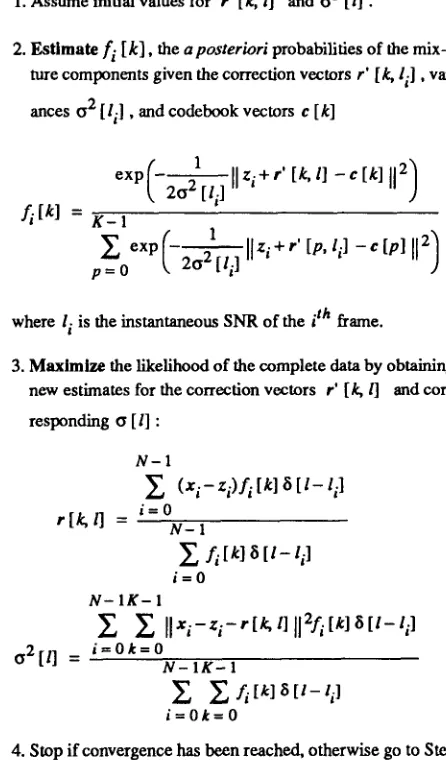
In [4] it is shown that the solution to the EM algorithm is the following iterative algorithm. In practice, convergence is reached after 2 or 3 iterations if we choose the initial val- ues of the correction vectors to be the ones specified by lhe SDCN algorithm.
1. Assume initial values for r' [k, l] and 02 [l] .
2. Estimate fi [k], the aposteriori probabilities of the mix- ture components given the correction vectors r' [k, li], vari- ances 02 [li], and codebook vectors c [k]
exp I" 1 202 [ l i] ~ [ k ] = r - ~
exp(- 1 p = 0 202 [li]
- - - I l z i +
r' [k,/]
- c [ k ]I12)
- - - I I zi + ,' tp, li] - c [p]
II
2)where I i is the instantaneous SNR of the i th frame.
3. Maximize the likelihood of the complete data by obtaining new estimates for the correction vectors r' [k, l] and cor- responding o [ l] :
N-1
(x i-
zi)f i
[k] ~ i t - til i = 0r[k, l] = N - I
E f i [ k] ~i [ l - li] i = 0
N - I K - I
E E Ilxi-zi-'t~OllZfitk]Stl-ll ]
o2[l] = i = 0 k = 0 N - I K - I
E E J~[k]S[t-li]
i = O k = O
4. Stop if convergence has been reached, otherwise go to Step 2.
[image:2.612.332.555.55.435.2]•
25 k~ 2 0 ~ SNR=29dB
i
10" $! I I !
0 0.00 0.25 0.50 0.75 1.00
Normalized Warped Frequency
~25r
20 SNR = 5 dB
~ lO
11
, , , ,
;t
0.00 0.25 0.50 0.75 1.00Normalized Warped Frequency
~25["
SNR = 0 dB
O ~ 0.25 0.50 O. 75 1.00
Normalized Warped Frequency
[image:3.612.67.299.47.486.2]-5
Figure
1: Comparison of compensation vectors using the FCDCN method with the PCC-160 unidirectional desktop microphone, at three different signal-to-noise ratios. The maximum SNR used by the FCDCN algorithm is 29 dB.The computational complexity of the FCDCN algorithm is very low because the correction vectors are precomputed. However, FCDCN does require simultaneously-recorded data from the training and testing environments. In previous studies [6] we found that the FCDCN algorithm provided a level of recognition accuracy that exceeded what was obtained with all other algorithms, including CDCN.
MFCDCN. Multiple fixed codeword-dependent cepstral normalization (MFCDCN) is a simple extension to the FCDCN algorithm, with the goal of exploiting the simplic- ity and effectiveness of FCDCN but without the need for environment-specific training.
In MFCDCN, compensation vectors are precomputed in parallel for a set of target envkonments, using the FCDCN
procedure as described above. When an utterance from an unknown environment is input to the recognition system, compensation vectors computed using each of the possible target environments are applied successively, and the envi- ronment is chosen that minimizes the average residual VQ distortion over the entire utterance,
llz + r[k, l,m] - c [k] II z
where k refers to the VQ codeword, I to the SNR, and m to the target environment used to train the ensemble of com- pensation vectors. This general approach is similar in spirit to that used by the BBN speech system [13], which per- forms a classification among six groups of secondary microphones and the CLSTLK microphone to determine which of seven sets of phonetic models should be used to process speech from unknown environments.
The success of MFCDCN depends on the availability of training data with stereo pairs of speech recorded from the training environment and from a variety of possible target environments, and on the extent to which the environments in the training data are representative of what is actually encountered in testing.
IMFCDCN. While environment selection for the compen- sation vectors of MFCDCN is generally performed on an utterance-by-utterance basis, the probability of a correct selection can be improved by allowing the classification process to make use of cepstral vectors from previous utter- ances in a given session as well. We refer to this type of unsupervised incremental adaptation as Incremental Multi- ple Fixed Codeword-Dependent Cepstral Normalization
OMFCDCN).
CDCN. One of the best known compensation algorithms developed at CMU is Codeword-Dependent Cepstral Nor- malization (CDCN) [2,4]. CDCN uses EM techniques to compute ML estimates of the parameters characterizing the contributions of additive noise and linear filtering that when applied in inverse fashion to the cepstra of an incoming utterance produce an ensemble of cepstral coefficients that best match (in the ML sense) the cepstral coefficients of the incoming speech in the testing environment to the locations of VQ codewords in the training environment.
than an algorithm closely related to SDCN, but this experi- ment has not yet been repeated for FCDCN.
2.2. Cepstral Filtering Techniques
In this :section we describe two extremely simple tech- niques, RASTA and cepstral mean normalization, which can achieve a considerable amount of environmental robusmess at almost negligible cost.
RASTA. In RASTA filtering [10], a high-pass filter is applied to a log-spectral representation of speech such as the cepstral coefficients. The SRI DECIPHER TM system,
for example, uses the highpass filter described by the differ- ence equation
y [ n ] = x [ n ] - x [ n - 1] + 0 . 9 7 y [ n - 1]
where x [n] and y [n] are the time-varying cepstral vectors of the utterance before and after RASTA filtering, and the index n refers to the analysis frames [11].
Cepstral mean normalization. Cepstral mean normaliza- tion (CMN) is an alternate way to high-pass filter cepstral coefficients. In cepstral mean normalization the mean of the cepstral vectors is subtracted from the cepstral coefficients of that utterance on a sentence-by-sentence basis:
y [n]
N
1
=
x In]
- ~ 2 . ,x [n]
1
n = l
where N is the total number frames in an utterance.
Figure 2 shows the low-frequency portions of the transfer functions of the RASTA and CMN filters. Both curves exhibit a deep notch at zero frequency. The shape of the CMN curve depends on the duration of the utterance, and is plotted in Figure 2 for the average duration in the DARPA Wall Street Journal task, 7 seconds. The Nyquist frequency for the time-varying cepstral vectors is 50 frames per sec- ond.
Algorithms like RASTA and CMN compensate for the effects of unknown linear filtering because linear filters pro- duce a static compensation vector in the cepstral domain that is the average difference between the cepstra of speech in the training and testing environments. Because the RASTA and CMN filters are highpass, they force the aver- age values of cepstral coefficients to be zero in both the training and testing domains. Nevertheless, neither CMN nor RASTA can compensate directly for the combined effects of additive noise and linear filtering. It is seen in Figure 1 that the compensation vectors that maximize the
likelihood of the data vary as a function of the S N R of indi-
vidual frames of the utterance. Hence w e expect compensa-
tion algorithms like M F C D C N (which incorporate this
knowledge) to be m o r e effective than R A S T A or C M N
(which do not).
~ I0"
-10 "
~ 2 0 ~
-30" -40"
/ CMN
, . ' ~ 2 4 6 8
\
Cepstral Frequency (Frames/sec) RASTAFigure 2: Comparison of the frequency response of the highpass cepstral filters implemented by the RASTA algo- rithm as used by SRI (dotted curve), and as implied by CMN (solid curve). The CMN curve assumes an utterance duration of 7 seconds.
3. E X P E R I M E N T A L R E S U L T S
In this section we describe the ability of the various envi- ronmental compensation algorithms to improve the recogni- tion accuracy obtained with speech from unknown or degraded microphones.
The environmental compensation algorithms were evalu- ated using the SPHINX-II recognition system [12] in the context of the November, 1992, evaluations of continuous speech recognition systems using a 5000-word closed- vocabulary task consisting of dictation of sentences from the Wall Street Journal. A component of that evaluation involved utterances from a set of unknown "secondary" microphones, including desktop microphones, telephone handsets and speakerphones, stand-mounted microphones, and lapel-mounted microphones.
3.1. Results from November CSR Evaluations
We describe in this section results of evaluations of the MFCDCN and CDCN algorithms using speech from sec- ondary microphones in the November, 1992, CSR evalua- tions.
pronunciations in the recognition
dictionary.
The effect of these computational shortcuts was to increase the baseline error rate for the 5000-word task from 6.9% as reported in [12] to 8.1% for the MFCDCN evaluation, and to 8.4% for the CDCN evaluation.~50
20
10
o
MFCDCN ALGORITHM
Secondary
rniceophone
%
CLSTLK
microphone
D [ ]
! I
No Processing MFCDCN
~50
20
10
( ~ CDCN ALGORITHM
Secondary
~. ~ microphones CLSTLK
microphone
[ ] o
i i
0 No Processing CDCN
Figure 3: Performance of the MFCDCN algorithm (upper panel) and the CDCN algorithm (lower panel) on the offi- cial DARPA CSR evaluations of November, 1992
Figure 3 summarizes the results obtained in the official November, 1992, evaluations. For these experiments, the MFCDCN algorithm was trained
using
the 15 environments in the training set and developmental test set for this evalua- tion. It is seen that both the CDCN and MFCDCN algo- rithms significantly improve the recognition accuracy obtained with the secondary microphones, with little or no loss in performance when applied to speech from the clos- etalking Sennheiser HMD-414 (CLSTLK) microphone. The small degradation in recognition accuracy observed for speech from the CLSTLK microphone using the MFCDCN algorithm may be at least in part a consequence of errors in selecting the environment for the compensation vectors. Environment-classification errors occurred on 48.8% of the CLSTLK utterances and on 28.5% of the utterances from secondary microphone. In the case of the secondary micro- phones, however, recognition accuracy was no better using the FCDCN algorithm which presumes knowledge of the correct environment, so confusions appear to have taken place primarily between acoustically-similar environments.In a later study we repeated the evaluation using MFCDCN compensation vectors obtained using only the seven catego-
ries of microphones suggested by BBN rather than the orig- inal 15 environments. This simplification produced only a modest increase in error rate for speech from secondary microphones (from 17.7% to 18.9%) and actually improved the error rate for speech from the CLSTLK microphone (from 9.4% to 8.3%).
Figure 4 summarizes the results of a series of (unofficial) experiments run on the same data that explore the interac- tion between MFCDCN and the various cepstral filtering techniques. The vertical dotted line identifies the system described in [12].
"
2O
10
0
CLSTLK microphone
CSR BASELINE EVALUATION SYSTEM
0 "
microphones
" 0 " - " 0
I I I I I
[image:5.612.66.289.62.382.2]No RASTA CMN CMN and CMN and Processing MFCDCN IMFCDCN
Figure 4: Comparison of the effects of MFCDCN, IMFCDCN, cepstral mean normalization (CMN), and the RASTA algorithm on recognition accuracy of the Sen- nbeiser HMD-414 microphone (solid curve) and the second ary microphones (dashed curve), from the November 1992 DARPA CSR evaluation data.
It can be seen in Figure 4 that RASTA filtering provides only a modest improvement in errors using secondary microphones, and degrades speech from the CLSTLK microphone. CMN, on the other hand, provides almost as much improvement in recognition accuracy as MFCDCN, without degrading speech from the CLSTLK microphone. We do not yet know why our results using CMN are so much better than the results obtained using RASTA. In con- trast, Schwartz et al. obtained approximately comparable results using these two procedures [13].
Finally, adding MFCDCN to CMN improves the error rate from 21.4% to 16.2%, and the use of IMFCDCN provides a further reduction in error rate to 16.0% for this task.
3.2. Results from the "Stress Test" Evaluation
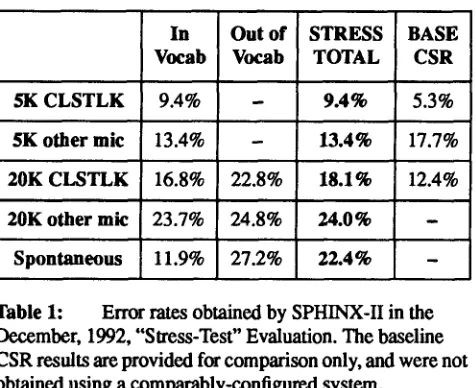
[image:5.612.327.564.112.329.2]The version of SPHINX-II used for this evaluation was con- figured to maximize the robustness of the recognition pro- cess. It was t r a i n e d on 13,000 s p e a k e r - i n d e p e n d e n t utterances from the Wall Street Journal task and 14,000 utterances of spontaneous speech from the ATIS travel planning domain. The trigram grammar for the system was derived from 70.0 million words of text without verbalized punctuation and 11.6 million words with verbalized punctu- ation. Two parallel versions of the SPHINX-II system were run, with and without IMFCDCN. Results obtained are summarized in the Table I below.
In Out o f STRESS BASE
Vocab Vocab TOTAL CSR
b'K C L S T L K 9.4% - 9.4% 5.3% 5K other mie 13.4% - 13.4% 17.7%
20K C L S T L K 16.8% 22.8% 18.1% 12.4%
20K other mic 23.7% 24.8% 24.0% -
Spontaneous [11.9% 27.2% 22.4% -
Table 1: Error rates obtained by SPHINX-II in the
December, 1992, "Stress-Test" Evaluation. The baseline CSR results are provided fox comparison only, and were not obtained using a comparably-configured system.
We also compared these results with the performance of the baseline SPHINX-H system on the same data. The baseline
system achieved a word error rate of 22.9% using only the bigram language model. Adding IMFCDCN reduced the error rate only to 22.7%, compared to 20.8% for the stress- t e s t s y s t e m u s i n g I M F C D C N . We b e l i e v e t h a t the IMFCDCN algoxithm provided only a small benefit because only a small percentage o f data in this test was from sec- ondary microphones.
In general, we are very encouraged by these results, which are as good or better than the best results obtained only one year ago under highly controlled conditions. We believe that the stress-test protocol is a good paradigm for future evaluations.
ACKNOWLEDGMENTS
This research was sponsored by the Department of the Navy, Naval Research Laboratory, under Grant No. N00014-93-2005. The views and conclusions contained in this document are those of the authors and should not be interpreted as representing the official policies, either expressed or implied, of the U.S. Govern- ment. We thank Raj Reddy and the rest of the speech group for their contributions to this work.
2.
3.
4.
5.
6.
7.
8.
9.
10.
11.
12.
13.
REFERENCES
Juang, B. H. "Speech Recognition in Adverse Environ- ments". Comp. Speech and Lang. 5:275-294, 1991. Acero, A. and Stern, R. M. "Environmental Robusmess in Automatic Speech Recognition". ICASSP-90, pages 849- 852. April, 1990.
Erell, A. and Weintranb, M. Estimation "Using Log-Spec- tral-Distance Criterion for Noise-Robust Speech Recogni- tion". ICASSP-90, pages 853-856. April, 1990.
Acerro, A. Acoustical and Environmental Robustness in Automatic Speech Recognition. Kluwer Academic Publish- ers, Boston, MA, 1993.
Liu, E-H., Acero, A., and Stern, R. M. "Efficient Joint Compensation of Speech for the Effects of Additive Noise end Linear Filtering". ICASSP-92, pages 865-868. March, 1992.
Acero, A. and Stern, R. M. "Robust Speech Recognition by Normalization of the Acoustic Space". ICASSP-91, pages
893-896. May, 1991.
Stockham, T. G., Cannon, T. M,. end Ingebretsen, R. B. "Blind Deconvolution Through Digital Signal Processing".
Proc. IEEE. 63:678-692, 1975.
Boll, S. E "Suppression of Acoustic Noise in Speech Using Spectral Subtraction". IEEE Trans. Acoust. Speech. and Sig. Proc. 2:113-120, 1979.
Davis, S.B, Mermelstein, P. "Comparison of Parametric Representations of Monosyllabic Word Recognition in Continuously Spoken Sentences'; IEEE Trans. Acoust. Speech. and Sig. Proc. 28:357-366, 1980.
Hermansky, H., Morgan, N., Bayya, A., Kohn, E "RASTA- PLP Speech Analysis Technique". ICASSP-92, pages 121- 124. March, 1992
Murveit, H., Weintraub, M. "Speaker-Independent Con- nected-Speech Recognition Using Hidden Markov Mod- els". Proc. DARPA Speech and Natural Language Workshop. February, 1992.
Huang, X.,Alleva, E, Hweng. M.-Y., Rosenfeld, R. "An Overview of the SPHINX-II Speech Recognition System".
Proc. DARPA Human Language Technology Workshop.
March, 1993.
[image:6.612.60.298.173.367.2]