Knowledge-Binding Commitments with Applications in
Time-Stamping
(Full Version)
⋆Ahto Buldas1,2,3,⋆⋆and Sven Laur4,⋆ ⋆ ⋆ 1
Cybernetica AS, Akadeemia tee 21, 12618 Tallinn, Estonia. 2
Tallinn University of Technology, Raja 15, 12618 Tallinn, Estonia. 3
University of Tartu, Liivi 2, 50409 Tartu, [email protected] 4
Helsinki University of Technology, Laboratory for Theoretical Computer Science, P.O.Box 5400, FI-02015 TKK, [email protected]
Abstract. We prove in a non-black-box way that every bounded list and set
com-mitment scheme is knowledge-binding. This is a new and rather strong security condition, which makes the security definitions for time-stamping much more natural compared to the previous definitions, which assume unpredictability of adversaries. As a direct consequence, list and set commitment schemes with par-tial opening property are sufficient for secure time-stamping if the number of elements has an explicit upper boundN. On the other hand, white-box reduc-tions are in a sense strictly weaker than black-box reducreduc-tions. Therefore, we also extend and generalize the previously known reductions. The corresponding new reductions areΘ(√N)times more efficient, which is important for global-scale time-stamping schemes whereNis very large.
1
Introduction
Commitment schemes are basic building blocks in numerous cryptographic protocols. The most important properties of commitment schemes are binding and hiding. A com-mitment is hiding if it reveals no information about the committed message and binding if it is impossible to change the committed message afterwards without detection. First such schemes for committing a single bit were proposed by Blum [4] and by Bras-sard et al [5] and were proven secure under the hardness of factoring assumption. Later works have significantly improved their efficiency and weakened the underlying com-plexity theoretic assumptions, see [14, 10] for further references. Here, we study the so called partially releasable commitments, in which one can compute a commitment (also called digest) for a listX = (x1, . . . , xN)of bit-strings, so that it is possible to partially open the commitment for everyxi ∈Xwithout disclosing the other elements ofX. For openingxi it is sufficient to present a decommitment stringsi (also called
⋆
This is the full version of a paper published in PKC 2007. Compared to the shortened version, this paper contains an additional appendix (Appendix B).
⋆⋆
Partially supported by Estonian SF grant no. 6944, and by EU FP6-15964: “AEOLUS”. ⋆ ⋆ ⋆
certificate). Achieving the hiding property is somewhat trivial, as one can always add another layer of commitments. Hence, our main emphasis is on the binding property. List commitments [3, 1, 17] that are only binding are known as one-way accumulators. In particular, we analyze the security of a time-stamping protocol, where clients send their requestsx1, . . . , xN to a Time-Stamping Server (TSS) who computes the commitmentcand sends the corresponding certificatess1, . . . , sN back to the clients. Ifcis published in an authentic way then everybody can verify thatxiwas generated beforecwas published. This principle is used in practical time-stamping schemes [12] wherec is computed as the root of a hash tree. List commitment schemes were be-lieved to be exactly what one needs for such kind of time-stamping. However, Buldas et al [7] pointed out a flaw in the security proof of [12]. By giving a carefully crafted oracle separation they showed that pure collision-resistance is insufficient to prove that the hash tree time-stamping schemes [12] are secure. In other words, either there are collision-resistant functions that are still insecure for time-stamping, or the security of time-stamping schemes follows from currently unknown complexity-theoretic results. The key point of this paradoxical result is that the number of committed elements is potentially unbounded. In Sec. 4, we prove that all list and set commitments, where the cardinality ofXhas an explicit bound|X| ≤ N, are suitable for time-stamping. The proof is given in the exact security framework and isΘ(√N)times more efficient than the previous reduction [7]. This improvement is especially valuable for global-scale time-stamping schemes in whichN is very large.
In Sec. 5, we show that all binding bounded list and set commitments are knowledge-binding. This is a new and extremely strong security requirement inspired from the se-curity of time-stamping schemes. Its strength is comparable to the plaintext awareness property, which is defined for public key encryption. The knowledge-binding property is also much more intuitive requirement for time-stamping schemes than the previous ones [7, 9], which use unpredictable probability distributions to model the stream of “new documents” sent to a TSS. Roughly, the knowledge-binding property states that for every efficient TSS, it is possible (by observing the commitment procedure) to effi-ciently extract the listXof all documents that can be opened by the TSS in the future. The dedicated extractor must know only the internal coin tosses of TSS and some pub-lic parameters. Consequently, even if the TSS is mapub-licious, it must know the whole list Xbefore the corresponding commitment is published. This allows to prove the security in the classical ideal vs real world comparison framework [11, pp.622–631,697–700].
constructingA′fromA. In this sense, Theorems 1–4 give substantially stronger security guarantees for a fixed hash function (e.g. SHA-1) than Theorems 5 and 6.
In Sec. 6, we briefly discuss about other possible applications of knowledge-binding such as distributed and fine-grained time-stamping.
Some of the details of this work have been omitted because of space limitations. The missing details will be published in the IACR ePrint Archive.
2
Preliminaries and Notation
We use a non-uniform model of computations, where each algorithmAis specified as an input of a universal multi-tape Turing machineUthat first copies the code ofAto its working-tape and then starts to interpret it.Ais at-time algorithm ifUperforms at mosttelementary operations to interpret the code ofAindependent of the input ofA.
By x ← D we mean that xis chosen randomly according to a distribution D. In particular, ifA is an algorithm, then x ← A(y)means that xis chosen accord-ing to the output distribution of A on an input y. Finite sets are identified with the corresponding uniform distributions, e.g.,x ← {0,1}ℓ means thatxis a uniformly chosen ℓ-bit string. If D1, . . . ,Dm are distributions and F(x1, . . . , xm) is a predi-cate, thenPr [x1← D1, . . . , xm← Dm:F(x1, . . . , xm)]denotes the probability that
F(x1, . . . , xm)is true after the ordered assignment ofx1, . . . , xm.
By a cryptographic primitivePwe mean a set of computable functions associated with the advantage functionAdvP(·), such that for every adversarial algorithmA, the advantageAdvP(A)is a positive real number. Mostly,AdvP(A)is defined as the non-trivial success (scaled probability) in certain gamesecthat captures the desired prop-erties ofP. A primitivePis said to be(t, ε)-secure in terms ofsecifAdvsec
P(A)≤ε for everyt-time adversaryA. For example, by a(t, ε)-secure collision-resistant hash function we mean a pairH = (Gen, h)of algorithms such that if pk ← Gen is an arbitrary output of the generation function thenh(pk,·) = hpk(·)is a function of type
{0,1}ℓ
→ {0,1}mwhereℓ > m; and for everyt-time adversaryA:
Advcoll
H (A) = Pr [pk←Gen,(x1, x2)←A(pk) :x16=x2∧hpk(x1) =hpk(x2)]≤ε .
Time-success ratio. Quite often it is suitable for adversaries to find a trade-off between
plausible attacking-timetand the corresponding advantageε(t)againstP. If the min-imum time-success ratio forPisαP, thenε(t)≤ αtP by definition. Often, we cannot
estimate anything else aboutPthanαP. Now, any black- or white-box reduction intro-duces a change ratioγ = α1
α0 whereα0is the time-success ratio of the basic primitive andα1is the ratio of the derived primitive, i.e., we have established a new approximate boundε1(t)≤γαt0. Therefore, large values ofγprovide better approximating bounds.
Sampling bounds. Our proofs use several standard statistical bounds. LetX1, . . . , Xm be identically distributed independent zero-one random variables withµ= Pr [Xi = 1] and letX =Pm
i=1Xi. Then for any0≤θ≤1the Chernoff bounds [13]
We also need a Birthday bound to determine the collision probability. LetY1, . . . , Ymbe identically but arbitrarily distributed independent random variables with possible values {1, . . . , N}. Then the probabilitypthat allYi-s are different satisfiesp≤e−
m(m
−1) 2N . In
particular, ifm≥1.5√NandN ≥9thenp≤ 1 2.
3
Partially Releasable Commitment Schemes
Set and list commitments. Most commitment schemes forℓ-bit strings facilitate only complete disclosure of the committed input. In the context of time-stamping, the com-plete input can be several gigabytes long whereas we actually need to disclose only a few hundred bits. Therefore, we study commitment schemes that facilitate partial dis-closure of inputs. List commitments are order-preserving: committed strings are ordered tuples. Set commitments in turn do not provide any ordering. Like ordinary commit-ment schemes, these commitcommit-ments are specified by four basic algorithms:Gen,Com, CertandVer. Initialization algorithmGen generates public parameterspk. Elements
(m1, . . . , mn)are committed by computing(c, d)←Compk(m1, . . . , mn), where the commitmentcis sent to the receiver anddis kept by the sender for later use. To prove thatmiwas indeed used to compute the commitmentc, the sender generates a certifi-cate5s
←Certpk(d, mi)the validity of which can be tested with theVeralgorithm. The commitment scheme is functional if for any(c, d)←Compk(m1, . . . , mn)and
s←Certpk(d, mi), the verification resultVerpk(c, n, mi, s) =truewith overwhelming probability. For list commitments, the certificatescontains also the exact locationiof the decommitted element, denoted asloc(s) =i. We explicitly assume that a decom-mitment certificate for a setX={x1, . . . , xr}is a union of the corresponding element certificatess1, . . . , srdenoted bys1∪. . .∪sr. Consequently, certificates can be freely joined together and split into sub-certificates. For many commitment schemes such lists can further be compressed but this is only an implementation detail.
We omit the formal definition of the hiding property, since we study only the fea-tures related to the binding property. The binding property is different for set and list commitments. For list commitments, the binding property is violated if an adversary can open thei-th element in two different ways:
Advbind(A) = Pr
pk←Gen, (c, n, x0, s0, x1, s1)←A(pk) :
x06=x1∧loc(s0) =loc(s1)
∧Verpk(c, n, x0, s0) =Verpk(c, n, x1, s1) =true
, (1)
where the probability is taken over the coin tosses of all relevant algorithms. Since certificates are closed under union and there is no ordering for set commitments, the only way to misbehave is to exceed the size ofX:
Advbind(A) = Pr
"
pk←Gen, (c, n,X, s)←A(pk) : Verpk(c, n,X, s) =true∧ |X|> n #
, (2)
5To be precise,Certshould return a vector of certificates for each location ofm
whereVerpk(c, n,X, s)first splitsXandsinto components and then verifies each
com-ponentxi ∈ Xseparately by using the corresponding component-certificatesi ∈ s. We say that the commitment scheme is (τ, ε)-binding if for all τ-time adversaries
Advbind(A)≤ε. For unbounded adversaries, we speak about statisticalε-binding. Note that set and list commitments must explicitly specify the numbernof the committed elements. Indeed, if the certificates do not reveal the size of the commitment, a malicious adversary can just hide some committed elements and receivers can never be sure if the commitment is fully opened. A commitment scheme is N-bounded if Verpk(c, n, x, s) =falsefor alln > N.
List commitment schemes that satisfy only the binding properties are known as one-way accumulators [1, 3, 17]. One-one-way accumulators that in addition to positive state-mentsx ∈ Xalso allow to (compactly) prove negative statementsx 6∈ Xare called undeniable attesters [6]. The commonly used binding requirement for one-way accu-mulators isn-times collision-freeness [1], which is equivalent to the binding property of set commitments.
Time-stamping schemes. Time-stamping protocols process documents in batchesX1, X2,X3, . . .that we call rounds. The rounds correspond to time periods of fixed duration (one hour, one day, etc.) After thei-th period, a short commitmentciof the correspond-ing batchXiis published. A documentx∈Xiprecedes documenty, if there isj >0 such thaty∈Xi+j. Obviously, for a fixed commitmentcithere must be an efficient way to prove thatx∈Xi. However, for documentsy6∈Xisuch proofs must be infeasible to create. Note thatcican be viewed as a classical set or list commitment to the setXiand the corresponding proof ofx∈Xi as a certificate. Therefore, time-stamping schemes share the same functionality and algorithmic description as the set and list commitment schemes. Such a structural similarity is indeed remarkable. Still, careful studies of the security requirements reveal considerable differences between time-stamping and com-mitment schemes. Different security definitions exist for time-stamping schemes [7–9, 12]. In this paper, we adapt the strongest6 definition [9] for the non-uniform precise
security framework with minor modifications in notations.
Formal definitions of time-stamping schemes do not require thatnis explicitly given as an argument to the verification algorithmVer, but negative results in [7] suggest that time-stamping schemes (at least those without additional third parties) must be bounded, i.e.,nhas to be at least implicitly specified.
Intuitively, time-stamping schemes must be secure against “back-dating” and this it-self raises a subtle issue: How to model the future? Most works [7–9] have taken an ap-proach based on computational entropy. Document generation is modeled as an efficient randomized procedure and the security guarantees are given for document distributions with high enough computational entropy. More formally, an adversaryA= (A1,A2)is
(τ, δ)-unpredictable if for everyτ-time predictorΠ:
AdvuprA (Π) = Pr
"
ω1←Ω,pk←Gen,xˆ←Π(pk, ω1),
(c, n, φ)←A1(pk;ω1),(x, s)←A2(φ) : ˆx=x
#
≤δ ,
6
whereω1 denotes the random coins ofA1 and the probability is taken over the coin tosses of all relevant algorithms. The second stageA2of the adversary models an effi-cient document generation (back-dating) procedure.
Definition 1 (Entropy based security). A time-stamping scheme is(t, τ, δ, ε)-secure if for every(τ, δ)-unpredictablet-timeA:
Advts(
A) = Pr
"
ω1←Ω,pk←Gen,(c, n, φ)←A1(pk;ω1),
(x, s)←A2(φ) :Verpk(c, n, x, s) =true #
≤ε . (3)
Here,δquantifies a trivial advantage. Indeed, consider the next adversaryA= (A1,A2):
– A1(pk;ω1)computes(c, d) ← Compk(ˆx)and the corresponding valid certificate s←Certpk(c,xˆ)and outputs a tuple(c,1,(ˆx, s)).
– A2(ˆx, s)generates a randomxso thatx= ˆxwith probabilityδ, and outputs(x, s). For everyτthe adversaryAis(τ, δ)-unpredictable. However, no matter how the time-stamping scheme is defined, the advantageAdvts(
A) ofAis at least δ. Hence, it is reasonable to assume thatδ≪ε. Moreover, aslog1
δ is an upper bound for the compu-tational R´enyi entropy, we implicitly assume that the compucompu-tational Shannon entropy of the future documents is at leastlog1
δ w.r.t. the time-boundτ.
The biggest drawback of the entropy based definition is non-uniformity. The se-curity definition is natural in the polynomial model but has some flaws when adapted to the exact model. It only offers protection against (τ, δ)-unpredictable adversaries! Hence, it does not exclude extremely successful adversaries that are just not quite so unpredictable. In theory, a time-stamping scheme could be protected against (τ, δ) -unpredictable adversaries but still be totally insecure against(τ, δ+δ100)-unpredictable adversaries. This flaw can be fixed by requiring strong uniformity in the definition:
Definition 2 (Black-box security). A time-stamping scheme is(t, τ, ε)-secure if there exists aτ-time black-box extractor machineKsuch that for everyt-timeA:
Advts(A) = Pr
ω1←Ω,pk←Gen,Xˆ ←KA(pk;ω1,·)(pk),
(c, n, φ)←A1(pk;ω1), (x, s)←A2(φ) :
(Verpk(c, n, x, s) =true∧x6∈Xˆ)∨ |Xˆ|> n
≤ε , (4)
whereω1denotes random coins ofA1andKgets a black-box access toA1(pk;ω1)and A2(φ;·). The working time ofKA(pk;ω1,·)includes the time needed to execute all oracle calls. For list commitments, we treatXˆ as a list and writex∈Xˆ iffx= ˆX[loc(s)].
Intuitively, we state that malicious time-stamping servers cannot issue valid cer-tificates for unknown documents, as there exists a well known algorithmKA(pk;ω1,·) for efficiently reconstructing the list of all valid documentsXˆ. This algorithm can be automatically constructed for everyt-time adversary.
It is straightforward to see that (t, τ, ε)-secure time-stamping scheme is always
we prove that every bindingN-bounded list commitment scheme is also a secure time-stamping scheme. Still, there are quantitative differences between these two notions.
Practical constructions based on hash trees. Merkle trees [15] and count-certified
hash trees [16] (described below) constructed from collision-resistant hash functions are binding but not hiding even if the hash function is modeled as a random oracle—a release of an element (a leaf node) also reveals one neighboring element (the sibling leaf node). Nevertheless, if we use Merkle trees to compute a short commitment from hiding and binding commitments, we get binding and hiding list and set commitments.
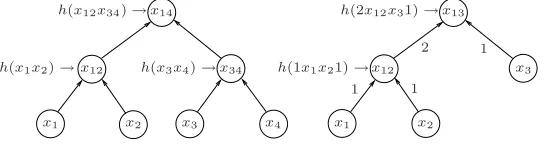
x1 x2 x3 x4
x12
x14
x34 h(x1x2)→
h(x12x34)→
h(x3x4)→
x1 x2
x12 x3
1
1 2
1 h(1x1x21)→
h(2x12x31)→x13
Fig. 1. Merkle hash tree for{x1, x2, x3, x4}and a count-certified hash tree for{x1, x2, x3}.
A Merkle hash tree for a listXis a binary tree the leaves of which are the elements of Xand each non-leaf node is a hash of its two children (Fig. 1, left). Nodes with a single child can be avoided. Hence, every non-leaf node is assumed to have two children.
A count-certified hash tree (Fig. 1, right) is a binary tree which is similar to a Merkle tree, except that its arcs are labeled with counters each of which equal to the number of leaves in the corresponding subtree. Each non-leaf vertexv is a hashh(nLxLxRnR), wherenLandnRare the counters of the left- and the right subtree respectively. The countercof the unique outgoing arc ofvis the sumnv =nL+nR.
Each hash tree can be represented as a commitment function(c,X)←Compk(X), wherec is the root hash value of the corresponding tree and pk denotes the public parameters associated with the collision-resistant hash function h. By the certificate Certpk(X, xi)forxi∈Xwe mean the smallest amount of data needed to recompute the root hash value. For example, in the Merkle hash tree (Fig. 1, left) the certificates2for
x2iss2= ((x1, ),(, x34))which represents a sequence of hashing steps starting from the leafx2and ending with the root hash value, whereas denotes an empty slot which during the verification is filled with the hash of the previous pair. Similarly, in the count-certified hash tree (Fig. 1, right) the certificate forx2iss2= ((1, x1, ,1),(2, , x3,1)). The verification functionVerpk(c, n, x, s)simply recomputes the root hash value by
us-ingsand compares it withc. It also checks whethern≤N. The verification algorithm for count-certified trees also recomputes the intermediate counter values to verify the certificates, in particular if the counter of the root vertex isn.
Collision-Extraction Property. For hash trees with a fixed shape and count-certified
1. ExecuteA1in a black-box way and store(c, n, φ)←A1(pk;ω1).
2. Generatemindependent samples(x1, s1)←A2(φ), . . . ,(xm, sm)←A2(φ). 3. Output(c, n)and a set of valid pairsV={(xi, si) :Verpk(c, n, xi, si) =true}.
Fig. 2. Black-box certificate extractorKA
cert(m).
Verpk(c, n, x1, s1) = true, andloc(s0) = loc(s1), then the internalh-calls of these two verifications comprise a collision forh. Moreover, if the tree is balanced, then the collision can be extracted inO(|s0|+|s1|) =O(log2N)time.
4
Bounded Commitments are Sufficient for Time-Stamping
In this section, we prove that bounded commitment schemes with partial opening are sufficient to construct secure time-stamping schemes. The new security reductions use a simple black-box certificate extractor (Fig. 2) and in the proofs we just show that a big enough set of valid decommitmentsVallows to break the binding property.
Our proofs do not only generalize the existing ones [7] but are also more efficient. Presented theorems together with the previous separation results [7, 9] provide a clear border between the well studied classical binding properties like collision-freeness and the properties needed for time-stamping. For bounded commitment schemes the binding property implies time-stamping security. Otherwise, these notions are independent— binding properties are not necessary [9] nor sufficient [7].
To clarify the presentation, we have omitted a smallO(NlogN +t) term that counts the computational effort needed to manage the listVof valid decommitments, as the contribution to the total working time is irrelevant for all reasonable values ofε. To be absolutely precise, one has to increase the time-bounds for the binding property byO(NlogN+t)in Theorems 1–4.
Theorem 1 (Entropy based security). Every 6t √
N ε ,
ε 8
-binding andN-bounded list
commitment scheme is also a t, t,432ε3·N, ε
-secure time-stamping scheme forN ≥9.
Proof. Let A = (A1,A2)be at-time adversary that violates t, t, ε3 432·N, ε
-security promise, i.e.,Advts(A)≥εandA2is sufficiently unpredictable (even for itself):
Pr [Coll] := Pr
"
pk←Gen,(c, n, φ)←A1(pk;ω),
(x0, s0)←A2(φ),(x1, s1)←A2(φ) :x0=x1
#
≤ ε
3
432N .
Ifm = 6√N
ε then the black-box certificate extractorK
A
cert(m)runs in time 6t
√
N ε and provides enough certificates to reveal a double opening. LetColl∗denote that two equal messagesxi=xjare produced internally byKAcert(m). Then by the union bound
Pr [Coll∗]≤ X
pk,ω1
Pr [pk, ω1]·
m(m−1)
2 ·Pr [Coll|pk, ω1]
≤ m(m2−1) ·Pr [Coll]≤ m 2
2 ·
ε3
432N ≤ ε
Next, we estimate the number of valid document-certificate pairs created byKA
cert(m). Letεpk,ω1 = Adv
ts(
A|pk, ω1)denote the probability thatAis successful for fixedpk andω1. AsPrpk←Gen, ω1←Ω:εpk,ω1≥
ε 2
≥ ε
2, we apply the Chernoff bound for these(pk, ω1)pairs withθ= 12 andXiindicating(xi, si)∈V, and get
Pr [|V| ≤1.5√N|εpk,ω 1≥
ε 2]≤e−
3√N
8 <1/3 .
SinceVconsists of identically distributed independent variables, we apply the Birthday bound. If|V| ≥1.5√Nthenloc(si) =loc(sj)for somei, jwith probability> 1
2. Let Cbe an adversary that runsKA
cert(m)and then tries to find a double opening inV. Then
Advbind(C)≥2ε·1−e−3
√N 8
·12 −Pr [Coll∗]> ε
6−
ε
24 =
ε
8
forN ≥9and we have obtained a desired contradiction. ⊓⊔
Theorem 2 (Entropy based security). Every 4N tε ,ε8
-binding and N-bounded set
commitment scheme is a t, t,64Nε32, ε
-secure time-stamping scheme forN ≥6.
Proof. Similarly to the previous proof, letA = (A1,A2)be a t-time adversary that violates a t, t,64Nε32, ε
-time-stamping security promise. In other words,Advts(A)≥
ε andPr [Coll] ≤ ε3
64(N+1)2. Fix m = 4N
ε . Then the black-box certificate extractor C:=KA
cert(m)then runs in time 4N tε . The Chernoff bound withθ= 1 2yields
Pr
|V| ≤N|εpk,ω1≥ ε 2
≤e−N4 <1/2 .
Again,Pr
pk←Gen, ω1←Ω:εpk;ω≥ε2 ≥ ε2 and we have obtained a contradic-tion:Advbind(C)≥ ε
2 ·
1−e−N4
−Pr [Coll∗]> ε4−m2 2 ·
ε3 64N2 =
ε
8. ⊓⊔
Theorem 3 (Uniform security). Every(2N t ε ,
ε
2)-binding andN-bounded list commit-ment scheme is also(t,2N tε , ε)-black-box secure time-stamping scheme.
Proof. For the proof we have to fix a canonical black-box extractor machineKA:
1. First runA1and store(c, n, φ)←A1(pk;ω1)and setXˆ[i] =⊥fori∈ {1, . . . , n}. 2. Fixm=2Nε and fork∈ {1, . . . , m}do
– Compute an independent sample(xk, sk)←A2(φ).
– IfVerpk(c, n, xk, sk) =trueandXˆ[loc(sk)] =⊥then setXˆ[loc(sk)] =xk. 3. Output the last snapshot ofXˆ.
Clearly, for everyt-time adversaryA= (A1,A2), the extraction algorithmKAruns in
time2N tε and the extractorKis valid for the definition.
For the sake of contradiction, assume that at-time adversaryA= (A1,A2)violates the security promise (4) w.r.t.K. Let a pair(xk, sk)be revealing ifxk6= ˆX[loc(sk)]in Step 2 ofKA. Then the probability that(x
KA. LetX
k be the corresponding zero-one indicator variable, i.e.,Xk = 1if(xk, sk) is revealing. Thenεk=E[Xk]> εand the average ofSm=Pmk=1Xkis
E[Sm] =E[X1+· · ·+Xm] =ε1+· · ·εm> mε= 2N .
On the other hand, E[Sm] ≤ N + Pr [Sm> N]· 2Nε and thusPr [Sm> N] > 2ε. Therefore, with probability strictly more than2εthere areN+ 1revealing pairs(xk, sk) computed byKA. As the commitment scheme isN-bounded, revealing pairs exist only
ifn≤N. Hence, at least one slot must be overwritten if there areN+ 1revealing pairs and we have found a double opening with probability strictly more than ε2. ⊓⊔
Theorem 4 (Uniform security guarantee). Every(2N tε ,2ε)-bindingN-bounded set commitment scheme is also(t,2N tε , ε)-black-box secure time-stamping scheme. Proof. The construction given above is also valid for set commitments. ⊓⊔
Comparison with previous results. Our reductions are not completely novel. A similar
proof with a different reduction was given in [7] for hash trees. Therefore, we compare the time-success ratios. Recall that the minimal time-success ratioαimpliesε(t)≤ t
α and hence large ratiosγ= α1
α0 lead to better security bounds.
In Thm. 1 we constructed a double opener with running timet0≈ 6t
√
N
ε and with advantageε0 ≈ ε8, based on a back-dating adversary with running timetand advan-tageε. Thus the change ratio isγ≈ ε
48√N for our reduction. If we adapt the reduction presented in [7] for the exact security model we obtain a ratioγ ≈ ε
2N, which is sig-nificantly smaller forN ≥600. In global-scale time-stamping services,Ncan be very large (say millions or even billions) and our new reduction by far supersedes the previ-ous one [7].
Similarly, one can verify that γ ≈ ε
4N for Thm. 3 and Thm. 4 but the security guarantees are much stronger. To break the black-box security an adversary can produce valid document-certificate pairs with low computational R´enyi entropy, which makes it impossible to use the birthday paradox. It is easy to see that the extractor must work in timeΘ(N tε )and√Nin the denominator is not achievable. See App. B for more details.
5
All Bounded Commitment Schemes are Knowledge-Binding
Definition 3. A commitment scheme is(t, τ, ε)-knowledge-binding if for everyt-time adversaryA= (A1,A2)there exist a dedicatedτ-time extractor machineKAsuch that
Advk-bind(
A) = max
adv Pr
pk←Gen, ω1←Ω, Xˆ ←KA(pk;ω1),
(c, n, φ)←A1(pk;ω1),(x, s)←A2(φ,adv) :
(Verpk(c, n, x, s) =true∧x6∈Xˆ)∨ |Xˆ|> n
≤ε ,
whereadvvaries over all advices of lengthtand the probability is taken over the coins ofGen,A1andA2. For list commitments,Xˆ is a list and writex∈Xˆ iffx= ˆX[loc(s)].
The new definition explicitly states that there exists an efficient extraction strategy KAthat is able (by observing the internal computations of the committing algorithmA1) to predict any bit-stringxthat is later ”back-dated” byA2. I.e, in some sensexalready existed before the commitment and no real back-dating attacks were performed.
But there is an even more intuitive interpretation. When an adversary publishes a commitmentc, he implicitly fixes his level of knowledge about the commitment and no future actions can change it. As the level of knowledge does not change in time, a successful opening “proves” that the adversary already “knew” the committed element when the commitment was created. Hence, we can omit proofs of knowledge at the commitment stage and reduce the number of rounds in various protocols. Thus, the new notion is very similar to plaintext-awareness of public-key encryption schemes.
Finally, note that knowledge-binding is a necessary condition for the multi-party security of time-stamping schemes. In the ideal implementation, TSS gives a listXto a trusted party who will later serve partial release queriesx∈X?Hence, there must be an efficient way to extract all documents that TSS can potentially open as a response for any future message that is independent ofpk, i.e., the extractor machineKA must exist. To get multi-party security in the malicious model, we must also protect a honest TSS against malicious clients. This can be done in an obvious way by using digital signatures, but due to the space limitations we defer the discussion to follow-up articles. Clearly, the knowledge-binding property can be established only by using white-box reductions. In other words, we cannot efficiently construct the code ofKA given only the code ofA, althoughKAitself is an efficient algorithm. Such reductions provide substantially weaker security guarantees for fixed hash functions like SHA-1, since we know a priori that efficient collision finders must exist for SHA-1. Therefore, the claims of existence without efficient construction strategies provide no new information. As a result, we can only talk about the security of hash function families, i.e., we have to consider SHA-1 as a “typical” representative of a collision-free hash function family.
The proofs consist of two main steps. First we analyze the behavior ofAand con-struct a dedicated knowledge extractor KA. Next we show that KA is efficient and
Advk-bind(A)is sufficiently small. To constructKA, we runAon all possible inputs and find suitable triggering messagesadvthat forceAto reveal most of the valid certificates. Next, we constructKAfromAand the triggering messages. As the knowledge-binding condition only requires the existence ofKA, the construction time is not an issue.
Theorem 5. For everyt >0andδ >0, there existsτ = (N
δ + 1)·O(t)such that every
Proof. Fix at-time adversaryAand consider a giant status matrixW[pk, ω1;adv, ω2] the rows of which are indexed by public keyspkand random coinsω1ofA1, whereas the columns are indexed byt-bit advicesadvand random coinsω2ofA2. Define
W[pk, ω1;adv, ω2] =
(
0, ifVerpk(c, n, x, s) =false ,
loc(s), ifVerpk(c, n, x, s) =true ,
where(c, n, φ) ← A1(pk;ω1)and(x, s) ← A2(φ,adv;ω2). Note that few columns ofWcover most of the rows containing non-zero elements. Namely, Lemma 1 from App. A assures the existence ofI =
(adv1, ω1
2), . . . ,(advk, ω2k) such that|I| ≤ Nδ and for any fixed advice-randomness pair(adv, ω2):
Pr [(pk, ω1) : 06=W[pk, ω1;adv, ω2]6∈ L[pk, ω1]∧ |L[pk, ω1]|< N]≤δ , (5)
whereL[pk, ω1] ={W[pk, ω1;adv, ω2] : (adv, ω2)∈ I}is a set of revealed locations. Now the construction7ofK
Ais evident:
1. Given(pk, ω1)store(c, n, φ)←A1(pk;ω1)and setXˆ[i] =⊥fori∈ {1, . . . , n}. 2. For each(adv, ω2)∈ Ido
– Compute(x, s)←A2(φ,adv;ω2).
– IfVerpk(c, n, x, s) =truethen setXˆ[loc(s)]←x.
3. Output the last snapshot ofXˆ.
To analyze the advantage ofKA, we fix a pair(adv, ω2). Let (c, n, φ) ← A1(pk;ω1) and(x, s) ← A2(φ,adv;ω2) as before. For valid decommitment value s, the entry
ˆ
X[loc(s)] =⊥only if|L[pk, ω1]|< N and thus the inequality (5) given above yields
Pr [(pk, ω1) :Verpk(c, n, x, s) =true∧Xˆ[loc(s)] =⊥]≤δ. Alternatively,KAcan fail
if Verpk(c, n, x, s) = true butXˆ[loc(s)] 6= x. However, we can naturally combine
A1,A2 andKA into an adversaryBthat outputs these double openings and performs
(Nδ + 1)·O(t)elementary operations. Consequently,Advbind(B)≤εand thus
Pr [(pk, ω1) :Verpk(c, n, x, s) =true∧x6= ˆX[loc(s)]6=⊥]≤ε .
As a result, we have obtained that for any pair(adv, ω2):
Pr [(pk, ω1) :Verpk(c, n, x, s) =true∧x6= ˆX[loc(s)]]≤δ+ε
and the claim follows. ⊓⊔
Theorem 6. For everyt >0andδ >0, there existsτ = (N
δ + 1)·O(t)such that every
(τ, ε)-binding set commitment scheme is(t, τ, ε+δ)-knowledge-binding.
7Note that all elements of the set
Iare hardwired as explicit constants into the code ofKA, i.e.,
KAdoes not computeI. AsKAruns on a universal Turing machine, it must rewind the code
Proof. Fix at-time adversaryAand consider a status matrixW[pk, ω1;adv, ω2]that is indexed identically to the previous proof but the entries are defined differently:
W[pk, ω1;adv, ω2] =
(
0, ifVerpk(c, n, x, s) =false , x, ifVerpk(c, n, x, s) =true ,
where (c, n, φ) ← A1(pk;ω1) and (x, s) ← A2(φ,adv;ω2). Then Lemma 1 from App. A assures the existence ofI =
(adv1, ω1
2), . . . ,(advk, ω2k) such that|I| ≤ Nδ and for every fixed advice-randomness pair(adv, ω2):
Pr [(pk, ω1) : 06=W[pk, ω1;adv, ω2]6∈ L[pk, ω1]∧ |L[pk, ω1]|< N]≤δ , (6) whereL[pk, ω1] ={W[pk, ω1;adv, ω2] : (adv, ω2)∈ I}is a set of revealed elements. Now the construction ofKAis straightforward:
1. Given(pk, ω1)store(c, n, φ)←A1(pk;ω1)and setXˆ ← ∅. 2. For each(adv, ω2)∈ Ido
– Compute(x, s)←A2(φ,adv;ω2).
– IfVerpk(c, n, x, s) =truethen addxtoXˆ.
3. Output the last snapshot ofXˆ.
To analyze the advantage ofKA, fix(adv, ω2). Let(c, n, φ)←A1(pk;ω1)and(x, s)← A2(φ,adv, ω2)as before. AsXˆ[pk, ω1] =L[pk, ω1]by the construction (see Lemma 1), the inequality (6) yieldsPr [Verpk(c, n, x, s) =true∧x /∈Xˆ ∧ |Xˆ|< n≤N]≤δ. The
extractor KA can also fail whenVerpk(c, n, x, s) = truebutx /∈ Xˆ and|Xˆ| ≥ n.
Again, we can naturally combineA1,A2andKAinto an adversaryBwith running-time
(Nδ +1)·O(t)that runs all algorithms and extracts all valid openings. Consequently, the restrictionAdvbind(B)≤εyieldsPr [Verpk(c, n, x, s) =true∧x /∈Xˆ∧ |Xˆ| ≥n]≤ε
and we have obtained that for any pair(adv, ω2):
Pr [Verpk(c, n, x, s) =true∧x /∈Xˆ]≤δ+ε
and the claim follows. ⊓⊔
Efficiency of the new reduction. Again, we compute time-success ratios to compare
the efficiency of the new white-box reduction to the previous black-box ones. To have a fair comparison we takeδ ≈ ε. Then Theorems 5 and 6 provide attacks against the binding property with parameters t0 ≈ (Nδ + 1)t andε0 = ε, provided that there exist at-time adversary achievingε+δsuccess. As a result, we obtain a change ratio
γ = α1 α0 ≈ (
N
δ + 1)−1· ε ε+δ ≈
ε
2N, which is better than the change ratioγ ≈ ε 4N provided by Thm. 3 and Thm. 4. The difference is not essential rather it comes from slightly loose success bounds in Thm. 3 and Thm. 4.
6
Applications of Knowledge-Binding Commitments
viewed as an indifference against outside advices. Similar to the plaintext-awareness, the knowledge-binding property allows one to combine commitments with other cryp-tographic primitives without a fear of unwanted interference. Such interference often makes it hard or impossible to prove the security of new constructions. If the secret or public parameters of other primitives are independent of the commitment parameters pk, then the rest of the protocol can be interpreted as an external advice. Hence, one can use the standard hybrid argument technique even if the primitives are used concurrently.
Distributed and fine-grain time-stamping. Knowledge-binding commitments give
rise to a secure time-stamping service where a central time-stamping authority (TSS) computes and publishes the round commitment(c, n)and distributes the respective cer-tificates si to the clients. But such service is susceptible to denial-of-service attacks. Hence, it is more natural to consider a distributed service wherekindependent servers compute sub-commitments(ci, ni)and at the end of the round the master commitment
(c, n)is compiled. Therefore, it is advantageous to use knowledge-binding commit-ments that facilitate fast merging of sub-commitcommit-ments and mostly local certificate com-putations. Count-certified hash trees have the following important property: every root node(ci, ni)of a hash subtree forms a correct commitment. Moreover, given two root nodes(cL, nL)and(cR, nR)it is straightforward to compute the commitment of the merged tree and update the corresponding certificates.
In a way, a set commitment scheme provides a really coarse-grain time-stamping service. It is impossible to order the events inside the roundX. List commitment pro-vides only a partial solution, as clients have to trust that the TSS orders documents cor-rectly in a single round. Tree-shaped list commitments that preserve knowledge-binding w.r.t. the root of each subtree allow also fine-grained time-stamping even if the TSS acts maliciously. Essentially, TSS has to send to a Client all root commitments(ci, ni)of all preceding computations, then the Client has strong guarantees that after submitting his query the TSS cannot insert any messages in the prefix of the list without getting caught. Hence, count-certified hash trees could be used for fine-grain time-stamping.
Non-malleable partially releasable commitments. To show that knowledge-binding
commitments have other applications outside of the domain of time-stamping, we give a construction of partially releasable non-malleable commitments form non-malleable string commitments and knowledge-binding commitments. It is just an informal exam-ple, we do not formalize the claim due to the lack of space.
Recall that a commitment scheme is non-malleable if given a commitmentc it is infeasible to construct a new commitmentc′ 6= csuch that after seeing a certificate
sforxit is infeasible to output a valid certificates′ forx′ such thatxandx′ are re-lated. LetL={c1, . . . , cn}be a list of non-malleable commitments forx1, . . . , xnand
(C, D)←Compk(L)is computed by using a knowledge-binding commitment scheme.
References
1. N. Bari´c and B. Pfitzmann. Collision-free accumulators and fail-stop signature schemes with-out trees. In Proc. of EUROCRYPT’97, LNCS 1233, pages 480–494, 1997.
2. D. Bayer, S. Haber, and W.-S. Stornetta. Improving the efficiency and reliability of digital time-stamping. In Sequences II: Methods in Communication, Security, and Computer Sci-ence, pages 329-334, Springer-Verlag, New York 1993.
3. J. Benaloh and M. de Mare. One-way accumulators: a decentralized alternative to digital signatures. In Proc. of EUROCRYPT’93, LNCS 765, pages 274–285, 1994.
4. M. Blum. Coin flipping by telephone: a protocol for solving impossible problems. In Proc. of CompCon, pages 133–137, 1982.
5. G. Brassard, D. Chaum, and C. Cr´epeau. Minimum disclosure proofs of knowledge. JCSS, vol.37, pages 156–189, 1988.
6. A. Buldas, P. Laud, H. Lipmaa. Eliminating counterevidence with applications to account-able certificate management. Journal of Computer Security, 10(3), pages 273–296, 2002. 7. A. Buldas and M. Saarepera. On provably secure time-stamping schemes. In Proc. of
ASI-ACRYPT 2004, LNCS 3329, pages 500–514, 2004.
8. A. Buldas, P. Laud, M. Saarepera, and J. Willemson. Universally composable time-stamping schemes with audit. In ISC05, LNCS 3650, pages 359–373, 2005.
9. A. Buldas, S. Laur. Do broken hash functions affect the security of time-stamping schemes? In Proc. of ACNS’06, LNCS 3989, pages 50–65, 2006.
10. I. Damg˚ard. Commitment schemes and zero knowledge protocols. In Lectures on Data Se-curity: modern cryptology in theory and prectice, LNCS 1561, pages 63–86, 1999.
11. O. Goldreich. Foundations of Cryptography II: Basic Applications, Cambridge University Press, 2004.
12. S. Haber and W.-S. Stornetta. Secure Names for Bit-Strings. In Proc. of ACM Conference on Computer and Communications Security, pages 28–35, 1997.
13. T. Hagerup and C. R¨ub. A Guided Tour of Chernoff Bounds. Information Processing Letters, 33, pages 305–308, 1990.
14. S. Halevi and S. Micali. Practical and provably-secure commitment schemes from collision-free hashing. In CRYPTO’96, LNCS 1109, pages 201–215, 1996.
15. R. C. Merkle. Protocols for public-key cryptosystems. Proceedings of the 1980 IEEE Sym-posium on Security and Privacy, pages 122–134, 1980.
16. G. Nuckolls, C. U. Martel, and S. G. Stubblebine. Certifying Data from Multiple Sources. In Proc. of the DBSec 2003, pages 47–60, 2003.
17. K. Nyberg. Fast accumulated hashing. In Proc. of FSE’96, LNCS 1039, pages 83–87, 1996.
A
Combinatorial Extraction Lemma
Consider a finite matrix W[r;c] the rows of which are indexed by r ∈ R and the columns are indexed byc ∈ C. Moreover, assume that a certain probability measure
Pr [·]is defined over the row indicesR. Then it is straightforward to state and prove a combinatorial lemma that we used for proving the knowledge-binding property.
Lemma 1. For anyδ >0andN ∈N, there exist a set of column indices∅ ⊆ I ⊆ C such that0≤ |I| ≤ N
δ and for every columnc∈ C:
Pr [r← R:W[r;c]6= 0∧W[r;c]∈ L/ [r]∧ |L[r]|< N]≤δ ,
Proof. Consider following iterative procedure:
1. SetI =∅and initialise row counterscnt[r] =N forr∈ R. 2. While existsc∈ Csuch thatPr [r:W[r;c]6= 0]≥δdo
(a) Choosecsuch thatPr [r:W[r;c]6= 0]≥δand insertcintoI. (b) For each rowr∈ Rsuch thatW[r;c]6= 0do
– Storew←W[r;c].
– Removewentries from the row.
IfW[r;c′] =wthenW[r, c′]←0forc′∈ C. – Decrease countercnt[r]←cnt[r]−1. (c) Zero all rows wherecnt[r] = 0.
– Ifcnt[r] = 0, setW[r;c′]←0forc′∈ C.
LetN ={r:∃W[r;c]6= 0}denote nonzero rows andNold,Nnewdenote the value of N before and after update at Step 2. Let
µ[N] = X
r∈N
Pr [r]cnt[r]
be the average counter value. Then by the constructionµ[Nnew]≤µ[Nold]−δafter a single iteration of Step 2. As initiallyµ[N]≤N, then after⌊N/δ⌋iterationsPr [N]≤
µ[N] < δ. Note that the algorithm nullifies the elementsW[r, c′]only if they already belong toL[r]or|L[r]| ≥N. In the end, each columnccontains at most aδ-fraction of elements that satisfy the predicateW[r;c]6= 0∧W[r;c]∈ L/ [r]∧ |L[r]|< N and
the claim follows. Note thatIcan be empty. ⊓⊔
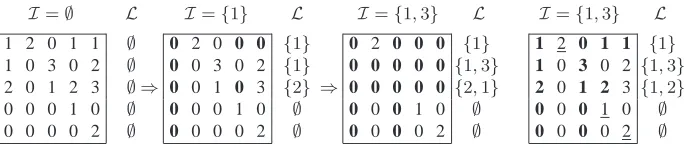
I=∅ L I={1} L I={1,3} L I={1,3} L
1 2 0 1 1 ∅ 1 0 3 0 2 ∅ 2 0 1 2 3 ∅ 0 0 0 1 0 ∅ 0 0 0 0 2 ∅
⇒
0 2 0 0 0 {1}
0 0 3 0 2 {1}
0 0 1 0 3 {2}
0 0 0 1 0 ∅ 0 0 0 0 2 ∅
⇒
0 2 0 0 0 {1}
0 0 0 0 0 {1,3}
0 0 0 0 0 {2,1}
0 0 0 1 0 ∅ 0 0 0 0 2 ∅
1 2 0 1 1 {1}
1 0 3 0 2 {1,3}
2 0 1 2 3 {1,2}
0 0 0 1 0 ∅ 0 0 0 0 2 ∅
Fig. 3. Illustration of Lemma 1. The first three sub-figures show how the columns are selected
for the uniform distribution over the rows and for parameter valuesN = 2,δ = 0.3, boldface symbols denote the changed values. The last sub-figure shows the final result. Boldface symbols denote the revealed entries. Underlined symbols denote the entries that satisfy the predicate.
B
Relation between different entropy based security notions
We briefly sketch why Def. 2 forcesΘ N t ε
andA2that opensxiwith probability Nδ. Then the(k+ 1)-st run ofA2reveals a new certificate (that has not been revealed before) forxiwith probability:
Pr [Reveling certificate] :=δ·(1−δ/N)k ≈δe−Nδ·k .
Consequently, fork= N
δ we getPr [Reveling certificate]≈ δ
e. Letε= δ
e. Then by the requirements of Def. 2,Kcannot do “much more” than runA2to reveal certificates8
and thus all extractor machines fail with probability greater thanεif they make less than N tεe = Θ(N t
ε )steps although no double openings exist. Now ifτ = o( N t
ε )then no commitment scheme can satisfy the requirement. Obviously, ifτ=Θ(N tε )then the security guarantee for binding must be also w.r.t. the time boundΘ(N t
ε ).
Interestingly enough, we got much better reduction for Def. 1 where the adver-saries must have high computational R´eny entropy. This implicitly requires thatAis a “very successful” adversary against the binding property. Let there beAsuch that it is
(t, ε3
432N)-unpredictable and succeeds with probabilityε. LetKbe the average number
9
of different documents for whichA2is able to provide a valid certificate. Then
Pr [(x1, s1)←A2(φ),(x2, s2)←A2(φ) :x1=x2]
≥ε·Pr [x1=x2|Verpk(c, n, xi, si) =true]≥ε/K
where the last inequality follows form basic properties of convex-cup functions. Since
ε < 1
N we getK≥432N
3and choosing√Namong them by sampling will reveal the desired double opening as the probability of hitting the same document and certificate pair is low. In Def. 2, a malicious adversary may reveal onlyN+ 1different values and choosing√N is not just enough to reveal different values for the same location as the probability of hitting the same element is high.
8
More formal arguments require oracle separation that ensures thatK cannot speed up the process by additional computations.
9Here the average is taken overpk