Multi-Recipient Signcryption for Secure
Wireless
Group
Communication
∗Yiliang Han
†Xiaolin Gui Xu’
an Wang
Department of Computer Science and Technology, Xi’an Jiaotong University, Xi’an 710049, China Department of Electronic Technology, Engineering Co llege of Armed Police Force, Xi ’an 710086 , China
Abstract
Secure group communication is significant for wireless and mobile computing. Overheads can be reduced
efficiently when a sender sends multiple messages to multiple recipients using multi-recipient
signcryption schemes. In this paper, we proposed the formal definition and security model of multi-recipient signcryption, presented the definition of reproducible signcryption and proposed security theorems for randomness reusing based multi-recipient signcryption schemes. We found that a secure reproducible signcryption scheme can be used to construct an efficient multi-recipient signcryption scheme which has the same security level as the underlying base signcryption scheme. We constructed a multi-recipient scheme which is provable secure in random oracle model assuming that the GDH problem is hard, based on a new BLS -type signcryption scheme. Overheads of the new scheme are only (n+1)/2n times of traditional ways when a sender sends different messages to n distinct recipients. It is more efficient than other known schemes. It creates a possibility for the practice of the public key cryptosystem in ubiquitous computing.
Key words
secure group communication; signcryption; multi-recipient signcryption; reproducible signcryption;
∗Supported by the National Natural Science Foundation of China under Grant No.60273085; the Program for New Century Excellent
Talents in University of China under Grant No.NCET -05-0829
†Correspond to: Yiliang Han,Department of Electronic Technology, Engineering College of Armed Police Force, Xi’an, Shaanxi,
710086, China. [email protected].
1.
Introduction
Security problem is significant for wireless and mobile communication systems . Data privacy and integrity, source authenticity are the main tasks to
strengthen information systems. To achieve
confidentiality and authenticity simultaneously, encryption and signature (message authenticated code) are often combined in sequence. The traditional way is infeasible with the disadvantages: (1) heavy overheads; (2) lack of security. Zheng proposed a novel conception named signcryption to perform the encryption and signature in a single primitive[1]. It fixed the above problems . It is an active and fruitful area in the past years. Bao and Deng improved it and gave a signcryption that can be verified publicly in 1998 [2]. DSA (Digital Signature Algorithm) based signcryption scheme SC-DSA [3], RSA based signcryption scheme RSA-TBOS (two birds one stone) [4], ECDSA based signcryption scheme [5] and Identity-based signcryption [6] were proposed in the past years . At the same times, some generic structures for signcryption and secure model were presented also [7,8]. We proposed generalized signcryption to achieve more functions with one
primitive [9]. However, Zheng’s conception is
unpractical for increasingly popular ubiquitous communications.
Our work is motivated by above problems. Our goal is to provide a theoretic model and a feasible scheme for secure group communications in wireless and mobile computing. The remainder of the paper is organized as follows. We reviewed the related works and preliminary in section 2 and section 3. In section 4, we proposed the definition and model of multi-recipient signcryption. Two security theorems about multi-recipient signcryption by randomness reusing
were proposed and proved. What’s more, we
constructed an efficient multi-recipient signcryption scheme based on bilinear paring in section 5. This scheme is semantic secure and unforgeable, which is more efficient than others. It is the unique one that can send multiple messages to distinct recipients. We conclude the whole paper in section 6.
2.
The state-of-art Research
2.1. Multi-recipient Encryption
How to produce and transfer messages to multiple recipients is the task of MRES (multi-recipient encryption scheme). In SM-MR (single message-multi-recipient) scheme, a sender sends a single message to different receivers. While in MM-MR (multi-message-multi-recipient) schemes, a sender sends different messages to different receivers. Obviously, SM-MR is a special case of MM-MR. In a MRES, overheads are from computation and communication. The totally computational overheads include encryption operation of sender and decryption operations of multiple receivers. While, the totally communication overheads include the broadcasted ciphertext . So, an efficient MRES is a scheme with low computational cost and shortened broadcast message.
To send encrypted message to multiple receivers, the natural way is trivial n-recipient which produces and sends a ciphertext for each one. Because that some schemes are not secure in multi-user setting, trivial n-recipient scheme is simple but infeasible, for example , Håstad have found that RSA may leak message[10]. In 2000, Baudron et al.[11] and Bellare et al.[12]independently proved the secu re condition
for MRES. They found that the trivial n-recipient
scheme is secure (in the sense of indistinguishability) if the base scheme is secure (in the sense of indistinguishability). The nice result can be used to test the security of some encryption schemes. But the
secure trivial n-recipient schemes have n times
overheads more than that of underlying base scheme.
Kurosawa [13] presented a technology called
randomness reusing to enhance the efficiency of multi-recipient encryption schemes based on ElGamal [14] and Cramer-Shoup[15]. The length of resulted ciphertext is half of the trivial n-recipient scheme. In general, randomness reusing will cause
serious secure problems. But Kurosawa’s result
showed that randomness can be reused without sacrificing security in some cases. Bellare et al.[16] [17] investigated the property of randomness reusing schemes and presented the reproducibility theorem to verify the security.
2.2. Multi-recipient signcryption
In one-to-many scenarios, such as secure
broadcast/mu lticast, privacy and authenticity can be achieved with signcryption simultaneously. But the trivial n-recipient signcryption is unpractical. We should extend signcryption to many users setting to enhance its efficiency, and evaluate its security accurately.
In the last few years, some SM-MR schemes were proposed . These schemes can send a single message to different recipients. Firstly, Zheng designed a scheme for multiple receivers [1]. It
encrypts message with a random number k which is
signcrypted to receivers by trivial n-recipient method. The totally overheads are about n+1 times than base scheme. This scheme is inefficient even if it is secure. We also designed a similar scheme for generalized signcrypiton [9]. In 2003, Boyen designed a multipurpose identity-based signcryption scheme which can be used in multiple receivers setting [18]. His method is carry out the sign operation once, and then performs the encrypt operation independently for each receiver, based on the output from sign operation. The n bilinear paring computations made the scheme very slow. In 2006, Duan et al. proposed a multi-receiver identity-based signcryption scheme which includes 1 paring operation in signcryption and 4n paring in designcryption [19]. In 2007, the scheme of Yu et al. [20], which includes 3n paring in designcryption, is on the bas is of Chen and Malone-Lee’s identity based signcryption [7]. In 2008, using a different way, Li et al. proposed a similar one which reduces the communication overheads slightly [21].
It is easy to see, MM-MR is more useful than SM-MR in wireless and mobile networks. It is used not only to broadcast messages, but also to communicate with distinct users simultaneously. For example, in data aggregation, the sink node often communicates with distinct sense nodes . Unfortunately, there are neither theoretic achievements including the model, definition and secure notions , nor practical scheme. To sum up, researches are imperfect, without general definition and secure model. Moreover, there is no theoretic basis for how to construct efficient and secure scheme, which hold back the efficiency of group communications.
3.1. Signcryption
Signcryption is a logical combination of encryption and signature. A common signcryption scheme is a two-party cryptographic protocol. The syntax is presented as follows [22]
Definition 1 (Signcryption).A signcryption scheme Σ=(Gen, SC, DSC) consists of three algorithms . Gen, the randomized keys generation algorithm, takes input a security parameter λand generates a pair of keys for user U. We write (SDKU, VEKU) ← Gen(U,
1λ). SDK is a secret key. VEK is a public key.
Signcryption algorithm SC is a probabilistic algorithm. It takes the private key of the sender A, the public key of the recipient B and a message m∈Mto return a signcrypted text w. We write w← SC(m,
SDKA, VEKB). Decryption algorithm DSC is a
deterministic algorithm. It takes the public key of the sender A, the private key of the recipient B, and a signcryption text w, to return the message m or a
invalid notation ⊥. We write m∪{⊥} ←DSC(w,
SDKB, VEKA). For a fixed message m∈M, we say
that the signcryption scheme Σ=(Gen, SC, DSC) is
correct if and only if DSC(SC(m, SDKS, VEKR),
SDKR, VEKS)=m.
The security notions of signcryption were presented by Zheng firstly [1]. But for a verifiable publicly signcryption scheme, we say that it is secure if the following conditions are satisfied [9]:
Unforgeability. It is computationally infeasible for an adaptive foreger, who may be a dishonest Bob and allowed to query Alice’s signcryption algorithm, to
masquerade Alice in creating an authentic
signcrypted text.
Confidentiality. It is computationally infeasible for an adaptive attacker to gain any partial information on the contents of a signcrypted text. The adaptive attacker may be any party other than Alice and Bob.
Now, we give the formal version of the above secure notions.
Definition 2 (Confidentiality). A signcryption scheme Σ=(Gen, SC, DSC) is semantic secure against IND-CCA2 (indistinguishability against adaptive chosen ciphertext attacks), if there is no probabilistic polynomial time attacker A can perform the attack experiment CCAExp with non-negligible advantage.
For secure parameter k∈N, we consider the
experiment CCAExp as follows. Experiment ind-cca2(k)
A ,
CCAExp∑
(1)I ← G (1k); (st) ←A(select, I) (2) (VEKS, SDKS) ← K (I) (3) (VEKR, SDKR) ← K (I)
(4) (m0, m1, st)←ASC(.), RO(.), DSC(find,
st), (|m0|=|m1|)
(5) b ← {0, 1}; w←SC(mb)
(6) d←ASC(.), RO(.), DSC(.) (guess, w, st)
(7) If d← b, and w was never queried to DSC(.), then return 1
Else return 0.
In the random oracle model [23] with secure
parameter k, an adversary A runs in time t and
performs qSC signcryption queries, qDSC
de-signcryption queries and qH queries to oracle RO(.),
has the advantage
]} 0 ) ( Pr[
] 0 ) ( max{Pr[
) (
1
0
= −
= =
− ∑
− ∑ ∑
k
k k
cca2 -ind
A ,
cca2 -ind
A , cca2
-ind
A ,
CCAExp
CCAExp
Adv .
Notes.A is an adaptive attacker and runs in three stages. In the selecting stage, the attacker is given some initial information and outputs a state information st. In the finding stage, A selects two messages with equal length and submits to signcryption subroutine after querying to RO(.), SC(.) and DSC(.). In the guessing stage, A continues to get the help from these oracles.
Definition 3 (Unforgeability). A signcryption
scheme Σ=(Gen, SC, DSC) is existentially
unforgeable against adaptive insider CMA (chosen message attacks), if there is no probabilistic
polynomial time forger E can perform the forge
experiment ForgeExp with non-negligible advantage.
For secure parameter k∈N, we consider the
experiment ForgeExp as follows. Experiment ForgeExpcma∑,E(k)
(1)I ← G (1k); (st) ←E(select, I) (2) (VEKS, SDKS) ← K (I) (3) (VEKR, SDKR) ← K (I) (4) If ESC(.)RO(.)
(VEKS,VEKR, SDKR) outputs (m, w) such that
(a) DSC RO(.)
(w, SDKR, VEKS) = m
(b) m was never queried to SC(.) Return 1 else return 0.
The forger E runs in time t and performs qSC signcryption queries and qH queries to oracle RO(.), has the advantage ∑ (k)=max{Pr[ cma∑ ,E(k)=1]}
cma E
, ForgeExp
Adv .
3.2. Bilinear Pairings and GDH Problem
Definition 4 (Bilinear Pairings). Let k be a security parameter and q be a k bit prime number. We consider groups G1 and G2 of the same prime order q. A
bilinear map e: G1× G1→ G2 satisfies the following
properties.
1. Bilinearity: e(aP, bQ) = e(P,Q)ab for all P, Q∈G1,
a, b∈Zq.
2. Non-degeneracy: e(P,Q)≠1 for any P, Q∈G1.
3. Computability: it is feasible to compute e(P,Q), P, Q∈G1.
problem). The GDH problem is to solve a given instance (P, aP, bP) of the CDH (Computational Diffie-Hellman) problem with the help of a DDH (Decisional Diffie -Hellman) problem oracle, that is able to decide whether (P, aP, bP, cP) is such that c = ab (mod q) by checking the equation e(P, cP) = e(aP, bP). Where, the CDH problem is given (P, aP, bP) to compute abP∈G1 for unknown a, b∈Zq. The DDH in G1 is given (P, aP, bP, cP) to decide whether ab≡c
(mod q) for unknown a, b,c∈Zq.
Assumption 1 (GDH assumption). For the secure parameterk∈N, a probabilistic polynomial time attacker A will resolve the GDH problem on G1 with
order q and generator P. His advantage
]} , , ) , , max{Pr[ )
( *
q
Z b a abP bP aP P
k = A( = ∈
AdvGDH,A is
negligible .
4.
MM-MR Signcryption
As mentioned above, MM-MR is a secure primitive with potential practice in ubiquitous computing. In this section, we will propose the theoretic basis for MM-MR.
4.1. Model
Our model considers the MM-MR scenario. A sender issues several different messages m1,… ,mt to several receivers Pi, i=1… t simultaneously. The receiver takes and designcrypts his signcryption text from the broadcasted message. MM-MR is a generic primitive of multi-recipient signcryption. Base signcryption scheme and SM-MR are both of special cases of MM-MR. We can easily find that, MM-MR signcryption scheme will become a SM -MR scheme
when m1=… = mt =m, and will become a base
signcryption scheme when t=1. A formal definition of MM-MR signcryption scheme as follows.
Definition 6(Multi-recipient). A multi-recipient
signcryption scheme MΣ=(Gen, MSC, DSC) consists
of three algorithms . Gen is a keys generation algorithm as above. Signcryption algorithm MSC is a probabilistic algorithm. It takes the private key of the sender A, the public keys VEKP ={VEKPi, i=1,… , t} of the recipient P={Pi, i=1… t} and messages M={mi, i=1,… , t, mi∈M} to return a signcryption text W←MSC(M, SDKS,VEKP). DSC is a deterministic algorithm. It takes the public key of the sender A, the private key of the recipient Pi and a ciphertext wi, to
return the message mi or ⊥. We write
mi∪{⊥}←DSC(wi, SDKPi, VEKA). For a fixed
message M∈M, we say that the multi-recipient
signcryption scheme MΣ=(Gen, MSC, DSC) is
correct if and only if DSC(SC(M, SDKS, VEKP),
SDKP, VEKS)= M.
4.2. Security notions
Signcryption aims to establish secure and authorized communication. Zheng pointed out that a secure signcryption scheme should achieve confidentiality, unforgeability and non-repudiation [1]. But for any verifiable signcryption scheme, the unforgeability implies the non-repudiation. So, confidentiality and unforgeability are sufficient for a verifiable scheme. Now, we give the definitions of confidentiality and unforgeability for a multi-recipient signcryption scheme.
4.2.1. Confidentiality
For a multi-recipient signcryption scheme,
confidentiality means that information of any plaintext could not be leaked to any others. In a SM-MR signcryption scheme, only outsider adversary wants to get the underlying message, since all of the receivers have the same one. While in a MM-MR signcryption scheme, recipients who want to get messages for any others are potential adversaries, because each recipient receives the different message. So, we take into account a scenario called insider attacks. We adapt the attacker model similar to insider attacker in [17]. Besides his own key pairs, the adversary has the ability to corrupt some fraction of other users and possession of their secret keys. W e assume that adversary B attacking MΣ has corrupted n-l receivers. Uncorrupted users are numbered as 1,… , l. B runs in three stages: (1) in selecting stage, B
is given the number of users n and outputs state
information st and a integer l, (1≤l≤n); (2) in finding
stage, B is given a common parameter I, state
information st and public keys of l uncorrupted users {VEK1 , … , VEKl}, outputs two l-victors M0, M1 of
messages ; (3) in guessing stage, B returns a bit d as his guess of the challenge bit b. In all of the stages, signcryption oracle MSC(.) signcrypts all of message
submitted by B except for the challenge message
vector M*. At the same time , designcryption oracle
DSC(.) designcrypts all of signcryption text submitted by B except for the challenge text vector W*.
Definition 7 (confidentiality). Let MΣ=(Gen, MSC,
DSC) be a MM-MR signcryption scheme. Let B be
an adaptive adversary which runs in three stages. For atk∈{cpa, cca}, b∈{0, 1}, k∈N. Consider following experiment.
Experiment mr-atk-b(k) n(.) B, , M Exp ∑
(1)I ←G (1k); (1l, st) ←B(select, n, I) (1≤l≤n) (2) (VEKS, SDKS) ← K (I)
(2) For i=1,… , l do (VEKi, SDKi) ← K (I) EndFor
(3) (M0, M1, M, coins, st)←BMSC(.), RO(.), O1(.), … ,
Ol(.)
(find, pk, st)
|M0|=|M1|=l; |M|=n-l; |VEK|=l; |coins|= n(k)-l
coinsi) EndFor
(5) VEKP ←(VEK1, … , VEKl, VEKl+1', … ,
VEKn')
(6)M*←(mb1,… , mbl, m1,… , mn-l) (7) W*=MSC(M*, SDKS,VEKP)
(8) d←BMSC(.), RO(.), O1(.), … , Ol(.)(guess, W*, st)
(9) Return d
The advantage of an attacker for ind-atk is defined as follows: ]} 0 ) ( Exp Pr[ ] 0 ) ( Exp max{Pr[ ) , , , , ( Adv 1 atk m r n B, , M 0 atk m r n B, , M atk m r n B, , M = − = = − − ∑ − − ∑ − ∑ k k q q q t
k RO MSC DSC .
The MM-MR signcryption scheme MΣ is said to
be IND-CPA (indistinguishability against chosen plaintext attacks) secure (or IND -CCA secure) if the function ) , , , , (
Advm rM∑−cpa,B,n k t qRO qMSC qDSC (or
) , , , ,
(k t qRO qMSC qDSC
cca mr n B, , M
Adv ∑− )is negligible for any
probabilistic polynomial time attacker B who runs in time t, using qRO queries to its random oracles, qMSC queries to its signcryption oracle and qDSC queries to its designcryption oracle.
4.2.2. Unforgeability
For a multi-recipient signcryption scheme, unforgeability means that any users have no ability to forge a signcrypted text from the sender (who is a signer also). Outsider adversary has to forge a signcrypted text to pass the verifying operation. While, the legitimate recipient has more powerful ability to win the forge attacks . He can forge a valid signcryption text as long as he forges a signature of sender. We adapt the forger model including insider attacker. Moreover, there is no need for any forger to forger signcryption text W on M, but w on any m. A scheme is secure against any forger, if it is secure against insider forger.
Definition 8 (unforgeability). Let MΣ=(Gen, MSC,
DSC) be a multi-recipient MM-MR signcryption scheme, and F be a forger. For any k∈N, consider the following experiment:
Experiment ForgeExpmrM∑-cma,F,n(k)
Experiment mr-cma(k)
n F, , M ForgeExp ∑
(1)I←G (1k); (st) ←F(select, n, I) (2) (VEKS, SDKS) ←K (I)
(3) For i=1,… , n do (VEKi, SDKi) ← K (I, coinsi) EndFor
(4) If FMSC(.)RO(.) outputs (mi, wi), mi∈M, wi∈W
(a) DSC RO(.) (w, SDK
Pi, VEKS) =mi (b) mi is never queried to MSC
Return 1 else return 0.
The advantage of a forger is defined as follows:
]} 1 ) ( ForgeExp max{Pr[ ) , , , ( Adv cma n F, , M cma n(.) F, , M = = ∑ ∑ k q q t
k RO MSC
The MM-MR signcryption scheme MΣ is said to be strongly existentially unforgeable against chosen-message attacks (SC-SUF-CMA) if the function
) , , , (
AdvcmaM∑,F,n(.) k t qRO qMSC is negligible for any random polynomial time forger F who runs in time t, using qRO queries to its random oracles, qMSC queries to its signcryption oracle.
4.3. Randomness Reusing and
Reproducible Signcryption Scheme
RR (randomness reusing) is a novel technology to improve efficiency of MRES. Generally, randomness reusing may cause serious problem for some encryption schemes. Kurosawa’s result [13] shows that some encryption schemes with randomness reusing is secure for multiple recipients setting, while keeping lower communication overheads. The schemes based randomness reusing can be marked as RR-MRES. Not all of RR-MRES are secure, even they are efficient. Bellare et al. pointed out that some RR-MRES keep high security for the differences of
the distinct recipient’s public keys [17]. They
proposed a condition for secure RR-MRES: if the base scheme is reproducible, then the corresponding RR-MRES is secure too.
Though signcryption is a type of public key primitive, it still differs to public key encryption. The signcryption algorithm takes as input a secret key of sender, a public key of receiver and a message to be transmitted. The designcryption algorithm takes as input a public key of sender, a secret key of receiver and a signcryption text. While , public encryption algorithm takes receiver’s public key and a message, decryption algorithm takes receiver’s secret key and ciphertext. The reproducibility of signcryption scheme is different to that of public key encryption scheme. We present the definition of reproducible signcryption scheme as follows .
Definition 9 (Reproducible Signcryption Scheme).
Fix a signcryption S=(Gen, SC, DSC). Let R be an randomized polynomial-time algorithm that takes as input a secret key of sender, a public key of receiver, signcryption text of a random message, another secret key of sender, a pair of keys of receiver, and another random message, returns a signcryption text. We say that S is reproducible if exists a R such that SC(m', SDKS', VEKR', v)=R(I, VEKR, SDKS, w, m', VEKR', SDKR', SDKS').
Theorem 1. Fix a signcryption scheme S=(Gen, SC,
DSC) and a integrity n, MS=(Gen, MSC, DSC) is
associated randomness reusing multi-recipient scheme. If S is reproducible, then for any randomized
polynomial time attacker Batk, there exists a
randomized polynomial time attacker Aatk, atk ∈{cpa,
cca}, such that for any k (k) n atk (k)
A , atk mr n B ,
M atk, Adv atk Adv ∑− ≤ ⋅ Σ .
Proof.
We consider a hybrid experiment [17] and attackers described in definition 4 and definition 7.
For confidentiality of a signcryption scheme, IND-CCA2 is the strongest secure notion. A scheme semantic secure against CCA2, implies IND-CCA and IND-CPA. We only consider the case of IND-CCA2.
Experiment HybirdEXP H j(k)=0 (0≤j≤n) (1)I ← G (1k); (1l, st) ←B(select, n, I) (1≤l≤n) (2) (VEKS, SDKS) ← K (I)
(3) For i=1,… , l do (VEKi, SDKi) ← K (I) EndFor
(4) (M0, M1, M, coins, st)←BMSC(.), RO(.), DSC1(.), … ,
DSC l(.)(find, st)
(5) For i=l+1,… , n do (VEKi', SDKi') ← K (I, coinsi) EndFor
(6) VEKP←(VEK1,… ,VEKl,VEKl+1', … ,VEKn') (7) If j≤l then M*←(m01,… , m0j, m1j+1, m1l, m1,… , mn-l)
else M*←(m01,… , m0l, m1,… , mn-l) (8) W*=MSC(M*, SDKS,VEKP)
(9) d←BMSC(.), RO(.), DSC1(.), … , DSC l(.)(guess, W*, st)
(10) Return d
Let pj=Pr[Hj(k)=0]. We claim that
n
p
k = =
− −
∑ ( ) 0]
Pr[ExpmrM cca,B,n0 and 0 1
] 0 ) (
Pr[ExpmrM∑−cca,B,−n k = =p .
We can get (k)=pn−p0 − ∑cca mr n B, , M Adv .
Then We construct an attacker A which runs B
as a subroutine, against the base scheme Σ. A runs three stages too. In each stage, A gets information from B’s outputs.
A (select, I)
(1)I ← G (1k); (1l, st') ←B(select, n, I) (1≤l≤n); j ← {1,… , l}
(2) st ←( st', l, j) (3) Return st A (find, I, VEKR)
(1) (VEKS, SDKS) ← K (I)
(2) If j≤l then For i=1,… , j-1,j+1,… ,l do (VEKi, SDKi) ← K (I); VEKj= VEKR EndFor
else For i=1,… ,l do (VEKi, SDKi) ← K (I) EndFor
(3) (M0, M1, M, coins, st')←BMSC(.), RO(.), DSC1(.), … ,
DSC l(.)(find, st')
(4) For i=l+1,… , n do (VEKi', SDKi') ← K (I, coinsi) EndFor
(5) VEKP←(VEK1,… ,VEKl,VEKl+1', … ,VEKn') (6) If j > l then m0j=mj; m1j=mj
(7) st ←( st', l, jM0, M1, M, VEKP)
(8) Return (m0j, m1j, st) A (guess, w, st)
(1) For i=1,… , j-1,j+1,… ,n do If i=l+1,… , n then m'← mi If i≤j then m'← m0i Else m'← m1i
wi←RP(I, VEKR, SDKS, w, m', VEKi, SDKi, SDKS)
EndFor
(2)W'←{ w1,… ,wj-1, w, wj+1,… ,mn}
(3) d←BMSC(.), RO(.), DSC1(.), … , DSC l(.)(guess, W', st')
(4)Return d
We claim that
n p p n k n n i i= = =
∑
= − ∑ 10( ) 0] 1
Pr[ cca
A ,
Exp and
n p p n k n i i 0 1 1
1( ) 0] 1
Pr[ = =
∑
== − − ∑ cca A , Exp .
Then, we can get
) ( 1 ] 0 ) ( Pr[ ] 0 ) ( Pr[ ) ( 0 1 0 p p n k k
k = = − = = n−
− ∑ −
∑
Σ cca, A
cca A , atk
A
, E x p E x p
Adv .
By taking the maximum, we obtain
that (k) n atk (k)
A , atk mr n B ,
M atk, Adv atk Adv ∑− ≤ ⋅ Σ .
The overheads of A include B’s overheads, picking
the random number j, producing n-1 key pairs and
RP’s overheads.
Theorem 2. Fix a signcryption scheme S=(Gen, SC,
DSC) and a integrity n, MS=(Gen, MSC, DSC) is
corresponding randomness reusing multi-recipient scheme. If S is reproducible, then for any randomized polynomial time forger F, there exists a randomized polynomial time attacker E. For any k:
) ( )
(k n cma k
E , cma mr n F, , M Adv
Adv ∑− ≤ ⋅ Σ
Proof.
We construct a forger E to forge a base
signcryption scheme running F as a subroutine. E attacks the signcryption scheme with sender S and recipient R. In F’s experiment, R is Pj, for j∈ {1,… , n}.
ESC(.)RO (VEK
S,VEKR, SDKR)
(1)I ← G (1k); (st) ←F(select, I); j ← {1,… , n} (2) (VEKS, SDKS) ←K (I)
(3) For i=1,… , j-1, j+1,… , n do
(VEKi, SDKi) ← K (I, coinsi); (VEKj, SDKj)= (VEKR, SDKR)
EndFor
(4) If (mi, wi) ←FMSC(.)RO(.)(VEKS,VEKP, SDKP) such that
(a) DSC RO(.) (w
i, SDKi, VEKS) = mi
(b) mi was never queried on MSC(.)
then wj←RP(I, VEKR, SDKS, wi, mj, VEKR, SDKR, SDKS)
Return (mj, wj)
After wining, F produces the signcryption text
associated with receiver Pj using reproducing
algorithm RP. It is easy to see that (mj, wj) is a valid message-signcryption text as well as (mi, wi).
In experiment ForgeExpcma∑,Ei(k), E attacks the base
signcryption scheme with sender S and recipient Pj. Thus,
) ( ForgeExp )
( ForgeExp ...
) ( ForgeExp )
( ForgeExp
cma E , cma
E ,
cma E , cma
E ,
n
2 1
k k
k k
∑ ∑
∑ ∑
= =
= .
Obviously,
∑
= ∑
∑
= =
=
n
i
k k
1
,
] 1 ) ( Pr[
] 1 ) ( Pr[
cma E , cma -mr
F,n M
i ForgeExp ForgeExp
.
By taking the maximum, we obtain that
) ( )
(k n cma,E k
cma mr
F,n ,
M Adv
Adv ∑− ≤ ⋅ Σ .
The overheads of E include the running times of F,
RP, picking the random number j and producing n-1
key pairs.
5.
An Efficient MM-MR
Signcryption Scheme
5.1. SC-BLS: An Improved Signcyption
Scheme based on BLS Signature
In this subsection, we will construct a signcryption scheme based on BLS signature scheme which was presented by Boneh, Lynn and Shacham in 2001 [24]. It is an efficient scheme based on any GDH group and be used broadly for its simplicity and low overheadss. In 2004, Libert and Quisquater proposed a signcryption scheme [35] based on BLS. The
scheme wraps up the message and sender’s public
key. So receiver could perform designcryption
operation without getting sender’s public key
beforehand. But the scheme is not secure since
signature couldn’t include receiver’s private
information and attackers have chance to forge a signcryption text that could be passed the verifying operation. In 2005, Tan pointed out that the scheme is neither semantic secure against chosen cipher attack nor key privacy [26]. At the same time, Yang et al. also found the problem and improved it [27]. Their improvement failed to grasp the essence and was broken by Tan [28]. Li et al. [29] presented another
improved scheme which is secure against Tan’s
attack. In order to keep the sender’s public key
privacy, these schemes encrypted it together with message. In fact, public key privacy is not necessary for general applications. Recipient could get sender’s identity information from network protocols directly. So, it is not practical to obtain the property while reducing communication bandwidth. Motivated by the base secure d emand, we improved Li’s scheme in this section. For a z-bits message, Li’s scheme [29]
produces z+3l bits signcryption text which could be reduced to z+2l bits in our scheme. We name the new scheme SC-BLS.
Let k be secure parameter, q is a k-bits prime, and G1 is a bilinear group with order q. P is a generator. l
is the length of elements on G1. H1: {0,
1}z×G1→G1and H2: G12→{0, 1}z+l are two hash
functions that can be regarded as random oracle.
Notation ? R means random selection. SC-BLS
consists of three algorithm: KeyGen, SC and DSC.
Algorithm KeyGen. User U picks a random xu←RZq and sets his public key to Yu=xuP∈G1. His
private key is xu. We will denote the sender and the receiver respectively by U = S and U=R and their key pair by (xS, YS) and (xR, YR).
Algorithm SC. to signcrypt a plaintext m∈{0, 1}z
intended to R, the sender S uses the following
procedure:
1. Pick a random r←RZq and compute U =rP∈G1.
2. Compute V = xSH1(m, rYR)∈G1.
3. Compute Z = (m||V)⊕H2(U, YR, rYR)∈{0, 1}z+l. The ciphertext is given by w = (U, Z)∈G1×{0, 1}
z+l .
Algorithm DSC. when receiving a ciphertext w = (U, Z), the receiver R has to perform the steps below:
1. Compute H2 (U, xRU)∈{0, 1} n+l. 2. Compute (m||V)=Z ⊕H2(U, YR, xRU).
3. Compute H = H1(m, xRU) G1 and then check if
e(YS, h)= e(P, V). If this condition does not hold, reject the ciphertext.
Correctness.If w = (U, Z) is a valid signcryption text, it is easy to see that xRU= rYR = xRrP and (m||V) is decrypted correctly. Thus e(P, V) =e(P, xSh) =e(xSP, h)= e(YS, h) is hold.
5.2. Multi-recipient Signcyrption Scheme
In this subsection, we will construct a multi-recipient scheme called MSC-BLS based on SC-BLS with
randomness reusing. In this scheme, a sender S
signcrypts messages M={mi|mi∈{0, 1}z, i=1, … , n } for n distinct receiver Ri, i=1, … , n, then broadcasts signcryption text. A receiver Ri gets his signcryption text and designcrypts it using base designcryption
algorithm. MSC-BLS also consists of three
algorithms: KeyGen, MSC and DSC.
Algorithm KeyGen: For a sender, his key pair is (xS, YS), xS←RZq YS=xSP∈G1. For a receiver Pi, i=1, … , n, his key pair is (xRi, YRi), xRi←RZq YRi= xRiP∈G1.
Algorithm MSC: To signcrypt messages M={mi|mi∈{0, 1}z, i=1, … , n}, S performs following operations.
1. Pick a random r←R Zq and compute U =rP∈G1.
2. For i=1,… ,n
(b) Compute Zi = (mi||Vi)⊕H2(U, YRi, rYRi)∈{0, 1}z+l.
EndFor
3. The ciphertext is given by W = (U, Zi) ∈G1×{0,
1}n+l. W = (U, Z1,… , Zn)
Algorithm DSC: When receiving W, the receiver Ri get his signcryption text wi=(U, Zi) and performs the steps below.
1. Compute H2 (U, xRiU)∈{0, 1} z+l. 2. Compute (mi||Vi)=Z ⊕H2(U, YRi, xRiU).
3. Compute hi = H1(mi, xRiU)∈G1 and then check if
e(YS, hi)= e(P, Vi). If this condition does not hold, reject the ciphertext.
Correctness. If wi=(U, Zi) is a valid signcryption text, it is easy to see that xRiU= rYRi = xRirP and (mi||Vi) is decrypted correctly. Thus e(P, Vi) =e(P, xShi) =e(xSP, hi)= e(YS, hi) is hold.
According to the definition in subsection 3.1, MSC-BLS is a general scheme. When m1=, … ,= mn = m, MSC-BLS will become a SM -MR scheme. When n=1, it will become SC-BLS. It has the same Key Gen algorithm and DSC algorithm as that of SC-BLS.
5.3. Security Analysis
5.3.1. Reproducibility of SC-BLS
Lemma 1. Base signcryption scheme SC-BLS=(Gen, SC, DSC) is a reproducible scheme.
Proof.
Firstly, we run signcrytion SC(m', SDKS', VEKR', r), for given random coins r, a sender S' and a recipient R' on the message m'.
Algorithm SC(m',SDKS', VEKR', r) 1. Compute U =rP∈G1.
2. Compute V' = xS'H1(m', rYR')∈G1.
3. Compute Z'= (m'||V')⊕H2(U, rYR')∈{0, 1}n+l. 4. Return w' = (U, Z')∈G1×{0, 1} n+l as cipher
text.
Then, we run a polynomial time reproducing
algorithm RP, which takes common parameters, a
public key of recipient R, secret key of a sender S, signcryption text w=(U, Z)of a message m, another message m', key pair of another recipient R', and
secret key of another sender S', outputs the
corresponding signcryption text.
Algorithm RP(I, VEKR, SDKS, w, m', VEKR', SDKR', SDKS')
1. Compute V' = xS'H1(m', rYR')∈G1.
2. Compute Z'= (m'||V')⊕H2(U, rYR')∈{0, 1}n+l. 3. Return w' = (U, Z')∈G1×{0, 1} n+l as cipher
text.
Obviously, SC(m',SDKS', VEKR', r)=RP(I, VEKR, SDKS, w, m', VEKR', SDKR', SDKS').
So, the base signcryption scheme is a reproducible scheme.
5.3.2. Security of SC-BLS
In the random oracle model assuming that GDH problem is hard.
Lemma 2. In the random oracle model with secure parameter k, if an adversary A has non-negligible
advantage εagainst the IND-CCA2 security of
SC-BLS when running in time t and performing qSC
signcryption queries, qDSC de-signcryption queries and qHi queries to oracles Hi, i=1,2, then there is an algorithm B that solves the GDH problem in G1 with
probability ε'≥ ε - qDSC(qH1/ 2k+qH2/ 2z+l) and within
running time t'=t+(4qDSC +2qH2)tb+ qH2te. Where tb denotes the time required for one pairing evaluation, te denotes the time required for exponention.
Proof.
For contradiction, we assume that an attacker A breaks IND-CCA2 of SC-BLS with probability greater than ε that within time t. We show that using A, one can construct an attacker B for solving the GDH problem with the help of a DDH solver due to the bilinear pairing.
Suppose that B is given (P, aP, bP) as an instance of CDH. B runs A as a subroutine to find the solution of abP. A then adaptively performs hash queries, signcryption queries and de-signcryption queries. Firstly, YU = bP∈G1 is given to B as a challenge
public key. To handle A’s queries, B maintains two lists L1 and L2 to keep track of the answers given to
oracle queries on H1 and H2.
Hash queries are simulated as follows.
H1 simulation. When a hash query H1 (m, P1) is
received, B checks if the query tuple (m, P1, h) is
already in L1. If it exists, the result of hP is returned.
Else, B picks a random number h∈Zq, inserts the tuple (m, P1, h) into list L1 and returns the result of
hP.
H2 simulation. When a hash query H2(P1, P2, P3) is
received, B checks if the query tuple (P1, P2, P3, v) is
already in L2. If it exists, the existing result of v is
returned. If it does not exist but e(P1, P2)= e(P, P3), B
picks a random number v∈{0, 1} z+l
inserts the tuple (P1, P2, P3, v) into list L2 and returns the number v. If
(P1, P2, ⋅, t) exists in L2, and e(P1, P2)= e(P, P3)
then replace the “⋅” with P3, and returns v, where “⋅”
is a symbol to denote blank. Else, B picks v∈{0, 1} z+l randomly and returns it.
Signcryption and de-signcryption queries are simulated as follows.
SC simulation. For a signcryption query on (m, YR) choosed by A B checks if YR∉G1or YR=YU, rejects it.
Otherwise, B picks r∈Zq randomly, computes the
tuple (m, rYR, h) into the list, and computes the result of V = hYU = h(bP). B simulates H2 (U, YR, rYR) and computes the result of Z = (m||bhP)⊕H2(U, YR, rYR), and returns w=(U, Z) as the signcryption text on a message m with the receiver’s public key YR and the sender’s public key YU.
DSC simulation. For a signcryption text (U, Z)
choosed by A, B checks if (U, YU, Qi, vi) exists in L2,
0≤ i ≤qh2, such that (mi||Vi)= Z⊕ vi, for the corresponding elements (mi, Qi, hi) in L1 is such that
Vi=hibP, then records the tuple (mi, U, YU, Vi, Qi, hi). If one of them satisfies e(P, Qi)= e(U, YU) and e(YSi, hi)= e(P, Vi), then returns (mi, U, Vi) to A as a signature pair with then sender’s public key YSi. Else returns with 0.
After completing the first stage, A chooses two z-bits messages m0 and m1 together with an arbitrary
sender’s private xS, asks a challenge signcryption text produced by B under receiver’s public key YU. B sets the challenge signcryption text as w=(U, Z), where U=aP, Z is selected from {0, 1} z+l randomly. Then B picks b∈{0, 1}randomly, adds the tuple (mb, ⋅) into L1, picks h∈Zq randomly, produdces and records hP as the result of H1 (mb, ⋅). Then, B produces and records v=Z⊕ (mb|| hbP) in the list as the result of H2
(U, YU, ⋅), sets V= hbP. Where “⋅” is symble to denote blank, it will be replaced by T if A queries H2 (U, YU, T) later. At the same time, the conrrespoding value in L1 will also be replaced. B returns w=(U, Z) to A. A
couldn’t determine that w is not a valid signcryption text unless he have asked the value of H2 (aP, bP,
abP).
A outputs b'∈{0, 1} as his guess of b after performing new queries as above. A has privelege to query all of messages accept w. B looks for (aP, bP, T) in the list L2, such that e(P, T)= e(aP, bP). If B
could find a proper (aP, bP, T), he returns T as the solution of CDH problem. Otherwise, B stops and returns 0.
Analysis. If the simulated attack is computationally indistinguishable form a real attack, we say that B’s simulation of B H1, H2, SC and DSC are perfect. Let
E be the event that abP is queried on H2 by A. In a
real attack game, the probability of A wins will be
Pr[b=b '] ≤ Pr[b=b'|¬E]+Pr[E] = 1/2+1/2Pr[E],
namely ε = 2Pr[b = b' ]-1≤ Pr[E].
The only event that causes the simulation is not peferct is that a valid signcryption text be rejected in designcryption query stage. It is the result of simulation of H1 and H2. For the queries on H1, the
probability is no more than qH1/ 2k. For the queries on
H2 , the probability is no more than qH2/ 2 z+l. The
totally probability is no more than qDSC(qH1/ 2k + qH2
/ 2z+l) for qDSC designcryption queries. Hence, the probability of B wins is ε'≥ ε - qDSC(qH1/ 2k + qH2/
2z+l).
Then we evaluate the running time of B. We only consider the expensive operations, such as pairing
evaluation and exponention. The running time of B
includes that of A, 4 pairing evaluations in each
designcryption query, 2 pairing evaluations and 2 exponentions in each signcryption query. It is easy to see, the running time of B is t'=t+(4qDSC +2qH2)tb+ qH2te. Where tb denotes the time required for one pairing evaluation, te denotes the time required for exponention.
Lemma 3. In the random oracle model with secure
parameter k, if there exists a forger F has
non-negligible advantage ρ to forge a valid SC-BLS
signcryption text when running in time t and
performing qSC signcryption queries and qHi queries to oracles Hi, i=1,2, then there is an algorithm E that solves the GDH problem in G1 with probability ρ' ≥ρ
- (qH1qSC + 1)/ 2k in time t'=t + 2qSCqH2tb+ (2qSC + 2qSCqH1) te Where tb denotes the time required for one pairing evaluation, te denotes the time required for exponention.
Proof.
We assume that a forger F could forge a valid SC-BLS signcryption text with probability greater than ρ that within time t. We can construct an attacker E
could solve the GDH problem. Suppose that E is
given (P, aP, bP) as an instance of CDH. E runs F as
a subroutine to find the solution of abP. F then
adaptively performs hash queries, signcryption queries. To handle F’s queries, E maintains two lists L1 and L2 to keep track of the answers given to oracle
queries on H1 and H2.
Hash queries are simulated as follows.
H1 simulation. When a hash query H1 (m, P1) is
received, E checks if the query tuple (m, P1, h) is
already in L1. If it exists, the result of hP is returned.
Else, E picks a random number h∈Zq, inserts the tuple (m, P1, h) into list L1 and returns the result of
haP.
Hash oracle H2 is simulated as in the proof of
lemma 2.
Signcryption is simulated as follows.
SC simulation. For a signcryption query on (m, YR) choosed by F E checks if YR∉G1or YR=YU, rejects it. Otherwise, E picks r∈Zq randomly, computes U =rP. Then E simulates H1 (m, rYR). If (m, rYR) is aleady in L1, E stops and outputs 0. Otherwise, E picks h∈Zq randomly, and sets the result of H1 (m, rYR) as hP. E simulates H2 (U, YR, rYR), computes the results of V = hYS, Z = (m||V)⊕H2(U, YR, rYR), and returns w=(U, Z)
as the signcryption text on a message m with the
receiver’s public key YR and the sender’s public key YU.
After completing the first stage, F produces a
signcryption text w'=(U', Z') and a pair of receipient’s keys.
outputs 0 and stops. Otherwise, H1 (m', rYR, h) must exists in L1, and be set as haP. It is easy to see
V'=tabP. E can compute abP=t-1V. E outputs abP and stops. Thus, E resolves the CDH problem.
Now we assess the probability of E’s success. In signcryption query stage, the probability of E fails to responde is no more than qH1qSC/2k, because each qSC
signcryption query includes qH1 queries. In
designcryption stage, E has no chance to reject a
valid signcrypiton text, because he performs a real
designcryption operation. The probability of F
produces a valid signcryption text without query is 1/2k. To sum up, the taltally probability of E solves abP is ρ'≥ ρ - (qH1qSC +1)/2k.
The running time of E includes that of F, 2
exponentions in each signcryptio n query, 2 exponentions in H1 query, 2 pairing evaluations in
each H2 query. Thus, the running time of E is
t'=t+2qSCqH2tb+ (2qSC+2qSCqH1)te. Where tb denotes
the time required for one pairing evaluation, te
denotes the time required for exponention.
5.3.3. Security of MSC-BLS
Theorem 4. In the random oracle model with secure parameter k, if an adversary B has non-negligible
advantage against the IND-CCA2 security of
n-recipient scheme MSC-BLS when running in time t and performing qSC signcryption queries, qDSC de-signcryption queries and qHi queries to oracles Hi, i=1,2, then there is an algorithm D that solves the GDH problem in G1 with non-negligible probability.
The advantage functions as follows.
) 2 2 ( ) ( ( )
( 1 2
1 zl
H k H DSC G
q q q k n
k +
−
∑ ≤ ⋅ GDH,D − +
atk mr
n B ,
M Adv
Adv atk,
Theorem 4 can be proof by theorem1, lemma 1and lemma 2 easyly. Namely, MSC-BLS is semantic secure against IND -CCA2 in random oracle with assuming that the GDH problem is computational infeasible.
Theorem 5. In the random oracle model with secure
parameter k, if there exists a forger F has
non-negligible advantage to forge a valid SC -BLS
signcryption text when running in time t and
performing qSC signcryption queries and qHi queries to oracles Hi, i=1,2, then there is an algorithm E that
solves the GDH problem in G1 with non-negligible
probability. The advantage functions as follows.
k SC H G
q q k n
k
2 ) 1 (
) ( ( )
( 1
1
+ − ⋅
≤
−
∑ GDH,E
cma mr
n F, ,
M Adv
Adv .
Theorem 5 can be proof by theorem 2, lemma 1 and lemma 3 directly. Namely, MSC-BLS is unforgeable against CMA in the random oracle with assuming that the GDH problem is computational infeasible.
5.4. Performance Analysis
The major advantage of multi-recipient signcryption scheme is cost(MΣ)<<ncost(Σ). Namely, it can reduce overheads efficiently, while keeping high level security.
We compared the major computational overheads and transmission overheads with other known schemes. In section 2.2, some known schemes are listed. All of them are SM -MR schemes. We
evaluated the following schemes: Boyen’s
multipurpose identity-based signcryption [18]
(denoted by Boyen), Duan and Cao’s multi-receiver
identity-based signcryption [19] (denoted by DC),
Yu ’s identity-based signcryption [20] (denoted by YYHZ), Li’s identity-based broadcast signcryption
[21] (denoted by LXH). There are two MM-MR
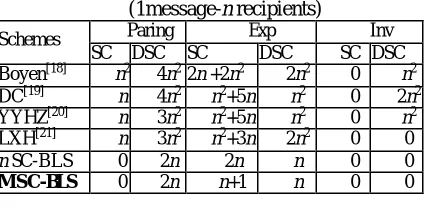
schemes as follows: trivial n-recipient scheme which runs SC-BLS repeatedly (denoted by n SC-BLS), and MSC-BLS. MM-MR schemes can also be used as SM-MR. We consider the costly operations which include pairing operation, exponentiation and inverse. Performances of above schemes sending 1 message to n recipients is listed in Table 1 and Table 2.
SM-MR has to perform n times when sending n
different messages to n recipients. While, MM -MR
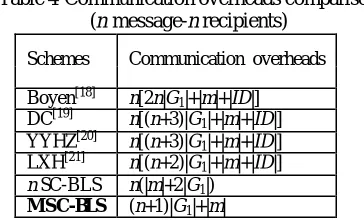
just needs one time. Performances of above schemes sending n message to n recipients is listed in Table 3 and Table 4.
Table 1 Computational overheads comparison (1message-n recipients)
Paring Exp Inv
Schemes
SC DSC SC DSC SC DSC Boyen[18] n2 4n2 2n +2n2 2n2 0 n2
DC[19] n 4n2 n2+5n n2 0 2n2
YYHZ[20] n 3n2 n2+5n n2 0 n2
LXH[21] n 3n2 n2+3n 2n2 0 0
n SC-BLS 0 2n 2n n 0 0
MSC-BLS 0 2n n+1 n 0 0
Table 2 Communication overheads comparison (1message-n recipients)
Schemes Communication overheads
Boyen[18] 2n|G1|+|m|+|ID| DC[19] (n+3)|G1|+|m|+|ID| YYHZ[20] (n+3)|G1|+|m|+|ID| LXH[21] (n+2)|G
1|+|m|+|ID| n SC-BLS n(|m|+2|G1|) MSC-BLS (n+1)|G1|+|m|
Table 3 Computational overheads comparison (n message-n recipients)
Paring Exp Inv Schemes
SC DSC SC DSC SC DSC Boyen[18] n 4n 2+2n 2n 0 n
DC[19] 1 4n n+5 n 0 2n
YYHZ[20] 1 3n n+5 n 0 n
LXH[21] 1 3n n+3 2n 0 0
Table 4 Communication overheads comparison (n message-n recipients)
Schemes Communication overheads
Boyen[18] n[2n|G1|+|m|+|ID|] DC[19] n[(n+3)|G1|+|m|+|ID|] YYHZ[20] n[(n+3)|G
1|+|m|+|ID|]
LXH[21] n[(n+2)|G1|+|m|+|ID|] n SC-BLS n(|m|+2|G1|)
MSC-BLS (n+1)|G1|+|m|
Notes:1. Paring denotes pairing operation, Exp denotes exponentiation, Inv denotes inverse, SC denotes signcryption operation, DSC denotes designcryption operation. 2. |G1| denotes the length of elements in G1, |m| denotes the length of message, |ID| denotes the length of identity. 3. In EEH scheme, |KH| denotes the length of hash function KH, the length of block cipher is equal to |m|.
Remark 1. MSC -BLS compared with n SC-BLS. Overheads of MSC-BLS are reduced efficiently as n growing. In signcryption operation, computation overheads of MSC-BLS are half of that of n SC-BLS, communication overheads of MSC-BLS are 2/3 of
that of n SC-BLS. The two schemes have the same
totally computational overheads in designcryption operation. The two schemes have the same computational overheads and communication overheads as the underlying base signcryption scheme when n=1.
Remark 2. MSC-BLS compared with other identity-based schemes. In above schemes, Boyen, DC, LL, YYHZ and LXH are identity-based signcryption schemes which include plenty of paring operations. Obviously, MSC-BLS has few pairing operations, exponentiation and inverse operations. Thus, MSC-BLS is more efficient than others. When sending 1 message to n recipients, the communication overheads of MSC-BLS are slightly greater than others. But, when sending n messages, overheads of other schemes are n times than that of the schemes when sending 1 message. MSC-BLS has the same overheads when sending 1 message or n messages .
To sum up, MSC-BLS is the most efficient scheme as we known, especially used in the applications that sends different messages to distinct recipients.
6.
Conclusion
In this paper, we investigated the efficiency and security of secure group communication. We present the result which provides a simple and reliable
method to construct an efficient group
communication scheme. If underlying base
signcryption scheme is reproducible and semantic secure and unforgeable, then the corresponding randomness reusing multi-recipient signcryption scheme is secure too.
MSC-BLS proposed in this paper is a good scheme of MM-M R. It creates a possibility for the practice of the public key cryptosystem in ubiquitous computing.
References
1 Zheng Y. Digital signcryption or how to achieve cost (signature &
encryption) << cost(signature) + cost(encryption). In: Kaliski Jr.
B.S. ed. Advances in Cryptology CRYPTO’1997. LNCS1294,
Heidelberg: Springer -Verlag,1997, 165-179
2 Bao F, Deng RH. A signcryption scheme with signature directly
verifiable by public key. In: Imai H., Zheng Y. ed. Public Key
Cryptography’98, LNCS 1431, Heidelberg: Springer-Verlag,1998,
55-59
3 Shin JB, Lee K, Shim K. New DSA-Verifiable signcryption
schemes. In: Lee PJ, Lim CH eds. Proc. of ICISC’2002,
Heidelberg: Springer -Verlag, 2003, 35-47
4 Malone-Lee J, Mao W. Two birds one stone: signcryption using
RSA. In: Joye M ed. CT -RSA’2003. LNCS2612, Heidelberg:
Springer-Verlag, 2003, 211-226
5 Han YL, Yang XY. New ECDSA-verifiable generalized
signcryption, Chinese Journal of Computer, 2006, 29(11):
2003-2012 (in Chinese with English abstract).
6 Chen L, Malone-Lee J. Improved identity-based signcryption. In:
Vaudenay S ed. Public Key Cryptography 2005, LNCS 3386,
Heidelberg: Springer -Verlag, 2005, 362-379.
7 An JH, Dodis Y, Rabin T. On the security of joint signature and
encryption. In: Knudsen L ed. Advances in Cryptology
EUROCRYPT ’2002, LNCS 2332, Heidelberg: Springer-Verlag,
2002, 83-107
8 Baek J, Steinfeld R, Zheng Y. Formal proofs for the s ecurity of
signcryption. Journal of Cryptology, 2007, 20(2): 203-235
9 Han YL. Generalization of signcryption for resources -constrained
environments. Wireless Communication and Mobile Computing,
2007, 7(7): 919-931
10 Håstad J. Solving simultaneous modular equations of low degree.
SIAM J. on Computing, 1988, 17(2): 336-341
11 Baudron D, Stern JP. Extended notions of security for multicast
public key cryptosystems. In: Montanari U, Rolim JDP , Welzl E
eds. Proc. of the 27th International Colloquium on Automata,
Languages and Programming (ICALP’2000), LNCS 1853,
Heidelberg: Springer-Verlag, 2000, 499-511
12 Bellare M, Boldyreva A, Micali S. Public-key encryption in a
multi-user setting: Security proofs and improvements. In: Preneel
B ed. Advances in Cryptology EUROCRYPT’2000, LNCS1807,
Heidelberg: Springer -Verlag, 2000, 259~274
13 Kurosawa K. Multi-recipient public-key encryption with shortened
ciphertext. In: Naccache D, Paillier P eds. Public Key
Cryptography 2002, Heidelberg: Springer-Verlag, 2002, 48-63
14 ElGamal T. A public key cryptosystem and signature scheme
based on discrete logarithms. IEEE Trans. Inf. Theory, 1985, 31(4):
15 Cramer R, Shoup V. A practical public key cryptosystem provably
secure against adaptive chosen ciphertext attack. In: Krawczyk H
ed. Advances in Cryptology— CRYPTO’98, LNCS 1462,
Heidelberg: Springer -Verlag, 1998, 13-25
16 Bellare M, Boldyreva A, Staddon J. Randomness re-use in
multi-recipient encryption scheme. In: Desmedt YG ed. Public Key
Cryptography 2003, Heidelberg: Springer-Verlag, 2003, 85-99
17 Bellare M, Boldyreva A, Kurosawa K and Staddon J.
Multi-recipient encryption schemes: how to save on bandwidth and
computation without sacrificing security. IEEE Transactions on
Information Theory. 2007, 53(11), 3927-3943
18 Boyen X. Multipurpose identity-based signcryption: A swiss army
knife for identity-based cryptography. In: Boneh D ed. Advances
in Cryptology -CRYPTO’2003. LNCS 2729, Heidelberg:
Springer-Verlag, 2003, 383-399
19 Duan SS, Cao ZF. Efficient and provably secure multi-receiver
identity-based signcryption. In: Batten LM, Safavi-Naini R eds.
ACISP’2006. LNCS 4058, Heidelberg: Springer-Verlag, 2006,
195-206
20 Yu Y, Yang B, Huang XY, and Zhang MW. Efficient
identity-based signcryption scheme for multiple receivers. In: Xiao B. et al.
eds. ATC’2007, LNCS 4610, Heidelberg: Springer-Verlag, 2007,
13~21
21 Li FG, Xin XJ, Hu YP. Indentity-based broadcast signcryption.
Computer Standards & Interfaces. 2008, 30 (2): 89-94
22 Dodis Y. Signcryption(short survey). In: Tilborg V. Henk CA eds.
Encyclopedia of Cryptography and Security, Berlin:
Spinger-verlag, 2005
23 Bellare M, Rogaway P. Random oracle are practical: a paradigm
for designing efficient protocols. In: Denning D, Pyle R, Ganesan
R, Sandhu R and Ashby V eds. Proc. of the First ACM Conference
on Computer and Communication Security, ACM, 1993, 62-73
24 Boneh D, Lynn B, Shacham H. Short signatures from the Weil
pairing. In: Boyd C ed. ASIACRYPT’2001. LNCS 2248,
Heidelberg: Springer -Verlag, 2001, 514-532
25 Libert B, Quisquater JJ. Efficient signcryption with key privacy
from gap Di ffie-Hellman groups. In: Bao F, Deng RH, Zhou J eds.
PKC2004. LNCS 2947, Heidelberg: Springer-Verlag, 2004,
187-200
26 Tan CH. On the security of signcryption scheme with key privacy.
IEICE Trans. Fundam. Electron. Commun. Comput. Sci. 2005,
E88-A(4), 1093-1095
27 Yang G, Wong DS, Deng X. Analysis and improvement of a
signcryption scheme with key privacy. In: Zhou J, Lopez J, Deng
RH and Bao F eds. ISC’2005. LNCS 3650, Heidelberg:
Springer-Verlag, 2005, 218-232
28 Tan CH. Analysis of improved signcryption scheme with key
privacy. Information Processing Letters, 2006, 99(4):135-138
29 Li CK, Yang G, Wong DS, Deng X and Chow SM. An Efficient
Signcryption Scheme with Key Privacy. In: Lopez J, Samarati P,
Ferrer JL eds. EuroPKI’2007, LNCS 4582, Heidelberg: