Available Online at www.ijcsmc.com
International Journal of Computer Science and Mobile Computing
A Monthly Journal of Computer Science and Information Technology
ISSN 2320–088X
IMPACT FACTOR: 6.199IJCSMC, Vol. 8, Issue. 5, May 2019, pg.65 – 71
Service Selection (Negotiating Users to Our Goal)
by Predicting Users’ Psychological Manner
(Iridology); Computer Position Next to Users
Dr. Amir Reza Shahbazkia
Bahcesehir Cyprus University
[email protected]
Abstract: Web services are becoming a common and convenient means of doing business over the Internet.
More-and-more web services are kept on arriving over the Internet, offering the same set of services to the end users. The
availability of similar web services increases the complexity of discovery as well as the selection process of web services.
The traditional way of discovery of web service involves keyword based searching followed by manual selection. The
keyword based search is not efficient. In this paper, we have used an improved mechanism for web service selection
based on website as a negotiator. As interest in website owners arises not only to keep their customers but also increase
the number of deals and interests. By effective negotiating, more income, than any other competitors will be obtained.
Improving in business has number of rules which sellers should obey. The business rules such as negotiation, body
language, time management, and selling strategy have been completely discussed in M.B.A And D.B.A courses. At the
same time, for websites there is not that much information. In this study we are going to introduce new rules for
websites to act more effective as a negotiator. Company managers before any negotiation, should choose the best
negotiator. This duty has different step. Important step is that the negotiators should be studied different courses related
to strategy of negotiation. Second step is to realize customers’ position on the negotiation table and his personal
behavior. Now a day’s websites are an important negotiator for any companies. To be the best in this mission we use the
iridology and position of computer comparing to user’s place.
Index Terms— rules of negotiating, iridology
1.
Introduction
One way to ensure business agility and efficiency is to be the winner in business negotiating. In this way, supported interfaces, pricing, availability, actions to be performed when violations occur and endured is very important factors. On the other hand the most important factor is feeling convenience by users. For instance suppose someone goes shopping in the shop A, the prices is cheaper than other shops and seller deliver goods very fast but he/she does not feel comfort.
make him/her more comfort during the usage of composite web service. It means not only we can consider to be the winner in the business negotiation but also we can increase the users due to their convenience in our composite web services.
2.
Related Works
Service model (1) able to express both technical and business quality aspects, and (2) which considers both programmer and fin al user perspectives. In a Service Oriented Architecture, our quality model can be adopted by the Web service broker to identify wh ich is the best Web service among a set of functionally equivalent Web services. Such a selection considers the quality of Web service along with the user preferences combining two decision making models: cost-benefit analysis and Analytic Hierarchy Process (AHP). For the sake of simplicity, we assume that our quality-driven selection process commences when a set of functionally equivalent Web services has been previously identified [1],the composition of services is used to implement complex functionality. The quality of service (QoS) is a demanding issue for the management of service compositions. A QoS-aware service selection recommends the services to be composed to account for the quality of a service composition and its execution cost incurred by requests. It is shown that in the presence of sophisticated service charging a cost minimization objective imposes the need for a request- and service composition-comprehensive service selection. This type of selection is called a tactical service selection. Existing tactical service selection models assume a deterministic execution environment. The need to adjust a service composition during the execution of a request to react on uncertain QoS attributes and service failures is neglected. Service reconfiguration approaches are proposed to deal with service failures, uncertain QoS attributes, and their impact on QoS restrictions. The challenge addressed in this paper is to propose a hierarchical service selection that integrates a tactical service selection with a service reconfiguration to satisfy the cost minimization objective and to main tain a successful execution of requests. It is shown that the tactical service selection can be efficiently combined with an existing service reconfiguration method to achieve both runtime-related goals and tactical objectives [2].
Currently, there is no work discussing and conveying a way which can easily attract web customers by predicting their activities; however, there are a lot of works discussing the best logical ways that direct web-customers to their goal. These works are mainly focused on logic solution to obtain shortest and economical way to the goal. Unfortunately, none of the works predict the web-customers’ activity as well as their feeling in the service selection. This research successfully build the first step towards achieving the use of predicting web-customers’ activities in service selections to present the best feeling and comfort to achieve their goal.
Works
NumOk
No
Data Obtained By Iridology Prediction 1000 550 450
Data Obtained By Place of Computer 1000 330 670
Data Obtained By Combination 1000 660 340
Total %100 %66 %34
Fig. 1 shows data obtained out of 1000 sample
In the Fig. 1 we compare our research with normal webs in this research we predicted %55 by using iridology. We predict %23. By using the place of the computer on the table of customers. Integrating couple of ways we obtained %66 correct prediction and being winner in the negotiating. The result obtained was acceptable. Although we applied different themes, easy or hard written text, psychological effectiveness but we did not applied psychological effect on the text. Hence by applying more improvement in written text we wish to obtain better results.
3.
Discuss
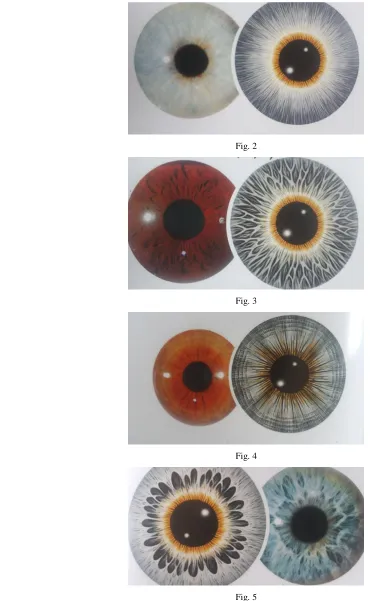
Fig. 2
Fig. 3
Fig. 4
Fig. 5
person the logical way of talking is quite differ to negotiating with scientific people. In the same manner in the composite websites we should use different themes, different manner of text and different ways of logical reasons to be the winner. If we want to divide these people in the hot manner and cold manner. We can say Fig. 2 and Fig. 4 are hot people and Fig. 3 and Fig. 5 are cold people. Now we want to discuss about the position of computer on the table of our users [7], [8], [9], [10], [11], [12], [13], [14], [15], [16], [17], [18].
Fig. 6
In Fig. 6 the place of computer is on the right side of user so the user feels very friendly with computer. In this case the text in the website is most effective on the brain of user. The user mostly uses the computer as a good friend and during the usage, user does not feel any stress.
Fig. 7
In Fig. 7 the place of computer is on the left side of user so the user feels the computer as a boss or director. In this case the text in the website is disturbing the brain of user (mostly when the user is hot manner person). The user mostly uses the computer as a boss or director, user feels should obey the computer.
Fig. 8
Hence when we want to obtain the most benefit from the composite web users we should consider not only the psych ological manner of the user but also the position of our negotiator in her/his place. It is very clear that if we are negotiate with one ideologist person and we are sitting on her/his write side is quite different to sitting on the left hand of him/her. This is very important to consider the psychological manner of the composite web user and also the position of our negotiator in his/her place (the computer). To win any kind of negotiation, to predict other side of negotiation psychological manner is the must. To choose the best position to other side, is also very important for winning the negotiation.
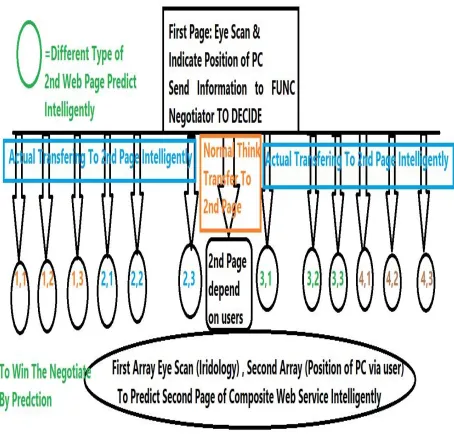
Now we try to describe how we use the composite web users’ eye scan and the position of computer via users. After getting online images through our composite web service, we send it to the function named “Negotiator”. In this function we compare the eye scan with our four main different eye scan, and also we compare the users’ image to verify position of computer via user. The output of this function as shown below will call another function named “TheWayOfNegotiation”. This called function will decide about the different kind of written text, themes of screen, the logical way of proof and the sensitive ways to direct the composite web users to our goal. The number of different ways are twelve ways. Multiplying main four kind of eye scans by three different position of computer via users, we obtain twelve different ways of negotiation.
Function Negotiator (webusereyescan,data1eyescan,data2eyescan,data3eyescan,data4 eyescan,webuserposition,data1userposition,data2userposition,data3userposition) Compare1=ImageProssesor(webusereyescan, data1eyescan) Compare2=ImageProssesor(webusereyescan, data2eyescan) Compare3=ImageProssesor(webusereyescan, data3eyescan) Compare4=ImageProssesor(webusereyescan, data4eyescan)
CC=FindMaximum(Compare1, Compare2, Compare3, Compare4) If CC=Compare1 PredictPersonality=X1 Endif If CC=Compare2 PredictPersonality=X2 Endif If CC=Compare3 PredictPersonality=X3 Endif If CC=Compare4 PredictPersonality=X4 Endif PositionCompare1=ImageProssesor(webuserposition, data1userposition) PositionCompare2=ImageProssesor(webuserposition, data2userposition) PositionCompare3=ImageProssesor(webuserposition, data3userposition) PC=FindMaximum(PositionCompare1, PositionCompare2, PositionCompare3) If PC=PositionCompare1 PredictNegotiation=Y1 Endif If PC=PositionCompare2 PredictNegotiation=Y2 Endif If PC=PositionCompare3 PredictNegotiation=Y3 Endif TheWayOfNegotiation(PredictPersonality,PredictNegotiation) EndFunc
4.
Conclusions
References
[1] A Quality Driven Web Service Selection ModelPierluigi Plebani (Politecnico di Milano, Italy) and Filippo Ramoni (Politecnico di Milano, Italy)Source Title: Handbook of Research on Service-Oriented Systems and Non-Functional Properties: Future Directions
Copyright: © 2012 |Pages: 23
DOI: 10.4018/978-1-61350-432-1.ch007
[2] Published in: IEEE Transactions on Services Computing ( Volume: 8 , Issue: 3 , May-June 1 2015 ) Page(s): 481 - 493
Date of Publication: 08 August 2014 ISSN Information:
INSPEC Accession Number: 15201126
DOI: 10.1109/TSC.2014.2346181
[3] Iridology – A Complete Guide, revised edition, Paperback – November 14,2013, by Farida Sharan ND.
[4] Dr. Jensen’s Guide to Better Bowel Care: A complete Program for Tissue Cleansing through Bowel Management Paperback September 1, 1998.
[5] Iridology: A Complete Guide to Diagnosing Through the Iris and to Related Forms of Treatment (A Thorsons Complementry Medical Textbook) Hardcover – May 1, 1990.
[6] Iridology – FAQ – Introduction 0404, Ebook.
[7] Ardrey, R., The Territorial Imperative, Collins, London, 1967
[8] Argyle, M., The Psychology of Interpersonal Behaviour, Penguin Books, 1967 [9] Argyle, M., Bodily Communication, Methuen, London, 1975
[10] Argyle, M., Shills with People: A Guide for Managers, Hutchinson, London, 1973 [11] Argyle, M., Training Managers, The Acton Society Trust, London, 1962 [12] Argyle, M., Social Interaction, Methuen, London, 1968
[13] Bacon, A.M., A Manual of Gestures, Griggs, Chicago, 1875
[14] Benthall, J. and Polhemus, T., The Body as a Medium of Expression, Allen Lane, London, 1975 [15] [16] Berne, E., Games People Play, Grove Press, New York, 1964
[17] Birdwhistell, R.L., Introduction to Kinesics, University of Louisville Press, Louisville, Kentucky, 1952
[18] Birdwhistell, R.L., Kinesies and Context, Allen Lane, London, 1971 Blacking, J., Anthropology of the Body, Academic Press, London, New York, 1977