i
A SURVEY OF DRIVERS OF PERFORMANCE ON WOMEN-OWNED SMALL AND MEDIUM ENTERPRISES IN SELECTED
MARKETS IN NANDI COUNTY KENYA
JANE JEPCHIRCHIR D53/OL/23066/2012
A RESEARCH PROJECT SUBMITTED TO THE SCHOOL OF BUSINESS IN PARTIAL FULFILLMENT OF THE REQUIREMENT FOR THE
AWARD OF DEGREE IN MASTER OF BUSINESS (HRM OPTION) OF KENYATTA UNIVERSITY
iii DEDICATION
iv
ACKNOWLEDGEMENT
I would like acknowledge several people who made completion of this research project a success. Special thanks to God for his grace throughout my studies, to all my family members, my friends and colleagues who have tirelessly encouraged me.
v
ABBREVIATIONS AND ACRONYMS
GDP: Gross Domestic Product
GEM: Global Entrepreneurship Monitor
ILO: International Labour Organization
MFI`s: Micro Finance Institutions
SACCO`s: Savings and Credit Cooperative Societies
SME`s: Small and Medium Enterprises
vi
TABLE OF CONTENTS
DECLARATION ... ii
DEDICATION ... iii
ACKNOWLEDGEMENT ... iv
ABBREVIATIONS AND ACRONYMS ... v
LIST OF TABLES ... ix
LIST OF FIGURES ... x
OPERATIONAL DEFINITION OF TERMS ... xi
ABSTRACT ... xii
CHAPTER ONE:INTRODUCTION ... 1
1.1 Background of the Study ... 1
1.1.1 Performance of Women-owned SMEs ... 1
1.1.2 Small and Micro Enterprises ... 3
1.2 Statement of Problem ... 5
1.3 Objectives of the Study ... 6
1.3.1General Objectives ... 6
1.4 Specific Objectives ... 6
1.5 Research Questions ... 6
1.6 Significance of the Study ... 7
1.7 Scope of the Study ... 7
1.8 Limitations of the Study ... 7
CHAPTER TWO:LITERATURE REVIEW ... 9
2.1 Introduction ... 9
2.2 Theoretical Framework ... 9
2.2.1 Max Weber Bureaucratic Theory ... 9
2.2.2 The Psychological Theory ... 10
vii
2.3 Empirical Review ... 11
2.3.1 Effect of Leadership Styles and Performance of Women Owned Enterprises... 11
2.3.1.1 Charismatic Leadership ... 12
2.3.1.2 Transformational Leadership ... 12
2.3.1.3 Autocratic Leadership ... 13
2.3.1.4 Bureaucratic Leadership ... 13
2.3.1.5 Leadership Style and Organizational Performance... 13
2.3.2 Effect of Skills on Performance of Women- Owned Smes. ... 15
2.3.3 Socio-Cultural Factors Affecting Performance of Women-Owned Smes ... 18
2.4 Conceptual Framework ... 21
2.5 The Research Gap. ... 22
CHAPTER THREE:RESEARCH METHODOLOGY ... 24
3.1Introduction ... 24
3.2 Research Design ... 24
3.3 Target Population ... 24
3.4 Sample Size ... 25
3.4.1 Sampling Procedure ... 26
3.5 Data Collection Procedure ... 26
3.6 Validity of Research Instruments ... 26
3.6.1 Reliability of Research Instruments ... 26
3.7 Data Analysis and Presentation ... 27
3.8 Ethical Consideration ... 27
CHAPTER FOUR:RESEARCH FINDINGS AND DISCUSSIONS ... 29
4.1. Introduction ... 29
4.2 Demographic Information ... 29
4.2.1 Respondents’ Distribution by Age ... 29
viii
4.2.3 Respondents’ Educational Background ... 30
4.2.4 Performance and Growth of Women Owned SMEs ... 31
4.3 Leadership Styles ... 32
4.3.1 Influence of Leadership Styles on Performance of Women owned SMES ... 32
4.4 Entrepreneurial Skills... 34
4.4.1 Training of Women on Entrepreneurial Skills. ... 34
4.4.2 Effects of Skills on Performance and Growth of Women Owned SMEs. ... 35
4.5 Socio-Cultural Factors ... 37
4.5.1 Family Issues and Performance of SMEs ... 37
4.5.2 Influence of Socio-cultural Affecting Performance of SMEs ... 38
CHAPTER FIVE:SUMMARY, CONCLUSIONS AND RECOMMENDATIONS ... 41
5.1. Introduction ... 41
5.2. Summary ... 41
5.3 Conclusions ... 42
5.4. Recommendations of the Study ... 43
5.4.1. Recommendations for Further Research ... 43
REFERENCES ... 44
APPENDICES ... 51
APPENDIX I: LETTER OF INTRODUCTION ... 51
APPENDIX II: QUESTIONAIRES ... 52
WOMEN ENTREPRENEURS QUESTIONAIRE ... 52
APPENDIX III: LETTER OF APPROVAL ... 56
APPENDIX IV: LETTER OF ATHORIZATION ... 57
ix LIST OF TABLES
Table 3.1: Distribution of the Target Population ... 25
Table 3.2: Distribution of the Sample Size ... 25
Table 3.3 Empirical Model. ... 27
Table 4.1: Respondents’ Distribution by Age ... 29
Table 4.2 Respondents’ Age When Starting Business ... 30
Table 4.3: Respondents’ Educational Background ... 31
Table 4.4: Performance and Growth of Women Owned SMEs ... 31
Table 4.5 Influence of Leadership Styles on Performance of women owned SMES . 33 Table 4.6: Effects of Skills on Performance and Growth of Women Owned SMEs. . 36
x LIST OF FIGURES
Figure 1: Showing the Impact of Leadership Styles ... 32
Figure 2: Showing the Extent to Which Training Affects Performance of SMEs ... 35
xi
OPERATIONAL DEFINITION OF TERMS
Entrepreneurship: The creation of value through creation of organization process of starting and or/growing a new profit making business.
Drivers: A process or condition that is vital for the continued success and growth of business.
Growth of SMEs: Change in status in terms of size and financial output.
Micro finance institutions: Deal with risks and returns, with funds attracted and loaned, with products and services that are similar to the ones offered by mainstream banking.
Performance: This is a qualitative change in the micro and small scale entrepreneurs.
Woman entrepreneur: A female human being running a business.
xii ABSTRACT
1 CHAPTER ONE
INTRODUCTION
This chapter describes the background of the study, statement of problem, broad objectives, specific objectives, research questions, significance, scope and limitations of the study.
1.1 Background of the Study
1.1.1 Performance of Women-owned SMEs
Entrepreneurship is the dynamic process of creating incremental wealth. The wealth created by individuals who assumed the major risks in terms of equity, time and /or career commitment or provided value for same product or service. Entrepreneurship is the process of creating something new with value by devoting the necessary time effort, assuming the accompanying financial, psychic, and social risks and receiving the resulting reward and personal satisfaction and independence Hisrich et al., (2007). Business growth was extremely important issue in the study in entrepreneurship. Despite its significance, not much work had been done to study growth of women owned enterprises until the launch of the Diana project in 1999 (Green et al, 2003). Notably absent was an understanding of factors affecting growth and a lack of cumulative knowledge to adequately conceptualize and build explanatory theories of growth process on women owned enterprises (Bush et al, 2006).
2
Other entrepreneurial factors identified by Tarus et al, (2006) are the previous management experience, family history, functional skills and relevant sector knowledge. None of these however had conclusively constituted to a universal success factor. Rosa et al., (1996) conducted one of the few large scale studies to measure the comparative performance of business by gender.
They found that women-owned businesses had a lower sales turnover, fewer employees serving mostly the local markets and women enterprises being less ambitious to grow their businesses and less optimistic than men about the success of the business in future. Perry & Coetzer, (2009) observed that women were considered in many societies as unfit to assume the responsibilities of credit, despite the fact that they take the responsibility of the survival of their families. Women entrepreneurship is essential for any country’s growth and development. Some scholars even argue that women entrepreneurs’ contribution tends to be higher than that resulting from entrepreneurial activity of men (Minniti, 2010). The general attention to women and entrepreneurship in developing countries has increased to a great extent and the focus on this ‘untapped source’ of growth seems to be indispensable for development practitioners and policy makers (Minniti et al., 2010).
The role of small-scale enterprises in catalyzing growth and development of a developing economy had been acknowledged by numerous scholars (Kibas, et al., 2006). The importance of microfinance activities and small enterprise sector was particularly apparent in terms of its ability to provide employment for those of working age. Using an estimated of 13million Kenyans working age in1993, micro and small enterprises provide employment for 16% of labor force. Again, the bulk of this employment is in rural areas Muteshi, (2006). Entrepreneurship requires skills, needed to assume the risk of establishing a business. Entrepreneurship skills are simply business skills which individuals acquire to enable them effectively function in the turbulent business environment as an entrepreneur or self-employed. It takes special skills to succeed as an entrepreneur but most entrepreneurial skills come by learning and practicing Ezeani, (2012).
3
World Economic Forum Gender Gap report (2014), the U.S. has experienced 11% growth over the last 40 years as a direct result of the increased participation of women, which has translated into $3.5 trillion. The report further eludes that if the barriers to female labor force participation were reduced, the Gross Domestic Product (GDP) of a country like Japan would grow by 16%. Investing in women as observed by world economic forum, promotes economic and social development as women reinvest in their communities and homes.
In both developed and developing economies; savings rise and spending shifts toward food, health, and education as women gain power over household income (World Economic Forum, 2014). Rapid growth of women’s self-employment and entrepreneurs confirm that women owned enterprises were an important avenue to improve women’s employability and economic growth, thus poverty alleviation. Fostering women’s self-employment and entrepreneurship was acknowledged as a policy priority by the regional briefing meeting in Geneva, (2000). Women being an emerging economic force, policy makers could not afford to ignore. Women in Africa constituted 52% of the total population and contribute 75% of the agricultural work and produce and market 60-80% of the food.
1.1.2 Small and Micro Enterprises
4
Women interests and activities in the economic growth and development especially in the area of SMEs have received outstanding interest of researchers. Global Entrepreneurship Monitor (GEM) (2005) confirmed that women participate in a wide range of entrepreneurial activities across the 37 Global Entrepreneurship Monitor and their activities in different countries have paid off in form of many newly established enterprises for job and wealth creation. This entrepreneurship is usually seen from the perspective of men driven economy (Schuler & Riley, 2010) due to its complexity, particularly its gender issues, the role of women entrepreneurs has not been properly documented. In Tanzania, many women have achieved financial and personal independence as they are actively involved in working hard. Lack of financial resources and entrepreneurial skills has not prevented them from starting up their businesses (Schuler & Riley, 2010).
All across Tanzania, women entrepreneurs are proving that they have a driving business spirit and that they are part of the solution to achieving economic growth and pulling people out of poverty (ILO, 2008). However, most women are engaged in petty trade activities like informal food catering, informal catering, food vending, beauty salon, roadside trade, local brewing, vegetable selling and tailoring that are typical viewed as a women’s activities ILO, 2002; Makombe, (2006).
In Kenya the small business sector has both potential and historic task of bringing millions of people including informal economy to the mainstream economy. The Kenyan Government through Kenya Vision 2030 envisages industries of tomorrow by improving SMEs productivity and innovation (MPNDV2030). In Kenya, women constitute 51% of the total population and they play very crucial roles in economic development as small scale entrepreneurs, but face some key challenges like limited access to finance, inadequate entrepreneurial skills, lack of reliable networks and market for their SMEs (Wanjohi et al., 2008).
5
owned by women who face the twin challenge of business skills and financing (UNDP, 2007).
Most entrepreneurship training programmes are too general in scope and do not offer a growth strategy orientation. Many of them focus on the start-up process with very limited effort on the part of the training providers with regard to doing any post-training follow-up. In addition, women tend not to use supporting government programmes including the training programmes provided (Langowitz, N. & Minniti M., 2007). This might be a problem pertinent to women entrepreneurs as generally there is a lack of entrepreneurship training and skills development in Kenya where most women entrepreneurs acquire their skills and experience through their family members, friends and previous experiences (Republic of Kenya, 2005).
1.2 Statement of Problem
Small and medium enterprises play a very important role in economic growth and employment. According to the Kenya National Bureau of Statistics, (2007) over 70% of the SMEs in Kenya are prone to fail. In general SMEs play a very critical role in every economy ranging from, employment, and source of income, empowerment and alleviation of poverty. The major problems faced by women entrepreneurs are competition from better quality products and marketing problems. Accessibility to initial capital, even when available, is also a major hurdle for women entrepreneurs (Kenya National Bureau of Statistics, 2007).
6
In the developed world leadership and prior knowledge have been associated with growth of women-owned enterprises (Bruni, Gherardi & Poggio, 2004; Eaglyet al., 2003). But the present study perceived that evaluation of the women’s leadership styles in business; skills and socio-cultural factors that influence the performance of women-owned and managed SMEs in Nandi County could solve the problem. This study, therefore sought to survey drivers of performance on women-owned Small and Medium Enterprises in selected markets in Nandi County, Kenya.
1.3 Objectives of the Study
1.3.1General Objectives
The purpose of the research sought to survey drivers of performance on women-owned small and medium enterprises in selected markets in Nandi County, Kenya.
1.4 Specific Objectives
(i) To determine how leadership styles affect performance of women-owned SMEs in Nandi County, Kenya.
(ii) To find out the effect of entrepreneurial skills on performance of women-owned SMEs in Nandi County, Kenya.
(iii) To establish the extent in which socio-cultural factors affect performance of women-owned SMEs in Nandi County, Kenya.
1.5 Research questions
(i) What effect does leadership styles have on performance of women-owned SMEs in Nandi County, Kenya
(ii) How are entrepreneurial skills affecting performance of women-owned SMEs in Nandi County, Kenya?
7 1.6 Significance of the Study
The research findings would have some impact on policies regarding enterprise support for female entrepreneurs, enterprise education in general and specifically enterprise education for female entrepreneurs and business owners. This research will also have impact on the way academicians will strategically view, design and deliver entrepreneurship programmes to female entrepreneurs and business owners for better performance, having looked at the challenges that face SMEs. This study is likely to provide information for all the micro financial institutions (MFIs). This will help in designing and implementing effective and efficient services directed towards women owned enterprises so that the benefits of MFIs can be realized.
This current research adds to the current growing literature on women entrepreneurship, women and business growth and entrepreneurship education. The study is useful to the various financial intermediaries like the banking institutions in developing new financial products that is relevant to small and medium women enterprises and low income households. With the increase in banks this addresses the relevant bank products which suit women owned enterprises. The study is also relevant to the insurance sector as it addresses on the issues of investment patterns and products that are relevant for women owned enterprises.
1.7 Scope of the Study
This study focused on women-owned SMEs and their managers at selected markets in Nandi County. The researcher targeted women entrepreneurs who run their own businesses like (Tailoring, kiosks, hotels, salons and green groceries). Specifically, this study sought to survey the drivers that affect performance of women-owned SMEs which are leadership styles, skills and socio-cultural factors.
1.8 Limitations of the Study
8
requisite authorization. This challenge was addressed by assuring the respondents that their identity remained anonymous and that the study was limited to academic use only.
9 CHAPTER TWO
LITERATURE REVIEW
2.1 Introduction
This chapter contained both theoretical and empirical literature review, conceptual frame work and knowledge gap in the area of study.
2.2 Theoretical Framework
2.2.1 Max Weber Bureaucratic Theory
According to Weber, M., (1947) Bureaucracy should be synonymous with order, consistency, reason and reliability. He noted that a bureaucratic organization should have the following characteristics:
Specialization and division of labor.
Specific set tasks allow employees to achieve its own objective. Thus every worker did not have to do many jobs, but an exclusive task that was assigned to that worker. This helped to alleviate multiple trainings and increase production.
Hierarchy of Authority.
Organizations need to have a chain of command that is shaped like a pyramid. There are levels of supervisors and subordinates. Each worker will answer to their corresponding supervisor. This would assist in having a direct line of communication and better efficiency in the organization.
Employment Based Experience.
10
Charismatic authority is founded on the idea that the best candidate for this position will be the one who can exert authority. If the candidate leaves the position then the authority does as well.
Weber felt that bureaucratic was the best way to delegate authority in an organization, because it neutralizes thwarted ideas of nepotism, preferential treatment, prejudice and discrimination. Hence, one would be selected in terms of their job competency and not their linage or personality. This theory aided the researcher on finding factors that alleviate multiple trainings and increase production, the direct line of communication and better efficiency in the organization and to exploit the entrepreneurial skills and competences of women-owned SMEs in selected markets within Nandi County.
2.2.2 The Psychological Theory
This theory was first proposed by McClelland, (1965). This theory considers entrepreneurs as people who do things in a better way and makes decisions in times of uncertainty. The dream to achieve big things overpowers monetary or other external incentives. McClelland’s theory holds that people have three motives for accomplishing things that is the need to achieve; the need for affiliation; and the need for power. The need for achievement and the need for power are the two major drivers to entrepreneurship. However, it is pertinent to note that McClelland failed to prove the sense of frustration that drives people to entrepreneurship.
2.2.3 Rensis Likert’s Participative Decision Making (PDM) Theory.
11
Likert hence created four distinct management styles: Exploitative, Benevolent, Consultative and Participative system. He believed that an organization’s performance is based on the systems or structures in place for the workers. Thus he believed that organizations could incorporate some aspects from the scientific management approach, human relations and human resource approach in order to maximize organizational outcomes. This theory helped the study on in increasing effective management of resources and assisted them in candid decision on performance of women-owned SMEs.
2.3 Empirical Review
2.3.1 Effect of Leadership Styles and Performance of Women Owned Enterprises Leadership is life blood of any organization and its importance cannot be underestimated. Many authors have studied this phenomenon but there is no conscious definition of what leadership is, no dominant paradigm for studying it, and little agreement regarding the best strategies for developing and exercising it (Bennis, 2007; Hackman & Wageman
12 2.3.1.1 Charismatic leadership
By far the most successful trait-driven leadership style is charismatic. Charismatic leaders have a vision, as well as a personality that motivates followers to execute that vision. As a result, this leadership type has traditionally been one of the most valued. Charismatic leadership provides fertile ground for creativity and innovation, and is often highly motivational. With charismatic leaders at the helm, the organization’s members simply want to follow. It sounds like a best case scenario. There is, however, one significant problem that potentially undercuts the value of charismatic leaders: they can leave the organization. Once gone, an organization can appear rudderless and without direction. The floundering can last for years, because charismatic leaders rarely develop replacements. Their leadership is based upon strength of personality. As a result, charismatic leadership usually eliminates other competing, strong personalities. The result of weeding out the competition is a legion of happy followers, but few future leaders Weber, (1947).
In this study, through the charismatic leadership women owned SMES were able to achieve their goals by enhancing creativity and innovation and hence competition reduced. This study was enriched by this kind of transaction leadership. There is need for them to have this personality of leadership in their daily business.
2.3.1.2 Transformational leadership
13 2.3.1.3 Autocratic leadership
Autocratic leaders are classic “do as I say” types. Typically, these leaders are not experienced with leadership thrust upon them in the form of a new position or assignment that involves people management. Autocratic leaders retain for themselves the decision- making rights. They can damage an organization irreparably as they force their ‘followers’ to execute strategies and services in a very narrow way, based upon a subjective idea of what success looks like. There is no shared vision and little motivation beyond coercion. Commitment, creativity and innovation are typically eliminated by autocratic leadership. In fact, most followers of autocratic leaders can be described as biding their time, waiting for the inevitable failure this leadership produces and the removal of the leader that follows Michael, (2010).
2.3.1.4 Bureaucratic leadership
Bureaucratic leaders create and rely on policy to meet organizational goals. Policies drive execution, strategy, objectives and outcomes. Bureaucratic leaders are most comfortable relying on a stated policy in order to convince followers to get on board. In doing so they send a very direct message that policy dictates direction. Bureaucratic leaders are usually strongly committed to procedures and processes instead of people, and as a result they may appear aloof and highly change adverse. The specific problem or problems associated with using policies to lead are not always obvious until the damage is done. The danger here is that leadership’s greatest benefits, motivating and developing people, are ignored by bureaucratic leaders, Weber, (1947).
2.3.1.5 Leadership style and organizational performance
14
organizational performance. Effective leadership style is seen as a potent source of management development and sustained competitive advantage, leadership style helps organization to achieve their current objectives more efficiently by linking job performance to valued rewards and by ensuring that employees have the resources needed to get the job done.
Sun, (2002) compares leadership style with the leadership performance in schools and enterprises, and found that leadership style had a significantly positive correlation with the organizational performance in both schools and enterprises. Broadly speaking, leadership performance is identical with organizational performance. Business management attributes their successes to leadership efficiency, that is, the leadership style of administrative supervisors has a considerable effect on the organizational performance (Sun, 2002).
Fu-Jin et al., (2010) opine that when executives use their leadership style to demonstrate concern, care and respect for employees, it would increase interest of employees in their work and enable them to put up better performance, thereby affecting their job satisfaction positively. Howell and Frost (1989) cited in Fu-Jin et al., 2010) also confirm that there is a positive relation between leadership style and organizational performance.
15
Participation in a self-help group fosters women’s self-confidence and encourages them to exercise greater decision-making within the household and in their enterprises. In Tunisia, it was noted that participation in the micro credit programmes constituted an apprenticeship of democracy through the self-managed solidarity groups which elect their president and treasurer (Ferri et al., 2009). This would be considered a very major development in mixed group where a woman is elected as president of a group in a still male dominated society. Group formation has been found to assist women entrepreneurs to formulate opinions that can be expressed; it is a means for women entrepreneur to know and be known by other women entrepreneurs Kiunga 2009; Nteere 2012; Allen 2010; Ferri et al., (2009).
2.3.2 Effect of Skills on Performance of Women- owned SMEs.
Human capital is the prerequisite for development, hence raising its quality and productivity is a critical factor for increasing economic growth and reducing poverty levels (URT, 2001). Education is looked upon as a major instrument of socio-economic transformation. It brings rapid changes in artifacts essential in production as well as rapid changes in work attitudes Owolabi, (1987). However, the influence of training on women performance, especially in Tanzania has not been adequately addressed in the literature. Additionally, there is a missing link on whether women owned small scale businesses have the necessary education to run business (URT, 2001).
16
Entrepreneurial skills compares favorably with the basic skills required for starting, developing, financing, financing and marketing business enterprise Lyve, (2005). Furthering this, Akande, (2011) described entrepreneurial skills as qualities or attributes required for an entrepreneur to start and successfully manage a business in a competitive environment.
This study looked at the business skills that business women possessed for the success of their businesses. Then there is need to clearly state what the clients should expect. If your clients have the wrong perception of what you can and are offering them it might be a challenge to turn them into repetitive business. This literature guided the study in establishing the entrepreneurial skills of the business women (Akande, 2011).
An entrepreneurial skill is needed in every business in order to learn how to delegate it. It is commonly known that small entrepreneurs do not know how to delegate. Delegation is the hardest thing for most of the small enterprise owners. Sometime it does not matter how the business grows and if new employees are hired, the owner does not like to trust and delegate to them. He/she likes to run all business on his/her own and carry all things by him/herself. But entrepreneurship is critical to business success and for a healthy work life balance. One person cannot do everything that needs to be done as he/she will get so busy and work will take over his/her personal life which causes personal unhappiness, stress and other problems ,Meager, (2011).
17
this section. These variables include; psychological, economic and social-demographic variables. The choice of these variables is subject to the entrepreneur’s view. However, in the entrepreneurship literature, business performance is measured from the economic perspectives in terms of increase in sales volume or turnover, employee strength and profits (Gales & Blackburn, 2003; Chandler & Hanks, 2005).
Due to the nature of women and the circumstances surrounding their entrepreneurial motivation, variables such as business net worth and outcome may be used in measuring their entrepreneurial performance. This was in line with the Bigoness’s, (2009) argument who reported that women had a stronger preference for jobs that offer opportunity for professional growth to jobs that offer opportunity for higher income. The relationship between women entrepreneurial motivation and their performance, the work of Stoner & Fry, (2002) offered a good insight on this. Their study found out that there is a positive relationship between the reasons why women start business and their business outcomes.
In other words, the factors that motivate women into entrepreneurship has/have way(s) of affecting their performance in the business. For instance, the pursuit of financial independence as a factor that influences women into business can positively affect their performance in terms of quantifiable variables such as volumes of production, capacity utilization, growth rates, market share, niche market positions, and return on assets, net worth, sales, dividend payouts, share price and profitability.
The measurement of business performance is also subject to the entrepreneurial motivational factors which might be pull or push and intrinsic or extrinsic (Ahuja & Lampert 2010; Ryan & Deci, 2009; Morris, 2006; Brunstein & Maier, 2005). The motivation is pull, push, intrinsic or extrinsic inclined, and the performance effect can be internally and/or externally measured.
18
terms of the growth she experiences in her business profit and/ or career life (Ahuja & Lampert, 2010).
2.3.3 Socio-cultural Factors Affecting Performance of Women-owned SMEs In developing countries, women entrepreneurs are always faced by social barriers that deter their economic success. Inter–American Development Bank (2010) ILO (2010) shares similar observations that women’s quest of having successful enterprises has been hindered by cultural, economic and political drawbacks. ILO (International Labor Office) seed program and ADB (African Development Bank) (2004) established that majority of the poor women entrepreneurs in sub-Saharan Africa operate their enterprises in harsh environments than their male counterparts.
In most of the cases, women entrepreneurs support the household needs of their families from the meager profits or capital of their underfinanced enterprises experiences low investment capital, limited market opportunities and low profits World Bank, (2005). Empowering women through education promotes gender equality, achievement of their potential for positive contributions to economic development. Investing in the education of women as a long term economic development strategy helps in empowering women. As was rightly observed by Omotayo (2015), education is a human right and an essential tool for achieving gender equality, economic development and growth. Women have proved themselves competent but they are still under-represented in positions. SME women are able to identify certain gender-related hurdles. Most prominent is coping with the dual responsibility and demands of family and business. Childbearing, child care and demands of husbands created problems which necessitate increased coping mechanisms (Omotayo, 2015).
19
information and experiences as well as to conduct training programs, seminars and workshops for improvement of the performances in their SME’s. This is due to the fact that women may not join their associates as they may be overloaded with family responsibilities (Mutuku, 2005).
Most prominent was in coping with the dual responsibility and demands of family and business. Child bearing, child care and demands of husbands created problems which necessitate increased coping mechanisms. Also important in the corporate situation is the male negative attitude. This usually present a serious problem as men control power, this therefore necessitate women to prove themselves over and over again when it comes to business management (Barret et al., 2008).
The World Bank Group (IFC, 2007) shows that women often benefit more than men from business enabling environment reforms as their businesses tend to have more problems. To address this issue, the gender and growth assessment tool was developed in Uganda, Kenya, Tanzania and Ghana. The World Bank Group started the Gender Enterprise Markets. Gender Enterprise Markets aim to help better leverage the untapped potential of women in the emerging markets. Its activities are structured around three main goals, namely increasing access to finance for women, adding value to IFC investment projects and addressing gender barriers in the business-enabling environment, Starcher, (2008).
Women's family obligations also bar them from becoming successful entrepreneurs in both developed and developing nations. Having primary responsibility for children, home and older dependent family members, few women can devote all their time and energies to their business. The financial institutions discourage women enterprises on the belief that they can at any time leave their business and become housewives again. Differential access to credit may of course be a reflection of differences in the choice of sector, educational level or the amount of loan requested.
20
is a determinant factor in the realization of women folk business aspirations. Another argument is that women enterprises have low-level management skills. Nevertheless, as sector choice and educational levels tend to be limited or influenced by gender, it is possible to conclude that any differential access based on this motive is indirectly caused by gender perceptions. In addition to this, women enterprises in developing countries like Kenya and others African countries continue to suffer from poor overall assets, poor enforcement of financial rights and the existence of unequal inheritance rights and consequently poor access to community and social resources. This phenomenon seems to be applicable to Kenyan women entrepreneurs. It was reported that women entrepreneurs faced a shortage of peer support networks compared with men even though various women entrepreneurs and industry associations have been formed which generally serve as a platform for women entrepreneurs to establish networks and exchange information and experiences as well as to conduct training programmes, seminars and workshops on motivation, leadership and entrepreneurship development and to provide other means of support (Stevenson and Jarillo, 2009).
This is due to the fact that women may not join these associations as they might be overloaded with business and family responsibilities. This limits the women entrepreneurs’ ability to seek informal advice and peer financing as well as the information networks needed for survival and growth. This might pose a challenge to women entrepreneurs in establishing networks which are helpful to the survival of their businesses (De Tienne, D. R. & Chandler, G. N. (2007). Networks have long been hailed as essential to the survival of female-run establishments Boyd, (2005). It is a critical element for entrepreneurs in gaining access to capital/loans, advice and information needed for initiating and operating a new venture easily (Carter et al., 2006). Entrepreneurs make use of social relations and social contacts as channels to gain access to information, customers, and suppliers and to the sources of finance. They make use of family networks to access unpaid family work as well as emotional support. It has been found that support from personal network improves survival, growth and performance chances of new ventures.
21
of new ventures. Help and emotional support from spouse are more important for success in case of the women entrepreneurs Mutuku et al., (2006). Men and women have different priorities in establishing networking relationships. Men’s motives are more instrumental (seeking personal gain) while women have more affective considerations in social relationships. Their management style is not seen as being relevant and thus, women are often excluded from the male networks which are very effective. Women do not have the same tools, assets, and chances than men in the small business arena. When confronted by business problems or difficulties, women entrepreneurs seek assistance first from family, then from close friends and only last from knowledgeable business sources whereas men entrepreneurs rather seek advice from their networks. According to Mutuku, et al., (2006), this might be due to lack of professional experience or the diverse social network needed for women to fully utilize the information and resources provided.
2.4 Conceptual Framework
22
Independent Variables Dependent Variables
Source author (2016)
Intervening Variables Source: Author 2016
2.5 The Research Gap.
Women are becoming increasingly important in the socio-economic development of both developed and developing economies as they own most of Small and Medium Enterprises. However, efforts to improve financial performance and growth of SMEs run by women remain futile partly due to lack of adequate knowledge by the concerned stakeholders on how capacity building impacts on financial performance and growth of women owned SMEs. The contribution of women to the economy is significant. The World Intellectual Property Organization (WIPO) speaks strongly about the positive role women play in creating wealth and employment. It says that during the years of economic crisis and recession, one robust sector that provides economic growth, increase productivity and employment is that of small and micro enterprises. The micro and small enterprises are mainly run by women.
The Organization for Economic Cooperation and Development OECD,(2004) notes that women entrepreneurs have untapped source of economic growth, create new jobs for themselves and others, provide society with different solutions to management,
Leadership styles Charismatic leadership Transformational leadership Autocratic leadership Bureaucratic leadership Skills Entrepreneurship Training Delegation
Sales and marketing
Social-cultural factors Gender inequality
Time (Dual responsibilities) Male negative attitude
Performance of women-owned SMEs Profitability
Customer satisfaction Growth
23
organizations and business problems and exploit entrepreneurial opportunities. Many women entrepreneurs have to experience the troubling “assistance” of support agencies. Harassment in government departments, indifferent and discriminating attitude of officials of all small-scale industry related departments, such as taxation, labor, power, are some of the problems that women entrepreneurs have to deal with activities of the enterprise. The inability to keep proper records, to separate business operations from personal, manage cash flow and growth is most likely to affect business performance of SMEs.
24 CHAPTER THREE
RESEARCH METHODOLOGY
3.1Introduction
This chapter sets out the procedure that was followed in completing the study. Specifically the following subsections was included; research design, target population, sample size and sampling procedure, data collection instruments, data analysis and presentation and finally ethical consideration.
3.2 Research design
A research design is the general plan of how one goes about answering the research question Saunders, Lewis & Thornhill, (2000).This research adopted a descriptive survey design. It employed both quantitative and qualitative techniques. A descriptive survey design sought to obtain information that described existing phenomena by asking individuals about their perceptions, attitude, behavior or values, Mugenda & Mugenda, (2003). This design was considered appropriate for the type of objective of this study as it enabled the researcher to describe the state of affairs as they existed without manipulation of variables which was the aim of the study.
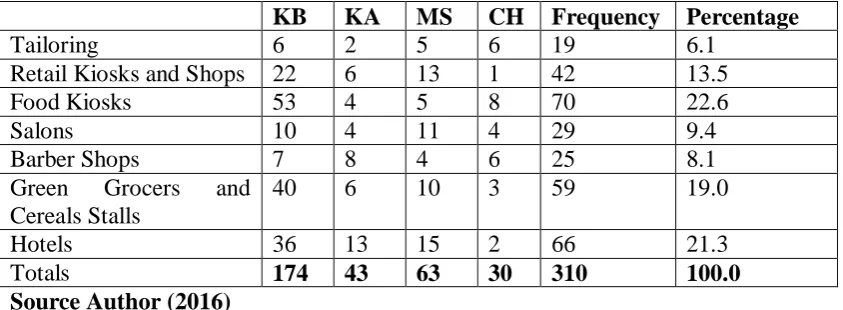
3.3 Target Population
25 Table 3.1: Distribution of the Target Population
KB KA MS CH Frequency Percentage
Tailoring 6 2 5 6 19 6.1
Retail Kiosks and Shops 22 6 13 1 42 13.5
Food Kiosks 53 4 5 8 70 22.6
Salons 10 4 11 4 29 9.4
Barber Shops 7 8 4 6 25 8.1
Green Grocers and Cereals Stalls
40 6 10 3 59 19.0
Hotels 36 13 15 2 66 21.3
Totals 174 43 63 30 310 100.0
Source Author (2016)
KB = Kabiyet market, KA = Kaiboi market, MS = Mosoriot market, CH = Chepterit market
3.4 Sample Size
Cooper and Schindler, (2000) stated that the sample size is the selected element or subset of the population to be studied. According to Mugenda & Mugenda, (2013) a sample size of between 20 and 30 percent was adequate for a population of below 1000.This study used 30 percent of the population, hence sought to gain information from 93 respondents who were women owned entrepreneurs and their managers at selected markets in Nandi County. This was shown in table 3.2 below.
Table 3.2: Distribution of the Sample Size
Source Author (2016)
Frequency Sample size
Tailoring 19 19*0.3 = 5.7
Retail Kiosks and Shops 42 42*0.3 =12.6
Food Kiosks 70 70*0.3 =21
Salons 29 29*0.3 =8.7
Barber Shops 25 25*0.3 =7.5
Green Grocers and Cereals Stalls 59 59*0.3 =17.7
Hotels 66 66*0.3 =19.8
26 3.4.1 Sampling Procedure
Sampling means selecting a given number of subjects from a defined population as representative of that population. To select the individual respondents the researcher used simple random sampling using lottery method where from 310 women, 93 respondents from both owners and managers of tailoring, retail kiosks and shops, food kiosks, hotels, salons and barber shops, green grocers and cereals stalls were selected.
3.5 Data Collection Procedure
Data is anything given as a fact on which research inference was based. It is an actual or assumed basis of reckoning Mugenda & Mugenda, (2008). In this study the researcher obtained an introductory letter from Kenyatta University, once granted the researcher collected data using questionnaires. The researcher explained the need for the research on all issues pertaining to the data collection procedures and techniques before carrying out the study. A set of 93 questionnaires was issued to the respondents. The researcher collected data using questionnaires. The questions in the questionnaires were both open ended and closed ended. The questionnaire was designed to collect quantitative data. These questionnaires were given to women entrepreneurs in selected markets in Nandi County using drop and pick method.
3.6 Validity of Research Instruments
Validity indicates the degree to which an instrument measures what it is supposed to measure; the accuracy, soundness and effectiveness with which an instrument measures what it is intended to measure (Kothari, 2004). To ensure validity of the research instrument, the researcher used expert raters and supervisors of Kenyatta University. Opinions and constructive criticism from the supervisors was used to improve the validity of research. Piloting of the questionnaires was done in randomly selected markets within Eldoret town from each of the category.
3.6.1 Reliability of Research Instruments
27
Eldoret market. The pilot tested scores was used to calculate Cronbach Alpha where a value greater than 0.7 indicated that the instrument was reliable.
3.7 Data Analysis and Presentation
Data analysis refers to separation of data into constituent elements. The data collected was analyzed using descriptive statistics. The researcher developed a coding scheme by creating codes and scales from the responses which was then summarized and analyzed using empirical equation. The empirical model shown below enabled analyzing the collected data in order to determine the analysis of variance, coefficient of determination a regression coefficients.
Table 3.3 Empirical Model.
The study was guided by a multiple regression model as shown below: Yi = β0 + βi (LSi) + βi (SSi) + βi (SFi) + ε
Where: Y = Growth of the ith SME LS = Leadership style Index of ith SME SS = Skills of ith SME
SF= Socio-cultural factors Index of ith SME
β are coefficients to be estimated and ε is the error term.
This model was estimated using least squares regression technique. The level of significance for this study was considered as ρ < 5%. All the quantitative analyses for this study were conducted using the Statistical Package for Social Sciences (SPSS) Version 20.
Quantitative data was presented through percentages, frequencies, and graphs and the findings were displayed by use of tables and figures.
3.8 Ethical Consideration
28
under study is sensitive because it involved the core business of the organization. Therefore, there was need to protect the identity of the respondents as much as possible.
29 CHAPTER FOUR
RESEARCH FINDINGS AND DISCUSSIONS
4.1. Introduction
This chapter presents and discusses the findings that were gathered in an attempt to achieve the objectives of this study. This section comprised of research findings and discussion from the data collected and analyzed and was then presented in tables, graphs and charts.
4.2 Demographic Information
The study initially sought to find out information on various aspects of the respondents’ background which includes the respondent’s age and academic background. This information aimed at testing the appropriateness of the respondent in answering the questions regarding to the drivers of performance on women-owned small and medium enterprises.
4.2.1 Respondents’ Distribution by Age
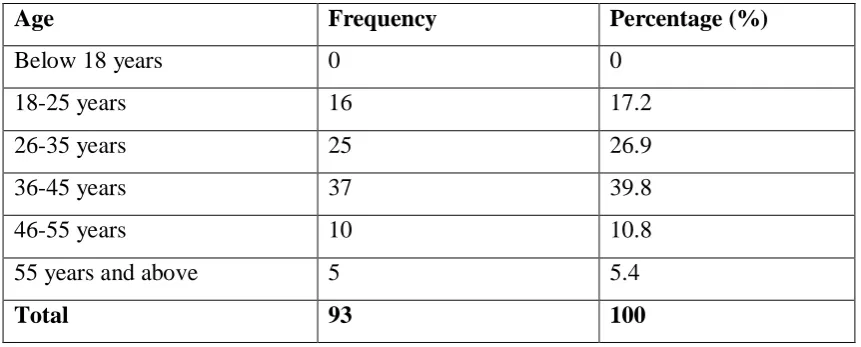
The study sought to establish the age of the respondents. The table below indicates the age of the respondents
Table 4.1: Respondents’ Distribution by Age
Age Frequency Percentage (%)
Below 18 years 0 0
18-25 years 16 17.2
26-35 years 25 26.9
36-45 years 37 39.8
46-55 years 10 10.8
55 years and above 5 5.4
Total 93 100
30
From the table above findings showed that 39.8% of the respondents were 36-45 years old, 26.9% were 26-35 years old, while 17.2% were 18-25 years, 10.8% were 46-55 years while 5.4% were 55 years and above. This depicts that majority of the women owned SMEs were operated by young and energetic women aged 36 to 45 years.
4.2.2 Respondents’ Age When Starting Business
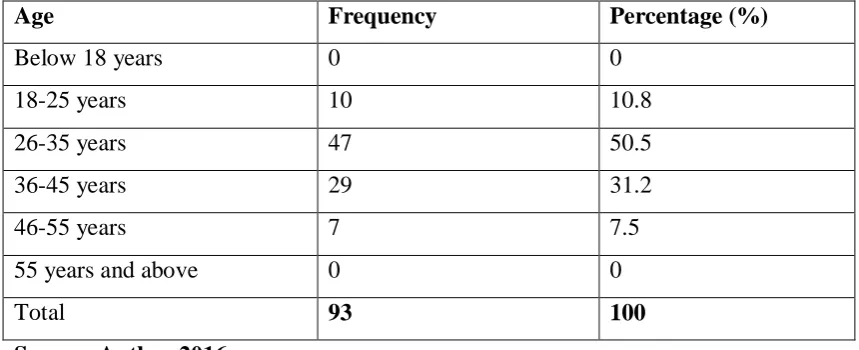
The study also sought to establish the age of the respondents at the time that they were starting the businesses. The findings are as shown in Table 4.2 below.
Table 4.2 Respondents’ Age When Starting Business
Age Frequency Percentage (%)
Below 18 years 0 0
18-25 years 10 10.8
26-35 years 47 50.5
36-45 years 29 31.2
46-55 years 7 7.5
55 years and above 0 0
Total 93 100
Source: Author 2016
Based on the findings, 50.5% of the respondents were 26-35 years old when they started their businesses, 31.2% were 36-45 years while 10% were 18-25 years old when they started their businesses. This illustrates that the majority of the women started their SMEs at an early age of 26-35 years and therefore had accumulated a lot of business knowledge and skills over time.
4.2.3 Respondents’ Educational Background
31 Table 4.3: Respondents’ Educational Background
Age Frequency Percentage (%)
Primary level of education 15 16.1
Secondary level of education 39 41.9
Diploma or certificate 30 32.3
Bachelor’s Degree 7 7.5
Master’s Degree 2 2.2
PHD Degree 0 0
Total 93 100
Source: Author 2016
According to the findings, most of the respondents 41.9% had attained Secondary level of education, 32.3% were diploma or certificate holders, 16.1% had attained primary level of education while 9.7% were degree holders. This information shows that the respondents had a sound academic background as they had attained secondary level of education to be able to run their businesses competently.
4.2.4 Performance and Growth of Women Owned SMEs
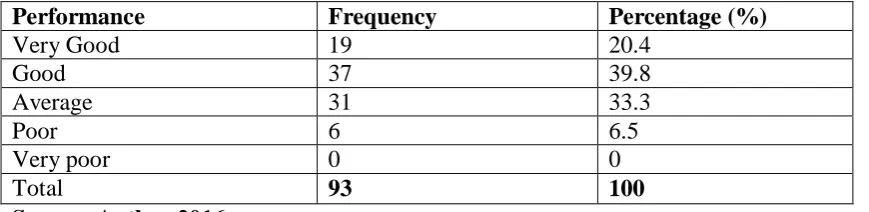
The study also sought to establish performance and growth of women owned SMEs.
Table 4.4: Performance and Growth of Women Owned SMEs
Performance Frequency Percentage (%)
Very Good 19 20.4
Good 37 39.8
Average 31 33.3
Poor 6 6.5
Very poor 0 0
Total 93 100
Source: Author 2016
32 4.3 Leadership Styles
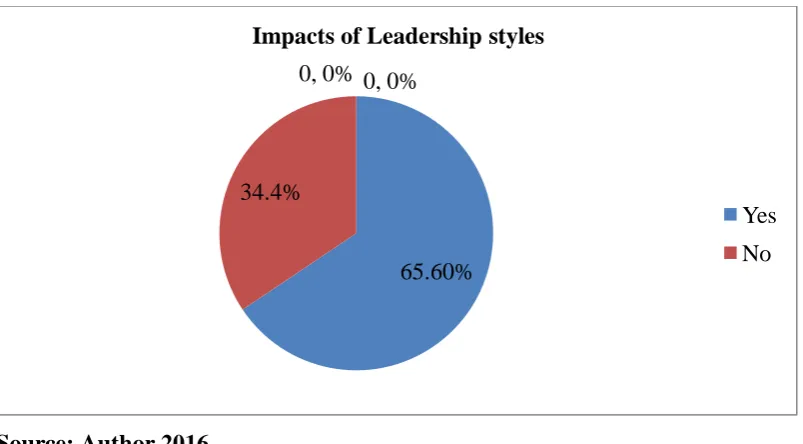
This study sought to find out on the impact of leadership styles on performance from the respondents in the selected markets in Nandi County.
Source: Author 2016
Figure 1: Showing the Impact of Leadership Styles
The study revealed that majority of the respondents 61(65.6%) showed that leadership is important in survival and performance and affects operations of employees in their business. However 32(34.4%) indicated that leadership does not assist to improve the women SMEs.
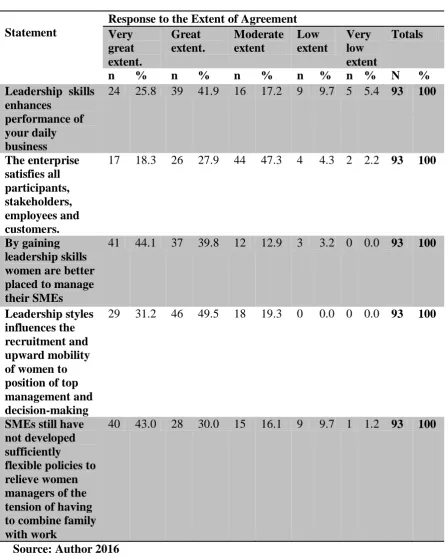
4.3.1 Influence of Leadership Styles on Performance of Women owned SMES The first objective of the study was to determine how leadership styles affect performance of women-owned SMEs in Nandi County, Kenya. In order to examine whether leadership styles influences performance and growth of women owned SMEs, the respondents were requested to indicate their level of agreement on relevant statements on attitude towards gender equality. The responses were rated on a five point Likert scale where: 1) To a very low extent, 2) To a low extent, 3) To a moderate extent, 4) To a great extent and 5) To a very great extent. The frequencies and percentages were generated from SPSS and are as illustrated in Table 4.5.
65.60% 34.4%
0, 0% 0, 0%
Impacts of Leadership styles
33
Table 4.5 Influence of Leadership Styles on Performance of women owned SMES
Statement
Response to the Extent of Agreement Very great extent. Great extent. Moderate extent Low extent Very low extent Totals
n % n % n % n % n % N %
Leadership skills enhances
performance of your daily business
24 25.8 39 41.9 16 17.2 9 9.7 5 5.4 93 100
The enterprise satisfies all participants, stakeholders, employees and customers.
17 18.3 26 27.9 44 47.3 4 4.3 2 2.2 93 100
By gaining leadership skills women are better placed to manage their SMEs
41 44.1 37 39.8 12 12.9 3 3.2 0 0.0 93 100
Leadership styles influences the recruitment and upward mobility of women to position of top management and decision-making
29 31.2 46 49.5 18 19.3 0 0.0 0 0.0 93 100
SMEs still have not developed sufficiently
flexible policies to relieve women managers of the tension of having to combine family with work
40 43.0 28 30.0 15 16.1 9 9.7 1 1.2 93 100
Source: Author 2016
34
(5.4%) of the respondents opined that leadership skills was not vital related to the running of their business.
According to the results it was evident that majority (47.3%) which was moderate depicts that the enterprise satisfies all participants, employees and customers while a slightly over 2.2% of the surveyed respondents which was a very low extent was satisfied. However a significant number (44.1%) the respondents indicated that by gaining leadership skills women are better placed to manage their SMEs which was of very great extent.
Furthermore results indicate that most of the sampled respondents (49.5%) which was of great extent showed that leadership styles influences the recruitment and upward mobility of women to position of business top management and decision-making whereas majority of the respondents (43%) showed that SMEs still have not developed sufficiently flexible policies to relieve women managers of the tension of having to combine family with work.
This result depicts leadership styles influences performance and growth of women owned SMES. This study attested to being trained on leadership to be a better manager of their business. Majority, therefore, of the women entrepreneurs lacked critical leadership skills in managing their SMEs. This indicates that the sample was largely comprised of a mix of respondents; those with past managerial and leadership experience and those without managerial/leadership experience. These results were critical in assessing the nature of prior knowledge of the respondents.
4.4 Entrepreneurial Skills
4.4.1 Training of Women on Entrepreneurial Skills.
35 Source: Author 2016
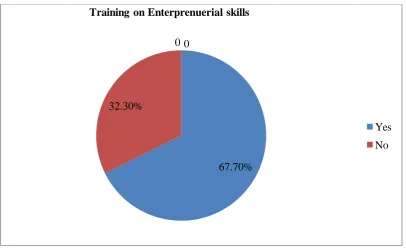
Figure 2: Showing the Extent to Which Training Affects Performance of SMEs It was evident that majority of the respondents (67.7%) have attended workshops, seminars and training on skills for instance networking skills and sales and marketing to run their daily business while (32.3%) revealed that they have not had any training. This study depicts that women owned SMEs entrepreneurial skills influences performance of their business as indicated in the pie chart above.
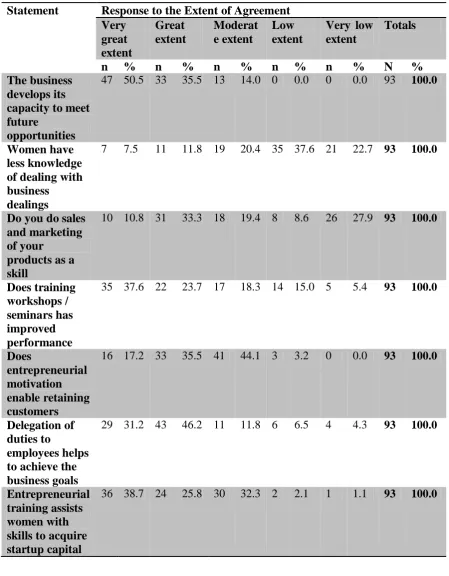
4.4.2 Effects of Skills on Performance and Growth of Women Owned SMEs. The second objective of this study was to determine the effects of skills on performance and growth of women owned SMEs in selected markets in Nandi County. Respondents were asked to what extent they agree on skills. These findings are indicated in table 4.6.
67.70% 32.30%
0 0
Training on Enterprenuerial skills
Yes
36
Table 4.6: Effects of Skills on Performance and Growth of Women Owned SMEs.
Statement Response to the Extent of Agreement Very great extent Great extent Moderat e extent Low extent
Very low extent
Totals
n % n % n % n % n % N %
The business develops its capacity to meet future
opportunities
47 50.5 33 35.5 13 14.0 0 0.0 0 0.0 93 100.0
Women have less knowledge of dealing with business
dealings
7 7.5 11 11.8 19 20.4 35 37.6 21 22.7 93 100.0
Do you do sales and marketing of your
products as a skill
10 10.8 31 33.3 18 19.4 8 8.6 26 27.9 93 100.0
Does training workshops / seminars has improved performance
35 37.6 22 23.7 17 18.3 14 15.0 5 5.4 93 100.0
Does
entrepreneurial motivation enable retaining customers
16 17.2 33 35.5 41 44.1 3 3.2 0 0.0 93 100.0
Delegation of duties to
employees helps to achieve the business goals
29 31.2 43 46.2 11 11.8 6 6.5 4 4.3 93 100.0
Entrepreneurial training assists women with skills to acquire startup capital
36 38.7 24 25.8 30 32.3 2 2.1 1 1.1 93 100.0
37
The highest number of the respondents (50.5%) indicated that their business develops its capacity to meet future opportunities and challenges to a very great extent, 35.5% to a great extent, 22.7 was to a very low extent while (37.6%) indicated that women have less knowledge of how to deal with business dealings to a low extent.
A higher number of respondents (33.3%) revealed that doing sales and marketing of your products as a skill to enhance performance to great extent. 37.6% of the surveyed respondents showed that training through workshops and seminars has improved business performance to a very great extent. Results also revealed that majority (44.1%) attested the fact that entrepreneurial motivation enables retaining customers to a moderate extent.
Research findings also revealed that a significant higher of respondents (46.2%) showed that delegation of duties to employees helps to achieve the business goals to a great extent while (38.7%) indicated that entrepreneurial training assists women with skills to acquire startup capital for their business to very great extent. Based on the findings it is vital in every small medium enterprise to embrace skills to enhance performance. This implies that skills were a key strategy required to enhance the performance and growth of women owned SMEs.
4.5 Socio-cultural Factors
The third objective of the study was to examine whether socio-cultural factors affect performance of women owned SMEs in selected markets in Nandi County.
4.5.1 Family Issues and Performance of SMEs
38 Source: Author 2016
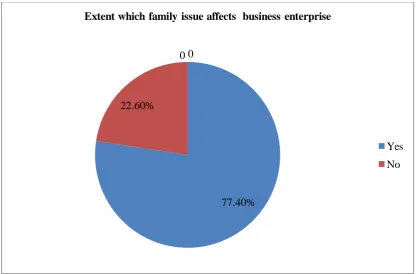
Figure 3: Extent to Which Family Issues and Performance of SMEs
Research findings showed that majority of the respondents (77.4%) had other family issue which affects the performance of their daily business. However (22.6%) number of respondents opined that family issues affect the performance of SMEs. According to the results it is significant for women owned SMEs to balance family duties and their business in order to improve their performance.
4.5.2 Influence of Socio-cultural Affecting Performance of SMEs
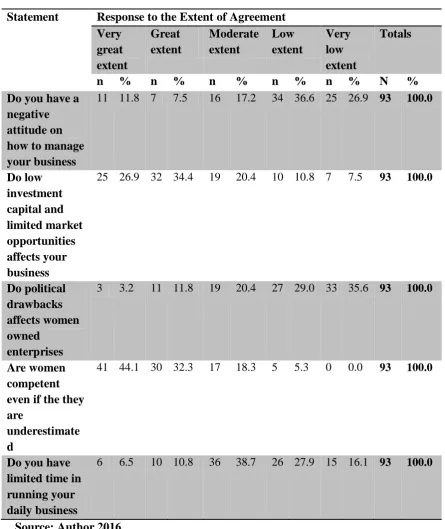
This study sought to find the extent which socio-cultural factors affects performance of your business. Findings are indicated in table 4.7 below:
77.40% 22.60%
0 0
Extent which family issue affects business enterprise
Yes
39
Table 4.7: Influence of Socio-cultural Affecting performance of SMEs Statement Response to the Extent of Agreement
Very great extent Great extent Moderate extent Low extent Very low extent Totals
n % n % n % n % n % N %
Do you have a negative attitude on how to manage your business
11 11.8 7 7.5 16 17.2 34 36.6 25 26.9 93 100.0
Do low investment capital and limited market opportunities affects your business
25 26.9 32 34.4 19 20.4 10 10.8 7 7.5 93 100.0
Do political drawbacks affects women owned
enterprises
3 3.2 11 11.8 19 20.4 27 29.0 33 35.6 93 100.0
Are women competent even if the they are
underestimate d
41 44.1 30 32.3 17 18.3 5 5.3 0 0.0 93 100.0
Do you have limited time in running your daily business
6 6.5 10 10.8 36 38.7 26 27.9 15 16.1 93 100.0
Source: Author 2016
40
It was also evident that 35.6% of the surveyed respondents agreed to a low extent that political drawbacks affects women owned enterprises, however (44.1%) stated that women are better placed to manage their SMEs (Mean=4.57), leadership is a major factor that women are competent even if the they are underestimated in positions due to gender inequality to a very great extent.
41 CHAPTER FIVE
SUMMARY, CONCLUSIONS AND RECOMMENDATIONS
5.1. Introduction
The first section of this chapter offers a summary of the study. The second section presents the conclusions of this study. The last section offers recommendations of this study.
5.2. Summary
This information aimed at testing the appropriateness of the respondent in answering the questions regarding to the drivers of performance on women-owned small and medium enterprises. Results illustrated that the majority of the women started their SMEs at an early age of 26-35 years and therefore had accumulated a lot of business knowledge and skills over time. This information shows that the respondents had a sound academic background as they had attained secondary level of education to be able to run their businesses competently.
The first objective of the study was to determine how leadership styles affect performance of women-owned SMEs in Nandi County. Result depicts leadership styles influences performance and growth of women owned SMES. Finding attested to being trained on leadership to be a better manager of their business. Therefore majority of the women entrepreneurs lacked critical leadership skills in managing their SMEs. Results indicated that the sample was largely comprised of a mix of respondents; those with past managerial and leadership experience and those without managerial/leadership experience. These results were critical in assessing the nature of prior knowledge of the respondents. Findings of the study depicts that women owned SMEs entrepreneurial skills influences performance of their business.
42
The third objective of the study was to examine whether socio-cultural factors affects performance of women owned SMEs in selected markets in Nandi County. Results showed that it was significant for women owned SMEs to balance family duties and their business in order to improve their performance. Based on these findings it is vital that these factors showed be addressed it helps enhancing the performance and growth of women owned SMES.
5.3 Conclusions
The purpose of the study was to examine the drivers of performance on women-owned SMEs in Nandi County Kenya. The reported data shows that most of the surveyed enterprises were experiencing moderate performance. The results show that respondents were able to meet their business objectives, utilize resources effectively, satisfy stakeholders and offer quality products. Therefore drivers of performance are a viable option for boosting the growth of women-owned enterprises. This study concluded from the results that women lack prior knowledge in management. The study depicts that women owned SMEs entrepreneurial skills influences performance of their business.
This study also cast doubts on the drivers of performance. The study findings indicate that a majority of the respondents had never attended any training session, seminar, or conference so often, as a way expanding their business skills base. According to results, it also revealed respondents lacked skills which was a key strategy required to enhance the performance and growth of women owned SMEs.
43 5.4. Recommendations of the Study
The study recommended the following:-
1) The study recommends that women entrepreneurs should incorporate leadership strategy in the learning by attending leadership training forums. This will make them effective managers in the running of their women owned SMEs.
2) The study recommends that the women entrepreneurs should invest in regular training on entrepreneurship.
3) Through this strategy they will be equipped with skills and gain expertise in managing their SMEs professionally and increase their business competitiveness in the market.
4) The study further recommends that the women entrepreneurs should manage and run their social networks professionally to make them a source of great support to their SMEs in terms of source of capital and investment ideas.
5) The study also recommends that the government and other stakeholders should create more awareness on policies to ensure that there is gender equality among women and men owned SMES. This will avert the longstanding perception that women owned SMES are less important than men owned SMES.
5.4.1. Recommendations for Further Research
Since this study was on the drivers of performance on performance of women owned SMEs in selected markets in Nandi County, Kenya, the study recommends that;
1) Similar study should be done in other markets outside Nandi County for comparison purposes and to allow for generalization of findings on the drivers of performance of women owned SMEs.