A New Class of Multivariate Public Key Cryptosystems Constructed Based
on Random Pseudo Cyclic Codes, K(XIII)SE(2)PKC, Realizing Coding Rate
of Exactly 1.0
Masao KASAHARA
Faculty of Informatics, Osaka Gakuin University, Suita-shi, 564-8511 Japan.
[email protected]
Abstract
In this paper, we present a new class of multivariate public-key cryptosystems, K(XIII)SE(2)PKC realizing the coding rate of exactly 1.0, based on random pseudo cyclic codes. The K(XIII)SE(2)PKC is constructed on the basis of K(IX)SE(1)PKC, formerly presented by the author. We show that K(XIII)SE(2)PKC is secure against the various attacks including the attack based on the Gr¨obner bases calculaion (GB attack) and the rank attack.
Keyword
Public key cryptosystem, Error-correcting code, Code based PKC, Cyclic code, Multivariate PKC, Gr¨obner bases, Rank attack, PQC.
1
Introduction
Extensive studies have been made of the Public Key Cryp-tosystem(PKC). The security of most PKC’s depends on the difficulty of discrete logarithm problem or factorization prob-lem. Thus it is desired to investigate another classes of PKC that do not rely on the difficulty of these two problems.
Sof far extensive studies have been made of the PKC con-structed based on the simultaneous equations of degree g (SE(g)PKC, g ≥ 2)[1-10]. All these proposed schemes are very interesting and important. However unfortunately, some of these schemes have been proved not necessarily secure against the conventional attacks such as Patarin’s attack[3], Kipnis-Schamir attack[11], Gr¨obner basis attack[12,13] and Braeken-Wolf-Preneel(BWP) attack[14].
The present author recently proposed several classes of mul-tivariate PKC’s that are constructed by many sets of linear equations[15-20]. It should be noted that McEliece PKC[21] presented in 1978 can be regarded as a member of the class of linear multivariate PKC.
In this paper we present a new class of multivariate pub-lic key cryptosystem, K(XIII)SE(2)PKC based on the
ran-dom error-correcting codes, realizing the coding rate of ex-actly 1.0. The K(XIII)SE(2)PKC is constructed on the basis of K(IX)SE(1)PKC[20], a member of the linear multivariate PKC. We show that K(XIII)SE(2)PKC is secure against the various excellent attacks including the attack based on the Gr¨obner bases calculaion (GB attack)[12,13] and the rank at-tack[14].
Throughout this paper, when the variable vi takes on
a value ˜vi, we shall denote the corresponding vector v =
(v1, v2,· · ·, vn) as
˜
v= (˜v1,v˜2,· · ·,˜vn). (1)
The vector v = (v1, v2,· · · , vn) will be represented by the
polynomial as
v(x) =v1+v2x+· · ·+vnxn−1. (2)
The ˜u, ˜u(x) et al. will be defined in a similar manner.
2
K(XIII)SE(2)PKC over
F
2m2.1
Construction
Let us define a few symbols :
G(x): Random polynomial for generating random pseudo cyclic code over F2m,
R0+R1x+· · ·+Rg−1xg−1+Rgxg,
where Ri (i= 1,· · ·, g−1), R0 ̸= 0
andRg̸= 0 take on an element ofF2m
equally likely in a random manner. eY : Exponent(period, order) of Y(x).
♯{Ai}: Order of the set {Ai}.
H(Ai) : Ambiguity ofAi, log2♯{Ai} (bit).
[Rij]a×b: Random matrix, where Rij (i =
1,· · · , a;j= 1,· · ·, b) takes on 0 or 1 equally likely in a random manner.
H
³
[Rij]a×b
´
: Ambiguity of [Rij]a×b, ab bit.
C : Ciphertext, (CI,CII).
CI: First ciphertext.
NV : Total number of variables.
NE : Total number of equations.
Let the message vectorAoverF2 be represented by
A= (A1, A2,· · · , AN). (3)
Throughout this paper we assume that the messages A1, A2,· · · , AN are mutually independent and equally likely.
LetAbe transformed into
A·HI =a= (a1, a2,· · · , aN), (4)
whereHI is anN×N non-singular random matrix overF2.
LettingN=nm,a is partitioned into
a= (m1, m2,· · ·, mn), (5)
wheremi is given by
mi= (ai1, ai2,· · · , aim). (6)
In the followings let us regardmi as an element ofF2m.
Letabe partitoned into
mA= (mg+1, mg+2,· · · , mg+f), (7)
mB= (mg+f+1, mg+f+2,· · · , mn), (8)
and
mC= (m1, m2,· · ·, mg), (9)
respectively, wherenis given by
n=g+ 2f. (10)
FrommA andmB, we obtain
(mA(x)mB(x)) α
≡p(x) modP(x), (11)
where P(x) is a primitive polynomial of degree f over F2m,
andαis given by
α= 1 + 2 + 22+· · ·+ 2B <2f m−1. (12) Letp(x) be represented by the vector :
p= (p1, p2,· · ·, pf). (13)
Remark 1 : Given mA(x) = ˜mA(x) and mB(x) = ˜mB(x),
the components of p over F2m are calculated from
Eq.(11), at the sending end. 2
The first ciphertextCI(x) overF2m is then given by
CI(x) =p(x). (14)
LetmA(x) overF2m be transformed into
mA(x)
3
≡m′A(x) modF(x)
=m′g+1+m′g+2x+· · ·+m′g+fxf−1, (15)
whereF(x) is a random polynomial overF2m of degreef.
LetmC(x) overF2m be transformed into
mC(x)3≡m′C(x) modH(x). (16)
whereH(x) is a random polynomial overF2m of degreef.
Letr(x) be given by
(m′A(x) +m′C(x))xg≡r(x) modG(x) =r1+r2x+· · ·+rgxg−1.
(17)
The code word,w(x), generated by the generator polyno-mialG(x), can be represented by
w(x) =r(x) + (m′A(x) +m′C(x))xg≡0 modG(x). (18)
The messagemC(x) is transformed into
mC(x)
3
=τ(x), (19)
where we assume that the degree ofτ(x) is less than or equal tof+g−1.
With thisτ(x), the wordu(x) is constructed by
u(x) =w(x) +τ(x)
=u1+u2x+· · ·+ug+fxg+f−1.
(20)
Regarding the worduas a (g+f)m-tuple overF2, the word uis transformed into
uHII =v, (21)
where HII is a (g+f)m×(g+f)m random non-singular
matrix overF2.
We see that the ambiguity ofHII overF2is given
approxi-mately by
|HII| ∼= (g+f)2m2 (bit), (22)
an extremely large value for
(g+f)m >∼ 80. (23)
Were it not for the tranformation by HII, the generator
Let us define several symbols :
˜
A(0)i : Non-zero message sequence that make ˜mc(x) be zero; i = 1,2.
˜
u(0)i (x) : Word corresponding to ˜A(0)i ; i= 1,2.
(˜u(0)1 (x),u˜(0)2 (x)) : Largest common divisor of ˜u1(x)
and ˜u2(x).
˜
w(0)i (x) : Code word corresponding to ˜A(0)i
;i= 1,2.
It is evident that ˜u(0)1 and ˜u(0)2 satisfy
˜
u(0)1 (x) = ˜w(0)1 (x) f or A˜(0)1 (24)
and
˜
u(0)2 (x) = ˜w(0)2 (x) f or A˜(0)2 , (25)
hence
³
˜
u(0)1 (x),u˜(0)2 (x)
´
≡0 modG(x). (26)
The Eq.(26) implies that G(x) can be disclosed from (˜u(0)1 (x),u˜(0)2 (x)).
In general, for J non-zero message sequences ˜
A(0)1 ,A˜(0)2 ,· · ·,A˜(0)J , the largest common divisor of ˜
u(0)1 (x),u˜(0)2 (x),· · ·,u˜(0)J (x) rapidly approaches to G(x) as J increases.
Remark 2 : The word u is transformed to v by Eq.(21). The large ambiguity of the transformation matrix HII
would much strengthen the hiding of the structure of the
code word w. 2
The second ciphertextCII(x) is given by
CII(x) =v(x). (27)
Remark 3 : The components of v over F2 constitute a set
of simultaneous equations of degree 2 in the variables
A1, A2,· · · , AN. 2
We have the following set of keys.
Public key : mA,mB, v,P(x),α.
Secret key : HI,HII,F(x),H(x),G(x),τ(x).
2.2
Encryption and decryption
[Encryption]
Step 1: Given ˜mA(x) and ˜mB(x), the vector ˜p(x) is
calcu-lated by Eq.(11).
Step 2: The ciphertext ˜CI(x) is given by ˜p(x) from Eq.(14).
Step 3: The ciphertext ˜CII(x) is given by ˜v(x) from Eq.(27).
[Decryption]
Step 1: The ciphertext ˜CII(x) = ˜v(x) is inverse transformed
to ˜u(x) by ˜v·HII−1, yielding ˜w(x) + ˜mC(x)3.
Step 2: The message ˜mC(x) is decoded by
˜
CII(x)dG=
n
˜
w(x) + ˜mC(x)
3odG
≡m˜C(x) modG(x),
(28)
wheredG is the inverse element of 3 moduloeG, the
ex-ponent ofG(x), yielding ˜w(x).
Step 3: From ˜w(x), the transformed message ˜m′A(x)+m′C(x) is decoded.
Step 4: The ˜m′C(x) is given by ˜mC(x)3modH(x) from
Eq.(16), yieldingm′A(x).
Step 5: The message ˜mA(x) is obtained by
{m˜′A(x)}dF ≡m˜
A(x) modF(x), (29)
wheredF is the inverse element of 3 modeF, the
expo-nent ofF(x).
Step 6: Letting eP be the exponent of P(x), the message
˜
mB(x) is obtained by
˜
mB(x)≡p(x)˜ βm˜−A1(x) modP(x), (30)
whereβ is given by
αβ≡1 modeP. (31)
Step 7: From ˜mA, ˜mB and ˜mC, the original message, ˜A, is
decoded by
( ˜mA,m˜B,m˜C)HI−1= ˜A
=
³
˜
A1,A˜2,· · ·,A˜N
´
Table 1: Example of K(XIII)SE(2)PKC(ρ= 1.0).
Example m N dA,dB dC g SPK(KB)
I 8 168 7 4 5 187.2
II 16 176 3 2 3 220.9
III 32 192 1 1 2 299.5
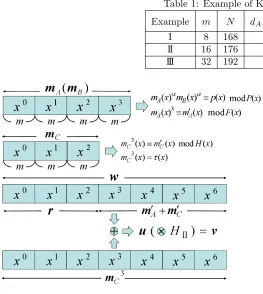
Figure 1: Schematic diagram of K(XIII)SE(2)PKC over F2m
(Example II in Table 1).
2.3
Examples
An example of a schematic diagram of K(XIII)SE(2)PKC over
F2m is given in Fig.1.
Let us show the size of the public key for K(XIII)SE(2)PKC overF2m by an example, for simplicity.
Let the degree ofmY(x) be denoted by dY. In the
follow-ings, we assume that dA, dB and dC are chosen so that the
relation,
dA = dB (33)
dA = 2dC−1 (34)
may hold.
The total number of variables,NV, is given by
NV =N = (dA+dB+dC+ 3)m. (35)
The total number of linear equations,NE1, is given by
NE1= (dA+dB+ 2)m. (36)
The total number of quadratic equations,NE2, is given by
NE2= (dA+dC+ 2)m. (37)
The size of the public key is given by
SPK = NE1·N+NE2·NH2(bit). (38)
It should be noted that the sizes of the public keysP(x) andαcan be disregarged.
In Table 1, we present three examples of K(XIII)SE(2)PKC overF2m.
2.4
Security considerations
Let us consider several possible attacks on K(XIII)SE(2)PKC.
Attack 1: Disclosing the code word w(x) by exhaus-tively estimatingG(x)
The probability of estimating random polynomialG(x) over
F2m, in an exhaustive manner, is given by
PC[G(x)]b ∼= 2−(g+1)m, (39)
not a sufficiently small value for Example I in Table 1. However, even ifG(x) can be estimated correctly with prob-ability 2−(g+1)m, it would still be hard to disclose the struc-ture ofw(x) exactly, i.e.,m′A(x),m′C(x), andr(x) due to the following reasons:
R1 : Addition ofτ(x) on the code wordw(x).
R2 : The word u(x) = w(x) +τ(x) is further transformed into v(x) using random non-singular matrixHII, whose
ambiguity takes on an extremely large value of approx-imately 104 bit for the examples in Table 1(Please refer
to Remark 2).
We conclude that K(XIII)SE(2)PKC would be secure against
the Attack 1. 2
Attack 2: Exhaustive attack onm˜A
Let an estimated value of ˜mA be denoted by ˆm˜A and the
set of all possible ˆm˜A, by
n
ˆ ˜
mA
o
. The order of
n
ˆ ˜
mA
o
can
be given by
♯
n
ˆ ˜
mA
o
= 2f m. (40)
The average number of the trials required for correctly es-timatingmA(x), ¯N( ˆmA) is given by
¯
N( ˆmA) =
1 2f m
¡
1 + 2 + 3 +· · ·+ 2f m¢
∼
= 2f m−1.
For the examples in Table 1, ¯N( ˆmA) is given by
¯
N( ˆmA)∼= 263∼= 9.22×10¹⁸. (42)
When ˜mA is estimated correctly in an exhaustive manner,
the ˜mB is accordingly given correctly from Eq.(11).
For correctly estimated ˜mA and ˜mB, in order to disclose
the messages ˜A1,A˜2,· · · ,A˜N, the GB attack should solve the
following sets of simultaneous equations :
SE(I) : The 2f m linear equations in the variables A1, A2,· · · , AN.
SE(II) : The (f+g)m quadratic equations in the variables A1, A2,· · · , AN.
For a given ciphertext ˜C, in order to disclose the messages ˜
A1,A˜2,· · · ,A˜N, GB attack should solve the above
simulta-neous equations, SE(I) and SE(II) in 2f m−1 times given by
Eq.(41). Besides, the number of variablesN takes on a large value of 168 ∼192 for the examples in Table 1. This would be a hard task for GB attack.
We conclude that K(XIII)SE(2)PKC would be secure against
Attack 2. 2
Attack 3: GB attack on ciphertext by representing
p(x) by a set of simultaneous equations
Thep(x) can be represented by the following simultaneous equations :
SE(III) : Thef equations of degree B in the variables
A1, A2,· · ·, AN. (43)
For Examples I, II and III given in Table 1, the degreeBtakes on 63, a large value.
For a given ciphertext ˜C, in order to disclose the messages ˜
A1,A˜2,· · · ,A˜N, GB attack should solve the two sets of
simul-taneous equations, SE(II), and SE(III).
We conclude that K(XIII)SE(2)PKC would be secure against
Attack 3. 2
Attack 4: Rank attack
K(XIII)SE(2)PKC would be secure against the rank attack as K(XIII)SE(2)PKC has no STS(Step-wise Trianglar Struc-ture). Furthermore the transformations by Eq.(11), Eq.(15) and Eq.(16) would much strengthen the security against the rank attack.
3
Conclusion
In this paper we have presented K(XIII)SE(2)PKC on the basis of K(IX)SE(1)PKC[20] using random pseudo cyclic codes. We have shown that our proposed K(XIII)SE(2)PKC can be made sufficiently secure against the various attacks including the attack based on Gr¨obner bases calculation(GB attack).
References
[1] T.Mastumoto and H.Imai: “Public Quadratic Polynomial-Tuples for Efficient Signature - Verification and Message-Encryption”, Advances in Cryptology, Eurocrypt’88, Springer-Verlag, pp.419-453, (1988).
[2] S.Tsujii, A.Fujioka and Y. Hirayama: “Generalization of the public-key cryptosystem based on the difficulty of solving a system of non-linear equations”, IEICE Trans. Vol.1 J-72-A, 2, pp.390-397, (1989-02).
[3] J. Patarin: “Hidden fields equations(HFE) and isomor-phisms of polynomials(IP): two new families of asymmet-ric algorithm”, Proc.EUROCRYPT’96, Lecture Notes in Computer Science, Vol.1070, pp.33-48, Springer, (1996-05).
[4] M.Kasahara and R.Sakai: “A Construction of Public Key Cryptosystem for Realizing Ciphertext of size 100 bit and Digital Signature Scheme”, IEICE Trans. Vol. E87-A, 1, pp.102-109, (2004-01).
[5] S. Tsujii, R. Fujita and K. Tadaki: “Proposal of MOCHIGOMA(piece in hand) concept for multivariate type public key cryptosystem”, Technical Report of IE-ICE, ISEC 2004-74, (2004-09).
[6] J. Ding: “A New Variant of the Matsumoto-Imai Cryp-tosystem through Perturbation”, PKC 2004, LNCS 2947, pp.305-318, 2004.
[7] M.Kasahara and R.Sakai: “A Construction of Public Key Cryptosystem Based on Singular Simultaneous Equa-tions”, IEICE Trans. Vol. E88-A, 1, pp.74-79, (2005-01).
[8] J. Ding, D. Schmidt and J. Gower: “Multivariate Public key Cryptography”, Springer-Verlag(2006).
[9] M.Kasahara: “New Classes of Public Key Cryp-tosystem Constructed on the Basis of Multivariate Polynomials and Random Coding - Generalization of K(III)RSE(g)PKC -”, Technical Report of IEICE, ISEC 2007-118, pp.41-47, (2007-12).
[10] M. Kasahara: “Public Key Cryptosystems Constructed Based on Cyclic Codes, Realizing Coding Rate of Exactly 1.0, K(XI)SE(g)PKC and K(XII)SE(g)PKC”, Technical Report of IEICE, ISEC 2011-23(2011-07).
[11] A. Kipnis and A. Shamir: “Cryptoanalysis of the HFE Public Key Cryptosystem by Relinearization”, Ad-vances in Cryptography-Crypto’99, LNCS 1666, pp.19-30, (1999).
[12] M. Bardet, J. C. Faug´ere and B. Salvy: “Complexity of Gr¨obner basis computation for semi-regular overdeter-mined sequence overF2 with solutions inF2”, Technical
[13] J-C Faug´ere: “Algebraic cryptanalysis of HFE using Gr¨obner bases”, INRIA (2003).
[14] C. Wolf: “Multivariate Quadratic Polynomials in Public Key Cryptography”, Dr. Thesis, Katholieke Universiteit Leuven, (2005-11).
[15] M.Kasahara: “Construction of New class of Linear Mul-tivariate Public Key Cryptosystem - Along With a Note on the Number 9999990 and its Application”, Technical Report of IEICE, ISEC 2009-44 (2009-09).
[16] M.Kasahara: “Linear Multivariate Cryptosystem Con-structed on the Basis of Probabilistic Structure”, 2009 JSIAM Annual Meesing, Osaka, (2009-09).
[17] M. Kasahara: “New Classes of Public Key Cryptosys-tems Constructed Based on Error-Correcting Codes and Probabilistic Structure”, Technical Report of IEICE , ISEC 2009-134 (2010-03).
[18] M. Kasahara: “A New Class of Public Key Cryptosystem Constructed Based on Error-Correcting Codes Realizing Coding Rate of Exactly 1.0”, Cryptology ePrint Archive, 2010/139 (2010).
[19] M. Kasahara: “A New Class of Public Key Cryptosys-tems Constructed Based on Error-Correcting Codes, Using K(III) Scheme”, Cryptology ePrint Archive, 2010/341 (2010).
[20] M. Kasahara: “Public Key Cryptosystems Con-structed Based on Random Pseudo Cyclic Codes, K(IX)SE(1)PKC, Realizing Coding Rate of Exactly 1.0”, Cryptology ePrint Archive 2011 / 545(2011) Masao Kasahara.