Estimating the Security of
Lattice-based Cryptosystems
Markus R¨
uckert
1∗Michael Schneider
21
2
Technische Universit¨at Darmstadt Department of Computer Science Cryptography and Computeralgebra
Germany October 6, 2010
Abstract. Encryption and signature schemes based on worst-case lattice problems are promising candidates for the post-quantum era, where classic number-theoretic assump-tions are rendered false. Although there have been many important results and break-throughs in lattice cryptography, the questions of how to systematically evaluate their security in practice and how to choose secure parameters are still open. This is mainly due to the fact that most security proofs are essentially asymptotic statements. In addition, the hardness of the underlying complexity assumption is controlled by several interdependent parameters rather than just a simple bit length as in many classic schemes.
With our work, we close this gap by providing a framework that (1) distills a hardness esti-mate out of a given parameter set and (2) relates the complexity of practical lattice-based attacks to symmetric “bit security” for the first time. Our approach takes various security levels, or attacker types, into account. Moreover, we use it to predict long-term security in a similar fashion as the results that are collected onwww.keylength.com. In contrast to the experiments by Gama and Nguyen (Eurocrypt 2008), our estimates are based on precisely the family of lattices that is relevant in modern lattice-based cryptography. Our framework can be applied in two ways: Firstly, to assess the hardness of the (few) proposed parameter sets so far and secondly, to propose secure parameters in the first place. Our methodology is applicable to essentially all lattice-based schemes that are based on the learning with errors problem (LWE) or the small integer solution problem (SIS) and it allows us to compare efficiency and security across different schemes and even across different types of cryptographic primitives.
Keywords. Lattice-based cryptography, post-quantum cryptography, Lenstra Heuristic
∗
1. Introduction
Lattice-based cryptography has received a lot of attention in the last couple of years. Not only because Gentry solved the long-standing problem of fully homomorphic encryption [Gen09], but mainly because people were, for the first time, able to base security on worst-case assumptions rather than on average-case assumptions. This was first pointed out by Ajtai [Ajt96] in a worst-case to average-worst-case reduction. In other words, successfully attacking a random instance of a cryptosystem immediately implies being able to solve all instances of the underlying problem, such as finding short vectors inall lattices.
In addition, these lattice problems are considered to withstand quantum-computer attacks, whereas factoring or discrete-logarithm-based systems are rendered insecure by the work of Shor [Sho97]. Another desirable trait of lattice problems is that they, unlike factoring, with-stand subexponential-time attacks.
However, the above advantages come at a price. Usually, the bit lengths of the involved keys are Ω(n2log(n)), where nis the natural system parameter. Fortunately, we can use ideal lattices, introduced by Micciancio [Mic07] as well as Peikert and Rosen [PR06], that reduce the key size to O(nlog(n)) bits. Thus, in practice, choosing n as small as possible is crucial. To the best of our knowledge, there is no work that systematically deals with selecting secure parameters or analyzing the hardness of the employed assumptions. Indeed, the task is more involved than in the case of, say, RSA. Lattice cryptosystems have numerous parameters that affect security and dealing with nalone is not sufficient.
So far, only Micciancio and Regev [MR08], Lyubashevky [Lyu09], as well as Lyubashevky and Micciancio [LM08] have proposed parameters for their schemes. In [MR08, Lyu09], this choice is based on an interesting observation by Gama and Nguyen [GN08b]. They consider the Hermite Short Vector Problem HSVP with parameter δ > 0 in lattices L of dimension
d. There, the task is to find a vector v with 0< kvk2 ≤δdD(L)1/d, where D(L) is a lattice constant. In [GN08b], the authors analyze “random lattices” according to the Goldstein-Mayer distribution [GM03] that are considered to provide hard instances ofHSVP. Their observation is that δ is the dominating parameter and that d only plays a minor role. They conjecture thatHSVPseems reachable forδ ≈1.01 and “totally out of reach” forδ <1.005 in dimensions
d≥500 if the lattice does not have a special structure.
The good news is that, given d, the hardness estimate δ could be determined from the security proof for the cryptosystem. The bad news is that cryptographic, typically called q -ary, lattices have a particular structure that can be exploited in attacks. E.g., Micciancio and Regev describe this sublattice attack in [MR08]. The bottom line is that solving δ-HSVP in
q-ary lattices of dimension m is only as hard as solving δ0-HSVP in dimension d < m and
δ0 > δ. Thus, HSVPbecomes strictly easier in q-ary lattices because there is a certain “slack” in the required attack dimension.
certificate, i.e., the parameter set is either secure or insecure. In particular, it does not offer security levels, such as 100 bits, meaning that the attack effort should be close to 2100 storage times computation units.
With our work, we intend to provide athird option, with a focus on lattice-based encryption [Reg09, GPV08, Pei09, SSTX09, LPR10] and signature schemes [GPV08, SSTX09, Lyu09, LM08, CHKP10, Boy10] because they are the main building blocks of public-key cryptography. Nevertheless, our results can be easily applied to more advanced schemes, such as identity-based encryption [GPV08], oblivious transfer [PW08, PVW08], collision resistant hashing [LM06, ADL+08], secret key delegation [CHKP10], and others.
We do not consider ad-hoc constructions like NTRU [HPS98] that fall outside the category of schemes motivated by Ajtai’s work. The lattices that correspond to attacks on NTRU have a particular structure and containessentially one unusually short “trapdoor” vector. Random Ajtai, or q-ary, lattices do not admit such a structure.
Apart from choosing secure parameters, we often wish to compare schemes with regard to their security level. Say, we have schemeX and a new scheme Y, which is more efficient than
Xin the sense that its public key is smaller, but at the expense of a stronger assumption. For a fair comparison, we first need a methodology to generate parameter sets that yield comparable security levels. Now, two things could happen: (1) the improvements in Y are still noticeable or (2) due to the stronger assumption, Y requires, say, a larger dimension that effectively nullifies the proposed improvement.
Our Contribution. Inspired by the works of Lenstra and Verheul [LV01] and the sub-sequent update by Lenstra [Len05], we propose a unified methodology for estimating security and selecting secure parameters for all modern lattice-based cryptography. To this end, we adopt the notion of dollar-days, i.e., equipment cost in dollar times attack time in days, as introduced in [Len05]. Our methodology also includes 3 different attacker types, ranging from a resource-constrained “Hacker” to an all-powerful “Intelligence agency”.
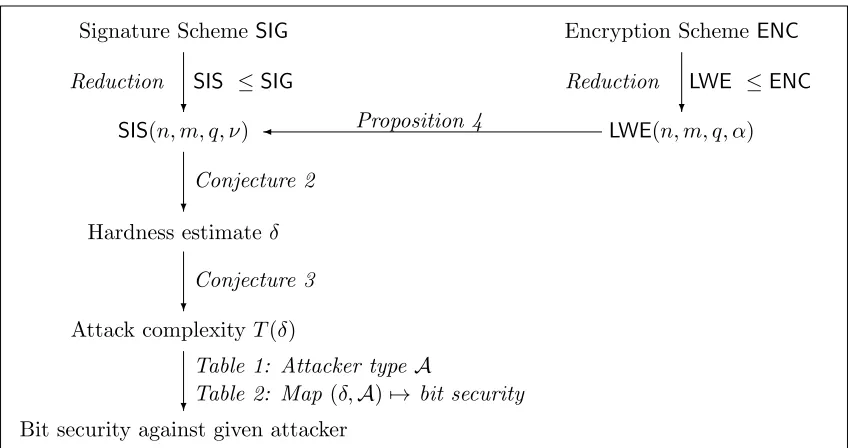
We follow a modular three-tier approach: core analysis, experiments, and application. Tier 1: At the core, there are our conjectures and observations about how the various param-eters for LWE and SIS influence the hardness of these problems in Section 3. In addition, via the duality of LWE and SIS we translate LWE instances into the language of SIS. Here, we manage to distill the hardness into one single parameter.
Signature Scheme SIG
SIS(n, m, q, ν) ?
Reduction SIS ≤SIG
Encryption Scheme ENC
LWE(n, m, q, α) ?
Reduction LWE ≤ENC
Proposition 4
?
Conjecture 2
Hardness estimateδ
?
Conjecture 3
Attack complexity T(δ)
?
Table 1: Attacker type A
Table 2: Map (δ,A)7→ bit security
Bit security against given attacker
Figure 1: User’s guide to estimating the bit security of lattice-based signature and encryption schemes.
Tier 3: The third part is the application of our framework to cryptographic schemes in Section 4. There are various potential applications. We can evaluate the security of proposed parame-ter sets in the liparame-terature and find that some do not provide sufficient security. Similarly, we can use our formulae in the reverse direction to output parameter sets for a given security level.
Thus, we can make absolute statements about individual cryptosystems, saying that schemes
X with parameter setP(X) is secure against a certain type of attacker until the year 2030. In addition, we can also make relative statements across different SIS- andLWE-based schemes. For example, saying that SISscheme X with parameters P(X) is more, less, or as as secure as LWE scheme Y with parameters P(Y). This allows a fair and easy comparison, especially when new schemes are presented, and it also allows us to match the security level of various primitives when used in a more complex protocol. Figure 1 summarizes our analysis and provides a user’s guide to estimating the security of a given parameter set.
that the signing procedure [GPV08, Pei10] for GPV, Bonsai, Ideal-GPV, and Ideal-Bonsai is rather inefficient as it involves a Gram-Schmidt orthogonalization of the secret trapdoor matrix in high dimensions. Finally, we would like to remark that when combining [SSTX09] and [LPR10] to obtain an ideal version of trapdoor-LWE [GPV08], where the decision-LWE
problem is hard1, there is a caveat. The parameter relations required for [LPR10] are within the worst-case for the trapdoor generation algorithm in [SSTX09]. As a result, one needs to resort to a sub-optimal setup for trapdoor generation with rather large dimensions.
2. Preliminaries
We denote with log the logarithm to basee, all other logarithms are specified, e.g., log2. Vectors and matrices are written in boldface, e.g.,v andM. The norm of a matrixMis defined to be
kMk= maxikmik, withmi being the columns of m. We write kvkfor the Euclidean norm.
2.1. Lattices
In this work, we only require full-dimension lattices. A (full-dimensional) lattice inRnis a dis-crete subgroup Λ ={Pn
i=1xibi|xi ∈Z}, typically represented by a matrixB= [b1, . . . ,bn]∈
Zn×nof R-linearly independent vectors. The matrixB is a basis of the lattice Λ and we write Λ = Λ(B). The number of linearly independent vectors in any such basis is the dimension dim(Λ) of the lattice. Given any basisBof the lattice Λ, the determinant det(Λ) of the lattice is p
det(BtB). It is an invariant of the lattice. Another set of invariants is the successive minima.
The i-th successive minimum λi(Λ) is the smallest radius of a sphere that contains i linearly
independent vectors in Λ. For a lattice Λ(B) withB∈Rn×ndefine the (full-dimensional) dual
lattice as the set of allx∈Rn withhx,yi ∈
Z for all y∈Λ(B).
Problems. One of the main computational problems in lattices is the approximate shortest vector problem (SVP). Given a basis B of Λ and an approximation factor γ ≥ 1, the task is to find a non-zero vector v ∈ Λ with kvk2 ≤γλ1(Λ). A related problem is the approximate shortest independent vector problem (SIVP), where given a basisBof Λ and an approximation factor γ, one is supposed to find a set {v1, . . . ,vn} of linearly independent vectors in Λ such
that maxikvik2≤γλn. For approximation factors exponential in dim(Λ), the problem is
solv-able in polynomial time (in dim(Λ)) by the LLL algorithm [LLL82] for approximation factors bigger than (4/3)dim(Λ). Using the block-wise algorithms of [Sch87, GHGKN06, GN08a], even sub-exponential approximation factors are reachable in polynomial time.
For polynomial approximation factors, which are relevant for cryptography, the best known algorithms are exponential (space and time) [AKS01, MV10]. The algorithm mostly used in practice is the BKZ algorithm [SE94]. Unfortunately, there is no theoretical average-case analysis of BKZ that could be used for determining its complexity.
In cryptography, we use lattices of a special form, which we callq-ary: letq∈N,A∈Zn×m q ,
we define Λ⊥q(A) = {v ∈ Zm : A v ≡ 0 (modq)}. Its, up to scaling, dual lattice Λ
q(A) is
defined as {w ∈ Zn : ∃e ∈ ZmAte ≡ w (modq)}, i.e., we have 1/q ·Λ⊥q(A) = (Λq(A))∗.
For a randomly chosen A, prime q, and m > n, the determinant of the corresponding q-ary
1
lattice is qn with high probability and typically, we have m = Ω(nlog(n)). A second type of cryptographic lattices are ideal lattices, which can also be represented as a q-ary lattice.
The main computational problem in a q-ary lattice Λ⊥q(A) is the “short integer solution” problem (SIS): given n, m, q,A ∈Zn×m
q , and a norm bound 1≤ν < q, find v∈Λ⊥q(A) with
0<kvk2 ≤ν.2 Basically, the SIS was introduced and analyzed by Ajtai [Ajt96] but there are numerous improvements to the analysis in, e.g., [MR07, GPV08]. For Λq(A), we consider the
“learning with errors“ problem (LWE): given (n, m, q, α), a random matrix A ∈ Zn×m q , and
m ”noisy“ inner products b =Ats+emodq, where the components of e are chosen from a centered, discretized normal distribution χα over Zq with standard deviation αq/
√
2π. The task is to recover s∈Zn
q. Stated differently, given A,b, solve the bounded distance decoding
problem that is similar to finding the closest lattice vector to b because w=Atsis a lattice vector that is close to b. Given w, one can easily recover s by linear algebra. This search version of LWEis at least as hard as solving the decision problem, i.e., distinguish (A,b) from uniform. The problems for ideal lattices are defined analogously.
Algorithmic View. In order to grasp lattice reduction algorithmically, the notion of Hermite-SVP (HSVP) approximation seems more adequate than that of approximate SVP. In practice, it is unlikely that λ1 is known, therefore it is impossible to check the SVP-condition
kvk2 ≤ γλ1(Λ). HSVP asks for a non-zero vector that satisfies kvk2 ≤δdim(Λ)det(Λ)1/dim(Λ) for a given δ >0, which can be easily verified without knowingλ1.
Concerning the hardness of this problem, the lattice dimension certainly plays a role but Nguyen and Gama show that δ is the dominating parameter. For random Goldstein-Mayer lattices, Gama and Nguyen argue that δ = 1.01 seems to be an approximate limit for today’s lattice basis reduction algorithms, even in high dimensions. For significantly smaller δ, the problem is intractable. This shows that, from a theoretical point of view, δ can be considered to be the main parameter controlling the hardness ofHSVP. However, in cryptanalysis, we do not deal with random Goldstein-Mayer lattice bases that have very large entries of bit length Ω(dim(Λ)), that are usually used to analyze lattice reduction algorithms. We rather have bases with entries of bit length log2(q) = Ω(log2(n)). Here, lattice reduction is potentially easier as we will discuss in the following.
Average-case Hardness. Both,LWE andSIS, are treated as average-case problems that are directly related to cryptographic schemes with a randomly chosen matrix A. By a worst-case to average-worst-case reduction, they are provably at least as hard as all instances of SIVP in dimensionn. In Section 3.2, we discuss howLWE can be interpreted asSISin a related lattice. Each instance ofSIScan be naturally interpreted as an instance of the Hermite-SVP. Given
SIS with (n, m, q, ν), we compute δ = mp
ν/qn/m and ask the Hermite-SVP solver to find v
with 0<kvk2 ≤δmqn/m. However, this direct translation is not the best possible attack. In [MR08], Micciancio and Regev point out that one can solve the same problem in a significantly lower lattice dimension. They assume the existence of a δ-HSVP solver for a fixed δ. Then, they argue that the optimum dimension for solving SIS with (n, m, q) with this solver is d= min{pnlog(q)/log(δ), m}. Now, one removes m−drandom columns from A to obtain A0, reduce the d-dimensional lattice bases of Λ⊥q(A0), and pad a short vector therein with zeros. The result is a rather sparse vector of norm ≤δdqn/d in Λ⊥q(A).
Unfortunately, this approach is not directly applicable to cryptography because in prac-tice, when attacking a cryptosystem, the attacker will also take ν into account and employ
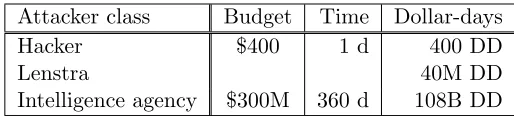
Attacker class Budget Time Dollar-days
Hacker $400 1 d 400 DD
Lenstra 40M DD
Intelligence agency $300M 360 d 108B DD
Table 1: Attacker classes and corresponding budget for each attacker.
stronger and stronger HSVP solvers until a sufficiently short vector is found. Therefore, we need a re-interpretation of the approach taken in [MR08] that involves ν instead of δ. This re-interpretation allows us to normalize SIS(n, m, q, ν) by removing the ”slack“ in the dimen-sion parameter m. The resulting distribution of lattices is what we will analyze by directly applying lattice basis reduction. We defer the details to Section 3.
Notice that the bases of ideal lattices have essentially the same structure and there is no lattice basis reduction algorithm that can take significant advantage of the ideal structure. Therefore our analysis carries over.
Worst-case Hardness. One might argue that, since there is a worst-case to average-case reduction, one might simply treat Goldstein-Mayer lattices as worst-case lattices, apply the reduction, and analyze the hardness ofHSVPin dimensionnin Goldstein-Mayer lattices with an appropriate δ. However, this leads to security estimates that are too conservative because the worst-case to average-case reduction seems far from tight, with respect to the involved lattice dimension and the approximation factor. Nevertheless, the worst-case to average-case reduction helps in choosing sensible parameters for the analyzed cryptosystems.
2.2. Lenstra’s Heuristic
The authors of [ECR09] describe an attacker model with attacker classes according to [BDR+96]; a subset of these classes is shown in Table 1. We add an attacker called “Lenstra”, with an amount of 40M dollar-days, which was the value for a suitable attacker proposed by Lenstra in [Len05]. Following the work of A.K. Lenstra and Verheul in [LV01], A.K. Lenstra pro-posed a slightly simplified framework to choose secure cryptographic parameters in [Len05]. Let k be the security parameter and assume the best attack against a given cryptosystem takes t(k) seconds on a machine that costs d dollars. Then, the total ”cost“ of the attack is T(k) = d·t(k)/(3600·24) dollar-days (DD). This notion is particularly interesting when estimating attack cost against lattice cryptography, where attacks may be parallelized with a time-money tradeoff.
Assume we have an estimate for the function T(k) for attacks against lattice-based cryp-tosystems. Then, we can find the optimum k∗ such that T(k∗)≥T2009, where T2009 is chosen according to the last column of Table 1. We choose 2009 as a reference date here because the employed compute server was bought in that year.
progress for practical strong algorithms, such as BKZ, is hard to judge. While, there are re-cent results [GHGKN06, GN08a, GNR10] showing that progress is indeed possible, there are no public implementations that beat BKZ in practice.
The above condition only yields secure parameters for the year 2009. For yeary,kneeds to satisfy the inequalityT(k)≥T2009·2(y−2009)·12/9 to be secure until yeary.
Asymmetric primitives are often combined with symmetric ones. Hash functions are neces-sary to sign long documents and block ciphers allow efficient hybrid encryption. We assume that these primitives are available at any given time in the future and that they are only affected by Moore’s Law. Unlike public-key primitives, block ciphers and hash functions can easily be replaced if there is a new attack.
3. Analysis
Let us first restrict our analysis to signature schemes, i.e., SIS-based schmes. The best known attacks against these schemes involve aq-ary lattice Λ = Λ⊥q(A) of dimensionm= Ω(nlog(n)) and a scheme-specific norm boundν, which can be obtained by studying the security reductions. Later on, in Section 3.2, we will see that attacking LWE-based encryption is quite naturally done by expressing it as an SISproblem as well.
Thus, the main goal of this section is to determine the effort T2009 (in dollar-days) that is required today for mounting attacks on SIS. From there, we can apply Lenstra’s Heuristic to estimate parameters for the future.
In order to grasp the hardness of most of these problems, we have conducted experiments on 10-100 random q-ary lattices per dimension m∈ {100,125,150,175,200,225,250,275,300}
and exponent c ∈ {2,3,4,5,6,7,8} for the relation q ≥ nc. The number of experiments per dimension has been chosen adaptively to focus on the interesting invervals. These parameters also determine n if we demand that m > nlog2(q). This setting covers even the hardest instances of SIS, where we demand the solution to be binary, i.e., ν = √m. The existence of such vectors can be verified with a pidgeonhole argument because the function fA(v) =
Avmodq admits a collision (v,v0)∈({0,1}m)2 ifqn/2m <1. Such a collision yieldsv−v0 ∈
Λ⊥q(A) withkv−v0k2≤√m.
As mentioned earlier, we need to take attacks into account that do not require the full lattice dimension m but rather work in a sub-dimension d. In Section 2, we have already explained that we require a re-interpretation of the approach taken in [MR08]. There, the sub-dimension dis determined by the fixed capabilityδ of the employed HSVPsolver, namely
d=pnlog(q)/log(δ), without takingν into account. We need the following approach and let
dbe determined only via n,q, and ν.
Proposition 1 (Normalization of q-ary Lattices) Let n≥128, q≥n2, and ν < q. LetS
be a δ-HSVP solver for variable δ. The optimal dimension for solving SIS(n, m, q, ν) withS is
d= min{x∈N:q2n/x ≤ν}.
Proof. Notice that when removingm−drandom columns fromAto form a matrixA0 ∈Zn×d q ,
the resultingq-ary lattice Λ⊥q(A0) still has determinantqn with high probability. Observe that
d >2nas otherwiseq2n/d≥q > ν. Letk=d−n. Then, the probability thatA0 generatesZnq
is Qn−1
i=1(1−qi−d)≈e
−q−kq−−q1−d
≈e−
q−k
The solver S finds lattice vectors of norm at most δdqn/d in dimension d. Given δ, the minimum of this function is obtained for d=pnlog2(q)/log2(δ) (cf. [MR08]). Equivalently, this means that, givend, one can solveHSVPforδ = 2nlog2(q)/d2. In consequence, a sufficiently goodHSVP solver in dimension dcan find vectors for length δdqn/d= 2nlog2(q)/dqn/d=q2n/d. Hence, we merely need to ensure that q2n/d≤ν and that the solver S works forδ ≤pd
ν/qn/d.
Note that, as mentioned in the above proof, the minimum attack dimension is d >2n≥256. Hence, special algorithms that efficiently reach smallerδin dimensions<256, do not contradict our analysis. To sum up, our analysis is based on the following conjecture.
Conjecture 2 For everyn >128, constantc≥2, primeq≥nc,m= Ω(nlog2(q)), andν < q, the best known approach to solve SIS with parameters (n, q, m, ν) involves solving δ-HSVP in dimension d= min{x∈N:q2n/x≤ν} withδ =pd
ν/qn/d.
3.1. Experimental Data
In our experiments, we have analyzed the running time of BKZ [SE94] with double floating-point precision, a scalable HSVP-solver, as implemented in Shoup’s NTL [Sho] on a $1,000 machine (AMD Opteron CPU, running at 2.4 GHz). We apply BKZ in the sub-dimension d
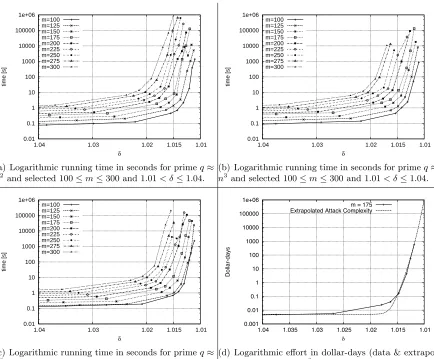
with an increasing block size parameter, i.e., with decreasing δ, until a vector of the desired length is found. Mark that our experiments only involve block size parameters ≤ 30 in or-der to avoid a known erratic behavior of the implementation in NTL. Also, performing the experiments in rather small dimensions, we give quite a conservative hardness estimate. Our first observation is that q plays a minor role ifδ ∈(1,1.02]. To see this, compare Figures 2(a) (q ≈ n2) and 2(c) (q ≈n8). For δ ≤1.02, the graphs show the same shape. This also holds forn2 ≤q ≤n8. Observe that the timings are in log-scale. The impact of the dimensionm is noticeable, but the slope of all graphs seems to be the same. The interesting part of the figures is where δ is smaller than 1.015, i.e., the right-hand side of the graphs. Here, the impact of the parameter δ is compelling, and much more noticeable than the impact of the dimension
m. Thus, we can considerδ to be the main security parameter.
Figure 2(b) shows the averaged samples for q ≈ n3 that were used for the interpolation. The fitting in Figure 2(d) was used to determine the hardness of attacks against lattice-based cryptosystems. For the interesting area whereδ <1.015, the “extrapolated attack complexity” function nicely approximates the data samples.
To arrive at very conservative estimates, we use SIS instances with a fix m = 175 and n, q
accordingly as our reference. For similar reasons, we choose a fix relation q ≈ n3 because all cryptosystems in Appendix A require q > n2. Thus, from now on, we can treatδ as the main security parameter and consider the cost function in dollar-days to beT(δ) =a21/(log2(δ)b)+c, for real constantsa, b, c. We use the (averaged) data samples in Figure 2(d) to find parameters
a, b, c for the above function T(δ) by a least-squares approximation. The resulting parameter
c= 0.005 can be neglected for smallδ. Now, we can draw our main conjecture, wheren≥128 rules out easy cases in small lattice dimensionsd <256.
Conjecture 3 Let all other parameters and relations as in Conjecture 2. For any δ ∈
0.01 0.1 1 10 100 1000 10000 100000 1e+06 1.01 1.015 1.02 1.03 1.04 time [s] δ m=100 m=125 m=150 m=175 m=200 m=225 m=250 m=275 m=300
(a) Logarithmic running time in seconds for primeq≈
n2and selected 100≤m≤300 and 1.01< δ≤1.04.
0.01 0.1 1 10 100 1000 10000 100000 1e+06 1.01 1.015 1.02 1.03 1.04 time [s] δ m=100 m=125 m=150 m=175 m=200 m=225 m=250 m=275 m=300
(b) Logarithmic running time in seconds for primeq≈
n3 and selected 100≤m≤300 and 1.01< δ≤1.04.
0.01 0.1 1 10 100 1000 10000 100000 1e+06 1.01 1.015 1.02 1.03 1.04 time [s] δ m=100 m=125 m=150 m=175 m=200 m=225 m=250 m=275 m=300
(c) Logarithmic running time in seconds for primeq≈
n8and selected 100≤m≤300 and 1.01< δ≤1.04.
0.001 0.01 0.1 1 10 100 1000 10000 100000 1e+06 1.01 1.015 1.02 1.025 1.03 1.035 1.04 Dollar-days b m = 175 Extrapolated Attack Complexity
(d) Logarithmic effort in dollar-days (data & extrapo-lation) for primeq≈n3,m= 175, and 1.01< δ≤1.04.
Figure 2: Logarithmic time complexity for solving δ-HSVP in different dimensions and for different moduli q. The x-axis corresponds to the Hermite factorδ.
Extrapolating T for smaller δ yields Figure 3. The horizontal bars correspond to today’s capabilities of the attacker types in Table 1. Notice that the extrapolation has moderate slope forδ <1.01 when compared to the actual data.
3.2. Attacking LWE
In contrast to lattice signatures that rely on (search) SIS, lattice-based encryption schemes are usually based on the decision LWE problem. While solving the search LWE problem also immediately solves the corresponding decision problem, the reverse direction only holds via a polynomial-time reduction. Thus, we choose to attack the decision problem as it presents the easier problem.
1e-10 1 1e+10 1e+20 1e+30 1e+40 1e+50 1e+60
1.004 1.006 1.008 1.01 1.012 1.014 1.016 1.018 1.02
Dollar-days
b
HSVP-Complexity Intelligence agency Lenstra Hacker
Figure 3: Estimated time complexity of δ-HSVP forδ ∈ [1.003,1.02]. The plots include hori-zontal lines, illustrating today’s power of different attacker types.
Proposition 4 (From LWE to SIS) A successful adversary against SIS(n, m, q,1.5√2π/α) can also break LWE(n, m, q, α).
We can interpret the decision-LWEproblem as an instance ofSISin the dual lattice 1/qΛ⊥q(A) because finding a short vectorw∈1/qΛ⊥q(A) and checking whetherhv,wiis close to Zsolves the decision problem. Note that an alternative interpretation is transforming an instance of the “bounded-distance decoding” problem in the LWE-lattice into an instance of the approximate shortest vector problem via a well-knownembedding method[GGH97]. Ifvis close to Λq(A), its
inner product withwwill be close to an integer. To see this, considerhv,wi=Ats+e,w=
Ats,w
+he,wi. Now, the first part of the sum is an integer becauseAw≡0 (mod q). As for the second part, we have to consider| he,wi |. The length ofein the direction ofwis short by design because we need to be able to decode and because it is drawn from a relatively tight Gaussian with standard deviation αq/√2π in each direction. However, the attack only works if both vectors are short. The length ofwdepends on how well we can cryptanalyze the lattice 1/qΛ⊥q(A). Following the reasoning in [MR08], we require kwk ≥1.5√2π/(αq) for the attack to fail as it makes the distribution of he,wimod 1 essentially uniform.
In consequence, we can phrase decision-LWEin the language ofSISwith with ν= 1.5√2π/α
and re-use the hardness estimates from Conjecture 3.
3.3. Applying Lenstra’s Heuristic
year Standard (2018) 2010 2020 2030 2040 2050 2060 2070 2080 2090 2100
bit security SHA/AES 75 82 88 95 102 108 115 122 128 135
λ 160 225 246 264 285 306 324 345 366 384 405
κ 128 150 164 176 190 204 216 230 244 256 270
Hacker 1.00993 1.01177 1.00965 1.00808 1.00702 1.00621 1.00552 1.00501 1.00458 1.00419 1.00389
Lenstra 1.00803 1.00919 1.00785 1.00678 1.00602 1.00541 1.00488 1.00447 1.00413 1.00381 1.00356
Int. agency 1.00710 1.00799 1.00695 1.00610 1.00548 1.00497 1.00452 1.00417 1.00387 1.00359 1.00336
Table 2: Infeasible parameters δ for HSVP. The upper rows present recommended post-quantum secure symmetric key size κ and hash function length λ. Each of the lower cells contains an upper bound for the HSVP-parameter δ, such that this problem is computationally hard for the given attacker (row) until the end of a given year (col-umn). According to Proposition 1 solvingδ-HSVPneeds to be infeasible in dimensions
d≥256.
2100. This table also allows a mapping between symmetric security and security parameters for lattice cryptography. In addition, we include a column “standard” for a standard hash function (SHA-1) and a standard block cipher (AES-128). The resulting parameter sets can be considered secure againstnon-quantum adversaries until 2018.
3.4. Post-quantum Secure Hash Functions and Symmetric Key Size
Encryption schemes and hash functions are rarely used without block ciphers and collision resistant hash functions, respectively. Since we want to propose parameters for the post-quantum era, we also want the symmetric ciphers and hash functions to be secure in this setting. In consequence, we need to take Grover’s search algorithm for quantum computers into account [Gro96]. Basically, its effect is that we have to double the key length of block ciphers that would be required in the non-quantum setting for symmetric ciphers. The output length of hash functions has to be multiplied with 3/2. According to the recommendations in [Len05] in conjunction with this doubling-law, we use the following formula that computes the required key length for security until the end of a given year y. As a simplification, we choose the symmetric parameters independently of the attacker type. A natural extension of our work would be to let λ and κ be functions of the attacker’s resources. Here, we use the simple Moore Law and the assumption that DES was secure in the year 1982, even against the strongest attacker. Then, κ≥2d56 + 12(y−1982)/18eis the proposed symmetric key length andλ≥3κ/2 is the proposed output length for hash functions. Using these formulae, we obtain the recommendations in Table 2. Notice that some of the schemes require the hash function to act as a random oracle. One scheme [Lyu09] even relies on “rewinding” the adversary to extract the solution to a hard problem. Generally, this is not possible with quantum adversaries due to the no-cloning theorem. Hence, we implicitly assume a stronger, quantum definition of the random oracle model or restrict the adversary to classical random oracle queries.
3.5. Comparison with Known Records in Lattice Reduction
There are currently two “lattice challenges” available online. TheSVP challenge3 corresponds to Goldstein-Mayer lattices that are well-suited to benchmark strong (non approximate)SVP
solvers in rather small dimensions<200. The best participants found a vector of`2-norm 2781 in dimension d = 112, which corresponds to δ = 1.009. However, a success in this challenge does not have any immediate implication in our context, as it applies to a different type of lattice and the dimensions involved are smaller than 256.
The Ajtai challenge4corresponds to lattices that are very similar to the ones we are studying here and there are challenges up to dimension 2000. More precisely, the Ajtai challenge asks to solve SIS(n, m, q, ν) in a simplified setup where q = n, m ≈ 2nlog(n), and ν < q. For the same n, this setup yields slightly easier instances than the setup in this paper. Here, the best participants found a vector of length ≈ 107 in dimension m = 750. This corresponds to δ = 1.0103 and an optimal attack dimension of d= 229 (cf. Proposition 1). Even though this result is still outside the relevant range for our analysis, it confirms our estimates, saying that today, a “Hacker” should be able to solve the problem for δ ≈1.011 and the adversary “Lenstra” might even solve it for δ≈1.009 in 2010 (cf. Table 2).
4. Applying the Framework
There are essentially two “directions” for applying our analytic framework. In the “forward” direction, we can take a cryptographic parameter set and an attacker type as input and output an equivalent security level or even a prediction of how long this parameter set can be considered secure.
When working in the “reverse” direction, we analyze a given schemes parameters and their relations as well as the corresponding worst-case to average-case reduction and, on input a year and an attacker type, output a set of concrete parameters that can be considered secure against the given attacker type until the given year (cf. Appendix A).
As mentioned before, we can easily make relative statements as well: Given SISscheme X
with parameters (n, q, m, ν) and LWEschemeY with parameters (n, q, m, α), we can compute their hardness parameters δX and δY. IfδX <(>)δY, the instance ofX is more (less) secure
than the instance of Y.
In this section, we will only apply our framework in the first sense, i.e., to analyze the (few) parameter sets that have been proposed in literature so far, regarding their exact security level. More concretely, we estimate the security of the parameters presented for LWE encryption in [MR08], to Lyubashevsky’s Fiat-Shamir signature scheme in [Lyu09] (cf. Table 3), and to the one-time signature scheme due to Lyubashevsky and Micciancio [LM08]. Mark that neither of these authors make claims about the exact security of there proposals because, prior to this work, there was no way of telling.
For SIS-based schemes [LM08, Lyu09], we analyze the corresponding security proof to de-termine the relevant SIS instances. For LWE [MR08], we compute the corresponding SIS -parameters as outlined in Section 3.2.
Since the parameter sets given in [MR08] (see Table 3) were specifically chosen to be secure against attackers that can solve HSVP for δ ≥ 1.01, they do not provide sufficient security
3
http://www.latticechallenge.org/svp-challenge
4
n 136 166 192 214 233 233 q 2003 4093 8191 16381 32749 32749 α 0.0065 0.0024 0.0009959 0.00045 0.000217 0.000217 ν 5.8e2 1.6e3 3.8e3 8.4e3 1.7e4 1.7e4
d 326 376 421 460 497 497
δ 1.0098 1.0098 1.0099 1.0099 1.0099 1.0099 year 2006 2006 2005 2005 2005 2005
bit 72 72 72 72 72 72
n 512 512 512 1024 q 231.727 259.748 295.747 295.872
m 4 5 8 8
ν 5.6e8 1.3e10 2.6e10 6.4e10 d 1118 1823 2835 5471 δ 1.0091 1.0064 1.0042 1.0023 year 2010 2035 2077 2180
bit 75 92 120 188
Table 3: Parameters given in [MR08] (left) and [Lyu09] (right), optimal attack dimension d, and hardness estimateδ. “year” denotes the expiration year of the parameter set and “bit” denotes the corresponding “bit security”.
against the medium adversary “Lenstra” and even the “Hacker” should be able to break them by 2020. See Appendix A for various secure LWE parameter sets that take the appropriate message length for hybrid encryption into account.
For the Fiat-Shamir-type signature scheme in [Lyu09], we compute theSISnorm parameter
ν = 2√mnnmdsdc, where ds is the norm bound for signing keys and dc controls the hashed
message length. The values differ from the ones in [Lyu09] because we express it in `2-norm, whereas they are given in `∞-norm in [Lyu09]. Note that the √mn factor corresponds to the dimension of ideal lattices, which is typically denoted with nm as opposed tom inq-ary lattices.
The parameters in [Lyu09] are based on an assumed hash length of 160 bit, therefore the underlying hash functions would only be secure until year 2018 (without taking quantum adversaries into account). However, the lattice parameters are quite reasonable as shown in Table 3. All but the first parameter set provide some security margin and with our framework, we can actually estimate how large it is.
The authors of [LM08] propose an exemplary parameter set for their one-time signature scheme. They let n = 512, q ≈ 227, and m = 9. This leads to ν = 20q1/mnlog2(n)√mn ≈
2.2·108. Using this parameter set, the attack dimension would be d= 999 and the hardness estimate is δ = 1.0097. Hence, it would be insecure against the attacker “Lenstra” and the “Hacker” is expected to break it by the year 2020. Secure parameters can be found in the appendix.
5. Conclusions
With our framework to analyze the SIS and LWEproblems, we have established a connection between lattice problems and symmetric “bit security” for the first time. While our analysis reveals certain weaknesses in the way parameters for lattice-based cryptosystems are currently proposed, it also provides the tools to systematically do so for various levels of security.
We propose that the presented methodology should be used whenever a new cryptographic primitive is presented to ensure that, concerning efficiency and security, it actually presents an improvement over known work. Furthermore, our work can be used to compare the security levels of parameter sets for entirely different cryptographic primitives, e.g., encryption and signature schemes. This is important when both are used in a more complex protocol, where all components should provide approximately the same level of security.
signature and encryption schemes for which there were no known concrete parameter sets. Doing so has revealed that all schemes that require trapdoor matrices (short bases) are far from practical and seem to require an enormous effort to become so. On the other hand, we have also seen that there are quite competitive signature and encryption schemes already, especially those working in ideal lattices. Refer to Appendix A.3 for details.
To conclude, with our work we would like to draw renewed interest to the development of practical, strong lattice basis reduction algorithms for large dimensions as well as to further op-timizing the parameter constraints for known lattice-based cryptosystems, which have mainly been of theoretic interest so far.
Acknowledgments
The authors would like to thank Chris Peikert for pointing out an efficiency improvement for the trapdoor constructions and Oded Regev for very helpful and stimulating discussions about ring-LWE. Furthermore, they thank Vadim Lyubashevsky, Nigel Smart, and Bogdan Warinschi for their helpful comments and for reviewing parts of this work.
References
[ADL+08] Y. Arbitman, G. Dogon, V. Lyubashevsky, D. Micciancio, C. Peikert, and A. Rosen. SWIFFTX: A proposal for the SHA-3 standard, 2008. In the First SHA-3 Candidate Conference.
[Ajt96] Mikl´os Ajtai. Generating hard instances of lattice problems (extended abstract). InSTOC, pages 99–108. ACM, 1996.
[AKS01] Mikl´os Ajtai, Ravi Kumar, and D. Sivakumar. A sieve algorithm for the shortest lattice vector problem. InSTOC, pages 601–610. ACM, 2001.
[AP09] Jo¨el Alwen and Chris Peikert. Generating shorter bases for hard random lat-tices. In Susanne Albers and Jean-Yves Marion, editors,STACS, volume 09001 of Dagstuhl Seminar Proceedings, pages 75–86. Schloss Dagstuhl - Leibniz-Zentrum fuer Informatik, Germany Internationales Begegnungs- und Forschungszentrum fuer Informatik (IBFI), Schloss Dagstuhl, Germany, 2009.
[Bab86] L´aszl´o Babai. On Lov´asz’ lattice reduction and the nearest lattice point problem. Combinatorica, 6(1):1–13, 1986.
[BDR+96] Matt Blaze, Whitfield Diffie, Ronald L. Rivest, Bruce Schneier, Tsutomu Shimo-mura, Eric Thompson, and Michael Wiener. Minimal key lengths for symmetric ciphers to provide adequate commercial security. A Report by an Ad Hoc Group of Cryptographers and Computer Scientists, 1996.
[CHKP10] David Cash, Dennis Hofheinz, Eike Kiltz, and Chris Peikert. Bonsai trees, or how to delegate a lattice basis. In Gilbert [Gil10], pages 523–552.
[Dwo08] Cynthia Dwork, editor. Proceedings of the 40th Annual ACM Symposium on Theory of Computing, Victoria, British Columbia, Canada, May 17-20, 2008. ACM, 2008.
[ECR09] ECRYPT2. Yearly report on algorithms and keysizes — report D.SPA.7, 2009. available athttp://www.ecrypt.eu.org/documents/D.SPA.7.pdf.
[Gen09] Craig Gentry. Fully homomorphic encryption using ideal lattices. In Mitzen-macher [Mit09], pages 169–178.
[GGH97] Oded Goldreich, Shafi Goldwasser, and Shai Halevi. Public-key cryptosystems from lattice reduction problems. In Burton S. Kaliski Jr., editor, CRYPTO, volume 1294 ofLNCS, pages 112–131. Springer, 1997.
[GHGKN06] Nicolas Gama, Nick Howgrave-Graham, Henrik Koy, and Phong Q. Nguyen. Rankin’s constant and blockwise lattice reduction. InCRYPTO, volume 4117 of LNCS, pages 112–130. Springer, 2006.
[Gil10] Henri Gilbert, editor. Advances in Cryptology - EUROCRYPT 2010, 29th An-nual International Conference on the Theory and Applications of Cryptographic Techniques, French Riviera, May 30 - June 3, 2010. Proceedings, volume 6110 of Lecture Notes in Computer Science. Springer, 2010.
[GM03] Daniel Goldstein and Andrew Mayer. On the equidistribution of Hecke points. Forum Mathematicum 2003, 15:2, pages 165–189, 2003.
[GN08a] Nicolas Gama and Phong Q. Nguyen. Finding short lattice vectors within mordell’s inequality. In Dwork [Dwo08], pages 207–216.
[GN08b] Nicolas Gama and Phong Q. Nguyen. Predicting lattice reduction. In Nigel P. Smart, editor,EUROCRYPT, volume 4965 ofLNCS, pages 31–51. Springer, 2008.
[GNR10] Nicolas Gama, Phong Q. Nguyen, and Oded Regev. Lattice enumeration using extreme pruning. In Gilbert [Gil10], pages 257–278.
[GPV08] Craig Gentry, Chris Peikert, and Vinod Vaikuntanathan. Trapdoors for hard lattices and new cryptographic constructions. In Dwork [Dwo08], pages 197–206.
[Gro96] Lov K. Grover. A fast quantum mechanical algorithm for database search. In STOC, pages 212–219. ACM, 1996.
[HILL99] Johan H˚astad, Russell Impagliazzo, Leonid A. Levin, and Michael Luby. A pseu-dorandom generator from any one-way function. SIAM J. Comput., 28(4):1364– 1396, 1999.
[KTX07] Akinori Kawachi, Keisuke Tanaka, and Keita Xagawa. Multi-bit cryptosystems based on lattice problems. In Tatsuaki Okamoto and Xiaoyun Wang, editors, Public Key Cryptography, volume 4450 of Lecture Notes in Computer Science, pages 315–329. Springer, 2007.
[Len05] Arjen Lenstra. The Handbook of Information Security, chapter 114 — Key Lengths. Wiley, 2005. available at http://www.keylength.com/biblio/
Handbook_of_Information_Security_-_Keylength.pdf.
[LLL82] Arjen Lenstra, Hendrik Lenstra, and L´aszl´o Lov´asz. Factoring polynomials with rational coefficients. Mathematische Annalen, 261(4):515–534, 1982.
[LM06] Vadim Lyubashevsky and Daniele Micciancio. Generalized compact knapsacks are collision resistant. In Michele Bugliesi, Bart Preneel, Vladimiro Sassone, and Ingo Wegener, editors, ICALP (2), volume 4052 of LNCS, pages 144–155. Springer, 2006.
[LM08] Vadim Lyubashevsky and Daniele Micciancio. Asymptotically efficient lattice-based digital signatures. In Ran Canetti, editor, TCC, volume 4948 of LNCS, pages 37–54. Springer, 2008.
[LPR10] Vadim Lyubashevsky, Chris Peikert, and Oded Regev. On ideal lattices and learning with errors over rings. In Gilbert [Gil10], pages 1–23.
[LV01] Arjen Lenstra and Eric R. Verheul. Selecting cryptographic key sizes. J. Cryp-tology, 14(4):255–293, 2001.
[Lyu09] Vadim Lyubashevsky. Fiat-shamir with aborts: Applications to lattice and factoring-based signatures. In ASIACRYPT, volume 5912 ofLNCS, pages 598– 616. Springer, 2009.
[Mer89] Ralph C. Merkle. A certified digital signature. In Gilles Brassard, editor, CRYPTO, volume 435 ofLNCS, pages 218–238. Springer, 1989.
[Mic01] Daniele Micciancio. Improving lattice based cryptosystems using the hermite normal form. In Joseph H. Silverman, editor, CaLC, volume 2146 of LNCS, pages 126–145. Springer, 2001.
[Mic07] Daniele Micciancio. Generalized compact knapsacks, cyclic lattices, and efficient one-way functions. Computational Complexity, 16(4):365–411, 2007. Prelim. in FOCS 2002.
[Mit09] Michael Mitzenmacher, editor. Proceedings of the 41st Annual ACM Symposium on Theory of Computing, STOC 2009, Bethesda, MD, USA, May 31 - June 2, 2009. ACM, 2009.
[MR07] Daniele Micciancio and Oded Regev. Worst-case to average-case reductions based on gaussian measures. SIAM J. Comput., 37(1):267–302, 2007.
[MV10] Daniele Micciancio and Panagiotis Voulgaris. A deterministic single exponential time algorithm for most lattice problems based on voronoi cell computations. In STOC. ACM, 2010.
[Pei07] Chris Peikert. Limits on the hardness of lattice problems in `p norms. In IEEE
Conference on Computational Complexity, pages 333–346. IEEE Computer Soci-ety, 2007.
[Pei09] Chris Peikert. Public-key cryptosystems from the worst-case shortest vector prob-lem: extended abstract. In Mitzenmacher [Mit09], pages 333–342.
[Pei10] Chris Peikert. An efficient and parallel gaussian sampler for lattices. In Tal Rabin, editor, CRYPTO, volume 6223 of Lecture Notes in Computer Science, pages 80–97. Springer, 2010.
[PR06] Chris Peikert and Alon Rosen. Efficient collision-resistant hashing from worst-case assumptions on cyclic lattices. In Shai Halevi and Tal Rabin, editors,TCC, volume 3876 ofLNCS, pages 145–166. Springer, 2006.
[PVW08] Chris Peikert, Vinod Vaikuntanathan, and Brent Waters. A framework for ef-ficient and composable oblivious transfer. In David Wagner, editor, CRYPTO, volume 5157 ofLNCS, pages 554–571. Springer, 2008.
[PW08] Chris Peikert and Brent Waters. Lossy trapdoor functions and their applications. In Dwork [Dwo08], pages 187–196.
[Reg09] Oded Regev. On lattices, learning with errors, random linear codes, and cryp-tography. J. ACM, 56(6), 2009.
[Reg10] Oded Regev. Regularity lemma for ring-lwe, 2010. Personal communication, June 2010.
[RS09] Alon Rosen and Gil Segev. Chosen-ciphertext security via correlated products. In Omer Reingold, editor,TCC, volume 5444 ofLNCS, pages 419–436. Springer, 2009.
[R¨uc10] Markus R¨uckert. Strongly unforgeable signatures and hierarchical identity-based signatures from lattices without random oracles. In Nicolas Sendrier, editor, PQCrypto, volume 6061 ofLNCS, pages 182–200. Springer, 2010.
[Sch87] Claus-Peter Schnorr. A hierarchy of polynomial time lattice basis reduction algorithms. Theor. Comput. Sci., 53:201–224, 1987.
[SE94] Claus-Peter Schnorr and M. Euchner. Lattice basis reduction: Improved prac-tical algorithms and solving subset sum problems. Mathematical Programming, 66:181–199, 1994.
[Sho] Victor Shoup. Number theory library (NTL) for C++.http://www.shoup.net/
ntl/.
[SSTX09] Damien Stehl´e, Ron Steinfeld, Keisuke Tanaka, and Keita Xagawa. Efficient public key encryption based on ideal lattices. In ASIACRYPT 2009, volume 5912 of LNCS, pages 617–635. Springer, 2009.
A. Selecting Secure Parameters
In the following, we apply our framework in the “reverse” direction, i.e., we generate secure parameter sets for various schemes out of their original description, such that they require a small enough δ when attacked with an HSVP solver. The resulting parameters are exemplary because most schemes allow various trade-offs.
We cover essentially every published lattice-based signature and encryption scheme and also some unpublished variants. Moreover, due to our modular three-tier approach, it is easy to include new schemes, that use LWE or SIS as their security assumption. For each scheme, one needs to figure out the exact (not asymptotic) parameter relations and constraints as functions of the main security parameter n. In addition, we let the worst-case to average-case reduction be a guiding principle for choosing the modulus q. In conjunction with the average-case reduction fromSIS(signatures) orLWE(encryption), these parameter relations specify the type of lattice that needs to be “attacked” in order to break the scheme. For signature schemes, the resulting instance ofSIS immediately yields the hardness estimateδ via Conjecture 2. As for encryption schemes, we need to exploit the duality of SIS and LWE before making such a statement. Once we have the hardness estimate δ = δ(n), we can easily determine the least
n, such that it provides sufficient hardness against various attacker types and for the desired period of time via Conjecture 3. All parameter sets correspond to security against the attacker type “Lenstra” but the analysis easily extends to any other type.
We will conclude this section with a set of remarks about our findings.
For some of the schemes, we require ideal lattices and some additional notation. We define ideal lattices over the ring R = Zq[x]/hfi for an irreducible polynomial f of degree n. The
descriptionAinq-ary lattices is replaced by a small number of degree-npolynomials, denoted with ˆa = (a1, . . . ,am) ∈ Rm. Since Rm ∼= Zmnq , the parameter m is in Ω(log(n)) for ideal
lattices. The resulting lattices dimension, however, is mn= Ω(nlog(n)). In addition, in ideal lattices, the matrix-vector productAvis replaced with the product ˆa~vˆ :=Pm
i=1aivi(modulo
f and q).
A.1. Signature Schemes
All modern lattice-based signature schemes are based on the hardness of the SISproblem. In other words, for each scheme, we can easily describe an equivalent instance ofSIS in terms of the parameters n, m, q, ν that also fully determine the hardness estimateδ forHSVP. For our choices ofn, m, andq, by the following worst-case to average-case reduction, theSISinstances in dimensionmare provably at least as hard as all instances of the shortest vector problem in dimension n.
Proposition 5 (Worst-case to Average-case [GPV08]) For anym≤poly(n),ν ≤poly(n), and for any prime q ≥νω(pnlog(n)), the average-case problem SIS(n, m, q, ν) is as hard as approximating the SIVP in the worst case within certain γ =νOe(
√
Using the attacker dimension d of Proposition 1, we can compute δ = pd
ν/qn/d. We let q
be governed by a constraint in the worst-case to average-case reduction. As this constraint introduces a circular dependency, we typically choose a fixed relation q≥nt, for t∈N, before the other parameters to resolve this issue. Having these relations at hand, we can also fix a δ
and find suitable n, m, q, ν such that they are valid parameters that guarantee security until the desired year. Combined with the infeasible values for δ for each year and attacker type (Table 2) we generate tables that present suitable parameters for each signature scheme. We propose exemplary parameters for GPV [GPV08], Lyubashevsky’s treeless signature scheme [Lyu09], the ideal lattice variant of GPV, the Bonsai tree scheme [CHKP10], its ideal lattice variant, and the Lyubashevsky-Micciancio one-time signature scheme [LM08].
GPV Signatures. The GPV signature scheme [GPV08] is due to Gentry, Peikert, and
Vaikun-tanathan. It benefits from the improved trapdoor generation algorithm in [AP09], which de-mands m1 ≥(1 +ϕ)nlog2(q),m2≥(4 + 2ϕ)nlog2(q), m=m1+m2, and odd primeq ≥3 (q has to satisfy q≥νω(√nlogn), for the worst-case to average-case reduction). For our choices of n (n≥100), m (m ≥1000), andq (q ≥n3), ϕ= 0.1 is a suitable choice. Forϕ= 0.1, the statistical distance from uniformity, m2·q−ϕn/2 in [AP09], is smaller than 2−80.
The most recent sampling algorithm [Pei10] improves the efficiency of the signature genera-tion process in GPV and in all derived schemes. However, it does not change the parameters. The GPV scheme is strongly unforgeable in the random oracle model as long as the respective instance ofSISwith norm boundν = 2s√mis hard, for a Gaussian parameters≥(1+20√m1)·
ω
p
log(n)
. Choosing log(n) forω
p
log(n)
we getν = 2(1 + 20√m1) log(n)
√
m.5
We choose m1 = d(1 + 0.1)nlog2(q)e and m2 = d(4 + 0.2)nlog2(q)e. For q we choose the smallest prime bigger than nt for the smallest t such that q ≥ 2ν√nlog2(n) (worst-case to average-case reduction). In our case, we could choose a prime q ≥n4. Messages are mapped toZnq via a full-domain hash. This set is always bigger than 2λ.
Here we describe the structure of the scheme, in order to compute the key and signature sizes. The parameters for GPV are presented in Table 4.
Secret Key: S ∈ Zm×m with kSk ≤ 20nlog(q). A close look at the trapdoor construction
allows to store the key in 2m1m2+m1log2(q)) bits, without storing the orthogonalized basis. This implies that generating signatures gets a bit more expensive, as it requires computation of the QR decomposition of the trapdoor basis.
Public Key: A∈Zn×m
q , i.e, nmlog2(q) bits.
Signature: σ∈Zm withkσk2 ≤s
√
m, i.e., mlog2(s√m) bits.
5This choice is suitable for all dimensionsm≥83; for thosem, the smoothing parameter index(see [MR07,
Pei07, GPV08] for more details) is smaller than 2−79. This renders the statistical distance between a uniform distribution and the “blurred” lattice negligible (i.e., 2−80). This is due to the fact that log(m)≥ p
log(2m(1 + 1/))/πform≥83 andλ∞1 (Z∗) = 1 (a lattice constant) in [GPV08, Lemma 4.3], using [Pei07,
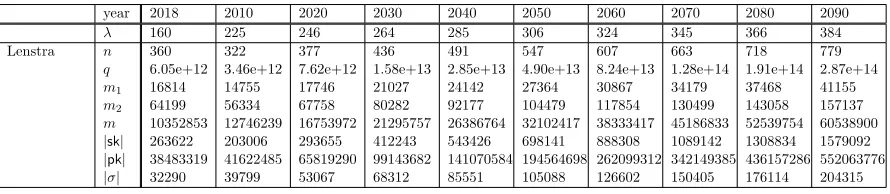
year 2018 2010 2020 2030 2040 2050 2060 2070 2080 2090 λ 160 225 246 264 285 306 324 345 366 384 Lenstra n
q m1 m
|sk| |pk| |σ| 330 1.19e+10 12148 58531 137613 78904 154 289 6.98e+09 10396 50087 100780 57779 130 338 1.31e+10 12494 60198 145562 83462 158 391 2.34e+10 14815 71380 204654 117348 190 440 3.75e+10 17001 81913 269498 154538 221 489 5.72e+10 19222 92615 344507 197556 252 542 8.63e+10 21660 104359 437415 250834 286 592 1.23e+11 23989 115583 536545 307694 320 641 1.69e+11 26298 126709 644799 369782 353 695 2.33e+11 28871 139103 777112 445659 390
Table 4: Recommended parameters for GPV signatures. The rows correspond to attacker types and the columns correspond to security until a given year. Sizes are in kilobytes (kB).
Ideal GPV. In [SSTX09], the authors explain how to create an ideal-lattice variant of the
GPV signature, in order to reduce the key sizes of the secret and public key. This variant comes with ˜O(n) verification time and signature length. Here we apply their idea and instantiate the GPV scheme with ideal lattices.
Choose k > 0 and n = 2k for the smallest possible k, σ = 1 and ρ = d1 + log3(q)e. The ring Ris R=Zq[x]/(xn+ 1). Choose the norm boundd=s
√
mn. No bound on ˜Lis known, but it is always possible to assume ˜L ≤ L = p2n(9ρ+σ). The dimension has to satisfy
m≥(dlog2(q)e+ 1)(σ+ρ), we choosemequal to that bound. Choose the Gaussian parameter as s = ˜Llog(n) = p2n(9ρ+σ)·log(n). The modulus q is chosen to be the smallest prime bigger than or equal ton7 satisfying q≡3 (mod 8), as in that casem >log2(q)/log2(2d) and
q > 4dmn√nlog2(n) hold. With kσk2 ≤ d we have ν(2) = 2d (in the Euclidean norm). We can use the same bound 2din the maximum norm, i.e., ν = 2d.
The parameters for Ideal-GPV are presented in Table 5.
Here we describe the structure of the scheme, in order to compute the key and signature sizes. Instead of storing the trapdoor basis, which implies the necessity to calculate orthogonalizations on the fly, it would also we possible to store the Gram-Schmidt orthogonalized basis.
Secret Key: Trapdoor S ∈ Zmn×mn such that ˆasˆ
i ≡ 0 modq for every column ˆs in S (in-terpreted as an element of Rm). The basis length is kSk ≤p2n(9ρ+σ). When look-ing closely at the construction, we find that the trapdoor can be reconstructed from
σ(m−σ)n√σn+ρ(m−ρ)nlog2(3) bits.
Public Key: ˆa∈Rm determining the ideal lattice, i.e., mnlog2(q) bits.
Signature: σ∈Rm withkσk2≤d, i.e., mnlog2(d) bits.
year 2018 2010 2020 2030 2040 2050 2060 2070 2080 2090 λ 160 225 246 264 285 306 324 345 366 384 Lenstra n
q m
|sk| |pk| |σ| 256 7.21e+16 2204 5072 3857 1151 256 7.21e+16 2204 5072 3857 1151 256 7.21e+16 2204 5072 3857 1151 256 7.21e+16 2204 5072 3857 1151 256 7.21e+16 2204 5072 3857 1151 512 9.22e+18 2688 14550 10584 2957 512 9.22e+18 2688 14550 10584 2957 512 9.22e+18 2688 14550 10584 2957 512 9.22e+18 2688 14550 10584 2957 512 9.22e+18 2688 14550 10584 2957
Bonsai Trees. Here we describe the original Bonsai tree scheme by Cash, Hofheinz, Kiltz, and Peikert [CHKP10]. It does not require random oracles for the security proof of existential unforgeability. A modified version by R¨uckert [R¨uc10] with essentially the same efficiency supports strong unforgeability. The Bonsai tree scheme makes use of the [AP09] trapdoor, which was used in the GPV case as well.
The parameters are: m1 = d(1 +ϕ)nlog2(q)e, m2 = d(4 + 2ϕ)nlog2(q)e, hashed message length λ, total dimension m =m1+ (λ+ 1)m2.6 Again, we can use ϕ= 0.1. We choose the Gaussian parameter s = (1 + 20√m1) log(n) and let q ≥ n5. If there exists a PPT attack against unforgeability on the signature scheme, then there is a PPT algorithm attacking SIS
forν = 2s√m. For the overview of the parameters, refer to Table 6.
Here we describe the keys and the signature of the scheme, in order to derive the key and signature sizes.
Secret Key: S ∈ Z(m1+m2)×(m1+m2) with kSk ≤ 20nlog(q). A close look at the trapdoor
construction allows to store the key in 2m1m2 +m1log2(q)) bits, without storing the orthogonalized basis. This implies that generating signatures gets a bit more expensive, as it requires computation of the QR decomposition of the trapdoor basis.
Public Key: A0 ∈ Zqn×(m1+m2),A(jk) ∈ Znq×m2, 2λ many, i.e., n(m1 + m2) log2(q) + 2λ·
nm2log2(q) bits.
Signature: σ∈Zm withkσk
2 ≤s
√
m, i.e., mlog2(s√m) bits.
year 2018 2010 2020 2030 2040 2050 2060 2070 2080 2090 λ 160 225 246 264 285 306 324 345 366 384 Lenstra n
q m1 m2 m
|sk| |pk| |σ| 360 6.05e+12 16814 64199 10352853 263622 38483319 32290 322 3.46e+12 14755 56334 12746239 203006 41622485 39799 377 7.62e+12 17746 67758 16753972 293655 65819290 53067 436 1.58e+13 21027 80282 21295757 412243 99143682 68312 491 2.85e+13 24142 92177 26386764 543426 141070584 85551 547 4.90e+13 27364 104479 32102417 698141 194564698 105088 607 8.24e+13 30867 117854 38333417 888308 262099312 126602 663 1.28e+14 34179 130499 45186833 1089142 342149385 150405 718 1.91e+14 37468 143058 52539754 1308834 436157286 176114 779 2.87e+14 41155 157137 60538900 1579092 552063776 204315
Table 6: Recommended parameters for Bonsai signature scheme. The rows correspond to at-tacker types and the columns correspond to security until a given year. Sizes are in kilobytes (kB).
Note that there is an improvement due to Boyen [Boy10] that reduces the dimension of the generated signatures at the expense of a stronger assumption. Unfortunately, this improvement does not seem to yield practical parameters either.
Ideal Bonsai. Here we describe how to instantiate the Bonsai tree scheme of [CHKP10] with
ideal lattices. As the security reduction to a worst case problem is stated in the infinity norm (and this norm is more natural for ideal lattices and ring elements) we describe the scheme using the infinity norm. Following [SSTX09], the parameters are: n which is a power of 2,
f =xn+ 1, primeq≡3 (mod 8),σ = 1,ρ=dlog3(q) + 1e. The output length of a secure hash function is denoted byλ. We choose ˜L=p2n(9ρ+σ) as bound for the length of the trapdoor.
R is again the ringZq[x]/hfi. We use a Gaussian parameters= ˜Llog(n) andd=s
√
mn.
It is required that m1 +m2 ≥ (dlog(q)e+ 1)(σ +r). We can choose m1 = σ = 1 and
m2=dlog (q) + 1e(σ+ρ)−1. Letm=m1+ (λ+ 1)m2. Following the worst-case to average-case reduction for ideal lattices, we choose a prime q ≥ n8 such that m > log2(q)/log2(2d) and q > 4dmn√nlog2(n). The corresponding approximation factor for SIS is ν = 2d. The overview of the parameters for the Ideal Bonsai scheme are presented in Table 7.
Here we describe the keys and the signature of the scheme, in order to derive the key and signature sizes. Instead of storing the trapdoor basis, which implies the necessity to calculate orthogonalizations on the fly, it would also we possible to store the Gram-Schmidt orthogonalized basis.
Secret Key: Trapdoor S ∈ Zmn×mn such that ˆasˆ
i ≡ 0 modq for every column ˆs in S (in-terpreted as an element of Rm). The basis length is kSk ≤p2n(9ρ+σ). When look-ing closely at the construction, we find that the trapdoor can be reconstructed from
σ(m−σ)n√σn+ρ(m−ρ)nlog2(3) bits.
Public Key: ˆa0 ∈ Rm1+m2, ˆb(ik) for k ∈ {0,1} and i∈ {1, . . . , λ}, random elements in Rm2,
i.e., nlog2(q)·(m1+m2+ 2λm2) Bits
Signature: σ∈Rm withkσk2≤s√mn, i.e., mnlog2(s√mn) bits.
year 2018 2010 2020 2030 2040 2050 2060 2070 2080 2090 λ 160 225 246 264 285 306 324 345 366 384 Lenstra n
q m1 m2 m
|sk| |pk| |σ| 512 4.72e+21 1 2447 393968 14639 1772856 635248 512 4.72e+21 1 2447 553023 14639 2488603 900169 1024 1.21e+24 1 3020 745941 42667 7459410 2562702 1024 1.21e+24 1 3020 800301 42667 8003010 2754533 1024 1.21e+24 1 3020 863721 42667 8637210 2978756 1024 1.21e+24 1 3020 927141 42667 9271410 3203399 1024 1.21e+24 1 3020 981501 42667 9815010 3396263 1024 1.21e+24 1 3020 1044921 42667 10449210 3621613 1024 1.21e+24 1 3020 1108341 42667 11083410 3847310 2048 3.09e+26 1 3595 1384076 120603 30449672 10080821
Table 7: Recommended parameters for Ideal Bonsai signature scheme. The rows correspond to attacker types and the columns correspond to security until a given year. Sizes are in kilobytes (kB).
It is noticeable that for the ideal Bonsai signature scheme, we need to choose a bigger modulusq than for the original Bonsai tree scheme.
LM-OTS. The one-time signature scheme of [LM08] does not require random oracles, and it
is asymptotically optimal (almost linear in the security parameter n) in concerns of key size and signature/verification time. It is equipped with a security proof of worst-case complexity assumptions. Using a tree construction it can be transformed into a regular signature scheme, with logarithmic overhead [Mer89]. The LM-OTS scheme is based on the collision resistant hash function of [LM06, Mic07, PR06]: H∈ HR,m={Hˆa: ˆa∈Rm}that maps elements from
Rm toR. For a λ-bit message signing and verification take time ˜O(λ) + ˜O(n), signature size is ˜O(n).
We fix the ring defining polynomial and operate inR=Zq[x]/hxn+ 1i. We choose a prime
q ≥n3 and m=dlog(n)e, as proposed in the original work [LM08]. The main parametern is chosen to be a power of 2. Messages are encoded in {−1,0,1}n, but |{−1,0,1}n| ≥ 2λ does
An attacker that, after seeing a signature/message pair, can output a valid signature of another message, can use a polynomial-time algorithm to find a collision in the underlying hash function and from this we derive ν = 20q1/mnlog2(n)√mn for SIS. See Table 8 for the proposed LM-OTS parameters.
Secret Key: kˆ ∈ Rm,ˆl ∈ Rm with
ˆ k
∞ ≤ 5blog2(n)cq 1/m,
ˆl
∞ ≤ 5nblog2(n)cq
1/m, i.e,
mnlog2(5blog2(n)cq1/m) +mnlog
2(5nblog2(n)cq1/m) bits.
Public Key: H∈ HR,m,H(ˆk),H(ˆl), i.e., mnlog2(q) + 2·nlog2(q) bits. H is shared among all users and generated from a trusted source of random bits, e.g., from the random bits of
π.
Signature: σ∈Rm withkσk∞≤10q1/mnlog2(n), i.e.,mnlog2(10q1/mnlog2(n)) bits.
year 2018 2010 2020 2030 2040 2050 2060 2070 2080 2090 λ 160 225 246 264 285 306 324 345 366 384 Lenstra n
q m
|sk| |pk| |σ| 1024 1.07e+09 7 8.71 33.75 20.29 1024 1.07e+09 7 8.71 33.75 20.29 1024 1.07e+09 7 8.71 33.75 20.29 1024 1.07e+09 7 8.71 33.75 20.29 1024 1.07e+09 7 8.71 33.75 20.29 1024 1.07e+09 7 8.71 33.75 20.29 2048 8.59e+09 8 19.83 82.5 48.62 2048 8.59e+09 8 19.83 82.5 48.62 2048 8.59e+09 8 19.83 82.5 48.62 2048 8.59e+09 8 19.83 82.5 48.62
Table 8: Recommended parameters for LM-OTS signature scheme. The rows correspond to attacker types and the columns correspond to security until a given year. Sizes are in kilobytes (kB).
Lyubashevsky Treeless Signatures. In [Lyu09] Lyubashevsky presents a signature scheme
secure in the random oracle model with key generation, signing, and verification time ˜O(n). Its security is based on the hardness of approximating the shortest, non-zero vector to within a factor of ˜O n2 in lattices corresponding to ideals inR=Z[x]/hxn+ 1i.
The parameters involved are: n, a power of 2, an integerm, an integerdcsuch that 2dc dnc
≥
2λ (for encoding messages), and a prime integerq ≥(2ds+ 1)m·2−128/n.
If the scheme is not strongly unforgeable, then there exists a polynomial time algorithm that solves SISin every lattice corresponding to ideals inR forν= 2√mn·nmdsdc.
We choose m = dlog2(n)e and compute the smallest dc such that 2dc dnc
≥ 2λ holds. Further, for ds we choose the smallest value such that q ≥ 4m2n2.5dsdclog(n) and m >
log(q)/log(2mndsdc) hold because of the worst-case to average-case reduction. This choice
of parameters implies that finding collisions in the underlying hash function is hard. Notice that the scheme allows various trade-offs. For example, a larger ds increases the key size but
allows for smallerm, as demonstrated in [Lyu09]. The scheme has the following structure. See [Lyu09] for a full description of the numerous parameters. Our proposed parameter sets are in Table 9.
Secret Key: ˆs∈Rm withkˆsk∞≤ds, i.e, mnlog2(2ds+ 1) bits for a typically small ds.
Public Key: H∈ HR,m,H(ˆs)∈R, i.e., nlog2(q) bits. His again global.
year 2018 2010 2020 2030 2040 2050 2060 2070 2080 2090 λ 160 225 246 264 285 306 324 345 366 384 Lenstra n
q m dc
ds |sk| |pk| |σ| 512 3.81e+12 9 23 13 2.67 2.61 12.03 512 7.25e+12 9 37 14 2.73 2.67 12.48 512 7.25e+12 9 41 14 2.73 2.67 12.56 512 1.32e+13 9 45 15 2.79 2.72 12.69 1024 4.77e+13 10 40 12 5.8 5.68 29.04 1024 1.03e+14 10 44 13 5.94 5.82 29.35 1024 1.03e+14 10 48 13 5.94 5.82 29.51 1024 1.03e+14 10 52 13 5.94 5.82 29.65 1024 1.03e+14 10 56 13 5.94 5.82 29.79 1024 1.03e+14 10 59 13 5.94 5.82 29.88
Table 9: Recommended parameters for treeless signatures. The rows correspond to attacker types and the columns correspond to security until a given year. Sizes are in kilobytes (kB).
Our parameters for the year 2020 lead to comparable sizes for keys and signatures as the parameters in the weakest sample instantiation of [Lyu09].
A.2. Encryption Schemes
We discuss the parameter choice for the multi-bit variant of Regev’s cryptosystem [Reg09, KTX07, PVW08, MR08], the dual-LWEcryptosystem [GPV08, Pei09], and the trapdoor-LWE
scheme [RS09, Pei09]. For each scheme, we also present a “ring” version that uses an ideal lattice version of LWE [LPR10]. After briefly recalling the LWE assumption, we describe its modification for rings and deal with decryption errors.
The LWE Assumption. Let n ∈ N, m ≤poly(n), q ≤poly(n), and α > 0. Furthermore, let A ←$ Zn×m
q ,s
$
←Zn
q, and e
$
←χm
α with χα being a discretized Gaussian distribution with
standard deviation αq/√2π and mean zero. A theorem in [Reg09] states that v ← Ats+e
is indistinguishable from uniform if α >√n/q by a worst-case to average-case reduction, i.e., solving decision LWE implies solving several worst-case lattice problems in dimension n with approximation factors inOe(n/α). Thus, choosing a largeα ensures worst-case hardness but it increases the probability of a decryption error. We let this reduction govern the choice ofαbut there are further restrictions, coming from the individual cryptosystems. Regev’s reduction relies on quantum computation but it was “dequantized” by Peikert in [Pei09]. Although Peikert requiresq = 2O(n) for the dequantization to work, we stick toq =poly(n). It is more practical and, similar to SIS, the worst-case to average-case reduction should not be more than a guideline for choosing actual parameters. Since there is a circular dependency in the parameters, we will make a sensible choice for q before choosing the remaining parameters. Having chosen a complete set of parameters, we verify that all constraints are satisfied.
The assumption that (A,v) is close to uniform helps in proving CPA security of all sub-sequent constructions. In Regev’s LWE construction it is used to show indistinguishability of the public key from uniform, while dual-LWE and trapdoor-LWE rely on this assumption for proving the same for the ciphertexts. The uniform distribution of ciphertexts (Regev) and keys (dual, trapdoor) is ensured by the particular choice ofmby the leftover-hash lemma [HILL99]. To get 2−κ-uniformity, we essentially require thatpqn/|D|m ≤2−κ, where D⊂
![Figure 3: Estimated time complexity of δ-HSVP for δ ∈ [1.003, 1.02]. The plots include hori-zontal lines, illustrating today’s power of different attacker types.](https://thumb-us.123doks.com/thumbv2/123dok_us/1873760.1243920/11.612.198.411.86.233/figure-estimated-complexity-include-zontal-illustrating-dierent-attacker.webp)

![Table 3: Parameters given in [MR08] (left) and [Lyu09] (right), optimal attack dimension d,and hardness estimate δ](https://thumb-us.123doks.com/thumbv2/123dok_us/1873760.1243920/14.612.90.523.82.174/table-parameters-given-optimal-attack-dimension-hardness-estimate.webp)