Better Bootstrapping in Fully Homomorphic Encryption
Craig Gentry IBM
Shai Halevi IBM
Nigel P. Smart University of Bristol
December 15, 2011
Abstract
Gentry’s bootstrapping technique is currently the only known method of obtaining a “pure” fully homomorphic encryption (FHE) schemes, and it may offers performance advantages even in cases that do not require pure FHE (such as when using the new noise-control technique of Brakerski-Gentry-Vaikuntanathan).
The main bottleneck in bootstrapping is the need to evaluate homomorphically the reduction of one integer modulo another. This is typically done by emulating a binary modular reduction circuit, using bit operations on binary representation of integers. We present a simpler approach that bypasses the homomorphic modular-reduction bottleneck to some extent, by working with a modulus very close to a power of two. Our method is easier to describe and implement than the generic binary circuit approach, and is likely to be faster in practice. In some cases it also allows us to store the encryption of the secret key as a single ciphertext, thus reducing the size of the public key.
We also show how to combine our new method with the SIMD homomorphic computation techniques of Smart-Vercauteren and Gentry-Halevi-Smart, to get a bootstrapping method that works in time quasi-linear in the security parameter. This last part requires extending the techniques from prior work to handle arithmetic not only over fields, but also over some rings. (Specifically, our method uses arithmetic modulo a power of two, rather than over characteristic-two fields.)
Keywords.Fully Homomorphic Encryption, Bootstrapping
Acknowledgments. The first and second authors are sponsored by DARPA and ONR under agreement number N00014-11C-0390. The U.S. Government is authorized to reproduce and distribute reprints for Governmental purposes notwithstanding any copyright notation thereon. The views and conclusions con-tained herein are those of the authors and should not be interpreted as necessarily representing the official policies or endorsements, either expressed or implied, of DARPA, or the U.S. Government. Distribution Statement “A” (Approved for Public Release, Distribution Unlimited).
Contents
1 Introduction 1
2 A simpler decryption formula 3
2.1 Working modulo2r+1 . . . 4
3 Basic Homomorphic Decryption 4 3.1 ComputingZ0 Homomorphically . . . 5
3.2 Extracting the Top and Bottom Bits . . . 5
3.3 Packing the Coefficients . . . 6
4 Algebraic Background 7 4.1 GeneralF(X) . . . 7
4.2 Cyclotomic Polynomials . . . 8
5 Homomorphic Decryption with Packed Ciphertexts 9 5.1 Encrypting theqL-Secret-Key . . . 10
5.2 Step One: ComputingZ0 Homomorphically . . . 10
5.3 Step Two: Switching to CRT Representation . . . 10
5.4 Step Three: Extracting the Top and Bottom Bits . . . 11
5.5 Step Four: Switching Back to Coefficient Representation . . . 11
5.6 Details of Step Two . . . 12
5.7 An Alternative Variant . . . 13
6 Lower-Degree Bit Extraction 13
References 14
1
Introduction
Fully Homomorphic Encryption (FHE) [14, 10] is a powerful technique to enable a party to compute an arbitrary function on a set of encrypted inputs; and hence obtain the encryption of the function’s output. Starting from Gentry’s breakthrough result [9, 10], all known FHE schemes are constructed fromSomewhat Homomorphic Encryption(SWHE) schemes, that can only evaluate functions of bounded complexity. The ciphertexts in these SWHE schemes include some “noise” to ensure security, and this noise grows when applying homomorphic operations until it becomes so large that it overwhelms the decryption algorithm and causes decryption errors. To overcome the growth of noise, Gentry used a bootstrappingtransformation, where the decryption procedure is run homomorphically on a given ciphertext, using an encryption of the secret key that can be found in the public key,1resulting in a new ciphertext that encrypts the same message but has potentially smaller noise.
Over the last two years there has been a considerable amount of work on developing new constructions and optimizations [8, 16, 12, 5, 17, 4, 11, 3, 13], but all of these constructions still have noise that keeps growing and must be reduced before it overwhelms the decryption procedure. The techniques of Brakerski et al. [3] yield SWHE schemes where the noise grows slower, only linearly with the depth of the circuit being evaluated, but for any fixed public key one can still only evaluate circuits of fixed depth. The only way to get “pure” FHE that can evaluate arbitrary functions with a fixed public key is by using bootstrapping. Also, bootstrapping can be used in conjunction with the techniques from [3] to get better parameters (and hence faster homomorphic evaluation), as described in [3, 13].
In nearly all SWHE schemes in the literature that support bootstrapping, decryption is computed by evaluating some ciphertext-dependent linear operation on the secret key, then reducing the result modulo a public odd modulus q into the range(−q/2, q/2], and then taking the least significant bit of the result. Namely, denoting reduction modulo q by [·]q, we decrypt a ciphertext c by computing a = [[Lc(s)]q]2
whereLc is a linear function andsis the secret key. Given an encryption of the secret keys, computing an encryption ofLc(s)is straightforward, and the bulk of the work in homomorphic decryption is devoted to reducing the result moduloq. This is usually done by computing encryptions of the bits in the binary representation ofLc(s)and then emulating the binary circuit that reduces moduloq.
The starting point of this work is the observation that when q is very close to a power of two, the decryption procedure takes a particularly simple form. Specifically, we can compute the linear function Lc(s) modulo a power of two, and then XOR the top and bottom bits of the result. We then explain how to implement this simple decryption formula homomorphically, and also how the techniques of Gentry et al. from [13] can be used to compute this homomorphic decryption with only polylogarithmic overhead. We note that the techniques from [13] can in principle be applied to any function, but applying them to homomorphic decryption is not straightforward since the input and output are not presented in the right form. Also, for our case we need to extend the results from [13] slightly, since we are computing a function over a ring (modulo a power of two) and not over a field.
We point out that in all work prior to [13], bootstrapping required adding to the public key many cipher-texts, encrypting the individual bits (or coefficients) of the secret key. This resulted in very large public keys, of size at leastλ2·polylog(λ)(whereλis the security parameter). Using the techniques from [17, 3, 13], it is possible to encrypt the secret key in a “packed” form, hence reducing the number of ciphertexts toO(logλ)
(so we can get public keys of size quasi-linear inλ). Using our technique from this work, it is even possible to store an encryption of the secret key as a single ciphertext, as described in Section 5. We next outline our main bootstrapping technique in a few more details.
1
Our method applies mainly to “leveled” schemes that use the noise control mechanism of Brakerski-Gentry-Vaikuntanathan [3].2Below and throughout this paper we concentrate on the BGV ring-LWE-based scheme, since it offers the most efficient homomorphic operations and the most room for optimizations.3 The scheme is defined over a ringR = Z[X]/F(X)for a monic, irreducible polynomialF(X)(over the
integersZ). For an arbitrary integer modulusn(not necessarily prime) we denote the ringRndef= R/nR=
(Z/nZ)[X]/F(X). The scheme is parametrized by the number of levels that it can handle, which we denote
byL, and by a set of decreasing odd moduliq0q1 · · · qL, one for each level.
The plaintext space is given by the ring R2, while the ciphertext space for the i’th level consists of
2-vectors over Rqi. Secret keys are polynomials s ∈ R with “small” coefficients, and we view s as the
second element of the 2-vectors= (1,s). A level-iciphertextc= (c0, c1)encrypts a plaintext polynomial
m∈R2with respect tos= (1,s)if we have the equality overR,[hc,si]qi = [c0+s·c1]qi ≡m (mod 2),
and moreover the polynomial [c0 +s ·c1]qi is “small”, i.e. all its coefficients are considerably smaller
thanqi. Roughly, that polynomial is considered the “noise” in the ciphertext, and its coefficients grow as homomorphic operations are performed. The crux of the noise-control technique from [3] is that a level-i ciphertext can be publicly converted into a level-(i+ 1)ciphertext (with respect to the same secret key), and that this transformation reduces the noise in the ciphertext roughly by a factor ofqi+1/qi.
Secret keys too are associated with levels, and the public key includes some additional information that (roughly speaking) makes it possible to convert a ciphertext with respect to level-ikeysi into a ciphertext with respect to level-(i+ 1)keysi+1. In what follows we will only be interested in the secret keys at level
Land level zero; which we will denote bysand˜srespectively to ease notation.
For bootstrapping, we have as input a level-Lciphertext (i.e. a vectorc∈R/qLRmodulo the smallest modulus qL). This means that the noise-control technique can no longer be applied to reduce the noise, hence (essentially) no more homomorphic operations can be performed on this ciphertext. To enable further computation, we must therefore “recrypt” the ciphertextc, to obtain a new ciphertext that encrypts the same element ofRwith respect to some lower leveli < L.
Our first observation is that the decryption at level Lcan be made more efficient whenqL is close to a power of two, specificallyqL = 2r+ 1for an integerr, and moreover the coefficients ofZ =hc,simod F(X)are much smaller thanqL2 in magnitude. In particular ifzis one of the coefficients of the polynomialZ then[[z]qL]2can be computed aszhri ⊕zh0i, wherezhiiis thei’th bit ofz.
To evaluate the decryption formula homomorphically, we temporarily extend the plaintext space to poly-nomials modulo 2r+1 (rather than modulo 2). The level-L secret key iss = (1,s), where all the coeffi-cients ofsare small (in the interval(−2r,+2r)). We can therefore considersas a plaintext polynomial in R/2r+1R, encrypt it inside a level-0 ciphertext, and keep that ciphertext in the public key. Thus, given the level-Lciphertextc, we can evaluate the inner product[hc,simodF(X)]homomorphically, obtaining a level-0 ciphertext that encrypts the polynomialZ.
For simplicity, assume for now that what we get is an encryption of all the coefficients ofZ separately. Given an encryption of a coefficient z of Z (which is an element in Z/2r+1Z) we show how to extract
(encryptions of) the zero’th andr’th bit using a data-oblivious algorithm. Hence we can finally recover a new ciphertext, encrypting the same binary polynomial at a lower leveli < L.
To achieve efficient bootstrapping, we exploit the ability to perform operations on elements modulo
2r+1in a SIMD fashion; much like in prior work [17, 3, 13]. Some care must be taken when applying these
2
Our method can be used also with other schemes, as long as the scheme allows us to choose a modulus very close to a power of two. For example they can be used with the schemes from [5, 4].
techniques in our case, since the inputs and outputs of the bootstrapping procedure are not in the correct format: Specifically, these techniques require that inputs and outputs be in CRT representation, whereas decryption (and therefore recryption) inherently deals with polynomials in coefficient representation. We therefore must use explicit conversion to CRT representation, and ensure that these conversions are efficient enough. See details in Section 5.
Also, the techniques from prior work must be extended somewhat to be usable in our case: Prior work demonstrated that SIMD operations can be performed homomorphically when the underlying arithmetic is over a field, but in our case we have operations over the ringZ/2r+1Z, which is not a field. The algebra
needed to extend the SIMD techniques to this case is essentially an application of the theory of local fields [6]. We prove many of the basic results that we need in Section 4, and refer the reader to [6] for a general introduction and more details.
Notations
Throughout the paper we denote by[z]qthe reduction ofzmodq into the interval(−q2,q2]. We also denote thei’th bit in the binary representation of the integerzbyzhii. Similarly, whenais an integer polynomial of degree dwith coefficients(a0, a1, . . . , ad), we denote byahiithe 0-1 degree-dpolynomial whose co-efficients are all thei’th bits(a0hii, a1hii, . . . , adhii). Ifc,sare two same-dimension vectors, thenhc,si denotes their inner product.
Organization
We present the simplified decryption formula in Section 2 and explain how to evaluate it homomorphically in Section 3. Then we recall some algebra in Section 4, and in Section 5 we explain how to use techniques similar to [13] to run bootstrapping in time quasi-linear in the security parameter. Some further optimizations are described in Section 6, and all the proofs are deferred to Appendix A.
2
A simpler decryption formula
Our first observation is that if the small modulusqLhas a special form – in particular, if it equalsu·2r+v for some integerrand for some small positive odd integersu, v– then the mod-qLdecryption formula can be made to have a particularly simple form. Below, we will focus on the case ofqL= 2r+ 1, which suffices for our purposes.
So, assume that qL = 2r + 1 for some integer r and that we decrypt by setting a ← [[hc,simod F(X)]qL]2. Consider now the coefficients of the integer polynomial Z = hc,simodF(X), without the
reduction modqL. Sinceshas small coefficients (and we assume that reduction mod-F(X)does not increase the coefficients by much) then all the coefficients of Z are much smaller thanq2L. Consider one of these integer coefficients, denoted byz, so we know that|z| q2L≈22r. We consider the binary representation ofzas a2r-bit integer, and assume for now thatz≥0and also[z]qL≥0. We claim that in this case, the bit [[z]qL]2can be computed simply as the sum of the lowest bit and ther’th bit ofz, i.e.,[[z]qL]2 =zhri ⊕zh0i.
(Recall thatzhiiis thei’th bit ofz.)
The proof of Lemma 1 is in Appendix A. We note that the proof can easily be extended for the case q =u2r+v, if that the bound onzis stengthen by a factor ofv. To remove the assumption that bothzand
[z]qare non-negative, we use the following easy corollary (whose proof is also in Appendix A):
Corollary 1. Letr ≥3andq = 2r+ 1and letzbe an integer with absolute value smaller than q42 −q, such that[z]q∈(−q4,q4). Denotez0 =z+ (q2−1)/4, then[[z]q]2=z0hri ⊕z0h0i.
Using Corollary 1 we can get our simplified decryption formula. First, we set our parameters such that qL= 2r+ 1and all the coefficients of the integer polynomialZ=hc,simodF(X)are smaller than
q2
L 4 −1
in absolute value, and moreover they are all less than qL−1
4 away from a multiple ofqL. Letc
∗ =1·q2L−1 4
be the fixed integer polynomial that has all of its coefficients equal to the integerq
2
L−1
4 . Given a two-element
ciphertextc= (c0, c1)∈((Z/qLZ)[X]/F(X))2, we compute a new ciphertextc0= (c0+c∗, c1), and next
we decryptc0using our new formula.
Specifically, since the first entry insis 1, we haveZ0 =hc0,si=hc,si+c∗ =Z+c∗, overZ[X]/F(X)
(without reduction moduloqL). Hence for every coefficientz0 inZ0, the corresponding coefficient inZ is z =z0 +q2L−1
4 , and we can use Corollary 1. Putting it all together, to decryptcwe setc 0 = (c
0+c∗, c1),
then computeZ0 ← hc0,simodF(X)over the integers (without reduction modqL), and finally recover the plaintext asZ0hri+Z0h0i. Ultimately, we obtain the plaintext polynomiala ∈F2[X]/F(X), where each coefficient inais obtained as the XOR of bits 0 androf the corresponding coefficient inZ0.
2.1 Working modulo2r+1
Since we are only interested in the contents of bit positions 0 andrin the polynomialZ0, we can computeZ0 modulo2r+1rather than over the integers. Observing that whenq
L= 2r+1then q2
L−1 4 ≡2r
−1 (mod 2r+1),
our simplified decryption of a ciphertext vectorc= (c0, c1)proceeds as follows (denotingc∗ =1·2r−1): 0. Before Recryption, we post-process the ciphertext to getc0 ←([c0+c∗]2r+1,[c1]2r+1);
1. ComputeZ0 ←[hc0,simodF(X)]2r+1;
2. Recover the 0-1 plaintext polynomiala= [Z0hri+Z0h0i]2.
(Note that when reducing modulo a power of 2, the bit representation is the same when reducing into the interval[−2r,2r−1]as when reducing into the interval[0,2r+1−1]. We can then interpret the reduction
mod2r+1 as done into either interval.)
3
Basic Homomorphic Decryption
To get a homomorphic implementation of the simplified decryption formula from above, we use an instance of our homomorphic encryption scheme with underlying plaintext spaceZ2r+1. Namely, denoting by˜sthe
level-0 secret-key and byq0 the largest modulus, a ciphertext encryptinga ∈ (Z/2r+1Z)[X]/F(X) with
respect to ˜s and q0 is a 2-vector ˜c over (Z/q0Z)[X]/F(X) such that|[h˜c,˜simodF(X)]q0| q0 and
[h˜c,˜simodF(X)]q0 ≡a (mod 2
r+1).
Recall that the ciphertext before bootstrapping is with respect to secret keysand modulusqL= 2r+1. In this section we only handle the simple case where the public key includes an encryption of each coefficient of the secret-keysseparately. Namely, denotings= (1,s)ands(X) =Pd−1
public key a ciphertext˜cjthat encrypts this constant polynomialsj with respect to˜sandq0. Below we abuse
notations somewhat, using the same notation to refer both to a constant polynomialz∈(Z/2rZ)[X]/F(X)
and the free term of that polynomialz∈(Z/2rZ).
3.1 ComputingZ0 Homomorphically
Given the qL-ciphertextc = (c0, c1) (that encrypts a plaintext polynomiala ∈ F2[X]/F(X)), we
post-process it to get c0 = (c0 +c∗, c1) mod 2r+1 as above, and then use the encryption ofs from the public
key to compute the simple decryption formula from above. Computing an encryption ofZ0 = [hc0,simod
F(X)]2r+1is easy, since the coefficients ofZ0are just affine functions (over(Z/2r+1Z)) of the coefficients
ofs, which we can compute from the encryption of thesj’s in the public key.
3.2 Extracting the Top and Bottom Bits
Now that we have encryptions of the coefficients ofZ0, we need to extract the top and bottom bits in each of these coefficients and add them (modulo 2) to get encryptions of the plaintext coefficients. In more details, given a ciphertext˜csatisfying[h˜c,˜simodF(X)]q0 ≡z (mod 2
r+1)wherezis some constant polynomial,
we would like to compute another ciphertext˜c0 satisfying[h˜c0,˜simodF(X)]q0 ≡ zh0i+zhri (mod 2)
(with[h˜c0,˜simodF(X)]q0 still much smaller thenq0in magnitude). To this end, we describe a procedure
to compute for alli= 0,1, . . . , ra ciphertext˜cisatisfying[h˜ci,˜simodF(X)]q0 ≡zhii (mod 2). Clearly,
we can immediately set˜c0= ˜c, we now describe how to compute the other˜ci’s.
The basic observation underlying this procedure is that modulo a power of 2, the second bit ofz−z2is the same as that ofz, but the LSB is zero-ed out. Thus settingz0= (z−z2)/2(which is an integer), we get that the LSB ofz0 is the second bit ofz. More generally, we have the following lemma, whose proof is in Appendix A:
Lemma 2. Letzbe anr-bit integer with binary representationz=Pr
i=02izhii. Definew0 def
= z, and
∀i >1, wi def=
z−Pi−1 j=02jw2
i−j
j mod 2r+1
2i (division by2
iover the rationals/integers).
Then thewi’s are integers and we havewih0i=zhiifor alli.
Our procedure for computing the ciphertexts ˜ci mirrors the process of Lemma 2. Specifically, we are given the ciphertext ˜c = ˜c0 that encrypts z = w0 mod 2r+1, and we iteratively compute ciphertexts ˜
c1,˜c2, . . .such that˜ciencryptswimod2r−i+1. Eventually we get˜crthat encryptswrmod2, which is what we need (since the LSB ofwris ther’th bit ofz).
Note that most of the operations in Lemma 2 are carried out in(Z/2r+1Z), and therefore can be
evalu-ated homomorphically in our(Z/2r+1Z)-homomorphic cryptosystem. The only exception is the the division by2iin Equation (2), and we now show how this division can also be evaluated homomorphically.
To implement division we begin with an arbitrary ciphertext vector˜cthat encrypts a plaintext element a∈(Z/2jZ)[X]/F(X)(for somej) with respect to the level-0 key˜sand modulusq0. Namely, we have the
equality overZ[X]:
(h˜c,˜simodF(X)) =a+ 2j·S+q0·T
for some polynomialsS, T ∈Z[X]/F(X), where the coefficient norm ofa+ 2jSis much smaller thanq0.
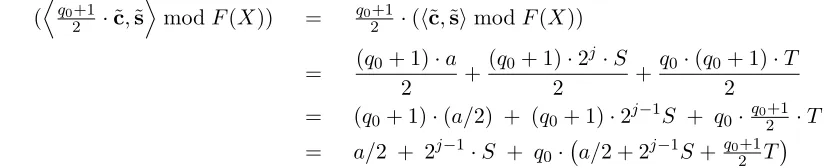
when we multiply˜cby the integer(q0+ 1)/2(which is the inverse of 2 modulo-q0). Then we have (
D q0+1
2 ·˜c,˜s
E
modF(X)) = q0+1
2 ·(h˜c,˜simodF(X)) = (q0+ 1)·a
2 +
(q0+ 1)·2j·S
2 +
q0·(q0+ 1)·T 2
= (q0+ 1)·(a/2) + (q0+ 1)·2j−1S + q0·q02+1 ·T = a/2 + 2j−1·S + q0· a/2 + 2j−1S+q02+1T
Clearly the coefficients ofa/2 + 2j−1Sare half the size of those ofa+ 2jS, hence they are much smaller than q0. It follows that ˜c0 = [˜c ·(q0 + 1)/2]q0 is a valid ciphertext that encrypts the plaintext a/2 ∈
(Z/2j−1Z)[X]/F(X)with respect to secret key˜sand modulusq0.
The same argument shows that if a is divisible by 2i over the integers (for some i < j) then [˜c· ((q0 + 1)/2)i]q0 is a valid ciphertext encryptinga/2
i ∈ (Z/2j−iZ)[X]/F(X). Combining this division-by-two procedure with homomorphic exponentiation mod2r+1, the resulting homomorphic bit-extraction procedure is described in Figure 1.
Bit-Extraction(˜c, r, q0):
Input: A ciphertext˜cencrypting a constantb∈(Z/2r+1Z)relative to secret key˜sand modulusq0. Output: A ciphertext˜c0encrypting the constantbh0i ⊕bhri ∈F2relative to secret key˜sand modulusq0.
1. Set ˜c0←˜c //˜cencryptzw.r.t.˜s
2. For i= 1tor
3. Set acc←˜c //accis an accumulator
4. For j= 0toi−1 // Computez−P
j2jw i−1
j
5. Set tmp←HomExp(˜cj,2i−j) // Homomorphic exponentiation to the power2i−j
6. Set acc←acc−2j·tmpmodq0
7. Set ˜ci ←acc·((q0+ 1)/2)imodq0 //˜ciencryptszhii 8. Output ˜c0+ ˜crmodq0
HomExp(˜c, n) uses native homomorphic multiplication to multiplyc˜by itself ntimes. To aid exposition,
this code assumes that the modulus and secret key remain fixed, else modulus-switching and key-switching should be added (and the level should be increased correspondingly to somei >0).
Figure 1: A Homomorphic Bit-Extraction Procedure.
3.3 Packing the Coefficients
Now that we have encryption of all the coefficients ofa, we just need to “pack” all these coefficients back in one polynomial. Namely, we have encryption of the constant polynomialsa0, a1, . . ., and we want to
get an encryption of the polynomialP
iaiXi. This can be done simply by generating encryptions of the monomialsXi,4using the native homomorphism of the cryptosystem to multiply each monomialXiby the corresponding constantai, and then add them all.
4
4
Algebraic Background
Below we describe the algebra needed when using the techniques of Gentry et al. from [13] of computing on packed ciphertexts for our needs. Recall that the BGV scheme is defined over a polynomial ringR = Z[X]/F(X). If the polynomial F(X)factors modulo two into distinct irreducible polynomialsF0(X)× · · · ×F`−1(X), then, by the Chinese Remainder Theorem, the plaintext space factors into a product of finite
fields
R2 ∼=F2[X]/F0(X)× · · · ×F2[X]/F`−1(X).
This factorization is used in [17, 3, 13] to “pack” a vector of `elements (one from each F2[X]/Fi(X)) into one plaintext polynomial, which is then encrypted in one ciphertext; each of the`components called a plaintext slot. The homomorphic operations (add/mult) are then applied to the different slots in a SIMD fashion. When F(X) is the m-th cyclotomic polynomial, F(X) = Φm(X), then the field Q[X]/F(X)
is Galois (indeed Abelian) and so the polynomialsFi(X)all have the same degree (which we will denote by d). It was shown in [13] how to evaluate homomorphically the application of the Galois group on the slots, and in particular this enables homomorphically performing arbitrary permutations on the vector of slots in time quasi-linear inm. This, in turn, is used in [13] to evaluate arbitrary arithmetic circuits (of average widthΩ(˜ λ)) with overhead only polylog(λ).
However, the prior work only mentions the case of plaintext spaces taken modulo a prime (in our case two), i.e. R2. In this work we will need to also consider plaintext spaces which are given by a power of a
prime, i.e. R2t for some positive integert. (We stress that byR2t we really do mean(Z/2tZ)[X]/F(X)
and notF2t[X]/F(X).) We now show how the techniques from [13] extends also to this case. We start by
considering general polynomials, and then specialize to cyclotomic polynomials.
4.1 GeneralF(X)
It turns out that for monic and square freeF(X)modulo2, all the properties we had modulo two carry over to when working modulo a power of two (i.e. the`slots, the Galois actions, etc). The “high brow” way of seeing this is to consider the message space modulo2t as the precisiontapproximation to the 2-adic integers; namely we need to consider the localization of the fieldK = Q[X]/F(X)at the prime2. We
sketch the underlying algebra for those who are interested, and provide elementary proofs of some of the main results, so as to obtain a somewhat self-contained treatment of what we require. However, the reader if referred to [6] for a complete treatment of local fields and their Galois theory.
We present the basic theory for a general primep, to demonstrate their is nothing special about the prime
2. As usual when dealing with local fields we use the notationZp to denote thep-adic integers, this is the ring of formal power series inp, i.e.
Zp = ( ∞
X
i=0
ai·pi:ai ∈Fp )
.
In holding an element inZp we only hold it to a givenp-adic precision, by which we mean we hold it as an integer in the ring(Z/ptZ). Then addition and multiplication inZpis defined by the induced operations obtained from the equivalent operations on(Z/ptZ). Intuitively one should think ofZp as representing the rings(Z/ptZ), for all values oftat once; indeedZpis the projective limit of(Z/ptZ)ast−→ ∞. The field
We will write Rp∞ = Zp[X]/F(X) and note that the approximation top-adic precisiontof this ring is our desired space Rpt. The field of fractions of Rp∞ is given by Qp[X]/F(X). Our first goal is to understand the algebra ofRp∞, and in so doing, to understand the algebra ofRpt. The following Lemma is
key:
Lemma 3. Letpbe a prime, lett≥1be an integer, and letG, H, F ∈Z[X]be monic integer polynomials, such thatG, H are co-prime modulop, and G·H = F (modpt). Then there exist monic polynomials
˜
G,H˜ ∈Z[X]such thatG≡G˜ (modpt)andH ≡H˜ (modpt)andG˜·H˜ =F (mod pt+1).
All proofs are given in Appendix A. Note, the process in the proof of Lemma 3 of turning a solution modulo ptto a solution modulopt+1is called “Hensel Lifting” in the literature.
Corollary 2. Letpbe a prime, lett ≥1be an integer and letF ∈ Z[X]be a monic integer polynomial, which is square-free modulop. ThenF is irreducible moduloptif and only if it is irreducible modulop.
Theorem 1. Letpbe a prime, lett≥1be an integer and letF ∈Z[X]be a monic integer polynomial, which is square-free modulop. Then the factorization ofF moduloptis determined uniquely by the factorization ofF modulop.
The above theorem tells us that the factorization ofRptinto plaintext slots is the same as the factorization
ofRp into plaintext slots, for all positive t. Thus ifa = (a0, . . . , a`−1) ∈ Rp consisting of a vector of` values, where each valueaiis moduloFi(X), then we can “lift” it to an elementa= (a0, . . . , a`−1)∈Rpt
whereai ≡ai (modp)andaiis defined moduloFi(X), whereFi≡Fi (modp)andFidividesFmodulo pt.
4.2 Cyclotomic Polynomials
For our purposes, we will selectF(X)to be them’th cyclotomic polynomialΦm(X). Ifdis the smallest integer such that m divides pd −1 then Φm(X) will factor into ` = φ(m)/d irreducible polynomials modulop, each of degreed, i.e. Φm(X) = Q`j−=01Fj(X) (mod p). By the above results we also see that
Φmfactors modptasΦm(X) = Q`j−=01Fj(X) (mod pt)whereFj ≡Fj (modp)and theFj’s are monic and irreducible modpt.
So if we selectF(X)to beΦm(X)then the algebraRpt splits into`rings(Z/ptZ)[X]/Fj(X)each of
degreed. The following standard result from the theory ofp-adic extensions can be found in either Cassels [6, Lemma 2.1] or Cohen [7, Lemma 4.4.26].
Lemma 4. For everyd, upto isomorphism there exists exactly one unramified extensionKofQp of degree d, which is the splitting field ofXq−XoverQp, whereq=pd.
This implies that our`rings(Z/ptZ)[X]/Fj(X)are isomorphic to each other; via linear maps defined overZ/pZ (on any linear basis of(Z/ptZ)[X]/Fj(X)when considered as aZ/ptZ-module). Indeed the
above Lemma is the p-adic analogue of the result from finite field theory that all finite fields of a given degree are isomorphic. Just as in [13, 17] (which concerned themselves with the case of finite fields), this allows the following presentational (and computational) simplification. We can pick a single irreducible (over Fp) polynomial of degree d; let us call this polynomialG(X). We then define the ring Rpdt to be (Z/ptZ)[X]/G(X), then each of our`slots inRpt are isomorphic toRpdt; so we can think of operations in Rpt as being operations on(Rpdt)`. Moreover, again by the above Lemma, we knowRpdt contains all of the
We now turn to examining the Galois Theory of the rings Rpt andRd
pt. The same description as in
[13] applies. Namely, that the Galois group of Rpt is isomorphic to the group (Z/mZ)∗. The elements
of the Galois group providing the map X −→ Xi on Rpt for i ∈ (Z/mZ)∗. The groupGalcontains the
decomposition group at p, namely the subgroup G generated by the element p, which is also the Galois group ofRpdt. The decomposition group has orderd, and its elements map roots of Fj to roots ofFj for the same value ofj. The generator of the decomposition group maps the interdeterminantXtoXp in all of our rings, and it commutes with the isomorphisms between the representations(Z/pZ)[X]/Fj(X)and Rpdt. Thus we can apply the Frobenius map to elements ofRpt and think of it applying simultaneously to the
representationQ
(Z/pZ)[X]/Fjand the representation(Rpdt)`.
The quotient group H ∼= Gal/G is of order` and given a set of coset representatives for Hwe can produce via Galois conjugation, addition and multiplication an arbitrary permutation on the slots ofRpt;
just as was done in [13] for the caset= 1.
5
Homomorphic Decryption with Packed Ciphertexts
The homomorphic decryption procedure from Section 3 is rather inefficient, mostly because we need to repeat the bit-extraction procedure from Figure 1 for each coefficient separately. Instead, we would like to pack many coefficients in one ciphertext and extract the top bits of all of them together. To this end we employ a batching technique, similar to Smart-Vercauteren (and later works) [3, 13, 17], using Chinese re-maindering over the ring of polynomials to pack many “plaintext slots” inside a single plaintext polynomial. These techniques rely on polynomial arithmetic modulo cyclotomic polynomials, so for the rest of this paper we assumeF(X) = Φm(X)for an appropriately chosen integerm.
Using these techniques for bootstrapping is not quite straightforward, however. The main difficulty is that the input and output of are not presented in a packed form: The input is a singleqL-ciphertext that encrypts a single plaintext polynomiala(which may or may not have many plaintext elements packed in its slots), and similarly the output needs to be a single ciphertext that encrypts the same polynomiala(but with respect to a larger modulus). Moreover, the bit extraction procedure yields the coefficients ofa, again not in a packed form. Our “packed bootstrapping” procedure consists of the following steps:
1. Using the encryption of theqL-secret-key with respect to the modulusq0, we convert the initialqL -ciphertext into aq0-ciphertext encrypting the polynomialZ0 ∈(Z/2r+1Z)[X]/Φm(X).
2. Next we apply a homomorphic inverse-DFT transformation to get encryption of polynomials that have the coefficients ofZ0in their plaintext slots.
3. Now that we have the coefficients ofZ0in the plaintext slots, we can apply the bit extraction procedure to all these slots in parallel. The result is encryption of polynomials that have the coefficients ofain their plaintext slots.
4. Finally, we apply a homomorphic DFT transformation to get back a ciphertext that encrypts the poly-nomialaitself.
5.1 Encrypting theqL-Secret-Key
As in Section 3, we use an encryption scheme with underlying plaintext space modulo2r+1 to encrypt the
qL-secret-keysunder theq0-secret-key˜s. TheqL-secret-key is a vectors= (1,s), wheres∈Z[X]/Φm(X) is an integer polynomial with small coefficients. Viewing these small coefficients as elements inZ/2r+1Z,
we encryptsas aq0-ciphertext˜c= (˜c0,˜c1)with respect to theq0-secret-key˜s= (1,˜s), namely we have [h˜c,˜simod Φm]q0 = [˜c0+ ˜c1·˜smod Φm]q0 = 2
r+1k˜+s (equality over Z[X])
for some polynomialk˜with small coefficients.
5.2 Step One: ComputingZ0Homomorphically
Given aqL-ciphertextc = (c0, c1) we first post-process it by addingc∗ toc0, gettingc00 = [c0+c∗]2r+1.
Then, given theq0 ciphertext˜c = (˜c0,˜c1)that encryptss, we compute the mod-2r+1inner product
homo-morphically by setting
˜
z= [c00+c1˜c0mod Φm]q0, [c1˜c1mod Φm]q0
. (1)
We claim that˜z is a q0-ciphertext encrypting ourZ0 with respect to the secret key˜s (and plaintext space
modulo2r+1). To see that, recall that we have the following two equalities overZ[X],
(c00+c1smod Φm) = 2r+1k+Z0 and (˜c0+ ˜c1˜smod Φm) =q0k˜+ 2r+1˜k0+s,
wherek,˜k,˜k0 ∈Z[X]/Φm, the coefficients of2r+1k+Z0are smaller than2qL2 q0, and the coefficients
of2r+1˜k0+sare also much smaller thanq0. It follows that:
(h˜z,˜simod Φm) = [c00+c1˜c0 mod Φm]q0 + (˜s·[c1˜c1 mod Φm]q0 mod Φm)
= (c00+c1(˜c0+ ˜c1˜s) mod Φm) +q0κ = (c00+c1(2r+1˜k0+s) mod Φm) +q0κ0
= (c00+c1smod Φm) +q0κ0+ 2r+1(c1·˜k0 mod Φm)
= q0κ0+ 2r+1(k+c1k˜0mod Φm) +Z0 (equality overZ[X])
for some κ, κ0 ∈ Z[X]/Φm. Moreover, since the coefficients ofc1 are smaller than qL q0 then the
coefficients of2r+1(k+c
1k˜0 mod Φm) +Z0 are still much smaller thanq0. Hencez˜is decrypted under˜s
andq0toZ0, with plaintext space2r+1.
5.3 Step Two: Switching to CRT Representation
Now that we have an encryption of the polynomialZ0, we want to perform the homomorphic bit-extraction procedure from Figure 1. However, this procedure should be applied to each coefficient ofZ0 separately, which is not directly supported by the native homomorphism of our cryptosystem. (For example, homomor-phically squaring the ciphertext yields an encryption of the polynomialZ02 mod Φm rather than squaring each coefficient ofZ0 separately.) We therefore need to convert ˜zto CRT-based “packed” ciphertexts that hold the coefficients ofZ0 in their plaintext slots.
The system parameter mwas chosen so thatm = ˜Θ(λ)andΦm(X)factors modulo 2 (and therefore also modulo 2r+1) as a product of degree-d polynomials with d = O(logm), Φm(X) = Q`j−=01Fj(X)
holding the valueZ0(X) mod (Fj(X),2r+1). This way, adding/multipliying/squaring the plaintext polyno-mials has the effect of applying the same operation on each of the slots separately.
In our case, we have φ(m) coefficients of Z0(X) that we want to put in the plaintext slots, and each ciphertext has only`=φ(m)/dslots, so we needdciphertexts to holds them all. The transformation from the single ciphertext˜zthat encryptsZ0itself to the collection ofdciphertexts that hold the coefficients ofZ0 in their slots is described in Section 5.6 below. (We describe that step last, since it is the most complicated and it builds on machinery that we develop for Step Four in Section 5.5.)
5.4 Step Three: Extracting the Top and Bottom Bits
Once we have the coefficients ofZ0 in the plaintext slots, we can just repeat the procedure from Figure 1. The input to the the bit-extraction procedure is a collection of somedciphertexts, each of them holding ` = φ(m)/dof the coefficients ofZ0 in its`plaintext slots. (Recall that we chosem = ˜O(λ)such that d = O(logm).) Applying the procedure from Figure 1 to these ciphertexts will implicitly apply the bit extraction of Lemma 2 to each plaintext slot, thus leaving us with a collection ofdciphertexts, each holding `of the coefficients ofain its plaintext slots.
5.5 Step Four: Switching Back to Coefficient Representation
To finally complete the recryption process, we need to convert thedciphertexts holding the coefficients ofa in their plaintext slots into a single ciphertext that encrypts the polynomialaitself. For this transformation, we appeal to the result of Gentry et al. [13], which says that every depth-Lcircuit of average-widthΩ(˜ λ)
and sizeT can be evaluated homomorphically in timeO(T)·poly(L,logλ), provided that the inputs and outputs are presented in a packed form. Below we show that the transformation we seek can be computed on cleartext by a circuit of sizeT = ˜O(m)and depthL=polylog(m), and hence (sincem= ˜Θ(λ)) it can be evaluated homomorphically in timeO˜(m) = ˜O(λ).
To use the result of Gentry et al. we must first reconcile an apparent “type mismatch”: that result requires that both input and output be presented in a packed CRT form, whereas we have input in CRT form but output in coefficient form. We therefore must interpret the output as “something in CRT representation” before we can use the result from [13]. The solution is obvious: since we want the output to be a in coefficient representation, then it is a polynomial that holds the valueAj = amodFj in thej’th slot for allj.
Hence the transformation that we wish to compute takes as input the coefficients of the polynomials a(X), and produces as output the polynomials Aj = amodFj for j = 0,1, . . . , `−1. It is important to note that our output consists of`values, each of them a degree-dbinary polynomial. Since this output is produced by an arithmetic circuit, then we need a circuit that operates on degree-dbinary polynomials, in other words an arithmetic circuit over GF(2d). This circuit has`·dinputs (all of which happen to be elements of the base fieldF2), and`outputs that belong to the extension fieldGF(2d).
Theorem 2. Fix m ∈ Z, let d ∈ Z be the smallest such that m|2d−1, denote ` = φ(m)/d and let
G∈F2[X]be a degree-dirreducible polynomial overF2(that fixes a particular representation ofGF(2d)). LetF0(X), F1(X), . . . , F`−1(X)be the irreducible (degree-d) factors of them-th cyclotomic polynomial Φm(X)modulo 2.
• When the inputs are from the base field (ai ∈F2∀i) and we denotea(X) =PiaiXi ∈F2[X], then the outputs satisfyzj =a(X) mod (Fj(X),2)∈F2[X]/G(X).
• Πmhas depthO(logm)and sizeO(mlogm).
The proof is in Appendix A. An immediate corollary of Theorem 2 and the Gentry et al. result [13, Thm. 3], we have:
Corollary 3. There is an efficient procedure that givendciphertexts, encryptingdpolynomials that hold the coefficients ofain their slots, computes a single ciphertext encryptinga. The procedure works in time
O(m)·polylog(m)(and uses at most polylog(m)levels of homomorphic evaluation).
5.6 Details of Step Two
The transformation of Step Two is roughly the inverse of the transformation that we described above for Step Four, with some added complications. In this step, we have the polynomial Z0(X) over the ring
Z/2r+1Z, and we view it as defining`plaintext slots with thej’th slot containingBj
def
= Z0 mod (Fj,2r+1). Note that the Bj’s are degree-d polynomials, and we consider them as elements in the “extension ring”
R2dr+1
def
= Z[X]/(G(X),2r+1)(whereGis some irreducible degree-dpolynomial modulo2r+1).
Analogous to Theorem 2, we would like to argue that there is an arithmetic circuit overR2dr+1that get as
input theBj’s (as elements ofR2dr+1), and outputs all the coefficients ofZ0(which are elements of the base
ringZ/2r+1Z). Then we could apply again to the result of Gentry et al. [13] to conclude that this circuit
can be evaluated homomorphically with only polylog overhead.
For the current step, however, the arithmetic circuit would contain not only addition and multiplication gates, but also Frobenius map gates. Namely, gatesρk(·)(fork∈ {1,2, . . . , d−1}) computing the functions
ρk u(X)
= u(X2k) mod (G(X),2r+1).
It was shown in [13] that arithmetic circuits with Frobenius map gates can also be evaluated homomor-phically with only polylog overhead. The Frobenius operations being simply an additional automorphism operation which can be applied homomorphically to ciphertexts.
Theorem 3. Fixm, r ∈ Z, let d ∈ Zbe the smallest such that m|2d−1, denote` = φ(m)/dand let G(X)be a degree-dirreducible polynomial overZ/2r+1Z(that fixes a particular representation ofR2dr+1).
LetF0(X), F1(X), . . . , F`−1(X)be the irreducible (degree-d) factors of them-th cyclotomic polynomial Φm(X)modulo2r+1.
Then there is an arithmetic circuitΨm,rwith Frobenius-map gates overR2dr+1that has`inputB0, B1, . . .,
B`−1 andφ(m)outputsb0, b1, . . . , bφ(m)−1, for which the following conditions hold:
• On any inputsB0, . . . , B`−1 ∈R2dr+1, the outputs ofΨm,rare all in the base ring,Zi0∈Z/2r+1Z∀i.
Moreover, denotingZ0(X) =P
iZi0Xi, it holds thatZ0(X) mod (Fj(X),2r+1) =Bj for allj.
• Πmhas depthO(logm+d)and sizeO(m(d+ logm)).
The proof is in Appendix A. As before, a corollary of Theorem 3 and the result from [13], is the following; where we apply the above theorem forbto our polynomialZ0.
Remark. We note that the transformation from Theorem 3 is nontrivial, mainly because it involves homo-morphically reducing a degree-(m−1)polynomial moduloΦm(X). This can be done for anymin depth polylog(m)and sizeO˜(m), (see, e.g., [15, Sec. 7.2] or [1, Sec. 17]), but this procedure is rather involved. In some special cases (e.g., whenmis prime) reduction moduloΦm(X)is immediate.
5.7 An Alternative Variant
The procedure from Section 5.6 works in timeO˜(m), but it is still quite expensive. One alternative is to put in the public key not just one ciphertext encrypting theqL-secret-keys, but rather several ciphertexts (approximatelyd), encrypting polynomials that hold the coefficients ofsin their plaintext slots. Then, rather than using the simple formula from Equation (1) above, we evaluate homomorphically the inner product of
s = (1,s) andc0 = (c0+c∗, c1)moduloΦm(X)and2r+1. This procedure will be even faster if instead of the coefficients ofswe encrypt their transformed image under length-mDFT. Then we can compute the DFT ofc1 (in the clear), multiply it homomorphically by the encrypted transformed s(in SIMD fashion)
and then homomorphically compute the inverse-DFT and the reduction modulo Φm. Unfortunately this procedure still requires that we compute the reduction mod-Φm(X) homomorphically, which is likely to be the most complicated part of bootstrapping. Finding a method that does not require this homomorphic polynomial modular reduction is an interesting open problem.
6
Lower-Degree Bit Extraction
As described in Figure 1, extracting ther’th bit requires computing polynomials of degree upto2r, here we describe a simple trick to lower this degree. Recall our simplified decryption process: we first post-process the ciphertext to getc0←[c0+c∗, c1]2r+1(wherec∗=1·2r−1), then setZ0 ←[hc0,simod Φm(X)]2r+1,
and finally recovera= [Z0hri+Z0h0i]2.
Consider what happens if we addqLto all the odd coefficients inc0, call the resulting vectorc00: On one hand, now all the coefficients ofc00are even. On the other hand, the coefficients ofZ00 =hc00,simod Φm(X)are still small enough to use Lemma 1 (since they are at mostcm·q· ksk1 larger than those ofZ0
itself, wherecmis the ring constant of mod-Φm(X)arithmetic andksk1is thel1-norm ofs). Sincec00=c0 (modqL)then we have
[[c0,smod Φm(X)]qL]2= [[
c00,smod Φm(X)]qL]2 =Z 00h
ri+Z00h0i
However, since c00 is even then so isZ00. This means thatZ00h0i = 0, and if we divideZ00 by two (over the integers), Z∗ = Z00/2, then we have[[hc0,simod Φm(X)]qL]2 = Z
∗hr−1i. We thus have a
varia-tion of the simple decrypvaria-tion formula that only needs to extract ther−1’st bit, so it can be realized using polynomials of degree upto 2r−1. Note that we can implement this variant of the decryption formula ho-momorphically, because for an evenZ00we can easily convert anq0-encryption ofZ00into an encryption of
Z00/2by multiplying by q0+1
2 moduloq0(as described in Section 3.2).
This technique can be pushed a little further, adding to c0 multiples ofq so that it is divisible by 4, 8, 16, etc., and reducing the required degree correspondingly to 2r−2, 2r−3, 2r−4, etc. The limiting factor is that we must maintain thathc00,sihas coefficients sufficiently smaller thanq2
L, in order to be able to use Lemma 1. Clearly, ifc00=c0+qκwhere all the coefficients ofκare smaller than some boundB(in absolute value), then the coefficients ofhc00,sican be larger than the coefficients ofZ0 =hc0,si(in absolute value) by at mostcm·q·B· ksk1. (Heuristically we expect the difference to depend on thel2norm ofsmore than
If we choose our parameters such that thel1-norm ofsis belowm, and work over a ring withcm =O(1), then the coefficients ofZ0can be made as small ascm·m·q, and we can make the coefficients ofκas large asB ≈q/(4cm·m)in absolute value while maintaining the invariant that the coefficients ofZ00are smaller thanq2/4(which is what we need to be able to use Lemma 1). By choosing an appropriateκ, we can ensure that the least significantblog(q/(4cmm))c=r− dlog(4cmm)ebits ofc00are all zero. This means that we can implement bit extraction using only polynomials of degree at most 2dlog(4cmm)e < 8c
mm = O(m). (Heuristically, we should even be able to get polynomials of degreeO(√m)since thel2 norm ofsis only
O(√m).)
To get an even smaller degree we can use squashing: Recall that we have s = (1,s) for some secret polynomials. We can add to the public key a small numbert = O(logm)of polynomials u1, u2, . . . , ut, such that for some “very sparse polynomials”v1, . . . , vtit holds thatPiuivi=s (mod Φm(X), qL). The vi’s are even much sparser thansitself, specifically thel1 norm of all of them together is onlymfor some
constant < 1. Given the ciphertext c = (c0, c1) we can post-process it by setting fi = c1 ·ui mod
(Φm(X), qL), then decryption of the post-processed ciphertextf = (c0, f1, . . . , ft)using the new secret key
v = (1, v1, . . . , vm) is done in principle using the same formulaa = [[hf,vimod Φm(X)]qL]2. We can
now simplify the decryption formula and evaluate it homomorphically exactly as we did in Sections 2, 3, and 5. The advantage of doing this is that thel1norm of the new keyvis much smaller, onlymas opposed
tom, so using the same trick as above the bit extraction procedure can be computed by polynomials of degree onlyO(m). (This squashing technique is essentially equivalent to using key-switching in order to switch theqLciphertextcinto a ciphertextfwith respect to the very sparse keyv= (1, v1, . . . , vm).)
References
[1] Daniel J. Bernstein. Fast multiplication and its applications. Algorithmic Number Theory, MSRI Publications, 44:325–384, 2008.
[2] Leo I. Bluestein. A linear filtering approach to the computation of the discrete fourier transform. Northeast Electronics Research and Engineering Meeting Record 10, 1968.
[3] Zvika Brakerski, Craig Gentry, and Vinod Vaikuntanathan. Fully homomorphic encryption without bootstrapping. InInnovations in Theoretical Computer Science (ITCS’12), 2012. Available athttp: //eprint.iacr.org/2011/277.
[4] Zvika Brakerski and Vinod Vaikuntanathan. Efficient fully homomorphic encryption from (standard) LWE. InFOCS’11. IEEE Computer Society, 2011.
[5] Zvika Brakerski and Vinod Vaikuntanathan. Fully homomorphic encryption from ring-LWE and secu-rity for key dependent messages. InAdvances in Cryptology - CRYPTO 2011, volume 6841 ofLecture Notes in Computer Science, pages 505–524. Springer, 2011.
[6] John William Scott Cassels. Local Fields, volume 3 of LMS Student Texts. Cambridge University Press, 1986.
[8] Marten van Dijk, Craig Gentry, Shai Halevi, and Vinod Vaikuntanathan. Fully homomorphic en-cryption over the integers. In Advances in Cryptology - EUROCRYPT’10, volume 6110 of Lec-ture Notes in Computer Science, pages 24–43. Springer, 2010. Full version available on-line from
http://eprint.iacr.org/2009/616.
[9] Craig Gentry. A fully homomorphic encryption scheme. PhD thesis, Stanford University, 2009. crypto.stanford.edu/craig.
[10] Craig Gentry. Fully homomorphic encryption using ideal lattices. In Michael Mitzenmacher, editor,
STOC, pages 169–178. ACM, 2009.
[11] Craig Gentry and Shai Halevi. Fully homomorphic encryption without squashing using depth-3 arith-metic circuits. InFOCS’11. IEEE Computer Society, 2011.
[12] Craig Gentry and Shai Halevi. Implementing Gentry’s Fully-Homomorphic Encryption Scheme. In
EUROCRYPT, volume 6632 ofLecture Notes in Computer Science, pages 129–148. Springer, 2011.
[13] Craig Gentry, Shai Halevi, and Nigel P. Smart. Fully Homomorphic Encryption with Polylog Over-head. Manuscript athttp://eprint.iacr.org/2011/566, 2011.
[14] Ron Rivest, Leonard Adleman, and Michael L. Dertouzos. On data banks and privacy homomorphisms. InFoundations of Secure Computation, pages 169–180, 1978.
[15] Victor Shoup. A new polynomial factorization algorithm and its implementation. Journal of Symbolic Computation, 20:363–397, 1995.
[16] Nigel P. Smart and Frederik Vercauteren. Fully homomorphic encryption with relatively small key and ciphertext sizes. InPublic Key Cryptography - PKC’10, volume 6056 ofLecture Notes in Computer Science, pages 420–443. Springer, 2010.
[17] Nigel P. Smart and Frederik Vercauteren. Fully homomorphic SIMD operations. Manuscript athttp: //eprint.iacr.org/2011/133, 2011.
A
Proofs
Lemma 1.Letq= 2r+ 1for a positive integerr, and letzbe a non-negative integer smaller than q22 −q, such that[z]qis also non-negative,[z]q ∈[0,2q]. Then[[z]q]2 =zhri ⊕zh0i.
Proof. Letz0 = [z]q ∈[0,2q], and consider the sequence of integerszi=z0+iqfori= 0,1,2,· · ·. Since
we assume thatz ≥0thenzcan be found in this sequence, say thek’th elementz =zk =z0+kq. Also
sincez < q22 −q thenk=bz/qc< 2q −1. The bit that we want to compute is[[z]q]2 =z0h0i. We claim
thatz0h0i=zkh0i+zkhri (mod 2). This is because
zk = z0+kq = z0+k(2r+ 1) = (z0+k) +k2r,
which in particular means thatzkh0i=z0h0i+kh0i (mod 2). But since0≤z0 ≤q/2and0≤k < q/2−1
then0≤z0+k < q−1 = 2r, so there is no carry bit from the additionz0+kto ther’th bit position. It
follows that ther’th bit ofzkis equal to the 0’th bit ofk(i.e.,zkhri=kh0i), and therefore
which implies thatz0h0i=zkh0i+zkhri (mod 2), as needed.
Corollary 1. Letr ≥ 3andq = 2r+ 1and letzbe an integer with absolute value smaller than q2
4 −q, such that[z]q∈(−q4,q4). Denotez0 =z+ (q2−1)/4, then[[z]q]2=z0hri ⊕z0h0i.
Proof. Note that
z0 = z+ (q2−1)/4 = z+ (q+ 1)(q−1)/4 = z+q−1 4
+ q·q−1 4 ,
and since(q−1)/4 = 2r−2 is an even integer, thenz0 ≡z+q−41 (modq). Moreover since[z]q ∈(−q4,q4] then[z]q+q−41 ∈[0, q/2], hence[z0]q= [z]q+ q−41 (over the integers), and as q−41 is an even integer then
[z]q = [z0]q (mod 2), or in other words[[z]q]2 = [[z0]q]2.
Sincez >−q42 andzis an integer thenz≥ −q24−1 and thereforez0 =z+q24−1 ≥0. Thusz0satisfies all the conditions set in Lemma 1, so applying that lemma we have[[z]q]2= [[z0]q]2 =z0hri ⊕z0h0i.
Lemma 2.Letzbe anr-bit integer with binary representationz=Pr
i=02izhii. Definew0 def
= z, and
∀i >1, wi
def = z−
Pi−1
j=02jw2 i−j
j mod 2r+1
2i (division by2
iover the rationals/integers). (2)
Then thewi’s are integers and we havewih0i=zhiifor alli.
Proof. The lemma clearly holds fori= 0. Now fix somei≥1, assume that the lemma holds for allj < i, and we prove that it holds also fori. It is easy to show by induction that for any integeruand allj≤rwe have
u2j mod 2r+1=uh0i+ 2j+1t for some integert.
Namely, the LSB of u2j mod 2r+1 is the same as the LSB of u, and the next j bits are all zero. This means that the bit representation ofvj
def
= 2jwj2i−j mod 2r+1 has bits0,1, . . . , j−1 all zero (due to the multiplication by2j), thenvjhji=wjh0i=zhji(by the induction hypothesis), and the nexti−jbits are again zero (by the observation above). In other words, the lowesti+ 1bits ofvjare all zero, except thej’th bit which is equal to thej’th bit ofz.
This means that the lowest ibits of the sum Pi−1
j=0vj are the same as the lowest ibits ofz, and the i+ 1’st bit of the sum is zero. Hence the lowestibits ofz−Pi−1
j=0vj are all zero, and thei+ 1’st bit is zhii. Hencez−Pi−1
j=0vj is divisible by2i (over the integers), and the lowest bit of the result iszhii, as needed.
Lemma 3.Letpbe a prime, lett≥1be an integer, and letG, H, F ∈Z[X]be monic integer polynomials, such thatG, H are co-prime modulop, and G·H = F (modpt). Then there exist monic polynomials
˜
Proof. Considering the productG·Hmodulopt+1, we know that it is of the formG·H=F+pt·F0for someF0 ∈Fp[X](since it equalsF modulopt). Moreover, sinceG, H are monic then the top coefficient ofG·H = F +pt·F0 is one, which means thatF0 must have lower degree thanF. We next prove that there existG0, H0∈Fp[X]such that(G+pt·G0)·(H+pt·H0) =F (modpt+1). Opening parentheses, removing terms that vanish modulopt+1, and substituting F +pt·F0 for G·H, we get the equivalent formula:
F = (G+pt·G0)·(H+pt·H0)
=G·H+pt·(G·H0+G0·H) +p2t
= (F+pt·F0)−pt·(G·H0+G0·H)
=F +pt·(F0−G·H0−G0·H) (modpt+1),
which after subtractingF and dividing byptis equivalent to the conditionG·H0+G0·H =F0 (modp). SinceG, Hare co-prime over the fieldFp, then there exists an inverse ofHmodulo(G(X), p)and vice versa. DefiningG0=F0·H−1 mod (G(X), p) andH0 =G−1modH(X), p, we see
G·H0+G0·H = 0·H0+ (F0·H−1)·H = F0 (mod G(X), p)
and similarlyG·H0 +G0 ·H = F0 (modH(X), p). By Chinese remainders (and usingG·H = F
(modp)) we haveGH0+G0H =F0 (modF(X), p). But the degree ofG·H0+G0·H is smaller than that ofF =G·H, and so is the degree ofF0, hence we obtainG·H0+G0·H =F0 (modp), without the reduction moduloF.
It follows that forG˜ =G+pt·G0 modpt+1andH˜ =G+pt·H0, we haveG˜·H˜ =F (modpt+1), and sinceG, Hare monic and have degrees larger thanG0, H0, respectively, then alsoG˜andH˜ are monic.
Corollary 2. One direction is obvious: if F is not irreducible modulo pt then there exist two nontrivial monic polynomialsG, H ∈Z[X]such thatG·H =F (modpt), so in particularG·H =F (modp).
For the other direction, fixF which is square free but not irreducible modulo p, and we show by in-duction ontthat it has two nontrivial monic factors modulopt, which are co-prime overFp. The base case t= 1is obvious, and the induction step is exactly Lemma 3.
Theorem 1.Letpbe a prime, lett≥1be an integer and letF ∈Z[X]be a monic integer polynomial, which is square-free modulop. Then the factorization ofF moduloptis determined uniquely by the factorization ofF modulop.
Proof. Suppose F modulo pt factors into irreducible factors F
0, . . . , F`−1. Then by setting Fi = Fi
(modp) we obtain the factorization ofF modulop. SinceFi is irreducible modulo pt, by Corollary 2 we have thatFi is irreducible modulop. In addition we cannot haveFi =Fj modulopsinceF is square free.
Going in the other direction: Given a factorization modulopwe can obtain a factorization moduloptby repeated application of Lemma 3
Then there is an arithmetic circuitΠmoverF2[X]/G(X) =GF(2d)withφ(m)inputsa0, a1, . . . , aφ(m)−1 and`outputsz0, z1, . . . , z`−1, for which the following conditions hold:
• When the inputs are from the base field (ai ∈F2∀i) and we denotea(X) =PiaiXi ∈F2[X], then the outputs satisfyzj =a(X) mod (Fj(X),2)∈F2[X]/G(X).
• Πmhas depthO(logm)and sizeO(mlogm).
Proof. Recall thatGF(2d)contains a primitivem-th root of unityτ, and thatΦmfactors into linear terms overGF(2d),Φm(X) = Qi∈(Z/mZ)∗(X−τi). Moreover, each of the irreducible factors ofΦmmodulo 2 is a product of the terms(X−τi)from one conjugacy class: namely there is a size-`set of representative indexesL={e0, e1, . . . , e`−1} ⊂(Z/mZ)∗such that for eachj= 0,1, . . . , `−1it holds that
Fj(X) = (X−τej)(X−τ2ej)(X−τ4ej)· · ·(X−τ2
d−1e
j).
The circuit for computing all the polynomialsAj
def
= amodFj, consists of first applying the DFT to the coefficients ofa, thus computing the evaluations a(τj)for allj ∈(Z/mZ)∗, and then computing eachAj from thedvaluesa(τej), a(τ2ej), . . . , a(τ2d−1ej).
The first part, computing the size-m DFT over GF(2d), can be accomplished by a circuit of depth
O(logm)and size-O˜(mlogm)using FFT techniques (e.g., using Bluestein’s trick [2]). The result is the m-vector of valuesa(τi)fori= 0,1, . . . , m−1, from which we extract only the valuesa(τi)fori∈(
Z/mZ)∗.
Next, consider an arbitrary index j ∈ {0,1, . . . , `−1} for which we want to computeAj = amod Fj ∈ GF(2d). We show thatAj can be obtained as a fixed linear combination overGF(2d)of the values
a(τej), a(τ2ej),. . . , a(τ2d−1ej). To see that, first note that for alli∈ {0,1, . . . , d−1}we haveF
j(τej2
i ) = 0. SinceAj =amodFj =a−κFj (for someκ), then we get
Aj(τej2
i
) = a(τej2i)−κ(τej2i)F
j(τej2
i )
| {z }
=0
= a(τej2i).
The coefficients of the degree-(d−1)polynomialAjcan therefore be computed from thedvaluesAj(τej2
i ) =
a(τej2i), for i = 0,1, . . . , d−1. Specifically, let V
j ∈ GF(2d)d×d be the Vandermonde matrix on the
pointsτ2iej:
Vj def=
1 1 1 1 . . . 1
1 τej τ2ej τ3ej . . . τ(d−1)ej 1 τ2ej τ4ej τ6ej . . . τ2(d−1)ej 1 τ4ej τ8ej τ12ej . . . τ4(d−1)ej
..
. ... ... ... . .. ...
1 τ2d−1ej τ2d−1·2ej τ2d−1·3ej . . . τ2d−1(d−1)ej
.
If we denote byuthe column vectorudef= a(τej), a(τ2ej), a(τ4ej), . . . , a(τ2d−1ej)t∈
GF(2d)d, then the
coefficient vector ofAj is obtained asVj−1u.
Moreover, we can get the field elementAj ∈ GF(2d)from its vector of coefficients by multiplying the
free term by1∈GF(2d), the next coefficient byX∈GF(2d), the one after that byX2 ∈GF(2d), etc., and then summing all these products. Denotingxdef= 1, X, X2, . . . , Xd−1
∈ GF(2d)dandw def= xVj−1, we have
We conclude that once we have all the valuesa(τi), they can be partitioned into the`different conjugacy classes, and then eachAj can be computed as a fixed linear combination of the values in the corresponding conjugacy class. Thus following the FFT circuit we need to compute`linear combinations ofdterms each, which takes an additional circuit of size`·d=O(m)(and insignificant depth).
Theorem 3. Fixm, r ∈ Z, let d ∈ Z be the smallest such thatm|2d−1, denote` = φ(m)/d and let
G(X)be a degree-dirreducible polynomial overZ/2r+1Z(that fixes a particular representation ofR2dr+1).
LetF0(X), F1(X), . . . , F`−1(X)be the irreducible (degree-d) factors of them-th cyclotomic polynomial Φm(X)modulo2r+1.
Then there is an arithmetic circuitΨm,rwith Frobenius-map gates overR2dr+1that has`inputB0, B1, . . .,
B`−1 andφ(m)outputsb0, b1, . . . , bφ(m)−1, for which the following conditions hold:
• On any inputsB0, . . . , B`−1 ∈R2dr+1, the outputs ofΨm,rare all in the base ring,Zi0∈Z/2r+1Z∀i.
Moreover, denotingZ0(X) =P iZ
0
iXi, it holds thatZ0(X) mod (Fj(X),2r+1) =Bj for allj.
• Πmhas depthO(logm+d)and sizeO(m(d+ logm)).
Proof. Recall that the structure ofR2dr+1 is determined by that ofGF(2d). In particularR2dr+1 contains a
primitivem-th root of unityτ, andΦmfactors into linear terms overR2dr+1,Φm(X) =Qi∈(Z/mZ)∗(X−τ
i).
Moreover, each of the irreducible factors ofΦm modulo2r+1is a product of the terms(X−τi)from one conjugacy class: namely for the same size-` set of representative indexes as in the proof of Theorem 2, L = {e0, e1, . . . , e`−1} ⊂ (Z/mZ)∗, it holds thatFj(X) = (X−τej)(X −τ2ej)· · ·(X−τ2
d−1e
j)for
allj. Conceptually, the circuitΨm,rconsists of first computing the coefficients of the input polynomialsBj, then computing the valuesZ0(τi), and finally computing the coefficients ofb(but the first two parts can be combined into one step).
For the first part, we need a circuit that takes as input the `extension-ring elements B0, . . . , B`−1 ∈
R2dr+1 and outputs the φ(m) elements of the base ring which are the coefficients of these extension-ring
elements (as represented by degree-dpolynomials inZ[X]/(G(X),2r+1)).
We claim that for each extension-ring element u ∈ Rd
2r+1 the coefficients of u(X) can be computed
as fixed linear combinations of thedFrobenius mapsµk =ρk(u): Indeed, for the extension-ring element u(X) = P
iuiXi we have the equalities over R2dr+1 ρk(u(X)) = u(X2
k
) = Pd−1 i=0 uiXi2
k
for all k. Writing these equalities in matrix form, we have
u(X)
ρ1(u(X))
ρ2(u(X))
.. . ρd−1(u(X))
=
1 X X2 Xd−1
1 X2 X4 . . . X2(d−1)
1 X4 X8 X4(d−1) ..
. . ..
1 X2d−1 X2·2d−1 X(d−1)2d−1 · u0 u1 u2 .. . ud−1
Denoting the above matrix byM (namelyMi,k = Xi2
k
mod (G(X),2r+1) ∈ R2dr+1), we can obtain the
coefficient vector ofuasM−1· u, ρ1(u), ρ2(u), . . . , ρd−1(u)
t .
Once we have the coefficients of theBj’s, we can evaluate them at them-th roots of unityτiby multiply-ing by the correspondmultiply-ing Vandermonde matrices. As in the proof of Theorem 2, we haveBj(τi) = Z0(τi) for the indexesiin thej’th conjugacy class (namelyi= ej·2k for somek). Denoting again the Vander-monde matrix for thej’th conjugacy class byVj, we can therefore compute the valuesZ0(τi) for thej’th conjugacy class as Z0(τej), Z0(τ2ej), . . . , Z0(τ2d−1ej)t=V
jM−1 Bj, ρ1(Bj), ρ2(Bj), . . . , ρd−1(Bj) t
The first two parts of the circuit Ψm,r therefore consist of applying to each input Bj the dFrobenius maps, and then multiplying each of the resultingd-vectors by the corresponding matricesVjM−1. Hence for these parts we have sizeO(`·d2) =O(m·d)and depth at mostO(logd).
Once we have all the values Z0(τi) for i ∈ (Z/mZ)∗, we can compute the coefficients of Z0 using