JOU
RNAL OF
RAN GE MANAGEMENT
Published bimonthly-January, March, May, July, September, November
Copyright 1982 by the Society for Range Management
Managing Edltor FLOYD E. KINSINGER
2760 West Fifth Avenue Denver, Cola. 80264 Tachnlcal Edltor REX D. PIEPER
Dept. of Animal 8 Range Sciences New Mexico State University Las Cruces, NM. 88003 Book Review Editor RICHARD E. FRANCIS
Rocky Mtn. Forest 8 Range Experiment Station 240 West Prospect Fort Collins, Cola. 80521 Productlon Edltor PATRICIA G. SMITH
2760 West Fifth Avenue Denver, Cola. 80204 Edltorlal Board 1g7g-61
ROD BOVEY. College Station, Tex. NEIL FRISCHKNECHT, Provo, Utah MARTIN VAVRA, Union, Ore. HAROLD GRELEN. Pineville, La. 1989-92
HENRY MAYLAND, Kimberly, Ida. JOHN MENKE, Davis, Calif. STEPHEN SHARROW, Corvallis. Ore. PHILLIP URNESS. Logan, Utah 1991-83
KIETH SEVERSON, Tempe Ariz. DAN URESK, Rapid City, SD. EARL WILLARD, Missoula, Mont. KARL WOOD, Las Cruces, N.M.
INDIVIDUAL SUBSCRIPTION is by membership in the Society for Range Management.
LIBRARY or other INSTITUTIONAL SUBSCRIP- TIONS on a calendar year basis are $56.00 for the United States postpaid and $66.00 for other coun- tries, postpaid. Payment from outside the United States should be remitted in US dollars by interna- tional money order or draft on a New York bank. BUSINESS CORRESPONDENCE, concerning sub- scriptions, advertising, reprints, back issues, and related matters, should be addressed to the Manag- ing Editor, 2760 West Fifth Avenue, Denver, Cola. 602’34.
EDITORIAL CORRESPONDENCE, concerning manuscripts or other editorial matters, should be addressed to the Technical Editor, Dept. of Animal and Range Sciences, New Mexico State University, Las Cruces, NM. 88003.
INSTRUCTIONS FOR AUTHORS appear on the inside back cover of each issue.
THE JOURNAL OF RANGE MANAGEMENT (ISSN 0022-409X) is published six times yearly for $56.00 per year by the Society for Range Management, 2760 West Fifth Avenue, Denver, Cola. 80204. SECOND CLASS POSTAGE paid at Denver, Colo. POSTMASTER: Return entlre Journal wtth addrss8 change-RETURN POSTAGE GUARANTEED-to Society for Range Management, 2760 West Fifth Avenue, Denver, Colo. 80204.
TABLE OF CONTENTS:
Vol. 35, No. 1, January 1982
ARTICLES 3 5
7
Rangeland Management and the Environment by Michel Baumer
Leaf Water Potentials of Perennial Grasses-Leaf Press and Pressure Chamber Evaluation by Jerry R. Cox and H. Glenn Hughes
Seasonal Diurnal Variation in Composition of Cow Diets by D.R. Kirby and J. W. Stuth
9 Prescribed Burning during Winter for Maintenance of Buffelgrass by W.T. Hamil- ton and C.J. Scifres
13 Summer Grazing of Sagebrush-Grass Range by Sheep by R.O. Harniss and H.A. Wright
18
22
26
32
Comparison of Four Methods to Estimate the Dissolved Nitrogen Fraction in Range Plants by D.J. Simonson, R.M. Hansen, and M.J. Trlica
Energy Biomass from Large Rangeland Shrubs of the Intermountain United States by Gordon A. Van Epps, Jerry R. Barker, and CM. McKell
Defoliation Impacts on Quality and Quantity of Forage Harvested from Big Sacaton (Sporobolus wrightii Munro) by Marshall R. Haferkamp
Crude Protein, Crude Fiber, Tannin, and Oxalate Concentrations of 38Astruguhs Species by A.M. Davis
35
39
Fertilization of a Native Grassland in the ‘Depresion del Rio Salado’, Province of Buenos Aires: Herbage Dry Matter Accumulation and Botanical Composition by H.D. Ginzo, Marta Collantes, and O.H. Caso
Fertilizer Effects on Above- and Belowground Biomass of Four Species by Jerry L. Holechek
43
46
51
Chemical Composition of Native Range Grasses Growing on Saline Soils of the South Texas Plains by J.M. Everitt, M.A. Alaniz, and A.H. Gerbermann Vegetative and Reproductive Growth of Bluebunch Wheatgrass in Interior British Columbia by Dee A. Quinton, Alastair McLean, and Darryl G. Stout
Response of Small Mammals to Livestock Grazing in Southcentral Idaho by Mark K. Johnson
53
57
60
62
A Method for Forecasting Potential Losses from Grasshopper Feeding on North- ern Mixed Prairie Forages by George B. Hewitt and Jerome A. Onsager A 3-Year Evaluation of Taste Aversion Coyote Control in Saskatchewan by Carl R. Gustavson, James R. Jowsey, and Donald N. Milligan
Identification of Subspecies of Big Sagebrush by Ultraviolet Spectrophotometry by Mark L. Shumar, Jay E. Anderson, and Timothy D. Reynolds
Response of Chihuahuan Desert Mountain Shrub Vegetation to Burning by Gary M. Ahlstrand
65
67
The Persistence of Fenitrothion Insecticide in Red Maple (Acer rubrum L.) and White Birch (Beth pupyf(feru (Marsh.)) Deer Browse by L.E. Lapierre Effects of Two Years of Irrigation on Revegetation of Coal Surface-mined Land in Southeastern Montana by Edward J. Depuit, Chester L. Skilbred, and Joe G. Coenenberg
75
81
Brush Control with Herbicides on Hill Pasture Sites in Southern Oregon by L.A. Norris, M.L. Montgomery, L.E. Warren, and W.D. Mosher
The Occurrence of Anagyrine in a Collection of Western American Lupines by A.M. Davis
84 Reseeding by Eight Alfalfa Populations in a Semiarid Pasture by M.D. Rumbaugh 87 Biomass Estimation in a Young Stand of Mesquite (Prosopis spp.), Ironwood
Rangeland
Environment
MICHEL BAUMER
Abstract
Management
and the
Management of the rangelands of the world for multiple use is a complicated process. Rangeland productivity can be increased by several means. However, some of these means have undesirable ecological consequences. There is a need for integration of range ecosystems management on a world-wide scale under an ecological framework.
Rangeland uses are multiple, but first among them comes graz- ing. Recreation is becoming increasingly important also but nearly exclusively in developed countries. Forestry, game production, nature parks, military fields, etc., are other uses.
The utilization of rangeland for any of these purposes can be made with or without control. If the control is a rational plan based on:
1) an inventory of the resources,
2) the calculation of the productive capacity under various systems of exploitation,
3) the regular and sustained harvest of a series of products without overexploitation of the capital assets which is made by the natural resources and the environment,
then it can be called a true “management.”
Such true management-which should rather be called amin- ugement, to keep the word created by the French foresters of the XVIIth century, and its meaning (Baumer et Rey 1974)-is envi- ronmentally sound. Unfortunately, its application to the immense rangelands of the world is far from being achieved everywhere.
Rangelands are situated for a large part in the developing coun- tries, and some of the less developed countries in the world are entirely made of rangelands or deserts or both.
From what can be seen in the rangelands of developed countries, such as the U.S.A. or Australia, it is obvious that range manage- ment specialists know the technical means to make the rangelands productive and to keep them in good condition, whatever their use is. However, not all the rangelands of even these countries are in a good condition, able to give sustained and regular products. In the Third World, most of the rangelands are not managed at all and are freely open to overexploitation. For some countries, for which range resources are the largest source-if not the only one-of internal and external income, this lack of management is a suicide as it leads to greater impoverishment of the already poor populations.
Rangeland Uses
The effects of the Lack of management of the rangelands are known. These include soil erosion, salinization, sand dune forma- tion, air pollution by smoke of forest fires, lack of water, pollution of water, quantitative reduction and qualitative degradation of the vegetational cover, including deforestation and degrassing, unbal- ance between animal species, etc. (Baumer 1978). Let us consider how the environment is variedly affected by the various strategies of rangeland use. Most of these strategies consist either in increas- ing the yield of the ranges or in improving their productivity.
Author’s address.is 446 Combe Caude, F 34100 Montpellier, France.
JOURNAL OF RANGE MANAGEMENT 35(l), January 1992
The simplest way to increase the production of the rangelands is to extend the managed acreage. Range productivity can be increased without modifying the range by enlarging the possibili- ties of its development by removing the limiting factors which
rendered certain areas unusable as rangeland, e.g., by removing stones. On the one hand the absence of the favoured species before the area was open did not allow its specific consumers and decom- posers to be present; thus the harmful species will colonize more or less rapidly the new, desired species. As far as the other phytopha- gous and pathogenic organisms in neighbouring ecosystems are concerned, the change in ecological conditions may result in distur- bances that can hardly be foreseen; thus, about 1000 species of Arthropods are estimated to have settled on lucern after its intro- duction with irrigation in the Central Valley of California (Van den Bosch et Stern 1969). On the other hand, insofar as the full spread- ing of habitats in the range is accompanied by an intervention into the ecosystem, some detrimental ecological factors may not have completely disappeared. This condition occurs when severe intra- specific competition weakens the newly introduced or favoured species, e.g., when a high density of vegetation does not allow a sufficient water supply to plant individuals.
The increase in production of the rangelands can be obtained by spreading of species in the whole of its potential area. While it colonizes new ecosystems, the introduced element can carry consu- mers on to its new habitats; at a later stage, the consumers may become so powerful that they attack in force their original range. A third strategy to extend the managed acreage of rangeland is the introduction of a species by man in new ecosystems where the periodic conditions were not compatible with the evolutionary characteristics of the new species concerned. Usually, the genie pool of the introduced population is so limited that it does not resist attacks by aboriginal consumers and decomposers.
Ecological Management
In addition to increasing production of the rangelands, ecologi- cal management will also aim at increasing their capability for productivity.
Let us briefly consider some of these practices and their environ- mental effects.
First, the lengthening of the time during which a rangeland is used or the shortening of the time necessary to each generation, either of fodder plants or, on the contrary, of grazing animals, affects the environment. For example, fast-growing plants have less elaborate structures, especially protective ones, such as cuticle, or have more rudimentary substances reducing digestibility, which facilitate their consumption by stock or game, and their destruc- tion by enemies: its results in an increased fragility of the system.
Second, increasing the production of useful biomass per acre is commonly obtained by multiplying the strata of useful vegetation in the rangeland: trees over shrubs over grasses as in the “deheisa” system of Portugal and Spain. On the contrary, the reduction of the canopy to a single layer, or further the discontinuity in that single layer, are self developing factors which induce an increasing reduction of the productivity and a consequent impoverishment of
the environment. Forexample Lozinskij (1962) noted that colonies of certain destructive caterpillars “appear in areas overgrazed by cattle, an overgrazing which results in the destruction of the under- growth and herbaceous vegetation, the cracking of soil and the clearing of forest. . . At the same time, insectivorous birds and entomophagous insects are destroyed”.
Third, production of optimum density of population is an other practtce to increase productivity of the rangeland. It also induces important environmental effects, of which the most important probably is the homogenization of agrosystem, by elimination or reduction of the interspecific competition: this requires a careful study of the effects upon all the elements of the system and on the downward links in the food chain; for example the protection of pastures against insects is an application of attempts to modify interspecific competition aiming at favouring consumption bycat- tle; but the use of low specificity chemicals can be harmful to cattle, and via the latter, to man. Consumption or decomposition of biomass is important to man. It has even been considered (Eckardt,
1974) that meadow plants have developed towards a strategy which increases the green biomass produced when they are grazed to allow the maintenance of a sufficient photosynthesis.
Fourth, it is also possible to increase the productivity by improv- ing the species. Species can be improved by increasing the perfor- mances of cultivated plants and bred cattle; for example, by selecting high yielding forage plants or by increasing the number of muscular fibres per kilogramme of veal or the protein content of Legumes sprouts. The aim is to increase the biomass of useful products in comparison with the total biomass of the individual. Among the consequences are broader requirements of nutrients and, therefore, an impoverishment of the environment if more inputs, such as fertilizers or irrigation, are not brought into the system; on the contrary, if these inputs are brought into the system, there occurs a risk of pollution of the environment.
Fifth, another way to improve the species is to ameliorate their quality, such as palatability of a forage plant or flavour of meat. Numerous processes aiming at that kind of improvement tend to channel the use of energy and metabolites, for example cutting grass at the stage it is the most nutritious. These processes are producing so-called wastes which, in fact, may become inputs into other systems; for example, the cut horns of a cow becoming crude material for craftmanship. . . or for manure.
Environmental Impacts
All these interventions are not without effect on the environment and especially on the sensitiveness of crops and livestock to ene-
mies. They may often result in a greater fragility and thus a lower resistance to parasites, predators, and nuisances. The use of machinery in the ranges causes changes in the relations which should not be overlooked, as Lincoln pointed out (1969). A strik- ing example of sensitization of the environment to nuisances and especially to diseases comes from the homogenization of the biota; each narrowing of a genie pool constitutes a danger. Examples are numerous; thus, since 1955 the number of bovine breeds which are raised in France declined from 30 to a few, and 90% of artificial inseminations are made with the sperm of only five bull breeds.
For An Other Development in a New
International Order
These few data underline the extreme complexity of the environ-mental effects of rangeland uses. They show there exists neither permanent solution nor hierarchy in the values of strategies, nor ideal recipe, nor all-purpose solution. That, a century after Darwin and Haeckel, some people aim at searching for an ideal technique show that mechanism and fixism still left deep impressions, as Labeyrie (1977) reminded recently.
Another conclusion can be drawn, which concerns mainly the developing countries, and therefore should concern all of us: envi- ronmentally sound solutions to the problems of the rangeland uses are known, but they are not applicable except in the context of An Other Development, aimed at creating a New International Order.
As Professor Goran Sterky, of the Swedish Agency for Research Cooperation with Developing Countries pointed out in a recent issue of “Development Dialogue” (1978): An Other Development is totally man-centered. As it was defined and elaborated in the
1975 Dag Hammarskjiild Report (“What Now”), An Other Development should be:
need-oriented being geared to the satisfaction of man’s needs, both material and non-material,
endogenous stemming from the heart of each society, which defines in sovereignty its values and the vision of its future,
self-reliant relying on the strength and resources of the society which pursues it, rooted at the local level in the practice of each community, ecologically sound utilizing rationally available resources in a
harmonious relation with the environment, bored on structural originating in the realization of the conditions transformation for self-management and participation in
decision-making by all.
We wish that, taking into consideration the recommendations of many strong voices in the U.N. system and elsewhere, including those of Albert TCvoCdjri: (1978) Mostafa K. Tolba, Paul-Mare Henry (1975), and others, there be immediately developed through existing structures such as F.A.O. and the Man and Biosphere project, an intensive effort at the world scale for an ecological management of our only one earth, specially of the rangelands of its poorest parts, the arid and semiarid zones.
It is a matter ofjustice. It could become a matter of death or life, for all of us.
Bibliographic
Baumer, M. 1978. Environmental impacts of rangeland uses. In: Proc. 1st lnternat. Rangeland Congress. Denver, Colorado, 14-18 Aug. 1978. Baumer, M., et. P.A. Rey. 1974. Pastoralisme, amenagement, cartographic de la vegetation et dtveloppement integral harmonise dans les regions circum-sahariennes. Geneve-Afrique, Acta africana:: 13(1):1-18. Eckardt, F.E. 1964. In: Proc. 1st Int. Congress Ecology, The Hague. Henry, P.M. 1975. La force de faibles. Paris, Ed. Entente, 156 p.
Labeydc, V. 1977. For the definition of an ecological strategy in the protection of agrosystems. SIe, Experimentia, 33(404): 404410. Lincoln, C. 1969. In: Proc. Tall. Timber Conf. Animal Ecol. Lozinskij, V.O. 1962. In: Ukr. Naucno Doshdr. Inst. Zakh. Res., 1 I. Sterky, G. 1978. Towards Another Development in health. Uppsala,
Development Dialogue, 1978(1):4-13.
Tbobdjrb, A. 1978. Lapauvretk, richesse des peuples. Paris. Economic et humanisme. 207 p.
Van den Bosh, et V.M. Stern. 1969. In: Proc. Tall Timber Conf. Animal Ecol.
Table I. Mean leaf water potentiais and standard errors (-bars) of greenhouse grown blue grama and western wheatgm for the leaf-press and pressure chamber at three times of the day.
Species
0600 1200 1645
Leaf-press’ Pressure chamber Leaf-press Pressure chamber Leaf-press Pressure chamber Blue grama 7.7V f 1.22 8.64” f 2.09 11.25b” f 1.22 i6.83b f 1.80 11.12bc f 1.09 15.5Zb f 2.34 Western wheatgrass 7.43” f 1.19 13.4ob f 2.02 9.67” f 0.88 21.1V f I.98 9.0@ f 1.53 i5.50b f 2.30 ‘Means with different superscripts are significantly different at 5% level.
Because of difference in chamber sizes, IO- to 20-cm leaf seg- ments were used in the pressure chamber and 5-cm leaf segments in the leaf press. Leaves were inserted into the pressure chamber with a 2.54 cm of the cut base remaining above the retaining lip. Pressure was applied at the rate of 0.7kg/cm*/sec, and when moisture was exuded from the cut edge the pressure was recorded. After the cut leaf was inserted into the leaf press and the cap locked, pressure was increased at the rate of O.Skg/cm*/sec and the pressure at each end point recorded. However, as water stress increased, the second and third end points were not always evident. The first end point, when water was initially exuded from the cut leaf edge, was always detecta- ble. Pressure chamber and leaf press measurements were sum- marized over 8 days, by species and sampling time, with multiple mean comparisons, standard errors, and regression coefficients.
Results and Discussion
Leaf press measurements for blue grama varied from -5.98 to -10. I I, -10.23 to -12.72, and -8.94 to -16.24 bars over the8daysat 0600, 1200, and 1645, respectively. Pressure chamber measurements for the three times were -5.34 to -17.54, -11.81 to -24.82, and -10.23 to -26.05 bars, respectively. Measurements for western wheatgrass varied from -5.52 to -10.43, -7.93 to -I 1.38, and -6.55 to -I 1.55 bars for the leaf press; and -8.68 to -19.02, - 15.05 to -25.28, and -8.68 to -25.0 I bars for the pressure chamber at 0600, 1200, and 1645, respectively.
Pressure chamber measurements of leaf water potential for both species follow an expected pattern: leaf water potential at 0600 is highest following night-time equilibration of soil mois- ture in the root zone and stomata closure; low leaf water poten- tials at 1200 represent the peak transpiration period, with the 1645 reading delineating a mid point between active transpira- tion and stomata closure (Hutcheson and Knight 1974). Mea- surements for the leaf press follow a similar trend, but small increases observed for the leaf press in periods of water stress are generally measured as large increases with the pressure chamber.
Comparisons on blue grama for the two water stress measur- ing apparatuses were similar before and after peak transpiration (Table 1). The data suggest a direct comparison of the methods would be useful at 0600 or 1645 on blue grama. The same trend is not apparent for western wheatgrass. The lack of change at 0600 and 1645, for blue grama, represents a physiological adap- tation for fixing C& and conserving water (Dye et al. 1972, Trlica and Singh 1974) and the Lack of sensitivity of the leaf press for measuring high leaf water deficits, rather than a time when the two methods can be directly compared.
Leaf water potentials for the two methods are poorly corre- lated for both species, with the exception of the predawn mea- surements for blue grama (Table 2). Hutcheson and Knight (1974) measured the diurnal and seasonal trends of water poten- tial for blue grama with a thermocouple psychrometer. Under ideal growing conditions predawn measurements are comparable with our observations with both the leaf press and the pressure chamber, while the 1200 and 1645 observations are comparable only with the pressure chamber.
Differences in leaf water potential estimates for the two methods are dependent on the atmosphere surrounding the leaf as pressure increases. The complete leaf is enclosed in the leaf press and pressure is equal on all vegetative material. The atmos-
6
Table 2. Regression coelficients (r) comparing kaf water potentkis, obtained by two methods, for blue grama and western wheatgrass.
Snecies 0600
Time
1200 1645
Blue grama Western
wheatgrass
0.62 0.34 0. I4
0.25 0.07 0.33
phere within the pressure chamber is equal on the leaf within the chamber, but a rubber retaining cork, which holds the leaf in place, allows water to be forced out the cut edge of the leaf into a different atmosphere. At higher pressure readings the retaining cork may restrict water flow by acting as a pincher on the leaf. Therefore, the pressure chamber may over-estimate internal leaf water deficits.
Conclusions
The leaf press has logistical and safety advantages over the pressure chamber. Predawn measurements with the leaf press are generally equivalent to similar predawn collections with the pres- sure chamber if soil moisture and temperature are optimum. Comparisons are erratic during periods of water stress, and large increases in leaf water potential measured with the pressure chamber are measured as small changes with the leaf press. The leaf press may be used to estimate predawn water poten- tials of herbaceous species under ideal growing conditions when a general trend is adequate. The leaf press is not recommended for accurate water stress determinations on range grasses at peak transpiration nor for predawn estimates when soil moisture is limiting.
Literature Cited
Bayer, J.S. 1967. Leaf water potentials measured with pressure chamber. Plant Physiol. 42133-137.
Brown, R.W., W.T. McDonough, and L. Van Kekerix. 1975. Comparison of the thermocouple psychrometer and leaf press for measuring leaf weather potential. Northwest Sci. Meeting, Pap. No. 115.
Campbell Scientific. 1974. Instruction manual -Model J-14Press. Camp- bell Scientific, Inc., Logan, Utah. 8 p.
Dixon, H.H. 1914. Transpiration and the ascent of sap in plants. The Macmillan Co. New York.
Dve. A.J.. L.F. Brown.and MJ. Trika. 1972. Carbondioxideexchange of bme gmma as influenced by several ecological parameters. US/IBP
Grassland Biome Tech. Rep. 181. Colorado State Univ. Fort Collins. 32 P.
Hutcheson, J.L., and D.H. Knight. 1974. Response patterns of bluegrama leaf water potential, measured with a thermocouple psychrometer. IBP. Tech. Rep. 241. 58 p.
Schoknder, P.F., H.H. Hammei, E.A. Hemmingsen, E.D. Bradstreet. 1964. Hydrostatic pressure and osmotic potential in leaves of man groves and some other plants. Proc. Nat. Acad. Sci. 52: 119-l 25.
Shayo-Ngowi, A., C.S. Campbell. 1980. Measurement of matric potential. in plant tissue with a hydraulic press. Agron. J. 72:567-568.
Triica, MJ., and J.S. Singh. 1974. Translocation of assimilates and crea- tion, distribution and utilization of reserves. In: IBP Arid-Lands Synthe- sis, Cambridge University Press. Cambridge. 76 p.
Wutng, R.H.,and B.D. Ckary. 1%7. Plant moisture stress: Evaluation by pressure bomb. Science. 155: 1253-1254.
Seasonal Diurnal Variation in Composition
of Cow Diets
D.R. KIRBY AND J.W. STUTH
Abstract
Seasonal diets between fall 1977 and spring 1979 were collected in morning and evening from esophageally fistulated cows in the Post Oak Savannah of east-central Texas. Chemical content of diurnal diets were similar within a season except CP was higher in evening collections as compared to morning collections during fall. Cows appeared to select for energy (IVDOM) over CP. Botanical composition of morning and evening diets differed only during summer. Since the cows spent more time during hot summer afternoons in the shade of woody plants, less grass and more forbs, vines, and woody vegetation were selected. Research based on morning diet collections only might result in biased samples. Recognition of nutritional and environmental stresses with poten- tial to alter grazing behavior of animals is critical for accurate sampling of livestock diets.
The most successful means of evaluating the forage consumed by grazing livestock is through the use of esophageally fistulated animals (Theurer et al. 1976). The minimum number of animal- sampling-days required to estimate dietary componentsaccurately may pose a problem from a lack of animals and/or a limited number of sampling-days. Some researchers have used twice-a-day sample collections. Van Dyne et al. (1964) and Bedell (1971) reported little difference in crude protein (CP) content between morning and evening diets. Van Dyne and Heady (1965a) indicated diets higher in CP were selected during the evening, and Kothmann (1966) reported significantly more CP and gross energy in evening diets. According to Obioha et al. (1970) morning diets of cows in spring and afternoon diets in fall were higher in nitrogen content. However, several workers have concluded that diurnal (within day) variation in dietary nutrient content is small in comparison to among-days variation (Weir and Tore11 1959; Lesperance et al. 1960; Obioha et al. 1970). Limited information is available on the influence of diurnal (within day) sampling on the botanical selec- tion by grazing cattle. Van Dyne and Heady (1965b) indicated that animals grazed more selectively during the afternoons than morn- ings. Obioha et al. (1970) reported animals selected more grass than forbs in the morning, but reversed this selection in the afternoon.
The purpose of this study was to determine the effect of time of forage collection as influenced by season on the chemical and botanical composition of cow diets.
Methods
Six, equally stocked paddocks, 1.5 to 2.5 ha, were selected in the Post Oak Savannah of east-central Texas. Details of experimental paddocks and climate were reported by Kirby (1980). Diets were sampled early morning and late evening for two days at the begin- ning and end of the seasonal grazing periods; spring (March to June), summer (June to September), and fall (September to December). Each seasonal grazing period was terminated at 50%
Authors are research assistant and assistant professor, Department of Range Science, Texas Agricultural Experiment Station, Texas A&M University System. This paper is published with approval of the director, Texas Agricultural Experiment Station! as TA-16035.
Rexwed for publication May 2, 1980.
utilization of the key management species, little bluestem (schiz-
achyrium scoparium) and brownseed paspalum (Paspalum plicatulum).
Four esophageally fistulated cows were grazed on each paddock. Animals were penned in late afternoon after grazing had ceased. Following removal of cannula a I-hr morning collection was con- ducted at approximately 0800 hours. Animals were then allowed to graze holding paddocks. Animals were then again penned at mid- afternoon, and a I-hr collection conducted at approximately 1600 hours.
Dietary samples from each cow were thoroughly mixed and two subsamples removed. One subsample was frozen, lyophilized, ground to pass a l-mm screen in a Wiley mill and used in determi- nation of nutrient content. Crude protein was determined by the micro-Kjeldahl method (AOAC 1970), and in vitro digestible organic matter (IVDOM) on an ash-free basis utilizing the fermen- tation stage of Tilley and Terry (1963) followed by extraction in neutral fiber detergent (Van Soest and Wine 1967). The remaining subsample was composited over animals by paddock, time and date of collection, then frozen and lyophilized. Botanical analysis followed the microscopic technique described by Kothmann (1968).
The percentages of CP, IVDOM, and forage classes in diets were subjected to analysis of variance. Significant differences among morning and evening collections by season, paddocks, dates, and cows were separated by Duncan’s new multiple range test (Steel and Torrie 1960).
Results and Discussion
Chemical content of early morning and late evening diets of the cattle were similar within seasons with one exception (Table 1). Evening diets had significantly lower CP content than morning diets during the fall grazing period. However, the relative magni- tude of this difference was small when compared to seasonal differences in nutrient content of cattle diets. Diet quality differen- ces in fall were similar to those reported by Van Dyne and Heady (1965a) in California and Obioha et al. (1970) in Nebraska for
Table 1. Crude protein (s) and in vitro digestible organic matter selected seasonally by cows gnwing morning and evening in the Post Oak Savan- nah.
Collection time
AM PM
AM PM
Season
Spring Summer Fall
crude protein
11.6 al 8.3 a 8.2 a
11.1 a 8.0 a 7.4 b
in vitro digestible organic matter
62 a 57 a 49 a
62 a 57 a 51 a
1Means in the same nutrient component and column with a common suffix are not significantly different (KO.05).
Table 2. Forage class (%) and plant parts (%) selected seasonally by cows grazing morning and evening in the Post Oak Savannah.
Forage Season
class and Spring Summer Fall
plant part AM PM AM PM AM PM
Grass 64a’
Leaf 55 Stem Live 6!:
Dead 3
Forb 24 a
Leaf 20
Stem 4
Live 24
Dead 0
woody 12a Leaf I1
Stem I
Live 12
Dead 0
Total
LeafStem 6: I Total
Live: Dead 32:1
62 a 55
7 59 3 28 a 24
4 26 2 IO a
9 I IO
0
6:l
13:l
84 a 76 b 76 a 78 a
81 74 63 67
3 2 13 II
83 76 75 77
I 0 I I
6a II b 3a 3a
6 10 3 3
0 I 0 0
6 II 3 3
0 0 0 0
10 a 13 a 21 a I9 a
9 I3 20 I8
1 0 1 I
IO I3 21 I9
0 0 0 0
241 32:l 6:l 7:I
99:1 -2 99:1 99:l
‘Means in the same season and row with a commcm suffix are not significantly dif- ferent (WO.05).
*Dead material was not identified in cattle diets for this date and time.
cattle, and Kothmann (1966) in Utah for sheep. These workers speculated that the diurnal differences in chemical content of diets resulted from changes in plant part(s) or species selected and/or fluctuations in chemical content of the plants. In this study, total digestible nutrient (i.e. IVDOM) content of fall diets nearly approximated 52%, the maintenance level required by a dry, preg- nant, mature cow, whereas CP was significantly above their main- tenance requirement (5.9%). Under these conditions, cows might be selecting forage which had higher IVDOM. No differences occurred between the IVDOM and CP contents of diets selected in morning and evening for spring and summer diets.
Diurnal variation in selection among grasses and forbs occurred only during the summer grazing period (Table 2). Morning and evening diet collections in spring and fall contained similar percen- tages of grasses, forbs, and woody vegetation. In addition, the total leaf:stem and live:dead ratios within a season were similar. In summer, less grass and more forbs and woody vegetation were
selected in afternoon compared to morning diets. Afternoon diets in the summer were selected in 5 to 100 C higher air temperatures than those in the spring or fall, and cows spent more time grazing in the shade of woody plants. Therefore, once-a-day, consecutive sampling at a specific time might result in biased samples. Recogni- tion of nutritional and environmental stresses which have potential to alter grazing behavior of animals is critical for accurate sam- pling of livestock diets.
Literature Cited
A.O.A.C. 1970. Official Methods of Analysis (I 1 th ed.) Ass. of Off. Agr. Chem., Washington, D.C. 1015 p.
Bedell, T.E. 1971. Nutritive value of forage and diets of sheep and cattle from Oregon sub-clover-grass mixtures. J. Range Manage. 24:125-133. Kirby, D.R. 1980. Herbaceous response and cattle diets following brush
management in the Post Oak Savannah. Ph.D. Diss. Texas A&M Univ., College Station. 135 p.
Kothmnno, M.M. 1966. Nutrient content of forage ingested in the morning compared to evening. J. Range Manage. 19~95-96.
Kothman, M.M. 1968. The botanical compositionand nutrient content of sheep grazing on poor condition pasture compared to good condition pastures. Ph.D. Diss. Texas A&M Univ., College Station. 60 n. Lcsperance, A.L., E.H. Jensen, V.R. Bohn&n, a&i R.A. Mad&, 1960.
Measuring selective grazing with fistulated steers. J. Dairy Sci. 43:1615- 1622.
Obioha, F.C., D.C. Clanton, L.R. Rittenhouse, and C.L. Streeter. 1970. Source of variation in chemical composition of forage ingested by eso- phageal fist&ted cattle. J. Range Manaae. 23: 133-136.
Stiel, kG.D., and J.H. Torrie. 1gO. Princ$es and Procedures of Statis- tics. McGraw-Hill, Inc. New York. 481 p.
Theorer, C.B., A.L. Lesperance, and J.D. Wallace. 1976. Botanical compo- sition of the diet of livestock grazing native ranges. Arizona Agr. Exp. Sta. Tech. Bull. 283. I9 p.
Tilley, J.M.A., and R.A. Terry. 1963. A two-stage technique for the in vitro digestion of forage crops. J. Brit. Grassld. Sot. 18:104-l I I.
Van Dyne, C.M., 0.0. Thomas, and J.L. Van Horn. 1964. Dietsof cattle and sheep on winter range. Proc. West. Sec. Amer. Sot. Anim. Sci.
15:1-6.
Van Dyne, G.M.,and H.F. Heady. l%Sa. Dietarychemical composition of cattle and sheep grazing in common on a dry annual range. J. Range Manage. 18:78-85.
Van Dyne, G.M.,md H.F. Heady. 196%. Botanical composition of sheep and cattle diets on a mature annual range. Hilgardia 36:465492. Van Soest, PJ., and R.H. Wine. 1967. Use of detergents in the analysis of
fibrous feeds. IV. Determination of plant cell-wall constituents. J. Ass. Off. Agr. Chem. 50:50-55.
Weir, W.C., and D.T. Torell. 1959. Selective grazing of sheep as shown by comparison of the chemical composition of range and pasture forage obtained by hand-clipping and that collected by esophageal fistulated sheep. J. Anim. Sci. 18:641-649.
Prescribed Burning during Winter for Main-
tenance of Buffelgrass
W.T. HAMILTON AND C.J. SCIFRES
Abstract
Neither a single burn during late winter nor a second burn 2 years later reduced the density of mixed brush dominated by blackbrush acacia, honey mesquite, and twisted acacia which had invaded buffelgrass seedings on the South Texas Plains. Based on canopy cover and height, most woody species had recovered to preburn status after two growing seasons. Buffelgrass responded by a flush of spring growth during the year of burning and cumula- tive herbage production exceeded that of unburned areas for three growing seasons after the single burn. However, during dry grow- ing conditions, less buffelgrass herbage was produced on burned than on unburned areas. A second burn tended to increase huffel- grass herbage production compared to the single burn. However, when moisture became limiting, less herbage wasalso produced on the twice-burned areas. Disappearance of buffelgrass, attributed primarily to grazing, closely paralleled herbage production, with the greatest disappearance occurring the first growing season after the burn.
Common buffelgrass (Cenchrus ciliaris L.) is a productive, introduced, warm-season perennial used extensively in the south Texas Plains for tame pasture and for seeding rangeland following root plowing. Crude protein content of buffelgrass forage exceeds that of many native species during the 260 to 280-day growing season (Varner and Blankenship 1978). Land-use conversion from native grasses to buffelgrass requires large investments, especially when seeding is preceded by intensive mechanical preparation such as root plowing, raking, and stacking. Such investments are often depreciated rapidly by reinfestation of seeded areas by mixed- brush species such as honey mesquite (Prosopis glandulosa var. glandulosa), blackbrush acacia (Acacia rigidula), and twisted aca-
cia (Acacia tortuosa) (Box and White 1969).
Buffelgrass pastures are not usually burned but are sometimes shredded to remove rough vegetation and to suppress brush regrowth. Buffelgrass yields usually diminish as brush invades the pastures and, without maintenance practices, often may be seriously reduced within IO years after planting.
Periodic fires are effective in maintaining grasslands by suppres- sion of woody plants (Sauer 1950; Humphrey 1962; Box et al. 1967; Daubenmire 1968; Scifres 1980). Increasing costs of fuel, labor, and equipment associated with mechanical practices, and the rising costs of herbicides and their application have stimulated interest in fire as an alternative method for maintaining improved rangeland (Scifres 1978). Fine fuel loads produced by buffelgrass the first several years following establishment normally exceed minimum requirements for conducting effective prescribed burns (Scifres 1980).
The primary objective of this study was to evaluate late-winter
Authors are lecturer and professor, Texas Agricultural Experiment Station, Department of Range Science, Texas A&M University. College Station, 77843. Approved by the Director, Texas Agricultural Experiment Station as TA-16127.
Land and partial support of this research were furnished by the Cerrito Prieto Ranch. Encinal, Texas. Authors greatly appreciate Julia Scifres for typing and preparation of the manuscript, and the support of Ed Harte, Will Harte, Richard Johnson,, Dan Sanchez, and Juan Martinez during the conduct ofthis research. The help of Jim Mutz, Carl Mohr, Herman Mayeux, and Andy Crane m plot mstallation and evaluation is gratefully acknowledged.
Received for publication June 23. 1980.
prescribed burning as a method for suppressing woody plant regrowth in buffelgrass pastures.
Materials and Methods Study Site Description
The study was conducted on the Cerrito Prieto Ranch, about 24 km south of Encinal in the west-central portion of the South Texas Plains (Gould 1975). The 31-year average annual precipitation at the ranch is approximately 50 cm, with peaks occurring in May and September. The climate of the area is characterized by hot summers and short, mild winters. The experiments were estab- lished on a gray sandy loam range site. Soils are primarily of the Copita series, a fine-loamy, mixed, hyperthermic Aridisol of the Ustollic Calciorthid subgroup. The soil is moderately deep, moder- ately permeable and calcareous, and is underlain by sandstone (Stevens and Arriaga 1977). Topography is gently rolling with generally less than 3% slopes.
The experimental area was broadcast seeded to common buffel- grass in 1967 following root plowing, raking, stacking, and burning of brush piles. Woody plant stands on the area were typical for similarly treated rangeland of the region based on the time lapse since treatment. Primary species on the experimental area were honey mesquite, blackbrush acacia, and twisted acacia with lesser amounts of desert yaupon (Schaefferia cunezfolia), leatherstem (Jatropha dioica), whitebrush (Aloysia lycioides). lotebush (Zizy- phus obtuszfolia), Berlandier wolfberry (Lycium berlandieri),
spiny hackberry (Celtis pallida), guayacan (Porlieria angustzfolia), tasajillo (Opuntia leptocaulis), and guajillo (Acacia berlandieri). Burning Procedures and Vegetation Evaluation
Late-winter burns were selected on the premise that invading woody species would be suppressed with minima1 risk ofdamage to forage species (Scifres 1980; Mayeux and Hamilton 1979). Two 3-ha plots within a IO-ha enclosure were burned on February 7, 1977. One-half of each plot which was burned in 1977 was burned on February 9, 1979. Four permanently marked belt transects, 3.7 m by 61 m, were established in each plot before the initial and second burns and four transects were established on adjacent untreated areas. Experimental design was a randomized complete block with two replications.
Woody plant height, canopy diameter, and number of live plants by species were recorded along each transect before burning and at approximately 4.6, 10, 17,23,25,27 and 33 months after burning.
Immediately before installation of the fires, fine fuel load was harvested from 25, 0.25-mz sampling areas, equidistantly spaced across each plot. Fuel samples were oven dried at 60°C for 24 hr and water content calculated on a wet-weight basis.
Weather data obtained immediately prior to initiation of burns included instantaneous wind speed at a height of 2 m, wind direc- tion, air temperature, relative humidity, and soil temperature at a depth of 5 cm. In addition, six soil samples were collected at 0 to I5 and I5 to 30 cm depths from each plot for estimating soil water content gravimetrically. Before burning in 1979, soil-water sam- ples were also recovered from 30 to 45 cm deep.
Burns were conducted as headfires following backfiring on the
lee side of the plots to an average distance of 15 m (Scifres 1980). Table 1. Fuel and weather conditions at the time of ignition of bums for Sets of heat-sensitive pellets mounted on asbestos plates were suppression of woody plants invading buffelgrass on the South Texas placed at four locations in each burn for estimating maximum Plains, En&al, Texas.
temperatures. The tempil sets were placed at IOcm, 50cm, and I m above the soil surface during the burn in 1977, and at IOcmand50
cm for the burn in 1979. Burn date (February)
Ten exclosures, 3.8 m in circumference and constructed of 9-ga, Variable 1977 1979
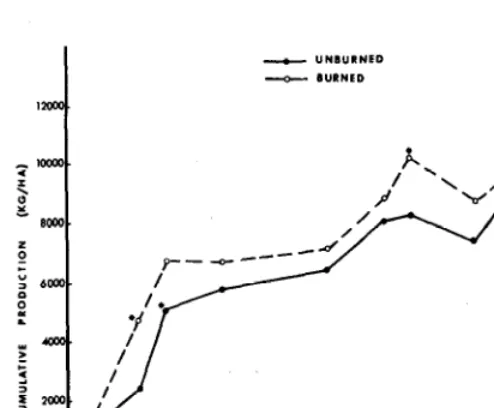
Fig. 1. Cumulative buffelgrass herbage production (kg/ha) at various dates after burning in February I977 on the South Texas Plains near Encinal. Asterisks indicate significantly more herbage producedfor the interval sinre last clipping (P5.0.5).
I5-cm mesh wire, were equidistantly spaced diagonally across each plot. The study area was grazed with cows at approximately I AU/8 ha from 60 days after burning for about I7 months. The pasture was then deferred for IO months, and thengrazed continu- ously at the same stocking rate until termination of the study. Buffelgrass standing crop inside each exclosure and at I m from the exclosure in a randomly selected cardinal direction was harv- ested to ground line within a 0.25-m? quadrat at 4,6, IO, 17,23,25, 27 and 33 months after the first burn. Exclosures were moved to new locations after each harvesting date. Herbage production was calculated as the average difference between herbaceous standing crop measured the preceding sampling period on the grazed area and that within the exclosure at the current sampling period (NAS- NRC 1962). Disappearance was estimated as the difference between the herbaceous standing crop on the grazed area and that within the exclosure at the current sampling period. Disappear- ance represented herbage utilization by livestock and losses such as trampling, consumption by rodents and insects, and weathering. Buffelgrass foliar cover was estimated at 24 and 33 months follow- ing the initial burn with 50, IO-point frame samples in each plot. Data were subjected to analysis of variance, and differences among means were determined with Duncan’s multiple range test at the 5% level.
Results and Discussion
Burn Conditions
Woody plant density on the area burned February 7, 1977, was adequate to impair fine fuel production and continuity, especially in the immediate vicinity of the woody plants. In addition to low fine fuel load (1,140 kg/ha) and poor fuel continuity, the wind speed, I3 km/ hr at headfire ignition, diminished to 8 km/ hr shortly after ignition (Table I). Relative humidity was 89% at headfire ignition and increased to 100% during the burn. Fine fuel water content was 23% at ignition. The burn blackened an esti-
Fine fuel load (kg/ ha) Standing crop Mulch
Fine fuel water content (%) Soil-water content (%)
o-15 cm 15-30 cm 30-45 cm
Maximum burn temperature (C) at 15 cm
Wind speed (km/ hr) Wind direction Air temperature (C) Soil temperature at 5 cm (C) Relative humidity (%)
1120 2448
20 882
23 14
16 19
225 223
8-13 O-8
SE E/NE
16 14
14 II
89 40
14 14 13
mated 80% of the surface area.
Conditions for the second burn (February 9, 1979) were more favorable than for the initial burn. Fine fuel load averaged 3,320 kg/ ha, relative humidity was 40%, and fine fuel water content was I4%, all within the limits suggested for successful range burning in South Texas (Scifres 1980). However, wind velocity was only 8 km/hr at ignition, and diminished to calm before burnout. Other variables, such as soil moisture, soil temperature, air temperature, and maximum fire temperatures were similar for the two burns.
Buffeigrass Production
The plots burned in I977 had produced significantly more buf- felgrass herbage (E.05) by late May, approximately 4 months after the burn, than was produced on unburned areas (Fig. 1). Soil water was adequate at the time of the burn (Table I) to promote early spring growth on the burned areas. In addition, 30.5 cm of precipitation occurred on the study area between the date of burn- ing and the herbage harvests in May. However, from May 24 to harvests in mid-July, only 4. I cm of precipitation were received. During that period, the unburned plots produced significantly more buffelgrass that was produced on the burned plots but cumul- ative herbage production was higher on the burned areas (Fig. I). Greater herbage production on the unburned plots (1,230 kg/ ha) than on burned plots (360 kg/ha) during the next I I months nullified the difference in cumulative herbage production between treatments. This response was attributed to dry growing condi- tions, since only 2 I .2 cm of precipitation were received during this period. However, buffelgrass herbage production on the burned plots was significantly greater for the December 1978 sampling, compared to that of unburned plots. During that period, June to December 1978, 51.5 cm of precipitation was received. Thus, cumulative buffelgrass herbage production was greater on plots burned once compared to that of unburned plots for 29 months following the burn, even though standing crop on burned areas was reduced more than that on unburned areasduringdry periods (Fig. 1).
As with the initial burn, soil water content at the time of the
second burn in February 1979 (Table I) was apparently adequate for rapid growth initiation of the buffelgrass. Although I2 cm of precipitation occurred from the time of the second burn to sam- pling in May 1979, 70% of the rainfall fell within 3 weeks of the sampling. The plots burned twice had produced 838 kg/ ha of herbage by May 1979, while those burned once and the unburned plots had produced no additional herbage since the date of the second burn (data not shown).
No significant precipitation occurred on the study area from June to the final sampling in mid-December 1979. Cumulative buffelgrass herbage production following the second burn (2,460 kg/ ha) tended to exceed that on the unburned plots (1,440 kg/ ha)
by December, 1979. There was no additional herbage production during the same period on the plots burned once. The greatest amount of cumulative buffelgrass herbage production during the extremely dry period from May through December 1979 occurred on the unburned plots.
Thus, burning promoted buffelgrass herbage production by mid spring following each fire, but less herbage was produced on burned than on the unburned plots as soil water was depleted during the summer. Apparently, the lush buffelgrass growth pro- moted by burning depleted available soil water more quickly than water was consumed on the unburned plots. Sharrow and Wright (1977) reported that increased soil temperature stimulated the growth of tobosagrass (Hilaria mutica) when moisture was not limiting, which caused subsequent reductions in soil water and nitrates. In our study, this consumptive depletion of soil water usually resulted in less buffelgrass herbage production on burned than on unburned plots during subsequent dry periods. However, significant rainfall following the dry periods resulted in more buffelgrass herbage being produced on burned than on unburned plots for the first two growing seasons following burning.
Foliar cover of buffelgrass 24 and 33 months after the first burn did not differ significantly among the treatments(data not shown). However, there was a trend toward slightly greater buffelgrass foliar cover on the burned plots (62%), compared to unburned plots (56%) after 24 months.
Buffelgraas Disappearance
The plots burned in February, 1977, and theadjacent, unburned plots were stocked with cows in April I977 (approximately 60 days following the burn) at a stocking rate of 1 AU/8 ha. Cumulative buffelgrass disappearance (Fig. 2) closely paralleled the cumulative
SAMILIND DATES
Fig. 2. Cumulative buffelgrass herbage disappearance (kg/ha) at various dates after burning in February 1977 on the South Texas Plains near Encinai. Asterisk indicates that signiJicantly more herbage disappeared for that sampling period (PS.05).
buffelgrass herbage production (Fig. I). Cumulative disappear- ance for the 15-month grazing period on the burned plots was 6,270 kg/ ha compared to 5,230 kg/ ha on the unburned plots, represent- ing 88% and 69% of the cumulative herbage production, respec- tively. Although the difference in herbage disappearance between burned and unburned plots was significant only at the first harvest date (May 1977), there was a trend toward greater cumulative herbage disappearance from the burned than from the unburned plots for the next I3 months. These data confirm other reports that grazing animals prefer the fresh, new growth following burning over that on unburned areas (Scifres 1980; Oefinger and Scifres 1977; Wright 1974, 1976, 1978).
Woody Plant Responses
Blackbrush acacia, twisted acacia, and honey mesquite
accounted for more than 95% of the woody plant canopy on the study area. Preburn canopy cover of woody plants on the area averaged 8%.
The density of live plants was not altered by burning, regardless of species or whether the areas were burned once or twice. Moreover, woody plant height replacement was similar to canopy replacement following both burns, and canopy replacement fol- lowing the second burn followed the same pattern as replacement after the first burn. Therefore, only the data on canopy replace- ment following the first burn are presented.
Honey mesquite canopy cover, as reflected by canopy diameters, progressively increased on the unburned plots during the course of the study (Fig. 3). Reductions in December 1978, compared to canopy measurements the previous June, reflect expected seasonal variations. In contrast to unburned plots, honey mesquite canopy diameters on burned plots tended to be less than preburn estimates for 6 months following the initial burn. However, canopy cover of honey mesquite on the burned plots exceeded the preburn values after IO months. Regardless of time of post burn measurement, canopy cover of honey mesquite on burned areas was less than that on unburned areas.
69
UNIUENEDB WINED
“ONE” ME5OUITE AL, OTNEI WOODY ?LANlS
TWIIED ACACIA
5177 7177 ii/n 5175 12171
Fig. 3. Sum of woody species canopy diameters expressed as apercent of preburn canopy estimates at various dates after burning buffegrass in February 1977 on the South Texas Plains near En&al. Asterisks indi- cate significant differences in sums of canopy diameters compared to preburn estimates (pS.05).
Canopy cover of blackbrush acacia was significantly reduced (p1.05) compared to preburn estimates, at 4 months after the initial burn in February 1977 (Fig. 3). Moreover, canopy cover of blackbrush acacia tended to be less than preburn estimates until June 1978, the second growing season after the burn. In compari- son, canopy diameter of blackbrush acacia on unburned areas in June 1978 was significantly greater than preburn.
There was a strong trend toward reduced canopy diameters of twisted acacia on burned areas, compared to preburn measure- ments, for 6 months following the first burn (Fig. 3). However, the twisted acacia canopies had recovered by November 1977 and were significantly greater than preburn canopy cover estimates by June, 1978.
The category “all other woody plants” included desert yaupon, leatherstem, whitebrush, lotebush, Berlandier wolfberry, spiny hackberry, guayacan, and guajillo, and accounted for less than 5% of the woody plant cover. Although canopy diameters of all other woody plants tended to be reduced, compared to preburn esti- mates, for 4 months following the initial burns, they equalled or exceeded preburn canopy diameters at all other evaluation dates (Fig. 3).
Conclusions
These data indicate that fire has the potential for maintaining productivity of buffelgrass pastures which are being invaded by mixed brush. Although cool-season burns did not kill the woody plants because of the ability of most species typical of South Texas mixed-brush communities to resprout following damage to top- growth, there was a reduction in brush canopy cover and heights following burning. This canopy and height reduction apparently contributed to increased herbage production during the spring following the fires when moisture was not limiting. Based on regrowth of woody plants in this study and under a rainfall regime considered normal for the study area (about 50 cm precipitation annually for the last 30 years), it appears that cool-season burns about every third growing season will suppress and maintain mixed brush at acceptable levels. However, care should be exer- cised in timing burns to coincide with years of normal or above- average preburn rainfall because of the increased water demand imposed by the luxuriant buffelgrass growth following burning.
Also, it appears that maintenance burning program should be initiated before the woody plants reach the height and canopy cover of those in this study, perhaps 4-6 years after clearing and seeding. The blackbrush acacia, honey mesquite, and twisted aca-
cia plants averaged I .2, I .O and I .6 m tall, respectively, at the time of the first burn. Burning sooner after establishment ofbuffelgrass would not only subject smaller woody plants to the fire but would also help ensure a heavier, more continuous load of fine fuel.
Literature Cited
Box, T.W., J. Powcfi, and D.L. Drawe. 1967. Influence of fire on south Texas chaparral communities. Ecology 48:955-961.
Box, T.W., and R.W. White. 1%9. Fall and winter burning of south Texas brush ranges. J. Range Manage. 22:373-376.
Daubenmire, R. 1968. Ecology of fire in grasslands. Adv. Ecol. Res. 5209-266. Academic Press, N.Y.
Gould, F.W. 1975. Texas plants. A checklist and ecological summary. Tex. Agr. Exp. Sta. Misc. Pub. 585 Rev. 121 p.
Humphrey, R.R. 1962. Range Ecology. Ronald Press Co, New York. 234 p. Mnyeux, H.S., Jr., and W.T. Hamilton. 1979. Cool-season bums suppress
common goldenweed. Proc. South Weed Sci. Sot. 32:255.
National Academy of Sciences-National Research Councfl. 1962. Basic Problems and Techniques in Range Research. Pub. 890. Nat. Acad. Sci.-Nat. Res. Council. Washington, D.C. p. 11 l-1 12.
Oetinpr, R.D., and C.J. Scifres. 1977. Gulf cordgrass production, utiliza- tion and nutritional status following burning. Texas Agr. Exp. Sta. Bull.
1176. 19 p.
Ssuer, C.O. 1950. Grassland climax, tire, and man. J. Range Manage. 3:16-21.
Scifres, C.J. 1978. Range vegetation management with herbicides and alternative methods: An overview and perspective. Symp. Use of Herbi- cides in Forestry, U.S. Dep. Agr., U.S. Environ. Prot. Agency (Feb. 21-22), Arlington Va. 151-165.
Scifres, C.J. 1980. Brush Management. Principles and Practices for Texas and the Southwest. Texas A&M Univ. Press, College Station. 360 p. Sbarrow, S.H., and H.A. Wright. 1977. Effects of fire, ash, and litter on soil
nitrates, temperature, moisture and tobosagrass production in the Rol- ling Plains. J. Range Manage. 30:266-270.
Stevens, J.W., and D. Arriaga. 1977. Soil survey of Maverick County, Tex. U.S. -Dep. Agr., Soil Co&v. Serv. Unnumbered Pub. 63 p. Varner. L.W.. and L.H. Bbmkensbia. 1978. Seasonal chanaes in nutritive
values of six south Texas grasses. Annu. Mtg. Sot. Range Manage. 3156.
Wright, H.A. 1974. Range burning. J. Range Manage. 27~5-11. Wright, H.A. 1976. Fire as a tool to manage tobosa grasslands. Prcc. Tall
Timbers Fire Ecology Conf. 12:153-167.
Wright, H.A. 1978. Use of fire to manage grassland of the Great Plains: Central and southern Great Plains. Proc. Internat. Rangeland Congr. 11694-696.
SRM Election Results
The Elections Committee composed of Wally Gallaher (Chairman), Herbert Fisser, Lee Carr, Bob Newlin, and Floyd Kinsinger met in Denver, December 8, to count ballots for new officers. Elected officers are:
First Vice President - Gerald W. Thomas Second Vice President - Joseph L. Schuster Directors 1982-1984 - Thomas E. Bedell
- Don D. Dwyer
Present Directors Jack R. Miller and S. Clark Martin will leave the Board in February, 1982.
The following members of the Colorado Section served as ballot counters under the supervision of the Elections Committee: John N. Baker, Jim Stone, Bob Buttery, Allan Strobel, Eric B. Janes, Dave Kathman, Bob Wagner, Lee Carr, Len Hendzel, Bob Newlin, Wally Gallaher, Gordon Bentley, Jeff Burwell, Edward C. Dennis, E.T. Bartlett, William V. McGinnies, C.H. Wasser, Dick Antonio, Allen Schroeder, Larry R. Rittenhouse, Terry Foppe Wendell Hassel
Ballots and tally sheets are retained in the Denver office for one year for review. A total of 1,639 ballots were cast, or approximately 31 percent of the voting membership.