Rational Distance-Bounding Protocols over Noisy Channel
Long Hoang Nguyen
Oxford University Department of Computer Science Parks Road, Wolfson Building, OX1 3QD, UK
[email protected]
ABSTRACT
We use ideas from game theory to define a new notion for an optimal threshold for the number of erroneous responses that occur during the rapid-bit exchange over noisy channels in a distance-bounding protocol. The optimal threshold will ensure that even if an intruder attacks the protocol, the ex-pected loss the verifier suffers will still be lower than when the intruder does not attack. Any rational intruder, who al-ways tries to maximise the verifier’s loss, will not therefore have any incentive to attack the protocol. We then demon-strate how statistical analysis and binary search are used to locate the unique and optimal threshold accurately.
Categories and Subject Descriptors: H.m [Information System]: Miscellaneous
General Terms: Security.
1.
INTRODUCTION
Ideas from game theory have been used to re-design a number of fair exchange protocols [2, 15] and secret shar-ing schemes [4, 5] so that parties cannot act on their own interests to bring these schemes to failure [5]. As an exam-ple, in a fair exchange, a party accepts to deliver an item iff it receives another item in return, and hence even unmali-cious but self-interested parties will be tempted to deviate from a protocol to gain advantage. This notion of play-ers’ rationality or self-interest is however not applicable to distance-bounding protocols because in those protocols it is in the mutual interest of both the legitimate verifier and prover that they should cooperate to complete a protocol successfully to authenticate each other.
We instead observe that in many scenarios the intruder is
rational in the sense that it always tries to maximise the expected loss or cost it can cause to the verifier (or tag reader) in a distance-bounding protocol. In the scheme, the loss a verifier suffers mainly comes from either false rejec-tion (rejecting a legitimate tag or user) or false acceptance (authenticating a malicious tag or attacker). Both of these arise from noise existing in the data layer which exchanges
Permission to make digital or hard copies of all or part of this work for personal or classroom use is granted without fee provided that copies are not made or distributed for profit or commercial advantage and that copies bear this notice and the full citation on the first page. To copy otherwise, to republish, to post on servers or to redistribute to lists, requires prior specific permission and/or a fee.
SIN’11,November 14–19, 2011, Sydney, Australia.
Copyright 2011 ACM 978-1-4503-1020-8/11/11 ...$10.00.
bits during the rapid-bit exchange or the challenge-response phase lasting multiple rounds of the protocols. The noise therefore necessitates the use of a tolerance threshold, such that a prover is authenticated if the total number of its er-roneous responses is below the threshold. These features motivate us to use techniques in game theory to define and locate an optimal threshold to resist this kind of rational intruder: even if an attacker impersonates a user (e.g. in an attempt to forge a false acceptance), the expected loss the verifier suffers will still be lower than when the verifier com-municates with the legitimate user. The attacker therefore does not have any incentive to disrupt a protocol.
The use of a rapid-bit exchange is to compute the upper bound on the distance of the prover as in a RFID distance-bounding protocol. Since only bits are rapidly exchanged over a noisy channel, the information can be corrupted.1 To
counter noise, Hancke and Kuhn [6] introduce the use of a threshold value on the number of erroneous responses. This work is subsequently extended by Kim et al. [7]. The contri-butions however do not attempt to define and locate an op-timal threshold value given that the number of rounds and the noise level are fixed. They simply point out that the likelihood of authenticating a legitimate user will become much higher than an attacker as the number of rounds in-creases without taking into consideration the cost of running these protocols and the losses arising from false acceptance and false rejection. This therefore motivates Dimitrakakis et al. [3] to introduce a general framework enabling an ex-pected loss analysis for all protocols of this type. In this framework, different costs are assigned to a variety of pos-sible events or protocol outcomes taking into account trans-mission energy, computation, and time overhead. They then show how to find a nearly optimal value for the threshold so that the worst-case expected loss is minimised, we will how-ever demonstrate that this is not the same as discouraging an intruder from attacking a protocol.
Our first contribution presented in Section 3 is to show that there exists a unique value for the threshold on the number of erroneous responses in a distance-bounding pro-tocol over noisy channel such that not only does a rational intruder not have any incentive to attack but also the ver-ifier’s loss due to false rejection is minmimised as much as possible. We then demonstrate how such a threshold can be exactly calculated by using statistical analysis in
combina-1Existing distance-bounding protocols usually separate
tion with binary search. This new approach will be used in this paper to resist two different and well-studied attacking strategies on any protocols of this type, namely distance-fraud attackers in Section 4 and mafia-distance-fraud attackers in Section 5. In Section 7, we point out that our approach can be easily adapted to locate exactly a different kind of optimal threshold due to Dimitrakakis et al. [3] that minimises the worst-case expected loss. This improves on the finite-sample loss bounds for a nearly optimal threshold of Dimitrakakis et al. that provides a good approximation but for a limited range of the probability of erroneous transmission.
To assess the performance of this new approach in resist-ing rational attackers, we have attempted to quantify the costs a verifier suffers due to false rejection and false ac-ceptance and then carried out experiments and report our results in Section 6. The experimental results clearly demon-strate that the optimal threshold value appears to grow lin-early with respect to the round number while sublinlin-early with respect to the level of noise.
2.
NOTATIONS
Capital lettersV,P,U andAdenote the legitimate ver-ifier, the prover, the legitimate user and the attacker in a distance-bounding protocol, where V always seeks to au-thenticate the legitimate userU who shares a private key withV. The role of the proverP can be played by either
U or A. P(X) denotes the probability of event X, while E(L|X) denotes the conditional expectation of the verifier’s
loss whenX is true.
We consider distance-bounding protocols whose rapid-bit exchange lastsnrounds under noisy conditions.2 This im-plies that whenever a symbol (or a bitx ∈ {0,1}) is sent during the rapid-bit exchange between the verifier V and the prover P, it can be altered due to noise in the physi-cal medium. Let us denote w = P(x 6= x0) the
probabil-ity of erroneous transmission in the data layer, wherex0 is the received symbol at the other end of the communication. Without loss of generalityw∈[0,0.5], because whenw >0.5 andwis known prior to a rapid-bit exchange,3 parties can adopt the following strategy to turn this into the case where
w0 = 1−w ≤0.5: if a node intends to commmunicate a bitb, then it will transmitband the probability the receiver getsbis 1−w.
During then-round rapid-bit exchange, V sends one-bit challengesc1,· · ·, cntoP, who then responds by
transmit-ting one-bit responsesr1,· · ·, rn. The verifier can calculate
the correct responseri=Ri(ci) for anyi∈ {1,· · ·, n}, and
hence can check the accuracy ofP’s response in each round.4 These responses coming fromP can however be corrupted due to noise, and so this necessitates the use of a tolerance thresholdτ∈ {1,· · ·, n}, such thatP is authenticated if the total number of erroneous responses is belowτ.
2
A distance-bounding protocol usually consists of three phases: initialisation, rapid-bit exchange and termination. Since rapid-bit exchange is most sensitive to noise, and not the other two, we focus on the rapid-bit exchange here.
3
The noise level can be estimated through communication during the intialisation and termination phases of a distance-bounding protocol [3].
4
The functionRi() depends on a private key shared between
V andU thoughRi() appears to be random and uniformly
distributed, i.e. for anyi∈ {1,· · ·, n}and given thatci6=c0i
we haveP(Ri(ci)6=Ri(c0i)) =P(Ri(ci) =Ri(c0i)) = 1/2.
Also due to noise, there are two possibilities that can go wrong in any protocol of this type:5
• False rejection: this happens whenV rejects a legiti-mate user (P =U) because the number of erroneous responses coming from the user U is greater than or
equal toτ. The verifierV therefore suffers a costlU.
We denoteP(≥τ|P=U) orP(U≥τ) the
probabil-ity of false rejection.
• False acceptance: this happens whenV authenticates a malicious attacker (P =A) because the number of erroneous responses coming from the attacker A is
smaller thanτ. The verifierV therefore suffers a cost
lA and P( < τ|P = A) or P(A < τ) denotes the
probability of false acceptance.
In addition to costs lA and lU associated with false
accep-tance and false rejection, a costlBis assigned to each round
of the rapid-bit exchange as suggested by Dimitrakakis et al. [3]. We note that even though the costs can vary widely in different scenarios in practice, if we can restrict the range of the intruder’s interests, such as incorrect authentication and denial of service, then it is possible to accurately esti-mate and compute the costs as demonstrated in Section 6.
Since there arenrounds in a rapid-bit exchange, as in [3], the lossesV suffers in different protocol outcomes are:
L=
nlB+lU if≥τ andP=U,
nlB+lA if < τ andP=A, and
nlB for otherwise.
From this definition, the expected loss the verifier suffers when the prover is eitherU orAcan be derived as follows
E(L|U, τ) = nlB+P(U< τ)·0 +P(U≥τ)·lU (1)
E(L|A, τ) = nlB+P(A< τ)·lA+P(A≥τ)·0 (2)
In the sections to come, we will demonstrate how noisy com-munication can be, perhaps interestingly, used to discourage a rational intruder from attacking protocols of this type.
2.1
A distance-bounding protocol
Although our work applies to a wide range of distance-bounding protocols under noisy condition, for clarity we give the specification of the distance-bounding protocol of Reid et al. [14] below. In this protocol, the verifierV (or the tag reader) and the legitimate proverP =U (or the tag) share a common secretx∈ {0,1}n
. The messages exchanged are:
1. V chooses a random numberyV ∈ {0,1}m and sends
it toP.
2. P also chooses a random number yP ∈ {0,1}m and
sends it toV.
3. Both entities now use a key derivation function f :
{0,1}n×{0,1}∗
→ {0,1}nto derive a keyk=f(x, V k
PkyV kyP). This is used to split the common secret
key into two shares,k andd=k⊕x.
4. V andPstart a rapid-bit exchange which is subject to noise. The following steps are repeated fornrounds. At each roundi∈ {1,· · ·, n}:
5
(a) V chooses a random bitci, transmits it toP, and
starts a clock.
(b) Upon receiving ci, P replies ri = Ri(ci), with
Ri(ci) =di ifci= 0, andRi(ci) =kiifci= 1.
(c) After the reception of ri, V stops the clock and
stores the delay time ∆tiand checksri.
It is easy to see that for anyi∈ {1,· · ·, n}and given that
ci6=c0iwe have
P(Ri(ci)6=Ri(c
0
i)) = P(di6=ki) =P(ki⊕xi6=ki)
= P(xi= 1) = 1/2
The same property applies to other protocols of this type, such as protocols of Hancke and Kuhn [6], and Kim et al. [7].
3.
LOSS ANALYSIS
Using ideas from game theory we observe that for a ra-tionalattacker, who always tries to maximise the verifier’s loss, we want to choose the threshold so that even if the at-tacker impersonates the prover in an attempt to forge a false acceptance, the expected loss it causes to the verifier is still lower than when the verifier communicates with a legitimate user. This is captured by the following inequality
E(L|P =U, τ) > E(L|P =A, τ) (3) P(U≥τ)·lU > P(A< τ)·lA
P(U≥τ)
P(A< τ)
> lA lU
Additionally we want to locateτ so thatE(L|P =U) is as
small as possible while Inequality (3) is still satisfied. From Equations (1) and (2), when we increase the threshold value
τ, thenE(L|P =U) decreases whileE(L|P =A) increases,
and hence there always exit a unique value forτ satisfying both Inequality (3) and the second condition captured by the following inequality.
E(L|P =U, τ+ 1) ≤ E(L|P =A, τ+ 1) (4) P(U≥(τ+ 1))
P(A<(τ+ 1))
≤ lA
lU
Given that the number of roundsn and the probability of erroneous transmissionware fixed, we will show in the sub-sequent sections that it is possible to calculate the unique integer thresholdτexactly such that Inequalities (3) and (4) hold at the same time.
Our strategy can be simply explained as follows. We first use statistical analysis to calculate the probabilities of false rejection P(U ≥ τ) and false acceptance P(A < τ) with
respect to any common value of the threshold τ and any level of noise over the communication channel. Sinceτis an integer chosen from{1,· · ·, n}, intuitively it is feasible to carry out a binary search to locate such an optimal value.
In order to understand the distribution of the number of erroneous responses coming from an attacker, we need to consider a variety of attacking strategies. To our knowl-edge, there are three main sources of attacking strategies in the literature that an intruder can pursue to cause incorrect authentication to distance-bounding protocols: (1) distance fraud; (2) mafia fraud; and (3) terrorist fraud. The last of these requires a legitimate user to be dishonest: although the user does not reveal the private key shared between it-self and the legitimate verifier to the attacker, it cooperates
V
P = U
c
ic'
ir'
i=R
i(
c'
i)
c'
ir''
iw
w
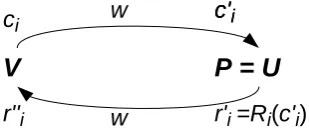
Figure 1: The verifier V is communicating with a
legitimate userU with whomV shares a private key that underlies the functionRi()for anyi∈ {1,· · ·, n}.
w denotes channel noise.
with the terrorist attacker, i.e. giving the attacker the cor-rect response to any challenge chosen by the attacker. Since it is impossible to resist a terrorist fraud attacker when there exist such a dishonest user, we will only investigate how to deal with the first two of these attackers in this paper.
As regards a legitimate user, there is only one type of legitimate user who shares a private key with the verifier and the user always follows the protocol to be authenticated to the verifier. In the next subsection we will first calculate the likelihood of false rejection as required in Inequalities (3) and (4) given the values forτ,wandn.
3.1
False rejection
In this scenario the prover is the legitimate user orP =
U and a protocol is run without the interference from any attacker as seen in Figure 1. Since we are interested in the probability of false rejection P(U ≥ τ) which depends on
the number of erroneous responses U that occur out of n
rounds of a rapid-bit exchange, we first need to compute the probability of erroneous response in each round.
Theorem 1. A legitimate user U wants to authenticate itself to the legitimate verifierV. Ifwdenotes the probability of erroneous transmission then the probability of erroneous response fromU in each round is:
P(Error|P =U) =w(3/2−w)
Proof. We need to deal with noise existing in both the
challenge and response phases of any roundi∈ {1,· · ·, n}:
• As seen in Figure 1, a challengeci is sent from V to
U, but because of noise whatU actually receives isc0i
such thatP(ci6=c0i) =w.
• The response r0i = Ri(c0i) is sent from U back to V,
and also because of noise what V receives is ri00such
thatP(r00i 6=r0i) =w.
From the above analysis, we can derive the probability of erroneous response fromU in each round as follows:
P(Error|P =U) = P(r00i 6=Ri(ci)|P=U)
= P(ci=c
0
i∧r
00
i 6=r
0
i) +
P(ci6=c
0
i∧Ri(ci) =Ri(c
0
i)∧r
00
i 6=r
0
i) +
P(ci6=c0i∧Ri(ci)6=Ri(c0i)∧r
00
i =r
0
i)
= (1−w)w+w2/2 +w(1−w)/2 = w(3/2−w)
The third equality follows because given thatci6=c0iwe
al-ways haveP(Ri(ci) =Ri(c0i)) =P(Ri(ci)6=Ri(c0i)) = 1/2 as
Figure 2: The first graph represents the binomial distributionBinom(n, w(3/2−w)) ofU. The second graph
represents the binomial distributionBinom(n,0.5) ofA. Third graph combines of the first two graphs.
The number of erroneous responsesU out ofn rounds
be-tweenV andU is represented by a binomial distribution
U∼Binom(n, w(3/2−w))
Given n, τ andw, the likelihood of false rejectionP(U ≥
τ) = 1−P(U < τ), which corresponds to the grey area
of the first graph of Figure 2, can be easily calculated to a high level of accuracy by using tabulations of the probability mass functions of the normal or binomial distribution [1].
4.
DISTANCE FRAUD ATTACKER
In this attack there are two active parties: a legitimate verifierV and a distance fraud attacker ADF who acts as
a legitimate U to convince V of being nearer to U than it really is. It is crucial to emphasise thatADF does not
interact withU who shares a private key withV.
Since we are interested in the probability of false accep-tanceP(A< τ) which depends on the number of erroneous
responsesA that occur out of n rounds of a rapid-bit
ex-change, we first need to compute the probability of erroneous response in each round.
Theorem 2. An attacker ADF only interacts with the
legitimate verifier V but not the legitimate user U as seen in Figure 3. Regardless of the level of noise, if we assume thatADF does not have any knowledge about the private key
shared between V and U then the probability of erroneous response fromADF in each round is:
P(Error|P =ADF) = 1/2
Proof. Since the attacker does not have any knowledge
about the private key shared between the verifier and the legitimate user, upon receiving any challenge ci the best
response the attacker can come up with is a random bit
r0i ∈R {0,1}, and that meansP(ri0 6=Ri(ci)) = 1/2. Since
the actual value of the challenge is of no importance to the attacker, there is no need to consider noise in the challenge phase of the exchange. We however need to take into account noise in the response phase, i.e. the responseV receives is
r00i such thatP(ri006=ri0) =w.
V
P = A
DF
c
ic'
ir'
i∈
R{0,1}
c'
ir''
iw
w
Figure 3: A distance fraud attackerADF posing as a
prover communicates with a verifier V.
We therefore arrive at:
P(Error|P=ADF) = P(r00i 6=Ri(ci)|P =ADF)
= P(r0i6=Ri(ci)∧r
00
i =r
0
i) +
P(r0i=Ri(ci)∧r
00
i 6=r
0
i)
= (1−w)/2 +w/2 = 1/2
It is important to point out that whenw∈[0,0.5] 1/2 =P(Error|P=ADF)≥P(Error|P =U)
The number of erroneous responsesA out ofnrounds
be-tweenV andADF can also be represented by the following
binomial distribution
A∼Binom(n,1/2)
Givenn,τ andw, the likelihood of false acceptanceP(A<
τ) that corresponds to the black area of the second graph of Figure 2 can also be easily calculated to a high level of accu-racy by using tabulations of the probability mass functions of the normal distribution [1].
4.1
Optimal threshold value
Since the threshold valueτis the same regardless of whether
P =ADF or P =U, we can combine the first and second
V
U' = A
MF= V'
c
ic'
ir'
ir''
iU
ac
iR
i(
ac'
i)
ac'
ir'
iw
w
w
w
Figure 4: A mafia fraud attackerAM F interacts with
both a verifierV and a legitimate userU.
From the combined graph, it becomes very clear that iter-atively we can find an integer value ofτ ∈ {1,· · ·, n}such that Inequalities (3) and (4) of Section 3 hold.
Since we assumed that w ≤ 0.5, and so w(3/2−w) ≤
0.5. Starting from the interval τ ∈ [1, n/2] and by using binary search, we are guaranteed to locate an optimal integer value forτ after at most (log2n−1) iterations such that the
following two conditions are satisfied.
P(U≥τ)
P(A< τ)
>lA lU
and P(U≥(τ+ 1))
P(A<(τ+ 1))
≤lA
lU
We will give our experimental results in Section 6 and our analysis on the behaviour of the optimal threshold as a func-tion of either round numbernor channel noisew.
5.
MAFIA FRAUD ATTACKER
When an attacker can interact with both the legitimate userU and the verifierV who share a common private key, there is another source of attack calledmafia fraud, and so
P =AM F. In a mafia fraud attack, the attacker plays the
role of the man-in-the-middle: AM F poses asU to interact
withV and poses asV to interact withU. The attacker tries to convinceV that it is communicating with the legitimate userU while in realityV communicates with the attacker.
Under noiseless conditions, the attacker could transmit an anticipated challengeacito the legitimate userU before the
verifierV sends its challengeci. Half of the time,aci=ci, so
the attacker can correctly replyRi(ci) to the verifier.
Oth-erwise, the attacker can make a random guess, being correct half of the time. However, we also need to consider the case when there exist noise in the communication channel. Without loss of generality, we assume that the probability of erroneous transmissionwis the same over channels between
AM F andU, and betweenAM F andV.6
Theorem 3. An attackerAM F interacts with the
legiti-mate user U and the verifier V as seen in Figure 4. If w denotes the probability of erroneous transmission then the chance of erroneous response fromAM F in each round is:
P(Error|AM F) =
1 4+
3w
2 −
7w2
2 + 4w
3
−2w4
Interpretation of the result: it is clear that when there is no noise or w = 0 we haveP(Error|AM F) = 1/4 which
is the same as previously reported in [14]. For w = 1/2 we haveP(Error|AM F) = 1/2, which implies that a mafia
fraud attacker does no better than a distance fraud attacker.
6
Although a noise analysis of mafia fraud attack was pro-vided in [8], the author is very grateful to Christos Dimi-trakakis for confirming an error in the analysis.
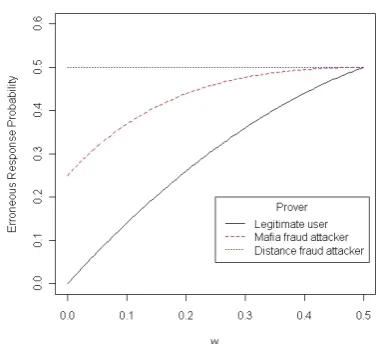
Figure 5: This is the erroneous response probabil-ity when the prover is (1) a user, (2) a mafia fraud attacker, or (3) a distance fraud attacker.
Moreover as we increaseswfrom 0 to 1/2, using differenti-ation technique it is not hard to prove that P(Error|AM F)
also increases from 1/4 to 1/2, and more importantly
P(Error|P =ADF)≥P(Error|P=AM F)≥P(Error|P=U)
This can be graphically illustrated by Figure 5. A mafia fraud attacker is therefore more powerful than a distance fraud attacker, which is indeed the case. Although it is more complicated to analyse the performance of a mafia fraud attacker, we can use the same analysis of Section 4 for a distance fraud attacker to tackle this problem. In the following we present a sketch of the proof, a formal (and detailed) proof is given in full version of this paper [9].
Proof. (Sketch) Following the strategy of a mafia fraud attacker over noisy channel described above and in Figure 4, in any roundi∈ {1,· · ·, n}the legitimate verifierV sends a challengeciwhich is intercepted by the attackerAM F. The
challenge c0i the attacker receives however might not equal
cidue to noise existing over the communication channel
be-tweenV andAM F, and hence we have two possibilities:
• With probability 1−w we haveci=c0i, this leads to
two further cases:
– With probability 1/2: c0i 6= aci where aci is the
anticipated challenge previously sent from AM F
posing as V to the legitimate user U. The best
AM F can do is to make a random guess ri0 ∈R
{0,1}as a response to the verifierV.
– With probability 1/2: c0i = aci. AM F therefore
can forward the response r0i, which AM F
previ-ously received fromU, to the verifier. Since there is noise over the communication channel between
AM F andU, we can use Theorem 1 to compute
P(ri06=Ri(c0i)).
The responseri0is then sent fromAM F toV, but again
receives at the other end of the communication. Using calculation detailed in [9], we arrive at:
P(r00i 6=Ri(ci)|ci=c
0
i) =
1 4+
5w
4 −2w
2
+w3
• With probabilityw: ci6=c0i, butAM F is not aware of
this fact and therefore still follows his or her strategy by first comparing c0i with the anticipated challenge
aci. Using calculation from [9], we arrive at
P(r00i 6=Ri(ci)|ci6=c
0
i) =
1 2−
w
4 +w
2− w3
wherer00i denotes the final responseV receives.
Using the above analysis, we can derive the probability of erroneous response fromAM F in each round as follows:
P(Error|P=AM F) = P(ci6=c0i)P(r
00
i 6=Ri(ci)|ci6=c0i) +
P(ci=c0i)P(ri00=6 Ri(ci)|ci=c0i)
= w
1 2−
w
4 +w
2
−w3
+
(1−w)
1 4+
5w
4 −2w
2
+w3
= 1
4+ 3w
2 −
7w2
2 + 4w
3
−2w4
The number of erroneous responsesA out ofn rounds
be-tweenV andAM F can be represented by the following
bi-nomial distribution
A∼Binom
n,1
4+ 3w
2 −
7w2
2 + 4w
3
−2w4
We note that for any values ofwandτ, bothP(A< τ) and
P(U ≥τ) can be easily calculated to a high level of
accu-racy by using tabulations of the probability mass functions of the normal distribution [1]. And hence an optimal thresh-old satisfying Inequalities (3) and (4) can also be found by binary search as described in Section 4.1.
6.
EXPERIMENTS
Even though Dimitrakakis et al. [3] introduced a general framework enabling an expected loss analysis for distance-bounding protocols, they did not explain how the costs due to false rejection and false acceptance can be derived. In this section we will first attempt to estimate the costs the verifier suffers corresponding to different protocol outcomes. We then use this information to carry out experiments to assess the performance of our approach in locating exactly the optimal threshold that can resist a rational attacker.
Let us suppose that the intruder is most interested in caus-ing incorrect authentication which is either false rejection or false acceptance, and completely ignores what (s)he might further benefit from the protocol outcomes.7 Consequently
the costs are closely related to the duration of time between successive protocol runs under different circumstances, be-cause these durations determine how long incorrect authen-tication is maintained following either a false acceptance or a false rejection.
7We do not consider what the intruder might further
bene-fit from incorrect authentication, because the corresponding losses vary widely in practice, and hence a careful analysis for each scenario will be required to determine the losses.
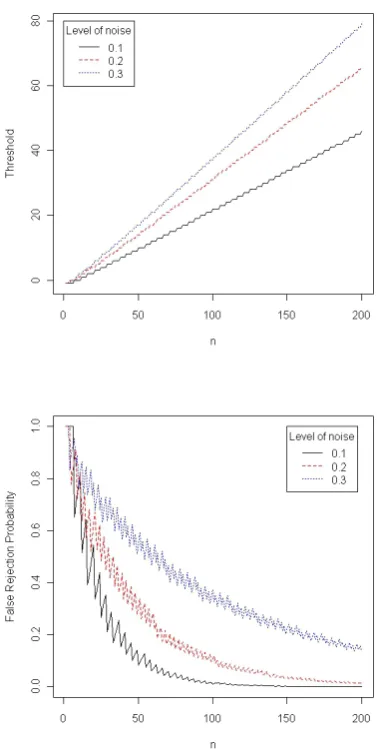
Figure 6: Under the presence of a mafia fraud at-tacker: these graphs depict the optimal thresholdτ and the corresponding probability of false rejection
P(U≥τ)versus the number of rounds n.
As an example, we can further extend any distance-bounding protocols to take into account the duration between succes-sive runs as follows:
• False rejection: If a verifier fails to authenticate a le-gitimate userU then another session will be initiated byU after a short period of time, say 1 hour.
• False acceptance: If a verifier authenticates a malicious party then it will take a longer time, say up to 10 hours, before the protocol is run again because neither the verifier nor the legitimate user is aware of the attack.
Using this information, we have carried out two experiments to assess our analysis regarding distance and mafia fraud at-tackers, where the ratiolA/lU= 10 is chosen due to the
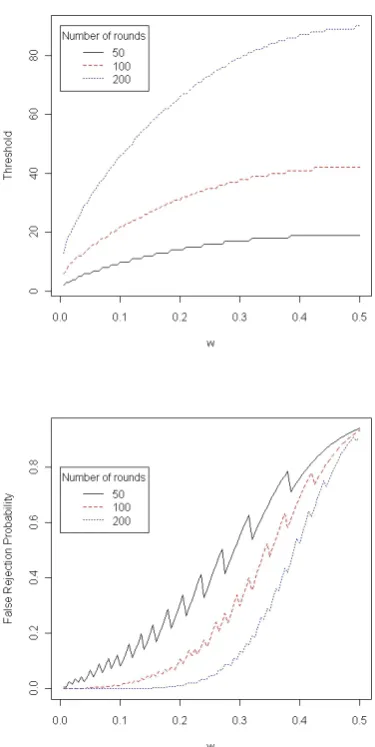
Figure 7: Under the presence of a mafia fraud at-tacker: these graphs depict the optimal thresholdτ and the corresponding probability of false rejection
P(U≥τ) versus noise.
the computation of the optimal threshold, and hence are ig-nored here. Although our analysis is applicable to different levels of noise over communication channels between the dif-ferent pairs of entities, for simplicity we will assume that the probabilities of erroneous transmission over all channels are equal to one another in our experiments. Since a mafia fraud attacker is more powerful than a distance fraud one, our ex-periments reported here only look at the optimal threshold that resists a mafia fraud attacker.8
In the first experiment, we fix the level of noisewand let the number of roundsnvary from 1 to 200. This experiment is repeated three times with different values forw: 0.1, 0.2 and 0.3 under the presence of a mafia fraud attacker. The
8
We have also carried out experiments under the presence of a distance fraud attacker whose results are very similar to those reported here.
first graph of Figure 6 depicts the optimal thresholdτ cor-responding to each value of n ∈ [1,200]. With each value ofn, and its corresponding optimal thresholdτ, we can cal-culate the probability of false rejectionP(U ≥τ) which is
plotted in the second graph of Figure 6. It is encouraging to see that as the number of rounds increases, the likelihood of false rejectionP(U≥τ) falls sharply. MoreoverP(U ≥τ)
decreases faster with less noisy channel.
In the second experiment, we fix the number of rounds
n and let the level of noise w vary from 0 to 0.5. This experiment is also repeated three times with different values forn: 50, 100 and 200 again under the presence of a mafia fraud attacker. Figure 7 depicts the optimal thresholdτ and the probability of false rejectionP(U≥τ) corresponding to
each value of w∈ [0,05]. It is clear that a higher level of noise leads to bigger threshold as well as the likelihood of false rejection. Moreover,P(U≥τ) increases faster with a
smaller round number.
7.
COMPARATIVE ANALYSIS
Dimitrakakis et al. [3] introduced a different notion for an optimal threshold (or minimax threshold) that minimises the worst-case expected lossE(L) defined as follows:
E(L) = max{E(L|P =U),E(L|P=A)} (5)
As previously observed, when the thresholdτincreases,E(L|P= A, τ) also increases whileE(L|P =U, τ) decreases, and thus
to minimiseE(L) we need to locate a threshold such that
E(L|P=U, τ) = E(L|P =A, τ) (6) P(U≥τ)
P(A< τ)
= lA
lU
In [3], Dimitrakakis et al. give the following formula to com-pute the nearly-optimal value for this kind of threshold.
τ∗ = n(pA+pU)
2 −
log(lA/lU)
4(pA−pU)
(7)
wherepA =P(Error|P =A) andpU=P(Error|P =U) are
the probabilities of erroneous response from the attacker and respectively the legitimate user in each round.
Minimising the worst-case expected loss is useful, there are however two further points we want to mention here.
• As pointed out in [3] the nearly optimal thresholdτ∗is constrained to be betweennpAandnpU, for otherwise
τ∗would go to negative infinity whenpA=pU. Given
thatlA≥lU andpA≥pU, we always haveτ∗≤npA.
The other conditionτ∗≥npU is equivalent to
pA−pU ≥ r
log(lA/lU)
2n (8)
From Theorems 1–3 and Figure 4, when the noise level
wapproaches 1/2,pA−pUdecreases toward zero. This
means thatτ∗ is not applicable forw that is near to 1/2. However as the number of roundnincreases,τ∗
works with bigger range of noise as seen in Inequality 8. In contrast our method introduced here can locate the minimax threshold exactly for any value ofw.
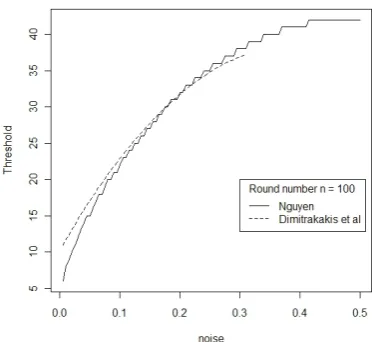
In Figure 8, we plot the actual minimax threshold computed by our strategy as a function of noise level
also plot the nearly optimal thresholdτ∗on the same graph but only for w∈ [0,0.32] because Inequality 8 does not hold whenw >0.32. This clearly shows that the nearly-optimal thresholdτ∗gives good approxima-tion for a limited range of noise.
Figure 8: Under the presence of a mafia fraud at-tacker: the graph depicts the optimal and nearly-optimal minimax thresholdτ versus noise.
• The minimisation of E(L) does not give any conclu-sive indication about the relative difference between
E(L|P =U) andE(L|P =A), which is crucial in our
goal of resisting a rational intruder as explained in Sec-tion 3. In other words, when an integer thresholdτ sat-isfying Equality (6) does not exist, the minimisation of
E(L) leads to either E(L|P =U, τ) >E(L|P =A, τ)
or E(L|P =U, τ) <E(L|P =A, τ), where the latter
will even encourage a rational intruder to attack.
This implies that even though the optimal threshold defined by Dimitrakakis et al. is similar to ours, they are not the same.
8.
CONCLUSIONS
We have introduced the use of ideas from game theory to define a new notion for an optimal threshold for the num-ber of erroneous responses during the rapid-bit exchange of distance-bounding protocols to make the protocols resilient against a rational intruder. The advantage of our approach based on statistical analysis and binary search over existing results in this area is that given any level of noise and round number we can locate exactly the optimal threshold value. Experimental results are provided to demonstrate the accu-racy of our analysis when being used to discourage a mafia fraud attacker from attacking a protocol of this type.
In addition to distance-bounding protocols, we have also investigated the relevance of the notion of a rational intruder to other types of authentication protocols which are based on passwords or human interactions [11, 12, 13]. Readers who are interested in this area can find out more at [10].
Acknowledgements: The author is financially supported by the US Office of Naval Research. The idea developed here arose from fruitful discussions with Dr. Aikaterini Mitrokotsa while the author was visiting Prof. Serge Vaudenay at the Security and Cryptography Laboratory at EPFL from 7th Febraury to 7th March 2011. The author is indebted to Prof. Serge Vaudenay for giving him the opportunity to visit EPFL and would like to thank Drs Aikaterini Mitrokotsa and Christos Dimitrakakis for their many helpful comments.
9.
REFERENCES
[1] M. Abramowitz and I.A. Stegun.Handbook of Mathematical Functions: with Formulas, Graphs, and Mathematical Tables. ISBN 0-486-61272-4.
[2] L. Butty´an, Jean-Pierre Hubaux, and S. ˇCapkun.A Formal Analysis of Syverson‘s Rational Exchange Protocol.Proceedings of the 15th IEEE workshop on Computer Security Foundations, 2002.
[3] C. Dimitrakakis, A. Mitrokotsa and S. Vaudenay.
Expected loss analysis of thresholded authentication protocols in noisy conditions. See
http://arxiv.org/pdf/1009.0278
[4] S.D. Gordon and J. Katz.Rational secret sharing, revisited. In Proceedings of Security and Cryptography for Networks. LNCS vol. 4116, 229-241, 2006.
[5] J. Halpern and V. Teague.Rational Secret Sharing and Multiparty Computation.In Proceedings of the thirty-sixth annual ACM symposium on Theory of computing STOC ’04. Pages 623-632, 2004.
[6] G. Hancke and M. Kuhn.An RFID distance-bounding protocol.Proceedings SecureComm 2005.
[7] C.H. Kim, G. Avoine, F. Koeune, F.X. Standaert, and O. Pereira.The Swiss-knife RFID distance bounding protocol. In Proceedings of ICISC 2008.
[8] A. Mitrokotsa, C. Dimitrakakis, P. Peris-Lopez, J.C. Hernandez-Castro.Reid et al.’s Distance Bounding Protocol and Mafia Fraud Attacks over Noisy Channels. IEEE Communications Letters, Feb 2010, Vol. 14, No. 2, pp. 121-123.
[9] L.H. Nguyen.Rational distance-bounding protocols over noisy channels.With formal proof of Theorem 3. Seehttp://eprint.iacr.org/2011/492
[10] L.H. Nguyen.Rational authentication protocols.See
http://eprint.iacr.org/2011/070.pdf
[11] L.H. Nguyen (editor), second edition. ISO/IEC 9798-6 (2010): Information Technology – Security Techniques – Entity authentication – Part 6: Mechanisms using manual data transfer.
[12] L.H. Nguyen and A.W. Roscoe.Authenticating ad hoc networks by comparison of short digests.Information and Computation 206 (2008), 250-271.
[13] L.H. Nguyen and A.W. Roscoe.Authentication protocols based on low-bandwidth unspoofable channels: a comparative survey.Journal of Computer Security, Vol. 9, No. 1 (2011), 139-201.
[14] J. Reid, J.M. Gonzalez Nieto, T. Tang, and B. Senadji.Detecting relay attacks with timing-based protocols.In Proc. ASIACCS 2007.
[15] P. Syverson.Weakly secret bit commitment:
APPENDIX
A.
DETAILED PROOF OF THEOREM 3
Theorem 3.An attackerAM F can interact with both thelegitimate userU and the verifierV. Ifwdenote the proba-bilities of erroneous transmission then the probability of er-roneous response fromAM F in each round is:
P(Error|AM F) =
1 4+
3w
2 −
7w2
2 + 4w
3
−2w4
This proof should be read along side Figure 4 which clearly depicts not only notations but also the strategy of a mafia fraud attacker. The order of reasoning and calculation of this proof is the same as in the sketch of this proof given in Section 5.
Proof. We first have the following
P(Error|AM F) = P(ci6=c0i)P(r00i 6=Ri(ci)|ci6=c0i) +
P(ci=c
0
i)P(r00i 6=Ri(ci)|ci=c
0
i)
= w·P(ri006=Ri(ci)|ci6=c
0
i) +
(1−w)·P(r00i 6=Ri(ci)|ci=c0i) (9)
We now attempt to calculate P(ri00 6= Ri(ci)|ci = c0i) and
P(r00i 6=Ri(ci)|ci6=c0i) respectively.
Using information from Figure 4 and the sketch of this proof given in Section 5, we have
P(r00i 6=Ri(ci)|ci=c
0
i) = P(c
0
i6=aci∧r
0
i=Ri(ci)∧r
00
i 6=r
0
i|ci=c
0
i) +
P(c0i6=aci∧ri06=Ri(ci)∧r00i =r
0
i|ci=c0i) +
P(c0i=aci∧ri0=Ri(ci)∧r00i 6=r
0
i|ci=c0i) +
P(c0i=aci∧ri0=6 Ri(ci)∧r00i =r
0
i|ci=c0i)
= 1
2 1 2w+
1 2 1
2(1−w) + 1
2[1−w(3/2−w)]w+ 1
2w(3/2−w)(1−w)
= 1
4+ 5w
4 −2w
2
+w3 (10)
The second equality holds due to Theorem 1 which gives us
P(r0i6=Ri(ci)|ci=c
0
i=aci) = w(3/2−w)
P(r0i=Ri(ci)|ci=c
0
i=aci) = 1−w(3/2−w)
Also using information from Figure 4 and the sketch of this proof given in Section 5, we have
P(r00i 6=Ri(ci)|ci6=c0i) = P(r00i =r
0
i)P(ri06=Ri(ci)|ci6=c0i) +
P(r00i 6=r
0
i)P(r
0
i=Ri(ci)|ci6=c
0
i)
= (1−w)·P(r0i=6 Ri(ci)|ci6=c
0
i) +
w·
1−P(r0i=Ri(ci)|ci6=c0i)
(11)
This probabilityP(ri06=Ri(ci)|ci6=c0i) can be computed as
follows
P(r0i6=Ri(ci)|ci6=c
0
i) = P(c0i=aci∧aci=ac
0
i∧r
0
i=Ri(ac
0
i)∧Ri(ci)6=Ri(c
0
i)|ci6=c
0
i) +
P(c0i=aci∧aci=ac
0
i∧r
0
i6=Ri(ac
0
i)∧Ri(ci) =Ri(c
0
i)|ci6=c
0
i) +
P(c0i=aci∧aci6=ac
0
i∧r
0
i6=Ri(ac
0
i)|ci6=c
0
i) +
P(c0i6=aci∧aci=6 ac0i|ci6=c0i)
= 1
2(1−w)(1−w) 1 2+
1
2(1−w)w 1 2+ 1 2w 2 +1 2 1 2 = 1 2− w 4 + w2 2 (12)
The second equality follows because we always have
P(Ri(ci) =Ri(ci0)|ci6=c0i) =P(Ri(ci)6=Ri(ci0)|ci6=c0i) = 1/2
as pointed out at the end of Section 2.1 and in Footnote 4. Substituting Equality (12) into Formula (11) arrives at
P(r00i 6=Ri(ci)|ci6=c
0
i) =
1 2−
w
4 +w
2−
w3 (13)