Security weaknesses in two multi-server password based
authentication protocols
*Jue-Sam Chou1, Chun-Hui Huang2, Cheng-Chung Ding3,
1Department of Information Management, Nanhua University, Taiwan R.O.C
*: corresponding author [email protected] Tel: 886+ (0)5+272-1001 ext.56536
2Department of Information Management, Nanhua University, Taiwan R.O.C
3Department of Information Management, Nanhua University, Taiwan R.O.C
Abstract
In 2004 and 2005, Tsaur et al. proposed a smart card based password authentication schemes for multi-server environments, respectively. They claimed that their protocols are safe and can withstand various kinds of attacks. However, after analysis, we found their schemes each have some secure loopholes. In this article, we will show the security flaws in these two protocols.
Keywords:multi-server, remote password authenticationl, smart card, key agreement, lagrange interpolating polynomial.
1. Introduction
In 1974, Roland Moreno invented integrated circuits card (IC card or smart card). At that time, it was used as the debit card by the bank. Recenlly, the smart card applications have got rapid progress not only for its promotion in the aspects of security and processing speed but also for its significant reduction in cost. It has widely accepted as an important tool in human’s life for its capablity of achieving the goals of integrity, privacy, authentication, etc.
user. Although, it uses an one-way hash function to protect the password, the attacker still might be able to find out the password for the fact that the password itself is weak or it may suffer the stolen verifier attack. To address this problem, some researchers proposed methods for authenticating the remote user by using the non-verification table way.
In 1990, Hwang et al. [5] first proposed a smart card based non-verification table mechanism for authentication. Thereafter, many schemes [1, 2, 3, 6, 8, 11] were proposed based on this non-verification-table type. These authentication mechanisms protect the transmitted information either by the discrete logarithm problem (DLP) or by the asymmetric encryption method. In 2004 and 2005, Tsaur et al. proposed two smart card based password authentication schemes [12, 13] for multi-server environments based on the non-verification-table type. They took the RSA asymmetric encryption and Lagrange interpolating polynomial as the foundation of the research. They claimed that their scheme is safe and can withstand various kinds of attacks. However, after analysis, we found that their schemes each have some security loopholes. In this article, we will demonstrate the security flaws.
The rest of this paper is organized as follows. In Section 2, we describe the background concepts of RSA cryptosystem and some related concept of mathematical problems. In Section 3, we review and show the attacks on Tsaur et al.'s two protocols. Finally, a conclusion is given in Section 4.
2.Background concepts
In this section, we briefly review the basic concept of RSA cryptosystem [9], threshold scheme, and lagrange interpolating polynomial.
2.1 RSA cryptosystem
encryption, e.g., the session key encryption, and can be applied in many situations such as signing and key exchange. Its security is based on the difficulty of factorization. The factorization problem is now still a NP-complete problem.
2.2 Threshold scheme and Lagrange interpolating polynomial
In 1979, Shamir [10]proposed thefirst(t,n)threshold secret sharing scheme based on lagrange interpolating polynomial. In it, a secret K can be shared among n participants. The secret dealer must distribute every participant’sa secret shadow. Only at least t or more participants can reconstruct the secret K. Conversely, if the number of participants is less than t, the participants can obtain nothing about the secret K. This method is mainly used in a plane containing t points to decide the polynomial with degreet-1. Takeingtas the threshold value and appling the Lagrange interpolating polynomial, we can obtain the polynomial. In the Following, we roughly describe the formation of the polynomial:
˙The dealer chooses a secretKand a prime numberpwhich and satisfiesp≧K. ˙The dealer randomly choosest-1degree polynomial ofF(x)=at-1xt-1+ at-2xt-2
+….+ a2x2+ a1x1+ K(modp), whereat-1, at-2,….,a2,anda1are all random
integer, with rang in [1,p-1].
˙Let each participant’s identity be xi, 1 ≤i ≤n. The dealer rests on xi deduce the
subkeyyi=F(xi)for each participant.
˙When the number of subkeys is greater thant, they (the participants) can contruct the polynomial to obtain the shared secretKby lettingxi= 0. In the following, we
roughly describe the Lagrange interpolating polynomial.
Let
(x1,y1),(x2,y2),,(xn,yn)
bendistinct points. Then, thet-1 degreepolynomialF(x)can beFformed by the following formula.
n
i
n
i j
j i j
j i
n n n
n
n n
n n
n n
x x
x x y
x x x
x x x
x x x
x x x y
x x x x x x
x x x x x x y x x x x x x
x x x x x x y x F
1 1,
1 2
1
1 2
1
2 3
2 1 2
3 1
2 1
3 1 2 1
3 2
1
) (
) (
) (
) )(
(
) (
) )(
(
) (
) )(
(
) (
) )( (
) (
) )(
(
) (
) )(
( )
(
3. Review and attack on two Tsaur et al.’sprotocols
this paper are first defined as follows.
CA : the central authority Sj : a legal server j Ui : a legal user i
ATTe : a malicious attacker p1, p2 : two distinct large primes
N, P, e : CA’s public keys d : CA’s secret key S_SKj : the secret key of Sj
S_IDj : the identity of Sj
E_Tij : Sj’s service period for Ui
U_IDi : the identity of Ui
U_PWi : the password of Ui
U_Ri,U_Si : Ui’s two secret keys
U_SCi : Ui’s smart card
fi(X) : a lagrange interpolating polynomial that CA constructs for Ui
M : an authentication message
h(X,Y) : an one-way hash function with two parametersXandY
g : a primitive element in a Galois field GF(p), where p is a large prime number
t : a timestamp
ΔT : endurable transmission delay time => : a secure channel
→ : a common channel
3.1 Review and attack onTsauretal.’sfirstprotocol
(A) Review ofTsauretal.’sfirstprotocol
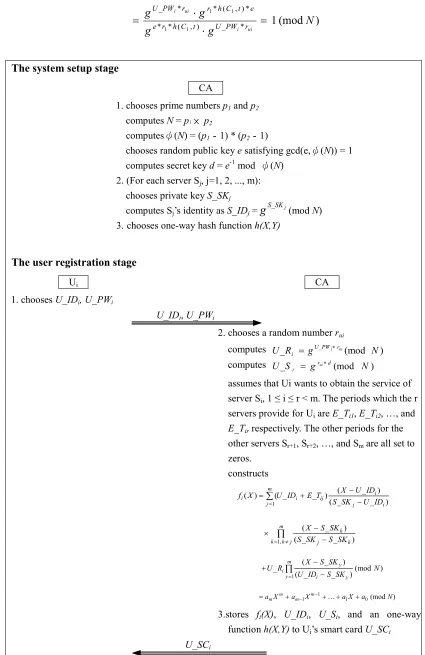
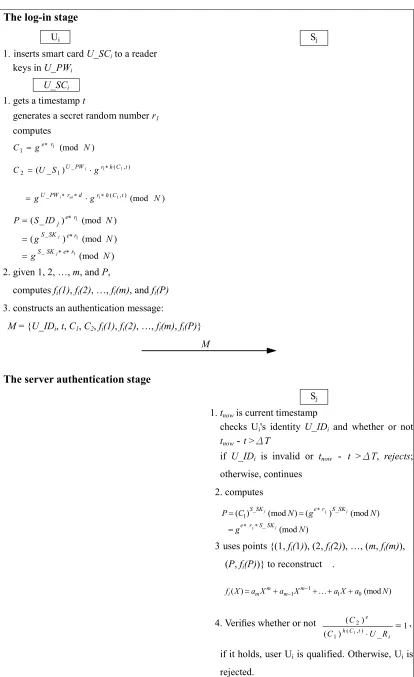
Tsauretal.’sfirstprotocol [12] consists of four stages. They are: (1)The system setup stage, (2)The user registration stage, (3)The log-in stage, and (4)The server authentication stage. We depict their scheme in figure 1 and also describe it as follows.
(1) The system setup stage
In this phase, CA selects the server’s private key and computes its identity. CA‘s operations are described as follows:
˙ According to RSA cryptographic algorithm, CA first selects two large prime numbers p1, p2, computes N = p1× p2, randomly chooses the encryption key e
and then uses the Extended Euclean Algorithm to compute his corresponding private key asd=e-1modψ(N).
˙ For each server Sj, CA selects S_SKj and computesS_IDj = gS_SKj(mod N) as
Sj’sprivate key and identity respectively, where j = 1,2, ..., m.
˙ In addition, it also chooses an one-way hash functionh(X,Y)for the system.
(2) The user registration stage
Assume that a new user Ui wants to register at m servers S1, S2, …,and Sm in a multi-server system. The entire registration process is described as follows (also shown in Fig. 1):
˙ Uichooses his identityU_IDiand passwordU_PWiand transmits them to CA.
˙ CA randomly chooses a numberrui for Ui, and computes Ui’s two secret keys as
follows:
)
(mod N
g R _
U U_PWi rui
i
)
(mod N
g _S
U i ruid
˙ CA assumes that Ui wants to obtain server Sj’s service, 1 ≤j ≤r < m. The service periods provided by the servers for Ui are E_Ti1, E_Ti2, …,and E_Tir
respectively. The other periods for the other servers Sr+1, Sr+2,…,and Smare all set to zeros. CA then constructs a Lagrange interpolating polynomial function fi(X)for Ui as follows:
m
j k
k j k
k
i j
i ij
m
j i
i
SK S SK S
SK S X ID
U SK S
ID U X T
E ID U X
f
, 1
1 ( _ _ )
) _ (
) _ _
(
) _ (
) _ _
( ) (
) (mod ) _ _
(
) _ (
_ 1
N SK
S ID U
SK S X R
U m
y i y
y i
) (mod 0 1 1
1X a X a N
a X
am m m m
˙ CA stores fi(X), Ui’s identity U_IDi, secret keys U_Si and U_Ri, and the one-way
function h(X,Y)in Ui’s smart card U_SCi. Then CA sends the card to Ui via a secure
channel.
(3) The log-in stage
smart cardU_SCi to the reader and keys in his U_PWi. Then, Ui performs following
steps by usingU_SCi:
˙ U_SCi gets a timestamp t from the system. Then, it generates a secret random
numberr1, and computesC1,C2, andPas follows:
) (mod
1
1 g N
C er
) (mod ) _ ( ) , ( _ ) , ( _ 1 2 1 1 1 1 N g g g S U C t C h r d r PW U t C h r PW U ui i i ) (mod ) (mod ) ( ) (mod ) _
(S ID 1 N g _ 1 N g _ 1 N
P e r S SK e r S SK e r
j j j
˙ Given 1, 2,…,m, andP,U_SCicomputesfi(1),fi(2),…,fi(m), andfi(P). Then, it
constructs an authentication messageM= {U_IDi,t,C1,C2,fi(1),fi(2),…,fi(m),
fi(P)} and sends it to Sj, one of themservers for, 1≤j≤m.
(4) The server authentication stage
In this phase, after receiving the authentication message from Ui, Sj requires his system to obtain current timestamptnowand performs the following steps to verify the
login message from Ui:
˙Checks Ui's identityU_IDiand whether or nottnow-t>ΔT, if Ui's identityU_IDi
is invalid ortnow-t>ΔT, Sjrejects; otherwise, it continues.
˙It uses the valueC1and its secret keyS_SKjto derive the valuePshown as
below. ) (mod ) (mod ) ( ) (mod )
(C1 _ N g 1 _ N g 1 _ N
P S SKj er S SKj erS SKj
Then, it uses these m + 1 points {(1,fi(1)), (2,fi(2)),…,(m,fi(m)), (P,fi(P))} to
reconstruct the interpolating polynomial
) (mod )
(X a X a 1X 1 a1X a0 N
fi m m m m
.
˙Checks to see whether 1
_ ) ( ) ( ) , ( 1 2
1
i t C h e R U C
C , if it holds, user Uiis qualified.
Otherwise, Uiis rejected. The verification formula is shown as follows.
) (mod 1 * _ ) , ( * * * ) , ( * * _ 1 1 1 1 N g g g g ui i ui i r PW U t C h r e e t C h r r PW U
The system setup stage
CA
1. chooses prime numbersp1andp2
computesN=p1× p2
computesψ(N) = (p1-1) * (p2-1)
chooses random public keyesatisfying gcd(e,ψ(N)) = 1 computes secret keyd=e-1mod ψ(N)
2. (For each server Sj, j=1, 2, ..., m):
chooses private keyS_SKj
computes Sj’s identity asS_IDj= j
SK S
g _ (modN)
3. chooses one-way hash functionh(X,Y)
The user registration stage
Ui CA
1. choosesU_IDi, U_PWi
U_IDi,U_PWi
2. chooses a random numberrui
computes U_R gU_PWi rui(mod N)
i
computes U_S gr d(mod N)
i ui
assumes that Ui wants to obtain the service of server Si, 1≤i≤r < m. The periods which the r
servers provide for UiareE_Ti1,E_Ti2,…,and
E_Tirrespectively. The other periods for the
other servers Sr+1, Sr+2,…,and Smare all set to
zeros. constructs m j k
k j k
k i j i ij m j i i SK S SK S SK S X ID U SK S ID U X T E ID U X f , 1 1 ) _ _ ( ) _ ( ) _ _ ( ) _ ( ) _ _ ( ) ( ) (mod ) _ _ ( ) _ ( _ 1 N SK S ID U SK S X R U m
y i y
y i ) (mod 0 1 1
1X aX a N
a X
a m
m m
m
3.stores fi(X), U_IDi, U_Si, and an one-way
functionh(X,Y)to Ui’ssmartcard U_SCi
U_SCi
The log-in stage
Ui Sj
1. inserts smart cardU_SCito a reader
keys inU_PWi
U_SCi
1. gets a timestampt
generates a secret random numberr1
computes
) (mod
1
1 g N
C er
) (mod ) _ ( ) , ( _ ) , ( _ 1 2 1 1 1 1 N g g g S U C t C h r d r PW U t C h r PW U ui i i ) (mod ) (mod ) ( ) (mod ) _ ( 1 1 1 _ _ N g N g N ID S P r e SK S r e SK S r e j j j
2. given 1,2,…,m, andP,
computesfi(1),fi(2),…,fi(m), andfi(P)
3. constructs an authentication message:
M= {U_IDi,t,C1,C2,fi(1),fi(2),…,fi(m),fi(P)}
M
The server authentication stage
Sj
1.tnowis current timestamp
checks Ui's identity U_IDi and whether or not
tnow-t>ΔT
if U_IDi is invalid or tnow - t >ΔT, rejects;
otherwise, continues 2. computes ) (mod ) (mod ) ( ) (mod ) ( _ _ _ 1 1 1 N g N g N C P j j j SK S r e SK S r e SK S
3 uses points {(1,fi(1)), (2,fi(2)),…,(m,fi(m)),
(P,fi(P))} to reconstruct .
) (mod )
(X a X a 1X 1 a1X a0 N
f m
m m m
i
4.Verifies whether or not 1 _ ) ( ) ( ) , ( 1 2
1
i t C h e R U C C ,
if it holds, user Uiis qualified. Otherwise, Uiis
rejected.
(B) Attackon Tsauretal.’sfirstprotocol
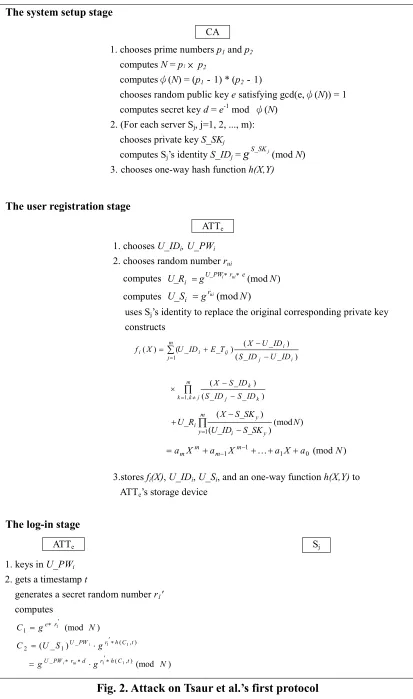
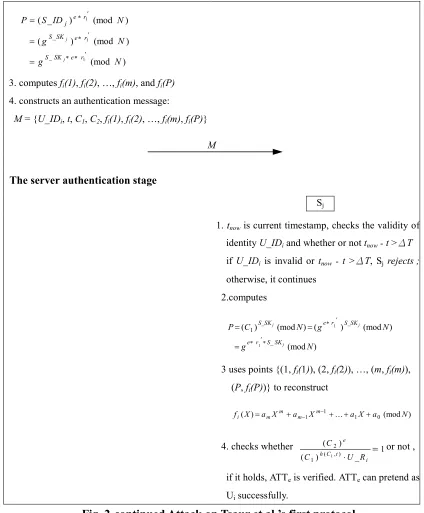
Tsaur et al. claimed that their protocol is safe and can withstand various kinds of attacks. In this section, we will show that their protocol is vulnerable (as shown in Fig. 2). In the following, we will describe that there exists a weakness inTsauretal.’sfirst
protocol. Since that a malicious adversary ATTe can successfully launch an attack shown as follows:
(1) Assume that there is a malicious attacker ATTewho wants to disguise as user Ui, a legal user in the system, to login to Sj. Before the login stage, ATTe purchases a smart card and pretends to be CA by preparing the needed parameters stored in the card for the login stage. ATTeperforms as follows.
˙ Enters U_IDi, randomly chooses a password U_PWi, selects a number rui, and
calculates Ui’s two secrets as follows.
) (mod N g
R _
U i U_PWiruie
) (mod N g
_S
U rui
i
˙ Then, it acts as CA. Though, ATTe does not know each server’s private key, it knows these servers’identities. Therefore, it can use each server’s identity to replace the original corresponding private key in the computation of fi(X) as
shown in Equation (1).
m
j k
k j k
k i
j i ij
m
j i
i
ID S ID S
ID S X ID
U ID S
ID U X T
E ID U X
f
, 1
1 ( _ _ )
) _ (
) _ _
(
) _ (
) _ _
( ) (
) (mod ) _ _
(
) _ ( _
1
N ID
S ID U
ID S X R
U m
y i y
y i
) (mod
0 1 1
1X a X a N
a X
a m
m m
m
…………Equation (1)
(2) In log-in stage, when ATTe wants to login to server Sj, It performs the follows steps:
˙ ATTe gets a timestamp t from the system. Then it generates a secret random
numberr1', and computesC1,C2, andPas follows:
) (mod
1
1 g N
C er ,
) , ( _
1
2 (U _S )U PW gr1 h C1 t
) (mod ) , (
_ g 1 1 N
gU PWirui rh C t
, ) (mod ) (mod ) ( ) (mod ) _
(S ID 1 N g _ 1 N g _ 1 N
P j er S SKj er S SKjer
.
˙ Then, ATTe computesfi(1),fi(2),…,fi(m), and fi(P)and sends an authentication
messageM= {U_IDi,t,C1,C2,fi(1),fi(2),…,fi(m), fi(P)} to server Sj.
(3) The server authentication stage
When receiving the authentication message from ATTe, Sj records the current timestamp in tnow. He then performs the following verification steps to authenticate
ATTe.
˙checks ATTe's identity U_IDi and whether or not tnow - t >ΔT, if the identity
U_IDiis invalid ortnow-t>ΔT, Sjrejects; otherwise, it continues.
˙Sj uses the transmitted value C1 and his secret keyS_SKj to derive the value P
(shown as below in Equation (2)),
) (mod ) ( ) (mod )
(C1 _ N g 1 _ N
P S SKj erS SKj
) (mod
_
1 N
gerS SKj
………Equation (2),
then uses these m + 1 points {(1,fi(1)), (2,fi(2)),…,(m,fi(m)), (P,fi(P))} to
reconstruct the interpolating polynomial
) (mod )
( 1 1 0
1X a X a N
a X a X f m m m m
i .
˙Sj verifies whether or not 1
_ ) ( ) ( ) , ( 1 2
1
i t C h e R U C C
, if it holds, ATTe is
authentic . Obviously, ATTecan pretend as Uisuccessfully since the computation result is equal to 1 as shown below in Equation (3).
e r PW U t C h r e e t C h r r PW U i t C h e ui i ui i g g g g R U C C * * _ ) , ( * * ) , ( * * _ ) , ( 1 2 1 1 1 1 1 ) ( _ ) ( ) ( e r PW U t C h r e e t C h r e r PW U ui i ui i g g g g * * _ ) , ( * * * ) , ( * * * _ 0 1 1 1 1 ) (mod 1 N
The system setup stage
CA 1. chooses prime numbersp1andp2
computesN=p1× p2
computesψ(N) = (p1-1) * (p2-1)
chooses random public keyesatisfying gcd(e,ψ(N)) = 1 computes secret keyd=e-1mod ψ(N)
2. (For each server Sj, j=1, 2, ..., m):
chooses private keyS_SKj
computes Sj’s identityS_IDj= j
SK S
g _ (modN)
3. chooses one-way hash functionh(X,Y)
The user registration stage
ATTe
1. choosesU_IDi, U_PWi
2. chooses random numberrui
computes U_Ri gU_PWiruie(modN) computes U_S grui(modN)
i
uses Sj’sidentity to replacetheoriginalcorresponding privatekey
constructs
) _ _
(
) _ ( ) _ _ ( ) (
1 j i
i ij
m
j i
i
ID U ID S
ID U X T E ID U X f
m
j k
k j k
k
ID S ID S
ID S X
,
1 ( _ _ )
) _ (
) (mod ) _ _ (
) _ ( _
1
N SK
S ID U
SK S X R U m
y i y
y i
) (mod
0 1 1
1X a X a N
a X
a m
m m
m
3.storesfi(X),U_IDi,U_Si, and an one-way functionh(X,Y)to
ATTe’sstorage device
The log-in stage
ATTe Sj
1. keys inU_PWi
2. gets a timestampt
generates a secret random numberr1'
computes
) (mod
1
1 g N
C er
) (mod )
_ (
) , ( _
) , ( _
1 2
1 1
1 1
N g
g
g S
U C
t C h r d r PW U
t C h r PW U
ui i
i
) (mod
) (mod )
(
) (mod )
_ (
1 1 1
_ _
N g
N g
N ID
S P
r e SK S
r e SK S
r e j
j j
3. computesfi(1),fi(2),…,fi(m), andfi(P)
4. constructs an authentication message:
M= {U_IDi,t,C1,C2,fi(1),fi(2),…,fi(m),fi(P)}
M
The server authentication stage
Sj
1.tnowis current timestamp, checks the validity of
identityU_IDiand whether or nottnow-t>ΔT
if U_IDiis invalid or tnow- t >ΔT, Sjrejects ;
otherwise, it continues 2.computes
) (mod
) (mod )
( ) (mod )
(
_
_ _
1
1
1
N g
N g
N C
P
j
j j
SK S r e
SK S r e SK
S
3 uses points {(1,fi(1)), (2,fi(2)),…,(m,fi(m)),
(P,fi(P))} to reconstruct
) (mod )
(X a X a 1X 1 a1X a0 N fi m mm m
4. checks whether 1
_ )
(
) (
) , ( 1
2
1
i t C h
e
R U C
C or not ,
if it holds, ATTeis verified. ATTecan pretend as
Uisuccessfully.
Fig. 2-continued Attack onTsauretal.’sfirstprotocol
3.2 Review and attack onTsauretal.’ssecond protocol (A) Review ofTsauretal.’ssecond protocol
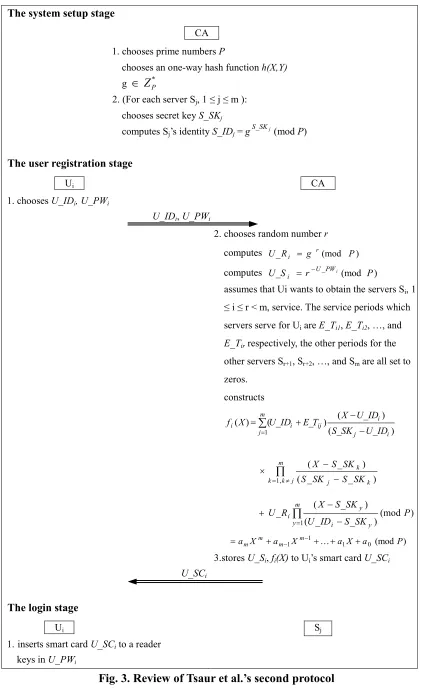
Tsauretal.’ssecond protocol [13] consists of four stages. They are: (1)The system setup stage, (2)The user registration stage, (3)The login stage, and (4)The server authentication stage. We describe them as follows and also depict it in Fig.3.
(1) The system setup stage
The CA selects a large number P, publishes a generator g of *
P
hash functionh(X,Y),then it selects a secret keyS_SKjfor server Sjand computes Sj’s
identity asS_IDj= gS_SKj (modP), 1≤j≤m.
(2)The user registration stage
In this phase, assume that a new user Uiwants to register at the m servers S1, S2,…,
and Smin a multi-server system. The entire registration process is described as follows (also shown in Fig. 3):
˙ Uichooses his identityU_IDiand passwordU_PWiand transmits them to CA.
˙ CA randomly chooses a numberr, larger than 160 bits for Ui, and computes Ui’s two secret keys as follows:
) (mod P g
R _
U i r
) (mod
_S r _ P
U U PWi
i
˙ CA supposes that Uiwants to obtain the service of one server Siamong all of the servers, 1 ≤i ≤r < m. Assume that the service periods which serves for Ui is E_Ti1,E_Ti2, …,and E_Tir respectively. The other periods for the other servers
Sr+1, Sr+2, …,and Sm are all set to zeros. CA then uses Sj’s secret key S_SKj to
construct a Lagrange interpolating polynomial functionfi(X)for Uias follows:
m
j k
k j k
k
i j
i ij
m
j i
i
SK S SK S
SK S X ID
U SK S
ID U X T
E ID U X
f
, 1
1 ( _ _ )
) _ (
) _ _
(
) _ (
) _ _
( ) (
) (mod ) _ _
(
) _ (
_ 1
N SK
S ID U
SK S X R
U m
y i y
y i
) (mod 0 1 1
1X a X a N
a X
am m m m
˙ CA then stores U_Si and fi(X) in Ui’s smart card U_SCi secret data space, and
sends it to Uivia a secure channel.
(3)The login stage
In this phase, when a registered user Ui wants to login to server Sj, it inserts his smart card U_SCi to the reader and keys in his U_PWi. Then, Ui performs the
˙ U_SCigets a timestamptfrom the system, and computes r(U_Si)U_PWi . Then,
it generates a secret random numberr1and computesC1,C2andp asfollows.
) (mod
1
1 g P
C r
) (mod ) , ( 1 1
2 r r h C t P
C
) (mod )
_
(S ID 1 P
p r
j
˙ Given 1, 2,…,m, andp,U_SCicomputesfi(1),fi(2),…,fi(m), andfi(p). Then, it
constructs an authentication messageM= {U_IDi,t,C1,C2,fi(1),fi(2),…,fi(m),
fi(p)} and sends it to Sj, 1≤j≤m.
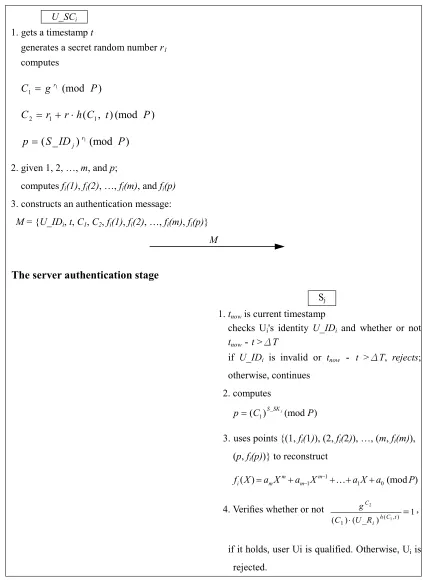
(4)The server authentication stage
In this phase, When Sj receives the authentication message from Ui, Sj obtains a current timestamptnow from his system and performs the following steps to verify the
login message from Ui:
˙Checks Ui's identity U_IDi and whether or not tnow - t >ΔT. If both hold, Sj
computes
) (mod )
(C1 _ P
p S SKj
˙uses the received m + 1 points {(1,fi(1)), (2,fi(2)),…,(m,fi(m)), (P,fi(P))} from
U_IDito reconstruct the interpolating polynomial
) (mod )
( 1 1 0
1X a X a N
a X a X
f m
m m m
i .
˙Checks to see whether 1 )
_ ( )
( 1 ( 1, )
2
h C t
i C
R U C
g , if it holds, user Uiis qualified.
Otherwise, Uiis rejected. The verification formula is shown as follows.
) , ( *
) , ( *
) , (
1 1 1
1 1
1 2
) _ ( )
( r r h C t
t C h r r
t C h i C
g g
g R
U C
g
) , ( *
) , ( *
1 1
1 1
t C h r r
t C h r r
g g
) (mod
1 P
The system setup stage
CA 1. chooses prime numbersP
chooses an one-way hash functionh(X,Y) g ZP*
2. (For each server Sj, 1≤j≤m ):
chooses secret keyS_SKj
computes Sj’s identityS_IDj=gS_SKj(modP)
The user registration stage
Ui CA
1. choosesU_IDi, U_PWi
U_IDi,U_PWi
2. chooses random numberr computes U_Ri g r(mod P)
computes U_S r U_PWi (mod P)
i
assumes that Ui wants to obtain the servers Si, 1
≤i≤r < m, service. The service periods which servers serve for UiareE_Ti1,E_Ti2,…,and
E_Tirrespectively, the other periods for the
other servers Sr+1, Sr+2,…,and Smare all set to
zeros. constructs
) _ _
(
) _ ( ) _ _ ( ) (
1 j i
i ij
m
j i
i
ID U SK S
ID U X T E ID U X f
m
j k
k j k
k
SK S SK S
SK S X
,
1 ( _ _ )
) _ (
) (mod ) _ _
(
) _ ( _
1
P SK
S ID U
SK S X R
U m
y i y
y i
) (mod 0 1 1
1X a X a P
a X
a m
m m
m
3.storesU_Si,fi(X)to Ui’ssmartcard U_SCi
U_SCi
The login stage
Ui Sj
1. inserts smart cardU_SCito a reader
keys inU_PWi
U_SCi
1. gets a timestampt
generates a secret random numberr1
computes
) (mod
1
1 g P
C r
) (mod ) , ( 1 1
2 r r h C t P
C
) (mod ) _
(S ID 1 P
p r
j
2. given 1,2,…,m, andp;
computesfi(1),fi(2),…,fi(m), andfi(p)
3. constructs an authentication message:
M= {U_IDi,t,C1,C2,fi(1),fi(2),…,fi(m),fi(p)}
M
The server authentication stage
Sj
1.tnowis current timestamp
checks Ui's identity U_IDi and whether or not
tnow-t>ΔT
if U_IDi is invalid or tnow - t >ΔT, rejects;
otherwise, continues 2. computes
) (mod )
( _
1 P
C p S SKj
3. uses points {(1,fi(1)), (2,fi(2)),…,(m,fi(m)),
(p,fi(p))} to reconstruct
) (mod )
( 1 1 0
1X aX a P
a X a X
f m
m m m
i
4.Verifies whether or not 1 )
_ ( )
( ( ,)
1 1
2
hC t i C
R U C
g ,
if it holds, user Ui is qualified. Otherwise, Uiis
rejected.
Fig. 3-continued Review ofTsauretal.’ssecond protocol
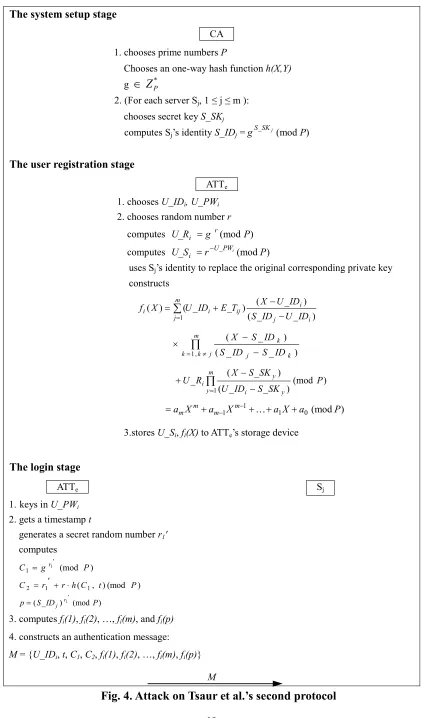
(B) Attackon Tsauretal.’ssecond protocol
Fig.4). In the following, we will describe that there exists a weakness inTsauretal.’s
second protocol. Since that a malicious adversary ATTe can successfully launch an attack shown as follows.
(1) Assume that there is a malicious attacker ATTe wants to disguise as user Ui, who is a legal user recorded in the system, to login to Sj. Before the login stage, ATTe purchases a smart card and pretends to be CA to prepare the needed parameters for being stored in his card for the login stage. ATTeperforms as follows.
˙ EntersU_IDi, randomly chooses a passwordU_PWi and a numberr larger than
160 bits, and computes Ui’s two secrets as follows.
) (modP g
R _
U i r
) (mod _
P r
_S
U U PWi
i
˙ Then, it acts as CA. Though, ATTe does not know each server’s private key, it knows these servers’identities. Therefore, it can use each server’s identity to replace the original corresponding private key in the computation of fi(X) as
shown in the following equation, Equation (4).
m
j k
k j k
k
i j
i ij
m
j i
i
ID S ID S
ID S X ID
U ID S
ID U X T
E ID U X
f
, 1
1 ( _ _ )
) _ (
) _ _
(
) _ (
) _ _
( ) (
) (mod ) _ _
(
) _ (
_ 1
P ID
S ID U
ID S X R
U m
y i y
y i
) (mod 0 1
1
1X a X a P
a X
am m m m
…………Equation (4)
(2) In login stage, when ATTe wants to login to server Sj, it performs the following steps:
˙ ATTe gets a timestamp t from the system, then it generates a secret random
numberr1’,and computesC1,C2, andpas follows:
) (mod
1
1 g P
C r
) (mod ) , ( 1 1
2 r r h C t P
) (mod )
_
(S ID 1 P
p j r
˙ Then, ATTe computes fi(1), fi(2),…,fi(m), and fi(p) and sends an authentication
messageM= {U_IDi,t,C1,C2,fi(1),fi(2),…,fi(m),fi(p)} to the server Sj.
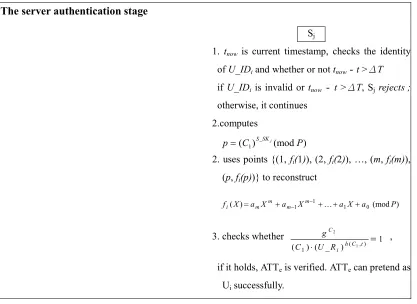
(3)The server authentication stage
When receiving the authentication message from ATTe, Sj records the current timesatamp in tnow. He then performs following verification steps to authenticate
ATTe.
˙checks ATTe's inentity U_IDi and whether or not tnow - t >ΔT. If both hold, Sj
computes
) (mod )
(C1 _ P
p S SK j
.
˙uses the received m + 1 points {(1,fi(1)), (2,fi(2)),…,(m,fi(m)), (p,fi(p))} from
ATTeto reconstruct the interpolating polynomial
) (mod )
(X a X a 1X 1 a1X a0 P
fi m m m m .
˙verifies whether or not 1 )
_ ( )
( 1 ( 1, )
2
h C t
i C
R U C
g , if it holds, ATTeis
authentic.
Obviously, ATTecan pretend as Uisuccessfully. Since the computation result of the verification is doomed to equal 1 as shown in the following equation, Equation (5).
) , ( *
) , ( *
) , (
1 1 1
1 1
1 2
) _ ( )
( r r h C t
t C h r r
t C h i C
g g
g R
U C
g
) , ( *
) , ( *
1 1
1 1
t C h r r
t C h r r
g g
) (mod 1 P
The system setup stage
CA 1. chooses prime numbersP
Chooses an one-way hash functionh(X,Y) g ZP*
2. (For each server Sj, 1≤j≤m ):
chooses secret keyS_SKj
computes Sj’s identityS_IDj=gS_SKj(modP)
The user registration stage
ATTe
1. choosesU_IDi, U_PWi
2. chooses random numberr computes U_Ri g r(modP) computes U_S r U_PWi(modP)
i
uses Sj’sidentity to replacethe original corresponding private key
constructs
) _ _
(
) _ ( ) _ _
( ) (
1 j i
i ij
m
j i
i
ID U ID S
ID U X T E ID U X
f
m
j k
k j k
k
ID S ID S
ID S X
,
1 ( _ _ )
) _ (
) (mod ) _ _
(
) _ ( _
1
P SK
S ID U
SK S X R
U m
y i y
y i
) (mod 0 1 1
1X a X a P
a X
am mm m
3.storesU_Si,fi(X)to ATTe’sstoragedevice
The login stage
ATTe Sj
1. keys inU_PWi
2. gets a timestampt
generates a secret random numberr1'
computes
) (mod
1
1 g P
C r
) (mod ) , ( 1 1
2 r r h C t P
C
) (mod ) _
(S ID 1 P
p r
j
3. computesfi(1),fi(2),…,fi(m), andfi(p)
4. constructs an authentication message: M= {U_IDi,t,C1,C2,fi(1),fi(2),…,fi(m),fi(p)}
M
The server authentication stage
Sj
1. tnow is current timestamp, checks the identity
ofU_IDiand whether or nottnow-t>ΔT
if U_IDiis invalid ortnow - t>ΔT, Sjrejects ;
otherwise, it continues 2.computes
) (mod )
(C1 _ P p SSKj
2. uses points {(1,fi(1)), (2,fi(2)),…,(m,fi(m)),
(p,fi(p))} to reconstruct
) (mod )
(X a X a 1X 1 a1X a0 P
f m
m m m
i
3. checks whether 1
) _ ( )
( ( ,)
1 1
2
h C t i C
R U C
g ,
if it holds, ATTeis verified. ATTecan pretend as
Uisuccessfully.
Fig. 4-continued Attack onTsauretal.’ssecond protocol
4. Conclusion
In this paper, we present the security analysis of Tsauretal.’stwo smart card based password authentication protocols in multi-server environments. Our results show that they are both vulnerable and suffer from the impersenation attack which we have described in this article.
References
[1] A.K.Awasthiand S.Lal“An enhanced remoteuserauthentication scheme using smart cards, ”IEEE Trans. Consumer Electron., vol. 50, No. 2, pp. 583-586, May 2004.
[2] C.K. Chan, L.M. Cheng,“Cryptanalysis of a remote user authentication scheme using smarts cards,“IEEE Transactions on Consumer Electronics,vol. 46, no 4, pp. 992–993, 2000.
[3] C.C.Chang,T.C.Wu,“Remote password authentication scheme with smart cards, ”IEE Proceedings-Computers and Digital Techniques,vol. 138, issue 3, pp.165–168, 1991.
[5]T.Hwang,Y.Chen,and C.S.Laih,“Non-interactive password authentications without password tables, ”IEEE Region 10 Conference on Computer and Communication Systems, IEEE Computer Society,Vol. 1, pp.429–431, 1990. [6] M.S.Hwang and L.H.Li,“A new remoteuserauthentication schemeusing
smart cards, ”IEEE Transactions on Consumer Electronics, vol.46, no.1, pp. 28-30, Feb. 2000.
[7] L. Lamport, “Passwordauthentication with insecure communication, ”
Communications of the ACM,Vol. 24, No. 11, pp. 770-772, Nov. 1981.
[8] K. C. Leung, L. M. Cheng, A. S. Fong and C. K. Chan, “Cryptanalysis of a modified remote user authentication scheme using smart cards, “IEEE Trans. Consumer Electron.,vol. 49, No. 4, pp. 1243-1245, Nov. 2003.
[9] R.L.Rivest,A.Shamir,and L.M.Adleman,“A Method forObtaining Digital
Signatures and Public-Key Cryptosystems,”Communications of the ACM,Vol. 21, No. 2, pp. 120-126, Feb. 1978.
[10] A. Shamir,“How to share a secret,“Communications of the ACM,Vol. 22, issus 11, pp. 612–613, Nov. 1979.
[11] J.J. Shen, C. W. Lin and M. S. Hwang, “A modified remote user authentication scheme using smart cards,”IEEE Trans. Consumer Electron.,vol. 49, No. 2, pp. 414-416, May 2003.
[12] W.J. Tsaur, C.C. Wu, W.B. Lee, “A smart card-based remote scheme for password authentication in multi-server Internet services,“Computer Standards & Interfaces,Vol. 27, No. 1, pp. 39-51, November 2004.