An Improved Differential Fault Attack on Camellia
∗ZHAO Xin-jie, WANG Tao
(Department of Computer Engineering, Ordnance Engineering College, Shijiazhuang 050003, China)
Abstract: The S-box lookup is one of the most important operations in cipher algorithm design, and also is the most effective part to
prevent traditional linear and differential attacks, however, when the physical implementation of the algorithm is considered, it becomes the weakest part of cryptosystems. This paper studies an active fault based implementation attack on block ciphers with S-box. Firstly, it proposes the basic DFA model and then presents two DFA models for Feistel and SPN structure block ciphers. Secondly, based on the Feistel DFA model, it presents several improved attacks on Camellia encryption and proposes new attacks on Camellia key schedule. By injecting one byte random fault into the r-1th round left register or the the r-1th round key, after solving 8 equations to recover 5 or 6 propagated differential fault of the rth round left register, 5 or 6 bytes of the rth equivalent subkey can be recovered at one time. Simulation experiments demonstrate that about 16 faulty ciphertexts are enough to obtain Camellia-128 key, and about 32, 24
ciphertexts are required to obtain both Camellia-192/256 key with and without FL/FL-1 layer respectively. Compared with the previous study by ZHOU Yongbin et. al. by injecting one byte fault into the rth round left register to recover 1 equivalent subkey byte and obtaining Camellia-128 and Camellia-192/256 with 64 and 96 faulty ciphertexts respectively, our attacks not only extend the fault location, but also improve the fault injection efficiency and decrease the faulty ciphertexts number, besides, our DFA model on Camellia encryption can be easily extended to DFA on Camellia key schedule case, while ZHOU’s can not. The attack model proposed in this paper can be adapted into most of the block ciphers with S-boxes. Finally, the contradictions between traditional cryptography and implementation attacks are analyzed, the state of the art and future directions of the DFA on Block ciphers with S-boxes are discussed. Key words: Implementation attack; Differential fault analysis; S-box lookup; Feistel structure; SPN structure; Camellia; Block cipher
Key schedule
1
Introduction
1.1 Related Works
Cryptology is the science that studies how to hide confidential information. Cryptology comprises of two complementary fields. Cryptography is the study and the practice of hiding information through designing ciphers and protocols, while cryptanalysis is the study of methods to obtain knowledge from hidden information. Traditionally speaking, ciphers are designed so that by observing only the input and output of the algorithm it is computationally infeasible to break the cipher, or equivalently determine the secret key used in encryption and decryption. Thus, the algorithm itself does not leak enough useful information during its operation to compromise security. With the development of Cryptography and Cryptanalysis, both the key length and algorithm complexity of cipher have been greatly improved, so it’s very difficult to compromise it through mathematically analysis. However, when a physical implementation of the algorithm is considered, additional information like timing of the circuit implementing the algorithm, behavior as a result of internal faults[2], power consumption[3], electromagnetic emanation[4], and acoustic effects[5] can provide enough information to compromise the security of the system. Attacks based on the use of this implementation specific information are known as Implementation Attacks (IMA), and they are quite effective, most of the ciphers are facing serious challenges. New directions for Cryptology are emerged to Implementation Cryptography and Implementation Cryptanalysis. The attacks present in this paper use Fault Cryptanalysis of block cipher.
The idea of fault attack was first suggested in 1997 by Boneh, DeMillo and Lipton[2], which makes use of the faults during the execution of a cryptographic algorithm. Under the idea, the attack was successfully exploited to break an RSA-CRT with both a correct and a faulty signature of the same message. Shortly after, Biham and Shamir proposed an attack on secret key cryptosystems called Differential Fault Analysis (DFA)[6], which combined the ideas of fault attack and differential attack. DFA attacks are based on deriving information about the secret key by examining the differences between ciphers resulting from correct operations and faulty operations. Since the presentation of DFA, many research papers have been published on using this cryptanalysis technique to successfully attack various cryptosystems, including ECC[7], 3DES[8], AES[9][10][11][12][13][14][15], Camellia[16], ARIA[17], CLEFIA[18][19],SMS4[20][21][22],
RC4[23][24] Trivium[25][26] and so on.
Camellia is a 128-bit block cipher jointly developed by NTT and Mitsubishi Electric Corporation in 2000[28]. It is chosen as a recommended algorithm by the NESSIE (New European Schemes for Signatures, Integrity and Encryption) project in 2003[29] and is certified as the IETF (Internet Engineering Task Force) standard cipher for XML security URIs, SSL/TLS cipher suites and IPsec in 2005[30][31][32]. In March 2009, Camellia is integrated into the OPENSSL-1.0.0-beta1[32], which is the most widespread cryptographic library of the world. The first and only fault attack on Camellia as we have known is proposed by ZHOU Yongbin et. al. [16], they inject single byte fault to the 18th ,17th ,16th, 15th round of Camellia encryption left registers, finally, under ideal conditions, Camellia-128 key can be recovered with 64 faulty ciphertexts, and Camellia-192/256 key can be retrieved with 96 faulty ciphertexts. Their attack assume that only full 8 bytes of one Camellia round left registers have been injected fault twice, an equivalent subkey can be retrieved, thus at least 16 ciphertexts is needed to recover one round equivalent subkey. Recovering Camellia-128 needs at least 4 round equivalent subkeys, and Camellia-192/256 needs at least 6 round equivalent subkeys, so at least 64 and 96 ciphertexts are needed for recovering Camellia-128 and Camellia-192/256 key respectively. In practical, more than 16 ciphertexts are needed to recover one round equivalent subkey, so in all, the attacker needs far more than 64 and 96 ciphertexts to recover Camellia-128 and Camellia-192/256 key.
1.2 Our Contributions
The contributions of our work can be summarized as follows:
(1) Propose the basic differential fault attack model and present two DFA models for Feistel and SPN structure block ciphers. The root of the DFA on block cipher with S-box lies in S-box itself, as long as the input and out differential value is known or analyzed by the adversary, it’s quite easy for the adversary to recover the S-box input value, and combing certain analysis methods, the secret key can be recovered. We summarize the basic DFA model into the problem of computing the input and output differential value of the S-box lookups, and according to whether the input differential is known or unknown, present two DFA models for Feistel and SPN structures for block ciphers with S-box respectively. The proposed DFA model can be adapted into most of the block ciphers with S-box, such as AES, ARIA, CLEFIA , SMS4 etc.
(2) Present several improved differential fault attacks on Camellia encryption and extend these attacks to DFA on Camellia key schedule case.
Unlike attacks in [16] by injecting one byte fault into the rth Camellia round left register to recover 1 byte of the rth round equivalent key, we inject single byte fault into the r-1th Camellia round left register or the r-1th round key. Thanks to the Camellia permutation operation feature, one byte fault before the r-1th round S function can propagate 5 or 6 faulty bytes of the rth round. We find out that, after solving 8 equations, it’s possible to recover these 5 or 6 faulty input differential values of the rth round, so 5 or 6 of the rth round equivalent key bytes can be obtained by one time. Extensive experimentations have been performed on a PC and on average 4 faulty ciphertexts are enough to recover one round equivalent key, 16 faulty ciphertexts are enough to recover Camellia-128 key. Due to the non-regularity feature of the FL and FL-1 layer, it’s quite complicated to recover the 13th round equivalent key by injecting fault into the 12th round before the last FL and FL-1 layer, so after injecting one byte fault to the 17th,16th,15th,14th,13th round, about 20 faults are enough to recover last 5 round equivalent key and limited candidates for 4 bytes of the 13th round equivalent key, in order to recover the full 13th round equivalent key, at most 12 extra times single byte fault are need to injected into the 13th round, the total fault number for recovering Camellia-192/256 key is about 32. If attacking the Camellia without FL and FL-1 layer, our attack needs about 24 faulty ciphertexts to recover full Camellia-192/256 key. It’s clear to see that our attack needs far less faulty ciphertexts than [16], one byte fault before the r-1th round permutation is usually related with 5 or 6 rth round equivalent key by DFA, and about random 4 faulty bytes can affect each of the 8 rth round equivalent key bytes twice. This is much more effective than [16], which need to inject each of the 8 bytes before the rth permutation for strictly twice. Table 1 demonstrates the improvement of our attacks over previous works.
Table 1. Improvement of our attacks over previous Camellia DFA work
Attack Camellia Fault Type Fault Location FL/FL-1 Fault
No [16] Camellia-128 18th,17th,16th,15th encryption round L
17, L16, L15, L14 ⅹ/√ 64
[16] Camellia-192/256 18th,17th,16th,15th,14th,13th encryption round L
17, L16, L15, L14, L13, L12 ⅹ/√ 96
Section 4.3 Camellia-128 17th,16th,15th,14th encryption round L
16, L15, L14, L13 ⅹ/√ 16
Section 4.4 Camellia-192/256 17th,16th,15th ,14th,13th,12th encryption round L
16, L15, L14 , L13, L12, L11 ⅹ 24
Section 4.4 Camellia-192/256 17th,16th,15th,14th,13th encryption round L
16, L15, L14, L13, L12 √ 32
Section 4.5 Camellia-128 Camellia key schedule k17, k16, k15, k14 ⅹ/√ 16
Section 4.5 Camellia-192/256 Camellia key schedule k17, k16, k15, k14, k13, k12 ⅹ 24
(3) Analyze the contradictions between traditional cryptography and implementation attacks, discuss the state of the art and possible future directions of the differential fault attack on Block ciphers with S-boxes.
some possible future directions of DFA on block ciphers with S-box.
1.3 Organization
This paper is organized as follows: Section 2 briefly describes preliminaries on Fault attack and Camellia. Section 3 presents the basic DFA model and how it can be used into SPN and Feistel block ciphers. Based on the Feistel DFA model, Section 4 presents several improved attacks on Camellia encryption, and then extends these attacks into DFA on Camellia key schedule case. Section 5 discusses on the contradictions between traditional cipher design and implementation attacks, makes some analysis on the state of the art and future directions of the DFA on Block ciphers with S-boxes, Section 6 is the conclusion.
2
Preliminaries
2.1 Fault Analysis
Fault Analysis is an active attack against the implementation of security modules. In the context of cryptanalysis, fault analysis aims to disturb the computation of a cryptographic algorithm in such a way that an erroneous result is obtained. By applying mathematical cryptanalysis these erroneous results can be used to extract cryptographic key material.
Generally speaking, fault attack is composed with two steps: fault injection and fault exploitation.
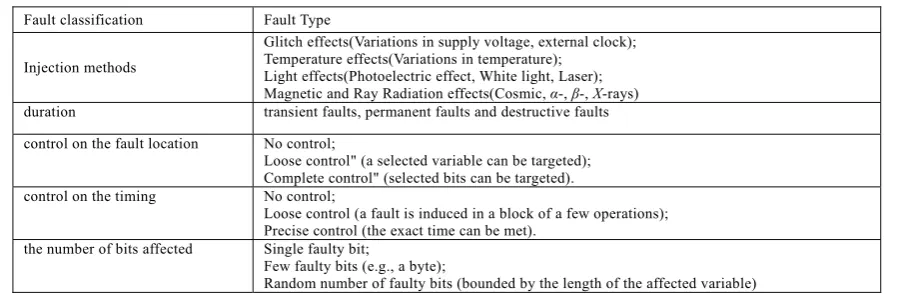
1 Fault injection: It mainly focuses on how to inject faults into the cryptographic devices during the encryption or decryption process on a proper time and location, its implementation and effects strongly depend on the fault injection equipment. Table 2 demonstrates the fault types according to different classifications. How to induce the specific types of faults is, however, not covered in this paper. The fault used in this paper adopts byte oriented fault model by computer simulations.
Table 2. Fault types
Fault classification Fault Type
Injection methods
Glitch effects(Variations in supply voltage, external clock); Temperature effects(Variations in temperature);
Light effects(Photoelectric effect, White light, Laser); Magnetic and Ray Radiation effects(Cosmic, α-, β-, X-rays) duration transient faults, permanent faults and destructive faults
control on the fault location No control;
Loose control" (a selected variable can be targeted); Complete control" (selected bits can be targeted).
control on the timing No control;
Loose control (a fault is induced in a block of a few operations); Precise control (the exact time can be met).
the number of bits affected Single faulty bit;
Few faulty bits (e.g., a byte);
Random number of faulty bits (bounded by the length of the affected variable)
2 Fault exploitation: It mainly focuses on how to make full use of the generated faults and use certain analysis methods to retrieve partial or full secret key, it depends on both the injected fault type and cipher algorithms. In most cases, fault exploitation usually combines traditionally cryptanalysis methods such as differential and collision methods. Classical fault exploitation methods include: differential fault analysis (DFA), floating fault analysis (FFA), collision fault analysis (CFA), and ineffective fault analysis (IFA). In this paper, we mainly focus on DFA methods.
2.2 Camellia
A full description of the Camellia cipher is provided in[27][28], but below is a brief description of the cipher’s properties that are utilized in this study.
Encryption Procedure:
Camellia is an iterated cipher. Camellia takes a 128-bit plaintext P as input, and has a total of N rounds, where N is 18 for Camellia-128, and 24 for Camellia-192/256. Camellia-128(192/256) requires 22(29) rounds of data processing composed of three main parts: an 18(24)-round Feistel structure, two (three) FL function and FL-1 function rounds are inserted every 6 rounds, and two input/output whitenings. In the first and last round, the 128-bit data block is XORed with 128-bit round keys. Before the data block is fed to the Feistel network, it is separated into two 64-bit data blocks. The left half goes into the F function together with the 64-bit round key and the output of the F function is XORed with the right half block. At the end of each round, the right and left half block will be exchanged. In the F function, the input 64-bit data is first XORed with the 64-bit round key and then grouped into eight 8-bit data blocks. All of them are separately input to 8 S-boxes.
Let r be the number of the rounds of Camellia. Let Lr-1 and Rr-1 be the left and the right halves of rth round inputs, and kr be rth
1 1
( , )
r r r r
r r
L R F L k R L
− −
= ⊕
⎧
⎨ =
⎩ (1)
The round function F of Camellia is defined as
64 64 64
2 2 2
(64) (64) (64 (64) (64)
:
( , ) ) ( ( )
F F F F
X k Y P S X k
× →
→ = ⊕ ) (2)
The S function comprises 8 S-boxes, and 4 different types S-boxes s0, s1, s2, s3 are used(where s1, s2, s3 are variations of s0). The P function {0,1}64→{0,1}64 maps input(z0, z1,…, z7) to output (z0’, z1’,…, z7’).
0 0 2 3 5 6 7 4 0 1 5 6 7
1 0 1 3 4 6 7 5 1 2 4 6 7
2 0 1 2 4 5 7 6 2 3 4 5 7
3 1 2 3 4 5 6 7 0 3 4 5 6
' , '
' , '
' , '
' , '
z z z z z z z z z z z z z z z z z z z z z z z z z z z z z z z z z z z z z z z z z z z z z z z z z z z z
= ⊕ ⊕ ⊕ ⊕ ⊕ = ⊕ ⊕ ⊕ ⊕
= ⊕ ⊕ ⊕ ⊕ ⊕ = ⊕ ⊕ ⊕ ⊕
= ⊕ ⊕ ⊕ ⊕ ⊕ = ⊕ ⊕ ⊕ ⊕
= ⊕ ⊕ ⊕ ⊕ ⊕ = ⊕ ⊕ ⊕ ⊕
(3)
In Camellia, the FL and FL-1 functions inserted every 6 rounds are used to provide non-regularity between the rounds so that the security of the cipher is increased and these two functions are similarly constructed by logical operations including AND, OR, XOR, and rotations.
Key Schedule:
Fig.1 shows the key schedule of Camellia. Two 128-bit variables KL and KR are defined as follows. For 128-bit keys, the 128-bit key K
is used as KL and KR is 0. For 192-bit keys, the left 128-bit of the key K is used as KL, and concatenation of the right 64-bit of K and the
complement of the right 64-bit of K is used as KR. For 256-bit keys, the left 128-bit of the key K is used as KL and the right 128-bit of K
is used as KR. Two 128-bit variables KA and KB are generated from KL and KR. Note that KB is used only if the length of the secret key is
192 or 256 bits. The 64-bit constants ∑i (i = 1, 2, …, 6) are used as “keys” in the Feistel network. The 64-bit sub-keys kwt, ku, and klv are
generated from KL, KR, KA, and KB. The sub-keys are generated by rotating KL, KR, KA, and KBfor a specific number of bits and taking
the left or right-half of them.
Fig.1 key schedule of Camellia
3
DFA Attack Model
3.1 Basic DFA Model
A lot of work have done on differential fault attacks, but seldom of them have explained the deeply roots of differential fault attack on block cipher with S-box. In this section, we try to analyze differential fault attack by a more straight and simple way.
[ ]
[
]
S a
⊕
S a
⊕ Δ = Δ
a
c
(4)Usually, the output of the S function S[] usually has an extra output whitenings by Xored the last round key Kl to generate the
ciphertexts C. As C is known, once a or S[a] is known, Kl can be easily recovered.
According to whether ∆a is known or unknown, there are two subcases: ∆a is known or unknown, and based on the solutions to these two cases, two DFA models for Feistel and SPN block ciphers can be generated.
3.2 Feistel Structure Block Cipher DFA Model
If ∆a is known, this case is usually related with Feistel structure block cipher. Fig.2 is the Feistel structure block cipher fault attack model, if we inject one byte fault ∆a into Lr-1, due to the feature of Feistel structure, the differential value of Lr-1 is not changed, so after analyzing the differential value of CL, we can get ∆a, after analyzing the differential value of CR, we can get the output differential
value ∆c.
Fig.2 Feistel structure block cipher fault model
The only unknown variable is a, if we input every possible value of a into formula (4), we can get the possible candidates of a, usually, these candidates number is limited. Fig.3 is the S-box and differential S-box (∆=1) of Camellia sorted descending, the gray square denotes candidates of S-box, and the white square denotes the impossible candidates of S-box. It’s clear to see that the Camellia S-box S has covered with every distinct candidate value from 0x00 to 0xff (total number is 256), every candidate is used only once. However, when it comes to the differential S-box S’(S’[i]=S[i]⊕S[i⊕∆], ∆=0x01), the new S-box S’ is not perfect as S, S’ hasn’t covered with every distinct candidate value from 0x00 to 0xff(total number is 127), usually every possible candidate of S’ is used twice or more. As to Camellia differential S-box, every possible candidate of S’ is used about twice, so after we input every possible value of a into formula (4), usually, we can get 2 candidates of a, which means that we can also get 2 candidates for Camellia equivalent key.
8 1 8 9 19 A 1A B 1B C 1C D 1D E 1E F 1F 0 10 1 11 2 1 2 3 1 3 4 1 4 5 15 6 1 6 7 1 7 2 8 3 8 29 39 2A 3A 2B 3B 2C 3C 2D 3D 2E 3E 2F 3F 20 30 21 31 2 2 3 2 2 3 3 3 2 4 3 4 25 35 2 6 3 6 2 7 3 7
4 8 49 4A 4B 4C 4D 4E 4F 40 41 4 2 4 3 4 4 45 4 6 4 7
5 8 59 5A 5B 5C 5D 5E 5F 50 51 5 2 5 3 5 4 55 5 6 5 7
6 8 69 6A 6B 6C 6D 6E 6F 60 61 6 2 6 3 6 4 65 6 6 6 7
7 8 79 7A 7B 7C 7D 7E 7F 70 71 7 2 7 3 7 4 75 7 6 7 7
8 8 89 8A 8B 8C 8D 8E 8F 80 81 8 2 8 3 8 4 85 8 6 8 7
9 8 99 9A 9B 9C 9D 9E 9F 90 91 9 2 9 3 9 4 95 9 6 9 7
A8 A9 AA AB AC AD AE AF A0 A1 A2 A3 A4 A5 A6 A7
B 8 B9 B A B B B C B D B E B F B0 B 1 B 2 B3 B 4 B 5 B6 B 7
C 8 C9 C A C B C C C D C E C F C0 C 1 C 2 C3 C 4 C 5 C6 C 7
D8 D9 DA DB DC DD DE DF D0 D1 D2 D3 D4 D5 D6 D7
E 8 E9 EA EB EC ED EE EF E0 E 1 E2 E3 E4 E5 E6 E7
F8 F9 FA FB FC FD FE FF F0 F1 F2 F3 F4 F5 F6 F7
S-box distributions 8 1 8 9 19 A 1A B 1B C 1C D 1D E 1E F 1F 0 10 1 11 2 1 2 3 1 3 4 1 4 5 15 6 1 6 7 1 7 2 8 3 8 29 39 2A 3A 2B 3B 2C 3C 2D 3D 2E 3E 2F 3F 20 30 21 31 2 2 3 2 2 3 3 3 2 4 3 4 25 35 2 6 3 6 2 7 3 7
4 8 49 4A 4B 4C 4D 4E 4F 40 41 4 2 4 3 4 4 45 4 6 4 7
5 8 59 5A 5B 5C 5D 5E 5F 50 51 5 2 5 3 5 4 55 5 6 5 7
6 8 69 6A 6B 6C 6D 6E 6F 60 61 6 2 6 3 6 4 65 6 6 6 7
7 8 79 7A 7B 7C 7D 7E 7F 70 71 7 2 7 3 7 4 75 7 6 7 7
8 8 89 8A 8B 8C 8D 8E 8F 80 81 8 2 8 3 8 4 85 8 6 8 7
9 8 99 9A 9B 9C 9D 9E 9F 90 91 9 2 9 3 9 4 95 9 6 9 7
A8 A9 AA AB AC AD AE AF A0 A1 A2 A3 A4 A5 A6 A7
B 8 B9 B A B B B C B D B E B F B0 B 1 B 2 B3 B 4 B 5 B6 B 7
C 8 C9 C A C B C C C D C E C F C0 C 1 C 2 C3 C 4 C 5 C6 C 7
D8 D9 DA DB DC DD DE DF D0 D1 D2 D3 D4 D5 D6 D7
E 8 E9 EA EB EC ED EE EF E0 E 1 E2 E3 E4 E5 E6 E7
F8 F9 FA FB FC FD FE FF F0 F1 F2 F3 F4 F5 F6 F7
differential S-box distributions (△=1)
Fig.3 the S box and differential S box (∆=1) of Camellia sorted descending
3.3 SPN Block Cipher DFA Model
should relate with the same differential S-box, if these 7 output values are not in the differential S-box, we can eliminate ∆=1, using this technique, we can get limited candidates of ∆a (usually 2 for 7 output differential value), then case 2 can even be transferred into Case 1(∆a is known), finally, a can be recovered very efficiently.
Fig.4 SPN structure block cipher fault model
4
Improved DFA on Camellia
4.1 Basic assumptions and Notations
Assumptions:
(1) Only one byte random fault is induced into the memory registers storing the intermediate results in one fault induction. Considering that the round function of Camellia takes only the left-half of the intermediate values as input, only the random single-byte fault occurred in the memory registers of the left-half input needs to be taken into account. Notice that the attacker knows neither the location nor the concrete value of the fault.
(2) For any one plaintext adaptively selected, two different ciphertexts under the control of the same secret key are available, the right ciphertext and the faulty one. This assumption is realistic in practice, for considering the scenarios under which an adaptive chosen message attack is mounted.
(3) The faulty ciphertexts of the required type are presumably available. How to induce the specific fault is not covered in this paper, since this is not the main concern of our paper. Nevertheless, the attacker should be able to identify the required faulty ciphertexts from a mass of faulty ciphertexts and discard those with faults occurring at a wrong timing.
(4) Only one user key is used during one successfully attack.
Notations:
(1) Kr: The equivalent subkey for rth round, is the exclusive OR of the half of the post-whitening subkey and rth subkey specified by
Camellia algorithm specification, on the path from the corresponding half of the ciphertext to the input of the S-box of rth round, along the encryption flow in reverse order. In case of Camellia-128, for example, the equivalent subkey for 18th round is K
18=k18⊕kw3, K17=k17⊕kw4 for 17th round, K16=k16⊕kw3 for 16th round, K15=k15⊕kw4 for 15th round, K14=k14⊕kw3 for 14th round, and K13=k13⊕kw4 for 13th round..
(2) Lr-1, Rr-1 : the 64-bit left and right halves of the rth round inputs. (3) kr, Kr: the 64-bit rth round subkey and equivalent subkey.
(4)∆ILri, ∆IRri : the ith byte of the rth round left and right half input differential value.(i∈[0,7])
(5)∆OLri, ∆ORri: the ith byte of the rth round output differential value.(i∈[0,7])
(6)∆Sri, ∆Pri: the ith byte of the rth round S function and P function output differential value.(i∈[0,7])
(7)∆CLi, ∆CRi: the ith byte of the left and right half ciphertext differential value.(i∈[0,7])
(8) fault: If not specially stating, fault denotes the non-zero differential value besides the faulty ciphertext.
4.2 Former DFA on Camellia Encryption
ZHOU’s attack[16] is a generic attack based on model in Section 3.2. It’s main idea is to inject a single byte fault on L
r-1 and use DFA model of Section 3.2 to recover Kr. Specifically speaking, just take recovering K18 as an example, the adversary induces one byte fault ∆IL18 to L17, then after the S function, the input differential fault ∆IL18 istransferred into single byte fault ∆S18, then after the P function, 5 or 6 bytes of the output ∆P18 have the same fault as one byte of ∆S18, after the final swap and exclusive OR of kw3 and kw4, the ∆CL equals ∆IL18 and also is the input S function differential value, the ∆CR equals ∆P18 and also is the output S function differential value, by applying DFA methods in Section 3.2, the adversary can recover L17⊕k18, as L17⊕kw3=CL, finally, the 18th
method to 17th, 16th, 15th, the adversary can recover other three equivalent subkeys, and combing the key reversion techniques, the initial key can be recovered and verified.
4.3 Improved DFA on Camellia-128 Encryption 1 Main idea
The main idea of our DFA on Camellia is as follows:
(1) Induce one byte fault into the r-1th Camellia encryption round, and deduce equivalent subkey K
r.
(a) Choose any one plaintext P, and obtain the corresponding correct ciphertext C.
(b) Disturb the encryption of P until one byte random fault is successfully induced into only the input Lr-2 of the r-1th round, and obtain the corresponding faulty ciphertext C*.
(c) Deduce several bytes (5-6 bytes) of Kr using differential analysis technique.
(d) Repeat the above steps, until all bytes of Kr are recovered.
(2) Induce one byte fault into the r-2th Camellia encryption round, and deduce K
r-1. (a) Choose any one plaintext P, and obtain the corresponding correct ciphertext C.
(b) Disturb the encryption of P until one byte random fault is successfully induced into only the input Lr-3 of the r-2th round, and obtain the corresponding faulty ciphertext C*.
(c) Deduce several bytes(5-6 bytes) of Kr-1 using differential analysis technique. (d) Repeat the above steps, until all bytes of Kr-1 are recovered.
(3) Proceed in the same way and attack, in turn, the encryption of rounds r-3, r-4…, and deduce the equivalent subkeys Kr-2, Kr-3…., accordingly.
(4) Recover Camellia-128 key by analyze Kr-3, Kr-2, Kr-1,Kr by key reversion techniques, Camellia-192/256 key by analyze Kr-5, Kr-4,Kr-3,Kr-2,Kr-1, Kr.
(5) Verify the correctness of the recovered Camellia key.
2 Attack the 17th round to recover K18.
Attacking the 17 round to recover K18 is depicted in Fig.5, specific attacking procedures are as follows: (1) Choose randomly plaintext P and obtain the correct ciphertext C under the secret key K.
(2) Induce one random byte fault ∆IL17 into L16, and obtain the faulty ciphertext C*. The faulty propagate procedure is as follows:
(a) The 17th round: When one random single byte fault ∆IL
17 is injected into L16, suppose the faulty index is 0, so ∆IL170≠0, ∆IL17i=0 (i∈[1,7]) then after the 17th round S function, the fault becomes ∆S170, after the 17th round P function, 5 bytes of fault were propagated (∆P170, ∆P171, ∆P172, ∆P174, ∆P177 in equitation (5)), but all of the 5 faulty values are equal to ∆S170, after the exclusive OR of R16, the left output differential equals ∆P17 (5 faulty bytes), and the right output differential equals ∆IL17 (1 faulty byte ∆IL170).
0 0 2 3 5 6 7 4 0 1 5 6 7
0 3 6 7 5 6
1 1 1 2
17
0 5 7
2 1 2 4
17 17 17 17 17 17 17 17 17 17 17 17 17
4 4
17 17 17 17 17 17 17 17 17 17 17 17
17 17 17 17 17 17 17 17
, , ,
P S S S S S S P S S S S S
P S S S S S S P S S S S S
P S S S S S S P
Δ = Δ ⊕ Δ ⊕ Δ ⊕ Δ ⊕ Δ ⊕ Δ Δ = Δ ⊕ Δ ⊕ Δ ⊕ Δ ⊕ Δ
Δ = Δ ⊕ Δ ⊕ Δ ⊕ Δ ⊕ Δ ⊕ Δ Δ = Δ ⊕ Δ ⊕ Δ ⊕ Δ ⊕ Δ
Δ = Δ ⊕ Δ ⊕ Δ ⊕ Δ ⊕ Δ ⊕ Δ Δ 6 2 3 5
17
3 5 6 7 0 3 5 6
1 2 4
3 17
4
17 17 17 17
4
17 17 17 17 17 17 , 17 17 17 17 17 17
S S S S S
P S S S S S S P S S S S S
= Δ ⊕ Δ ⊕ Δ ⊕ Δ ⊕ Δ
Δ = Δ ⊕ Δ ⊕ Δ ⊕ Δ ⊕ Δ ⊕ Δ Δ = Δ ⊕ Δ ⊕ Δ ⊕ Δ ⊕ Δ
7
7
(5)
(b) The 18th round: ∆IL
18 has the same 5 faulty bytes equal to ∆S170, ∆IR18 has only one faulty byte ∆IL170. After the 18th round S function, the faulty values become 5 differential value ∆S180, ∆S181, ∆S182, ∆S184, ∆S187, after the 18th round P function, the faulty differential values become 8 distinct differential value ∆P18, and after the exclusive OR of R17, the faulty values become 8 distinct differential value ∆OL18.
(c) The encryption output: After the 18th round, the output differential of C
L is equals ∆IL18, has 5 faulty value equal to ∆S170, and the output differential of CR is 8 distinct differential byte ∆OL18.
(3) Deduce the fault location.
Different fault locations injected into L16 can generate different indices sets of the fault CL, the relationship between faulty byte index i of L16 and faulty bytes indices of CL is shown in Table 3. According to this feature, the attacker can identify the fault location
injected into L16 and choose corresponding further analysis strategies below.
Table 3. Induced one byte fault into L16i Fault byte index i of L16 Faulty bytes indices of CL
i=0 0,1,2,4,7
i=1 1,2,3,4,5
i=2 0,2,3,5,6
Fault byte index i of L16 Faulty bytes indices of CL
i=4 1,2,3,5,6,7
i=5 0,2,3,4,6,7
i=6 0,1,3,4,5,7
i=7 0,1,2,4,5,6
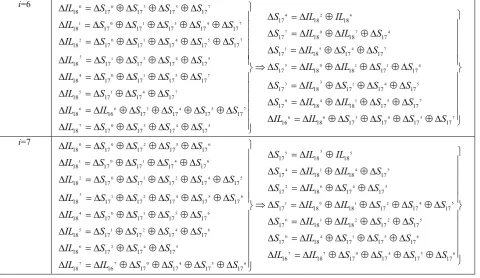
(4) Deduce ∆S18 and ∆IL170.
It’s easy to discover that 8 distinct differential value ∆OL18 is known to the attacker by analyzing CR⊕CR*, and 8 ∆OL18i value is generated by ∆S180, ∆S181, ∆S182, ∆S184, ∆S187 and ∆IL170. All of this can generate 8 equations, it’s quite simple to recover these 6 unknown differential value (∆S180, ∆S181, ∆S182, ∆S184, ∆S187 and ∆IL170) by equation (6).
0 0 0 2 7
0 7
1 1
0 7
2 1 2
1 2 3
0 7
4 1
5 1 2 7
6 2 7
18 17 18 18 18
4
18 18 18 18 18
4
18 18 18 18 18 18
4
18 18 18 18
18 18 18 18
4
18 18 18 18 18
4
18 18 18 18
OL IL S S S OL S S S S OL S S S S S OL S S S
OL S S S OL S S S S OL S S S
Δ = Δ ⊕ Δ ⊕ Δ ⊕ Δ
Δ = Δ ⊕ Δ ⊕ Δ ⊕ Δ
Δ = Δ ⊕ Δ ⊕ Δ ⊕ Δ ⊕ Δ
Δ = Δ ⊕ Δ ⊕ Δ
Δ = Δ ⊕ Δ ⊕ Δ
Δ = Δ ⊕ Δ ⊕ Δ ⊕ Δ
Δ = Δ ⊕ Δ ⊕ Δ
Δ
0 2 5
5 6
1
2 1 2
1 4
7 5
3
0 0 0 2
7 0
18 18 18
18 18 18
18 18 18
4
18 18 18
18 18 18
17 18 18 18 18
4
18 18 18
S OL OL S OL OL S OL OL S OL OL S OL OL
IL OL S S S OL S S
⎫ ⎪
⎫
Δ = Δ ⊕ Δ
⎪
⎪
⎪ Δ = Δ ⊕ Δ
⎪ ⎪
⎪
⎪ Δ = Δ ⊕ Δ
7
⎪⇒ ⎪
⎬ Δ = Δ ⊕ Δ ⎬
⎪ ⎪
⎪ Δ = Δ ⊕ Δ ⎪
⎪ ⎪
⎪ Δ = Δ ⊕ Δ ⊕ Δ ⊕ Δ ⎪⎭
⎪ ⎪
= Δ ⊕ Δ ⎭
(6)
(5) Recover 5 or 6 bytes of K18.
From step (4) we can recover 5 output differential faulty bytes of the 18thS function, as the input differential fault is 5 equal faulty byte value ∆S170. By applying the general DFA model of Section 3.2, it’s quite easy to recover 5 different S function input value, which can be expressed as L17i⊕k18i (i=0,1,2,4,7), as L17i⊕kw3i =CLi, CL is known to the attacker, so k18i⊕kw3i(i=0,1,2,4,7) can be recovered.
(6) Recover full 8 bytes of K18.
Repeat step (1)-(5) to recover full 8 bytes of K18. Note that after K18 is recovered, as every input 17th round S-box single byte fault ∆IL17 is recovered, and the output 17th round S-box differential value can be find out though ∆CL, using basic DFA on Camellia, the adversary can even recover several bytes of K17.
3 Attack the 16th round to recover K17.
Attacking the 16 round to recover K17 is depicted in Fig.6. Specific attacking procedures are as follows: (1) Choose randomly plaintext P and obtain the correct ciphertext C under the secret key K.
(2) Induce one random single byte fault ∆IL16 into L15, and obtain the faulty ciphertext C*. The faulty propagate procedure is as follows:
(a) The 16th round: When one random single byte fault ∆IL
160 is injected into L15, then after the 16th round S function, the fault becomes ∆S160, after the 16th round P function, 5 bytes of fault are propagated (∆P160, ∆P161, ∆P162, ∆P164, ∆P167), but all of the 5 faulty values are equal to ∆S160, after the exclusive OR of R15, the left output differential equals is ∆P16 (5 faulty bytes), and the right output differential is ∆IL16 (1 faulty byte ∆IL160).
(b) The 17th round: ∆IL
17 has the same 5 faulty bytes equal to ∆S160, ∆IR17 has only one faulty byte ∆IL160. After the 17th round S function, the faulty values become 5 differential value ∆S170, ∆S171, ∆S172, ∆S174, ∆S177, after the 17th round P function, the faulty differential values become 8 distinct differential value ∆P17, and after the exclusive OR of R16, the faulty values become 8 distinct differential value ∆OL17.
(b) The 18th round: ∆IL
18 is equal to 8 distinct differential byte value ∆OL17 , ∆IR18 is equal to ∆IL17(the same 5 faulty bytes equal to ∆S160). After the 18th round S function, the faulty values become 8 differential value ∆S18, after the 18th round P function, the faulty differential values become 8 distinct differential value ∆P18, and after the exclusive OR of R17, the faulty values become 8 distinct differential value ∆OL18.
(c) The encryption output: After the 18th round, the output differential of C
L is equals ∆IL18, and the output differential of CR
is equal to ∆OL18. (3) Deduce ∆IL17.
It’s easy to see that ∆IL17 was equal to ∆P18 Xor-ed with ∆OL18. ∆OL18 is equal to ∆CR and known to the attacker, all we need to do is to compute ∆P18. In order to compute ∆P18, we need to compute ∆S18, as CL, CL*is known, K18 is recovered by step 2, ∆S18 can be obtained by equation (7), and then ∆P18 can be obtained by equation (8).
∆S18i=S[CLi ⊕K18i] ⊕S[CL*i ⊕K18i] (7)
0 0 0 1
0
1 1 1
0
2 1
2 3 5 6 7 5 6
18 18 18 18 18 18 18 184 18 18 18 18 18
3 4 6 7 2 4 6 7
18 18 18 18 18 18 18 185 18 18 18 18 18
2 4 5 7
18 18 18 18 18 18 18 18
, , ,
P S S S S S S P S S S S S
P S S S S S S P S S S S S P S S S S S S P
Δ = Δ ⊕ Δ ⊕ Δ ⊕ Δ ⊕ Δ ⊕ Δ Δ = Δ ⊕ Δ ⊕ Δ ⊕ Δ ⊕ Δ
Δ = Δ ⊕ Δ ⊕ Δ ⊕ Δ ⊕ Δ ⊕ Δ Δ = Δ ⊕ Δ ⊕ Δ ⊕ Δ ⊕ Δ
Δ = Δ ⊕ Δ ⊕ Δ ⊕ Δ ⊕ Δ ⊕ Δ Δ
3 1 0
2 3 4 5 7
6 18 18 18 18 1
2 3 4 5 6 3 4 5 6
18 18 18 18 18 18 18 , 187 18 18 18 18 18
S S S S S
P S S S S S S P S S S S S
= Δ ⊕ Δ ⊕ Δ ⊕ Δ ⊕ Δ
Δ = Δ ⊕ Δ ⊕ Δ ⊕ Δ ⊕ Δ ⊕ Δ Δ = Δ ⊕ Δ ⊕ Δ ⊕ Δ ⊕ Δ
7
8
7
(8)
(4) Deduce the fault location.
Different fault locations injected into L15 can generate different indices sets of the fault ∆IL17, the relationship between fault byte index i of L15 and Faulty byte indices of ∆IL17 is identical with Table 3. According to this feature, the attacker can identify the fault location injected into L15 and choose corresponding further analysis strategies below.
(5) Deduce ∆S17 and ∆IL160.
From (3) we can recover 5 input differential faulty bytes of the 17thS function ∆IL
17, in order to recover the 5 differential S function input value, we also need to recover ∆S17. In order to recover ∆S17 and ∆IL160, we need to know about ∆IL18, it’s easy to discover that ∆IL18 is also equal to the output differential of CL. After solving the equation (9), ∆S17 and ∆IL160 can be recovered.
0 0 0 2 7
0 7
1 1
0 7
2 1 2
3 1 2
0 7
4 1
5 1 2 7
6 2 7
18 16 17 17 17
4
18 17 17 17 17
4
18 17 17 17 17 17
4
18 17 17 17
18 17 17 17
4
18 17 17 17 17
4
18 17 17 17
IL IL S S S IL S S S S IL S S S S S
IL S S S IL S S S IL S S S S IL S S S
Δ = Δ ⊕ Δ ⊕ Δ ⊕ Δ
Δ = Δ ⊕ Δ ⊕ Δ ⊕ Δ
Δ = Δ ⊕ Δ ⊕ Δ ⊕ Δ ⊕ Δ
Δ = Δ ⊕ Δ ⊕ Δ
Δ = Δ ⊕ Δ ⊕ Δ
Δ = Δ ⊕ Δ ⊕ Δ ⊕ Δ
Δ = Δ ⊕ Δ ⊕ Δ
Δ
0 2 5
5 6 1
2 1 2
1 4
3
7 5
0 0 0 2
7 0
17 18 18
17 18 18
17 18 18
4
17 18 18
17 18 18
16 18 17 17 17
4
18 17 17
S IL IL S IL IL S IL IL S IL IL S IL IL
IL IL S S S IL S S
⎫ ⎪
⎫
Δ = Δ ⊕ Δ
⎪
⎪
⎪ Δ = Δ ⊕ Δ
⎪ ⎪
⎪
⎪ Δ = Δ ⊕ Δ
⎪⇒ ⎪
⎬ Δ = Δ ⊕ Δ ⎬
⎪ ⎪
⎪ Δ = Δ ⊕ Δ ⎪
⎪ ⎪
⎪ Δ = Δ ⊕ Δ ⊕ Δ ⊕ Δ ⎪⎭
⎪ ⎪
= Δ ⊕ Δ ⎭
(9)
(6) Recover 5 or 6 bytes of K17.
(7) Recover full 8 bytes of K17.
Repeat step (1)-(6) to recover full 8 bytes of K17. Note that after K17 is recovered, as every input 16th round S-box single byte fault ∆IL16 is recovered, and the output 16th round S-box differential value ∆S16 (equals ∆IL17) can be recovered, using basic DFA on Camellia, the adversary can even recover several bytes of K16.
Fig.6 DFA model of attacking the Camellia 16th round to recover K17
4 Attack the 15th round to recover K16, Attack the 14 th
round to recover K15.
Proceed in the same way as step 3 and step 4 above to recover K15 and K16. Note that the key point is to find out input and output differential of the rth S-box, apply the DFA model of Section 3.2 to recover K
r. 5 Retrieve the initial Camellia-128 key.
From step 1 to 4, we can recover K15, K16, K17, K18. Learned from Camellia Specification[27], K15, K16, K17, K18 can be expressed as:
(10)
18
17 18 17
16 16 15
15
(
111)
(
111)
(
111)
(
111)
||
(
111) (
47)
(
111)
(
94)
||
(
111) (
30)
(
111)
(
94)
A L L R
A R L L A L
A L A R A A
A R A L
K
K
K
K
K
K
K
K
K
K
K
K
K
K
K
K
K
K
K
K
=
<<<
⊕
<<<
⎫
⎪
=
<<<
⊕
<<<
⎪ ⇒
=
<<<
⊕
<<<
⎫
⎬
⎬
=
<<<
⊕
<<<
⎪
=
<<<
⊕
<<<
⎭
⎪
=
<<<
⊕
<<<
⎭
16 15
18 17
(
||
)
17
(
47)
((
||
)
47) (
64)
A A
L A
K
K
K
K
K
K
K
K
<<<
=
⊕
<<<
⎫
⇒
⎬
=
>>>
⊕
<<<
⎭
follows:
KA Searching Algorithm: SearchingKA(SK,C)
unsigned char KP[128],cTemp SK←
ø
Foreach i from 0x00 to 0x01 {
KP[0] ←i
Foreach j from 0 to 127 {
cTemp ← (KP[(47*j)%128] ^ C[(47*j)%128])&0x01
If(j!=127)
KP[(47*(j+1))%128] ← cTemp; Else if(j==127)
{
If(cTemp==KP[0])
Add KP to SK
} } }
Using Algorithm above, we can get at most 2 candidates of KA, sometimes even directly just get the unique value of KA. After
that, using equation (10) above, it’s easy to recover KL, KL also has at most 2 candidates. 5 Verify the Camellia-128 key.
Using the plaintext and correct ciphertext, we can encrypt the plaintext with the prediction KL and verify it’s correctness by
comparison of the ciphertext with the correct ciphertext. Finally, the correct initial Camellia-128 key can be verified.
4.4 Improved DFA on Camellia-192/256 Encryption
1 Recover K13, K14, K15, K16, K17, K18
The improved DFA on Camellia-192/256 method is much like Camellia-128. Note that if the attacked Camellia algorithm doesn’t use FL and FL-1 layer, it’s possible to recover K
13, K14, K15, K16, K17, K18 using the same methods in Section 4.3. But if the attacked Camellia algorithm has FL and FL-1 layer, using the same methods in Section 4.3, it’s possible to recover K
14, K15, K16, K17, K18, K13 can be recovered by applying the DFA model of Section 3.2.
2 Retrieve the initial Camellia-192/256 key
(11)
18 17
18 17
16 15 14 13
(
111)
(
111)
(
111)
(
111)
||
(
111) (
47)
(
111)
(
94)
(
111)
(
94)
(
111)
(
94)
(
111)
(
94)
B L L R
B R L L
B L
B L A R
B R A L
B L R R
B R R L
K
K
K
K
K
K
K
K
K
K
K
K
K
K
K
K
K
K
K
K
K
K
K
=
<<<
⊕
<<<
⎫
⎪
=
<<<
⊕
<<<
⎪
=
<<<
⊕
<<<
⎪
=
<<<
⊕
<<<
⎪ ⇒
⎬
=
<<<
⊕
<<<
⎪
⎪
=
<<<
⊕
<<<
⎪
=
<<<
⊕
<<<
⎪⎭
16 15
14 13
16 15 14 13
18 17
||
(
111) (
30)
||
(
111) (
30)
||
||
( ((
),
5(64)),
6(64))
(
||
)
47 (
64)
B A
B R
A R
B A R
L B
K
K
K
K
K
K
K
K
K
K
K
K
K
K
F F K
K
K
K
K
K
⎫
⎪
=
<<<
⊕
<<<
⎬
⎪
=
<<<
⊕
<<<
⎭
⊕
=
⊕
⎫
⎪
⇒
=
⊕
⎬
⎪
=
>>>
⊕
<<<
⎭
∑
∑
((
) (
))>>>30
From equation (11), it’s clear to see that KA⊕KR can be recovered directly, as KA⊕KR, ∑5, ∑6 is known, it’s easy to compute KB,
finally, KL can be retrieved, and the initial Camellia-192/256 key can be obtained.
4.5 DFA on Camellia Key Schedule
The DFA model in Section 4.3,4.4 can be easily adopted into attacking the Camellia key schedule procedure. DFA on Camellia key schedule used in encryption is as follows:
(1) Induce one byte fault into kr-1 during the Camellia key schedule, after analyzing the faults propagated in the encryption procedure, deduce equivalent subkey Kr.
(b) Induce one byte fault into kr-1 during the Camellia key schedule, and obtain the corresponding faulty ciphertext C* of encrypting P.
(c) Deduce several bytes (5-6 bytes) of Kr using differential analysis technique.
(d) Repeat the above steps, until all bytes of Kr are recovered.
(2) Induce one byte fault into kr-2 during the Camellia key schedule, after analyzing the faults propagated in the encryption procedure, deduce Kr-1.
(a) Choose any one plaintext P, and obtain the corresponding correct ciphertext C.
(b) Induce one byte fault into kr-2 during the Camellia key schedule, and obtain the corresponding faulty ciphertext C* of encrypting P.
(c) Deduce several bytes(5-6 bytes) of Kr-1 using differential analysis technique. (d) Repeat the above steps, until all bytes of Kr-1 are recovered.
(3) Proceed in the same way and attack, in turn, kr-3, kr-4…, after analyzing the faults propagated in the encryption procedure, deduce the equivalent subkeys Kr-2, Kr-3…., accordingly.
(4) Recover Camellia-128 key by analyze Kr-3, Kr-2, Kr-1,Kr by key reversion techniques, Camellia-192/256 key by analyze Kr-5, Kr-4,Kr-3,Kr-2,Kr-1, Kr.
(5) Verify the correctness of the recovered Camellia key.
This attack model of this Section is much alike Section 4.3,4.4, so we just take attacking the K18 as an example to explain it.
Fig.7 DFA model of attacking the Camellia key schedule to recover K18
Suppose we can inject one byte random fault into the register storing k17, then during the Camellia-128 encryption, the fault propagate procedure is almost the same as injecting one byte random fault into L16, specific propagate procedure is shown in Fig.7. Note that the differences between Fig.7 and Fig.5 are as follows:
(1) The fault is injected into k17, not L16, but the fault propagated into ∆IL18 is the same as Fig.5, and no fault is in R17. (2) After the 18th round P function, the faulty differential values become 8 distinct differential value ∆P
18, and after the exclusive OR of R17, the different faulty values are unchanged, which is different from Fig.5 (no fault is in R17).
0 0 2 7
0 7
1 1
0 7
2 1 2
1 2 3
0 7
4 1
5 1 2 7
6 2 7
7
18 18 18 18
4
18 18 18 18 18
4
18 18 18 18 18 18
4
18 18 18 18
18 18 18 18
4
18 18 18 18 18
4
18 18 18 18
18
OL S S S OL S S S S OL S S S S S OL S S S
OL S S S OL S S S S OL S S S OL
Δ = Δ ⊕ Δ ⊕ Δ
Δ = Δ ⊕ Δ ⊕ Δ ⊕ Δ
Δ = Δ ⊕ Δ ⊕ Δ ⊕ Δ ⊕ Δ
Δ = Δ ⊕ Δ ⊕ Δ
Δ = Δ ⊕ Δ ⊕ Δ
Δ = Δ ⊕ Δ ⊕ Δ ⊕ Δ
Δ = Δ ⊕ Δ ⊕ Δ
Δ = Δ
0 2 5
5 6
1
2 1
1 4
7 5
3
0
18 18 18
18 18 18
18 18 18
4
18 18 18
18 18 18
4
18 18
S OL OL S OL OL S OL OL S OL OL S OL OL
S S
⎫ ⎪
⎪ Δ = Δ ⊕ Δ ⎫
⎪ ⎪
⎪ Δ = Δ ⊕ Δ ⎪
⎪
2
⎪⇒ Δ = Δ ⊕ Δ ⎪
⎬ ⎬
⎪ Δ = Δ ⊕ Δ ⎪
⎪ ⎪
⎪ Δ = Δ ⊕ Δ ⎪
⎭ ⎪
⎪ ⎪
⊕ Δ ⎭
(12)
(4) After attacking k17, we can obtain recover K18, but we can’t recover any byte of K17 as in Section 4.3.
Proceed in the same way as step above to recover K17, K16 and K15, using key prediction and verification methods in Section 4.3,
Camellia-128 key can be recovered very efficiently. If attacking Camellia-192/256 without FL/FL-1 layer, the adversary can proceed in
the same way as step above to recover K18, K17, K15, K16, K15 and K14. Using key prediction and verification methods in Section 4.4,
Camellia-192/256 key can be recovered very efficiently.
4.6 Complexity Analysis
Due to the limit abilities of the attacker, it’s very difficult to induce accurate and effective faults for DFA, so how many faulty ciphertexts are needed to crack the cipher is also very crucial. Next, we make a sketch of this complexity analysis.
1 1 1 0 1 0 0 1 0 1 1 1 1 1 0 0 1 0 1 1 0 1 1 0 1 1 0 1 0 0 1 1 0 1 1 1 0 1 1 1 1 0 1 1 1 0 1 1 1 1 0 1 1 1 0 1 1 1 1 0 1 1 1 0
M = (13)
According to the non-linear feature of the differential Camellia S-box distributions, it’s not difficult to acquire that most of times, about two of the same one faulty S-box input byte can successfully recover one key byte. The relationship Matrix about fault byte index i of Lr-2 and recovered Kr byte indices of this paper is shown in equation (13), Mij=1 denotes that it’s a related key byte, else not, i
denotes the fault byte index of Lr-2 and j denotes the index of Kr. It’s clear to see that when i∈[0,3], one fault in Lr-2 can relate with 5 bytes of Kr, and when i∈[4,7], one fault in Lr-2 can related with 6 bytes of Kr. At least 3 random faults can cover 8 bytes of Kr twice, so
ideally speaking, at least 3 faulty pairs ciphertexts is enough to recovered Kr. The relation between fault number and success rate of
recovering Kr is shown in Table 4. In practical, during the experiment, we find out that about 4 faults is enough to recover Kr.
Table 4. Fault Number and Success Rate of Recovering Kr
Fault Number Success Count Full Count Success Rate
3 24 512 4.69%
4 1608 4096 39.26%
5 22880 32768 69.82%
6 226920 262144 86.56%
7 1977360 2097152 94.29%
8 16378376 16777216 97.62%
So, about 4 random faulty ciphertexts are enough to recover one round equivalent subkey, 16 ciphertext are enough to recover Camellia-128 key. Due to the non-regularity feature of the FL and FL-1 layer, it’s quite complicated to recover K
13 by injecting fault to L11, so after injecting single byte fault to the 17th,16th,15th,14th,13th round, about 20 faults are enough to recover full bytes of K18, K17, K16, K15, K14, K13,and limited candidates for 4 bytes of K13, in order to recover full K13 key bytes, we need to inject at most 12 extra times single byte fault to the 13th round, using the basic DFA Camellia methods in Section 4.2 to recover K13. So the total fault count for recover Camellia-192/256 key is at most 32 faulty ciphertexts (in fact 24 is enough). If attacking the Camellia without FL and FL-1 layer, our attack needs about 24 faulty ciphertexts to recover full Camellia-192/256 key. Noting that it’s impossible to recover Kr by
4.7 Experimental Results and Comparisons
We have implemented the experimental simulations of the attacks given in this paper.The simulations are written in Visual C++6.0 on Windows XP.Our simulations run on a personal computer (Athlon 64-bit 3000+ 1.81 GHz CPU and 1GB RAM) and successfully extract the full 128-bit Camellia key by using 16 faulty ciphertexts of Camellia with and without FL/FL-1 layer, the full 192/256-bit Camellia key by using 32 and 24 faulty ciphertexts of Camellia 192/256 with and without FL/FL-1 layer respectively. These experimental results strongly support the complexity analysis presented in Section 4.5. See the appendix B for data we used in one successful simulation DFA on Camellia-128 encryption procedure. It’s clear to see that our DFA methods are much more effective than ZHOU’s attack in [16], Our approach has the following properties:
(1) Firstly, the assumption of our proposed fault type is the same as [16], but the fault depth has been enhanced. That is, in the chosen plaintext attacks, some registers in one round can be induced one byte fault. To recover the rth round equivalent subkey K
r, our
proposed fault location is in Lr-2, while [16] shows that the first fault location is in Lr-1.
(2) Secondly, in the same assumptions as above, the faulty ciphertexts number of our proposed attacking methods is far less than [16](See Table 1). If [16] is firing two times to kill one bird, ours are firing two times to kill 5 or 6 birds.
(3) Thirdly, in the same assumptions above, the efficiency of our proposed attacking methods is higher than that in [16]. In order to recover Camellia-128 key, K18, K17, K16, K15 are needed to be recovered one by one. Recovering Kr-1 needs the precondition of successfully recover Kr. In [16], recover Kr needs to accurately inject into every index of Lr-1 twice, so 16 faults needed is a rather ideal case. In the real condition, about 32 or even more random faults are needed in order to cover every index of Lr-1 twice. The attack proposed in this paper needs far loose conditions, on average 4 random faults is enough to propagate the faults into every index of Lr-1 twice in practical, thus are much more effective than [16].
(4) Lastly, our DFA methods on Camellia encryption procedure can be easily adapted into DFA on Camellia key schedule case, while [16] can not. It’s impossible for [16] to inject fault into kr to recover Kr(the adversary can not get the input differential value of
the rth S-box lookup), however, according to the analysis of the Section 4.5, it’s quite easy to inject fault into k
r-1 to recover Kr.
5
Discussions
5.1 Contradictions between traditional cryptography design and implementation attacks
In the cryptography design, cryptographists usually add more non-linear (S-box lookups) and complicated linear operations to prevent cipher algorithms from linear and differential attack and it indeed works well on traditional mathematical analysis. But when it comes to the cryptosystem implementation, it meets unprecedented challenges. It is just the non-linear part operations leaking more information on secret key. The S-box lookup, as one of the most important operations during the cipher algorithm design, and also is the most effective part to prevent traditional linear and differential attacks, usually, the input of the S-box is related with one plaintext\ciphertext byte, one initial key or subkey byte, and the elements of the S-box is open to the public. Next, we take the S-box lookup as an example and discuss the relationships between it and implementation analysis.
1 Cache based attack (CBA):
Cache hit and miss feature can affect the whole encryption time and the accessed Cache sets information of the cryptosystems, this can be utilized as timing driven and access driven Cache attacks. In timing driven attack, the adversary can use the whole encryption time to predict whether two times S-box lookup is Cache hit or miss, thus get the possible or impossible key byte candidates. In access driven attack, the adversary can use a spy process loading a L1 Cache size array to clear the Cache before the encryption, then trigger the cipher encrypt operations, after that, the spy process can gather the accessed Cache sets of the encryption process by measuring the time (Cache hit and Cache miss time are different) to reload each Cache block size array element. Combing the plaintext and ciphertext, the adversary can get the possible or impossible candidates for the encryption key and finally recover the whole encryption key. Note that it was just the frequent S-box lookup operations leading to Cache timing attacks.
2 Differential side channel attack (DSCA):
In differential side channel attack, the attacker gets several power consumption or electromagnetic emanation curves. As the S-box dictionary is known to the attacker, the adversary first divides the key search space to several bytes, then tries every possible value of each byte to predict one or bits of the S-box lookup results and get the possible hamming weight or distance, combing the real power or electromagnetic curves which is affected by the hamming weight or distance. Then, the correct key bytes can always has high coefficient than wrong key bytes, so the S-box lookups can also be used in DSCA to recover encryption key. In fact, beside S-box lookup operation, any operations in encryption with strong non-linear feature can be used in DSCA to recover encryption key.
3 Differential fault attack(DFA)
recover the input value of the S-box, which can be used for further analyzing and recovering of the encryption key. Current S-box is not perfect, the differential S-box doesn’t cover all the candidates from 0x00 to 0xff, which leaks some information about the input differential once the adversary gets the output differential for SPN block ciphers, even if the differential S-box is prefect (cover all the candidates from 0x00 to 0xff), as the output differential and input differential value of the Feistel block ciphers is known to the adversary, it may become more easy to recover the S-box input value by just one fault, which make differential fault attack become more effective. Anyway, S-box makes differential fault attack on block cipher with S-box becomes possible.
From analysis above, we can safely come to the conclusion that there indeed exist great contradictions between traditional cipher design and implementation attacks, but how to solve this problem is still unknown and confused every cryptographist.
5.2 State of the art and the future directions of the DFA on Block ciphers with S-boxes
Analyzed from these published papers of DFA on Block ciphers with S-boxes (DES[6],3DES[8], AES[9][10][11][12][13][14][15], Camellia[16], ARIA [17], CLEFIA[18][19],SMS4[20][21][22]), it’s easy to discover that all of them were based on DFA methods. In our opinion, all of the attacks above are based on the basic DFA model in Section 3.1, and according to the different structure of block ciphers and whether the input differential fault of the S-box lookup is known or unknown, all of the attacks above can be classified into Feistel structure DFA model in Section 3.2 and SPN structure model in Section 3.3 two kinds. The differences between these attacks depend highly on the specific attacked cipher algorithm design and the faults propagate features.
Based on the current development trend of DFA on block ciphers with S-box, and the analysis methods in other implementation attacks, we can analyze and predict the future possible directions of DFA:
(1) Broaden fault width
At the beginning of the DFA on DES, the fault width is 1 bit, this is because DES is a bit based block cipher. When DFA was first used on AES, the fault width is also 1 bit in [9], and after that, more and more DFA on AES and other block ciphers are based on one byte ([10][11][12][13][14][15][16][17][18][19][20][21][22]). We think that, on the precondition of identify faulty parts, broaden fault width to more bits even multi-bytes maybe one of the directions for DFA.
(2) Enhance fault depth
At the beginning, in DFA attacks on Feistel structure block cipher, the attacker usually attacks the rth round (before the rth round P function ) to recover the rth round key, such as [9][10][11][17][20], and in DFA attacks on SPN structure block cipher, the attacker usually attacks the r-1th round(before the r-1th round P function ) to recover the rth round key such as [16][19]. With the development of DFA methods, the fault depths are enhanced, the attacker usually attacks the r-nth (n>1) round (before the r-nth round P function ) to recover the rth round key, such as [12][13][21][22].
(3) Combing fault analysis.
The first is combing other side channel attacks with fault attacks, such as power attacks, electromagnetic attacks with fault attacks, and the second is combing other traditional mathematical analysis methods with fault analysis, such as collision analysis, stochastic analysis methods.
6
Conclusion
In this paper we present the basic differential fault attack model and how it can be used into SPN and Feistel block ciphers, then take Camellia block cipher as an example, propose several improved differential fault attacks on Camellia encryption procedure and extend them into DFA on Camellia key schedule case. With the byte oriented fault model, only 16 ciphertexts are required to obtain the Camellia-128 key, 32, 24 ciphertexts are required to obtain both Camellia-192/256 with and without FL/FL-1 layer respectively. Our methods not only extend the fault location, but also improve the efficiency of fault injection and decrease the number of faulty ciphertexts. Besides, our attack model can be adapted into most of block cipher with S-boxes, such as AES, ARIA, CLEFIA , SMS4 etc. Further more, all the attacks described in this paper have been successfully put into experimental simulations on a personal computer and the experimental results effectively support the analysis and the arguments.
Acknowledgements
We are indebted to ZHENG Tian-ming, YANG Guang-kai for their interests and discussions about Camellia fault analysis methods, LUO Lan for her patientce and insightful advices on this paper, and the (anonymous) referees for their suggestions.