Electronic Thesis and Dissertation Repository
6-14-2019 11:00 AM
Analysis, Design and Demonstration of Control Systems Against
Analysis, Design and Demonstration of Control Systems Against
Insider Attacks in Cyber-Physical Systems
Insider Attacks in Cyber-Physical Systems
Xirong NingThe University of Western Ontario
Supervisor Jiang, Jin
The University of Western Ontario
Graduate Program in Electrical and Computer Engineering
A thesis submitted in partial fulfillment of the requirements for the degree in Doctor of Philosophy
© Xirong Ning 2019
Follow this and additional works at: https://ir.lib.uwo.ca/etd
Part of the Controls and Control Theory Commons, and the Systems and Communications Commons
Recommended Citation Recommended Citation
Ning, Xirong, "Analysis, Design and Demonstration of Control Systems Against Insider Attacks in Cyber-Physical Systems" (2019). Electronic Thesis and Dissertation Repository. 6248.
https://ir.lib.uwo.ca/etd/6248
This Dissertation/Thesis is brought to you for free and open access by Scholarship@Western. It has been accepted for inclusion in Electronic Thesis and Dissertation Repository by an authorized administrator of
ii
Abstract
This dissertation aims to address the security issues of insider cyber-physical attacks and provide a defense-in-depth attack-resilient control system approach for cyber-physical systems.
Firstly, security analysis for cyber-physical systems is investigated to identify potential risks and potential security enhancements. Vulnerabilities of the system and existing security solutions, including attack prevention, attack detection and attack mitigation strategies are analyzed.
Subsequently, a methodology to analyze and mathematically characterize insider attacks is developed. An attack pattern is introduced to represent key features in an insider cyber-physical attack, which includes attack goals, resources, constraints, modes, as well as probable attack paths. Patterns for such attacks are analyzed for different attack stages. Impacts and consequences of these attacks are analyzed by using an attack tree. Stealthy conditions of insider attacks are identified through temporal and spatial analysis, respectively.
On the defense side, a cross-layered detection scheme is developed to reveal stealthy insider attacks, and an attack-resilient control scheme is proposed to mitigate impacts of these attacks. The detection scheme includes a hierarchical approach by incorporating different detection methods in multiple layers to provide a defense-in-depth detection against the attacks. A model-based anomaly detection method is used to uncover the anomalies caused by temporal stealthy attacks, while a data-driven clustering detection method is used to recognized anomalies induced by spatial stealthy attacks. The attack-resilient control scheme consists of a decision logic and multiple attack-resilient controllers. The decision logic responds to the anomalies identified by the detection scheme and subsequently switches to suitable controllers. These controllers are designed to respond to these attacks and mitigate or minimize their impacts.
iii
iv
Keywords
v
Acknowledgments
There are lots of people who have helped, supported, and inspired me for the past six years, to make this dissertation possible.
First and foremost, I would like to express the sincere gratitude to my supervisor Dr. Jing Jiang for offering the opportunity to work in this group. I am grateful to his continuous guidance, support and patience throughout the whole study and research.
Second, I am very grateful to Dr. Xinhong Huang for providing lots of help, advise and friendship in many ways. Her management skills and kindness have helped me steer the journey in the right direction.
Third, I’d like to thank all CIE group members and all my friends for their help and encouragement. I have never felt alone because of their friendship. They have made this journey colorful. A special thanks for my close friend Dr. Xiaoyan Wang who has given me lots of care and help in the past years.
Last and most importantly, I would like to express the greatest gratitude to my family for their everlasting love, support and understanding throughout my life. My husband Ning Yu has been giving me tremendous support, sharing and understanding. My daughter Shiyin Yu has been giving me countless courage, hope and happiness. My parents Qifan Ning and Fenggai Wang are always there for me with forever love and trust.
vi
Table of Contents
Abstract ... ii
Acknowledgments... v
Table of Contents ... vi
List of Tables ... xi
List of Figures ... xiii
Abbreviations ... xvi
Nomenclature ... xviii
Chapter 1 ... 1
1. Introduction ... 1
1.1 Background ... 1
1.2 Motivations ... 3
1.3 Research scope ... 4
1.4 Contributions of the dissertation ... 5
1.5 Structure and organization of the dissertation ... 8
Chapter 2 ... 11
2 Investigation on Security of Cyber-Physical Systems under Insider Attacks ... 11
2.1 Introduction ... 11
2.2 Survey on vulnerability analysis related to insider attacks ... 11
2.3 Survey on threat assessment ... 13
2.3.1 Cyber-physical attacks and their characteristics ... 13
2.3.2 Modeling methods for insider attacks ... 15
2.3.3 Techniques for stealthy condition analysis ... 17
vii
2.4 Investigation of security enhancement solutions ... 19
2.4.1 Attack prevention and detection ... 19
2.4.2 Mitigation methods ... 21
2.4.3 Security architecture development ... 22
2.5 Discussions ... 23
Chapter 3 ... 25
3 Vulnerability Analysis under Insider Attacks ... 25
3.1 Introduction ... 25
3.2 Definition of an insider threat ... 25
3.3 Vulnerability analysis of cyber-physical systems ... 26
3.3.1 Hierarchical analysis ... 27
3.3.2 Data flow analysis in a control loop ... 28
3.4 Attack analysis ... 28
3.4.1 Insider attacks on cyber-physical systems ... 28
3.4.2 Attack trees ... 31
3.5 NPCTF environment ... 34
3.5.1 Cyber-physical aspects of NPCTF ... 34
3.5.2 Vulnerability analysis of NPCTF ... 35
3.5.3 Insider attacks on NPCTF ... 38
3.6 Conclusions ... 39
Chapter 4 ... 40
4 Design of a Modular Platform for Security Assessment of Cyber-Physical Systems . 40 4.1 Introduction ... 40
4.2 Existing work ... 41
viii
4.3.1 Requirements of functional modules ... 45
4.3.2 Overall design of the proposed platform ... 48
4.4 Design of functional modules ... 49
4.4.1 Attack Scenario Generation Module ... 49
4.4.2 Security Enhancement Module ... 51
4.4.3 Security Evaluation Module ... 53
4.4.4 Platform Management Module ... 54
4.5 Construction of a prototype platform ... 55
4.5.1 Composition of a cyber-physical environment ... 55
4.5.2 Construction of a specific platform ... 56
4.6 Case Studies ... 62
4.6.1 Experiment design ... 63
4.6.2 Experimental results... 66
4.7 Conclusions ... 71
Chapter 5 ... 73
5 Analysis and Formulation of Insider Attacks through Data Tampering ... 73
5.1 Introduction ... 73
5.2 System analysis ... 73
5.2.1 Cyber-physical systems ... 73
5.2.2 Cyber-physical systems under insider attacks ... 76
5.3 Formulation of insider attacks ... 77
5.3.1 Formulation of an attack pattern ... 77
5.3.2 Formulation of insider attacks ... 79
5.4 Analysis of insider attacks ... 82
ix
5.4.2 Impact analysis of insider attacks ... 85
5.5 Case studies ... 86
5.5.1 Experimental setup... 86
5.5.2 Experimental results... 90
5.5.3 Analysis of similarities and differences based on attack pattern ... 93
5.6 Conclusions ... 94
Chapter 6 ... 95
6 Cross-layered Anomaly Detection of Insider Attacks ... 95
6.1 Introduction ... 95
6.2 Problem formulation ... 96
6.2.1 System model ... 96
6.2.2 Anomaly detection problem ... 99
6.3 Design of a cross-layered anomaly detection scheme ... 100
6.3.1 Cross-layered detection framework ... 100
6.3.2 Cross-layered detection methods ... 102
6.4 Case studies ... 109
6.4.1 Experimental setup... 109
6.4.2 Performance results ... 112
6.5 Conclusions ... 117
Chapter 7 ... 118
7 An Attack Defensive Scheme against Insider Attacks ... 118
7.1 Introduction ... 118
7.2 An attack defensive framework ... 119
7.3 Design of an attack-resilient control system ... 121
x
7.3.2 Resiliency in mitigation ... 122
7.3.3 Automated mitigation and supervised mitigation ... 125
7.4 Case studies ... 125
7.4.1 Experiment design ... 125
7.4.2 Experimental results... 129
7.5 Conclusions ... 133
Chapter 8 ... 135
8 Conclusions and Future Work ... 135
8.1 Conclusions ... 135
8.1.1 Theoretical analysis and design ... 135
8.1.2 Experimental validation and evaluation ... 137
8.2 Limitations of this work ... 138
8.3 Future work ... 139
References ... 141
Appendices ... 156
xi
List of Tables
Table 2.1 Insider attacks on cyber-physical systems ... 15
Table 2.2 Impact analysis of insider attacks from different perspectives ... 16
Table 2.3 Review of techniques for stealthy condition analysis ... 17
Table 2.4 A literature review on methods for impact analysis ... 19
Table 2.5 A literature review of prevention and detection methods ... 19
Table 2.6 Review on mitigation methods ... 21
Table 2.7 A literature overview of security architecture design ... 23
Table 2.8 Defense-in-depth solutions for security enhancement ... 23
Table 3.1 Potential entry points for insider attacks on CPS ... 29
Table 4.1 Existing security testing platforms ... 42
Table 4.2 Summary of functional modules ... 46
Table 4.3 Attack library in an Attack Scenario Generation Module ... 50
Table 4.4 Cross-layer design of a Security Enhancement Module ... 52
Table 4.5 Design consideration in a Security Evaluation Module ... 54
Table 4.6 Implementation of an Attack Scenario Generation Module ... 59
Table 4.7 Construction of a Security Enhancement Module ... 60
Table 4.8 Attack scenarios launched on the platform ... 64
Table 4.9 Security enhancement methods used in Case #2 ... 64
xii
Table 4.11 Case studies on the platform ... 65
Table 4.12 Results of detection methods on the platform ... 69
Table 5.1 Steps for mounting insider attacks on the heater control loop ... 90
Table 6.1 Case studies for the cross-layer detection scheme ... 109
Table 6.2 Results of detection methods ... 116
xiii
List of Figures
Figure 1.1 Diagram of a cyber-physical system ... 1
Figure 1.2 Research focus of the dissertation ... 5
Figure 1.3 Overview of the topics covered in the dissertation ... 9
Figure 2.1 Techniques on security analysis and enhancement ... 12
Figure 2.2 Classification of insider attacks on cyber-physical systems ... 14
Figure 3.1 Architecture and composition of a cyber-physical system ... 27
Figure 3.2 An attack tree ... 31
Figure 3.3 Overview of the NPCTF ... 33
Figure 3.4 Cyber-physical attacks on the heater control loop ... 36
Figure 3.5 Attack tree analysis of the heater control system ... 38
Figure 4.1 Process to generate an attack ... 47
Figure 4.2 Defense framework for a cyber-physical system ... 48
Figure 4.3 Proposed architecture of a cyber-physical security platform ... 49
Figure 4.4 Organization of an Attack Scenario Generation Module ... 50
Figure 4.5 Function blocks of a Security Enhancement Module ... 52
Figure 4.6 Function blocks of a Security Evaluation Module ... 54
Figure 4.7 Function blocks of a Platform Management Module ... 55
Figure 4.8 Composition of the prototype security platform ... 57
xiv
Figure 4.10 Implementation of a Security Enhancement Module on NPCTF ... 60
Figure 4.11 Implementation procedures for a Security Evaluation Module ... 62
Figure 4.12 Cyber-physical attacks on the heater control loop ... 63
Figure 4.13 Attack scenarios on the temperature sensor data ... 67
Figure 4.14 Attack scenarios on the heater actuator ... 68
Figure 4.15 Attack mitigation against attacks ... 70
Figure 5.1 A cyber-physical system with an anomaly detection scheme ... 74
Figure 5.2 Diagram of a replay attack ... 81
Figure 5.3 Stealthiness in an attack process ... 83
Figure 5.4 Attack tree analysis of the two attack scenarios ... 89
Figure 5.5 Attack process analysis... 91
Figure 5.6 A false-data injection attack on the sensor ... 91
Figure 5.7 A replay attack on the sensor ... 92
Figure 6.1 Definition of a safety boundary ... 97
Figure 6.2 A cross-layered anomaly detection framework ... 101
Figure 6.3 Flow chart of the proposed methodology ... 103
Figure 6.4 Functional elements in a model-based anomaly detection ... 104
Figure 6.5 Data-driven clustering-based detection method ... 107
Figure 6.6 Model-based anomaly detection under a FDI attack ... 113
xv
Figure 6.8 Model-based anomaly detection under a replay attack ... 115
Figure 6.9 Clustering-based anomaly detection under a replay attack ... 116
Figure 7.1 A defense-in-depth framework ... 119
Figure 7.2 A conceptual diagram of the attack response scheme ... 121
Figure 7.3 Structure of an attack-resilient control system ... 123
Figure 7.4 Safety region for the decision-making scheme [155] ... 124
Figure 7.5 Performance of the automated attack-resilient control scheme ... 130
xvi
Abbreviations
AA Actuator AttackAI Analog Input
AO Analog Output
AP Attack Pattern
AT Attack Tree
CIP Common Industrial Protocol CPS Cyber-Physical System CUSUM CUmulative SUM DI Digital Input DO Digital Output DoS Denial of Service
ECCS Emergency Core Cooling System FDI False-Data Injection
HMI Human-Machine Interface IDS Intrusion Detection System I/O Input/ Output
IP Internet Protocol KF Kalman Filter
NPCTF Nuclear Process Control Test Facility OPC OLE for Process Control
P Proportional
PD Proportional-Derivative
PID Proportional-Integral-Derivative PLC Programmable Logic Controller
xvii SE State Estimate
TCP/IP Transmission control protocol/ Internet Protocol UDP User Datagram Protocol
xviii
Nomenclature
A System state transition matrixB System input matrix C System output matrix Ci Centroid of a cluster i
L Steady-state Kalman filter gain N Total number of observations Q Estimate error covariance R Measurement noise covariance Ri Radius of a cluster i
( )
x k System state ˆ( )
x k State estimate ( )
y k System measured output ( )
y k System observed output ˆ( )
y k Output prediction ( )
u k System input ( )
u k Received input in actuators
( )
r k Measurement residual ( )
a k Attack input ( )
I k Measurement data set ( )
P k The covariance of state vector estimate ( )
P k The error covariance ahead in Kalman filter prediction ( )
S k Safety set u
The binary incidence matrix to control channels y
The binary incidence matrix to measurement channels
p
x p-norm of a vector x
b Residual bias value
xix
Chapter 1
1. Introduction
1.1 Background
Cyber-physical systems (CPSs) can be essentially viewed as a physical process and its corresponding control systems connected through some form of common communication networks [1], as is shown in Figure 1.1. Data between the physical process and the control system are transmitted through communication networks for monitoring and control purposes [2]. Because the networks can also be used by potential adversaries, it opens up potential entry points for them to tamper with the transmitted data. Adversaries might even gain access to safety-critical system information by exploiting weaknesses of networks or communication protocols. Due to cyber-physical interactions, malicious adversaries might manipulate the transmitted data to disrupt the physical process through cyber means, which is referred herein as cyber-physical attacks [3]. If these attacks are targeted to safety-critical processes, they can cause immense damage in the physical parts of the system and even endanger human lives.
Figure 1.1 Diagram of a cyber-physical system
Cyber-physical attacks can come from either an insider threat or an external threat. The insider threat is the most daunting challenge to handle [4], it is because that insider attackers usually have legitimated access to the targeted resources and may even know how to carry out
Physical processes Cyber systems (Computation and control)
Communication networks (Data transmission)
destructive actions while avoiding being detected [5]. A well-publicized insider attack is on the Maroochy Shire Council’s sewage control system in Austria [3]. There are also many cyber-attacks targeted on safety-critical systems that take advantage of the insider knowledge and cause adverse effects on physical processes. Stuxnet on Siemens PLC systems by introducing a malware capable of modifying internal commands [6]. In 2013, Havex attack was meticulously prepared to remotely compromise the industrial control systems and caused massive damages in safety-critical infrastructures [7]. Black energy attacked Ukrainian power grids in 2015 by seizing control of SCADA systems to deliberately switch off substations to cause wide-area blackouts [8].
There are two unique features commonly in these attacks:
1) All these attacks are stealthy. In all the cases, attackers are able to gain access into the system and leveragetheir inside knowledge about the system to bypass the anomaly detection schemes and achieve their attack goals without triggering any alarms [9]. Even though there are many security measures implemented to fence off external attackers in the cyber-physical systems, such as intrusion detection, data encryption and access control mechanisms, they may be ineffective to insider attacks.
Therefore, it is of great significance to find security solutions that can extract the features of insider attacks, identify system vulnerabilities related to insider attacks, and manage the security risks respect to insider attacks.
2) All these attacks are enabled due to cyber-physical interaction. Attackers have taken advantage of the cyber-physical interactions inside the system. They have compromised the network and tampered the transmitted data in the cyber layer, then used the cyber-physical interdependencies to manipulate the process operation and caused severe cyber-physical damage without being detected.
and control theory are needed to provide attack detection and resilient control against insider cyber-physical attacks, which is the focus of this dissertation.
1.2 Motivations
Based on the analysis of the reported attack accidents, it is necessary to address the security challenge of insider cyber-physical attacks against cyber-physical systems, where the attacker can (1) tamper sensor readings or (2) manipulate control commands [11]. This kind of attacks are referred as insider attacks in this dissertation.
Even though there are many researches on modeling and analysis methods of insider attacks, it is still challenging to describe features of attacks mathematically because attacks usually happen in unpredicted ways. Therefore, instead of identifying a specific model of attacks, it is necessary to analyze the resulting impacts of insider attacks on the CPS and develop corresponding countermeasures.
A major distinction of physical security with respect to cyber security is the cyber-physical interaction of the control system with the cyber-physical processes. Cyber-cyber-physical attacks originate from cyber space but have impacts on the physical processes.
For safety-critical CPS, the ultimate objective is to secure process and control mechanisms [12]. It is motivated to develop an attack-resilient control approach that can provide attack detection, protection and control for both cyber and physical aspects of the system. In order to analyze the impacts of cyber-physical attacks, and to validate the implemented security enhancement strategies, there is also a need of a security assessment platform to conduct experimental evaluation.
1.3 Research scope
This dissertation considers the security problem of cyber-physical systems against insider attacks from a control perspective. The focus of this work is on insider cyber-physical attacks, whereby the attacker is assumed to be able to interrupt the communications during the data transmission and tamper with the data of sensor measurements or control commands.
The scope and assumptions of the research are listed as follows.
The inside attacker considered has access to the system or already inside the system, can compromise communication networks, tamper with the exchanged sensor measurements or control commands being sent and received, and cause damages to the physical process.
Attacks are considered being stealthy for the anomaly detection scheme that only detects if the transmitted data meets the physical laws or relationships which will not trigger an alarm.
The attack goal is to initialize an attack in the cyber space to cause impacts and damage on the physical process.
Attacks are assumed to happen in a single channel at a time, coordinated attacks are not considered in this dissertation.
It is assumed that the supervisory layer is secure and could not be penetrated by the attacker.
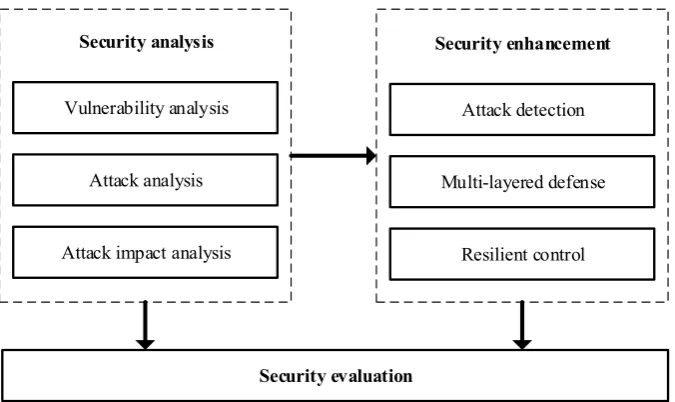
The focus of this dissertation is on providing security analysis on system vulnerabilities and threats with respect to insider attacks, and designing security enhancement methods to prevent, detect and mitigate the impacts of such attacks. This research consists of the following three core tasks, as is shown in Figure 1.2.
Attack detection
Multi-layered defense
Resilient control Vulnerability analysis
Attack analysis
Attack impact analysis
Security evaluation
Security analysis Security enhancement
Figure 1.2 Research focus of the dissertation
Please note, terminologies used in the dissertation have been defined based on the industry standards ISA/IEC-62443: Security for Industrial Automation and Control Systems: Technical Security Requirements for IACS Components [13], and related technical references.
1.4 Contributions of the dissertation
Based on the research tasks in Figure 1.2, the contributions of the dissertation can be summarized into three main groups: (1) security analysis, (2) security enhancement, and (3) security evaluation.
The contributions of this aspect are threefold.
First, potential ways of breach of security in cyber-physical systems have been investigated and analyzed. Second, a unified formulation against insider attacks has been proposed. Features of insider attacks are extracted using an attack pattern. Lastly, stealthy conditions of insider attacks are identified based on a temporal and spatial analysis. Different attack scenarios and their impacts are represented through an attack tree.
This analysis links attack threats with system vulnerabilities. The outcome of the analysis can then be used to improve the security of CPSs against potential insider attacks. Moreover, the dissertation has improved the existing work on attack pattern and stealthiness analysis against insider attacks.
(2) Security enhancement
The contributions on this topic can be highlighted in the following three aspects.
First, an online cross-layered detection scheme has been designed to reveal potential anomalies in multiple layers. The detection scheme takes a hierarchical approach by combining different detection methods in respective layers to provide a defense-in-depth detection against attacks of different forms. A state estimation with CUSUM based detection method and a data-driven detection method are proposed to work together to detect stealthy attacks. The cross-layered detection scheme is proved to be effective, as shown by examples how attack-inflicted anomalies can be detected before the attack can cause significant impacts on the wellbeing of the physical process.
Second, an attack defensive framework has been developed in this work. This framework, combining attack prevention, anomaly detection and mitigation strategies, offers a defense-in-depth protection against insider attacks to maintain the CPS in a safe state. By using the proposed framework, system security has been enhanced as attack anomalies are detected quickly, and the system operator can be alerted promptly to take actions and to mitigate impacts of the attacks.
Third, this dissertation introduces an attack-resilient control scheme to mitigate effects of attacks, which includes an attack response scheme, a decision-making scheme and a set of switchable controllers. The attack response scheme can isolate and replace the corrupted data, the decision-making scheme can switch in appropriate controller into the system, and the controller can mitigate the attack and bring the system to a safe state. This work provides a temporary solution to protect the system before more permanent solutions can be taken by human operators to secure the system.
(3) Security evaluation
The contributions in this topic have two parts.
First, a general design methodology for developing a security assessment platform has been developed, which provides an overview on how to develop a security platform on a cyber-physical system. Modular design makes the development and implementation flexible.
To the best of our knowledge, there are no such platforms reported in the open literature.
1.5 Structure and organization of the dissertation
The dissertation is structured as follows:
Chapter 2 investigates the cyber-physical security issues related to insider attacks based on existing research work and literature. Risk assessment methods including vulnerability analysis, threat assessment and impact analysis are investigated and analyzed. Security enhancement strategies including topics on attack prevention, attack detection, and attack mitigation are surveyed and discussed. Meanwhile, security issues and challenges are also analyzed.
Chapter 3 analyzes system vulnerabilities and potential insider attacks on the system. Cyber-physical interactions and attack impacts are examined in the form of an attack tree. A specific analysis is demonstrated on a nuclear process control test facility (NPCTF).
Chapter 4 presents a modular design of an experimental security platform. It develops a general design guideline for a cross-layered experimental security platform, and proposes a modular approach to design and implement a platform for security tests on cyber-physical systems. This chapter also describes the process of constructing a security platform prototype for a specific cyber-physical environment and the way to use it for various security assessments.
Chapter 5 introduces a methodology on analysis and formulation of insider attacks through data tampering. Attack features are characterized by an attack pattern, stealthy conditions are analyzed, and impacts are also discussed.
Chapter 6 provides a cross-layered detection approach to detect anomalies from different layers. It integrates network intrusion detection with physical process detection, and combines model-based and data-driven detection algorithms to reveal various stealthy attacks.
Chapter 7 presents an attack-resilient control system design, which includes a decision-making scheme to respond to the attacks resiliently, and an attack-resilient controller to mitigate the impact of attacks. This chapter also presents an attack defensive framework to provide defense-in-depth protection for cyber-physical systems.
Chapter 2
2
Investigation on Security of Cyber-Physical Systems
under Insider Attacks
2.1 Introduction
Security is critically important to ensure a reliable operation of cyber-physical systems. The purpose of this chapter is to investigate techniques for security analysis and enhancement solutions, which can provide some references and guidance as how to design defensive strategies.
Topics covered in this chapter are summarized in Figure 2.1. These topics can be classified into three categories: vulnerability analysis, threat assessment, and security enhancement strategies. System vulnerabilities and features of insider threats are analyzed and surveyed. Existing security solutions, including attack prevention, attack detection and attack mitigation strategies are also investigated.
The remainder of this chapter is organized as follows. In Section 2.2, system vulnerabilities are surveyed. In Section 2.3, features of insider threats are discussed, attack models are investigated and methods to evaluate impacts of attacks are also summarized. In Section 2.4, a variety of security solutions including attack prevention, detection and mitigation techniques are surveyed and compared, secure architectures are discussed to develop a defense-in-depth control system. Finally, Section 2.5 presents some discussion and potential solutions on security of CPSs.
2.2 Survey on vulnerability analysis related to insider attacks
Figure 2.1 Techniques investigated on security analysis and enhancement
Security Analysis
Vulnerability analysis
Hierarchical analysis
Threat analysis
Attack types
Eavesdropping
DoS
Deception
Attack models
Graph‐based model
Time‐based model
Stealthy condition analysis
Temporal stealthy
Spatial stealthy Attack impact
analysis
Security solutions
Prevention
Detection
Model‐based
Data‐based
Mitigation
Attack response
Decision making
Resilient control
Design for security
Diverse design
Redundant design Defense‐in‐depth
A method based on fault tree analysis is used to identify process vulnerabilities to insider attacks in [4]. A graph-based model is proposed to determine inherent network vulnerabilities that could be exploited by a malicious insider in [14]. Several behavior-based models are proposed to establish the relation between the vulnerabilities and insider attacks in [4] and [15]. An insider threat model in [16] is established to acquire cyber situational awareness. Since a cyber-physical attack is initiated from the cyber domain, and then manifested to the physical domain, a successful insider attacker will have to combine knowledge from both domains to explore the vulnerabilities to inflict physical damage to the process. It is necessary to analyze the vulnerabilities among the cyber-physical couplings and interactions. Unfortunately, the interactions and dependencies between the cyber and physical components have not been considered in these techniques.
2.3 Survey on threat assessment
2.3.1 Cyber-physical attacks and their characteristics
Insider attacks on cyber-physical systems can be classified by attack types, entry points and stealthy conditions, as summarized in Figure 2.2.
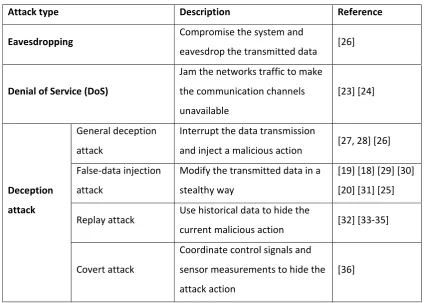
Adversaries may interrupt the communication networks, tamper with the data packets being sent to the controller or eavesdrop to gain information on the system state [17]. Thus, the type of attacks can correspondingly be categorized into three groups: eavesdropping, denial-of-Service (DoS) attacks, and deception attacks [1].
Figure 2.2 Classification of insider attacks on cyber-physical systems
A malicious attack could be carefully designed to compromise transmitted sensor data and tamper with the data that is sent to the detection scheme without being detected. A methodology is presented to generate stealthy attacks in [18]. Impacts of false-data injection attacks are characterized as a reachable set in [19], this reachable set are compared with the safety set of the system to evaluate the attack impacts. Detectability and identifiability of attacks are characterized analytically using an extended observer in [20].
To study the stealthiness of an attack, a graph-based model is constructed to determine inherent network vulnerabilities that could be exploited by a malicious insider in [21]. State-estimation methods are used to characterize the unobservable attack in [22].
To get the maximum attack impact, an DoS attack schedule is proposed to bypass intrusion detection mechanisms in [23]. To study the worst case that might caused by attacks, the maximum impacts of a DoS attack is studied in [24], and the worst damage of a false-data injection attack and the minimum number of the manipulated variables required by this kind of attacks are studied in [25].
Attack Classsification
By attack type
Eavesdropping DoS Deception
False‐data injection attack
Replay attack Covert attack By entry points
Computational attack Data attack Physical attack
By Stealthy condition
Temporal stealthy Spatial Stealthy
Table 2.1 Insider attacks on cyber-physical systems
Attack type Description Reference
Eavesdropping Compromise the system and
eavesdrop the transmitted data [26]
Denial of Service (DoS)
Jam the networks traffic to make the communication channels unavailable
[23] [24]
Deception attack
General deception attack
Interrupt the data transmission
and inject a malicious action [27, 28] [26] False‐data injection
attack
Modify the transmitted data in a stealthy way
[19] [18] [29] [30] [20] [31] [25]
Replay attack Use historical data to hide the
current malicious action [32] [33‐35]
Covert attack
Coordinate control signals and sensor measurements to hide the attack action
[36]
2.3.2 Modeling methods for insider attacks
Attack models are used to map the insider threats to cyber-physical system vulnerabilities. In Table 2.2, attacks are analyzed based on control-theoretic, cyber security, and hybrid approaches separately.
than the system architecture have been discussed in [46]. A game-theoretic model is proposed to model and analyze the insider threats in [47].
Table 2.2 Impact analysis of insider attacks from different perspectives
Approaches Proposed techniques Reference
Control-theoretic
Attack models, stealthy condition of attacks [32]
Physical watermarking detection to replay attacks [37]
Moving target detection [38]
Characterization of robust estimation and control [39]
Cyber security Sequence-aware intrusion detection system [40]
Big data analytics for attacks on PLC [41]
Hybrid approaches Attack graph generation [42]
Most of these modeling work have been focused on modeling attacker’s behavior, there is fewer considerations which assess the insider threat in a control-theoretical manner. System vulnerabilities exploited by the insider attacks, physical impacts of the attacks, and system resources used by an attacker need to be studied in order to provide indications for a secure control system design.
process. It is necessary to analyze the vulnerabilities among the cyber-physical couplings and interactions. Unfortunately, the interactions and dependencies between the cyber and physical components have not been considered in these techniques.
In order to capture the impacts of an insider attacker, a tuple has been used based on organization structure [52], to trace a sequence of attack actions leading up to safety violations. Attack models are represented using dataflow-based directed graphs in [53]. Similarly, attack trees [54], attack graphs [55], integrated fault-attack trees [56], and attack pattern trees [57] are all used to characterize insider attacks and their attack paths and steps. These researches help to identify system vulnerabilities under insider attacks.
2.3.3 Techniques for stealthy condition analysis
The ultimate goal of an insider attacker is to drive some critical system variables into unsafe states without triggering any alarms by keeping the attack stealthy or delaying any detection or responses. A well-planned attacker might bypass the anomaly detection system or hide his/her actions for a long period. An adversary is capable to tamper with the sensor data without raising an alarm, some examples are presented in [28, 58] [59] and [60]. Works on stealthy condition analysis are summarized in Table 2.3.
Table 2.3 Review of techniques for stealthy condition analysis
Type of attacks Description of stealthy condition Reference Replay Bypass the anomaly detector [32] [33] [62]
False data injection attack Tamper the anomaly detector [51] [58] [65]
Zero-dynamics attack Modify control commands to hide attacker’s
actions [66]
Covert attack Bypass traditional anomaly detectors [96]
Surge attack, bias attack,
and geometric attack Bypass traditional anomaly detectors [27]
spatial stealth attack to conceal malicious attacks using healthy historical data, such as replay attacks in [62]. A methodology is presented to study stealthy attacks in [63]. Detectability and identifiability of a stealthy attack are defined in [64]. However, none of these studies have taken into account essential features of an insider attacker. As a result, many assumptions made in these works may not be directly applicable for attacks committed by an insider. Therefore, common characteristic of attacks and their impacts on cyber-physical systems need to be analyzed.
2.3.4 Attack impact analysis
Impacts of attacks can illustrate the security status of a cyber-physical system and provide insights on designing detection and mitigation schemes. Research work on impact analysis is summarized in Table 2.4. A game theory method is used to analyze the cyber threats within a cyber-physical system in [67]. Impacts of attacks on critical networks are evaluated in [68] and [69] to increase the resilience of cyber-physical systems. In order to analyze how an cyber attack can affect the physical process, a threat model is proposed in [70], possible consequences of DoS attacks and deception attacks are assessed. Impacts of combination attacks are considered in [71], and an aspect-oriented method is proposed to model these impacts in [72]. To better understand the attack impacts timely, an algorithm is presented in [73] to predict the possible consequences by attacks. In order to develop the characteristics of attacks, an attack description language is proposed in [74], however, this method can only be applied to known attacks.
The above-mentioned methods mainly focus on analysis of insider attacks in the cyber domain. By combining information from both cyber and physical domains, it is more likely that a pattern from a cyber-physical attack can be revealed, and subsequent impacts can be alleviated.
Table 2.4 A literature review on methods for impact analysis
Methods References
Game theory method to analyze cyber-physical attacks [67]
Analysis of attack impacts on networks [68]
Cause-consequence relationship analysis [69]
Impact analysis on DoS and integrity attacks [70]
Statistical analysis for various attack scenarios [71]
Aspect-oriented risk assessment [72]
Predictive risk assessment method [73]
Qualitative and quantitative analysis for cyber-physical attacks [74]
2.4 Investigation of security enhancement solutions
Reviews on security solutions include prevention, detection and mitigation. Attack prevention is defined as the first barrier against insider attacks starting from the entry point. Attack detection techniques need to be built for all layers of a cyber-physical system, and mitigation mechanisms are initiated to respond and mitigate the impacts of the attacks.
2.4.1 Attack prevention and detection
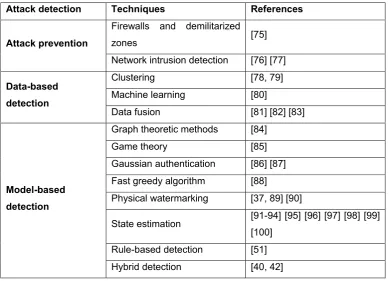
Attack detection is to identify anomalies of the system. Attack detection techniques can be classified into two groups: (1) passive detection techniques to prevent attacks, and (2) active detection techniques to identify the anomalies of attacks. Active detection techniques can be designed as data-based methods or model-based methods. Related techniques are investigated in Table 2.5.
However, they might be ineffective for sophisticated attacks and insider attacks. it is necessary to employ defense-in-depth detection strategies to provide a layered detection.
Active anomaly detection techniques can be classified into data-based and model-based techniques. Data-based approaches does not require system and attack models, they detect the anomalies through machine-learning [80] and pattern recognition techniques [78, 79] for analyzing hidden patterns in the observed training data set. Model-based approaches are based on the parametric models under normal operations and under different attack scenarios. The detection decision rules are made on the residuals between system observations and model-based system outputs, such as game theory [85], physical watermarking [90] and state estimation techniques [91-100]. However, the residuals are often not obvious due to the model uncertainties and noises, and the model might be utilized to bypass the detection schemes by sophisticated attackers. It is required to consider the cumulative effects of insider attacks and the constraints of system models when designing a detection framework.
Table 2.5 A literature review of prevention and detection methods
Attack detection Techniques References
Attack prevention
Firewalls and demilitarized
zones [75]
Network intrusion detection [76] [77]
Data-based detection
Clustering [78, 79]
Machine learning [80]
Data fusion [81] [82] [83]
Model-based detection
Graph theoretic methods [84]
Game theory [85]
Gaussian authentication [86] [87]
Fast greedy algorithm [88]
Physical watermarking [37, 89] [90]
State estimation [91-94] [95] [96] [97] [98] [99]
[100]
Rule-based detection [51]
2.4.2 Mitigation methods
Once safety violations or anomalies are detected, corresponding mitigation actions will be triggered. The objective of attack mitigation is to minizine impacts of the attack and recover the system operation as much as possible.
There are two types of mitigation strategies: (1) proactive methods that mitigate the system prior to the detection of an attack and (2) reactive mitigation that takes actions only when an attack has been detected. This chapter investigates the related work of proactive methods, which is summarized in Table 2.6.
Table 2.6 Review on mitigation methods
Techniques Approaches References
Game-theory control
Dynamic zero-sum game theory and a jamming
strategy [101]
A receding horizon Stackelberg control law [102]
Resilient control
Attack-resilient control with a distributed control
methodology [103,104,105]
Attack-resilient control through a time-trigger strategy [106] Attack-resilient control with a Kalman state estimator [107]
A multiple-task robust controller [108]
Attack-resilient control using a hybrid model [109]
A two-stage attack-resilient control system [110]
Reconfiguration control for safety violations [111]
Optimal control
An optimal decoder to minimize the attack effects [112]
Design of an optimal estimator to minimize the
worst-case impact [113]
Horizon linear–quadratic control [114]
Predictive control A predictive control system to compensate for adverse
effects [115]
Networked control Contingency analysis to detect malicious control
These methods include game-theory methods, resilient control method, optimal control method, predictive method, and network control method. A dynamic zero-sum equilibrium control strategy is proposed to defend DoS attacks in [101] and a receding horizon control law against replay attacks is presented in [102]. Attack-resilient control designs are studied based on various strategies, such as distributed controllers in [103, 104, 105], multi-agent time-trigger strategies in [106], and state estimation through Kalman filter in [107]. Hybrid controllers are designed in [108] and [109] to defend stealthy attacks, a two-stage resilient control system is designed to respond and mitigate attack impacts. In order to minimize the attack impacts, optimal control is considered in [112], [113] and [114]. In order to compensate the adverse effects of attacks, a predictive control system is demonstrated in [115], and a contingency analysis is given in [116].
However, most of these mitigation methods are designed based on known attacks, since the attacks are unknown and hard to predict, some of the impacts of attacks may not be acquired and mitigated effectively. A resilient defensive framework should be performed in multiple layers to secure the cyber-physical system.
2.4.3 Security architecture development
A secure architecture is also necessary to ensure the security of a cyber-physical system. Security enhancement solutions should be considered from the cyber layer to physical layer. Table 2.7 summarizes the design of security architectures from different perspectives. A data fusion-based framework is proposed in [117] in order to enhance the robustness of networks. The cyber-physical interactions of a resilient cyber-physical system architecture are discussed in [118]. A authentication architecture for a IoT system is studied to presented to enhance the end-to-end security. A cyber-physical security architecture is proposed in [119] from an information security perspective. A layered architecture is analyzed in [120] to improve the security of communication protocols.
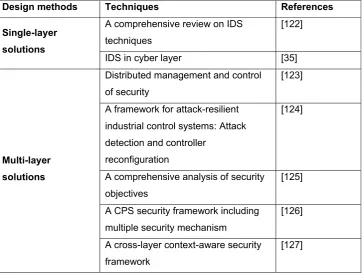
security architecture is in need to accommodate various security solutions in multi-layer systems. Different defense-in-depth designs for CPS are presented in Table 2.8.
Table 2.7 A literature overview of security architecture design
Proposed approach References
A fusion-based defense mechanism [117]
Qualitative and quantitative analysis for cyber-physical interactions [118]
IoT-based security architecture [119]
An information security framework [120]
Security architectures to study security of heterogeneous protocols [121]
Table 2.8 Defense-in-depth solutions for security enhancement
Design methods Techniques References
Single-layer solutions
A comprehensive review on IDS techniques
[122]
IDS in cyber layer [35]
Multi-layer solutions
Distributed management and control of security
[123]
A framework for attack-resilient industrial control systems: Attack detection and controller
reconfiguration
[124]
A comprehensive analysis of security objectives
[125]
A CPS security framework including multiple security mechanism
[126]
A cross-layer context-aware security framework
[127]
2.5 Discussions
of view, provide indicators for security enhancement strategies; and (2) attack mitigation methods may be improved when a defense-in-depth structure and multi-layer redundant design are considered.
Chapter 3
3
Vulnerability Analysis under Insider Attacks
3.1 Introduction
One of the core features of cyber-physical systems is the tight cyber-physical connectivity and interactions. Malicious adversaries might use the physical couplings to launch cyber-physical attacks on safety-critical processes and cause disruptions in operations of cyber-physical processes. To understand insider attacks on cyber-physical systems and develop a corresponding defensive framework, it is necessary to map out the relations from the insider attacks to the vulnerabilities within a cyber-physical system.
There are two questions need to be answered when assessing the system security.
(1) What assets in the cyber-physical system are vulnerable to insider attacks?
This question is related to system vulnerabilities that might be taken advantage of by inside attackers.
(2) What are the threats from insider attacks?
This question can be answered by the analysis of possible attacks, including analysis of attack models and their impacts.
To answer these two questions, this chapter analyzes system vulnerabilities under insider attacks.
3.2 Definition of an insider threat
An insider threat is defined by a unique set of attributes, which includes [128]:
resources and avoid being detected by access control strategies that are designed mainly to prevent against external intrusions [5].
Authorized resources: Insiders already have authorized resources to conduct operations for their assigned duties, which also give them accessible to the targeted resources and carry out destructive attacks.
Knowledge: Insiders already have certain degree of the knowledge of the targeted system and its security countermeasures. They may even know how to exploit the system vulnerabilities and carry out their malicious actions without being detected, which makes detecting, mitigating, or recovering from insider attacks extremely challenging [13].
Security issues associated with insider attacks normally have two unique traits:
Cyber-physical coupling: attacks launched from cyber space can cause physical damage in the processes.
Stealthy attacks: insiders could design their attacks in such a way to avoid being detected.
3.3 Vulnerability analysis of cyber-physical systems
Vulnerabilities are the weaknesses that an adversary could exploit and use to cause damages to the systems [126]. Analysis of vulnerabilities can identify the potential entry points and understand how an attacker might take advantage of the vulnerabilities to launch malicious attacks. The vulnerabilities of cyber-physical systems can be classified into five categories [129]:
architectural vulnerabilities;
security policy vulnerabilities;
software and hardware vulnerabilities;
detection and control related vulnerabilities.
In this chapter, vulnerabilities of cyber-physical systems are analyzed in two aspects: hierarchical analysis and data flow analysis.
3.3.1 Hierarchical analysis
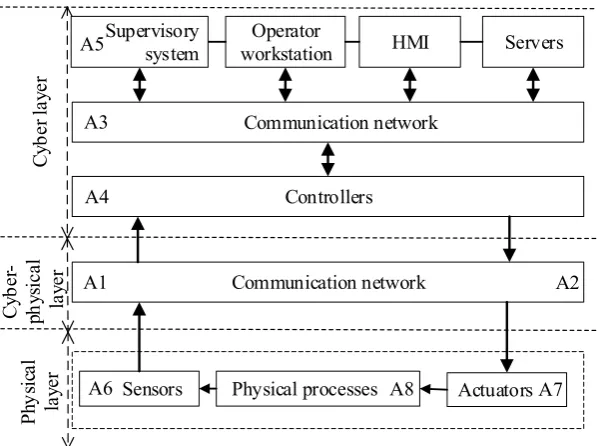
Actuators Physical processes HMI Operator workstation Servers Controllers Sensors Cy be r l ay er Ph ys ic al la ye r Communication network Communication network Supervisory system Cy be r-ph ys ic al la ye r A1 A2 A3 A5 A6 A4 A8 A7
Figure 3.1 Architecture and composition of a cyber-physical system
cyber layer, (2) data transmission in the cyber-physical layer, and (3) sensor measurements and control commands in the physical layer.
3.3.2 Data flow analysis in a control loop
In cyber-physical systems, there are two types of data flow in a control loop: sensor data flow and actuator data flow. In a cyber-physical system, the cyber system interacts with the physical system by reading the sensor data and sending the control commands through cyber-physical interactions. Sensor data flow and actuator data flow are interdependent, a change in one side will lead to changes in the other side [10].
1) Sensor data flow. Sensor data are sensor measurements from the physical system, compromised sensor data may mislead the controllers to make false control commands and result in security violations at the physical system.
2) Actuator data flow. Actuator data flow are transmitted from the cyber layer to the physical system. Such information in the cyber space can be used by attackers to cause undesired deviation in the operation of the physical system.
3.4 Attack analysis
3.4.1 Insider attacks on cyber-physical systems
3.4.1.1 Potential entry points for insider attacks
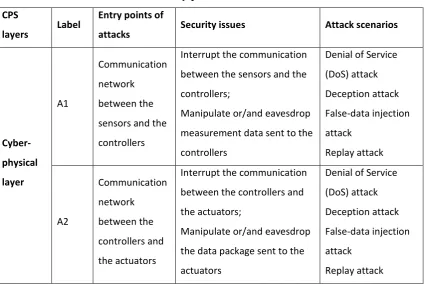
Potential entry points of cyber-attacks are labelled as A1- A8 in Figure 3.1. The nature of these attacks is explained in Table 3.1.
illegitimate activities from human operators or event detection algorithms implemented in the supervisory system. Such attacks are called stealthy attacks.
Attacks initialized at A4 and A5 can compromise the controller or the supervisory system or alter some system configurations [17]. Attacks launched from A6, A7 and A8 can be viewed as physical attacks.
This dissertation mainly focuses on security issues as a result of cyber-physical attacks that tamper with the data streams to cause damages in the physical process. The attack surface is originated from A1, A2 and A3, possible attack scenarios can be summarized in Table 3.1.
Table 3.1 Potential entry points for insider attacks on CPS
CPS
layers Label
Entry points of
attacks Security issues Attack scenarios
Cyber layer A3 Communication network between controllers and supervisory systems Interrupt the communication between the controllers and the supervisory systems; Manipulate or/and eavesdrop the data package between the controllers and the supervisory systems Denial of Service (DoS) attack Deception attack False‐data injection attack Replay attack A4 Controllers Interrupt normal operations of the controlled process, manipulate the control logics in the controllers, or send tampered data to the supervisory system/detection system Denial of Service (DoS) attack Deception attack False‐data injection attack Ladder logic bombs[133] A5 Supervisory system Compromise the supervisory systems, change system configurations, or disrupt detection systems Malware, code or program injection Physical layer
A6 Physical process Physical attack on physical processes
Direct physical attacks
A7 Sensors Physical attack on sensors Direct physical attacks
A8 Actuators Physical attack on actuators Direct physical attacks
3.4.1.2 Definition of a successful attack
In this dissertation, a successful attack is defined as: (1) the attack goal has been achieved; and (2) the attack is stealthy before its goal is achieved.
a physical process beyond its safety limits while remaining undetected. This definition can be used to evaluate whether the attack is successful or not.
A failed attack: The insider attack fails if it is detected before the attack causes safety issues in process variables.
3.4.2 Attack trees
A comprehensive attack tree that integrates anti-models are constructed to show the logical sequence of an attack. Attack tree relate the system vulnerabilities from the attacker’s entry points in cyber layer to physical processes. Anti-goals are used to model an attacker’s malicious intentions related to system vulnerabilities [164]. By constructing a comprehensive attack tree, attack anti-goals and steps can be mapped to system vulnerabilities.
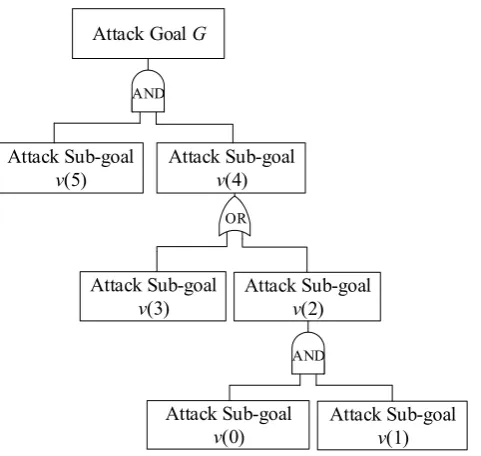
An attack tree is shown in Figure 3.2.
Attack Goal G
Attack Sub-goal v(5)
Attack Sub-goal v(4)
Attack Sub-goal v(3)
Attack Sub-goal v(2)
Attack Sub-goal v(0)
Attack Sub-goal v(1)
AND
AND OR
Figure 3.2 An attack tree
connective functions and subsequently a tree structure is formed. The synthesis of the tree is described graphically using connective symbols (AND, OR). The node that represents the attack goal is referred as a root node. When an attack sub goal is broken down further, the corresponding node is called a non-leaf node. Once an attack sub anti-goal is exhaustive, or when it is decided not to expand the analysis further, the corresponding branch is terminated with a leaf node.
In this chapter, an attack tree with system state and attack scenarios has been constructed to identify the attack pattern from the cyber domain to the physical process.
Procedures to construct a comprehensive attack tree is as follows:
(1) Set attack goals and sub-goals;
(2) Design attack mode scenarios;
(3) Define the attack steps;
(4) Link the attack steps as a chain to form a complete attack path;
(5) Integrate common attack steps for different attack mode scenarios; and
(6) Construct a complete attack tree.
The attack tree is constructed from the top to the bottom, but the execution sequence of an attack is from the bottom to the top. The attack tree results from a graph theoretic analysis of the network, security of a network and its interaction with the physical processes can be analyzed based on the attack tree.
The AND-OR refinement structure can be used to link sets of sub goals in an attack scenario. Each sub-goal in the attack tree is considered to be a vulnerability point in the system, v(0) is the entry point of an insider attack on the CPS, and G is the final attack goal.
( ( )) (0), (1), ,
V P i v v G (3.1)
In order to identify the vulnerabilities, all the nodes and variables in each attack path are needed to form a valid attack path.
3.4.2.1 Attack path identification using attack tree
Attack paths and the corresponding steps can be identified based on the attack tree from the bottom to the top. An attack path not only reflects the cyber-physical interactions of the system, but also reveals the attack sequence hidden within the system. Attack steps based on the corresponding attack path can also be identified.
For rest of this chapter, a practical cyber-physical system is used to illustrate the conception. This system is known as Nuclear Process Control Test Facility (NPCTF), as is shown in Figure 3.3.
3.5 NPCTF environment
In this dissertation, all case studies are implemented on NPCTF. As a foundation of the case study, this chapter analyzes the vulnerabilities and potential insider attacks. For generality and simplification, the following chapters will give brief introductions on NPCTF.
3.5.1 Cyber-physical aspects of NPCTF
NPCTF is designed as a general-purpose process control test facility, supporting research in instrumentation and control (I&C) at the Control, Instrumentation, and Electrical Systems (CIES) Research Laboratory at The University of Western Ontario (UWO) [134].
NPCTF is a fully operational scaled version of a physical plant, which represents the relevant portions of a cyber-physical system. In order to provide accurate information and real-life experimentation capabilities, this facility consists of a physical simulator to mimic the dynamics of a nuclear power plant, real field devices placed in the physical environment, and real programmable logic controllers (PLCs), which generate and exchange data packets via a communication switch in the cyber layer.
To identify the vulnerabilities related to insider attacks, the environment for a cyber-physical security platform used in the NPCTF is described as follows.
3.5.1.1 Physical Process
In NPCTF, sensor measurements and actuator signals are associated with the analog or digital data in thermal-hydraulic processes, controllers generate actual data packets and interact with field devices to carry out detection and control tasks. There are totally 19 AIs, 30 AOs, 8 DIs, 14 DOs and 12 control loops in the NPCTF. Detailed description of the control loops can be found in [134].
Insider attacks on sensors and actuators will choose I/O messages between devices and PLC in NPCTF as input to attacks, which are exchanged through TCP/IP packets.
3.5.1.2 Control System and Anomaly Detection System
An ABB Freelance AC700 PLC is chosen to implement the protection and control for the NPCTF. The PLC receives measurements from the sensors and computes the corresponding control actions. Anomaly detection system is set based on the safety limits of the physical processes. Anomalies can be detected if a process variable exceeds the designated limits. The Anomaly detection system is also used to detect anomalies caused by attacks on NPCTF.
The control algorithm and anomaly detection system are programmed in a Ladder logic diagram and sequential event logic diagram, using the ABB Control Builder F. Since there were no security checks for performing logic updates, an attacker can tamper with the sensor readings or control signals to the actuators through this vulnerability.
3.5.1.3 Communication Network
Measurement data from the sensors and actuator data sent to the actuators are collected as (AI, DI) and (AO, DO) and transmitted over the control network in the NPCTF. Information between NPCTF process and the ABB PLC is communicated via a field bus, and communication between PLC and HMI is based on TCP and UDP protocols.
3.5.2 Vulnerability analysis of NPCTF
For clarity of presentation, the heater control loop on NPCTF is selected as an example to analyze the system vulnerabilities. The heater control loop is shown in Figure 3.4.
according to the minimum (LL) and maximum (HH) bounds defined by the system safety limit. The safety limit of water temperature T1 and T2are set at 37℃, which should not be surpassed, otherwise potential damages to the system can occur and force a system shutdown.
A3
A2 A1
C2' C2 Device communication network
Sensor Heater Actuators Controller (AC700F)
Control communication network Supervisory station
2
T
2
T
Figure 3.4 Cyber-physical attacks on the heater control loop
ECCS (emergency core cooling system) is used as an emergency control when the system is in an unsafe state.
The safety setting on the heater control system is given as follows: the safety boundary of T1 and T2 is set as <HH=35℃, LL=15℃>, and the set point is 37℃. The current C2 ranges from 0 to 100%.
The vulnerabilities of the heater control loop are analyzed by considering the following aspects.
1) Architectural vulnerabilities
heater. A3 is the entry point to the communication network between PLC and the supervisory station.
2) Security policy vulnerabilities
Currently, there is only passive security policy, which is the firewalls and safety thresholds. Attackers may take advantage to intrude the communication network and attack the heaters of the system.
3) Software and hardware vulnerabilities
All the hardware on NPCTF have no safety and security protection. Most of the software are open-sourced and have no access control or encryption. This vulnerability may open some backdoors due to the lack of security policies.
4) Communication network vulnerabilities
TCP and UDP are used in the communication network between PLC and the supervisory station, UDP protocol is vulnerable to most of the sniff tools. The attackers can compromise the communication network and deliver the attacks into the channel.
5) Detection and control related vulnerabilities
There are only passive detection measures, such as safety limit, firewalls are used in NPCTF, which is ineffective for insider attacks. The existing controller in the heater control loop is a PD controller for normal operation, which cannot maintain the system performance under various situations.
3.5.3 Insider attacks on NPCTF
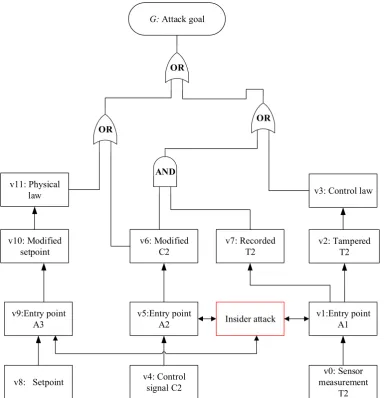
Based on the potential entry points, the insider can attack in the heater control system by three means: (1) attack by tampering with sensor data T2; (2) manipulation of the control commands C2; and (3) modification to the setpoints of T2. Types of attacks may include false-data injection attack, replay attacks, and other more sophisticated deception attacks.
Given that the attacker aims to attack the heater outlet temperature of T2, an attack tree can be constructed to analyze these possible attacks in Figure 3.5.
G: Attack goal
v3: Control law
v6: Modified C2
v7: Recorded T2
v2: Tampered T2
Insider attack v1:Entry point A1
v0: Sensor measurement
T2 AND
OR
v5:Entry point A2
v4: Control signal C2 v10: Modified
setpoint
v9:Entry point A3
v8: Setpoint v11: Physical
law
OR
OR
Based on the attack tree, it can be observed how an attacker can advantage of system vulnerabilities from the cyber space to physical process. Attack steps and attack path can also be derived from the attack tree.
3.6 Conclusions
In this chapter, a general analysis of the vulnerabilities subject to insider attacks are presented. Possible entry points and the corresponding insider attacks are listed based on the system architecture. An attack tree is used to analyze impacts of attacks and to demonstrate the relationship between system vulnerabilities and insider attacks.