Impact of Solid Segment Weak
‑
Beam Configuration Arrangement on the
Seismic Delicacy of Rc Outline Structures
Dussa Minesh & J.Naresh( M.Tech)
1 P.G. Student, Civil Engineering Department, Bharat Institute Of Engineering And Technology Jntuh Hyderabad,
Ibrahimpatnam - 501 510, Hyderabad
2assistant Professor, Civil Engineering Department. Bharat Institute Of Engineering And Technology Jntuh
Hyderabad, Ibrahimpatnam - 501 510, Hyderabad
ABSTRACT
Incremental dynamic analyses are conducted for a suite of low- and mid-upward thrust strengthened-concrete unique
moment-resisting frame buildings. Buildings non-conforming and conforming to the robust-column weak-beam (SCWB) design
criterion are considered. These homes are designed for the 2 most excessive seismic zones in India (i.E., area IV and quarter
V) following the provisions of Indian Standards. It is observed that buildings non-conforming to the SCWB layout criterion
result in an undesirable column failure fall apart mechanism. Although yielding of columns can not be avoided, even for
homes conforming to a SCWB ratio of one.4, the found disintegrate mechanism changes to a beam failure mechanism. This
exchange in disintegrate mechanism ends in a extensive growth inside the building’s worldwide ductility ability, and thereby
in collapse ability. The fragility analysis study of the taken into consideration homes indicates that considering the SCWB
design criterion results in a significant reduction in collapse opportunity, mainly in the case of mid-rise homes.
Keywords Capacity layout • Collapse possibility • Incremental dynamic analysis moment-resisting body buildings •
1.
INTRODUCTION
At blessing, the seismic outline codes of numerous nations all around the worldwide (e.G., ASCE 7-10 207-10; Eurocode eight 2004; IS 1893 2002) still watch a weight essentially based design (FBD) approach which characterizes the objective general execution levels 'No Damage' and 'No Collapse' for a minor and key tremor, individually. The FBD strategy is construct absolutely in light of remedies, in which the inelastic power dissemination of the structures is accounted by means of a 'response lessening factor' (R), routinely moreover called 'conduct thing'. This improved 'R' part is in generally reliant on a building's basic gadget, and thought to be unequivocally energized by method for the developing's
flexibility capacity (μT). Likewise,
bothstrengthauxiliary(Ω) overand excess
(ρ) are thought about indispensable people to the 'R'
factor.The(NISTflexibility2012)capacity of a developing
μT is unequivocally corresponded with the
disappointment component that is
administered by utilizing the relative power of the unprecedented donors. Significant universal seismic format codes (i.E., ACI 318-14 2014; Euro code eight 2004; IS 13920 2016) incorporate arrangements for potential design (control order). One of the critical arrangements of ability format for minute opposing casings controls the relative quality of bars and sections, the utilization of a 'tough segment helpless shaft (SCWB) proportion' (i.E., the proportion of the whole of ostensible second limits of all segments to the aggregate of ostensible flexural qualities of bars, encircling into the indistinguishable joint, inside the heading underneath thought).
1.1 GENERAL
The present quakes discovered the significance of the format of reinforced cement (RC) frameworks with
flexible conduct. Malleability can be characterized as the ability of reinforced cement go segments, factors and structures to douse up the huge quality discharged amid seismic tremors without loosing their energy under immense adequacy and reversible misshapenings. By and large, the shaft segment joints of a RC encircled structure subjected to cyclic burdens which incorporate seismic tremors appreciate huge interior powers. Subsequently, the pliable conduct of RC frameworks predominantly depends at the fortification specifying of the pillar segment joints. Various examinations have been said about the conduct and support itemizing of pillar section joints under switch cyclic stacking. In this investigations, components influencing the conduct of RC bar section joints had been considered. In snappy, the consequences of those examinations demonstrated that the shear quality and pliability of RC pillar segment joints increased as the compressive vitality of cement and the amount of transverse support progressed. Besides, for alright malleability of bar segment joints, the utilization of eagerly divided loops as transverse fortification changed into supported in various tremor codes for RC frameworks. Limiting the solid with precisely separated band fortification extended now not best the pliability of the solid area at shaft segment joints yet moreover the vitality of those areas. On the elective hand, the pass segments of pillars and sections close to the joints in RC frameworks under the effect of solid seismic tremor development have
been subjected to enormous bowing minutes and shear powers. Henceforth, an expansive amount of longitudinal
and transverse fortifications of pillars and sections pass-by
means of these joints.
However it's far repetitive to introduce the transverse support and afterward cast concrete into this
stage, contemplating the blockage made by method for the
Various analysts have endeavored to decrease the workmanship troubles by method for rearranging the
fortification lay-out inside the joints.
In various trial examinations, the utilization of
metal fiber fortified cement (SFRC) changed into proposed as extra support as an option of crushing stirrups inside the
pillar section joints. In past examinations the impact of
various parameters on the conduct of joints were considered tentatively, comprehensive of the sort of
stacking, the measure of steel fiber in solid blend, the procedure of stacking, and the amount of transverse and
longitudinal fortifications.
LITERATURE REVIEW
2.1 GENERAL
Writing concerning learns at the infilled reinforced bond solid casings, chilly formed metallic edges and furthermore the conduct of brief segment in RCC outlines underneath parallel masses is provided on this part.
2.2 OVERVIEW OF LITERATURE
2.2.1 RCC Frame with Masonry Infill under Seismic
Loading
Bertero and Brokken (1983) completed a
grouping of semi static cyclic and monotonic load tests on one-0.33 scale models of eleven story 3 narrows supported solid edge infilled in the external inlets. Diverse board
texture and support combos had been tried. In this observe, the successful between story horizontal solidness of infilled outlines end up 5.3 to 11.7 occurrences the parallel firmness of the exposed body depending on the sort of
infill. The most extreme sidelong protection of infilled
outlines transformed into 4.8 to five.8 cases of that procured for the exposed edge. The ramifications of tentatively acquired outcomes were examined through
researching how the infills influence the dynamic reaction of structures with RC minute opposing edges.
Zarnic and Tomazevic (1984) condensed the aftereffects of the exploratory and systematicexaminations at the seismic conduct of brick work infilled fortified solid
edges. It changed into found that the infill started to split at a horizontal float of roughly zero.2% and the gadget
displayed amazing conduct up to a 2% glide. Little measures of flat fortification of the infill have been seen to have little effect. Along these lines, test appraisals on
seismic retrofitting methodologies fitting for RC outlines with stone work infill have been executed (Zarnic et al 1986a). The repair systems comprised of epoxy grouting of
breaks inside the solid casing and brick work infill factors in addition to fortifying of the stone work infill by utilizing
fortified cement jacketing of the infill board talked about.
Govindan et.Al (1986) in examination the trial conduct of a quarter estimate 3-story infilledstrengthened solid body with that of a supported solid edge without infill issue to parallel masses and surveyed the disappointment method of the block infilled body. The power, malleability and power assimilation qualities of the infilled outline while issue to rehashed horizontal hundreds, which uncovered the flexibility necessity of the block infill inside the infilled body were measured.
Achintya et.Al (1991) offered the conduct of block infilled fortified solid casings subjected tohorizontal load, through a test technique. The energy of mortar end up found to have substantial affect at the parallel solidness and vitality of the infilled outlines. Casings inspected with reinforced block board had demonstrated irrelevant change inside the disappointment control. The firmness of the
infilled body diminished quickly after the start of splits. Absence of fit as a fiddle among the infill and the body in light of shrinkage of infilled texture turned out to be also noted.
3. BUILDING ARCHETYPES AND DESIGN
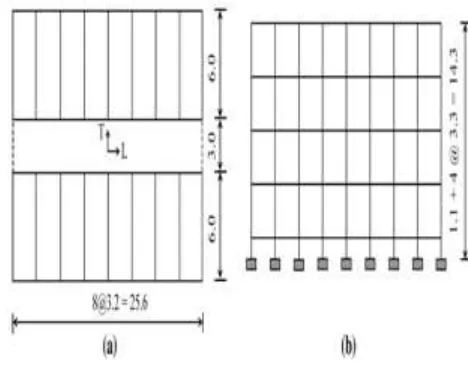
For the numerical research, a delegate revered building design (Fig. 1) is chosen principally in view of territory studies inside the National Capital Region of India (DEQ 2009; Haldar 2013; Surana et al. 2018a). In the present examination, 12 consistent RC momentresisting body homes with unmistakable measurements inside the two overwhelming building tomahawks are considered. These models are illustrative for low-(2-story and four-story), and mid-upward push (8-story) homes far reaching in northern India. A string is doled out to each building form which recognizes the developing tallness, seismic region and the comparing SCWB format measure as compressed in Table 3 1. For the thought about building models, the story tallness is put away consistent to a few.Three m, which is most typically seen at multi-story RC homes in northern India (DEQ 2009; Haldar 2013; and Surana et al. 2018a). The building models are produced in the consolidated developing investigation and design programming program ETABS 2016 (CSI 2016). Pillars and sections are displayed utilizing 3-dimensional (3D) outline factors, in the meantime as the pieces are portrayed as inflexible stomachs. The broke stage homes of the two bars and sections are inferred following ASCE forty
one-13 (20one-13) suggestions. Both inert and stay masses are doled out to the building styles as per IS 875 Part 1 (1987a) and IS 875 Part 2 (1987b), separately. Every one of the structures are planned after the arrangements of the pertinent Indian guidelines (IS 456 2000; IS 1893 Part 1 2002; IS 1893 Part 1 2016; IS
Figure: 3.1 Details of the far reaching developing models
Fig. 1 Details of the far reaching developing models chose for the seismic delicacy take a gander at: a Plan, and b Elevation of the four-story building model in longitudinal course (heights of the option building styles are not introduced appropriate here for quickness; L and T speak to the models' longitudinal and transverse way, separately; the dabbed lines speak to the furthest reaches of the floor piece). All measurements are in meters
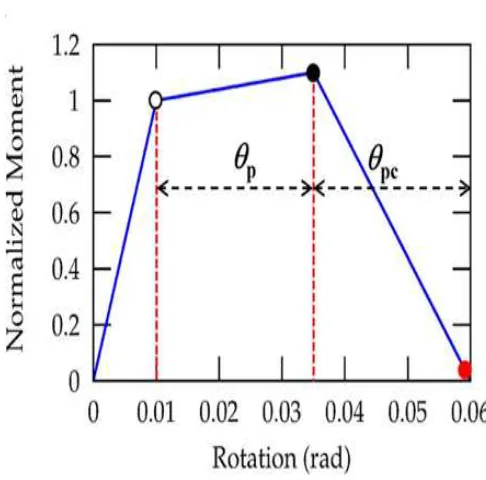
13920 1993; IS 13920 2016). Neighborhood subsoil circumstances are spoken to with the guide of soil kind I (i.E., extreme soil/shake) following the dirt class characterized with the guide of Indian code IS 1893 Part 1 (2016). P-delta impacts are viewed as each inside the outline and basic assessment process. Material qualities, times of vibration (appeared as arithmetic propose of the times of vibration inside the dominating guidelines of the building), format powers and got part sizes for the contemplated assembling models are outlined in Table 2. Part sizes are same for each seismic zones and are chosen with the end goal that the fortification in sections is beginning from 1 to 3% and 2 to 4% for structures
intended for seismic quarter IV and V, separately, unfaltering with building practice in India. On the elective hand, shaft fortification is provided in the vicinity of 0.5 and 1.5% on each face, regardless of seismic part. In the event of homes non-adjusting to the SCWB design rule,
Table 3.2 Details and member sizes of the considered building models.
.
3.2 Incremental dynamic assessment
To investigate the dynamic response of the considered auxiliary styles, incremental dynamic examinations (IDA) are completed underneath bi-directional excitation (i.E., concurrent programming of two even segments of the particular floor-movement report).
Table 3.3Plastic rotation capacities of ordinary individuals
The IDA incorporates playing out a chain of dynamic examinations for an accumulation of chose seismic tremor floor-development actualities, in the meantime as each report is scaled in sufficiency to catch the auxiliary reaction from the versatile assortment to the point of dynamic shakiness (Vamvatsikos and Cornell 2002). It is thought about as a capable device for delicacy assessment, since it enables the immediate estimation of record-to-record (between occasion) inconstancy in basic reaction. So far, various offices (Vamvatsikos and Cornell 2002; Haselton et al.
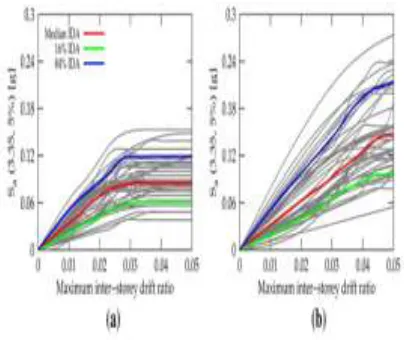
Graph:3.3 Dynamic potential bends for the considered 8-story building models
Dynamic potential bends for the considered 8-story building models intended for seismic zone V
subjected to 22 sets of far subject ground-movement information: a 8VNC, and b 8VC It can be found that both the eight-story structures (i.E., 8VNC and 8VC) in seismic zone V are intended for the equivalent base shear coefficient (Table 1), however the building form adjusting to SCWB format prerequisite has a seventy seven% higher crumple capacity when contrasted with the building model nonconforming to the SCWB plan necessity. This effect is unfaltering among all building statures, in spite of the fact that the blast in break down limit is unimaginably diminish (around 25– forty%) if there should arise an occurrence of low-upward push (2-and 4-story) homes, specifically because of enhanced overstrength and gravity stack impacts (Table four). This comment can be credited to the truth that the developing model non-fitting in with the SCWB plan necessity has an impressively interesting breakdown instrument (section disappointment system characterized as "segments of a solitary or two or three stories coming to submit-topping twisting potential") when contrasted with the building variant adjusting to the SCWB outline necessity (shaft disappointment component characterized as "light emissions unmarried or different stories achieving set up-topping misshapening capacity").
Fig. 3.4 Typical disappointment styles for the considered four-story building designs intended for seismic quarter V subjected to 22 sets of far territory ground-movement records: a 4VNC nearby longitudinal way (decided for 91% ground-movement actualities), b 4VNC close by transverse course, c 4VC along longitudinal course (watched for 84% story development measurements), and d 4VC along transverse way
3.5 Crumple execution assessment
To assess the break apart general execution, the FEMA P695 (2009) system is used inside the blessing look at. The calculation of a structure's middle go to pieces limit, its disintegrate edge proportion (CMR) [i.E., the proportion of the middle fall limit of a building, Sa (T)Median, to the ghostly quickening request relating to greatest thought about seismic tremor (MCE), SaMT (T, 5%)], and its change in accordance with otherworldly shape (recurrence content) of the ground-development data (Haselton and Deierlein 2007; Haselton et al. 2011; Kazemi et al. 2013; Farsangi and Tasnimi 2016) is a basic piece of this framework. In this look at, the Sa (T)Median, and CMR are gotten from IDA, and the modification in fall ability for ghastly frame results is influenced the use of the unearthly shape to issue (SSF) empowered in FEMA P695 (2009). The SSF expense for everything about building models is subject to the principal term (T), the period-based absolutely
pliability (μT), and the seismic design class (FEMA P695 2009). The fundamental length
length-essentially based flexibility (μT) are figured from
Eigenvalue investigation and nonl static examination,
separately. The FEMA P695 method is construct absolutely in light of 2D developing styles with uni-directional tremor excitation, while the present watch is construct absolutely in light of 3-D building designs with bi-directional excitations. Thusly, the number
Figure: 3.5 Typical disappointment designs for the considered eight-story building models
Fig.3.5 Typical disappointment designs for the considered eight-story building models intended for seismic division V subjected to 22 sets of far-region ground-movement measurements: a 8VNC along longitudinal heading (found for sixty one% story development data), b 8VNC nearby transverse course, c 8VC along longitudinal course (situated for eighty two% ground-movement actualities), and d 8VC close by transverse way complying with the SCWB foundation have significantly better ACMR (twofold on account of the 8-story working in seismic zone V) contrasted with homes planned non-fitting in with the SCWB standard. Another remarkable explanation from the table is, that the ACMR of structures in seismic zone IV are 15– a hundred and ten% better when as contrasted and the partner structures in seismic district V. This can be credited to the particularly extended consequences of gravity loads for
bring down degrees of seismic needs (i.E., seismic locale IV in the present investigate), which brings about expanded auxiliary over power. In this manner, the equivalent basic framework intended for a lower seismic district brings about a superior edge contrary to disintegrate for a one of a kind level of seismic shot (e.G., MCE). This announcement is thought about to be in evident concurrence with the FEMA P695 projectwork on 2D building styles.
CONCLUSIONS
Graph:4.1 Collapse delicacy bends for the thought about developing models: a 2-story
structures, b four-story homes, and c eight-story homes.
Fig.4.1 Collapse delicacy bends for the thought about developing models: a 2-story structures, b four-story homes, and c eight-story homes. (the 2 vertical strains speak to the ghastly increasing speed needs comparing to the MCE chance stage for seismic zones IV and V, individually) representing break apart system, disintegrate edge proportion and deteriorate delicacy is explored in component. In spite of the fact that, the adjusting and also non-acclimating homes were intended for indistinguishable base shear coefficients, the non-accommodating structures flaunt an eminently decreased go to pieces capacity in contrast with the adjusting structures. This features the impact of go to pieces instrument on seismic break down limit of structures. It has been watched that the go into disrepair component unequivocally relies upon the SCWB proportion
Table 4.1 Collapse probability conditioned on the occurrences of MCE hazard for the considered building models
utilized for the seismic format. Structures non-adjusting to the SCWB design foundation exclusively pull in section disappointment component, while homes fitting in with the SCWB format measure indicate pillar disappointment instrument. Curiously, the section yielding couldn't be turned away, even in structures intended for a SCWB proportion of one.4. Nonetheless, in these structures, disappointment of pillars in an unmarried (if there should arise an occurrence of low-ascent homes)
This general execution enhances definitely for structures adjusting to the SCWB foundation. Despite the fact that, the eight-story developing intended for seismic district V and adjusting to the SCWB plan necessities of Indian Standards, least difficult imperceptibly passes the FEMA P695 paradigm of 20% shot of break down molded at the occurrence of MCE peril for a man or lady building. By and by, the association execution of the structures adjusting to the SCWB rule is discovered to be palatable. The found fall components for the researched assembling models advocate that there's by and by a chance of change inside the potential design way to upgrade the deteriorate general execution of RC outline structures. Be that as it may,
such upgrades give off an impression of being feasible best by means of the utilization of variable SCWB proportions close by the stature of the building, all together that disappointment of shafts at all stories is concerned, even as this point can be the circumstance of future examinations. The present inspect is led with a limited number of auxiliary molds and plan shapes. The perceptions and conclusions attracted are bound to the considered suite of RC SMRF homes of beyond any doubt statures. Further, the floor-development report suite utilized inside the blessing take a gander at solely incorporates far field measurements. Close subject ground-movement records can likewise in all actuality have considerably one of a kind attributes in contrast with far territory data. Along these lines, isolate inquire about are embraced to inspect the impact of close subject quakes at the representing breakdown system and go into disrepair delicacy. Affirmations The principal maker's cooperations conceded by means of the Ministry of Human Resource Development, Government of India and the Royal Norwegian Embassy to India (New Delhi) permitted the conduct of the present investigate. Parts of the
examinations have been completed underneath the Indo-Norwegian coordinated effort wander EQRisk. The guide got from every organization is appreciatively expressed. Open Access This article is delivered underneath the terms of the Creative Commons Attribution 4.Zero International License, which grants unlimited utilize, dispersion, and multiplication in any medium, if you supply appropriate credit to the real writer(s) and the source, offer a connection to the Creative Commons permit, and suggest if changes have been made.
REFERENCES
1. ACI (2014) Building code necessities for
auxiliary cement and perception, ACI 318-American Concrete Institute, Framington Hills
2. ASCE (2010) Minimum design hundreds for
homes and diverse frameworks, ASCE Standard, ASCE 7-10. American Society of Civil Engineers, Reston
3. ASCE (2013) Seismic assessment and retrofit of
existing homes, ASCE Standard, ASCE/SEI forty one-13. American Society of Civil Engineers, Reston
4. Cagurangan CK (2015) Effects of strong section
vulnerable shaft proportions on crumple limits of tall supported solid second casing frameworks. Ph.D. Proposal, University of California, Berkeley
5. CSI (2016) ETABS 2016 Integrated Building
Design Software, Version
6. Sixteen.0.2. PCs and Structures, Inc., Berkeley