A Study on the Thermal Properties Of 100% Modal Fabric
R.Divya& G.Manonmani
1 Assistant Professor Department of Costume Design & Fashion, PSG College of Arts
and Science, Coimbatore, India.
2 Assistant Professor Department of Home Science, Mother Teresa University,
Kodaikanal, Coimbatore, India.
Hyperlink :{[email protected]}
Abstract
The thermal comfort properties of fabric
structures made from Modal yarns. 100%
Modal is spun into yarns of identical
linear density. Each of the yarns produced
was converted to single jersey knitted
fabrics, cross tuck fabric, cross miss fabric
& twill fabric. The thermal conductivity of
the fabrics was generally found to
decrease with increase in the proportion of
Modal fibre. The water vapour
permeability and wicking of the fabrics
were observed to increase with increase in
Modal fibre content. Statistical analysis
also indicates that the results are
significant for water vapour permeability
of the fabrics. Wicking test was also done
which gives fabric absorbency of water
that how much it takes.
Key words: Modal fabric, Water
vapour permeability & Wicking.
INTRODUCTION
Knitting is a method of forming
fabric from a single strand of yarn, using
two needles. The resulting fabric has given
more than woven fabric. It is a technique
to turn thread or yarn into a piece of cloth.
Knitted fabric consists of horizontal
parallel courses of yarn which is different
from woven cloth as said by Prakash. C
(2012). The courses of threads or yarn are
joined together by interlocking loops in
which a short loop of one course of yarn or
thread is wrapped over another course.
Fabric can be formed by hand or machine
knitting, but the basic principle remains
exactly the same i.e. pulling a new loop
through the old loop. A knitted fabric
consist of forming yarns into loops, each
of which is typically only released after a
succeeding loop has been formed and
intermeshed with it so that a secure ground
loop structure is achieved by Koushik.
Modal is a wood pulp based cellulo
sic fiber, made out of pure wooden chips fr
om the beech
tree, technically as the European Schneider
Zelkova tree. While viscose rayon can be
obtained from the wood pulp from a numb
er of different trees, Modal uses only beec
h wood thus it is essentially a variety of vis
cose rayon; a generic name for modified vi
scose rayon
fiber that has high tenacity and high wet
modulus.
Modal was first developed by Aust
ria based Lenzing AG Company who trade
marked the fabrics’ name, but now many
manufacturers make their own versions. It
was initially imported from Czech Repu
blic, Slovakia, Hungary and Germany; but
now for Indian market, it is catered to by L
en
zing, Austria, which has tied up with Rajas
than Textile Mills.
Thermal properties: Physical property
of a solid body related to application of
heat energy is defined as a thermal
property. Thermal properties explain the
response of a material to the application of
heat. Important thermal properties are
Heat capacity
Thermal expansion
Thermal conductivity
Thermal stresses
Air Permeability
Water Vapour Permeability
Heat capacity: External energy
required to increase temperature of a solid
mass is known as the material’s heat
capacity, it is defined as its ability to
absorb heat energy. Heat capacity is not an
intrinsic property i.e. it changes with
material volume/mass. Specific heat - For
comparison of different materials, heat
capacity has been rationalized. Specific
heat is heat capacity per unit mass. It has
units as J/kg-K or Cal/kg-K. With increase
of heat energy, dimensional changes may
occur. Hence, two heat capacities are
usually defined. Heat capacity at constant
pressure, Cp, is always higher than heat
capacity at constant volume; Cv. Cp is
only marginally higher than Cv. Heat is
absorbed through different mechanisms:
lattice vibrations and electronic
contribution.
Thermal expansion: Increase in
temperature may cause dimensional
changes. Linear coefficient of thermal
expansion (α) defined as the change in the
dimensions of the material per unit length.
Thermal conductivity: It is ability of a
material to transport heat energy through it
temperature region. Heat energy
transported through a body with thermal
conductivity. It is a microstructure
sensitive property and has units as W/m.K.
Thermal stresses: Stresses due to
change in temperature or due to
temperature gradient are termed as thermal
stresses. Thermal stresses in a constrained
body will be of compressive nature if it is
heated, and vice versa. Engineering
materials can be tailored using multi-phase
constituents so that the overall material can
show a zero thermal expansion coefficient.
Eg.: Zerodur – a glass-ceramic material
that consists of 7080% crystalline quartz,
and the remaining as glassy phase.
Sodium-zirconium-phosphate (NZP) have
a near-zero thermal expansion coefficient.
Air Permeability: The air permeability
is a very important factor in the
performance of some textile materials.
Especially, it is taken into consideration
for clothing, parachutes sails, vacuum
cleaners, fabric for air bags and industrial
filter fabrics. The air permeability is
mainly dependent upon the fabric’s weight
and construction.
Water vapour permeability: Water
vapor permeability is a measure of the
passage of water vapor through the
material. It is also known as water vapor
transmission rate (WVTR) or moisture
vapor transmission rate (MVTR). It is the
mass of water vapor transmitted through a
unit area in a unit time under specified
conditions of temperature and humidity.
Breathability or also referred to as Water
Vapor Permeability can be described as the
ability of a fabric to allow
moisture vapor to be transmitted through
the material.
Wicking: Moisture transfer
properties and drying rate of fabrics are
two major factors affecting the
physiological comfort of garments.
Moisture transfer and quick dry behavior
of textiles depend mainly on the capillary
capability and moisture absorbency of
their fibers. These characteristics are
especially important in sport garments next
to the skin or in hot climates. In these
situations, it is critical that textiles are able
to absorb large amounts of perspiration,
draw moisture to the outer surface and
keep the body dry. Therefore, in order to
optimize these functionalities in sport
clothing, and to support moisture
management claims, it is necessary to
determine the wicking behavior and quick
drying capability of functional fabrics.
FLOW CHART
Fabric 100%
Modal
MSJ MTW MCT MCM
Thermal Comfort
Property
Thermal Water Wicking
Conductivity vapour
Air Permeability
Permeability
MSJ -Modal Single Jersey
MTW - Modal Twill
MCT - Modal Cross Tuck
MCM - Modal Cross Miss
Fabric Production
(Production of Weft Knitted Fabric
with 0.30cm Loop Length)
The following stitch combination of
fabrics are produced for our study
Knit Stitch – Single Jersey
Knit and Tuck – Cross Tuck
Knit and Miss – Cross Miss
Knit, Tuck & Miss – Knitted Twill
Single Jersey
Jersey fabric is a type of knit textile made
from cotton or a cotton and synthetic
blend. Some common uses for jersey
fabric include t-shirts and winter bedding.
The fabric is warm, flexible, stretchy, and
very insulating, making it a popular choice
for the layer worn closest to the body.
Jersey also tends to be soft, making it very
comfortable.
Tuck and miss stitch
Apart from the knitted loop stitch
are the tuck stitch and the miss stitch (float
stitch).
Tuck
A tuck stich is composed of a held
loop, one or more tuck loops and knitted
loops. It is produced when a needle
holding its loop also receives the new
loop. The tuck loop assumes an inverted
U-shaped configuration.
Miss
A miss stitch or float stich is
composed of a held loop, one of more float
loops and knitted loops. It is produced
when a needle holding its old loop fails to
receive the new yarn that passes, as a float
loop to the back of the needle, and to the
reverse side of the resultant stitch.
Twill
Twill is a type
of textile weave with a pattern of diagonal
parallel ribs (in contrast with
a satin and plain weave). This is done by
passing the weftthread over one or
more warp threads then under two or more
warp threads and so on, with a "step," or
offset, between rows to create the
characteristic diagonal pattern.[1] Because
of this structure, twill generally drapes
well.
THERMAL PROPRERTIES OF
MODAL FABRIC IN WATER
VAPOUR PERMEABILITY &
WICKING TEST ARE DISSCUSSED
BELOW.
Water Vapour Permeability Test
Water vapour permeability of
fabric samples was determined using an
SDL Atlas instrument (M261, USA)
according to ISO 14596. A test specimen
was sealed over the open mouth of a test
dish which contains water, and the
assembly was placed in a controlled
atmosphere. After establishing equilibrium
water vapour pressure gradient across the
sample, successive weightings of the
assembled dish were made and the water
vapour permeation through the specimen
was determined. The water vapour
permeability (WVP) in g/m²/day was
calculated by the equation;
𝑊𝑊𝑊𝑊𝑊𝑊=24×𝑀𝑀𝐴𝐴×𝑡𝑡
where M is the loss in mass of the
assembly over the time period t (in g), t is
the time between successive weighing of
the assembly in hours, A is the area of
exposed test specimen (equal to the
internal area of the test dish (in m²).
Wicking Test
Wicking behaviour of fabric
53924. Ten specimens were cut along the
warp and weft directions respectively to
dimensions of 200 mm × 25 mm and
suspended in a reservoir of 1% K2CrO4
with their bottom ends at a depth of 30 mm
into the water. The height of the solution
raised was measured and recorded in terms
of mm after 60 seconds.
Moisture transfer properties and
drying rate of fabrics are two major factors
affecting the physiological comfort of
garments. Moisture transfer and quick dry
behaviour of textiles depend mainly on the
capillary capability and moisture
absorbency of their fibbers. These
characteristics are especially important in
sport garments next to the skin or in hot
climates. In these situations, it is critical
that textiles are able to absorb large
amounts of perspiration, draw moisture to
the outer surface and keep the body dry.
Therefore, in order to optimize these
functionalities in sport clothing, and to
support moisture management claims, it is
necessary to determine the wicking
behaviour and quick drying capability of
functional fabrics.
RESULTS AND DISCUSSION
In this study, the results on the
thermal comfort properties of , water
vapour permeability and wicking test has
been seen and discussed.
The result of the study discussed below
Water Vapour Permeability Test
The bi-layer knitted structures of
fabrics had higher water vapour transport
than the other fabrics because their
thickness and weight were lower than for
the others fabrics. This is because, in a
steady state, moisture vapour transport
through fabrics is controlled by the
diffusion process, which is influenced by
the fabric structure.
Water Vapour Permeability of Modal fabric
Water Vapour permeability of Modal fabric.
WVP
(g/m2/day)
MSJ MCM MCT MTW
1 2501.432 2300.371 2758.672 2268.269
2 2418.642 2424.556 2740.931 2299.949
4 2448.210 2389.075 2758.672 2306.285
Water Vapour permeability of Modal fabric.
From the above Table & Figure it
is clear that the fabric of Modal from the
four structures in the test of the Water
Vapour permeability of Modal Cross Tuck
gives good result compared to single
jersey, cross miss & twill
Table-Water Vapour Permeability of modal fabric – Average
WVP
(g/m2/day)
MSJ MCM MCT MTW
Avg 2418.642 2324.291 2774.195 2239.785
Figure-Water Vapour permeability Modal fabric- avg 0
500 1000 1500 2000 2500 3000
W
A
T
E
R
V
AP
OUR
P
E
RM
E
ABIL
IT
Y
(g/m
2/d
ay)
MODAL FABRIC
MSJ
MCM
MCT
VTW
0 1000 2000 3000
MSJ MCM MCT MTW
Wat
er
vapou
r
perm
eabi
li
ty
WV
P
(
g/
m
2/
day)
MODAL FABRIC
From the above Table & Figure it
is clear that the fabric of Modal from the
four structures in the test of the Water
Vapour permeability of Modal Cross Tuck
gives good result compared to single
jersey, cross miss & twill.
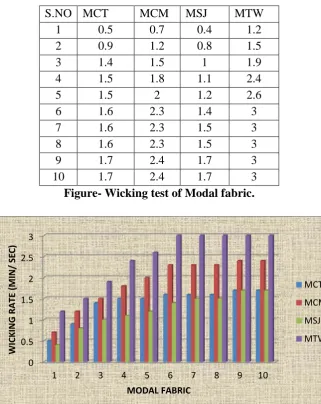
Wicking
Wicking is the spontaneous flow
of liquid in a porous substrate, driven by
capillary forces. The capillary forces
caused by wetting is wicking. The
longitudinal wicking height determines the
liquid transporting ability, and the faster
the rate of wicking, the better the sweat
transporting ability will be, hence the
fabric feels more comfortable to wear.
Wicking test of Modal fabric.
Table -Wicking test of Modal fabric.
S.NO MCT MCM MSJ MTW
1 0.5 0.7 0.4 1.2
2 0.9 1.2 0.8 1.5
3 1.4 1.5 1 1.9
4 1.5 1.8 1.1 2.4
5 1.5 2 1.2 2.6
6 1.6 2.3 1.4 3
7 1.6 2.3 1.5 3
8 1.6 2.3 1.5 3
9 1.7 2.4 1.7 3
10 1.7 2.4 1.7 3
Figure- Wicking test of Modal fabric.
0 0.5 1 1.5 2 2.5 3
1 2 3 4 5 6 7 8 9 10
WI
CK
ING
R
A
TE
(M
IN/
S
EC)
MODAL FABRIC
MCT
MCM
MSJ
From the four structural variation of modal
that is Modal single jersey, Modal twill,
Modal cross miss and Modal cross tuck we
get the result that in wicking test modal
twill gives good result.
Summary & Conclusions
A “Warm – cool feeling” is a very
important property, as a result of which a
human can feel comfort or discomfort in
various activities and environmental
conditions. This feeling could be achieved
by using different types of yarns. It was
determined that higher air permeability is
characterized for knits manufactured only
from pure yarns.
The thermal comfort properties of
single jersey fabrics made from yarns of
100% Modal yarns were investigated.
water vapour permeability are significantly
affected by the Moisture Vapour
Transport. An increase in the Modal fibre
content in the fabric affects the thermal
comfort properties. The wicking height of
woven fabric, with longer yarn floats and
less crimped yarns, is the highest. Increase
in weft yarn density leads to a decrease in
porosity, due to increased warp yarn crimp
and therefore a decrease in wicking height.
References
[1]. H.Y.Wu et al. (2009). Fibres & Textiles in
Eastern Europe. Vol. 17, No.4(75):46-51.
[2]. Sheela Raj, S.Sreenivasan. (2009). Total
wear comfort index as an objective parameter for
characterization of overall wearability of cotton
fabrics. Journal of Engineered Fibers and Fabrics.
Vol. 4:29.
[3]. Merve Küçükali Öztürk, et al. (2011). A
study of wicking properties of cotton-acrylic yarns
and knitted fabrics. Textile Research Journal. 81
(3):324-328, DOI:10.1177/0040517510383611.
[4]. Youngmin Jun, Chung Hee Park, Huensup
Shin & Tae Jin Kang. (2009).Thermal comfort
properties of wearing caps from various textiles.
Textile Research Journal.79 (2): 179-189,
DOI:101177/0004051750808093444.
[5]. S.Cimilli, B.U.Nergis & C.Candan.(2010).
A comparative study of some comfort-related
properties of socks of different fiber types. Textile
Research Journal. Vol 80:948-957.
[6]. http://www.lenzing.com
[7]. Meltem Yanilmaz and Fatma Kalaoglu.
Investigation of wicking, wetting and drying
properties of acrylic knitted fabrics. Textile
Research Journal 2012; 82: 820- 831.
[8]. Kreze T., Malej S., 2003, “Structural
Characteristics of New and Conventional
Regenerated Cellulosic Fibers”, Textile Research
Journal, 73(8), 675-684.
[9]. Ozdil, N., 2008, “A study on thermal comfort properties of the socks”, Tekstil ve