Available Online atwww.ijcsmc.com
International Journal of Computer Science and Mobile Computing
A Monthly Journal of Computer Science and Information Technology
ISSN 2320–088X
IMPACT FACTOR: 5.258
IJCSMC, Vol. 5, Issue. 8, August 2016, pg.92 – 97
SURVEY ON CRYPTOGRAPHIC
ALGORITHMS FOR OUTSOURCING
MOBILE DATA TO CLOUD
S.Velmurgan M.Phil. Scholar,
Department of Computer Science, Bishop Heber College (Autonomous),
Trichirappalli, Tamilnadu, India
R.Thamarai Selvi
Asst. Professor & Head,
Department of computer Applications, Bishop Heber College (Autonomous),
Trichirappalli, Tamilnadu, India
ABSTRACT: Mobile devices are fast becoming a key computing platform and an essential part of
human life as the most effective and suitable statement tools not bounded by time and place. Mobile
Cloud Computing refers to an infrastructure where data storage space can happen away from mobile
device i.e. on a cloud. To ensure the correctness of users' data in the cloud, the framework
essentially focuses on the data security over the Cloud Computing Paradigm by purposing new
cryptographic technique named as Two Phase SHA and AES encryption algorithms to secure the
files in the server and for increasing the transfer rate of the information the file is used. The
performance of the secure technique is performed using the .NET technology and their performance
in terms of time complexity and storage overhead computed. The results maintain the efficient
methodology of file hosting and allotment in the cloud storage additionally that is efficient during
the speedy upload and downloads. Thus the proposed technique is adoptable e and secure for secure
storage services.
Keywords: Mobile Cloud Computing, Key Management, Security, Cryptography
I. INTRODUCTION
Mobile applications must be quickly provisioned and released with the work of negligible administration efforts or the service provider’s communications. With the explosion of mobile applications and the provision of Cloud Computing for a range of services for mobile users, mobile cloud computing is introduced as an addition of cloud computing into the mobile location. But the major issue present in this technology is security of outsourced data as protection is main issue in cloud computing also. Security risks in Mobile Cloud Computing should be even more because we have to take care of cloud protection as well as mobile security.
Cloud computing is a universal term for anything that involve distributing hosted services over the Internet. These services are broadly separated in the three categories: Infrastructure as a Service (IaaS), Platform as a Service (PaaS), and Software as a Service (SaaS), The Infrastructure as a Service (IaaS) the neutral infrastructure by a seller which you can contact more than internet and usage to install your software, build or install your applications. Infrastructure as a service (IaaS) is an identical, highly automated offering, where compute possessions, complemented by storage and networking capabilities are own and hosted by a cloud service provider and offered to customer on - demand.
1.1. TERMS OF CRYPTOGRAPHY
Plain Text: The unique message that the person wishes to communicate with the other is defined as Plain Text. In cryptography the actual: letter that has to be send to the other end is given a special name as Plain Text.
Cipher Text: The message that cannot be understood by anyone or pointless message is what we call as Cipher Text. In Cryptography the unique message is transformed into non readable message before the transmission of actual message.
Encryption: A procedure of converting Plain Text into Cipher Text is called as Encryption. Cryptography uses the encryption method to send confidential messages over an insecure channel. The process of encryption requires two things- an encryption algorithm and a key. Encryption algorithm means the technique that has been used in encryption. Encryption takes place at the sender side.
Decryption: A reverse procedure of encryption is called as Decryption. It is a process of converting Cipher Text into Plain Text. Cryptography uses the decryption scheme at the receiver side to obtain the original message from non-readable message. The process of decryption require 2 things- a Decryption algorithm and a key. A Decryption algorithm means the system that should be used in Decryption. Generally the encryption and decryption algorithm are same.
Key: A Key is a number or alpha numeric text or may be a special symbol. The Key is used at the
moment in time of encryption take place on the Plain Text and at the time of decryption takes place on the Cipher Text. The selection of key in Cryptography is very significant since the security of encryption algorithm depends directly on it.
II. RELATED WORK
The authors [Yu et al. 2010] have established a assessable and well-grained data access control
On the other hand, the single holder move toward probably will hold back the execution of applications with the difference circumstances, where any associate in a group can’t be allowed to save and distribute data files with others.
In [Kallahalla et al. 2003] optional a cryptographic storage method that facilitates protected file distribution of changeable server, called Plutus. With splitting files into file sets and encrypting each one folder place through an excellent file-block key, the information holder is able to share the file set with the others via dispatching the similar lockbox key, where the lockbox key is working to encrypt the file block keys. On the other hand, it outcome in an strong key distribution overhead for major file sharing. Moreover, the file-block keys required to be reviewed and shared one or more for a user un-authorization.
A integer of safety scheme for data distribution on undependable servers have been
recommended [M. Kallahalla et al. 2003, E. Goh et al. 2003, G. Ateniese et al. 2005]. Systems
information holders preserve the encrypted data files in unreliable storage space and share out the same decryption keys only to approved users. As a result, illegal persons and storage space servers not be able to find out the text of the data files. On the other hand; the difficulties of user involvement and authorization in these method are linearly augment with several data holders and many retracted users, respectively.
The author [Lu et al. 2010] optional a safe attribution method o the basis of code text strategy attribute-oriented encryption technique [B. Wang et al. 2012 ] that permits any associate in a group to distribute data with others. On the other hand, the concern of user authorization is not decorated in their method.
The authors [Yu et al. 2010] establish a measurable and well-grained data access management
method in cloud computing on the basis of key policy attribute-based encryption (KP-ABE) method [C. Wang et al. 2010]. Unfortunately, the single possessor approach holds back the execution of their plan into the case, anywhere any user is approved to preserve and distribute data and get the fully authorized data.
III. PERFORMANCE ANALYSIS
The Performance analysis can be taken three encryption techniques like AES, DES and RSA algorithms with their amalgamations namely ARSA and D-RSA. The DES and AES ideally belong to the category of symmetric key in cryptography and RSA belongs to the category of asymmetric key cryptography. The complete explanation of the proposed techniques is explained below. Experiments results are given to analysis the efficiency of each algorithm. There are two main features that specify and distinguish one algorithm from another are the capability to secure and protect the data against attacks and speed of encryption and decryption.
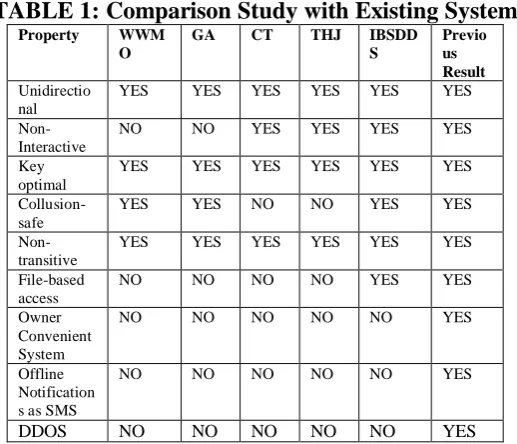
COMPARATIVE ANALYSIS
TABLE 1: Comparison Study with Existing System
Property WWM
O
GA CT THJ IBSDD
S
Previo us Result
Unidirectio nal
YES YES YES YES YES YES
Non-Interactive
NO NO YES YES YES YES
Key optimal
YES YES YES YES YES YES
Collusion-safe
YES YES NO NO YES YES
Non-transitive
YES YES YES YES YES YES
File-based access
NO NO NO NO YES YES
Owner Convenient System
NO NO NO NO NO YES
Offline Notification s as SMS
NO NO NO NO NO YES
DDOS NO NO NO NO NO YES
TABLE 2 : Number Of Properties Applicable To Existing System
System No. Of properties
applicable
WWMO 4
GA 4
CT 4
THJ 4
IBSDDS 6 Proposed System 9
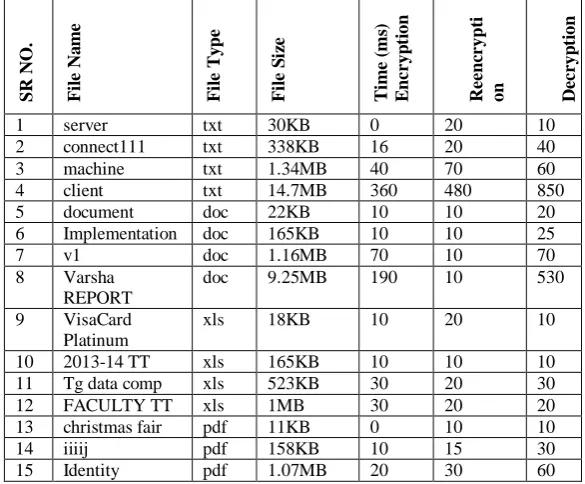
Table 3 : Time Required For File Upload And Download In Milli Seconds
Fig 2.Graph of System results
IV. CONCLUSION
In this study Two Phase RSA encryption algorithm for protecting the confidentiality and
integrity of uploading files or data in mobile storage cloud. Encryption algorithms play an important role in communication security whereas input data size, Computation time, power utilization and mean processing time are the major issue of concern. The selected encryption combinations A-RSA and DRSA algorithms are used for performance evaluation based on the text files used and the experimental result it was concluded that A-RSA algorithm gives better result in all aspects compared to D-RSA algorithm. Many more algorithms to be evaluate and their results can be analyzed with one another to produce the most excellent implemented security algorithm in cloud background for future use. This technique analyzes the range of the data security and encryption process was very high while comparing old technique.
REFERENCES
[1] PortioResearch,"Mobilesubscribersworldwide", [online] Available www.onbile.comlinfo/mobile.
[2] Morten V. Pedersen, Member IEEE, and Frank H. P. Fitzek, Senior Member, "Mobile Clouds: The New Content Distribution Platform", Proceedings of the IEEE, Vol. 100, May, 2012.
[3] M.Sujithra,G.Padmavathi,SathyaNarayanan,”Mobie Device Data Security: A Cryptographic Approach by Outsourcing
S R N O . F il e N a m e F il e T y p e F il e S iz e T im e (m s) E n cr yp ti on R ee n cr yp ti on D ec ryp ti on
1 server txt 30KB 0 20 10 2 connect111 txt 338KB 16 20 40 3 machine txt 1.34MB 40 70 60 4 client txt 14.7MB 360 480 850 5 document doc 22KB 10 10 20 6 Implementation doc 165KB 10 10 25 7 v1 doc 1.16MB 70 10 70 8 Varsha
REPORT
doc 9.25MB 190 10 530
9 VisaCard Platinum
xls 18KB 10 20 10
[4] S. D. C. di Vimercati, S. Foresti, S. Jajodia, S.Paraboschi, and P. Samarati, “A data outsourcing architecture combining cryptography and access control”, In Proceedings of the ACM workshop on Computer security architecture, pages 63–69, 2007.
[5] Akash Kumar Mandal, Chandra Parakash and Mrs. Archana Tiwari, “Performance Evaluation of Cryptographic Algorithms: DES and AES”, IEEE Students’ Conference on Electrical, Electronics and Computer Science, pp. 1-5,2012. [6] R.Rivest, A. Shamir, L.Adleman. "A method for obtaining digital signatures and public-key cryptosystems”,
Communications of the ACM , Feb 1978.
[7] Wei Ren, Linchen Yu, Ren Gao, Feng Xiong,” Light weight and Compromise Resilient Storage Outsourcing with Distributed Secure Accessibility in Mobile Cloud Computing”, Tsinghua Science And Technology ,ISSNl1007-0214ll06/09ll,pp520 528.Volume 16, Number 5, October 2011.
[8] Itani W, Kayassi A, Chehab A “Energy-efficient incremental integrity for securing storage in mobile cloud computing”,
International Conference on Energy Aware Computing (ICEAC10), Cairo, Egypt, 2010.
[9] S. Yu, C. Wang, K. Ren, and W. Lou, “Achieving Secure, Scalable, and Fine-Grained Data Access Control in Cloud Computing”, Proceeding IEEE INFOCO , 534 –542, 2010.
[10] M. Kallahalla, E. Riedel, R. Swaminathan, Q.Wang, and K. Fu,“Plutus: Scalable Secure File Sharing on Untrusted Storage”,. Proceeding USENIX Conf. File and Storage Technologies, 2003.
[11] E. Goh, H. Shacham, N. Modadugu, and D.Boneh, “Sirius: Securing Remote Untrusted Storage”. Proceeding Network
and DistributedSystems Security Symp. (NDSS) : 131–145, 2003.
[12] R. Lu, X. Lin, X. Liang, and X. Shen, “Secure Provenance”, The Essential of Bread and Butter of Data Forensics in
Cloud Computing.Proceeding ACM Symp. Information, Computer and Comm.Security : 282-292, 2010.
[13] G. Ateniese,K. Fu,M. Green,and S.Hohenberger, “Improved Proxy Re-Encryption Schemes with Applications to Secure Distributed Storage”, Proceeding Network and Distributed Systems Security Symp. (NDSS) , 2005.
[14] B. Wang, B. Li, and H. Li.Knox, “Privacy-Preserving Auditing for Shared Data with Large Groups in the Cloud”,
Proceeding 10th Int’l Conf. Applied Cryptography and Network Security : 507-525, 2003.