ZSIM: PROGRAM DOCUMENTATION
(Manual for TR-88/1)
G.T. Brauns
S.H. Ardalan
and
M.B.
Steer
Center for
Comrrrunicat.iona
and Signal Processing
Electrical and Computer Engineering Departm.ent
North Carolina State University
CCSP-TR-88/2
1
Abstract
This report documents the progress of ZSIM, a nonlinear Z-domain SIMulator for
delta-sigma modulators.
The simulator uses table look-up techniques to achieve high
computation speeds and high accuracy is maintained by using device-level simulations to
develop the look-up table. The simulator allows for simulation of circuit nonidealities
including clock feed-through, nonlinearities, and hysteresis. This report solely includes a
ZSIM
NONLINEAR Z DOMAIN SIMULATOR
USER'S MANUAL
version ZSIMOal
July 8, 1987
Gregory T. Brauns
Michael B. Steer
Sasan H. Ardalan
Center for Communications and Signal Processing Department of Electrical and Computer Engineering
North Carolina State University
Raleigh, NC 27695-7911
INDEX
1. VERSION NOTES 2
2. INSTALLATION GUIDE 2
3 • I/O CONVENTIONS 3
4. PROGRAM ORGANIZATION 3
5. USERS' GUIDE 5
6. GENERATING YOUR OWN TABLES 13
7. TABLE INTERPOLATION 14
ZSIMOa1
1. VERSION NOTES
- 2 - VERSION NOTES
ZSIMOal is the first distribution of ZSIM. This version is tailored to the
simulation ot Delta Sigma Modulators (DSM). It has a user-triendly input
format but lacks a totally stand alone topology specification. Currently up
to third order DSM can be simulated using difference equations and first
and second order DSM can be simulated using table methods.
2. INSTALLATION GUIDE
ZSIMOa1 is written in ANSI standard FORTRAN 77 and operation has been verified
on DEC MICROVAXES running Ultxrix 1.2 or MICROVMS operating systems.
ZSIMOa1 is distributed as two sets of files - ZSIMALL.FOR and the
individual module files.
ZSIMALL.FOR is just all the routines below plus fdateof concatenated together.
** ZSIMALL file **
zsimall should be compiled and linked.
** individual module files **
The files below should be compiled and linked together.
agen aquant ascint calfbw calsdr
casfil cassec compar decimate desim
dffil dtable envirn fft fread
gauss gendec gentor init intgtr
nlfil no dept nodset noiset polate
ranf sdrsub tablrd zana zbdec
zcalsdr zcmd zdec zdump zequat
zhelp zinput zprint zsdr zset
zsim
The program calls a routine fdate using
call fdate(date)
where date is dimensioned as
character*24 date
On UNIX systems this returns the date. On nonunix machines the
above routine can be provided or the dummy file fdate.f (included
ZSIMOal
3. I/O CONVENTIONS
- 3 - I/O CONVENTIONS
All input to ZSIM is converted to uppercase at input. On some systems,
e.g. unix based, user's need to be aware that files are always accessed
in uppercase by the program.
There is a high level input capability so that input can be taken from the
keyboard and/or from a disk file - see user's guide for more information.
comments can be included by preceeding an input line by ,
4. PROGRAM ORGANIZATION
The program is organized by sets of modules with a common set of high
level input routines contained in the file zinput.f.
The program is block oriented. A hi9h level view ot the program is as follows:
Level of program:
ZSIM
top next
INPUT
SIMULATION
DECIMATE
SDR
Input parameters
Perform simulation of sampled data system
Perform decimation
Perform SDR calculations
Greater detail is given on the next page.
Description ot a circuit must be in terms of nodes however in ZSIMOal arbitrary
topology has not been completely implemented. ZSIM needs to be informed as to
the interconnection of blocks in the sampled data system. At present only
first and second order delta sigma modulators can be modeled (indicated by
the parameter CIRCUIT) using table modeling techniques and first second
and third order delta sigma modulators (again indicated by the parameter
CIRCUIT) using difference equation techniques.
The distinction between a table based simulation and a difference equation
simulation is indicated by the command to do the simulation (the command
SIMULATE performs a table based simulation and DESIMULATE does
ZSIMOa! - 4 - PROGRAM ORGANIZATION
ZSIM: A Nonlinear Z-domaia SIMulator
I
ZSET
ZCMDI
I
,
ZSIM
I
,
I
ZPRINT
t
NODEPT
r--~-..,
r - - - l - - . - - - ' l
I
ZSfR
I
I
ZD1EC
I
I
I
I
I
ZCALSDR
I
I
GE.'mEC
ZBDEC
I
I
I
I
I
I
CAL'snR
I'I
DE~TE
DEh::
DEdIMP
I
L
~
I
_
~tE!.-1
I
II
I
CAfn.
DFFlL
:
NLFn.
I
I
I
5
dr
t..£.~c
J
1Je~ima..t~
r---~~---I
I
I
I
I
I
I
I
I
DESIM
AGr~
ir
T
AQUANT
I
I
GAY
SS
POY
TE
I
I
,.... _
R.}u'lFDTA..BLE
..J
I
I
Simvl"+ioY'\
I
ZEq~,U'
:
r
GE;Jroa - -- -- -- --..
ZHiLP"
I
~AL~B~
I
~~~
Z~r~
I
I
T..-\.BLRD
NODSET
I
L~~ "'::'~~J
Inpur
ZSIMOal
5. USER'S GUIDE
- 5 - USER'S GUIDE
This guide is organized by commands. ZSIM is largely self
documenting and help on each command is available by typing
"COMMAND" HELP.
Commands Available:
COMMAND
SIMULATE DESIMULATE GEN
SCINT QUANT TABLE CIRCUIT ENVIRONMENT HISTOGRAM CLEAR DUMP STOP INIT DECIMATE SDR EQUATION NOISE
KEYWORD
SIM DES GEN SCINT QUANT TABLE CIRe ENV HIST CLEAR DUMP STOP INIT DEC SDR EQ NOISE
DESCRIPTION
Perform z-domain simulation (tables)
Perform z-domain simulation (diff eq)
Define generator input
Define integrator input
Define quantizer input
Define table description Define circuit type
Define simulation features
Specify histogram for the tables
Erase all parameters to default
Dump contents of stored node values End session
Initialize quantities
Perform a decimation
Signal-to-Distortion calculation Specify difference equation parameters Define Gaussian white noise at a node
The following input/output commands are available:
read filename read
write filename
eof end t i t l e prompt echo on echo off
the file filename is opened for input
the previously opened file is now used for input
the file filename is opened for output
the input data file is closed
the input data file is temporarily closed
write line to output file
write line to terminal
the flag prt is set
the flag prt is cleared
ZSIMOal - 6 - USER'S GUIDE
##***#*###*#*#### CIRCUIT '*##t**##I#tll#I###I#
Usage:
CIRCUIT HELP : This Message
CIRCUIT
=
n: Set order of modulator to "n"
#*###########################*#######1#####*1##
It#*#II#III#*i#I### CLEAR lilll##I#I#i#I##*#*##
Usage:
CLEAR HELP : This Message
CLEAR
: Set everything to default value
#illl#i#IIII##### DECIMATE ####################
Usage:
DEC HELP
This Message
DECIMATE n1 n2 TYPE=ZBDEC
This performs a decimation on the values of
node n1 and outputs the result (usually
the baseband) at n2 TYPE indicates the type
of canned decimation.
DECIMATE n1 n2 TYPE=GENDEC NUMBER=nn WINDOW=sss TAPS=nn
INTDEC=nn BBANDDEC=bb FILE=filename FILTER=sss
This performs a decimation on the values of
node n1 and outputs the result (usually
the baseband) at n2. NUMBER can be to
base 2, 8.g.: NUMBER=nn BASE 2
WINDOWs available: UNIFORM TRIANgle PARABolic
TAPS length of the decimation filter.
INTDEC: FIR decimation factor
BBANDDEC : baseband decimation factor.
FILE specifies file with filter coefficients
FILTERs available: DIRECT form
NORMalized lattice CASCade form
###i###########################################
Included in this distribution of ZSIM is the file
VB.CAS which specifies a cascade filter
designed for decimation to voiceband. VB.CAS
has a 3.4 kHz rolloff for an 8kHz sampling
frequency. Coefficients for other filters
must be generated by the user. A program
ZSIMOal - 7 - USER'S GUIDE
1#*### DIFFERENCE EQUATION SIMULATION #**####*#
Usage:
DES HELP
This Message
DES
Simulate a circuit described by difference
equations
#****#***********
Usage:
DUMP HELP
: This Message DUMP
DUMP file n no
: Dump first "non values at node nn"
: to "file"
######*####11#############################*####
#########1*##### INITIALIZE ###################
Usage:
INIT HELP
: This Message
INIT NODE n x
INitializes NODE n to x. This is required
as several blocks use previous node values
in calculations
###############################################
####ii########### NOISE Usage:
NOISE HELP : This Message
####################
NOISE n xl x2
Add Gaussian white noise to node "n~ with
: mean "xl" and standard deviation "x2"
ZSIMOa1 - 8 - USER'S GUIDE
11"***'*",,**,*
EQUATION11**1""1'***'*"1'
Usage:
EQ HELP
: This Message
EQ GAIN#=xxx1 DELTA#=xxx2 OFINTI=xxx4 SAT#%=xxxS
#
=
1, 2, or 3 for respective integrator but may be left out to describe all integrators.This inputs ideal circuit parameters: GAIN# gain of integrator
DELTA# reference voltage of quantizer OFINT# integrator offset referred to
the output
SATt' integrator saturation
, '+' for upper limit
%
= '-'
for lower limitNOTE Finite Gain Bandwith is not implemented.
Default Values are:
gainl deltal of intI sat1
1.00 1000 00 5.00
gain2 delta2 ofint2 sat2
1000 1000
o.
5000
gain3 delta3 ofint3 sat3
1.00 1.00 00 5.00
Difference equation implemented:
yt(new)
=
y#<old)+9ain*£xl-bit*delta#}+ofint* y#(new) is limited to + or - sat#where y# is the output of the I integrator y#(new) is the new output of the integrator y#(old) is the output of the integrator at
the previous clock cycle x is the analog input
gain#, delta# and ofint# are as defined above bit is the output of the
quantizer (+ or - 1)
ZSIMOal - 9 - USER'S GUIDE
###*#**#*#*##*### GENERATOR ####################
Usage:
GEN HELP
This Message
GEN no node TYPE = DC AMP=x2
generator number "no" at node "node"
DC generator of amplitude "xl" and
GEN no node TYPE
=
RAMP THR(ESHOLO]=xl AMP=x2generator number "no" at node "node"
ramp generator of amplitude "x2" and
threshold of "xl"
GEN no node TYPE = SINE FREQ=freq OFFSET=xl AMP=x2
generator number "no" at node "node"
sinewave generator of frequency "freg",
amplitude "x2", offset "xl", and zero phase
GEN no node TYPE = SINE FREQ=freg AMP=xl PHASE
generator number "no" at node "node"
sinewave generator of frequency "freq",
amplitude "xl", and phase ot "x2" degrees
x2 OEG
GEN no node TYPE
=
SINE FREQ=treq AMP=xl DB WRT x3PHASE = x4 RAO
generator number "no" at node "node"
sinewave generator of frequency "freq",
amplitude "xl" With Respect To "x3" V and
phase of "x4" radians
GEN no node TYPE=STEP INIT=xl AMP=x2 DELAY=x3
step generator with initial value "xl",
ZSIMOal - 10 - USER'S GUIDE
################# QUANTIZER ################### Usage:
QUANT HELP : This Message
QUANT n n1 n2 THRES=xxx1 TYPE=sssl BAND=xxx2 SAME=nnnl Quantizer "n" at input node "nl" and output
node "n2" has THRESHOLD
ot
"xx x I " and TYPE=
NONHysteresis or HYSTeresis. options 1.previously defined quantizernumber "nnnl" uses the same data table
2."xxx2" is a deadzone region where the quantizer output zero.
NOTE:: option 1 is presently disabled since the quantizer is ideal and not characterized by a table as of nowo TYPE must be specified NONHysteresis until a hysteresis table is programmed. Integrator table must include x3=O
(see section 5 on generating tables) when BAND option is used.
########### SIMULATION USING TABLES ################ Usage:
SIM HELP
This Message
SIM
ZSIMOal
###########*#*##*
Usage:
SDR HELP
This Message SDR
- 11
-*#####1#############
USER'S GUIDE
SDR n1 n2 TYPE=CALSDR NPOINTS=nnn1 NFFT=nnn2 NSKIP=nnn3
FFTWINDOW=sssl DECWINDOW=sss2 FB=xxxl TAPS=nnn4
This performs a Signal-to-Distortion
calculation on the values of node n1. The calculated spectrum is
stored as node n2. Options available:
NPOINTS = total number of input bins
NFFT = number of bins to use for fft
NSKIP = number of initial bins to ignore
(NPOINTS = NFFT + NSKIP)
FFTWINDOW UNIForm HAMMing blackman-HARRis
DECWINDOW = IGNORE UNIForm TRIAngular PARAbolic
(DECWINDOW should be the same
used in decimation.)
The following parameters can be ignored if
decimation not used (DECWINDOW=IGNORE)
FB : baseband sampling frequency
TABS : number of taps in decimation filter
must be the same as that used in
the decimate command.
###############################################
Warning: The parameters in SDR must agree
with those in the decimate command.
We suggest that FFTWINDOW = UNIFORM be used
as only this has be debugged and tested.
This amounts to not using a window and
is satisfactory provided the input signal
coincides with a bin.
The SDR calculation determines the signal
level SIG, the total distortion level DIST,
the noise level NOIS, and the harmonic level
HARM. DC is excluded from the calculation.
DlST = NOlS + HARM
Since very few bins (of the frequency spectrum)
are typically available, the noise in the
location of the harmonics is estimated by
averaging the noise on either side of the
harmonics and subtracting i t from the total
signal level at the harmonic bins. The
FFTWINDOW used determines the signal spread
and the number of bins over which the signal
ZSIMOal - 12 - GENERATING TABLES
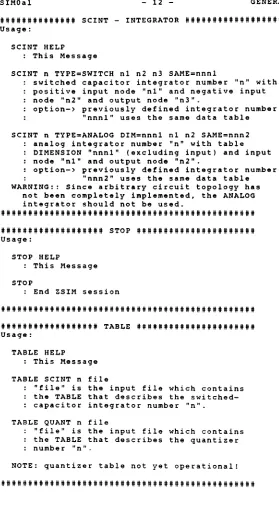
############## SCINT - INTEGRATOR ############*#####
Usage:
SCINT HELP : This Message
SCINT n TYPE=SWITCH n1 n2 n3 SAME=nnn1
switched capacitor integrator number "n" with
positive input node "n1" and negative input
node "n2" and output node "n3"0
option-> previously defined integrator number
"nnnl" uses the same data table
SCINT n TYPE=ANALOG DIM=nnnl n1 n2 SAME=nnn2
analog integrator number "n" with table
DIMENSION "nnnl" (excluding input) and input
node "nl" and output node "n2".
option-> previously defined integrator number
"nnn2" uses the same data table
WARNING:: Since arbitrary circuit topology has
not been completely implemented, the ANALOG
integrator should not be usedo
*##############################################
################### STOP ######################
Usage:
STOP HELP
: This Message
STOP
: End ZSIM session
###############################################
################## TABLE #################*####
Usage:
TABLE HELP : This Message
TABLE SCINT n file
"file" is the input file which contains
the TABLE that describes the
switched-capacitor integrator number "n".
TABLE QUANT n file
"file" is the input file which contains
the TABLE that describes the quantizer
number "n"A
ZSIMOal - 13 - GENERATING TABLES
6. GENERATING YOUR OWN TABLE
Currently tables can only be used to describe the characteristics of switched capacitor integrators.
Integrator
+---+ analog input (xl)
--->---1
1
1
1--->---
output of integrator (x2)fedback bit (x3)
--->---1
1
+---+xl and x2 can be any real value x3 must be an integer
This is described by the difference equation
x2(n) x2(n-l) + G*( x1(n) - x3(n-l)
where nand n-l refer to cycle numbers and G is gain.
format of table:
*
comment linesxl(l) xl(i)
x2(1) x2(j)
x3(1) x3(k)
begin
xl( I )
x2(J)
x3(K)
comments:
This is the input to the integrator at the current cycle. Values of xl are in monotonic order.
This is the output ot the integrator at the previous cycle. Values of x2 are in monotonic order.
This is the binary fedback bit for the integrator at the current cycle.
Values of x3 are in monotonic order and must be integers.
instruction initiating table
ZSIMOal - 14 - GENERATING TABLES
x2[xl(1)] x2[xl(i)] x2[xl(I») line tor x2 (1) x3 (1 )
x2[xl(1)] x2[x1(i)] x2[x1(I)] line tor x2 (j ) x3 (1)
x2(xl(1)] x2[xl(i)] x2(xl(I)] line for x2(J) x3(1)
x2(x1(1)] x2[xl(i)] x2(xl(I)] line for x2 (1) x3(k)
x2(xl(1)] x2[xl(i)] x2[xl(I)] line for x2( j ) x3(k)
x2[xl(1)] x2(xl(i)] x2(xl(I)] ! line for x2(3) x3(k)
x2[xl(1)] x2(xl(i)] x2[xl(I)] I line tor x2(1) x3(K)
x2[xl(1)] x2[xl(i)] x2[xl(I)] I line tor x2 (j ) x3(K)
x2(xl(1)] x2[xl(i)] x2[xl(I) ] line for x2(J) x3(K)
done indicates that table
is finished
7. TABLE INTERPOLATION
The purpose
ot
the tables is to represent an output y as an arbitraryfunction of inputs xl, x2, ..0 x n . i.e. y = T (xl,x2, . . . x n } . Crude
table interpolation is incorporated in ZSIM at present but this is
adequate tor simulatinq delta-9iqma modulators (OSMe). The output
of an inteqrator in a OSM is the function of two continuous variables
-the analoq input xl and -the previous value ot the inteqrator output x2
-and one discrete variable - the fedback bit x3 which usually is binary.
Thus in OSHs the table describes the function y
=
T(xl,x2,x3). Thediscrete value reduces this to a 2 dimensional function y
=
T(xl,x2).This is a plane which can be depicted as shown. Generally the xl and
an x2 values will not coincide with the quantization of the graph and
so i t will be nessary to interpolate to determine
y.
This is done byfirst linearly interpolatin9 alon9 lines of constant xl to reduce the
function to be determined to y = T (xl). Now linear interpolation with
respect to xl yields the desired value of the function. This concept
can be extended to mUltiple dimensions.
1)
1)
I
Lines of
constant
X2
.-J
2)
x( k)
(xl,yl)
T(x2,y
T(yl)
y(k)
y(k-(xl,y2)
T(y2)
T(x2,y
T
T
t__
Lines of
t
- - .
ZSIMOa1
8. EXAMPLE
- 15 - EXAMPLE
Table based simulation of a second-order Delta-Sigma Modulator clocked at
1.024 MHz with
an
input signal of 1 kHz. The SDR is calculated for voiceband.Circuit:
GEN
CD
J
DEC
SDR
Input files: example circuit, TABLE1, TABLE2, VB.CAS
Output files: example-output, NODE4, NODES, NODE6
These files are printed below together with a keyboard transcript
of the session.
KEYBOARD TRANSCRIPT (EXAMPLE)
, zsim
ZSIM version ZSIMOal
Nonlinear
Z
Domain SimulatorBrauns, Steer, Ardalan, ECE Dept
North Carolina state University
* read example_circuit
"example circuit "example:output
%
Decimation Parameters From File: " VB.CAS
32768 points decimated to 2S6
signal-to-Distortion Ratio (dB)
Signal-to-Noise Ratio (dB)
signal-to-Harmonic Distortion Ratio (dB)
DUMP file: "NODE4 "
no. values output 100 node number
DUMP file: "NODES
no. values output 256 node number
DUMP file: "NODE6
no. values output 128 node number
? replacing old generator ?
Decimation Parameters From File: VB.CAS
32768 points decimated to 256
signal-to-Distortion Ratio (dB)
signal-to-Noise Ratio (dB) .
signal-to-Harmonic Distortion Rat~o (dB)
54.3512 55.2068 61.8269
63.6741 63.8709 77.2103
4
5
ZSIMOa1
INPUT FILE:
- 16
-example_ciruit
EXAMPLE
* file: example circuit
print parameters on echo on
write example output
histogram
-*
---*
*
*
EXAMPLE SIMULATION
Perform one table method simulation and one difference equation
simulation. Tables are derived by difference equation.
*
---*
set up environment: sampling frequency and the number of clock cyclesenviron freq=1.024 MHZ
environ cycles=32768
*
since the topology is not completely automatic, specify that we are*
simulating a second order circuitcircuit=2
* describe generator: the level is with respect to 205 V
* we could have used AMP = 0.019
gen 1 1 type=sine freq=1000 amp=-30 db wrt 2.5
*
describe the first switched capacitor integrator with tablesscint 1 type=switch 1 4 2 table scint 1 table!
*
describe the second switched capacitor integrator with tablesscint 2 type=switch 2 4 3
table scint 2 table2
*
describe the quantizer as ideal: output is +1 or -1ZSIMOal - 17 - EXAMPLE
*
initialize node values - not completely necessary by this will* eliminate some warning messages
init node 1 0
init node 2 0
init node 3 0
init node 4 1
* now start the simulation simulate
* ************************************************************************
*
*
*
*
VOICEBAND PERFORMANCE parabolic decimation weighting
sdr calculated using 256 baseband bins sdr calculated with equalization
sdr ignores first 128 transient bins
*
input: -30 dB wrt 2.5 Vdecimate 4 5 type=gendec number=32768 window=para taps=128 intdec=32
bbanddec=4 file=vb.cas filter=cascade
sdr 5 6 type=calsdr npoints=256 nskip=128 nfft=128 fftwin=unif
decwin=para fb=4000 £5=8000 taps=128 signal=lOOO
*
print out first 100 bits of bitstreamdump node4 4 100
*
print out the baseband signaldump nodeS 5 256
* print out the spectrum for the second set of 128 baseband points
dump node6 6 128
*
---*
now simulate with difference equations for input• signal level of -20 dB wrt 2.5 V
gen 1 1 type=sine freq=lOOO amp=-20 dB wrt 2.5
eq qainl=O.l qain2=0.5 sat=1.5 deltal=2.5 delta2=0.25
init node 1 0
init node 2 0
init node 3 0
init node 4 1
ZSIMOa1 - 18 - EXAMPLE
decimate 4 5 type=gendec number=32768 window=para taps=128
intdec=32 bbanddec=4 file=vb.cas filter=cascade
sdr 5 6 type=calsdr npoints=256 nskip=128 nfft=128 fftwin=unif
decwin=para fb=4000 fs=8000 taps=128 signal=lOOO
stop
INPUT FILE: TABLE1
0.10000 2.50000 -0.50 -0.30 -0.400 -0.200 0.000 0.200 0.400 0.600 0.800 0.900 0.900 0.900 -0.900 -0.700 -0.500 -0.300 -0.100 0.100 0.300 0.500 0.700 0.900 2.50 0.90 1.75 0.70 -0.475 -0.275 -0.075 0.125 0.325 0.525 0.725 0.900 0.900 0.900 -0.900 -0.775 -0.575 -0.375 -0.175 0.025 0.225 0.425 0.625 0.825 1.00 0.50 -0.550 -0.350 -0.150 0.050 0.250 0.450 0.650 0.850 0.900 0.900 -0.900 -0.850 -0.650 -0.450 -0.250 -0.050 0.150 0.350 0.550 0.750 0.50 0.30 -0.600 -0.400 -0.200 0.000 0.200 0.400 0.600 0.800 0.900 0.900 -0.900 -0.900 -0.700 -0.500 -0.300 -0.100 0.100 0.300 0.500 0.700 0.10 0.10 -0.640 -0.440 -0.240 -0.040 00160 0.360 0.560 0.760 00900 0.900 -0.900 -0.900 -0.740 -0.540 -0.340 -0.140 00060 0.260 0.460 0.660 -0.10 -0.10 -0.660 -0.460 -0.260 -0.060 0.140 0.340 0.540 0.740 0.900 0.900 -0.900 -0.900 -0.760 -0.560 -0.360 -0.160 0.040 0.240 0.440 0.640 -0.700 -0.500 -0.300 -0.100 0.100 0.300 0.500 0.700 0.900 0.900 -0.900 -0.900 -0.800 -0.600 -0.400 -0.200 0.000 0.200 0.400 0.600 -0.750 -0.550 -0.350 -0.150 0.050 0.250 0.450 0.650 0.850 0.900 -0.900 -0.900 -0.850 -0.650 -0.450 -0.250 -0.050 0.150 0.350 0.550
*
INTEGRATOR #1*
Integrator gain*
switch voltagebegin
x1= -2.50 -1.75 -1.00
x2= -0.90 -0.70 -0.50
x3= -1 1
ZSIMOal
-
19-
EXAMPLEINPUT FILE: TABLE2
*
INTEGRATOR *2*
Integrator gain 0.500000*
switch voltage 0.250000begin
x1= -0.70 -0.50 -0.30 -0.10 0.10 0.30 0.50 0.70
x2= -1.50 -1.30 -0.80 -0.40 -0.10 0.10 0.40 0.80 1.30 1.50
x3= -1.0 1.0
-1.5000 -1.5000 -1.5000 -1.4250 -1.3250 -1.2250 -1.1250 -1.0250
-1.5000 -1.4250 -1.3250 -1.2250 -1.1250 -1.0250 -0.9250 -0.8250
-1.0250 -0.9250 -0.8250 -0.7250 -0.6250 -0.5250 -0.4250 -0.3250
-0.6250 -0.5250 -0.4250 -0.3250 -0.2250 -0.1250 -0.0250 0.0750
-0.3250 -0.2250 -0.1250 -0.0250 0.0750 0.1750 0.2750 0.3750
-0.1250 -0.0250 0.0750 0.1750 0.2750 0.3750 0.4750 0.5750
0.1750 0.2750 0.3750 0.4750 0.5750 0.6750 0.7750 0.8750
0.5750 0.6750 0.7750 0.8750 0.9750 1.0750 1.1750 1.2750
1.0750 1.1750 1.2750 1.3750 1.4750 1.5000 1.5000 1.5000
1.2750 1.3750 1.4750 1.5000 1.5000 1.5000 1.5000 1.5000
-1.5000 -1.5000 -1.5000 -1.5000 -1.5000 -1.4750 -1.3750 -1.2750
-1.5000 -1.5000 -1.5000 -1.4750 -1.3750 -1.2750 -1.1750 -1.0750
-1.2750 -1.1750 -1.0750 -0.9750 -0.8750 -0.7750 -0.6750 -0.5750
-0.8750 -0.7750 -0.6750 -0.5750 -0.4750 -0.3750 -0.2750 -0.1750
-0.5750 -0.4750 -0.3750 -0.2750 -0.1750 -0.0750 0.0250 0.1250
-0.3750 -0.2750 -0.1750 -0.0750 0.0250 0.1250 0.2250 0.3250
-0.0750 0.0250 0.1250 0.2250 0.3250 0.4250 0.5250 0.6250
0.3250 0.4250 0.5250 0.6250 0.7250 0.8250 0.9250 1.0250
0.8250 0.9250 1.0250 1.1250 1.2250 1.3250 1.4250 1.5000
1.0250 1.1250 1.2250 1.3250 1.4250 1.5000 1.5000 1.5000
done
O.OOOOOOOE+OO 1.000000 1.000000 0.9999999 0.9999999 0.9652057 0.8840800 0.7729724 0.6509438 O.OOOOOOOE+OO
INPUT FILE: VB.CAS
5
1.000000 -1.347701 -1.253062 -0.9458774
8.8302962E-02 -1.530978 -1.513509 -1.517837 -1.531974 -0.7699454 32000.00
1909.065000000000
(This file describes the coefficents for the
cascade filter)
(This file was produced by a program external
ZSIMOa1 - 20 - EXAMPLE
OUTPUT FILE: example_output
"example_output
" Mon Oct 5 08:55:05 1987"
ZSIM version ZSIMOa2
Nonlinear Z Domain simulator
Brauns, steer, Ardalan, ECE Dept
North Carolina state University
• histogram
* •
---1.00 1.75 2.50
0.50 0.70 0.90
-0.550 -0.475 -0.400 -0.350 -0.275 -0.200
-0.150 -0.075 0.000
0.050 0.125 0.200
0.250 0.325 0.400
0.450 0.525 0.600
0.650 0.725 0.800
0.850 0.900 0.900
0.900 0.900 0.900
-0.600 -0.400 -0.200 0.000 0.200 0.400 0.600 0.800 0.900 -0.640
-0.440 -0.240 -0.040 0.160 0.360 0.560 0.760 0.900 -0.660
-0.460 -0.260 -0.060 0.140 0.340 0.540 0.740 0.900 0.10000 2.50000
-0.700 -0.500 -0.300 -0.100 0.100 0.300 0.500 0.700 0.900 -0.750
-0.550 -0.350 -0.150 0.050 0.250 0.450 0.650 0.850
*
*
EXAMPLE SIMULATION• *
Perform one table method simulation and one difference equation*
*
simulation. Tables are derived by difference equation.• *
---* •
set up environment: sampling frequency and the number ot cloek cycles* environ freq=1.024 MHZ
*
environ cycles=32768* •
since the topology is not completely automatic, specify that we are* •
simulating a second order circuit* circuit=2
* *
describe generator: the level is with respect to 2.5 V* *
we could have used AMP = 0.079*
gen 1 1 type=sine freq=1000 amp=-30 db wrt 2.5*
*
describe the first switched capacitor integrator with tables*
scint 1 type=switch 1 4 2*
table scint 1 table1T * INTEGRATOR #1
T
*
Integrator gainT
*
switch voltageT begin
T x1= -2.50 -1.75 -1.00 -0.50 -0.10 0.10 0.50
T x2= -0.90 -0.70 -0.50 -0.30 -0.10 0.10 0.30
T x3= -1 1
T -0.900 -0.825
T -0.700 -0.625
T -0.500 -0.425
T -0.300 -0.225
T -0.100 -0.025
T 0.100 0.175
T 0.300 0.375
T 0.500 0.575
ZSIMOal
-
21-EXAMPLE
T 0.900 0.900 0.900 0.900 0.900 0.900 0.900 0.900 0.900 0.900
T -0.900 -0.900 -0.900 -0.900 -0.900 -0.900 -0.900 -0.900 -0.900 -0.900
T -0.900 -0.900 -0.900 -0.900 -0.900 -0.900 -0.900 -0.850 -0.775 -0.700
T -0.900 -0.900 -0.850 -0.800 -0.760 -0.740 -0.700 -0.650 -0.575 -0.500
T -0.800 -0.725 -0.650 -0.600 -0.560 -0.540 -0.500 -0.450 -0.375 -0.300
T -0.600 -0.525 -0.450 -0.400 -0.360 -0.340 -0.300 -0.250 -0.175 -0.100
T -0.400 -0.325 -0.250 -0.200 -0.160 -0.140 -0.100 -0.050 0.025
0.100
T -0.200 -0.125 -0.050 0.000 0.040 0.060 0.100 0.150 0.225 0.300
T
o .
0.075 0.150 0.200 0.240 0.260 0.300 0.350 0.425 0.500T 0.200 0.275 0.350 0.400 0.440 0.460 0.500 0.550 0.625 0.700
T 0.400 0.475 0.550 0.600 0.640 0.660 0.700 0.750 0.825 0.900
T done 1.50 -1.0250 -0.8250 -0.3250 0.0750 0.3750 0.5750 0.8750 1.2750 1.5000 1.5000 -1.2750 -1.0750 -0.5750 -0.1750 0.1250 0.3250 0.6250 1.0250 1.5000 1.5000 1.30 -1.1250 -0.9250 -0.4250 -0.0250 0.2750 0.4750 0.7750 1.1750 1.5000 1.5000 -1.3750 -1.1750 -0.6750 -0.2750 0.0250 0.2250 0.5250 0.9250 1.4250 1.5000 0.70 0.80 0.50 0.40 -1.2250 -1.0250 -0.5250 -0.1250 0.1750 0.3750 0.6750 1.0750 1.5000 1.5000 -1.4750 -1.2750 -0.7750 -0.3750 -0.0750 0.1250 0.4250 0.8250 1.3250 1.5000 0.30 0.10 -1.3250 -1.1250 -0.6250 -0.2250 0.0750 0.2750 0.5750 0.9750 1.4750 1.5000 -1.5000 -1.3750 -0.8750 -0.4750 -0.1750 0.0250 0.3250 0.7250 1.2250 1.4250 0.10 -0.10 -1.4250 -1.2250 -0.7250 -0.3250 -0.0250 0.1750 0.4750 0.8750 1.3750 1.5000 -1.5000 -1.4750 -0.9750 -0.5750 -0.2750 -0.0750 0.2250 0.6250 1.1250 1.3250 0.500000 0.250000 -0.10 -0.40 -1.5000 -1.3250 -0.8250 -0.4250 -0.1250 0.0750 0.3750 0.7750 1.2750 1.4750 -1.5000 -1.5000 -1.0750 -0.6750 -0.3750 -0.1750 0.1250 0.5250 1.0250 1.2250 -0.30 -0.80 -0.50 -1.30 1.0 -1.5000 -1.4250 -0.9250 -0.5250 -0.2250 -0.0250 0.2750 0.6750 1.1750 1.3750 -1.5000 -1.5000 -1.1750 -0.7750 -0.4750 -0.2750 0.0250 0.4250 0.9250 1.1250
*
* describe the second switched capacitor integrator with tables*
scint 2 type=switch 2 4 3*
table scint 2 table2T
*
INTEGRATOR 12T
*
Integrator gainT * Switch voltage
T begin
T x1= -0.70
T x2= -1.50
T x3= -1.0
T -1.5000 T -1.5000 T -1.0250 T -0.6250 T -0.3250 T -0.1250 T 0.1750 T 0.5750 T 1.0750 T 1.2750 T -1.5000 T -1.5000 T -1.2750 T -0.8750 T -0.5750 T -0.3750 T -0.0750 T 0.3250 T 0.8250 T 1.0250 T done
* * describe the quantizer as ideal; output is +1 or -1
ZSIMOa1 - 22 - EXAMPLE
*
*
initialize node values - not completely necessary by this will• • eliminate some warning messages
*
init node 1 0*
init node 2 0*
init node 3 0*
init node 4 1* *
now start the simulation*
simulate****.*.*******~**********************************************************.*••••
INTEGRATOR OUTPUT
Integrator" 1
Input max value
output max value
=
Integrator" 2
Input max value
Output max value
7.9056ge-02 0.425817
0.425817 0.334090
Input min value
output min value
=
Input min value Output min value
-7.9056ge-02 -0.427949
-0.427949 -0.337891
******************************************************************************
HISTOGRAM FOR TABLE 1
xl values: 10
x2 values: 10
x3 values: 2
0 0 0 0 0 0 0 0 0 0
0 0 0 0 0 0 0 0 0 0
0 0 0 0 916 916 0 0 0 0
0 0 0 0 9721 9721 0 0 0 0
0 0 0 0 15164 15164 0 0 0 0
0 0 0 0 6663 6663 0 0 0 0
0 0 0 0 304 304 0 0 0 0
0 0 0 0 0 0 0 0 0 0
0 0 0 0 0 0 0 0 0 0
0 0 0 0 0 0 0 0 0 0
0 0 0 0 0 0 0 0 0 0
0 0 0 0 0 0 0 0 0 0
0 0 0 0 0 0 0 0 0 0
0 0 0 0 294 294 0 0 0 0
0 0 0 0 7563 7563 0 0 0 0
0 0 0 0 14927 14927 0 0 0 0
0 0 0 0 8821 8821 0 0 0 0
0 0 0 0 1163 1163 0 0 0 0
0 0 0 0 0 0 0 0 0 0
ZSIMOa1
HISTOGRAM FOR TABLE 2
xl values: 8
x2 values: 10
x3 values: 2
- 23 - EXAMPLE
o
o
o
o
o
o
o
o
o
o
o
o
o
o
o
o
o
o
o
o
0 0 0 0 0 0 0
0 0 0 0 0 0 0
0 0 0 0 0 0 0
0 297 6158 8703 2858 16 0
0 297 1552 14924 8832 1163 0
0 0 1394 6221 5974 1147 0
0 0 0 0 0 0 0
0 0 0 0 0 0 0
0 0 0 0 0 0 0
0 0 0 0 0 0 0
0 0 0 0 0 0 0
0 0 0 0 0 0 0
0 0 0 0 0 0 0
0 0 0 0 0 0 0
891 6257 6345 979 0 0 0
916 9718 15175 6666 293 0 0
25 3461 8830 5687 293 0 0
0 0 0 0 0 0 0
0 0 0 0 0 0 0
0 0 0 0 0 0 0
* * ************************************************************************
*
**
*
* *
*
*VOICEBAND PERFORMANCE parabolic decimation weighting
sdr calculated using 256 baseband bins sdr calculated with equalization
sdr ignores first 128 transient bins
*
*
input: -30 dB wrt 2.5 V*
decimate 4 5 type=gendec number=32768 window=para taps=128intdec=32 bbanddec=4 file=vb.cas filter=cascade
Decimation Parameters From File: VB.CAS
32168 points decimated to 256
*
sdr 5 6 type=calsdr npoints=256 nskip=128 nfft=128 fftwin=unifdecwin=para fb=4000 fs=8000 taps=128 signal=1000
baseband frequency: 4000.00 Hz.; sampling frequency: 8000.00 Hz.
128 total fft bins
64 bins in baseband: signal on bin 17
ZSIMOal
FFT RESULTS
Signal Strength Total Noise
- 24
-1.9999918172406 6.0304125187815d-06
EXAMPLE
Total Distortion
Total Harmonics
7.3436389151260d-06 1.3132267903341d-06
Signal-to-Distortion (dB):
Signal-to-Noise (dB):
Signal-to-Harmonic (dB):
5403512 55.2068 61.8269
* *
print out first 100 bitsot
bitstresm*
dump node4 4 100DUMP file: "NODE4
no. values output 100 node number 4
*
*
print out the baseband signal*
dump nodeS 5 256DUMP file: "NODES
no. values output 256 node number 5
*
*
print out the spectrum for the second set of 128 baseband points*
dump node6 6 128DUMP file: "NODE6
no. values output = 128 node number 6
* *
*
* now simulate with difference equations for input*
*
signal level of -20 dB wrt 2.5 V*
gen 1 1 type=sine freq=1000 amp=-20 dB wrt 2.5? replacing old generator ?
*
eq gain1=0.1 gain2=0.5 sat=1.5 delta1=2.5 delta2=O.25*
init node 1 0*
init node 2 0*
init node 3 0* init node 4 1
*
simulate*******************************************************************************
INTEGRATOR OUTPUT
Integrator # 1
Input max value
Output max value
Integrator # 2
Input max value
Output max value
0.250000 0.461255
0.461255 0.352487
Input min value Output min value
Input min value Output min value
-0.250000 -0.464121
-0.464121 -0.354863
ZSIMOal - 25 - EXAMPLE
decimate 4 5 type=gendec number=32768 window=para taps=128
intdec=32 bbanddec=4 file=vb.cas filter=cascade
Decimation Parameters From File: " VB. CAS
32768 points decimated to 256
sdr 5 6 type=calsdr npoints=256 nskip=128 nfft=128 fftwin=unif
decwin=para fb=4000 fs=8000 taps=128 signal=1000
baseband frequency: 4000.00 Hz.; sampling frequency: 8000.00 Hz.
128 total fft bins
64 bins in baseband; signal on bin 17
3 harmonics in baseband
FFT RESULTS
Signal strength Total Noise
1.9999991705350 8.2024190071623d-07
Total Distortion Total Harmonics
8.5826086590927d-07 3.8018992284193d-08
Signal-to-Distortion Signal-to-Noise Signal-to-Harmonic
'*
stop(dB) : (dB) : (dB) :
c . . . • . . . . c
c AGEN
c
c PURPOSE:
This sUbroutine simulates the generator
generator number
circuit value at node i
clock cycle of simulation
information array for generator
frequency of generator in Hz (output>
i node cycle gen f
PARAMETERS:
e c c c c c
e
e
c .
subroutine AGEN(i,node,cycle,gen,f)
integer i,cycle,nocyc,block,tsadd
integer mgen,pgen,circut
common/blkmax/mgen,pgen,mscint,pscint
common/parmax/mxblk,mxdim,mxdim3,mxtele,mxnode,mxicyc,mxtype,mxnumx common/funblk/block,period,nocyc,tsadd,pi,freqpt,circut
real gen(mgen,pgen),node(mxnode) ,out,noise(10,3)
common/nose/noise character*20 str
logical kf,fin,prt,ofile,rfile
common/freerd/nwrite,ntype,aval,ival,str,ich,kf,fin,prt,ofile,rfile
c
c BRANCH TO GENERATOR TYPE
e
goto(100,200,300,400)int(gen(i,1»
e
c DC GENERATOR
c
100 out=gen(i,3)
f=O. goto 1000
c
c SINE GENERATOR
c
200 f=gen(i,2)
phase=gen(i,6)
angle=2.0*pi*f*period*(cycle-1) + phase
out=gen(i,S)+gen(i,3)*sin(angle) goto 1000
c
c RAMP GENERATOR
c
300 if«cycle-1)*period.ge.gen(i,S»then
out=gen(i,3) else
out=gen(i,3)/gen(i,S)*period*(cycle-l) endif
f=O. goto 1000
c
c STEP GENERATOR
c
400 if( (cycle-1)*period.ge.gen(i,S»then
out=gen(i,3) else
out=gen(i,2) endif
f=O.
c
c ADD NOISE IF SPECIFIED
c
1000 iii=int(gen(i,4»
if(int(noise(iii,l» .eq.1)then
call gauss(noise(iii,3),noise(iii,2),y)
out=out+y endif
c c c
AQUANT
SUBROUTINES CALLED:
gauss
PURPOSE:
This subroutine simulates the quantizer.
PARAMETERS:
i quantizer number node present node values nodep previous node values cycle clock cycle of simulation
Quant information array for quantizers node(int(gen(i,4)))=out
return end
c · · · . . • . . . .
c c c c c c c c
c
c c c c c c c
c . . . • . . . • . . . • . . .0 0• • •
subroutine AQUANT(i,node,nodep,cycle,quant)
integer i,mquant,pquant,cycle
common/blkmax/mgen,pgen,mscint,pscint,mquant,pquant
common/parmax/mxblk,mxdim,mxdim3,mxtele,mxnode,mxicyc,mxtype,mxnumx real quant(mquant,pquant),node(mxnode),nodep(mxnode),in,out
character*20 str
logical kf,fin,prt,ofile,rfile
common/freerd/nwrite,ntype,aval,ival,str,ich,kf,fin,prt,ofile,rfile
in=node(int(quant(i,3» ) out=node(int(quant(i,4») c
c BRANCH TO QUANTIZER TYPE
c
goto(10,50)int(quant(i,1) ) c
c QUANTIZER WITH NO HYSTERESIS
c
10 if(in.ge.quant(i,2)+quant(i,6))~hen out=l
else if(in.le.quant(i,2)-quant(i,6»then out=-l
else out=O endif goto 1000 c
c QUANTIZER WITH HYSTERESIS
c
50 write(ntype,*)'? hysteresis quantizer not yet programmed ?' c
c STORE OUTPUT AS PRESENT & PREVIOUS VALUE
c
1000 node(int(quant(i,4» )=out nodep(int(quant(i,4) »=out return
end
ASCINT
PURPOSE:
This subroutine simulates the integrator
c .
c c c c c c
SPECIAL VARIABLES:
c c c c
c
c c c
c
PARAMETERS: i
node nodep scint ptable tables
integrator number present node values previous node values
SUBROUTINES CALLED:
polate
present input to integrator
previous value of integrator output
previous value for switched-reference input xl
x2 x3 c
c c c c c
c
c .
subroutine ASCINT(i,cycle,node,nodep,scint,ptable,tables)
integer block,tsadd,nocyc,fbindx,mscint,pscint,circut,out,cycle real xl,x2,x3
common/blkmax/mgen,pgen,mscint,pscint,mquant,pquant
common/parmax/mxblk,mxdim,mxdim3,mxtele,mxnode,mxicyc,mxtype,mxnumx common/funblk/block,period,nocyc,tsadd,pi,freqpt,circut
integer ptable(mxtype,mxblk,mxdim3)
real scint(mscint,pscint) ,tables(mxtele),noise(IO,3) real node(mxnode),nodep(mxnode),maxout(S),minout(S) real maxin(S) ,minin(S)
common/nose/noise character*20 str
logical kf,fin,prt,ofile,rfile
common/freerd/nwrite,ntype,aval,ival,str,ich,kf,fin,prt,ofile,rfile common/intmax/maxout,minout,maxin,minin
fbindx=int(scint(i,2» x2=O.
x3=O.
c
c DEFINE SIGNALS FOR ANALOG INTEGRATOR
c
if(int(scint(i,l».eq.l)then out=int(scint(i,4) )
xl=node(int(scint(i,3»)
if(ptable(fbindx,i,I).eq.2)then if(cycle-l.eq.O)then
maxout(i)=O.O minout(i)=O.O maxin(i)=O.O minin(i)=O.O x2=nodep(out)
x3=nodep(int(scint(i,4») else
x2=nodep(out)
x3=nodep(int(scint(i,4) » endif
endif c
c
c
DEFINE SIGNALS FOR SWITCHED REFERENCE INTEGRATOR
else if(scint(i,l) .eq.2)then out=int(scint(i,S) )
xl=node(int(scint(i,3» ) if(cycle-l.eq.O)then
maxout(i)=O. minout(i)=O. maxin(i)=O.O minin(i)=O.O x2=nodep(out)
x3=nodep(int(scint(i,4» ) else
x2=nodep(out)
x3=nodep(int(scint(i,4» ) endif
endif
+
c c c
INTERPOLATE SIGNAL VALUES TO OBTAIN OUTPUT
call POLATE(ptable(fbindx,i,l) ,fbindx,i,ptable,tables,node(out), xl,x2,x3)
c c
c
ADD NOISE IF SPECIFIED
if(int(noise(out,l) ).eq.l)then
node(out)=node(out)+y endif
c c c
STORE PRESENT VALUES AS PAST VALUES FOR NEXT CLOCK CYCLE
nodep(out)=node(out) c
c DETERMINE MAXIMUM, MINIMUM INTEGRATOR OUTPUT
c if(node(out).gt.maxout(i»maxout(i)=node(out) if(node(out).lt.minout(i»minout(i)=node(out) if(xl.gt.maxin(i»maxin(i)=xl if(xl.lt.minin(i»minin(i)=xl return end CALFBW PURPOSE:
To calculate difference equation coefficients that model finite gain-bandwidth of operational amplifiers.
c . . . • . . . . • . . . · · .. · · · .. · · · • . · . c c c c c e e
c . . . • • . . . · · · . · subroutine calfbw(ft,fs,gamma,a,b,c) real ft,fs,gamma,a,b,c,alphal,alpha2,gamma2,pi data pi/3.1415926/ gamma2=1.O/(1.O+gamma) alphal=pi*ft*gamma2/fs alpha2=pi*ft/fs a=l.O-exp(-alphal) b= gamma2*exp(-alphal)*(1.O-exp(-alpha2» c= gamma2/exp(alphal+alpha2) return end
t ; • • • • • • • • • • • • • • • • • • • • • • • • • • • • • • • • • • • • • • 0 • • • • • • • • • • • • • • • • • •• • • • • • • • • • • • • • •
CALSOR
PARAMETERS:
This subroutine calculates the sdr of an input baseband signal
VARIABLES: signal <output> <output> <output> <input> <input> <output> <input> main
(number of fast cycles) iw 1
iw 2
iw 3 baseband frequency
baseband sampling frequency number of weights in decimator
real array of length at least 2*(2**m) complex array of length at least 2**m the number of fft bins on each side of the for a specific window type
array containing baseband signal
array containing calculated spectrum in dB Number of points to do fft on
number of points to skip signal to distortion ratio signal to noise ratio
signal to harmonic distortion ratio number of data points in b
logical unit number for terminal output logical unit number for file output window to be used in FFT
iwind 0 uniform iwind = 1 hamming
iwind = 2 blackman-harris (4 sample) decimation window type required for equalization
iw = 0 do not equalize
c
\,;
.
subroutine calsdr(b,spec,nn,nfft,nskip,sdr,snr,sthd,prt,ntype,
+ nwrite,iwind,iw,fb,sampfq,nfast,sigfq)
CGTB
CGTB START
real sigfq,period,fb,sampfq,pi
integer iw,nwrite,ntype,nfast
logical prt
END
integer block,nocyc,circut,spread,tsadd,freqpt
common/funblk/block,period,nocyc,tsadd,pi,freqpt,circut complex x(32768)
integer nfft,nskip,nn
real xx(65536) ,y(32768) ,spec(32768) ,b(32768) ,equal(32768)
logical fftyes
common/fourie/snoise,sig,totno1,totno2,totno3,snr1,snr2,snr3,fftyes
equivalence (x,xx)
10 CMBS
c
106
CMBS
c c c
do 10 i=l,nn y(i)=b(i) continue START
if(nskip.ne.O)then do 106 i=nskip+1,nn
y(i-nskip)=y(i)
write(ntype,*)'y(i)' ,y(i) continue
endif
END
put signal through window
110 108
c hamming
elseif(iwind.eq.l)then spread=l
do 109 j=l,nfft
wd=0.54-0.46*cos(2.0*pi*(j-1)/(nfft-1) ) xX(2*j-1)=y(j)*wd
xx(2*j)=O.O
tdeng=tdeng+xx(2*j-1)**2
109 continue
c 4-sample blackman-harris (-74dB)
elseif(iwind.eq.2)then spread=2
aO=.40217 a1=.49703 a2=.09392 a3=.00183
do 110 j=l,nfft
rrad=2.0*pi*(j-l)/(nfft-l)
wd=aO_a1*cos(rrad)+a2*cos(rrad*2)-a3*cos(rrad*3) xx(2*j-l)=y(j)*wd
xx(2*j)=0.O
tdeng=tdeng+xx(2*j-l)**2 continue
endif tdeng=O.O c uniform
if(iwind.eq.O)then spread=O
do 108 j=l,nfft
xx(2*j-1)=y(j) xx(2*j)=0.0
tdeng=tdeng+xx(2*j-1)**2 continue
c
c calculate equalization weights
c
CGTB START
df=sampfq/nfft CGTB END
- fs=1.0/period
do 22 i=l,nfft
equal(i)=l.O else
freq=(i-l)*df
temp=sinxox(freq,nfast,fs) temp=1.0/temp
if(iw .eq. 1 )equal(i)=temp if(iw .eq. 2 )equal(i)=temp**2 if(iw .eq. 3) equal(i)=temp**3 endif
22 continue
call fft(x,nfft)
call sdrsub(xx,equal,sdr,snr,sthd,nfft,spread,iw,fb,sampfq,
+ period,siqfq,prt,nwrite)
S!qnal-to-Distortion Ratio (dB) signal-to-Noise Ratio (dB)
siqnal-to-Harmon!c Distortion Ratio (dB) write(ntype,*)'
write(ntype,*)' write(ntype,*)' fftpts=nftt
do 900 j=l,nfft
spec(j)=xx(2*j-l)*xx(2*j-l)+xx(2*j)*xx(2*j) if (spec(j) .eq. 0.0) then
spec(j) = -100.0 else
spec(j)=10.0*aloglO(spec(j) ) endif
900 continue
c
~ put snr outputs into common block e
snr1=sdr snr2=snr snr3=sthd tttyes=.true. return
end
, , sdr , , snr , ,sthd
c D . " D .
c
c SINXOX
c c
c
c
PURPOSE:
To equalize for decimation filtering equalization ( sinc(x) correction. )
c
c o • • D .
function sinxox(f,N,fs) real t
real fs,pi integer N
data pi/3.14159265/ c
if (f .eq. 0.0) then sinxox=1.0
return endif fN=N
xl=f*fN*pi/fs x2=f*pi/fs
sinxox=sin(xl)/sin(x2)/fN return
end
l,; • • • • • • • • • • • • • • • • • • • • • • • • • • • • • • • • • • • • • • • • • • • • • • • • • • • • • • • • • • • • • • • • • • • • • •
c
':: CASFIL
c
c PURPOSE:
c Subroutine implements cascade form IIR digital Filter
c . . . • • . . . • . • . • • . • . . . • . . • . • . . . • . • . . . • • . . • . . • . . • . • . . • . .
c
c cascade form filter coefficients are read from a file
c zc(1,i) zc(2,i) i=1 to ns the numerator coefficeients c pc(1,i) pc(2,i) i=1 to ns the denominator coefficeients c In the z domain:
e
c xx() is the real array of input samples
c y() is the array of filtered samples calculated by the subroutine c npts is the number of points in the arrays
c
c****··******·****·******·*···***··· •• * •••••••••••••• c Sasan H Ardalan, CCSP August 2, 1986
c
c · * * · · · * · · · * · * · · · ••••••••••••••••• subroutine casfil(xx,y,npts,ird)
dimension xx(npts),y(npts) real zc(2,20) ,pc(2,20) real xs(3),ys(3),ycas(20,2) integer i,j,npts,ns,ird
33
34
c
70
71
S5
S6
S7 50
80
read(ird,·)ns do 33 i=1,ns
read(ird,·)zc(1,i),zc(2,i) do 34 i=l,ns
read(ird,*)pc(1,i),pc(2,i) read(ird,·)fs
read(ird,*)wnorm
write(6,*)'IIR Filtering Cascade Form, Sampling Rate:' ,fs do 70 j=1,3
xs(j)=O.O ys(j)=O.O continue do 71 i=1,ns do 71 j=1,2 ycas(i,j)=O.O do 80 i=1,npts
do 50 j=l,ns
if (j .eg. 1 )then xs(2)=0.0
xs(3)=0.O xs(l)=xx(i) il=i-1
if(i1 .gt. 0) xs(2)=xx(il) i2=i-2
if(i2 .gt. 0) xs(3)=xx(i2) endif
i f ( j .gt. 1 ) then do 5S jj=1,3
xs(jj)=ys(jj) endif
do 56 jj=1,2
ys(jj+l)=ycas(j,jj) . '
call cassec(xs,ys,zc(l,j) ,zc(2,j) ,pc(I,) ,pc(2,)) do S7 jj=I,2
ycas(j,jj)=ys(jj) continue
y(i)=ys(I)/wnorm continue
return end
subroutine cassec(xs,ys,bl,b2,al,a2) dimension xs(3),ys(3)
ys(1)=xs(I)+bl*XS(2)+b2*xs(3)-al· ys(2)-a2*ys(3) return
end
COMPAR
PURPOSE:
This subroutine stores information about quantizers.
c .
c c
c
c
c
c c c c
PARAMETERS: quant qntflg ptable
information array for quantizers
SUBROUTINES CALLED: fread
STORAGE: for quantizer number i
quant(i,1) type [1:no hysteresis, 2:hysteresis] quant(i,2) threshold value
quant(i,3) input node quant(i,4) output node
quant(i,5) quantizer reference code [set to 3]
quant(i,6) one-sided zero-band value [independent of (i,2») c
c
c
c c c c c c c c c
c . . . 0 • o • • • • • • • • • • • • • • • • • • • • • • • • • • • • • • • • 0 • • • • • • • • • • • • • • • • •• • • • • • • • • • • • • •
subroutine COMPAR(quant,qntflg,ptable)
integer block,nocyc,tsadd,mquant,pquant,circut,tbindx common/blkmax/mgen,pgen,mscint,pscint,mquant,pquant
common/parmax/mxblk,mxdim,mxdim3,mxtele,mxnode,mxicyc,mxtype,mxnumx common/funblk/block,period,nocyc,tsadd,pi,freqpt,circut
logical qntflg(mquant) ,replac,done integer ptable(mxtype,mxblk,mxdim3) real quant(mquant,pquant),save(lO)
character*20 str
logical kf,fin,prt,ofile,rfile
common/freerd/nwrite,ntype,aval,ival,
+ str,ich,kf,fin,prt,ofile,rfile
call fread if(fin)then
write(ntype,*)' ? insufficient quantizer data 7'
if(prt)write(nwrite,*)' 7 insufficient quantizer data l ' return
endif
if(str(1:4).eq.'HELP' )then write(ntype,50)
if(prt)write(nwrite,50)
50 format(
+ ' ###################### QUANTIZER ########################'
,I,
+ ' Usage:'
,II,
+ QUANT HELP'
,1,
+ : This Message'
,II,
+ QUANT n n1 n2 THRES=xxx1 TYPE=sss1 BAND=xxx2 SAME=nnn1'
,1,
+ Quantizer "n" at input node "n1" and output node "n2"',/,
+ has THRESHOLD of "xxx!" and TYPE
=
NONHysteresisor',I,
+ HYSTeresis.'
,I,
+ options 1.previously detined quantizer number "nnnl"',ID
+ uses the same data table'
,I.
+ 2."xxx2" is a deadzone region where the'
,1,
+ quantizer is undecisive (output=O).'
,II,
+ NOTE:: option 1 is presently disabled since the' , / , + quantizer is ideal and not characterized by' , / ,
+ a table as of now.'
,I,
+ TYPE must be specified NONHysteresis'
,I,
+ until a hysteresis table is programmed'
,11,
+ ' ######################################################i##') return
endif
c
c DETERMINE WHICH QUANTIZER IS INPUT
c
i=ival
c
c DETERMINE IF MEMORY IS AVAILABLE c
if(block.eq.mxblk)then
write(ntype,*)' ? At maximum block capacity?' return
else if(i.gt.mquant)then
write(ntype,*}' ? At maximum quantizer capacity?' return
endif
c
c DETERMINE IF QUANTIZER i EXISTS
done=.true.
if( .not.qntflg(i) )then block=block+l
qntflg(i)=.true. else
write(ntype,·)' 1 replacing old quantizer l ' replac=.true.
endif
c
c SAVE OLD QUANTIZER INFO IN CASE OF INPUT ERROR c
do 5 j=l,pguant save(j)=quant(i,j)
5 continue
c
c READ QUANTIZER INPUT c
quant(i,S)=3
fbindx=int(quant(i,S) ) call fread
if(fin)goto 100 quant(i,3)=ival call fread if(fin)goto 100 quant(i,4)=ival call fread if(fin)goto 100
if(str(1:3) .ne. 'THR' .and.str(1:3) .ne. ' t h r ' )goto 200 call fread
il(fin)goto 100 quant(i,2)=aval call fread if(fin)goto 100
if(str(1:3) .ne.'TYP'.and.str(1:3) .ne.'typ' )goto 200 call fread
if(fin)goto 100
if(str(1:2) .eq. 'NO' .or.str(1:2) .eq. 'no' )quant(i,l)=l if(str(1:3) .eg. 'HYS' .or.str(1:3) .eq. 'hys' )quant(i,1)=2 quant(i,6)=0
call fread if(fin)goto 1000
i f ( s t r ( 1 : 3 ) . e q . ' BAN' .0r . s t r ( 1 : 3 ) . e q . ' ban' ) the n
call fread
if(fin.or.aval.eq.O.O)goto 100 quant(i,6)=abs(aval)
endif c
c DETERMINE IF HYSTERESIS QUANTIZER HAS SAME CHARACTERISTICS AS ANOTHER ONE c
if(int(quant(i,l» .eq.2)then ptable(fbindx,i,l)=l call fread
if( .not.fin)then
i f ( s t r ( l : l ) .ne.' 5 ' .and.str(l:l) .ne.' 5 ')goto 200 call fread
if(fin)goto 100
if(ival.lt.l.or.ival.gt.mquant)goto 200 if( .not.qntflg(ival) )then
write(ntype,46)ival
46 format(' 7 Quantizer ' , i 3 , ' table DOES NOT EXIST 7')
goto 1000 endif
do 10 jj=1,mxdim3
ptable(fbindx,i,jj)=ptable(fbindx,ival,jj)
10 continue
endif endif goto 1000
c
c ERROR MESSAGES c
100 write(ntype,*)' 7 insufficient quantizer data 7' if(replac)then
write(ntype,*)' 7 old quantizer s t i l l present 7'
done=.false. goto 1000
200 write(ntype,*)' 1 illegal quantizer input format l ' if(replac)then
write(ntype,*)' 1 old quantizer s t i l l present l '
endif
done=.false.
if( .not.done)then do 15 j=1,pquant
quant(i,j)=save(j) continue
endif return end 15
c
c RESTORE OLD QUANTIZER INFO IF INPUT ERROR OCCURS
c 1000
c • · · •
c
c DECIMA
Integer Control Variables
determines weights,1=uniform,2=triangular,3=parabolic
PURPOSE:
To decimate and filter pulse stream
iw:
M: 2**M is the number of SOM samples at fs sampling rate nf: is the length of the decimation filer
idec: is the decimation factor Variables
fs: Sigma Delta Modulator Fast Sampling frequency p() : sample value SDM pulse Stream, ipt= +-1 iaccum: Decimation filter Accumulator
Subroutines called:
casfil,dffil or nlfil: Base Band Filters
Arrays
y: Array for baseband filtering output and y-axis plotting D: Integer array of decimation filter weights
TF: Integer array, Tapped Delay Line for FIR decimation Filt. Inputs to the program include number of samples generated, Decimation filter length and weighting
Decimation factor, Baseband Filter Selection,
This program decimates and baseband tilters the Sigma Delta Modulation pulse stream
c c c c c c c c c c c c c c
c .
subroutine decima(p,bb,M,nbb,fs,fb,
iw,nf,idec,ibbdec,ifch,filtyp) c
c c c c c c
c
c c c c c c c
c
c
c P() contains Delta-Sigma Pulse stream as +-1 integer c 2**M is the number of Delta-Sigma Samples
c bb() is the baseband result OUTPUT c nbb number of baseband samples OUTPUT c fs is fast rate sampling rate for p() c fb is the baseband sampling rate OUTPUT
c iw determines the weighting: l-Uniform 2-Triangular 3-Parabolic c nf number of taps for FIR decimation filter
c idec is the decimation factor
c ibbdec is the decimation factor after baseband filtering c ifch is the logical number of the file containing baseband
c IIR filter parameters
c filtyp is the IIR filter type O-none l-direct form c 2- Normalized Lattice 3- Cascade Form
c
c nbb=2**M/idec/ibbdec r- fb=fs/idec/ibbdec
integer p(1)
real xx(4096),y(4096)
integer D(4096),TF(4096)
real fs,fb
integer filtyp integer iw
integer M,nf,idee integer ifch data PI/3.1415926/
c
c idee is decimation factor
c
nd=M/idec
c
e iw:
c 1 Uniform
c 2 Triangular
c 3 Sinc (3)'
e
c nf: Number of Fast Cycles log 2
c
nfl=nf-l nfd2=int(nf/2) nfd3=int(nf/3.)+1
c
c setup weights for decimation filters
c
wnorm=O.O
do 78 i=l,nf
if (iw .eg. 1) then
D(i)=1
else if (iw .eg. 3) then
i f ( i .le. nfd3) then
D(i)=int(i*(i+l)/2) D(nf-i+1)=D(i)
else if(i .le. nfd2) then
D(i)=int(nfd3*(nfd3+1)/2+(i-nfd3)*(2*nfd3-1-i» D(nf-i+l)=D(i)
endif
else if(iw .eq. 2) then
if(i . I t . nfd2) then
D(i)=i else
D(i)=nf-i end if end if
c
c initialized Tapped Delay Line to Zero
c
TF(i)=O
wnorm=wnorm+D(i)
78 continue
c
c decimate delta sigma bit stream
c
ndl=nd-l jj=O
do 79 j=l,nd
do 75 ii=l,idec
jj=jj+l
c
c shift new SOM sample into delay array TF
c
do 40 k=nf,2,-1
40 TF(k)=TF(k-l)
TF (1 )=p (j j )
c
c Filter Prior to Decimation
c
iaccum=O
do 70 k=l,nf
70 iaccum=iaccum+TF(k)*O(k)
75 continue
c
c
y(j)=iaccum/wnorm
79 continue
c
c At this point y() contains nd decimated SDM samples
c
c
c Base Band Filter decimated SDM samples c xx() filtered samples of y()
c
c
c
c
c
c c CGTB
87
FILTERING filtyp:
o
no filtering1 direct form coefficients 2 normal lattice coefficients 3 cascade form coefficients
START
if(filtyp .eq. O)then do 87 i=l,nd bb(i)=y(i) continue
nbb=nd
fb=fs/idec/200 else
CGTB END
if(filtyp .eq. l)then call dffil(y,xx,nd,ifch) else if( filtyp .eq. 2 )then
call nlfil(y,xx,nd,ifch) else if(filtyp .eq. 3) then
call casfil(y,xx,nd,ifch) endif
close(unit=ifch) c
c decimate filtered samples to baseband rate c
c ibbdec decimation factor
c
88
CGTB START
k=O
do 88 i=l,nd,ibbdec k=k+l
bb(k)=xx(i) continue nbb=nd/ibbdec
c
CGTB END endif
fb=fs/idec/ibbdec/2.0 fb=fs/idec/ibbdec
PURPOSE:
To perform a simulation using difference equations for one clock cycle.
c
c Number of points: nd c
return end
c • . . . • . • . . . . • • . . . • . • . • . • • . . • . • • . . • • • • • • . • • • . • • • • • . • . • . . • . . • • • • . . • • c
OESIM c
c
c c
c
c . • . . . • • . . . . • • . . . • • . . • . . . • . . . .
subroutine OESIM(cycle,node,nodep,nodes)
integer cycle,nodes,circut,block,nocyc,tsadd,freqpt real period,pi
common/funblk/block,period,nocyc,tsadd,pi,freqpt,circut
common/parmax/mxblk,mxdim,mxdim3,mxtele,mxnode,mxicyc,mxtype,mxnumx real node(mxnode),nodep(mxnode)
real mindel,maxdel,offset real al,a2,a3,fgbwl,fgbw2,fgbw3
5
+
+ +
+ +
real aal,aa2,aa3,bl,b2,b3,cl,c2,c3
common/diffeg/al,a2,a3,fgbwl,fgbw2,fgbw3, deltal,delta2,delta3,
ofintl,ofint2,ofint3,
satmnl,satmxl,satmn2,satmx2,satmn3,satmx3, maxdel,mindel,offset,
aal,aa2,aa3,bl,b2,b3,cl,c2,c3
real maxout(S) ,minout(S),maxin(S),minin(S)
7ommon/intmax/maxout,minout,maxin,minin 1f(cycle.eg.l)then
do 5 ii=1,5
maxout(ii)=O.O minout(ii)=O.O maxin(ii)=O.O minin(ii)=O.O continue
endif
xin=node(l) pt=nodep(nodes) yl=nodep(2) y2=nodep(3) y3=nodep(4)
C These statements are valid only if unity-gain bandwidth is infinite
c
el=xin-pt*deltal
if (circut .eg. 3) then
yld=yl
yl=yl+el*al+ofintl ul=cl*ul+aal*yl+bl*yld
ul=max(satmnl,min(satmxl,ul) ) e2=ul-pt*delta2
y2d=y2
y2=y2+e2*a2+ofint2 u2=c2*u2+aa2*y2+b2*y2d u2=max(satmn2,min(satmx2,u2» e3=u2-pt*delta3
y3d=y3
y3=y3+e3*a3+ofint3 u3=c3*u3+aa3*y3+b3*y3d u3=max(satmn3,min(satmx3,u3» e5=u3
C These statements store maximum integrator values
if(ul.gt.maxout(l»maxout(l)=ul if(ul.lt.minout(l»minout(l)=ul if(xin.gt.maxin(l) )maxin(l)=xin if(xin.lt.minin(l) )minin(l)=xin if(u2.gt.maxout(2) )maxout(2)=u2 if(u2.1t.minout(2»minout(2)=u2 if(ul.gt.maxin(2»maxin(2)=ul if(ul.lt.minin(2»minin(2)=ul if(u3.gt.maxout(3) )maxout(3)=u3 if(u3.1t.minout(3»minout(3)=u3 if(u2.gt.maxin(3»maxin(3)=u2 if(u2.1t.minin(3) )minin(3)=u2
C These statements are valid only if unity-gain bandwidth is infinite
node(2)=ul node(3)=u2 node(4)=u3 nodep(2)=ul nodep(3)=u2 nodep(4)=u3
elseif (circut .eq. 2) then
yld=yl
yl=yl+el*al+ofintl ul=cl*ul+aal*yl+bl*yld
ul=max(satmnl,min(satmxl,ul) ) e2=ul-pt*delta2
y2d=y2
y2=y2+e2*a2+ofint2 u2=c2*u2+aa2*y2+b2*y2d
u2=max(satmn2,min(satmx2,u2) ) e5=u2
C These statements store maximum integrator values
DFFIL
PURPOSE:
To simulate a direct form IIR digital Filter
Sasan H Ardalan, CCSP July 26, 1985 xx() is the real array of input samples
y() is the array of filtered samples calculated by the subroutine npts is the number of points in the arrays
if(ul.lt.minout(l))minout(l)=ul if(xin.qt.maxin(l))maxin(l)=xin if(xin.lt.minin(l))minin(l)=xin if(u2.gt.maxout(2))maxout(2)=u2 if(u2.lt.minout(2))minout(2)=u2 if(ul.gt.maxin(2))maxin(2)=ul if(ul.lt.minin(2))minin(2)=ul
C These statements are valid only if unity-gain bandwidth is infinite node(2)=ul
node(3)=u2 nodep(2)=ul nodep(3)=u2
elseif (circut .eq. 1) then yld=yl
yl=yl+el*al+ofintl ul=cl*ul+aal*yl+bl*yld
ul=max(satmnl,min(satmxl,ul) ) e5=ul
C These statements store maximum inte9rator values if(ul.qt.maxout(l))maxout(l)=ul
if(ul.lt.minout(l))minout(l)=ul if(xin.qt.maxin(l))maxin(l)=xin if(xin.lt.minin(l))minin(l)=xin
C These statements are valid only if unity-gain bandwidth is infinite node(2)=ul
nodep(2)=ul endif
c
c Quantize Error e5 c
if (es .ge. 0.0 ) then pt maxdel else
pt mindel endif
node(nodes)=pt nodep(nodes)=pt return
end
c . . . • . . c
c
c c c c c
c Oirect form filter coefficients are read from a file c The inputs from the file are as follows:
c m n : where m is the number of zeroes plus one c n is the number of poles
c b(i) i=l,m+n : the numerator and denominator coefficients c
c In the z domain:
c Y(z)/X(z)=C(z)/[l+A(z))
c C(z)=cO+cl*z**(-l)+ . . . cm-l*z**(-m+l) c A(z)=al*z**(-l)+ . . . +an*z**(-n)
c
c The subroutine calculates the vector inner product y(k)=x Tb
c x where x =[x(k) x(k-l) x(k-m+l) -y(k-l) -y(k-2) . . . --y(k-n)] T c b==[cO cl : .. cm-l a1 a2 . . . an ]T
c c c c c c c
c .
subroutine dffil(xx,y,npts,ird) double precision x(40),b(40) real xx(npts),y(npts)
real templ,temp2 real sum
e
integer mp1,ird
real xl,yr
read(ird,*)m,n nt=n+m
read(ird,*) (b(i) ,i=l,nt) read(ird,*)fs
read(ird,*)wnorm
write(6,*)'IIR Direct Form F ' l t '1 er1ng, Sampling Rate:' ,fs
initialize input vector x and coefficient vector b
do 20 i=l,nt
x(i)=O.O continue sum=O.O np1=npts+l c c c 20 c c e *** *** *** *** ***
*** the following loop calculates the filter
do 30 j=l,npl
x1=xx(j) yr= -sum response *** *** *** *** *** *** c c c *** *** ***
shift the new value of xx(m) into the vector x ******
*** temp2=X1
do 24 i=l,m
templ=x(i) x(i)=temp2 temp2=templ continue *** *** *** 24 c e c 25 c c c c 27 30 *** *** *** ***
shift -y into vector x
temp2=yr mp1=m+l
do 25 i=mp1,nt
temp1=x(i) x(i)=temp2 temp2=templ continue
calculate value of y.
yest= x(transpose)*b
sum=O.O
do 27 i=l,nt
sum=sum+x(i)*b(i) y(j)=sum/wnorm continue return end *** *** *** *** *** *** ***
c . . . . c c c c c c c c c c c c c c c. ENVIRN PURPOSE:
This subroutine edits the environment for the program simulation
EDIT PARAMETERS:
PERIOD - sampling period
FREQ - sampling frequency
CYCLES - number of cycles to be simulated
character*20 str
logical kf,fin,prt,ofile,rfile
common/freerd/nwrite,ntype,aval,ival,str,ich,kf,fin,prt,ofile,rfile
call fread
if(str(1:4) .eq. 'HELP' )then write(ntype,SO)
if(prt)write(nwrite,SO)
50 format(
+ ' #********##*######## ENVIRONMENT ##########*#****###*####'
,I.
+ r Usage:'
,II,
+ ENV HELP'
,1,
+ This Message'
,II,
+ ENV CYCLES=nnnl FREQ=xxx1 PERIOD=xxx2'
,I,
+ control external circuit parameters:'
,1,
+ "nnnl": number of simulation cycles',I,
+ "xxxl": clock sampling frequency'
,1,
+ "xxx2": clock sampling period',I,
+ FREQ and PERIOD should not be used simultaneously',II,
+ ' 11##1###11#######1####################################tt#') return
endif
c
c CHANGE SAMPLING PERIOD c
25 if (str(l:3) .eq. 'PER' .or.str(l:3) .eq. 'per' )then call fread
if(fin)goto 500 period:aval call fread
if(str(1:2) .eq. 'MS' .or.str(1:2) .eq. 'ms' )period=period*1.0e-03 if(str(l:2) .eqo 'US' .or.str(1:2) .eq. 'us' )period=period*1.0e-06 if(str(1:2) .eq. 'NS' .or.str(1:2) .eq. 'ns' )period=period*1.0e-09 if(str(1:2) .eq. 'PS' .or.str(1:2) .eq. 'ps' )period=period*1.0e-12 c
c CHANGE SAMPLING FREQUENCY c
else if(str(1:3) .eq. 'FRE' .or.str(1:3) .eq. 'fre' )then call fread
if(fin)goto 500 period=1.0/aval call fread
if(str(1:2) .eq. 'PH' .or.str(l:2) .eq. 'ph' )period=period*1.Oe-12 if(str(1:2) .eq.'GH' .or.str(1:2) .eq.'gh' )period=period*1.Oe-09 if(str(1:2).eq.'MH'.or.str(1:2).eq.'mh')period=period*1.0e-06 if(str(1:2).eq.'KH' .or.str(1:2) .eq.'kh')period=period*1.0e-03
c
c CHANGE NUMBER OF CYCLES TO SIMULATE c
else if (str(l:5) .eq. 'CYCLE' .or.str(1:5) .eq. 'cycle' )then call fread
if(fin)goto 500
if(ival.gt.mxicyc)then
write(ntype,*)' Too many cycles specified, Maximum =' ,mxicyc if(prt)then
write(ntype,*)' Too many cycles specified, Maximum =' ,mxicyc else
nocyc=ival endif call fread endif
else return endif goto 25
500 write(ntype,*)'? argument expected for "environment" ] ' return
end
c .
C": FDATE
c
c Dummy routine for systems that do not supply the date
c