Security Proofs for an Efficient Password-Based Key Exchange
E. Bresson1, O. Chevassut2, and D. Pointcheval3 1 D´epartement Cryptologie, CELAR, 35174 Bruz Cedex, France
2 Ernest Orlando Lawrence Berkeley National Laboratory, Berkeley, CA 94720, USA [email protected].
3 CNRS–´Ecole normale sup´erieure, 75230 Paris Cedex 05, France [email protected].
Abstract. Password-based key exchange schemes are designed to provide entities communicating over a public network, and sharing a (short) password only, with a session key (e.g, the key is used for data integrity and/or confidentiality). The focus of the present paper is on the analysis of very efficient schemes that have been proposed to the IEEE P1363 Standard working group on password-based authenticated key-exchange methods, but for which actual security was an open problem. We analyze theAuthA key exchange scheme and give a complete proof of its security. Our analysis shows that theAuthAprotocol and its multiple modes of operation are provably secure under the computational Diffie-Hellman intractability assumption, in both the random-oracle and the ideal-cipher models.
1 Introduction
Problem.The need for secure authentication seems obvious when two entities—a client and a server— communicate on the wired-Internet, but proving an identity over a public link is complex. The method deployed by the engineers of the Secure Shell protocol (SSH) [2] to determine a client’s identity to log him/her into another computer, execute commands on a remote machine, and move files from one machine to another is to ask him to type-in a password. The remote machine maintains the association between the client name and the password. Another method is to take advantage of a public-key infrastructure (PKI) to check that an entity knows the secret-key corresponding to the public-key embedded in a certificate. This method was adopted by the IETF TLS Working Group to secure the traffic between a web browser and a bank server over the wired-Internet, but work is currently under way to enrich this “transport layer” security protocol (TLS) with password-based authentication methods [18].
The primaryraison d’ˆetre for password-based authentication is to enable clients to identify them-selves to servers through a lightweight process since no security infrastructure or special hardware to carry the passwords is required. One example is when a password is used as a means to establish a secure communication channel from the computing device a human relies on to the remote machine he wants to talk to. This process, or password-authenticated key-exchange as it is often termed [6, 7, 21], provides the two computing devices with a session key to implement an authenticated communication channel within which messages sent over the wire are cryptographically protected. Humans directly benefit from this approach since they only need to remember a low-quality string (i.e. 4 decimal digits) chosen from a relatively small dictionary rather than a high-quality symmetric encryption key.
The fundamental security goal for a password-authenticated key exchange protocol to achieve is security against dictionary attacks. One can not actually prevent the adversary from guessing a value for the password and using this value in an attempt to impersonate a player. If the attack fails, the adversary can eliminate this value from the list of possible passwords. However, one would like this attack to be the only one the adversary can mount: afternactive interactions with some participants the adversary should not be able to eliminate a greater number of passwords thann. Namely, a passive eavesdropping should be of no help to the adversary since an off-line exhaustive search on the password should not get any bias on the actual password. The off-line exhaustive search is called adictionary attack.
c
The need for lightweight authentication processes is even greater in the case of the wireless-Internet. Wireless nodes are devices with particular mobility, computation and bandwidth requirements (disk-less base station, cellular phone, pocket PC, palm pilot, laptop computer, base station gateway) that place severe restrictions when designing cryptographic mechanisms. The TLS protocol has been en-riched with elliptic-curve cipher suites to run on low-power devices [8] and has within the WAP Forum evolved into a “transport layer” security protocol to secure mobile-commerce (WTLS) [22]. The Wired Equivalent Privacy (WEP) protocol, which is part of the IEEE 802.11 standard, does rely on high-quality symmetric encryption keys for protecting the wireless local-area network (WLAN) traffic between a mobile device equipped with a wireless ethernet-card and a fixed access point, but the WEP does not specify how the keys are established [9]. Currently, the IEEE 802.11 standard does not specify any method for key exchange.
Contributions.This paper examines the security of theAuthApassword-authenticated key exchange protocol proposed to the IEEE P1363 Study Group on standard specifications for public-key cryptog-raphy [20]. AlthoughAuthA has been conjectured cryptographically secure by its authors, it has still not been proven to resist dictionary attacks [4]. In this paper we provide a complete proof of security for theAuthA protocol. We work out our proofs by first defining the execution of AuthAin the com-munication model of Bellare et al. [3] and then adapting the proof techniques recently published by Bresson et al. [12] for the password-based group key exchange.
We have defined the execution of AuthAin Bellareet al.’s model wherein the protocol entities are modeled through oracles, and the various types of attacks are modeled by queries to these oracles. This model enables a treatment of dictionary attacks by allowing the adversary to obtain honest executions of the AuthAprotocol. The security of AuthAagainst dictionary attacks depends on how many interactions the adversary carries out against the protocol entities rather than on the adversary’s computational power. Our analysis shows that some of theAuthAmodes of operation achieve provable security against dictionary attacks in both the random oracle and ideal-cipher models [3, 5] under the computational Diffie-Hellman intractability assumption.
Related Work. The IEEE P1363 Standard working group on password-based authenticated key-exchange methods [21] has been focusing on key key-exchange protocols wherein clients use short passwords in place of certificates to identify themselves to servers. This standardization effort has its roots in the works of Bellareet al.[3] and Boykoet al.[11], wherein formal models and security goals for password-based key agreement were first formulated. Bellare et al. analyzed the EKEprotocol [6] (where EKE
stands for Encrypted Key Exchange), a classical Diffie-Hellman key exchange wherein the two flows are encrypted using the password as common symmetric key. While they announced a security result of this “elegant” and efficient structure in both the random oracle and ideal-cipher models, the full proof never appeared anywhere. On the other hand, Boykoet al.[11] provided such a proof, but it was in another security model, the multi-party simulatability model. We thus provide a complete proof in the Bellare et al. security model, in a model where both a random oracle and an ideal-cipher are available.
One should note that Boyko et al.’s security result [11] holds in the random oracle model, while Bellare et al.’s one [3] holds in both the random oracle model and the ideal-cipher one together. More recent works provided password-based schemes for which security holds in the standard model only [15–17]. These are either based on general computational assumptions, or on the Decisional Diffie-Hellman problem (using a variant of the Cramer-Shoup encryption scheme [14].) While relying on a strong computational assumption, they are neither practical nor very efficient.
More interestingly, EKE later evolved into the proposal AuthA [4], which is formally modeled by the One-Encryption Key-Exchange (OEKE) in the present paper: only one flow is encrypted (using either a symmetric-encryption primitive or a multiplicative function as the product of a Diffie-Hellman value with a hash of the password). The advantage of such a scheme over the classical EKE, wherein the two Diffie-Hellman values are encrypted, is its easyness of integration. AnOEKEcipher enables us to avoid many compatibility problems when adding password-based capabilities to existing network security protocols since the initial messages of the security protocols do not need to be modified. This argument in favor of OEKE was put forward when discussions were under way to enrich the Transport Layer Security (TLS) protocol with password-based key-exchange cipher suites [18, 19]. In a TLS One-Encryption Key-Exchange initiated by the server, the server does not need to know the client’s name (a name is mapped to a password by the server using a local database) to compute and send out the server’s TLS key-exchange message, but does need it to process the incoming client’s TLS exchange message. Therefore, engineers embodied the client’s name in the client’s TLS key-exchange message rather than embodying it in the client’s TLS hello message [18]. OEKE is thus of great practical interest, but none of the previous security analyses ever dealt with it.
Our paper is organized as follows. In Section 2, we recall the model and the definitions that should be satisfied by a password-based key exchange protocol. In Section 3, we show that OEKE, a “simplified” variant of a AuthA mode of operation, is secure. In Section 4, we build on this result to show that some of the AuthA modes of operation proposed to the IEEE P1363 Study Group are secure.
2 Model
In this section we recall the formal model for security against dictionary attacks where the adversary’s capabilities are modeled through queries. In this model, the players do not deviate from the protocol and the adversary is not a player, but does control all the network communications.
2.1 Security Model
Players. We denote a server S and a user, or client, U that can participate in the key exchange protocol P. Each of them may have several instances called oracles involved in distinct, possibly concurrent, executions of P. We denote client instances and server instances by Ui and Sj (or by I
when we consider any kind of instance).
The client and the server share a low-entropy secretpw which is (uniformly) drawn from a small dictionary Password of size N. The assumption of the uniform distribution for the password is just to make notations simpler, but everything would work with any other distribution, replacing the probabilityq/N by the sum of the probabilities of theq most probable passwords.
Abstract Interface. The protocolAuthA consists of the following algorithm:
– Thekey exchangealgorithmKeyExch(Ui, Sj) is an interactive protocol betweenUi andSj that provides the instances ofU andS with a session key sk.
Queries. The adversary Ainteracts with the participants by making various queries. Let us explain the capability that each query captures:
– Execute(Ui, Sj): This query models passive attacks, where the adversary gets access to honest
executions ofP between Ui and Sj by eavesdropping.
– Send(I, m): This query models A sending a message to instance I. The adversary A gets back the response I generates in processing the message m according to the protocol P. A query
Send(Ui,Start) initializes the key exchange algorithm, and thus the adversary receives the flow
the client should send out to the server.
TheExecute-query may at first seem useless since using theSend-query the adversary has the ability to carry out honest executions of P among parties. Yet the Execute-query is essential for properly dealing with dictionary attacks. The numberqs of Send-queries directly asked by the adversary does not take into account the number of Execute-queries. Therefore,qsrepresents the number of flows the
adversary may have built by itself, and thus the number of passwords it would have tried.
2.2 Security Notions
Freshness. The freshness notion captures the intuitive fact that a session key is not “obviously” known to the adversary. An instance is said to be Fresh in the current protocol execution if the instance has accepted and neither it nor the other instance with the same session tag have been asked for a Reveal-query.
The Test-query.The semantic security of the session key is modeled by an additional queryTest(I).
TheTest-query can be asked at most once by the adversaryAand is only available toAif the attacked instance I is Fresh. This query is answered as follows: one flips a (private) coin b and forwards sk
(the value Reveal(I) would output) ifb= 1, or a random value ifb= 0.
AKE Security. The security notions take place in the context of executing P in the presence of the adversary A. The game Gameake(A, P) is initialized by drawing a password pw from Password, providing coin tosses toA, all oracles, and then running the adversary by letting it asking a polynomial number of queries as described above. At the end of the game, A outputs its guess b0 for the bit b
involved in theTest-query.
We denote the AKE advantageas the probability thatA correctly guesses the value ofb; more precisely we define AdvakeP (A) = 2 Pr[b = b0]−1, where the probability space is over all the random coins of the adversary and all the oracles. The protocolP is said to beAKE-secureifA’s advantage is negligible in the security parameter.
Authentication. Another goal of the adversary is to impersonate the client or the server. In the present paper, we focus on unilateral authentication of the client, thus we denote by SucccP−auth(A) the probability that A successfully impersonates a client instance in an execution of P: this means that a server would accept a key while the latter is shared with no client. The protocol P is said to beC-Auth-secureif such a probability is negligible in the security parameter.
2.3 Computational Diffie-Hellman Assumption
Let G=hgi be a finite cyclic group of order a`-bit prime numberq, where the operation is denoted multiplicatively. A (t, ε)-CDH attacker inGis a probabilistic machine ∆running in timetsuch that
SucccdhG (∆) = Pr
x,y[∆(g
x, gy) =gxy]≥ε
where the probability is taken over the random valuesxandy. TheCDH-Problem is (t, ε)-intractable
if there is no (t, ε)-attacker inG. TheCDH-assumption states that is the case for all polynomialtand any non-negligibleε.
3 One-Encryption Key Exchange
Client U Server S
pw pw
accept←false accept←false terminate←false terminate←false
x←R [1, q−1] y←R [1, q−1]
X←gx −−−−−−−−−−−→U, X Y ←gy
Y ← Dpw(Y?) S, Y ?
←−−−−−−−−−−− Y?← Epw(Y)
KU←Yx KS←Xy
Auth← H1(UkSkXkYkKU)
skU← H0(UkSkXkYkKU)
accept←true −−−−−−−−−−−→Auth Auth=? H1(UkSkXkYkKS)
if true,accept←true
skS← H0(UkSkXkYkKS)
terminate←true terminate←true
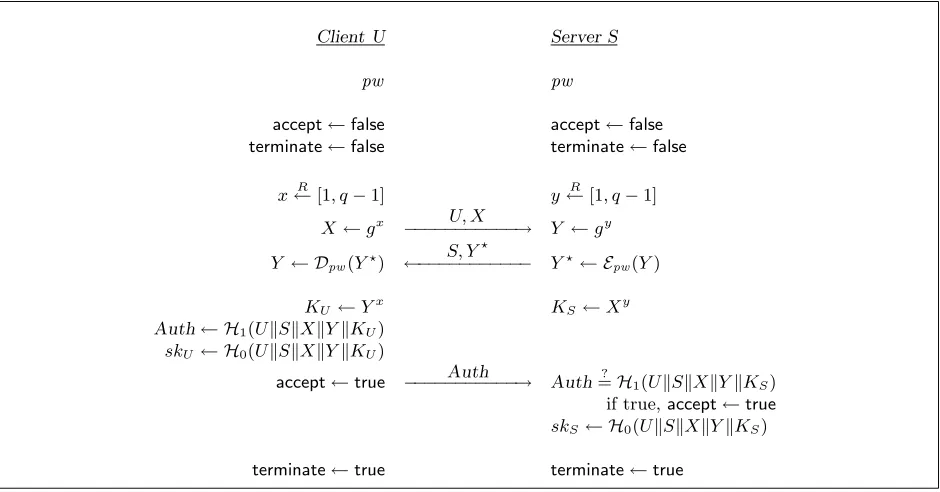
Fig. 1. An execution of the protocol OEKE, run by the client U and the server S. The session key is sk =
H0(UkSkXkYkYx) =H0(UkSkXkYkXy).
one flow of the basic Diffie-Hellman key exchange encrypted under the password and two protocol entities holding the same password. It therefore slightly differs from the originalEKE[3, 6] in the sense that only one flow is encrypted using the password; instead of the two as usually done. But then, it is clear that at least one authentication flow has to be sent. We prove this is enough to satisfy the above security notions.
3.1 Description of the Scheme
The arithmetic is in a finite cyclic groupG=hgiof order a`-bit prime numberq, where the operation is denoted multiplicatively. Hash functions from {0,1}? to {0,1}`0 and {0,1}`1 are denoted H
0 and
H1. A block cipher is denoted (Ek,Dk) where k ∈Password. We also define ¯Gto be equal to G\{1},
thus ¯G={gx|x∈Z?q}.
As illustrated on Figure 1 (with an honest execution of the OEKE protocol), the protocol runs between a clientU and a serverS, and the session-key spaceSKassociated to this protocol is{0,1}`0 equipped with a uniform distribution. Client and server initially share a low-quality string pw, the password, uniformly drawn from the dictionaryPassword.
The protocol consists of three flows. The client chooses a random exponentx and computes the value gx which he sends to the server. The server in turn chooses a random exponent y, computes
the value gy, and encrypts the latter under the passwordpw before to send it out on the wire. Upon
receiving the client’s flow, the server computes the Diffie-Hellman secret value gxy, and from it the session keysk. Upon receiving the server’s flow, the client decrypts the ciphertext, computes the Diffie-Hellman secret value, and an authentication tag Auth for client-to-server unilateral authentication. The client then sends out this authenticator. If the authenticator verifies on the server side, the client and the server have successfully exchanged the session key sk.
3.2 Semantic Security
goal. We consider the unilateral authentication goal in the next section. In the proof below, we do not consider forward-secrecy, for simplicity, but the semantic security still holds in this context, with slightly different bounds. The details can be found in the Appendix D. However, remember that any security result considers concurrent executions.
Theorem 1. Let us consider the OEKE protocol, where SK is the session-key space and Password is
a finite dictionary of size N equipped with the uniform distribution. Let A be an adversary against the AKE security of OEKE within a time bound t, with less than qs interactions with the parties and
qp passive eavesdroppings, and, askingqh hash-queries and qe encryption/decryption queries. Then we have
Advakeoeke(A)≤3× qs
N + 8qh×Succ cdh
G (t
0
) +(2qe+ 3qs+ 3qp) 2
q−1 +
q2
h+ 4qs
2`1 .
where t0
≤t+ (qs+qp+qe+ 1)·τG, with τG denoting the computational time for an exponentiation
in G. (Recall thatq is the order of G.)
This theorem shows that theOEKEprotocol is secure against dictionary attacks since the advantage of the adversary essentially grows with the ratio of interactions (number ofSend-queries) to the number of passwords. This is particularly significant in practice since a password may expire once a number of failed interactions has been achieved, whereas adversary’s capability to enumerate passwords off-line is only limited by its computational power. Of course, this security result only holds provided that the adversary does not solve the computational Diffie-Hellman problem.
Proof (of Theorem 1).In this section we incrementally define a sequence of games starting at the real game G0 and ending up at G8.
Game G0:This is the real attack game, in the random oracle and ideal-cipher models. Several oracles are thus available to the adversary: two hash oracles (H0 and H1), the encryption/decryption oracles (E andD), and all the instancesUi andSj (in order to cover concurrent executions). We define several
events in any gameGn:
– event Sn occurs ifb=b0, where bis the bit involved in theTest-query, andb0 is the output of the
AKE-adversary;
– event Encryptn occurs ifA submits a data it has encrypted by itself using the password;
– event Authn occurs if A submits an authenticator Auththat will be accepted by the server and
that has been built by the adversary itself. By definition,
Advakeoeke(A) = 2 Pr[S0]−1. (1) In the games below, we furthermore assume that when the game aborts or stops with no answerb0
outputted by the adversaryA, we choose this bitb0 at random, which in turn defines the actual value of the event Sk. Moreover, if the adversary has not finished playing the game after qs Send-queries
or lasts for more than time t, we stop the game (and choose a random bit b0
), where qs and t are
predetermined upper-bounds.
Game G1: In this game, we simulate the hash oracles (H0 and H1, but also two additional hash functions H2 : {0,1}? → {0,1}`2 and H3 : {0,1}? → {0,1}`3, with `2 = `0 and `3 = `1, that will appear in Game G7) and the encryption/decryption oracles, as usual by maintaining a hash list ΛH
(and another listΛA containing the hash-queries asked by the adversary itself) and an encryption list
ΛE (see Figure 2) We also simulate all the instances, as the real players would do, for theSend-queries
(see Figure 3) and for theExecute, Revealand Test-queries (see Figure 4).
For a hash-query Hi(q) (with i∈ {0,1,2,3}), such that a record (i, q, r) appears in ΛH, the answer is r.
Otherwise the answerris defined according to the following rule:
IRuleH(1) – Choose a random elementr∈ {0,1}`i.
The record (i, q, r) is added toΛH. If the query is directly asked by the adversary, one adds (i, q, r) toΛA.
For an encryption-queryEk(Z), such that a record (k, Z,∗,∗, Z?) appears inΛE, the answer isZ?. Otherwise
the answerZ?is defined according to the following rule:
IRuleE(1) – Choose a random elementZ?∈G¯.
Then one adds the record (k, Z,⊥,E, Z?) toΛ E.
For a decryption-queryDk(Z?), such that a record (k, Z,∗,∗, Z?) appears inΛE, the answer isZ. Otherwise,
one applies the following rule to obtain the answerZ:
IRuleD(1) – Choose a random elementϕ∈Z?
q, compute the answerZ=gϕ and add the record
(k, Z, ϕ,D, Z?) toΛ E.
Fig. 2.Simulation of the random oracles, and the encryption/decryption oracles
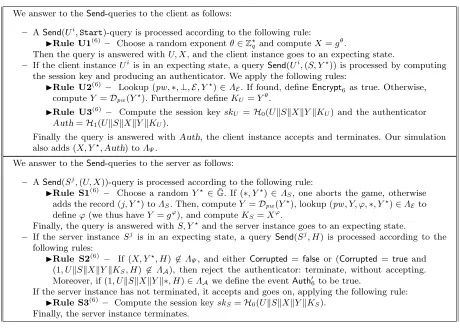
We answer to theSend-queries to the client as follows:
– ASend(Ui,Start)-query is processed according to the following rule:
IRule U1(1) – Choose a random exponentθ∈Z?q and computeX =gθ.
Then the query is answered withU, X, and the client instance goes to an expecting state. – If the client instanceUi is in an expecting state, a querySend(Ui
,(S, Y?)) is processed by computing
the session key and producing an authenticator. We apply the following rules:
IRule U2(1) – ComputeY =Dpw(Y?) andK U=Yθ.
IRule U3(1) – Compute the authenticatorAuth=H1(UkSkXkYkKU) and the session key
skU=H0(UkSkXkYkKU).
Finally the query is answered with Auth, the client instance accepts and terminates. Our simulation also adds ((U, X),(S, Y?),Auth) toΛ
Ψ. The variableΛΨ keeps track of the exchanged messages.
We answer to theSend-queries to the server as follows:
– ASend(Sj,(U, X))-query is processed according to the following rule:
IRule S1(1) – Choose a random exponent ϕ ∈ Z?q, compute Y = gϕ, Y? = Epw(Y) and KS=Xϕ.
Finally, the query is answered withS, Y?and the server instance goes to an expecting state.
– If the server instance Sj is in an expecting state, a query Send(Sj, H) is processed according to the
following rules:
IRule S2(1)– ComputeH0=H1(UkSkXkYkKS), and check whetherH=H 0
. If the equality does not hold, the server instance terminates without accepting.
If equality holds, the server instance accepts and goes on, applying the following rule:
IRule S3(1) – Compute the session keyskS=H0(UkSkXkYkKS).
Finally, the server instance terminates.
Fig. 3.Simulation of theSend-queries
An Execute(Ui, Sj)-query is processed using successively the simulations of the Send-queries: (U, X) ←
Send(Ui,Start), (S, Y?)←Send(Sj,(U, X)) and Auth←Send(Ui,(S, Y?)), and outputting the transcript
((U, X),(S, Y?),Auth).
AReveal(I)-query returns the session key (skUorskS) computed by the instanceI(if the latter has accepted).
A Test(I)-query first getssk fromReveal(I), and flips a coinb. Ifb= 1, we return the value of the session keysk, otherwise we return a random value drawn from{0,1}`0.
happens with probability at most q2E/2(q−1) since |G¯|= (q−1), whereqE is the size ofΛE:
|Pr[S1]−Pr[S0]| ≤ q
2
E
2(q−1). (2)
Game G2: We define game G2 by modifying the way the server processes the Send-queries so that the adversary will be the only one to encrypt data. We use the following rule:
IRule S1(2) – Choose a random Y? ∈ G¯ and compute Y = Dpw(Y?). Look for the record (pw, Y, ϕ,∗, Y?) in the list Λ
E to define ϕ (we thus have Y = gϕ), and finally compute
KS =Xϕ.
The two games G2 and G1 are perfectly indistinguishable unless ϕ = ⊥. This happens when
Y? has been previously obtained as the ciphertext returned by an encryption-query. Note that this
may happen when processing a Send-query, but also during a passive simulation when processing an
Execute-query:
|Pr[S2]−Pr[S1]| ≤ qSqE
q−1, (3)
where qS is the number of involved server instances: qS ≤qs+qp. Furthermore note that from now, only the adversary may ask encryption queries, since the server is simulated using the decryption oracle.
Game G3: In this game, we avoid collisions amongst the hash queries asked by the adversary toH1, amongst the passwords and the ciphertexts, and amongst the output of theSend-queries. We play the game in a way that: no collision has been found by the adversary forH1; no encrypted data corresponds to multiple identical plaintext; at most one password corresponds to each plaintext-ciphertext pair; abort if two instances of the server have used the same random values. This will help us later on to prove Lemma 2, the key step in proving Theorem 1. We use the following rules:
IRule H(3) – Choose a random element r∈ {0,1}`i. If i= 1, this query is directly asked by
the adversary, and (1,∗, r)∈ΛA, then we abort the game.
Then, for any H, #{(1,∗, H)∈ΛA} ≤1. But this rule may make the game to abort with probability
bounded byqh2/2`1+1
IRule E(3) – Choose a random element Z?∈G¯. If (∗,∗,⊥,E, Z?)∈ΛE, we abort the game. Then, for any Z?, #{(∗,∗,⊥,E, Z?) ∈ ΛE} ≤ 1. But this rule may make the game to abort with
probability bounded byq2E/2(q−1).
IRule D(3) – Choose a random elementϕ∈Z?q and compute Z=gϕ. If (∗, Z,∗,∗, Z?)∈ΛE, we abort the game. Otherwise, we add the record (k, Z, ϕ,D, Z?) to Λ
E.
Then, for any pair (Z, Z?), #{(∗, Z,∗,∗, Z?) ∈Λ
E} ≤1. But this rule may make the game to abort
with probability bounded byq2E/2(q−1).
IRule S1(3) – Choose a randomY?∈G¯. If (∗, Y?)∈ΛS, abort the game, otherwise add the record (j, Y?) toΛS. Then, computeY =Dpw(Y?), look for the record (pw, Y, ϕ,∗, Y?) inΛE
to define ϕ (we thus have Y =gϕ), and compute KS = Xϕ. The variable ΛS keeps track of
the messages sent out by the server S.
Then, there is no collision among theY? outputted by the server instances (and thus the usedY). But
The two gamesG3 andG2 are perfectly indistinguishable unless one of the above rules make the game to abort:
|Pr[S3]−Pr[S2]| ≤
2qE2 +qS2
2(q−1) +
q2h
2`1+1. (4)
Game G4: We define game G4 by aborting the executions wherein the adversary may have guessed the password and used it to send an encrypted data to the client. We achieve this aim by modifying the way the client processes the queries. We use the following rule:
IRule U2(4) – Look for (pw,∗,⊥,E, Y?)∈ΛE. If the record is found, defineEncrypt4 as true
and abort the game. Otherwise, computeY =Dpw(Y?) andKU =Yθ.
The two gamesG4 and G3 are perfectly indistinguishable unless eventEncrypt4 occurs:
|Pr[S4]−Pr[S3]| ≤Pr[Encrypt4]. (5)
Game G5: We define game G5 by aborting the executions wherein the adversary may have been lucky in guessing the authenticator (that is, without asking the corresponding hash query). We reach this aim by modifying the way the server processes the queries:
IRule S2(5) – Check whether H=H0, whereH0 =H1(UkSkXkYkKS). If the equality does hold, check if (1, UkSkXkYkKS, H) ∈ ΛA or ((U, X),(S, Y?), H) ∈ ΛΨ. If these two latter
tests fail, then reject the authenticator: terminate, without accepting. If this rule does not make the server to terminate, the server accepts and moves on.
This rule ensures that all accepted authenticators will come from either the simulator, or an adversary that has correctly decryptedY? intoY, (computedKS) and asked the query to the oracleH
1. The two games G5 andG4 are perfectly indistinguishable unless the server rejects a valid authenticator. Since
Y did not appear in a previous session (since the Game G3), this happens only if the authenticator had been correctly guessed by the adversary without askingH1(UkSkXkYkKS):
|Pr[Encrypt5]−Pr[Encrypt4]| ≤ qs
2`1 |Pr[S5]−Pr[S4]| ≤
qs
2`1. (6)
Game G6: We define gameG6 by aborting the executions wherein the adversary may have guessed the password (that is the adversary has correctly decrypted Y? into Y) and then used it to build and send a valid authenticator to the server. We reach this aim by modifying the way the server processes the queries:
IRule S2(6) – Check if ((U, X),(S, Y?), H) ∈ ΛΨ. If this is not the case, then reject the authenticator: terminate, without accepting. Check if (1, UkSkXkYk∗, H) ∈ΛA. If this is the
case, we define the eventAuth06 to be true, and abort the game.
This rule ensures that all accepted authenticators come from the simulator. The two gamesG6andG5 are perfectly indistinguishable unless either (1, UkSkXkYkKS, H)∈ΛAor (1, UkSkXkYk∗, H)∈ΛA,
which both lead to Auth06 to be true:
|Pr[Encrypt6]−Pr[Encrypt5]| ≤Pr[Auth06] |Pr[S6]−Pr[S5]| ≤Pr[Auth06]. (7)
Game G7: In this game, we do no compute the authenticatorAuthand the session key sk using the oracles H0 and H1, but using the private oracles H2 and H3 so that the valuesAuth and sk are completely independent fromH0 and H1, but also Y,pw and any ofKU orKS. We reach this aim by using the following rules:
IRule S3(7) – Compute the session keyskS=H2(UkSkXkY?).
Since we do no longer need to compute the values KU and KS, we can also simplify the way client and server process the queries:
IRule U2(7) – Look for a record (pw,∗,⊥,E, Y?) in ΛE. If the record is found, we define
Encrypt7 as true and abort the game.
IRule S1(7) – Choose a random Y? ∈ G¯. If (∗, Y?) ∈ ΛS, one aborts the game, otherwise adds the record (j, Y?) to ΛS. Then, compute Y =Dpw(Y?).
The games G7 and G6 are indistinguishable unless the following event AskH occurs: A queries the hash functions H0 or H1 on UkSkXkYkKU or on UkSkXkYkKS, that is on the common value
UkSkXkYkCDH(X, Y):
|Pr[Encrypt7]−Pr[Encrypt6]| ≤Pr[AskH7] |Pr[S7]−Pr[S6]| ≤Pr[AskH7]
Pr[Auth
0
7]−Pr[Auth
0
6]
≤Pr[AskH7]. (8)
Lemma 2. The probabilities of the events S7,Encrypt7, and Auth
0
7 in game G7 can be upper-bounded
by the following values:
Pr[S7] = 1
2 Pr[Encrypt7]≤
qs
2N Pr[Auth
0
7]≤
qs
2N. (9)
Proof. The formal proof of this lemma can be found in the Appendix A.1. The main idea in simulating this game is to choose the passwordpw at the end of the game. The passwordpw is in fact only needed to determine whether the events Encrypt7 orAuth07 have occurred, and it turns out that determining whether these events have occurred can be postponed until the time limit has been reached or the adversary has askedqsqueries. The probabilities ofEncrypt7orAuth
0
7can then be easily upper-bounded since no information, in the information theoretical sense, about the password pw is known by the
adversary along this simulation. ut
Game G8: In this game, we simulate the executions using the random self-reducibility of the Diffie-Hellman problem, given oneCDHinstance (A, B). We do not need to known the values ofθand
ϕ, since the valuesKU orKS are no longer needed to compute the authenticator and the session keys: IRule U1(8) – Choose a random elementα∈Z?q, and computeX =Aα. Also add the record
(α, X) to ΛA.
IRule D(8) – Choose a random element β∈Z?q, and compute the answer Z =Bβ. Also add the record (β, Z) toΛB. If (∗, Z,∗,∗, Z?)∈Λ
E then we abort the game; otherwise we add the
record (k, Z,⊥,D, Z?) to Λ
E.
Pr[AskH8] = Pr[AskH7]. (10)
Remember that AskH8 means that the adversary A had queried the random oracles H0 or H1 on UkSkXkYkZ, where Z = CDH(X, Y). By picking randomly in the ΛA-list we can get the
Diffie-Hellman secret value with probability 1/qh. This is a triple (X, Y,CDH(X, Y)). We can then simply
look in the listsΛA andΛB to find the values α andβ such thatX =Aα and Y =Bβ:
CDH(X, Y) =CDH(Aα, Bβ) =CDH(A, B)αβ.
Thus:
Pr[AskH8]≤qhSucc cdh
G (t
0
This concludes the proofs (the details of the computations can be found in the Appendix A.2. Simply note that qE is the size of ΛE, which contains all the encryption/decryption queries directly asked by
the adversary, but also all the decryption queries made by our simulation: at most one perSend-query (direct or through Execute-queries), which makes qE ≤ qe+qs+qp. Similarly, qS is the number of
involved server instances, and thus qS ≤ qs+qp. Furthermore, one can easily see that in this last
game, t0 ≤t+ (qs+qp+qe+ 1)·τG. ut
3.3 Unilateral Authentication
The following theorem shows that theOEKEprotocol furthermore ensures authentication from client to server, in the sense that a server instance will never accept an authenticator that has not actually been sent by the corresponding/expected client instance with probability significantly greater than
qs/N.
Theorem 3. Let us consider the OEKE protocol, where SK is the session-key space and Password a
finite dictionary of size N equipped with the uniform distribution. Let A be an adversary against the AKE security of OEKE within a time bound t, with less than qs interactions with the parties and qp
passive eavesdroppings, and, asking qh hash-queries and qe encryption/decryption queries. Then we have
Advcoeke−auth(A)≤ 3
2 ×
qs
N + 3qh×Succ cdh
G (t
0
) +(2qe+ 3qs+ 3qp) 2
2(q−1) +
q2
h+ 4qs
2`1+1 .
where t0
≤t+ (qs+qp+qe+ 1)τG, with τG denoting the computational time for an exponentiation in G. (Recall that q is the order of G.)
Proof. The proof is similar to the previous one. But one can find more details in the Appendix B. ut
4 Applications
We describe some applications of our security results. We first show that some of the AuthA modes of operations [4] proposed to the IEEE P1363 Standard working group encompass particular cases of
OEKE. Then, we make the ideal-cipher model more concrete.
4.1 Verifier-based Key Exchange
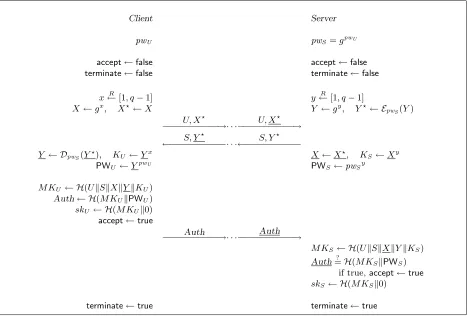
The AuthA protocol standardized by the IEEE organization is slightly different from our protocol since client and server do not share a passwordpw. The AuthAhas an added mechanism preventing an adversary corrupting the password table of a server from impersonating a client at once. TheAuthA
protocol takes advantage of the asymmetric cryptography principles when generating the passwords hold by the client and the server. The client holds a derived password pwU =H0(UkSkPW) (where PW is the actual password, and pwU has the same entropy but in Z?q) and the server holds a value pwS derived from the latter password as follows pwS =gpwU. It has the same entropy as PW too. It
is then straightforward to modify our protocol to make use of these valuespwU and pwS rather than
just the shared password pw (see Figure 5): pwS plays the role of the common password, and H0(UkSkXkYkZ)← H(H(UkSkXkYkZ)k0) H1(UkSkXkYkZ)← H(H(UkSkXkYkZ)kYpwU).
Client Server
pwU pwS =gpwU
accept←false accept←false
terminate←false terminate←false
x←R [1, q−1] y←R [1, q−1] X←gx, X?←X Y ←gy, Y?← Epw
S(Y)
U, X?
−−−−−−−−−−−→· · · U, X
?
−−−−−−−−−−−→
S, Y?
←−−−−−−−−−−−· · · S, Y
?
←−−−−−−−−−−−
Y ← DpwS(Y ?),
KU←Yx X←X?, KS←Xy
PWU←YpwU PWS←pwSy
M KU← H(UkSkXkYkKU)
Auth← H(M KUkPWU)
skU← H(M KUk0)
accept←true
Auth
−−−−−−−−−−−→· · ·−−−−−−−−−−−→Auth
M KS← H(UkSkXkYkKS)
Auth=? H(M KSkPWS)
if true,accept←true
skS← H(M KSk0)
terminate←true terminate←true
Fig. 5.TheAuthAprotocol run by the clientUand the serverS– The session key forUisskU=H(H(UkSkXkYkYx)k0).
The session key forS isskS=H(H(UkSkXkYkXy)k0).
4.2 The AuthA Modes of Operation
When engineers choose a password-based key exchange scheme, they take into account its security, computation and communication efficiency, and easiness of integration. Since they do not all face the same computing environment, they may want to operate theAuthAprotocol in different ways: encrypt both flows of the basic Diffie-Hellman key exchange; achieve mutual-authentication; the server sends out the first protocol flow. These different ways have already been described in [4] and do not seem to alter the security of theAuthAprotocol. But more precise security analyses similar to the above ones should be performed before actually using the other modes.
4.3 Instantiating the Encryption Function
It is clear that a simple block-cipher can not be used in place of the ideal-cipher required by the security result. We indeed need permutations ontoGfor all the secret keys, otherwise partition attacks can be mounted [10]. In specific cases where the encoding of the elements is compact, on can use the iterated technique [1]: one encrypts the element, and reencrypts the result, until one finally falls in the groupG. Decryption operates the same way. With well-chosen elliptic curves, the average number of iterations can be bounded by 2. Furthermore, the size of the blocks can thus be less than 256 bits. However, one must be careful in the implementation to prevent timing attacks.
5 Conclusion
The reductions presented in this paper are not optimal, but our intend was to present easy to read, understand and meaningful proofs rather than very efficient ones. We think that the terms 3qs/2N
or 3qs/N can be improved to qs/N, but the proof would then in turn becomes very intricate. For technical reasons the hash functionH1 used to build the authenticator has to be collision-resistant in our proofs, but the authors of AuthA [4] suggest to use a 64-bit authenticator. This may turn out to be enough in practice, but the proof presented in the paper would then need to be modified. It, however, seems a bad idea to use the same hash functionHeverywhere in AuthA.
Acknowledgments
The second author was supported by the Director, Office of Science, Office of Advanced Scientific Computing Research, Mathematical Information and Computing Sciences Division, of the U.S. De-partment of Energy under Contract No. DE-AC03-76SF00098. This document is report LBNL-51868. Disclaimer available at http://www-library.lbl.gov/disclaimer.
References
1. M. Bellare, A. Boldyreva, A. Desai, and D. Pointcheval. Key-Privacy in Public-Key Encryption. InAsiacrypt ’01, LNCS 2248, pages 566–582. Springer-Verlag, Berlin, 2001.
2. M. Bellare and T. Kohno and C. Namprempre. Authenticated Encryption in SSH: Provably Fixing the SSH Binary Packet Protocol. InProc. of the 9th CCS. ACM Press, New York, 2002.
3. M. Bellare, D. Pointcheval, and P. Rogaway. Authenticated Key Exchange Secure Against Dictionary Attacks. In Eurocrypt ’00, LNCS 1807, pages 139–155. Springer-Verlag, Berlin, 2000.
4. M. Bellare and P. Rogaway. The AuthA Protocol for Password-Based Authenticated Key Exchange. Contributions to IEEE P1363. March 2000. Available fromhttp://grouper.ieee.org/groups/1363/.
5. M. Bellare and P. Rogaway. Random Oracles Are Practical: a Paradigm for Designing Efficient Protocols. InProc. of the 1st CCS, pages 62–73. ACM Press, New York, 1993.
6. S. M. Bellovin and M. Merritt. Encrypted Key Exchange: Password-Based Protocols Secure against Dictionary Attacks. InProc. of the Symposium on Security and Privacy, pages 72–84. IEEE, 1992.
7. S. M. Bellovin and M. Merritt. Augmented Encrypted Key Exchange: A Password-Based Protocol Secure against Dictionary Attacks and Password File Compromise. InProc. of the 1st CCS, pages 244–250. ACM Press, New York, 1993.
8. S. Blake-Wilson, V. Gupta, C. Hawk, and B. Moeller. ECC Cipher Suites for TLS, February 2002. IEEE RFC 20296.
9. N. Borisov, I. Goldberg, and D. Wagner. Intercepting Mobile Communications: The Insecurity of 802.11. InProc. of ACM International Conference on Mobile Computing and Networking (MobiCom’01), 2001.
10. C. Boyd, P. Montague, and K. Nguyen. Elliptic Curve Based Password Authenticated Key Exchange Protocols. In ACISP ’01, LNCS 2119, pages 487–501. Springer-Verlag, Berlin, 2001.
11. V. Boyko, P. MacKenzie, and S. Patel. Provably Secure Password Authenticated Key Exchange Using Diffie-Hellman. InEurocrypt ’00, LNCS 1807, pages 156–171. Springer-Verlag, Berlin, 2000.
12. E. Bresson, O. Chevassut, and D. Pointcheval. Group Diffie-Hellman Key Exchange Secure against Dictionary Attacks. InAsiacrypt ’02, LNCS 2501, pages 497–514. Springer-Verlag, Berlin, 2002.
13. E. Bresson, O. Chevassut, and D. Pointcheval. Encrypted Key Exchange using Mask Generation Function. Work in progress.
14. R. Cramer and V. Shoup. A Practical Public Key Cryptosystem Provably Secure against Adaptive Chosen Ciphertext Attack. InCrypto ’98, LNCS 1462, pages 13–25. Springer-Verlag, Berlin, 1998.
15. O. Goldreich and Y. Lindell. Session-Key Generation Using Human Passwords Only. InCrypto ’01, LNCS 2139, pages 408–432. Springer-Verlag, Berlin, 2001.
16. J. Katz, R. Ostrovsky, and M. Yung. Efficient Password-Authenticated Key Exchange Using Human-Memorizable Passwords. InEurocrypt ’01, LNCS 2045, pages 475–494. Springer-Verlag, Berlin, 2001.
17. J. Katz, R. Ostrovsky, and M. Yung. Forward Secrecy in Password-only Key Exchange Protocols. InProc. of SCN ’02, 2002.
18. M. Steiner, P. Buhler, T. Eirich, and M. Waidner. Secure Password-Based Cipher Suite for TLS.ACM Transactions on Information and System Security (TISSEC), 4(2):134–157, 2001.
20. IEEE Standard 1363–2000. Standard Specifications for Public Key Cryptography. IEEE. Available from http://grouper.ieee.org/groups/1363, August 2000.
21. IEEE Standard 1363.2 Study Group. Password-Based Public-Key Cryptography. Available from http://grouper.ieee.org/groups/1363/passwdPK.
22. Wireless Application Protocol. Wireless Transport Layer Security Specification, February 2000. WAP TLS, WAP-199 WTLS.
A Complements for the Proof of Theorem 1
A.1 Proof of Lemma 2
Game G7: In this game, we compute the authenticatorskU and the session keyskS using the private oracles H2 and H3 as depicted on Figure 6. Generating these values by querying the private oracles only X and Y? enable us to no longer need to compute the values Y, K
U, andKS for the simulation,
but just to compute them at the end with the actual value ofpw for defining the eventsEncrypt7 and
Auth07.
TheRule U2(7), Rule S1(7) and Rule S2(7) can indeed be rewritten as rules that do not need the password along the simulation, but only make use of it at the end of the simulation. One can easily see on Figure 7 that theRule U2+(7) and Rule S2+(7) are not useful for the simulation, but that they are only useful to determine whether events Encrypt7 orAuth07 occurred. They can thus be postponed until the adversary has askedqs queries, or time limit expired. But then, one can note that the passwordpw is not used anymore, until these last rules are proceeded: one can run the simulation, without any password, and just choose it before processing these two rules.
Let us denote byR(U) the set ofY? received by a client instance, and byR(S) the set of (H, Y?) used by a server instance. From an information theoretical point of view, since we have avoided collisions in the Game G3,
Pr[Encrypt7] = Pr
pw[∃Y
? ∈R(U),(pw,∗,⊥,E, Y?)∈Λ
E] ≤
#R(U)
N
Pr[Auth07] = Pr
pw[∃(H, Y
?)∈R(S), Y ← D
pw(Y?),(1, UkSkXkYk∗, H)∈ΛA]≤
#R(S)
N .
By definition of the sets R(U) andR(S), sinceY? is received in the second query to the user, andH
in the second query to the server, the cardinalities are both upper-bounded byqs/2.
Moreover, the session keys are random, independent from any other data (from an information theoretical point of view, sinceH2 and H3 are private random oracles). Then, Pr[S7] = 1/2. ut
A.2 Conclusion of the Proof of Theorem 1
By summing up all the relations, one completes the proof. From Equations (1), (2), (3), (4) and (5),
|Pr[S4]−Pr[S0]| ≤
qE2
2(q−1) +
qSqE
q−1+
2qE2+q2S
2(q−1) +
qh2
2`1+1 + Pr[Encrypt4]
≤(2qE+qS)
2
2(q−1) +
qh2
2`1+1 + Pr[Encrypt4]
From Equations (6 – 8), |Pr[Encrypt7]−Pr[Encrypt4]| and |Pr[S7]−Pr[S4]| are both upper-bounded by
qs
2`1 + Pr[Auth
0
6] + Pr[AskH7]≤
qs
2`1 + Pr[Auth
0
7] + 2 Pr[AskH7]. (12) Then,
|Pr[S7]−Pr[S0]| ≤ (2qE +qS)
2
2(q−1) +
qh2
2`1+1 + 2qs
2`1
We answer to theSend-queries to the client as follows:
– ASend(Ui,Start)-query is processed according to the following rule:
IRule U1(7) – Choose a random exponentθ∈Z?q and computeX =gθ.
Then the query is answered withU, X, and the client instance goes to an expecting state.
– If the client instanceUi is in an expecting state, a querySend(Ui,(S, Y?)) is processed by computing
the session key and producing an authenticator. We apply the following rules:
IRule U2(7)– Lookup (pw,∗,⊥,E, Y?)∈ΛE. If found, defineEncrypt7as true and abort the
game.
IRule U3(7) – Compute the session key skU = H2(UkSkXkY?) and the authenticator
Auth=H3(UkSkXkY?).
Finally the query is answered with Auth, the client instance accepts and terminates. Our simulation also adds ((U, X),(S, Y?),Auth) toΛ
Ψ.
We answer to theSend-queries to the server as follows:
– ASend(Sj
,(U, X))-query is processed according to the following rule:
IRule S1(7) – Choose a random Y? ∈G¯. If (∗, Y?)∈ ΛS, one aborts the game, otherwise
adds the record (j, Y?) to
ΛS. Then, computeY =Dpw(Y?).
Finally, the query is answered withS, Y?and the server instance goes to an expecting state.
– If the server instance Sj is in an expecting state, a query Send(Sj, H) is processed according to the
following rules:
IRule S2(7) – Check if (X, Y?, H)∈ΛΨ. If this is not the case, then reject the authenticator:
terminate, without accepting. Check if (1, UkSkXkYk∗, H)∈ΛA. If this is the case, we define
the eventAuth0
7 to be true, and abort the game.
If the server instance has not terminated, it accepts and moves on to apply the following rule:
IRule S3(7) – Compute the session keyskS=H2(UkSkXkY?).
Finally, the server instance terminates.
Fig. 6.Simulation of theSend-queries inG7
We first rewrite theRule U2:
IRule U2-(7) – Does nothing.
IRule U2+(7) – Lookup (pw,∗,⊥,E, Y?)∈ΛE. If found, defineEncrypt7 as true (and abort the
game).
We then modify the organization of theRule S1and theRule S2:
IRule S1-(7) – Choose a randomY?∈G¯. If (∗, Y?)∈Λ
S, one aborts the game, otherwise adds
the record (j, Y?) to
ΛS.
IRule S2-(7) – Check if ((U, X),(S, Y?), H)∈
ΛΨ. If this is not the case, then reject the
authen-ticator: terminate, without accepting.
IRule S2+(7) – Compute Y =Dpw(Y?), and lookup (1, Uk
SkXkYk∗, H)∈ΛA. If found, define
Auth0
7as true (and abort the game).
From Equations (9), (10) and (11), one gets
Pr[Encrypt7]≤ qs
2N Pr[Auth
0
7]≤
qs
2N Pr[AskH7]≤qhSucc cdh
G (t
0
), (13)
which concludes the proof. ut
B Proof of Theorem 3
We can actually use the proof presented in Section 3.2, since
Advcoeke−auth(A) = Pr[Auth0],
and see that in gameG6, Pr[Auth6] = 0, and Equations (2), (3), (4), (5), (6), and (7) extends to
|Pr[Auth1]−Pr[Auth0]| ≤ q
2
E
2(q−1) |Pr[Auth2]−Pr[Auth1]| ≤
qSqE
q−1
|Pr[Auth3]−Pr[Auth2]| ≤
2qE2+q2S
2(q−1) +
qh2
2`1+1 |Pr[Auth4]−Pr[Auth3]| ≤Pr[Encrypt4]
|Pr[Auth5]−Pr[Auth4]| ≤ qs
2`1 |Pr[Auth6]−Pr[Auth5]| ≤Pr[Auth
0
6]. Then, using Equations (12) from the conclusion of the previous proof, and Equation (8), one gets,
Advcoeke−auth(A)≤ q
2
E
2(q−1) +
qSqE
q−1 + 2q2
E+q2S
2(q−1) +
q2
h
2`1+1 + Pr[Encrypt4] +
qs
2`1 + Pr[Auth
0
6]
≤ (2qE+qS)
2
2(q−1) +
qh2+ 2qs
2`1+1 +Pr[Encrypt7] + qs
2`1 + Pr[Auth
0
7] + 2 Pr[AskH7]
+ Pr[Auth07] + Pr[AskH7]
≤ (2qE+qS)
2
2(q−1) +
qh2+ 4qs
2`1+1 + Pr[Encrypt7] + 2 Pr[Auth
0
7] + 3 Pr[AskH7],
which concludes the proof, using Equation (13). ut
C Security Proof of AuthA
Proving the security of this new protocol follows the same path as the one in Section 3.2, until the GameG8:
Game G8: In that game, we simulate the executions using the random self-reducibility of the Diffie-Hellman problem, given one Diffie-Diffie-Hellman instance (A, B). We first choose a random elementγ ∈Z?q and definepwS =Aγ. We also add the record (γ,pwS) to ΛA.
IRule U1(8) – Choose a random elementα∈Z?q, and computeX =Aα. Also add the record (α, X) to ΛA.
IRule D(8) – Choose a random element β ∈ Z?q, and compute the answer Z = Bβ. Also add the record (β, Z) toΛB. If (∗, Z,∗,∗, Z?)∈Λ
E, one aborts the game, otherwise adds the
record (k, Z,⊥,D, Z?) to Λ
Pr[AskH8] = Pr[AskH7]. (14) Remember that AskH8 means that the adversary A queried the random oracles H0 or H1 on
UkSkXkYkCDH(X, Y), and thus H on UkSkXkYkCDH(X, Y) or ∗kCDH(pwS, Y). By picking
ran-domly in theΛA-list, with probability 1/qh, we can get the Diffie-Hellman secret value. This is a triple
(X, Y,CDH(X, Y)). One then simply looks up intoΛA andΛB to get α and β such that X =Aα and Y =Bβ:
CDH(X, Y) =CDH(Aα, Bβ) =CDH(A, B)αβ.
Thus:
Pr[AskH8]≤qhSucccdhG (t
0
). (15)
This concludes the proof. ut
D Forward-Secrecy
The previous security results and proofs do not deal with forward-secrecy. Considering forward-secrecy requires to take into account a new kind of query that we call the Corrupt-query (any other kinds of queries can still be asked, before but also after this one):
– Corrupt(I): This query models the attacks resulting in the password pw of this party I to be revealed. Agets back from its query pw but does not get any internal data of I.
Then we define a new flavor of freshness, saying that an instance isFresh (or holds a Fresh key
sk) if the following conditions hold. First, the instance has computed and accepted a session key. Second, noCorrupt-query has been made by the adversary since the beginning of the game (before the session key is accepted). Third, neither it nor its partner have been asked for a Reveal-query.
This security level means that the adversary does not learn any information about previously
established session keys when making aCorrupt-query. We thus denote by AdvakeP −fs(A) the advantage an adversary can get on a fresh key, in the protocol P, with the ability to make aCorrupt-query.
Theorem 4 (AKE-FS Security). Let us consider the OEKEprotocol, where SK is the session-key
space and Password a finite dictionary of size N equipped with the uniform distribution. Let A be an adversary against the AKE security ofOEKEwithin a time boundt, with less thanqsinteractions with
the parties and qp passive eavesdroppings, and, asking qh hash-queries and qe encryption/decryption queries. Then we have
Advakeoeke−fs(A)≤3× qs
N + 4qh(1 + (qs+qp)
2)×Succcdh
G (t
0
) +(2qe+ 3qs+ 3qp) 2
q−1 +
q2h+ 4qs
2`1 .
where t0
≤t+ (qs+qp+qe)·τG, with τG denoting the computational time for an exponentiation inG.
(Recall that q is the order of G.)
Proof. To deal with forward-secrecy, we define eventCorruptedas the event thatAasks aCorrupt-query, and we refine events Encrypt, Auth, Auth0 and AskH respectively into EncryptBC, AuthBC, AuthBC0
and AskHBCrespectively:
EncryptBCk:=Encryptk≺Corrupted AuthBCk :=Authk≺Corrupted
AuthBC0k:=Auth0k≺Corrupted AskHBC0k :=AskHk≺Corrupted
that is EncryptBCk, AuthBCk, AuthBC
0
k or AskHBCk respectively occur if Encryptk, Authk, Auth
0
k or
AskHk respectively occurbefore corrupting a player.
IRule S2(6) – If (X, Y?, H) 6∈ ΛΨ, and either Corrupted = false or (Corrupted = true and (1, UkSkXkYkKS, H) 6∈ ΛA), then reject the authenticator: terminate, without accepting.
Moreover, ifCorrupted=false and (1, UkSkXkYk∗, H)∈ΛA we define the event AuthBC06 to
be true, and abort the game.
IRule U3(7) – If Corrupted = false, then compute the session key skU = H2(UkSkXkY?) and the authenticator Auth= H3(UkSkXkY?). Otherwise, compute the session key skU =
H0(UkSkXkYkKU) and the authenticator Auth=H1(UkSkXkYkKU).
IRule S3(7) – If Corrupted = false, then compute the session key skS = H2(UkSkXkY?). Otherwise, compute the session keyskS =H0(UkSkXkYkKS).
IRule U2(7) – Lookup (pw,∗,⊥,E, Y?)∈ΛE. If found, defineEncrypt7 as true and abort the
game. Otherwise, computeY =Dpw(Y?). IfCorrupted=false, furthermore define KU =Yθ.
IRule S1(7) – Choose a random Y? ∈ G¯. If (∗, Y?) ∈ ΛS, one aborts the game, otherwise adds the record (j, Y?) toΛ
S. Then, computeY =Dpw(Y?). IfCorrupted=false, furthermore
lookup (pw, Y, ϕ,∗, Y?)∈Λ
E to defineϕ (we thus have Y =gϕ), and compute KS=Xϕ.
By evaluating the events Encrypt7 andAuth7 at the corruption time, one gets as before
|Pr[S6]−Pr[S0]| ≤
(2qE+qS)2
2(q−1) +
qh2
2`1+1 + Pr[EncryptBC4] +
qs
2`1 + Pr[AuthBC
0
6],
Pr[EncryptBC4]≤ qs
N + qs
2`1 +qhSucc
cdh
G (t
0
) Pr[AuthBC06]≤ qs
2N +qhSucc cdh
G (t
0
).
As a consequence,
|Pr[S6]−Pr[S0]| ≤ 3qs
2N + 2qh×Succ cdh
G (t
0
) +(2qE+qS) 2
2(q−1) +
q2
h
2`1+1 + 2qs
2`1. (16) We now go back the game G6, as presented on Figure 8. We furthermore abort the game where the events EncryptBC6 orAuthBC06 happen to be true.
Game G7: We now have to make a different analysis: we need to know the private exponents of (almost) all the instances of the parties, since the adversary may send the authenticator after making the Corrupt-query, and thus knowing the password. Otherwise, a later Reveal-query would not be perfect. Therefore, one first bets on an execution (passive or active) to be tested: one chooses a random index µ ∈ {1, . . . , qs+qp} and a random index ν ∈ {1, . . . , qs+qp}. If the Test-query does not correspond to the client involved in theµ-thSend-query, and the server involved in theν-thSend -query, then one aborts the game, outputting a random bitb0
. Since the Test-query can only be asked to an instance that has accepted before any corruption and that only simulated keys can be asked,
Pr[S7] = 1
(qs+qp)2 ×Pr[S6] +
1− 1
(qs+qp)2
×1 2. Then,
Pr[S6]−1
2
= (qs+qp)2×
Pr[S7]− 1
2 . (17)
Game G8: We now inject aCDH instance into this specific execution: we are given (A, B), with the discrete logarithms aand b
We answer to theSend-queries to the client as follows:
– ASend(Ui,Start)-query is processed according to the following rule:
IRule U1(6) – Choose a random exponentθ∈Z?q and computeX =gθ.
Then the query is answered withU, X, and the client instance goes to an expecting state.
– If the client instanceUi is in an expecting state, a querySend(Ui,(S, Y?)) is processed by computing
the session key and producing an authenticator. We apply the following rules:
IRule U2(6) – Lookup (pw,∗,⊥,E, Y?)∈Λ
E. If found, defineEncrypt6 as true. Otherwise,
computeY =Dpw(Y?). Furthermore define
KU=Yθ.
IRule U3(6) – Compute the session keyskU =H0(UkSkXkYkKU) and the authenticator
Auth=H1(UkSkXkYkKU).
Finally the query is answered with Auth, the client instance accepts and terminates. Our simulation
also adds (X, Y?,Auth) toΛ Ψ.
We answer to theSend-queries to the server as follows:
– ASend(Sj
,(U, X))-query is processed according to the following rule:
IRule S1(6) – Choose a random Y? ∈G¯. If (∗, Y?)∈ ΛS, one aborts the game, otherwise
adds the record (j, Y?) to
ΛS. Then, computeY =Dpw(Y?), lookup (pw, Y, ϕ,∗, Y?)∈ΛE to
defineϕ(we thus haveY =gϕ), and computeK
S=Xϕ.
Finally, the query is answered withS, Y?and the server instance goes to an expecting state.
– If the server instance Sj is in an expecting state, a query Send(Sj, H) is processed according to the
following rules:
IRule S2(6) – If (X, Y?, H) 6∈
ΛΨ, and either Corrupted = false or (Corrupted = trueand
(1, UkSkXkYkKS, H) 6∈ ΛA), then reject the authenticator: terminate, without accepting.
Moreover, if (1, UkSkXkYk∗, H)∈ΛA we define the eventAuth06 to be true.
If the server instance has not terminated, it accepts and goes on, applying the following rule:
IRule S3(6) – Compute the session keyskS=H0(UkSkXkYkKS).
Finally, the server instance terminates.
Fig. 8.Simulation of theSend-queries inG6
IRuleD(8) – If this corresponds to theν-th instance of the server, setϕ=b, otherwise choose a random element ϕ ∈ Z?q. Then compute Z = Bϕ. If (∗, Z,∗,∗, Z?) ∈ ΛE, one aborts the
game. One finally adds the record (k, Z, ϕ,D, Z?) to ΛE.
The games G8 and G7 are perfectly indistinguishable:
Pr[S7] = Pr[S8]. (18)
Game G9: In that game, the session key and the authenticator of this specific execution of the protocol is defined using private random oraclesH2 and H3, independent fromH0 and H1. For that, we modify the following rules:
IRule U2(9) – Lookup (pw,∗,⊥,E, Y?) ∈ΛE. If found, define Encrypt9 as true. If this does
not correspond to the µ-th instance of the client, one computes Y = Dpw(Y?) and defines
KU =Yθ (otherwise we won’t need it).
IRule U3(9) – If this corresponds to the µ-th instance of the client, one computes the session key skU = H2(UkSkXkY?) and the authenticator Auth = H3(UkSkXkY?). Oth-erwise, compute the session key skU = H0(UkSkXkYkKU) and the authenticator Auth =
H1(UkSkXkYkKU).
IRule S1(9) – Choose a randomY?∈G¯. If (∗, Y?)∈ΛS, one aborts the game, otherwise adds the record (j, Y?) to Λ
S. If this does not correspond to the ν-th instance of the server, one
computes Y =Dpw(Y?), looks up (pw, Y, ϕ,∗, Y?)∈ΛE to define ϕ (we thus have Y =gϕ),
IRule S3(9) – If this corresponds to the ν-th instance of the server, one computes the session key skS = H2(UkSkXkY?). and the authenticator Auth = H3(UkSkXkY?). Oth-erwise, compute the session key skU = H0(UkSkXkYkKS) and the authenticator Auth =
H1(UkSkXkYkKS).
The games G9 and G8 are indistinguishable unless the following event AskH9 occurs: A queries the hash functions H0 orH1 onUkSkXkYkCDH(X, Y):
|Pr[S9]−Pr[S8]| ≤Pr[AskH9]. (19)
Game G10: Now, we are not given the discrete logarithms aand banymore:
IRule U1(10) – If this corresponds to the µ-th instance of the client, setX =A, otherwise, choose a random element θ∈Z?q and compute X =gθ.
IRule D(10) – If this corresponds to the ν-th instance of the server, set Z =B and ϕ=⊥, otherwise choose a random element ϕ∈Z?q and compute Z =Bϕ. Finally, if (∗, Z,∗,∗, Z?)∈
ΛE, one aborts the game. One then adds the record (k, Z, ϕ,D, Z?) to ΛE.
SinceKU and KS are not required for this execution of the protocol (the session key and the
authen-ticator are defined using independent private random oracles onX and Y? only), the two games are
indistinguishable:
Pr[S9] = Pr[S10] Pr[AskH9] = Pr[AskH10]. (20) Furthermore, it is now clear that
Pr[AskH10] =qh×Succ cdh
G (t
0
). (21)
As a conclusion, from the Equations (16), (17), (18), (19), (20) and (21),
Pr[S6]−1
2
≤2(qs+qp)2×Pr[AskH9]≤2(qs+qp)2qh×SucccdhG (t
0
).
This security result can definitely be improved using the random self-reducibility of the Diffie-Hellman problem. Namely, one could remove the factor (qs+qp)2, but this would make the reduction much