MODIFIERS OF COLOR PATTERN GENES I N
DROSOPHILA POLY MORPHA
*
MARLY NAPP MARTfNEZ AND ANTONIO R. CORDEIRO
Departamento de Gerwtica, Uniuersiaade Federal do R . G. S.,
Porto..2legre, Caixa Postnl 1953, B r a d
Received March 5. 1969
CONSPICUOUS color polymorphism is not common in the genus Drosophila. However, the work of DA CUNHA (1949, 1955),
HEED
(1962, 1963) andHEED
and BLAKE (1963) showed that the cardini group of species to which poly- morpha belongs, exhibits more externally visible color variants than any other Drosophila group so far studied in this resptxt. Other species of the uirilis, me- lanica, melanogaster and victoria groups also show some genetically determined variability in their pigmentation patterns(PIPKIN
1962,FREIRE-MAIA
1964). I t is possible that less evident differences in tergite pigmentation like the one re- ported by ROBERTSON and Low (1966) inD.
melanogaster do occur in nature and go unnoticed or are not considered to be genetically dete-mined. As the basis of the developmental and biochemical genetics of Drosophila body pigmentation is being elucidated, knowledge on the naturally occurring variants becomes more important and meaningful to the studies on gene dynamics in populations.Since 1949 DA CUNHA has established that three phenotypes of
D.
polymorphs,
light. intermediate and dark, found in Brazil are due to alleles at the locus e, pro-
duced by the respective genotypes, ezez, d e d and d e d . Recently,
HEED
and BLAKE (1963) discovered a third allele, dominant light eL in populations in northernSouth America. These authors found evidence for the action of modifiers in several crosses. A female-limited dominant modifier suppressing the dark pheno- type was detected but not firmly established in crosses between strains from Trinidad and ?dentes Claros (Brazil). Two recessive lethals have also been found by
HEED
and BLAKE (1 963), one being female-limited and the other being linked to the dark allele and not sex-limited. Quite simultaneously NAPP (1963) found that modifiers altered the phenotypic distribution from crosses obtained with ma- terial from Rio Grande do Sul.I n this paper we describe the observations that led us to suggest the existence of color modifying alleles that segregate independently from the major locus, e. The strength of the effects of these modifiers is such that the darkening allele i i i homozygous condition, mama, changes the ezez light homozygotes into a n inter- mediate phenotype, and the lightening allele m z m z is even stronger. This masking effect makes unreliable the determination of gene frequency by simple pheno- typic inspection of individuals from polymorphic populations of this species.
* This paper is dedicated to Professor TH. DOBZHANSKY, the founder of evolutionary genetics
in Brazil.
I
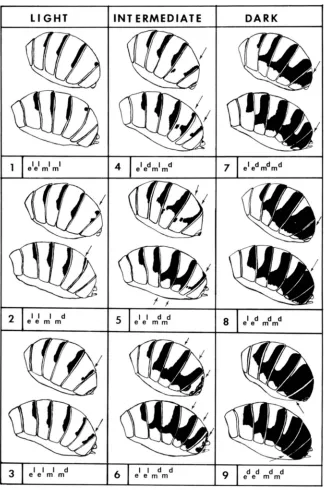
LIGHT121"'d
e e m m1-
e e m mIN1 ERMEDIATE
7
e e m m6lslsl"d
DARK
8
I
e'ed mdmd ~d d d d
9 l e e m m
FIGURE t .-The ninr pattrms of pigmentation of Drosophila polymorphu tergites. The arrows
point to spots of incrrased pigmentation from type 1 to 9, useful for type drterminntion. Only one
of the possible combinations of the major genes, d . and the modifiers. m', m", is presented
for each typr. Thr three classrs, light, intrrmrdiate and dnrk correspond approximatrly to
DA CurviiA's (19M) classification.
MATERIALS AND METHODS
The strains of D. polrmorphn DORZII~NSKY and PAVAN usrd in this work came from a sample
COLOR PATTERNS IN
D.
polymorpha 5 75State of Rio Grande do Sul, Brasil, at the locality of Itapeva. The frequency of polymorph was
12.5% in a total of 780 flies collected November 6, 1960. The gravid females isolated in culture
vials started the isofemale strains used in this work and maintained until the end of 1964..
Another sample was collected at the locality of Eldorado 40 km South of Port0 Alegm,
R.G.S. The culture medium we use in our laboratories is quite suitable for this species as well
as for most Drosophilae (MARQUES et al. 1966). It has been pointed out by DA CUNHA (1 94Q) and
HEED and BLAKE (1963), that D . polymorpha is not easy to grow in laboratory conditions due
partially to the skipping and wandering habit of their larvae. They are also temperature sensitive and start wandering as a result of minor temperature changes. Premature pupation of the wandering larvae decreases the number of adults in each culture. Single-pair cultures give an
average of 34 individuals. All cultures have been maintained at 25°C yet the life cycle varied
from 15 to 20 days depending on the crowding conditions of the cultures. After sexing, the newly
hatched adults were aged in uncrowded culture vials for 8 to 9 days to attain full pigmentation
and thus to be scored accurately.
R E S U L T S
The great variability exhibited by the presumed simple hybrids ezed compelled us to make detailed drawing of the male and female abdominal tergite patterns of pigmentation and score the frequencies of each color form for all crosses. As the data accumulated we chose the nine patterns that allowed the easiest classifi- cation of the array of observed forms. These arbitrary nine classes are pictured in Figure 1. These patterns have been arranged in such a way as to allow comparison with the classification presented by DA CUNHA (1949) and adopted by HEED
and BLAKE (1963). DA CUNHA considered three major phenotypes only, light,
intermediate and dark. From type 1 to 9 there is an increase of the pigmented area of the tergites.
The gravid females collected at Itapeva were isolated in culture vials and their
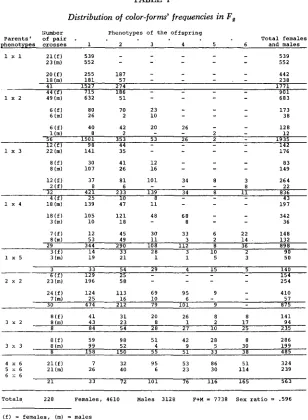
F, sexed, aged, and classified according to nine patterns. Single-pair matings were then performed with these individuals. The crosses among the types 1 to 6, that gave offspring within these limits proved to bear the “light” major allele, ez, only. However, they appear to be heterogeneous for specific and nonspecific modifiers. Table 1 shows the results of these crosses ordered according to the number of types appearing in the F,. The males were scored independently from the females. The variability of color patterns of these offspring frequently exceeds the limits of their parents (Table 1 ) . About half of the crosses 1 X 1 gave only type 1 but the other half produced type 2 also. The crosses 1 x 3 pro- duced variable results, twelve of them produced only types 1 and 2 among the females, and twenty-two gave males within these same limits. However, twelve others produced females classifiable from types 1 to 6, and only eight exhibited males within these same limits (Table 1 ) . The data were obtained for each cross and pooled in Table 1 to illustrate the fact that the males show less variability than the females. The twenty-nine crosses 1 x 4 follow the same trend, which again is seen in the type 2 x 2 crosses. The crosses between darker types usually gave variable results, the males showing lower numbers in the types 5 and 6. Since the material for these crosses has not been subjected to selection toward stabilization of the phenotypes, this variability is not unexpected. All these results (Table 1) share a common characteristic; they manifest no darker forms than type 6.
T h e
5 76 M. N. M A R T I N E Z A N D A. R. CORDEIRO
TABLE 1
Distribution of color-form' frequencies in F ,
number P h e n o t y p e s o f t h e o f f s p r i n g
P a r e n t s ' of p a i r
.
T o t a l f e m a l e s p h e n o t y p e s crosses 1 2 3 4 5 6 a n d males1 x 1 2 1 ( f ) 5 3 9 5 3 9
2 3 ( m ) 5 5 2
-
-
5 5 2442 2 3 8 2 0 ( f ) 2 5 5 1 8 7
1 8 (m) 1 8 1 5 7
4 1 1 5 2 7 214 1 7 7 1
4 4 ( f ) 7 1 5 1 8 6 9 0 1
1 x 2 4 9 (m) 6 3 2 5 1 6 8 3
2 3 1 7 3
2 3 8
6 ( f ) 80 2 6 7 0
6 (m) 1 0
20 2 6 1 2 8
8 2 2 1 2
6 ( f ) 40 42
56 1 (m) 1 5 0 1 3 5 3 5 3 26 2 1 9 3 5
1 2 ( f ) 9 8 44 - 1 4 2
1 x 3 2 2 ( m ) 1 4 1 3 5
-
- 1 7 630 4 1 1 2 8 3
8 ( m ) 1 0 7 2 6 1 6
-
-
-
1 4 98 ( f )
8 3 2 6 4
8 6 8 2 2
2 ( f )
4 ( f ) 2 5 1 0 8 4 3
1 x 4 1 8 (m) 1 3 9 4 7 11 1 9 7
1 8 ( f ) 1 0 5 1 2 1 4 8 6 8 3 4 2
3 (m) 1 0 1 8 8 36
7 ( f ) 1 2 4 5 3 0 33 6 2 2 1 4 8
8 (m) 5 3 49 11 3 2 1 4 1 3 2 2 9 3 4 4 2 9 0 1 0 8 1 1 2 8 36 8 9 8 3 ( f ) 1 4 3 3 2 8 3 1 0 2 9 0 1 x 5 3 (m) 1 9 2 1 1 1 5 3 5 0
3 3 3 5 4 29 4 1 5 5 1 4 0
6 ( f ) 1 2 9 2 5 1 5 4
2 x 2 2 3 ( m ) 1 9 6 5 8
-
2 5 42 4 ( f ) 1 2 4 1 1 3 6 9 9 5 9 4 1 0
7 (m) 2 5 1 6 1 0 6 5 7
30 474 212 79 1 0 1 9 8 7 5
4 1 3 1 20 26 8 8 1 4 1
8 (m) 2 3 8 1 2 1 7 9 4
5 4 2 8 2 7 1 0 2 5 2 3 5
3 x 2 4 3
8 4 -
-
-
1 2 ( f ) 37 8 1 1 0 1 3 4
-
32 4 2 1 2 3 3 1 3 9 34 8 11 8 3 68 ( f ) 5 9 9 8 5 1 4 2 2 8 8 2 8 6 3 x 3 8 (m) 9 9 5 2 4 9 5 30 1 9 9
8 1 5 8 1 5 0 5 5 5 1 3 3 3 8 4 8 5 4 x 6 2 l ( f ) 7 32 9 5 5 3 8 6 5 1 3 2 4 5 x 6 Z l ( m ) 26 40 6 2 3 30 1 1 4 2 3 9 6 x 6
2 1 3 3 7 2 1 0 1 76 1 1 6 1 6 5 5 6 3
T o t a l s 2 2 8 F e m a l e s , 4 6 1 0 Males 3 1 2 8 F+M = 7 7 3 8 S e x r a t i o = .596
( f ) = f e m a l e s , (m) = males
Pooled data for single-pair matings F, from nature; females and males scored separately, and
ordered according to the number of types occurring in each F2 culture.
1 to 9. This observation indicates that the types darker than 6 in the sample studied contained at least one dark ea allele.
From the results in Table 1 we inferred that darkening modifiers are frequent in our sample, since 125 in il total of 228 crosses produced type 3 or darker. If
COLOR PATTERNS I N
D.
polymorphaTABLE 2
Extremes of pigmentation in homozygotes for the major genes e' and ed
due to selection of modifiers
577
Homozygotes elel selected toward the
relatively darker (6) and lighter (1) types
'Homozygotes edeb selected toward darker type (9)
Cross Offspring types Cross Offspring types Cross Offspring types
Generation types 3 4 5 6 types 1 2 3 types 7 8 9
1 P 5 19 21 10 1 0 1 10 22 4 P 9 57 107 23 $ 2 10 14 18 5 $ 2 31 12 . . $ 8 . . 101 35
2 9 5 . . . . 51 26 9 1 45 8
_ _
0 9 . . 118 139$ 6 . . . . 21 43 $ 1 29 2 . . $ 8 . . 32 136
3 9 6 . . . . 68 19 9 1 47 9 . . 0 9 . . 17 70
$ 6 . .
_ _
. . 67 $ 1 46 . . . . $ 9 . . . . 514 9 6 _ . . . 76 29 9 1 73 15 . . 0 9 . . 28 79
8 ' 6 . . . 93 $ 1 61 . . . . $ 9 . . . _ 118
* Selection favoring lighter types (7) was not successful; the cultures have been lost.
P = female types crossed and female offspring types observed.
$ = male types crossed and male offspring observed.
After the 4th generation of selection the lines tended to stabilize around the propertions above, and the e W lighter and darker lines were observed for about 20 generations.
afterwards were maintained by mass culture, and always showed phenotypes varying from 1 to 6. Other strains exhibited variation between types 7 to 9. In order to reduce this variability we conducted a simple selection experiment to- ward the extreme phenotypes appearing in these two sets of strains. This selection progressed rather quickly in lines #I17 and #60, which proved to be homo- zygotes d e z , and stabilized around types 1 and 6, respectively, On the other hand, the line #303, homozygous dark &ed, gave a fast response to selection toward type 9 maintaining. however, some variation. The selection of homozygotes eded toward lighter forms ( 7 ) did not succeed. This failure was probably fortuitous due to the difficulty of raising this fly. New attempts in this direction are underway. As for lines #117, #60 and #303, we have observations during twenty generations showing that they maintained the relative uniformity attained after selection. The males are less variable than the females (see Table 2, Figures 2 and 3 ) . These simple selection experiments suggest also that the color modifier genes are not numerous. It is not easy to assess the precise extent of the variability due to the environmental factors since we have incomplete knowledge of the genetic factors affecting pigment deposition in the tergites. The results described sub- sequently disclosed a pair of color modifying alleles; the darkening ma and the lightening m z modifiers.
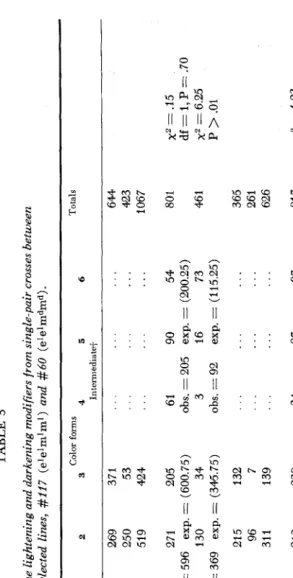
TABLE 3 Segregaiion of the lightening and darkening modifiers from single-pair crosses between selected lines, #I17 (elelmlml) and #60 (e'elmdmd). Color forms Totals Phenotypes and Generation and 1 2 3 4 5 6 genotypes of the P, number of crmses Light+ In temiediatet 33 F,
P 8
P+8 4 269 371 120 250 53 124 519 424 ... ... ... ... ... ... ... ... ...
644 423 1067
33 F, 0 120 271 205 obs. = 596 205 130 34 obs. = 369 exp. = (600.75) exp. = (345.75) 18 21 5 132 158 96 7 176 311 139 61 90 54 3 16 73 obs. = 205 exp. = (200.25) obs. = 92 exp. = (115.25) 801 x2 = .15 df = 1, P = '70 x2 = 6.25 P
>
.01 461 16 F,0 8
?+b
365 261 626
... ... ... ... ... ... ... ... ... 39 F, 0 148 213 238 obs. = 599 206 100 12 obs. = 318 obs. = 1195 exp. = (1213.50) exp. = (612.75) exp. = (319.50) 34 87 97 6 12 90 obs. = 218 exp. = (204.25) obs. = 108 exp. = (106.50) obs. = 423 exp. = (404.50) 817 x2 = 1.23 P
>
.20 x2 = .22 P>
.50 xz = 1.13 P>
.20 x2 = 2.84 P>
.05x?
= .022 P>
.go*426 1618
COLOR PATTERNS IN
D.
polymorpha 5 7940
20
1
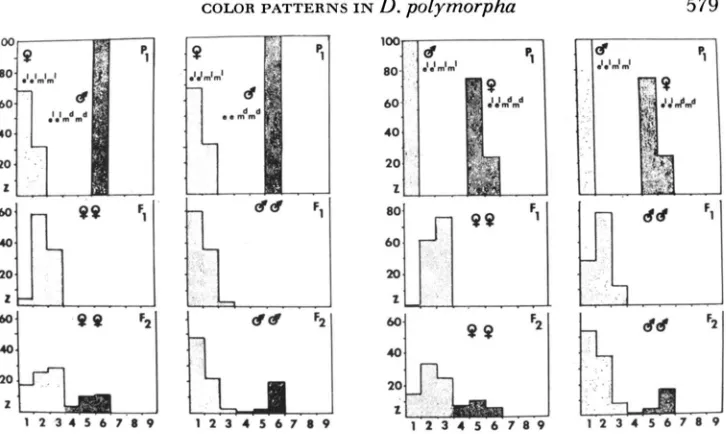
FIGURE 2.-Frequency distribution (in percent) of the phenotypic hquencies of homozygotes
elel with lightening modifiers ( m ' m l ) or darkening modifiers (mdma) and their offspring. The
lightening modifiers are quasi-dominant over the darkening ones (see Table 3 also). (The num-
bers 1 to 9 correspond to those of Figure 1 .)
(see Figure 1 ) according to the classification of DA CUNHA ( 1949). The F, shows besides the above phenotypes the ones classified as 4, 5 and 6. These three types can be considered as elel ma"'. The type 4 which does not appear in the darkened line #60 may be explained by the effect of some minor lightening gene present in the line #117, besides the rn' gene. The agreement with the 3: 1 ratio is good except for the distribution of the males of the first set of crosses. The totals for the males and for the females conform with this hypothesis (see Table 3). The over- all total fits the hypothesis of a pair of modifying alleles with a 3: 1 segregation pattern. Figure 2 presents graphically the phenotypic distributions of the parental lines compared to their offspring (F, and F,) appearing in Table 3. These results clearly demonstrate a simple Mendelian basis for the color modifiers. W e may call attention to the fact that the darkening modifiers contained in line #60
suffice to convert the light homozygotes elel into intermediate phenotypes. Crosses between elel and &ed, homozygotes for the major genes, gave very
diverse results depending on the modifiers present. If the darkening modifiers are prevalent, the F, exhibited color forms from 6 to 8 as shown in Table 4, which summarizes the crosses between line #60 (elel mdmd) and line #303
(&ed
mdmd). Consequently the heterozygote, eied mdmd, for the major a'lleles shows about 87% of females and 8804 of males among the dark phenotypes 7 and 8. Inthe F,, the type 4 that was not present in the parental line #60 now appears. This fact further supports our observations that line #303 bears one weak light- ening modifier with low penetrance. I n this segregation type 4, occurred in
TABLE
4
Frequencies
of
color
forms
in
the
F,
and
F,
from
single-pair
matings
between
e’elmdmd
(line
#60)
and
ededmdmd
(line
#303)
Color
forms’
4
5
6
7
0
Intermediate
Dark
9
Totah
Phenotypes
and
Generation
and
genotypes
of
the
PI
number
of
crosses
23
F,
P
...
...
66 (12.99) 36 (12.21) 1 02 222 (43.70) 95 (32.30) 31 7 220 (43.31) 164 (55.59) 384
...
508 295 803
30 (6.04) 63 (19.50) 93
407 323
5 (1 .OO)
38 (7.64) 31 (9.600) 69
88 (17.71) 35 (10.84) 123 172 (34.61) 1 02 (31.58) 274 164 (33.00) 92 (28.48) 256
820 543 352
5
31
F,
0 8
64 (11.79) 66 (18.75) 130 263 (39.78) 147 (41.76) 41
0
212 (4a.43) 139 (39.94) 35 1
... ... ...
...
... ...
895 808 403
1
F,
0 8
9 (1.11)
49 (6.07) 15 (3.04) 64
125 (15.47) 86 (1 7.41.) 21
1
319 (39.48) 120 (24.34) 439 2eE (30.20) 164 (33.27) 408 62 (7.67) 108 (21.91)
170
... 9
1301
*
Category
of
color
form
according
to
DA
CUNHA
(1949)
In
parentheses
are
the
frequencies
in
percent
for
each
class
of
COLOR PATTERNS IN
D.
polymorpha 581type
eded
mama was expected. Several individual crosses produced type 9 only in some generations, type 8 recurring, however, especially among the females in other generations. This may indicate that environmental variations are partially responsible for this variation. Nevertheless, some genetic variability is most certainly present since different strains present diverse degrees of variation.As can be seen in Table 4 the F, distribution of phenotypes over‘laps both parental lines. Assuming that the frequencies of heterozygotes for the major genes in the F, can be deduced from their relative frequencies in classes 6,
7
and 8, we found that the ratios differ greatly from the expected 1:2:1 with a n excess of ‘Lheterozygotes’’. This surplus of heterozygotes is more likely due to the masking effect of the darkening modifiers and not to their superior fitness.
The crosses of fem,ales ezez mlmz (line #117) with males ea& mdmd (line #303)
produced an F, ranging from types 1 to 6 as can be seen in Table
5.
The extreme light types 1 to 3 were not expected. Some of the single-pair crosses pooled in Table 5 did not produce these types. W e believe that line #303 bears a weak lightening modifier which in conjunction with mz reinforces its suppressing effect. This hypothesis will be tested in further work. Recalling that the known modifiers m z and ma segregated in a ratio 3:l (Table 3), and that the major alleles ez anded
should give a 1 :2: 1 ratio, it clearly impossible to establish the limits of a 6:3:3:2: 1: 1 ratio from data presented in Table 5, because of the phenotypic overlap. The segregation of the major genes is masked by the effects of the modifiers. Reducing the nine classes to three-light, intermediate and dark-the corresponding frequencies do not agree with the 1 : 2:1
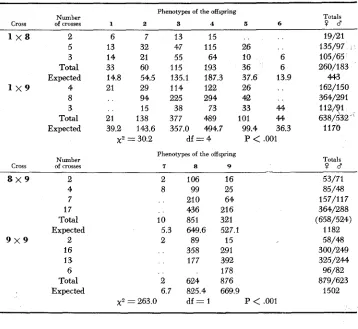
ratio, due to a n excess of light phenotypes. This certainly results from quasidominance of the lightening modifiers (see Table 3 also).Evidence favoring the view that line #303 bears a weak lightening modifier, that may also be present in the lightened light line # 117, was mentioned already. Further support for the view that dark lines with types 8 and 9 only may conceal this weak lightening modifier is presented in the pooled data of Table 6. The crosses 1 x 8 and 1 x 9 should give intermediate types only; how- ever, in 70% of the cases the unexpected light types l, 2 and 3 appeared together with the intermediate and frequently with the dark types also. We never ob- servrd the exclusive occurrence of light types in these crosses and thus the possi- bility that the dominant light allele dexribed by HEED and BLAKE (1963) was present is excluded. The results presented in Table 6 are properly accounted for
by the presence of a weak modifier in both lines (#117 and #303). The crosses between 8
x
9 and 9 X 9 differ significantly in their F, (Table 6), which validates the distinction between these classes and points to the possibility that type 8 harbors the weak lightening modifier more frequently than type 9 individuals.TABLE 5 Frequencies of color forms in the F, and F, from single-pair matings between elel mlml (line #117) and ededmdmd (line #303)
5
Color forms Phenotypes and Generation and Light* Intermediate' Dark' 2 genotypes of the P, number of crosses 1 2 3 4 5 6 7 8 9 Totals 0 1 and Q 2 71 F, ? 19 182 326 615 52 24 .. .. .. 12185
~ elel mlml (1.56) (14.94) (26.77) (50.49) (4.27) (1.97)2
3
$9 8 59 69 345 311 142 43 .. .. 969 N eded mdmd (6.09) (7.13) (35.60) (32.09) (14.65) (4.44) 4 78 251 671 926 194 67 2187
3
p PCOLOR PATTERNS IN
D.
polymorphaTABLE 6
Distribution of phenotypes of the offspring of single-pair crossings between types
583
Phenotypes of the offspring
Number Totals
Cross of crosses 1 2 3 4 5 6 P a
1 x 8 2 6 7 13 15 19/21
5 13 32 47 115 26 135/97
3 14 21 55 64 10 6 105/65
Total 33 60 115 193 36 6 260/183
1 x 9 4 21 29 114 122 26 . . 162/150
8 94 225 294 42 364/291
Total 21 138 377 489 101 44 638/532
Expected 14.8 54.5 135.1 187.3 37.6 13.9 443
3 15 38 73 33 44 11241
Expected 39.2 143.6 357.0 494.7 99.4 36.3 1170
x 2 = 30.2 df = 4 P
<
.001Number Cross of crosses
Phenotypes of the offspring
7 8 9
Totals P a
8 x 9 2
4 7 17
Total Expected
9 x 9 2
16 13 6 Total Expected
2
8
. .
. .
10 5.3 2
. .
2 6.7
x 2 = 263.0
106 99
21 0
436 85 1 649.6
89 358 177 624 825.4 d f = 1
16 25 64 21 6 321 527.1
15 29 1 392 178 876 669.9
P
<
,00153/71 85/48 157/117 364/288 (658/524)
1182 58/48 300/249 325/244 96/82 879/623
1502
DISCUSSION
Our results clearly show that color modifiers are present in the southernmost natural populations of Drosophila polymorpha which confirms the suspicion of
DA
CUNHA (1949). HEED and BLAKE (1963) observed that some crosses “pro- duced intermediates” that are “variable depending upon the origin of theed
allele.” These variations suggest the presence of modifiers at different frequencies in Villavicencio, Pirassununga (S. Paulo) and Montes Claros (Minas Gerais)
.
The importance of these modifiers in determining color patterns is shown in Figures 1, 2 and 3 and in the F, and F, distributions presented in our tables. Consequently it will be necessary to prepare special analyzer strains to determine the gene frequencies in natural populations, since the genotypes cannot be de- duced from simple inspection of the phenotypes.
5 84 M. N. M A R T I N E Z A N D A . R. CORDEIRO
x
80
*I
FIGURE 3.-Frequency distribution (in percent) of the pigmentation phenotypes of Dro-
sophila polymorpha with known genotypes. Females and males were scored separately. The
shades correspond to the three phenotypic classes (light, intermediate and dark), and the numbers 1 to 9 to the types shown in Figure 1.
gaster. Marker genes are not as yet available for a similar analysis of
D.
poly-norpha color genes; however, our data indicate that most of the genetic variance
in color patterns is due to a few loci.
The full understanding of the genetic basis of Drosophila tergite pigmentation depends on the elucidation of developmental and biochemical processes. We may consider very briefly the evidences on these grounds and their bearing on our problem. The origin of the imaginal hypoderm of the thorax and the abdomen differ greatly, and this may be the basis of why many Drosophila species have quite different color in the thorax and the abdomen, and also the reason why some polymorphisms are restricted to one of these areas.
D.
lebanonensis shows thorax polymorphism andD.
polymorpha and many others show abdomen poly- morphism. The thorax imaginal hypoderm, which secretes the cuticle, is a product of proliferation and fusion of the peripheral primordia cells. The abdomen hypo- derm originates from one dorsal and one ventral pair of cells that appears in each segment a few hours after pupation inD.
melanogaster (ROBERTSON 1936). These cells divide and actively displace the larval hypoderm, except in the last segment that is formed by the genital disc.COLOR PATTERNS IN D. polymorpha 585
(GEIGER and MITCHELL 1966). As MITCHELL ( 1967) pointed out, it is important
to remember that the phenol oxidases “are involved more vitally in epicuticle formation, epinephrine formation and perhaps resilin formation than in produc- tion of melanin. The lack of pigmentation (in insects) would probably never be due to the total absence of this complex enzyme as this would most certainly be a lethal condition since the fly has no substitute for the hardening of the cuticle.” Recent findings of MITCHELL and WEBER (1965) and MITCHELL (1966) indi- cate that at least five protein components participate in the dopa oxidase conver- sions, and that although the A tyrosinase component is always present in all stages from late larvae to adult flies, melanization occurs in a n orderly fashion that starts with thoracic bristles and follows to the abdominal bristles and tergite plates ( D .
melanogaster)
.
Studying intersex mosaicism in D. melanogaster ( 2 X 3 A ) tergitecolor patterns, STERN (1966) demonstrated that there is no change in the chro- mosome numbers but that the maleness or femaleness of pigmentation is “caused by processes similar to developmental differentiation in which the genetic content of different tissues i s considered to be alike, although the diffeTentiation activity of various genes may have been different.” Apparently the antagonistic factors present can be favored alternatively at the so-called “turning points” of the developmental process. The
D.
polymorpha heterozygotes el& mzmd show rather frequently asymmetrical color patterns already observed by DA CUNHA (1946,1949) in the
F,
obtained by crossing the dark and light true breeding strains.Another phenomenon observed by DA CUNHA (1949) and confirmed by us is that thc phenotypic variability greatly increases among the hybrids in compari- son with that of their parents. This fact is apparent in our results as can be seen particularly in Table 5 and Figure 3.
Environmental effects may play a greater role in increasing phenotypic vari- ability of heterozygotes than of the homozygotes. We observed that heterozygosis for modifier genes increases the phenotypic variability and apparently its de- pendence on environmental conditions. This effect per se might well be of im- portance for mimetic adaptation. This dependence on environment could account partially for the contradictory results that have been reported by STALKER (1953)
and HEED (1962) on the polymorphism of
D.
acutilabella as well as for the failureof STURTEVANT ( 1921 ) to determine the genetic basis for the inheritance of color
pattern in
D.
cardini. His conclusion, that the conditions under which the larvae develop determifie the phenotype of the adults, may have a similar basis.DA CUNHA (1955) found two geographic races of
D.
neocardini that are uni-586 M. N. MARTINEZ A N D A. R. CORDEIRO
one light the other dark, produced a n F, with types 6 and 9 in the F,. Each line was homozygous for the two known loci, however the heterozygotes displayed a quite surprising variability.
The natural populations of this species in northern South America are monomorphic in several collecting places studied by HEED and BLAKE (1963) and by HEED (1963). These authors found that these populations contain another allele, dominant light &, that decreases in frequency southward. To explain the excess of the homozygates observed by DA CUNHA (1949) in the southern populations, HEED (1963) made the assumption that this allele might be present at low frequencies in these populations. This interesting hypothesis cannot be excluded by the fact that we have not detected this allele in our sample. As HEED suggested, this allele follows a geographic trend decreasing southward and our sample is the southernmost so far studied. All those problems have to wait for a genetic analysis of the natural populations with appropriate marker strains.
On the other hand we can only speculate that if the heterozygotes ezed have some superior physiological characteristic in relation to homozygotes, the rela- tively high frequency of the extreme phenotypes observed in nature could be produced by disruptive selection acting upon the modifiers and providing a high frequency of edezmzmz and ede'mdmd, phenotypically light and dark, respectively. Consequently, both the physiological advantages of heterozygosis for the major genes and the fitness value of the extreme phenotypes are obtained. The extreme phenotypes can be fitted in two opposing ecological niches or favored alterna- tively in time by cyclic selection (THODAY 1959).
The authors express their indebtedness to Professors A. B. DA CUNHA, W. B. HEED, J. M.
THODAY and SEYMOUR ABRAHAMSON for suggestions valuable to the writing of this paper. The
grants of the Rockefeller Foundation of the Conselho Nacional de Pesquisas, and of the Conselho de Pesquisas da Universidade Federal do Rio Grande do Sul are gratefully recognized.
SUMMARY
COLOR PATTERNS IN
D.
polymorpha 587polymorpha, a working hypothesis is advanced to explain the excess of the pre-
sumed “homozygotes,” and the apparent balanced nature of the color poly- morphism exhibited by this species. Assuming that the heterozygotes e1ea are physiologically most fi’t, a disruptive selection can favor the modifiers to produce the extreme phenotypes with the constitutions ezed mzmL and el& mama sharing the double advantage of being heterozygotes for the major genes and pheno- typically extreme. This suggestion and the one advanced by HEED (1963) are not mutually exclusive and will be tested in further work.
L I T E R A T U R E C I T E D
DA CUNHA, A. B., 1964 Polymorphism in natural populations of a species of Drosophila. J.
Heredity 37: 253-256. -, 194.9 Genetic analysis of the polymorphism of color pattem
in Drosophila polymorpha. Evolution 3: 239-251.
-
, 1955 Sobre duas recas de Dro- sophila neocardini Streisinger. Rev. Brasil. Biol. 15 : 11 7-125.Segregational load in Drosophila kikkawm I. Crossing experiments.
Genetics 5 0 : 21 1-219.
Salivary gland function in phenol oxidase production
in Drosophila melanogaster. J. Insect Physiol. 12: 744-754.
The genetic characteristics of island populations. Univ. Texas Publ., 6205:
173-206. -, 1963 Density and distribution of Drosophila polymorpha and its color
alleles in South America. Evolution 1 7 : 502-518.
HEED, W. B. and P. R. BLAKE, 1963 A new color allele at the e locus of Drosophila p o l y m o r p h
from northern South America. Genetics 48: 217-234.
LEWIS, H. W. and H. S. LEWIS, 1963 Genetic regulation of dopa oxidase activity in Drosophila.
Ann. N. Y. Acad. Sci. 100: 827439.
MARQUES, E. K., M. NAPP, H. WINGE and A R. CORDEIRO, 1966 A cornmeal, soybean flour,
wheat germ medium for Dmsophila. Drosophila Inform. Serv. 41 : 187.
MITCHELL, H. K., 1966 Phenol oxidases and Drosophila development. J. Insect Physiol. 12:
755-765. -, 1967 Biochemical aspects of Drosophila. Annual Rev. Genetics 1 : 185-
200.
MITCHELL, H. K. and U. M. WEBER, 1965 Drosophila phenol oxidases. Science l a : 964-965.
NAPP, M., 1963 Genes modificadores controlando a variabilidade fenotipica em Drosophila polymorpha. Ciencia Cult. 1 5 : 198.
PIPKIN, S. B., 1962 Mesonotal color polymorphism in Drosophila 1. Zebanonensis. Genetics 47: 1275-1290.
ROBERTSON, A. and J. H. Louw, 1966 Polymorphism of genes affecting amount and distribu-
tion of black pigment in the abdominal cuticle of D. melanogaster. ‘Drosophila Inform. S e n .
41: 154.
The metamorphosis of Drosophila melanogaster including an accurately
timed account of the principal morphological changes. J. Morphol. 6 5 : 471-495.
Regular responses to selection 3. Interaction between
located polygenes. Genet. Res. 7: 96-121.
Taxonomy and hybridization in the Cardini group of Drosophila. Ann.
Entomol. Soc. Amer. 46 : 343-358.
The North American species of Drosophila. Carnegie Inst. Wash.
Publ. 301: pp. 150.
Pigmentation mosaicism in intersexes of Drosophila. Rev. Suisse Zool. 7 3 : 239-
355.
Effects of disruptive selection. I. Genetic flexibility. Heredity 1 3 : 187-
218.
-,
1961 Idcationof polygenes. Nature 191: 368-370.FREIRE-MAIA, N., 1964
GEIGER, H. R. and H. K. MITCHELL, 1966
HEED, W. B., 1962
ROBERTSON, C. W., 1936
SPICKETT, S. G. and J. M. THODAY, 1966
STALKER, H. D., 1953
STURTEVANT, A. H., 1921
STERN, C., 1966