Robust Final-Round Cache-Trace Attacks
Against AES
Joseph Bonneau
Computer Science Department, Stanford [email protected]
Abstract. This paper describes an algorithm to attack AES using side-channel information from the final round cache lookups performed by the encryption, specifically whether each access hits or misses in the cache, building off of previous work by Acıi¸cmez and Ko¸c [AK06]. It is assumed that an attacker could gain such a trace through power consumption analysis or electromagnetic analysis. This information has already been shown to lead to an effective attack. This paper interprets cache trace data available as binary constraints on pairs of key bytes then reduces key search to a constraint-satisfaction problem. In this way, an attacker is guaranteed to perform as little search as is possible given a set of cache traces, leading to a natural tradeoff between online collection and offline processing. This paper also differs from previous work in assum-ing a partially pre-loaded cache, provassum-ing that cache trace attacks are still effective in this scenario with the number of samples required being inversely related to the percentage of cache which is pre-loaded.
Keywords:AES, cryptanalysis, side-channel attack, power analysis, cache.
1
Introduction
Side-channel attacks have been demonstrated experimentally against a variety of cryptographic systems. Side-channel attacks utilize the fact that in reality, a cipher is not a pure mathematical functionEK[P]→C, but a functionEK[P]→
(C, t), wheret is any additional information produced by the actual encryption operation. Often the additional data t leaks enough useful information for an attacker to fully recover the key. The attack presented in this paper focuses on obtaining a “trace” of cache accesses performed by the encryption by analyzing the power consumption of the encryption.
In 1997, Rijmen and Daemen proposed the Rijndael cipher to the National Institute of Standards and Technology (NIST) as a candidate for the Advanced Encryption Standard (AES). After four years of competition, Rijndael was cho-sen by NIST in October 2000 and officially became AES in 2001 with US FIPS 197. The cipher is now widely deployed and is expected to be the world’s pre-dominant block cipher over the next 25 years. In its final evaluation of Rijndael [NBB+00], NIST stated that table lookup operations are “easy to defend against
In spite of this favorable review, side channel cryptanalysis has been the most effective approach to attacking AES so far. The heavy use of lookup tables has been widely demonstrated to be an exploitable cryptographic side-channel on computers with cached memory [TTMM02,TSS+03,Pag02,Per05]. Side-channel
attacks against AES have been based on direct cache observation [OST06], tim-ing [Ber05,BM06], and most recently power consumption [BBM+06,AK06]. The
reliance on lookup tables is once again exploited in the attack described in this paper.
2
Overview of the AES cipher
A full description of the Rijndael cipher is provided in [DR02], but below is a brief description of the cipher’s properties that are utilized in this study.1AES is
an iterated cipher: Each rounditakes a 16-byte block of inputXiand a 16-byte block of key material Ki, producing a 16-byte block of output Xi+1, using a
temporary 16-byte state bufferT. Each round is carried out as follows:
T :=SubBytes(Xi),
T :=ShiftRows(T),
T :=MixColumns(T),
Xi+1:=T⊕Ki.
While the three functionsSubBytes,ShiftRows, andMixColumnsare spec-ified as algebraic operations, performance-oriented software implementations of AES combine all three operations and pre-compute the values.2 The values are
stored in large lookup tables,T0, T1, T2, T3, each mapping one byte of input to
four bytes of output. In software, these tables each require 28
·4 = 1024 bytes of storage. Each round is carried out by splitting up the 16 bytes of Xi into
xi
0, xi1, . . . , xi15, and the 16 bytes ofKiintok0i, k1i, . . . , k15i . The encryption round
is then carried out as:
Xi+1={T0[xi0 ]⊕T1[xi5 ]⊕T2[xi10]⊕T3[xi15]⊕ {ki0 , ki1 , ki2 , ki3 },
T0[xi4 ]⊕T1[xi9 ]⊕T2[xi14]⊕T3[xi3 ]⊕ {k4i , ki5 , ki6 , ki7 },
T0[xi8 ]⊕T1[xi13]⊕T2[xi2 ]⊕T3[xi7 ]⊕ {ki8 , ki9 , ki10, ki11}, (1)
T0[xi12]⊕T1[xi1 ]⊕T2[xi6 ]⊕T3[xi11]⊕ {k12i , ki13, ki14, ki15}}.
The round calculation can be performed very efficiently in software this way, using just 16 table lookups and 16 word-length x-or’s. A complete encryption in 128-bit mode consists of an x-or with the first 16 bytes of key material, referred to as “input whitening,” followed by 9 normal encryption rounds, plus
1 This paper will focus exclusively on AES with a 128 bit key. 192 and 256 bit versions
use a different key expansion algorithm and more rounds.
2
a simplified final round. The final round performs no MixColumns operation as it might trivially be inverted by an attacker and would ostensibly slow down hardware implementations. This omission will prove crucial, as it causes software implementations to use a new tableT4 in the last round, which is just the AES
S-Box used in SubBytes:
C={T4[x 10 0 ]⊕k
10 0 , T4[x
10 5 ]⊕k
10 1 , T4[x
10 10]⊕k
10 2 , T4[x
10 15]⊕k
10
3 , (2)
T4[x104 ]⊕k 10
4 , T4[x109 ]⊕k 10
5 , T4[x1014]⊕k 10
6 , T4[x103 ]⊕k 10 7 ,
T4[x108 ]⊕k 10
8 , T4[x1013]⊕k 10
9 , T4[x102 ]⊕k 10
10, T4[x107 ]⊕k 10 11,
T4[x 10 12]⊕k
10 12, T4[x
10 1 ]⊕k
10 13, T4[x
10 6 ]⊕k
10 14, T4[x
10 11]⊕k
10 15}.
A total of 10 rounds are used in 128-bit AES, but 11 16-byte blocks of key material are needed because of the input-whitening. These 176 bytes of key material are generated by taking the raw 16-bytes of the key and repeatedly carrying out a non-linear transformation which produces the next 16-byte block based on the previous 16-byte block until all 176 bytes are created. This key expansion structure has two important properties. First, the 16 bytes of key material used for input whitening prior to the first encryption round are just the raw key bytes. Second, the key expansion algorithm was explicitly chosen [DR02] to be invertible given any 16 consecutive bytes of the expanded key. This is useful to an attacker in that recovery of the final 16 bytes of the expanded key (or any other 16 bytes) is equivalent to recovery of the original key.
A complete AES encryption can be viewed in terms of the table lookups it performs: for each of the tablesT0, T1, T2, T3, four lookups are made in each of
the first nine rounds for a total of 36 lookups. In the final round 16 lookups are made into the tableT4, bringing the total number of lookups performed to 160.
We will call the entire set of lookup indices {l1, l2, . . . l160} a lookup trace for
the encryption operation. Knowing a complete lookup trace for a single encryp-tion operaencryp-tion, along with either the ciphertext or plaintext, would instantly be enough information to recover the key3. Such a simple attack would require the
attacker have control over the target machine’s memory bus, which is unlikely in practice. However, there are multiple side-channels which leak enough partial information about an encryption’s lookup trace to recover the key.
3
Cache Model and Attack Assumptions
The attacks in this paper assume the computer performing the encryption op-eration uses cached memory which can be described using a simple model of the cache. A cache is a small, fast storage area sitting between the CPU and main memory. When values are looked up in main memory, they are stored in
3
the cache, usually evicting older values in the cache. Subsequent lookups to the same memory address can then retrieve the data from the cache, which is faster than main memory, this is called a “cache hit.” Because most software exhibits temporal locality in memory accesses, caches greatly improve performance.
Unfortunately, because a cache miss on a modern processor requires fetching the requested data from main memory, as well as possibly inserting a stall into the pipeline or attempting to execute further instructions out of order, the pro-cessor uses more electricity during a cache miss than a hit. As a result, cache misses are easily identifiable as spikes in the power consumption graph of a pro-cessor performing AES encryption [BBM+
06]. We assume that it is possible for an attacker to recover acache tracefor the final round of an encryption by such power analysis methods. In contrast with a lookup trace, a cache trace does not include the exact indices looked up, only whether the lookup hit in cache or missed in cache. We denote a cache trace for the final round by{t1, t2, . . . , t16},
where eachti is either “hit” or ”miss” in correlation with the result of the ith
table lookup in the final round.
Modern caches do not store individual bytes, but groups of bytes from con-secutive “lines” of main memory. Line size varies, but two common values are 32 bytes for a Pentium III and 64 bytes on more recent Pentium IV processors. Since the usual size of AES table entries is 4 bytes, groups of 8 consecutive table entries share a line in the cache on a Pentium III, this value is defined as δin [OST06]. In general it will hold thatδ= l
b wherel is the processor’s . line size
andb is the block size of table entries.
The value ofδis critically important to cache-based attacks because for any addressesa,bwhich are equal ignoring the lower log2δbits (notated ashai=hbi
in [OST06]), looking up addressawill cause an ensuing access tobto hit in cache instead of main memory. This has been noticed to be a significant problem for attacks on the first round of AES in that it makes recovery of the low-order key bits impossible [AK06,OST06,BM06]. In particular, this effect requires the attack of Acıi¸cmez and Ko¸c to consider the second round and become significantly more complex.
Unlike the cache trace attacks described by Acıi¸cmez and Ko¸c[AK06], we will not assume the cache is completely clean prior to encryption. For instance, ift2
is “hit” for some encryption’s cache trace, we do not conclude that hl1i=hl2i.
This could certainly be the case, but it could also be the case that the cache line needed by the lookup l2 happened to be in cache prior to the start of the
encryption. This would represent afalse hitin that it did not hit in cache due to the lines loaded by the encryption itself, but due to the line being pre-loaded4
. We do assume that any cache line loaded during encryption will remain there for the duration of the encryption. This is a safe assumption because the T4table, with a size of 1024 kB, should fit easily into the L1 cache of any modern
processor. Since the table entries are the only values loaded during encryption, the encryption routine will not evict any of the table lines out of cache once
4
they are loaded. It would be possible for lines to be evicted in the middle of an encryption if the process were context switched out, but this would be evident in the power usage of the encryption, and the sample could then be discarded. This assumption is critical because it allows to conclude, iftiis “miss” for some
encryption, thathlii 6=hljifor any j < i.
4
Related Work
Side-channel attacks have been demonstrated against implementations of many cryptosystems, utilizing timing [Ber05,TSS+
03,Koc96,BB05,KQ99,BM06], power consumption [ABDM00,KJJ99], electromagnetic radiation [GMO01], etc. Side channel attacks have been most effective against public-key cryptographic im-plementations, particularly smart cards. Public key algorithms are vulnerable because they typically perform lengthy mathematical operations, whose time and power consumption are data-dependent. In the AES selection process, Rijn-dael was considered “favorable” to defend against side-channel attacks because it did not utilize conditional statements or data-dependent rotations, which were commonly the basis of the side-channel attacks on public key systems [DR99]. In the final evaluation, NIST agreed that Rijndael appeared safe against side-channel attacks, considering table-lookups a “safe” operation [NBB+00].
To the surprise of its designers and NIST, AES has proved vulnerable to side-channel attacks on machines with cached memory due to its use of table lookups. Direct observation attacks, as demonstrated by Osvik, Shamir, and Tromer [OST06], discover specific information as to what values are present in an encryption’s lookup trace by running code on the target machine before and after encryption. For example, if the attacker can determine that, whenever p0=z, the data inT0[z′] is accessed during encryption, then it must be the case
that x0
0 =z′. Since it holds thatp0⊕k0 =x00, the attacker can conclude that
k0 =z⊕z′. This principle is used to construct sophisticated, effective attacks
which are successful with as few as 800 encryption samples.
An encryption’s lookup trace also affects the overall time of the encryp-tion. This effect was first used to construct attacks against DES by Tsunoo et al. [TSS+03,TTMM02], who also described possible attacks against AES. A
Finally, information is leaked about the lookup-trace through power analysis. This possibility was mentioned by Page [Pag02] and by Kelsey et al [KSWH00]. Power analysis and electromagnetic analysis has previously been used as a side-channel to attack cryptographic smartcards [KJJ99,GMO01]. For AES, the crit-ical point is that cache misses require the functioning of a large amount of circuitry to fetch the desired data from main memory. As a result, cache misses should show up as huge spikes in a graph of power usage. As demonstrated by Bertoni et al [BBM+06], given a power usage trace of an AES encryption, it
is easy to tell which table lookups resulted in cache misses and which resulted in cache hits. They used this information to construct an attack by specifically evicting a small part of the AES tables prior to encryption, then observing if a miss occurred to indicate that the evicted data was needed during the encryp-tion.
More powerful attacks were recently described by Acıi¸cmez and Ko¸c [AK06]. Ine one attack, they use the entire first and second round traces, along with known plaintext, to recover an AES key. For example, suppose the second access to T0 in the first round results in a cache hit. Then it can be deduced that the
first two lookups inT0must be the same. We can see from Equation 1 that these
lookups are justP0⊕K0andP4⊕K4, so we have learned thatK0⊕K4=P0⊕P4.
Due to the use of cache-lines on modern processors (see Section 3), the attack must also examine the second round, which ultimately narrows the number of possible keys to around 232
given sufficient cache traces. They also develop a similar final round attack, which is simpler and also effective.
These attacks are significant in that they can recover the full key after ob-serving between 5 to 50 encryptions, with a varying amount of exhaustive search required. Acıi¸cmez and Ko¸c correctly stress that the exhaustive search can be carried out “offline” after the encryption traces are obtained so it is often desir-able to do more offline work if it means fewer traces are needed. The final round attack presented in this paper is very similar to the work of Acıi¸cmez and Ko¸c, but views the attack in a different manner as a constraint satisfaction problem.
5
The Attack
5.1 Constraint inference
The goal of the attack is to use a series of final-round cache traces, as well as known ciphertexts, to recover the key. To do this, we wish to gather as many constraints as possible on the key bytes from each cache trace. We consider only binary constraints, that is, for each pair of key bytes (k10
i , k 10
j ), we wish
to rule out as many possible values (x, y) for that pair. Given a cache trace {t1, t2, . . . , t16}for the final round of some encryption, we consider Equation 2.
Suppose that some valuetj= “miss”, that is, we know thejthlookup resulted
in a cache miss. We know that it is then not equal to any of the previous cache lookups indices, for all ti, with i < j, we know that hlii 6= hlji. Consider the
corresponding ciphertext bytes ci and cj. We know that ci =k10i ⊕T4[li] and
cj=k10j ⊕T4[lj]. Note the key bytes ki10andk 10
j are taken from the final round
of the expanded key schedule. If we guess some valuez for the value ofk10 i , we
can compute5 the conditional lookup index
lzi =T−1
4 [ci⊕z], this is the value of
liwhich would have been accessed ifzis correct. We know that the lookup index
hlii 6=hlji, so we wish to compute all values ofljwhich would be impossible iflzi
is the correct lookup index, these are just any values for whichhlz
ii=hlji. There
will beδsuch values, which can easily be enumerated by computinglz
j(n) =liz⊕n
for all 0≤n < δ. Finally, for eachlz
j(n), we computez′(n) =T4[lzj(n)]⊕cj, this corresponds
to the value for the key bytek10
j which would be required to be consistent with
the known ciphertext bytesci, cj and the valuezfork10i . We can thus conclude
that it is impossible to have k10
i =z and k
10
j =z′(n), because this would have
meant hlii=hljiand lj would have hit in the cache. So all pairs (z, z′(n)) for
0≤n < δ are ruled out as possible values for (k10 i , k
10 j ).
We can repeat this process for every value of 0 ≤ z ≤ 255, producing a total of 256·δconstraints on (k10
i , k 10
j ). Also, we can produce constraints for all
pairsi, j withi < j, so in totalj·256·δconstraints are produced. Notice that the presence of the S-box between the known ciphertext values and the lookup indices actually improves the attack. Because the S-box is non-linear, the values z′[n] will appear to be randomly distributed throughout the range [0,255] given any one z. Although the ruled-out lookup values liz, ljz(n) only differ in their low-order bits, this small differential is destroyed by the S-box, leading to a good distribution of constraints on (ki10, k10j ) and avoiding the problems of the first round attacks in [AK06]. This effect was also useful in the timing attacks described in [BM06].
5.2 Constraint propagation
With ample cache traces, it would easy be to produce enough constraints to uniquely identify each key byte by the analysis above, eventually, the only
un-5
Since T4 is the AES S-box, a permutation, we know that T4−1 is a well-defined
constrained possibility for (k10 i , k
10
j ) would be the correct pair of values. However,
well before this occurs there will be enough constraints that only one possible as-signment tok10
1 , k 10 2 ,· · ·, k
10
16will satisfy all constraints, although each individual
byte will appear to have multiple possible values. This is just the classic con-straint satisfaction problem in artificial intelligence, and good search algorithms exist to find keys which solve the constraint sets produced in this attack. With enough constraints, a small enough number of keys will identified as possible, which can presumably be checked against a known plaintext/ciphertext pair.
To illustrate the problem, suppose after analyzing all of our cache traces we are left with (k10
1 , k 10
2 )∈ {(0x01, 0x02), (0x04, 0x05)}, (k
10 1 , k
10
3 )∈ {(0x01,
0x03), (0x06, 0x07)}, (k102 , k
10
3 )∈ {(0x02, 0x03), (0x08, 0x09)}. In this
example it is obvious that the only possibility is (k10 1 , k
10 2 , k
10
3 ) =(0x01, 0x02,
0x03), even though by constraints alone it appears that k10
1 could be any of
(0x01, 0x04, 0x06). The value0x04is clearly impossible fork10
1 though, since
there is no possible value fork10
3 which could then satisfy the constraints.
To check for consistency and eliminate all values, we can use the AC-3 al-gorithm [Mac77], which checks for consistency between possible values and the constraints, and then propagates constraints. The algorithm works as follows: First, the domain for every bytek10
i is set to {0, . . . ,255}. Next all pairs (i, j)
are placed in a queue. As each (i, j) is de-queued, each valuexremaining in the domain ofk10
i is checked for consistency. If for any other bytek 10
j there does not
exist a possible value (k10i , k 10
j ) = (x, y) for somey remaining in the domain of
k10
j , thenxis eliminated from the domain ofk 10
i . If any values are eliminated,
then all pairs (k10 i , k
10
j ) are re-added to the end of the queue. The algorithm
stops when the queue is emptied.
AC-3 is a natural choice for this attack since it guarantees consistency for binary constraints, which are produced by the power analysis. AC-3 has asymp-totic complexity O(n2
d3
), where n is the number of nodes (key bytes) and d is the initial domain (in this case 256). So, the asymptotic running time of 232
is possible, although in practice the algorithm as tested against constraint sets which the attack would produce runs very efficiently, taking only seconds on a personal computer. Similar constraint propagation algorithms exist with better asymptotic complexity, but for this attack they would probably not provide a considerable speedup.
5.3 Search
The correct key is identified by search, using the constraint propagation algo-rithm to guide the search. First, a guessx0is made fork010. Then, based on this
assignment, forward propagation is used to eliminate values for the remaining 15 bytes. For each key byte k10
j for j > 0, we eliminate the valuey from the
domain ofk10
j if we know from the constraint set that (k 10 0 , k
10
j )6= (x0, y). After
forward propagation, the AC-3 constraint propagation algorithm is run again to remove inconsistent values from the domains of the remaining key bytes.
Next, a guessx1 is made fork110 based on the key byte’s remaining domain,
When a full guess for all key bytes is made, this guess is then checked against a known plaintext/ciphertext pair for correctness6
.
The search must backtrack if either a complete guess is made which is incor-rect, or if at some point the domain of an unassigned key byte becomes empty. In either case, the last assignment made is incorrect, it must be undone and a new assignment made. This also requires unrolling the constraint propagation that may have occurred due to the assignment being removed, this is facilitated by storing in the domain of each key byte at what search depth constraints were placed. In this manner, backtracking only requires a single scan over each byte’s domain to remove incorrect constraints.
Because AC-3 is an optimal constraint propagation algorithm for binary con-straints, this search is optimal in that it will eventually find the correct key, and will search as few incorrect keys as is possible. In the extreme case of no con-straints being known, the algorithm is equivalent to exhaustive search.
5.4 Decryption Attack
AES decryption in software is very similar to encryption, with a slightly different key schedule, and equally vulnerable to cache trace attacks. The attack is slightly simpler against decryption since it recovers constraints on the raw key, instead of the final section of the expanded key. In decrypt mode, the attacks require known plaintext instead of known ciphertext.
6
Experimental Results
6.1 Experimental Setup
As mentioned previously, the attack will always succeed given enough time, although this could mean exhaustive search of every possible key if no constraints are known and would not be a meaningful attack. To study the effectiveness of the attack, we set a threshold τ of offline work that the attacker is able to perform in attempting to recover the key given a set of n cache traces. It is impossible to precisely quantify “work” because different operations involved in the attack, for instance checking a key for correctness vs. updating one element in a table of constraints, will have a different fixed cost. We consider either checking and updating one table entry, or checking one key for correctness, as one “operation” and considerτ to be the maximum number of operations practical for the attacker to carry out. By stopping the search afterτ has been exceeded, the amount of work done either in searching or propagating constraints to a fixed amount. For our experiments we use a relatively small value ofτ = 230
, an level which puts the attack time on the order of one minute on a common personal computer. In a real attackτ might be much higher.
6
The attack has been simulated against the optimized C implementation of AES, as submitted in the original Rijndael proposal [DR02]. This implemen-tation is used without significant change in many open source cryptographic libraries such as OpenSSL v 0.9.8(a), Crypto++5.2.1, and LibTomCrypt 1.09, libgcrypt v 1.2.2, and Botan v 1.4.2. We have assumed that it is possible to produce a precise cache trace through power analysis, for experiments we have simulated this process by augmenting the encryption code to keep a record of hits and misses based on the indices looked up during the encryption operation. We track for each cache line in the tableT4whether or not it is in cache, loading
it in on the first access to it.
6.2 Data
The effectiveness of the attack is dependent on the value ofδas defined in Section 3. Common cache-line sizes are 32 bytes for Pentium III and earlier, 64 bytes for Pentium IV and other recent processors. These give values forδof 8, and 16 if a four-byte wideT4 table is used. Some AES implementations implementT4 as
a one-byte wide table7
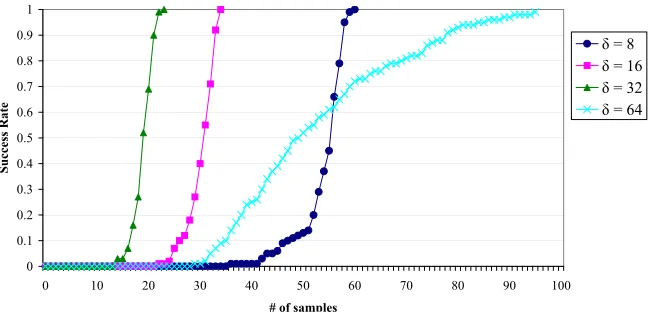
, this gives values for δof 32, and 64 respectively. Thus, we have simulated the attack for values ofδ ranging from 8-64 and we present results in Figure 1.
0 0.1 0.2 0.3 0.4 0.5 0.6 0.7 0.8 0.9 1
0 10 20 30 40 50 60 70 80 90 100
# of samples
S
u
cc
es
s
R
a
te
δ = 8
δ = 16
δ = 32
δ = 64
Fig. 1.Success rate of attack for common values ofδ
7
6.3 Analysis
It is interesting that the attack is less effective at high or low values ofδ, specif-ically, the performance at δ = 16 or 32 is best, and δ= 64 is the worst. This can be understood because varyingδproduces two simultaneous effects. Higher values of δ produce constraints more quickly, specifically each miss at position 1≤j ≤15 producesj·256·δas outlined in Section 5.1 (a miss at position 0 is useless). However, at higher values ofδthe number of misses is lower, especially at higherj, since the table is loaded into cache much more quickly. Specifically, since the table will occupy 256
δ cache lines, the probability of a miss in position
j can be estimated8
at ( 256
δ −1 256
δ )
j−1
= (1− δ 256)
j−1
. This is problematic for high values of delta because it makes misses in the final cache accesses very unlikely, for example, with δ = 64 the chance of the last cache access missing is just 0.7515= 1
.3%. Thus, each miss produces more constraints at higher value ofδ, but the misses occur less frequently.
The results observed can be explained by a probabilistic model of the con-straints produced by a set of cache traces. The attack algorithm takes a set ofN cache traces and uses it to produce constraints by eliminating impossible values for pairs of key bytes, and then attempting to search for the key using those constraints. The success rate of the attack given a time limitτ should be well predicted by the number of constraints produced. For any cache trace, a miss occurs at positionjwith probability (1− δ
256)jand producesj·256·δconstraints,
giving an expected value for the number of constraints as:
E(#constraints) =
15 X
j=1
(1− δ 256)
j·j·256·δ
δ 8 16 32 64
E(#constraints) 178,976 263,303 292,626 204,235
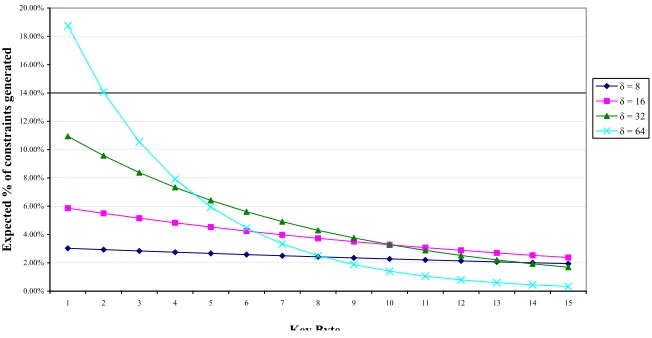
This gives a rough explanation for the observed data, as samples are the most useful in terms of constraint production at δ = 32. However, the constraints produced are not equally distributed but instead biased towards the earlier key bytes, because the earlier cache accesses are more likely to be misses. This bias is different for different values ofδ, however, as seen in Figure 2, higher values of δ are more biased towards constraining the earlier key bytes. This bias is actually beneficial to the search, as values are guessed for the lower key bytes first. Since there are more constraints on these bytes, the search tree is pruned more quickly by assigning to these bytes, this is an application of the common “most constraining variable” heuristic used in constraint satisfaction [RN95].
8
Due to this effect, the higher values ofδperform better than the naive estimate at constraint generation would predict.
0.00% 2.00% 4.00% 6.00% 8.00% 10.00% 12.00% 14.00% 16.00% 18.00% 20.00%
1 2 3 4 5 6 7 8 9 10 11 12 13 14 15
Key Byte
E
x
p
ec
te
d
%
o
f
co
n
st
ra
in
ts
g
en
er
a
te
d
δ = 8 δ = 16 δ = 32 δ = 64
Fig. 2.Bias towards constraints on lower key bytes
The relatively long “tail” in the success rate forδ= 64 in Figure 1 can also be explained by the random model. Atδ= 64, it is expected that a lower number of misses will be observed in the available cache traces, but this will compensated by the fact that each miss is more useful. For the higher key bytes the chance of a miss is very low atδ= 64. There is a binomial distribution of the expected number of misses at each position. For δ = 64, since the expected number of misses is very low in the later positions, the number of samples needed is much more variable. The absence of a few misses will greatly reduce the number of constraints produced. In contrast, at lowerδ the number of misses expected is high, so individual misses are less important and the success rate spikes quickly.
7
Robustness to a Partially pre-loaded cache
The above experiments and random model are based on the cache being clean prior to encryption, although this assumption is not explicitly utilized. To simu-late the effects of some table entries being pre-loaded into the cache, prior to the encryption each table line can be marked as being loaded into the cache with a probabilityσ. As a baseline, we setσ= 0 to simulate a totally clean cache, this is the best case scenario for the attack. We simulated the effects of a partially pre-loaded cache by varying the value ofσused in the experiments. The results were very similar to the above results, albeit requiring 1
1−σ times more samples
to achieve the same success rates. The reason for this is that the production of constraints is decreased by 1
lookup indexlidoes not collide with any of the previous lookups in the
encryp-tion, with probabilityσthe line accessed byli was randomly pre-loaded into the
cache. In this case, the access is recorded as a false hit and its information is lost to the attack. Thus, constraints are only retained with probability 1−σ, so
1
1−σ times more traces must studied to obtain the same number of constraints
as the optimal case whereσ= 0.
This analysis indicates that the number of samples required is infinite as σ → 1. This is an obvious condition of the attack model, if every line of the table is consistently in memory prior to encryption, the cache trace will be nothing but hits (many of them false hits) and no useful information is gained. Thus the attack, while not assuming a clean cache, will still fail if unless some portion of the table is not pre-loaded. This suggests that pre-loading the cache prior to encryption should be an effective countermeasure.
In order to try and get some of the table lines out of cache prior to encryption, an attacker may be able to run specific code on the machine9
, but more likely will rely on code running in between encryptions to read in other data which evicts the cache lines used by T4. In practice, this means it is unlikely that a
different, random portion ofT4will be in cache prior to each encryption. It is far
more likely that some certain subset ofT4is being evicted by the code running in
between encryptions, and that the same lines ofT4tend to get knocked out over
and over rather than different random lines. However, this is a problem because of the randomness produced by the cipher. The worst possible case is if only one line is out of memory prior to encryption, and it is the same line before every encryption. Experimentally, the attack still succeeds in this situation, and the performance numbers are indistinguishable from one random line being evicted from cache. This indicates that even if only one line of cache is invalidated between encryptions, the attack will still succeed. This scenario putsσat δ−1
δ ,
meaning that the total number of samples required increases by 1 1−δ−1
δ = δ, which not a serious impediment to the attack forδin the range 8-64.
8
Utilizing a Clean Cache Assumption
The attack can be strengthened if it is assumed that the cache is clean prior to encryption, because information is then revealed by cache hits as well as cache misses, this is then a very similar attack to the final round attack of Acıi¸cmez and Ko¸c. Specifically, if we assume a clean cache and have a cache trace where lj is a hit, we know that the cache line accessed bylj must be equal to a cache
line already accessed, that is, it must be that hlii = hlji for some 0 ≤ i < j.
These constraints are powerful because they indicate only a small number of possible values for lj. Unfortunately, these constraints are not as easy to work
with because they are not binary constraints as before, they are disjunctions potentially involving all 16 unknown key bytes. Iflj is a hit, it can be inferred
that hlji=hl0i ∨ hlji=hl1i ∨ · · · ∨ hlji=hlj−1i.
For the case ofl1, a hit does produce a binary constraint withl0, namely it
directly indicates thathl0i=hl1i. This case can be added to the set of binary
constraints as discussed in Section 5.1.
For other hits, they do not produce binary constraints and must be treated differently. Because a hit at lookuplj produces a constraint which only relates
to indicesliwithi < j, these constraints can be considered when guessing a new
value fork10
j in the search, as described in Section 5.3. Because a guess will have
already been made for the bytesk10 0 , k
10 1 , . . . , k
10
j−1, the constraints based on hits
can be used to avoid making a guess forlj which is impossible.
Suppose the search algorithm is prepared to guess that k10j = z. For each cache trace where lj is a hit, the value ljz = T−
1
4 [cj⊕z] is computed, this is
the lookuplj that would have occurred if the guess z is correct. Next, the set
of previous lookups in that tracel0, l1, . . . , lj−1 can be computed since guesses
have already been made for the key bytesk10 0 , k
10 1 , . . . , k
10
j−1. Specifically, if all of
the key guesses were correct than each previous lookup li can be calculated as
T−1
4 [cj⊕ki10]. If the guessz is correct, then it must be thathlzji=hliifor some
previous li, so z is checked against each previous value. If no match is found,
than the guesszis incorrect and another guess must be tried.
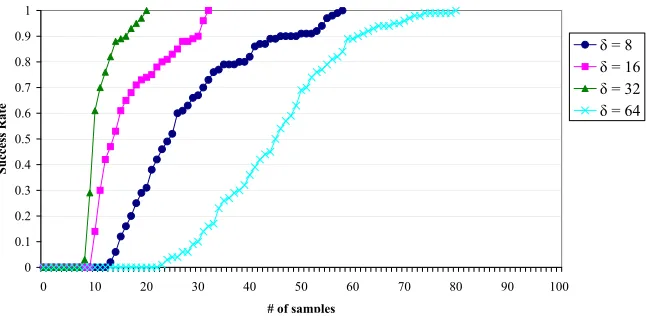
In this way, the constraints can be used to identify incorrect guesses earlier than would otherwise be possible, pruning significant portions of the search tree. This enables the attack to succeed faster or with fewer samples under a constant amount of search. To quantify this effect, the above approach was implemented and run in experiments similar to those for the attack without using hit information, with the same constant upper bound in the amount of search performed. This improves the success rate, as can be seen by comparing the experimental results in Figure 3 to those in Figure 1, and as summarized in Table 8.
0 0.1 0.2 0.3 0.4 0.5 0.6 0.7 0.8 0.9 1
0 10 20 30 40 50 60 70 80 90 100
# of samples
S
u
cc
es
s
R
a
te
δ = 8
δ = 16
δ = 32
δ = 64
δ= 8δ= 16δ= 32δ= 64 Med. samples, no cache assumption 56 31 19 49 Med. samples, clean cache assumption 25 14 10 45
Table 1.Comparison of performance with or without a clean-cache assumption
It is also useful to compare the above results with the analysis provided by Acıi¸cmez and Ko¸c of their own attacks. This data appears to fit in well with their calculations, confirming both the accuracy of their model and the efficiency of this formulation of the attack.
9
Countermeasures
Defending AES against side channel attacks in general is a daunting task. For cache-trace attack based on power analysis, the best defense would be hardware-based obfuscation of the encryption’s software’s cache accesses. This could take the form of either designing a microprocessor to use a consistent amount of power regardless of the operation it is performing, or at the minimum reducing the power difference between cache hits and misses. Kocher concedes that it is probably impractical to ever build a semiconductor-based processor which did not leak information through its power usage [KJJ99]. It should be possible to insert noise in the power usage graph by randomly using additional power. This would probably be unacceptable in practice for many platforms for which minimizing power usage is crucial, such as laptop computers and other portable devices.
It has been suggested frequently that the encryption process obscure its cache accesses by either adding random lookups or preloading all elements of the ta-ble [Ber05,OST06,BM06,AK06,BBM+06,BGNS06]. Pre-loading the table should
eliminate cache trace attacks as the cache trace would be all hits for the actual encryption operation. This approach should slow down encryption by 30−50%, which may make it impractical for widespread use.
lookups performed in the middle rounds are much more difficult to correlate with ciphertext or plaintext data [BGNS06].
Another method, as discussed in [BM06], is to eliminate the use of a special T4 table and instead re-use the previous four tables, each of which completely
contains the S-box values. This is an attractive defense because it comes at no performance cost and would greatly reduce the number of constraints produced by the cache trace attack. Unfortunately, this protection is not be possible for the decryption routines since the inverse S-box table is not contained in any of the decryption tables.
10
Conclusions
This paper has presented an approach to attacking AES given a small set of cache traces by reduction to a simple constraint satisfaction problem. By not assuming a clean cache, the attack is more robust than previous attacks. The attack also demonstrates that such an attack is practical with a low number of samples and requires computations which are easily performed on a desktop computer.
If an attacker is able to gain access to the power consumption profile of a target machine, presumably by physical access and inserting a monitoring device, than this attack could be used for many malicious purposes. One example would be hijacking the AES key used to encrypt data in an SSL session. This would be likely if a target machine is encrypting a small number of packets, while doing some unrelated work in between to evict some AES tables from memory. Another possibility would be to attempt to recover the encryption key used in a target’s encrypted file system, if the target is occasionally encrypting disk blocks.
A machine’s power consumption data is a high amount of information to give to an attacker, but the fact it enables a relatively strong attack against AES further illustrates that cached memory is fundamentally insecure and should be avoided by future cryptographic primitives.
References
[ABDM00] Mehdi-Laurent Akkar, R´egis Bevan, Paul Dischamp, and Didier Moyart. Power analysis, what is now possible.... In Advances in Cryptology— ASIACRYPT 2000, pages 489–502, 2000.
[AK06] Onur Acıi¸cmez and C¸ etin Kaya Ko¸c Trace Driven Cache Attack on AES. IACR Cryptology ePrint Archive, April 2006.
[BAK98] Eli Biham, Ross J. Anderson, and Lars R. Knudsen. Serpent: A new block cipher proposal. InFast Software Encryption ’98, pages 222–238, 1998. [BB05] David Brumley and Dan Boneh. Remote timing attacks are practical.
Computer Networks, 48(5):701–716, 2005.
[BBM+06] Guido Bertoni, Luca Breveglieri, Matteo Monchiero, Gianluca Palermo,
[Ber05] Daniel J. Bernstein. Cache-timing attacks on AES. April 2005. http://cr.yp.to/antiforgery/cachetiming-20050414.pdf.
[BM06] Joseph Bonneau and Ilya Mironov. Cache-collision Timing Attacks Against AES. April 2006. Workshop on Cryptographic Hardware and Embedded Systems 2006.
[BGNS06] Ernie Brickell and Gary Graunke and Michael Neve and Jean-Pierre Seifert. Software mitigations to hedge AES against cache-based software side chan-nel vulnerabilities. IACR ePrint Archive, Report 2006/052, Feb 2006. [DR99] Joan Daemen and Vincent Rijmen. Resistance against implementation
attacks: A comparative study of the AES proposals.Second AES Candidate Conference, February 1999.
[DR02] Joan Daemen and Vincent Rijmen. The design of Rijndael: AES—the advanced encryption standard. Springer-Verlag, 2002.
[GMO01] Karine Gandolfi, Christophe Mourtel, and Francis Olivier. Electromag-netic analysis: Concrete results. InCryptographic Hardware and Embedded Systems—CHES 2001, pages 251–261, 2001.
[KJJ99] Paul C. Kocher, Joshua Jaffe, and Benjamin Jun. Differential power anal-ysis. InAdvances in Cryptology—CRYPTO ’99, pages 388–397, 1999. [Koc96] Paul C. Kocher. Timing attacks on implementations of Diffie-Hellman,
RSA, DSS, and other systems. InAdvances in Cryptology—CRYPTO ’96, pages 104–113, 1996.
[KQ99] F. Koeune and J.-J. Quisquater. A timing attack against Rijndael. Tech-nical Report CG-1999/1, June 1999.
[KSWH00] John Kelsey, Bruce Schneier, David Wagner, and Chris Hall. Side channel cryptanalysis of product ciphers. Journal of Computer Security, 8(2/3), 2000.
[Lau05] Cedric Laradoux. Collision attacks on processors with cache and coun-termeasures. Western European Workshop on Research in Cryptology— WEWoRC’05, C. Wolf, S. Lucks, and P.-W. Yau (editors), pp. 76–85, 2005. [Mac77] Alan Mackworth Consistency in networks of relationsArtificial Intelligence
8, 1977.
[Mat97] Mitsuru Matsui. New block encryption algorithm MISTY. InFast Software Encryption ’97, pages 54–68, 1997.
[NBB+
00] J. Nechvatal, E. Barker, L. Bassham, W. Burr, M. Dworkin, J. Foti, and E. Roback. Report on the development of the Advanced Encryption Standard (AES). October 2000. http://csrc.nist.gov/CryptoToolkit/aes/round2/r2report.pdf.
[NSW06] Michael Neve, Jean-Pierre Seifert, and Zhenghong Wang. A refined look at Bernstein’s AES side-channel analysis.ASIACCS, p. 369, 2006.
[NS06] Michael Neve and Jean-Pierre Seifert. Advances on access-driven cache attacks on AES. InSAC’06, to appear.
[OST06] Dag Arne Osvik, Adi Shamir, and Eran Tromer. Cache attacks and coun-termeasures: the case of AES. InCT-RSA, pages 1–20, 2006.
[Pag02] Daniel Page. Theoretical use of cache memory as a cryptanalytic side-channel. Technical Report CSTR-02-003, University of Bristol, April 2002. [Pag03] Daniel Page. Defending against cache based side channel attacks. Technical
Report. Department of Computer Science, University of Bristol, 2003. [Pag05] Daniel Page. Partitioned cache as a side-channel defense mechanism. IACR
[Per05] Colin Percival. Cache missing for fun and profit. Presented at BSDCan ’05, 2005. http://www.daemonology.net/hyperthreading-considered-harmful/. [RN95] Stuart Russell and Peter Norvig. Artificial Intelligence: A Modern
Ap-proach. Prentice Hall, Upper Saddle River, NJ, 1995. [TSS+
03] Yukiyasu Tsunoo, Teruo Saito, Tomoyasu Suzaki, Maki Shigeri, and Hiroshi Miyauchi. Cryptanalysis of DES implemented on computers with cache. In
Cryptographic Hardware and Embedded Systems—CHES 2003, pages 62– 76, 2003.