R E S E A R C H
WEB EXCLUSIVE
Editor’s key points
Playing outside has many benefits for children and is foundational to their physical, psychological, and social development. Playgrounds are a common venue for this type of play, but despite the known benefits, playground activity comes with the risk of incurring injury. The authors aimed to synthesize recent evidence to determine the prevalence of playground-related injuries.
Although playgrounds are a common location for childhood injuries, the authors found that these injuries are relatively low in frequency and severity. Almost two-thirds of injuries are low-severity injuries, while about 30% are severe enough to prompt a medical consultation. In a minority of cases, injuries lead to emergency department visits, but rarely to hospitalization, and only a small proportion of children with playground-related injuries are likely to suffer any long-term sequelae.
The risk of injury from playground activity must be weighed against the benefits that such activity provides for children. Playgrounds are a place where they can socialize, develop emotional intelligence, and reduce the risks of physical inactivity at a very low cost. It is also possible to reduce playground injuries simply with adult supervision.
Don’t take down
the monkey bars
Rapid systematic review of
playground-related injuries
Nicolas Bergeron Catherine Bergeron Luc Lapointe PhD Dean Kriellaars PhD
Patrice Aubertin Brandy Tanenbaum Richard Fleet MD PhD
Abstract
Objective To synthesize the available evidence on playground-related injuries and to determine the prevalence of these injuries in pediatric populations.
Data sources A rapid systematic review was conducted using PubMed, EMBASE, and the Cochrane Library, as well as the gray literature.
Study selection The search was limited to studies published between 2012 and 2016 and identified a total of 858 articles, of which 22 met our inclusion criteria: original quantitative studies published in peer-reviewed journals in the past 5 years, concerning unintentional injuries in playgrounds in children aged 0 to 18 years.
Synthesis Information was collected on study and injury characteristics, and the proportion of pediatric injuries related to playground activity was determined. Studies were performed in various countries and most were retrospective cohort studies. The prevalence of playground-related injury ranged from 2% to 34% (median 10%). Studies varied in the types of injuries investigated, including head injuries, genitourinary injuries, ocular and dental trauma, and various types of fractures. Most injuries were low severity.
Résumé
Objectif Faire une synthèse des données actuellement disponibles sur les blessures qui surviennent sur des terrains de jeu et déterminer leur prévalence chez de jeunes enfants.
Sources des données On a effectué une revue systémique à l’aide des bases de données PubMed, Embase et Cochrane Library, mais à partir de la littérature grise.
Choix des études On a retenu uniquement les études scientifiques publiées entre 2012 et 2016 : on a ainsi repéré un total de 858 articles, parmi lesquels 22 étaient conformes à nos critères d’inclusion, soit des études quantitatives originales publiées dans des revues révisées par des pairs au cours des 5 dernières années et portant sur des blessures non intentionnelles survenues sur des terrains de jeu chez des jeunes de 0 à 18 ans.
Synthèse On a recueilli des renseignements sur les caractéristiques des études et des blessures et la proportion des blessures chez les enfants qui étaient liées aux activités sur les terrains de jeu. Ces études provenaient de divers pays, et la plupart étaient des études de cohorte rétrospectives. La prévalence de ce type de blessure variait entre 2 % et 34 % (médiane 10 %). Les études variaient quant au type de blessures étudiées, dont des blessures à la tête, à la région génito-urinaire, aux yeux et aux dents ainsi que plusieurs types de fractures. La plupart étaient de faible gravité.
Conclusion Même si les terrains de jeu sont souvent l’occasion de blessures, celles-ci sont relativement peu fréquentes et de faible gravité.
Ne supprimez pas
les cages à grimper!
Une revue systématique rapide des blessures
qui surviennent sur les terrains de jeu
Nicolas Bergeron Catherine Bergeron Luc Lapointe PhD Dean Kriellaars PhD
Patrice Aubertin Brandy Tanenbaum Richard Fleet MD PhD
Points de repère
du rédacteur
Jouer dehors est avantageux de plusieurs façons pour les enfants; cela joue un rôle fondamental dans leur développement physique, psychologique et social. Les enfants choisissent souvent les terrains de jeu pour s’amuser, mais malgré les avantages qu’ils en retirent, ce type d’activité présente certains risques de blessures. Les auteurs ont voulu faire un résumé des données scientifiques récentes à ce sujet afin d’établir la prévalence des blessures qui surviennent sur les terrains de jeu.
Bien que des blessures
surviennent sur les terrains de jeu, les auteurs ont observé qu’elles sont généralement peu fréquentes et rarement sévères. Environ les deux tiers d’entre elles sont de faible gravité, et seulement 30 % sont suffisamment sévères pour exiger une consultation médicale. Dans un petit nombre de cas, elles requièrent une visite à l’urgence, mais rarement une hospitalisation. De plus, il n’y a qu’une petite proportion des enfants blessés sur les terrains de jeu qui sont susceptibles de subir des séquelles à long terme.
Don’t take down the monkey bars
RESEARCH
P
laying outside has numerous benefits and helps meet 3 key needs of children: physical activity,1emotional well-being,2 and development of motor
competencies.3 Playground activity is foundational in the
psychological and physical development of children and might predict future participation in other sports and recreational activities.4-6 In fact, physicians are
increas-ingly prescribing outdoor play to address the current epidemic of physical inactivity.7 Risky play—a novel
cat-egorization of play that involves potential risk of physical injury—provides children with exhilarating positive emo-tions and exposes them to situaemo-tions they might have once feared. As their coping skills improve, they are able to master situations and cease to fear them.8 Risky play
has been shown to be important for children’s health, development, learning, social behaviour, self-esteem, independence, conflict resolution, risk detection, and risk competence8-12; playgrounds are a common venue
for this type of play. Activities such as climbing, jump-ing, balancjump-ing, swingjump-ing, and running become essential aspects of a child’s growth and development.
Although playground activity has known benefits, it comes with the risk of incurring a playground-related injury. In Canada, playground falls account for approxi-mately 1500 hospitalizations each year.13 An estimated
214 883 playground injuries occur in the United States each year, representing around 353 injuries per 100 000 children aged 14 years and younger.14 Based on the
reporting of playground-related injuries from govern-ment and media sources, it is possible that parents, playground supervisors, and other caregivers limit play-ground participation. Indeed, some municipalities are closing playgrounds or dismantling their equipment owing to fear of injuries and liability.1,15 In order to
inform the current knowledge regarding playground-related injuries, we conducted a rapid systematic review to synthesize the available evidence on playground-related injuries and to determine the prevalence of these injuries in pediatric populations.
——
Methods
——
A rapid systematic review of literature published within the past 5 years (2012 to 2016) was conducted to cre-ate an evidential summary of the most recent relevant research on playground-related injuries.
Data sources
We defined a playground as a piece of land used espe-cially by children and usually equipped with facilities for recreation including slides, swings, monkey bars, see-saws, teeter-totters, jungle gyms, and climbing frames. A search strategy was built using a combination of search terms (MeSH, EMTREE) and key words including child, playground, and injury (search strategy is available from the corresponding author on request). This strategy was
used to search 3 online databases (PubMed, EMBASE, Cochrane Library). We also used key words to search the gray literature for relevant publications using Google and Google Scholar. Searches were performed between June and September 2016.
Study selection
Original articles and abstracts published in peer-reviewed journals were eligible, as well as published reports from the gray literature. Our inclusion criteria were as follows:
• quantitative studies,
• articles published in the past 5 years (2012 to 2016), • studies concerning childhood injuries,
• children aged 0 to 18 years, • unintentional injuries, and
• injuries happening in playgrounds.
Case reports, articles written in languages other than English, and reports on bacterial outbreaks were excluded.
Review process
After performing the search, duplicates were removed, and the remaining articles were screened by title and abstract. Eligibility of articles for inclusion in the review was assessed by 1 team member (one of N.B., C.B., L.L.) and supplemented by an intercoder validation procedure whereby disagreements were resolved by discussion between 2 of those team members. Full-text articles were obtained if the title or abstract did not contain sufficient information for assessment against the inclu-sion criteria. The articles that met the incluinclu-sion crite-ria were split between 2 reviewers (C.B., N.B.), and data extraction was performed by each reviewer individually for their assigned articles, with the addition of inter-coder validation. Information from studies selected for inclusion were entered in a data extraction sheet that included year, study design, cohort description, sample size, demographic characteristics, and number and type of playground injuries. We searched the references of included articles and relevant systematic reviews for additional articles. A narrative synthesis approach was used to present the results of the review.
——
Synthesis
——
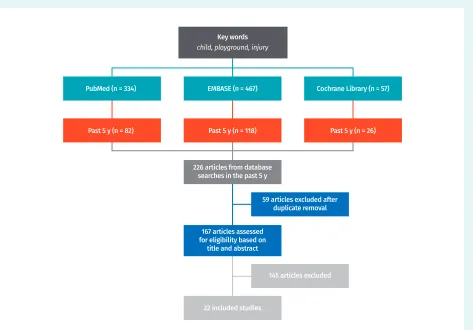
In total, 858 articles were identified by the search strategy. We removed duplicates and excluded articles published before 2012, leaving 167 articles for screening by title and abstract. There were 22 articles that met our inclusion criteria and that were included in the review (Figure 1).
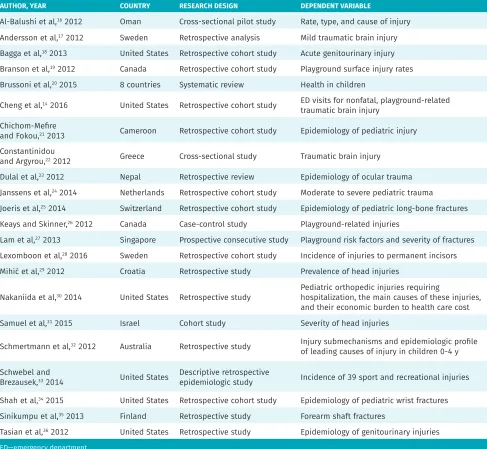
The characteristics of included studies are shown in
Table 1.14,16-36 Most were retrospective cohort studies,
individual studies, male children accounted for between 45% and 70% of patients (median 62%).16,36
General epidemiology
Playground-related injuries tend to occur more often during early childhood. An Australian study found that playground falls were the leading cause of injuries lead-ing to hospitalization among children aged 0 to 4 years, with 91.6 hospitalizations per 100 000 individuals in this age group.32 Using 2001 to 2008 data from the National
Electronic Injury Surveillance System (NEISS) in the United States, Schwebel and Brezausek determined that playgrounds were the most common cause of injury in children aged 1 to 9 years while participating in sport or recreational activities.33 A summary report of Canadian
injury data showed that the highest number of fall-related hospitalizations in 2010 was due to falls in playgrounds.13
Similarly, a Finnish study found that falls on the play-ground were the most common cause of injury in children aged 0 to 16 years, accounting for 34% of all injuries.35 A
study from Cameroon also observed that falls were the most common injury mechanism in children younger than 16 years of age, and that these injuries occurred most often on playgrounds.21 In a study of injuries
presenting at a primary care setting in Oman, play-grounds were the second most common location where injuries occurred, accounting for 10.2% of injuries.16
Among other studies, playgrounds were the second most frequent cause of pediatric injuries in 3 studies,23,24,28 the
third most frequent cause of injury in 2 studies,22,34 and
the fourth most frequent cause of injury in 2 studies.25,27
Injury types
Studies examined various types of injuries that occurred on playgrounds. Five studies reported on various types of fractures,25,27,30,34,35 5 studies described head
inju-ries occurring on playgrounds,14,17,22,29,31 and 2 studies
reported on genitourinary injuries.18,36
Fractures. Joeris et al reported that falls were the lead-ing cause of long-bone fractures (27%), and leisure activities accounted for 25% of pediatric fractures; only 11% of fractures were caused by playground accidents.25
Shah et al investigated wrist fractures in children using NEISS data from 1998 to 2013; they observed that 8% of wrist fractures were associated with monkey bars, playground gyms, or other playground climbing appa-ratus, and that wrist fractures were most common in
Figure 1. Search strategy
Key words
child, playground, injury
PubMed (n = 334) EMBASE (n = 467) Cochrane Library (n = 57)
Past 5 y (n = 82) Past 5 y (n = 118)
22 included studies
59 articles excluded after duplicate removal
145 articles excluded
Past 5 y (n = 26)
167 articles assessed for eligibility based on
title and abstract 226 articles from database
Don’t take down the monkey bars
RESEARCH
children aged 3 to 10 years.34 When examining a 16-year
trend, the authors reported that the incidence of play-ground-related wrist fractures has remained relatively unchanged overall. Another study of 2006 data from the Kids’ Inpatient Database in the United States observed that a fall from playground equipment was the leading cause of humerus fractures (21.9%) and radius fractures (11.3%).30 In a European study conducted from 1997 to
2009, playground falls caused 6.2% of both-bone forearm fractures and were the most common cause of injury for both boys (36%) and girls (30%).35 Furthermore, in their
investigation on the severity of playground-related frac-tures in Singapore, Lam et al reported that any amount of supervision at the time of injury resulted in a lower likelihood of serious fractures (ie, requiring reduction or operative fixation), although supervision by a parent
or sibling resulted in a lower likelihood of serious frac-tures than supervision by grandparents or maids.27 While
Lam and colleagues also observed that increased patient weight was directly related to the severity of fractures, they found no correlation between fracture severity and the height or type of playground equipment.
Brain injuries. In their investigation of mild trau-matic brain injuries (TBI), Andersson et al found that falls from a height were the most common cause, and playgrounds accounted for 8% of the locations where such accidents occurred.17 Another study examined the
prevalence of TBI in school-aged children and found that blows to the head were the most common risk fac-tor for persistent alteration of mental status, with 9% of children experiencing blows to the head receiving
Table 1. Characteristics of included studies
AUTHOR, YEAR COUNTRY RESEARCH DESIGN DEPENDENT VARIABLE
Al-Balushi et al,16 2012 Oman Cross-sectional pilot study Rate, type, and cause of injury
Andersson et al,17 2012 Sweden Retrospective analysis Mild traumatic brain injury
Bagga et al,18 2013 United States Retrospective cohort study Acute genitourinary injury
Branson et al,19 2012 Canada Retrospective cohort study Playground surface injury rates
Brussoni et al,20 2015 8 countries Systematic review Health in children
Cheng et al,14 2016 United States Retrospective cohort study ED visits for nonfatal, playground-related
traumatic brain injury Chichom-Mefire
and Fokou,21 2013 Cameroon Retrospective cohort study Epidemiology of pediatric injury
Constantinidou
and Argyrou,22 2012 Greece Cross-sectional study Traumatic brain injury
Dulal et al,23 2012 Nepal Retrospective review Epidemiology of ocular trauma
Janssens et al,24 2014 Netherlands Retrospective cohort study Moderate to severe pediatric trauma
Joeris et al,25 2014 Switzerland Retrospective cohort study Epidemiology of pediatric long-bone fractures
Keays and Skinner,26 2012 Canada Case-control study Playground-related injuries
Lam et al,27 2013 Singapore Prospective consecutive study Playground risk factors and severity of fractures
Lexomboon et al,28 2016 Sweden Retrospective cohort study Incidence of injuries to permanent incisors
Mihić et al,29 2012 Croatia Retrospective study Prevalence of head injuries
Nakaniida et al,30 2014 United States Retrospective study Pediatric orthopedic injuries requiring hospitalization, the main causes of these injuries,
and their economic burden to health care cost Samuel et al,31 2015 Israel Cohort study Severity of head injuries
Schmertmann et al,32 2012 Australia Retrospective study Injury submechanisms and epidemiologic profile
of leading causes of injury in children 0-4 y
Schwebel and
Brezausek,33 2014 United States Descriptive retrospective epidemiologic study Incidence of 39 sport and recreational injuries
Shah et al,34 2015 United States Retrospective cohort study Epidemiology of pediatric wrist fractures
Sinikumpu et al,35 2013 Finland Retrospective study Forearm shaft fractures
Tasian et al,36 2012 United States Retrospective study Epidemiology of genitourinary injuries
them in playgrounds.22 According to Mihi
ć
et al, 5.7%of head injuries occurred at the playground, and these injuries were most frequently inflicted by hitting.29 Falls
from a playground device accounted for 2% of all falls among mild head injury patients in Israel aged 0 to 2 years.31 Finally, Cheng et al examined 2001 to 2013 data
from the NEISS and found that, in the United States, there was an annual average of 21 101 children 14 years of age and younger who were treated in emergency departments for playground-related TBI.14 Overall, 95.6%
of these patients were treated and released without hos-pitalization, suggesting that the severity of injury was relatively minor in most cases.14
Other traumatic injuries. Dental, ocular, and genito-urinary traumas have also been investigated in play-ground injury studies. Playplay-ground equipment such as swings, slides, rocking horses, and climbing struc-tures, as well as jumping on trampolines, accounted for 13.4% of dental trauma cases in children 8 to 10 years of age.28 Playgrounds were also the second most
com-mon location where ocular traumas occurred in pedi-atric patients, with 25.3% of these injuries sustained on the playground.23 Bagga et al and Tasian et al used
NEISS data from 2002 to 2010 to examine genitourinary injuries due to falls from playground equipment. Bagga et al reported that these injuries occurred in 16% of chil-dren aged 4 to 7 years and in 12% of chilchil-dren aged 8 and older,18 while Tasian et al found that 6% of genitourinary
injuries in children younger than 18 years of age who presented to emergency departments were caused by playground equipment.36
Effect of playground setting. Using emergency-based surveillance data for Canadian children aged 3 to 11 years, Keays and Skinner compared the severity of playground-related injuries occurring at home versus in public set-tings.26 Although fewer playground injuries occurred at
home (16% vs 84%), children who fell from playground equipment at home were more likely to have severe inju-ries (odds ratio [OR] of 1.30, 95% CI 1.23 to 1.37) and fractures (OR = 1.47, 95% CI 1.39 to 1.55). Children 3 to 5 years of age who fell from a slide at home had the great-est odds of severe injury (OR = 1.72, 95% CI 1.41 to 2.09) and fractures (OR = 2.17, 95% 1.79 to 2.64) compared with children who fell off the slide in a public playground.
Effect of playground surface and season. To determine the effect of season on playground surface injury rates, Branson et al analyzed data from student incident report forms at elementary schools in the Canadian province of Alberta.19 Equipment on which injuries occurred most
frequently were the monkey bars (32.1%) and the slide (12.7%). Most injuries were of low severity (63.2%), and the most common injuries observed were abrasions, bruises, and inflammation (44.8%). Playground surface
types included natural rock, crushed rock, poured-in-place, and rubber crumb. Compared with natural rock, rubber crumb surfacing had a significantly lower rate of injury in the spring (rate ratio of 0.34, 95% CI 0.12 to 0.98). No other season-surface comparisons were statis-tically significant.
——
Discussion
——
The results of this rapid systematic review demonstrate that playgrounds are a common site of pediatric injury, especially among children earlier in their development. The prevalence of playground-related injuries among included studies ranged from 2% to 34% (median 10%). Most of the injury types examined were low severity. These findings suggest that although playgrounds are a common location of childhood injuries, these injuries are relatively low in frequency and severity. It is impor-tant to note that it is possible to reduce playground inju-ries simply with adult supervision.27
Although playground activity was the leading cause of pediatric injury in some studies, other studies dem-onstrated that rates of serious injury can be greater from activities such as playing at home or cycling. In 2010, transport injuries were the top cause of death in Canadian children aged 0 to 14 years.13 With respect
to fractures, more were caused by motor vehicle colli-sions, cycling, or leisure activities than by playground falls.25 Moreover, while TBI ranks as the fifth most
com-mon injury occurring in playgrounds, children are still more at risk of suffering TBI while at home, at school, or in traffic.17,29 Likewise, dental traumas are caused more
often by simply slipping and falling, ocular injuries occur more frequently at home than on playgrounds, and gen-itourinary injuries are caused more often by using sport-ing equipment or fallsport-ing from furniture.18,23,28
Furthermore, low-severity injuries account for 63% of injuries on Canadian playgrounds.19 About 30% of
play-ground injuries are severe enough to prompt a medical consultation, while less than 2% require transportation by ambulance.19 In the United States, of all the children
who visited an emergency department between 2001 and 2013 for playground-related injuries, more than 95% were treated and released without requiring fur-ther hospitalization.14 These findings suggest that while
playground injuries do occur, they are mainly associated with minor musculoskeletal injuries, cuts, and bruises (ie, minor injuries that necessitate little or no medical attention). In a minority of cases, injuries lead to emer-gency department visits, but rarely to hospitalization. In this modern orthopedic era, only a small proportion of children with playground-related injuries are likely to suffer any long-term sequelae.
Don’t take down the monkey bars
RESEARCH
development of social skills such as conflict sensitivity, conflict resolution, sharing, turn-taking, negotiation, leadership, and maintaining peer relationships.11,37-39 Free
play also has psychological benefits: children enjoy it and it appears to reduce anxiety.8,37,38 Play develops many
qualities such as creativity, resilience, confidence, imagi-nation, independence, self-control, and risk perception and management.9,40-42 It is important to note that risky
play does not imply the child is in danger, but rather that there is a situation where the outcome is unknown and children must decide on a course of action.43,44 Being
active on playgrounds also has benefits for physical health and is linked to better bone health, increased physical fitness, lower body mass index, a more favour-able lipid profile, lower blood pressure, and protection against future chronic diseases.45,46 Simply playing
out-side rather than inout-side increases physical activity in children, and the availability of parks and recreational facilities is also positively linked to physical activity.47,48
Physical activity behaviour learned in childhood often carries on into adulthood.4-6 Last, play at recess has been
shown to be predictive of school achievement and the performance of cognitive tasks such as language, prob-lem solving, and mathematic skills.49,50
Limitations and strengths
Certain limitations warrant cautious interpretation of this review of playground injury data. First, most stud-ies were based on emergency department databases, so the total number of playground injuries might be under-represented. Thus, more studies of playground injuries through direct observation are needed to increase our knowledge of these injuries. Next, surprisingly, none of the studies defined what they considered to be a play-ground, so their observations might not be compara-ble. The only key word we used to identify articles that reported playground-related injuries was playground. As we excluded articles published more than 5 years before our review, we might have missed useful arti-cles. Also, data extraction was performed by a single coder. Finally, a rapid systematic review methodology (rather than systematic review) was used to optimize time and resources while preserving essential informa-tion. Therefore, minimal critical appraisal and evalua-tion of variaevalua-tions in the research design of the included studies were performed in order to weigh the included articles. Despite these limitations, this review has sev-eral strengths. We conducted a comprehensive search in 3 online databases and the gray literature, we system-atically applied selection and extraction criteria, and we included studies performed in any country. Also, as this review identified a large number of articles published only over a 5-year period, it shows that it could be pos-sible to conduct a larger review that could include a thorough meta-analysis.
Conclusion
The prevalence of playground-related injuries among included studies ranged from 2% to 34%, with a median of 10%. Although playgrounds are a common location for childhood injuries, these injuries are relatively low in fre-quency and severity. The risk of injury from playground activity must be weighed against the benefits that such activity provides for children. Playgrounds are a place where they can socialize, develop emotional intelligence, and reduce the risks of physical inactivity at a very low cost. Given the current state of physical and mental health among children, it is counterintuitive to isolate playground injuries as a serious cause for parental con-cern. More effort should be made to evaluate the relative risk associated with various forms of play and to provide an objective measure from which parents can make an informed choice. It could also be interesting to conduct a similar review that would try to explore how we could further decrease the risk of injuries in playgrounds by looking at the effect of numerous factors such as play-ground design, setting, and parental supervision. Mr N. Bergeron and Ms C. Bergeron are medical students and Dr Lapointe is a postdoc-toral fellow, all in the Department of Family Medicine and Emergency Medicine at Laval University in Quebec city, Que. Dr Kriellaars is Associate Professor in the Department of Physical Therapy at the University of Manitoba in Winnipeg. Mr Aubertin is Director of Research and Teacher Training Programs at the National Circus School in Montreal, Que. Ms Tanenbaum is Program Coordinator in the Office for Injury Prevention at Sunnybrook Health Sciences Centre in Toronto, Ont. Dr Fleet is Professor and Research Chair in Emergency Medicine at Laval University.
Acknowledgment
This research was funded by the Chaire de recherche en médecine d’urgence, Université Laval–CISSS Chaudière-Appalaches.
Contributors
Mr N. Bergeron, Ms C. Bergeron, and Dr Lapointe participated in designing the study protocol, collected data, carried out the initial analyses, and reviewed and revised the final version of the manuscript. Dr Kriellaars, Mr Aubertin, and Ms Tanenbaum
thought of the idea of conducting the rapid review, participated in designing the study protocol, edited the manuscript, and reviewed and revised the final version of the manuscript. Dr Fleet was the principal supervisor of the project, contributed to the original idea of conducting the rapid review with other co-authors, and participated in designing the study protocol, writing the initial manuscript drafts with co-authors, and reviewing and revising the final version of the manuscript. All authors approved the final manuscript as submitted and agree to be accountable for all aspects of the work.
Competing interests
None declared
Correspondence
Dr Richard Fleet; e-mail [email protected] References
1. Lee H, Tamminen KA, Clark AM, Slater L, Spence JC, Holt NL. A meta-study of qualita-tive research examining determinants of children’s independent acqualita-tive free play. Int J Behav Nutr Phys Act 2015;12:5.
2. Thompson Coon J, Boddy K, Stein K, Whear R, Barton J, Depledge MH. Does partici-pating in physical activity in outdoor natural environments have a greater effect on physical and mental wellbeing than physical activity indoors? A systematic review.
Environ Sci Technol 2011;45(5):1761-72. Epub 2011 Feb 3.
3. Tortella P, Haga M, Loras H, Sigmundsson H, Fumagalli G. Motor skill development in Italian pre-school children induced by structured activities in a specific playground.
PLoS One 2016;11(7):e0160244.
4. Telama R. Tracking of physical activity from childhood to adulthood: a review. Obes Facts 2009;2(3):187-95. Epub 2009 Jun 12.
5. Janz KF, Burns TL, Levy SM; Iowa Bone Development Study. Tracking of activity and sedentary behaviors in childhood: the Iowa Bone Development Study. Am J Prev Med 2005;29(3):171-8.
6. Biddle SJ, Pearson N, Ross GM, Braithwaite R. Tracking of sedentary behaviours of young people: a systematic review. Prev Med 2010;51(5):345-51. Epub 2010 Aug 1. 7. James AK, Hess P, Perkins ME, Taveras EM, Scirica CS. Prescribing outdoor play:
outdoors Rx. Clin Pediatr (Phila) 2017;56(6):519-24. Epub 2016 Nov 12.
9. Brussoni M, Olsen LL, Pike I, Sleet DA. Risky play and children’s safety: balanc-ing priorities for optimal child development. Int J Environ Res Public Health
2012;9(9):3134-48.
10. Engelen L, Bundy AC, Naughton G, Simpson JM, Bauman A, Ragen J, et al. Increasing physical activity in young primary school children—it’s child’s play: a cluster ran-domised controlled trial. Prev Med 2013;56(5):319-25. Epub 2013 Feb 24.
11. Lavrysen A, Bertrands E, Leyssen L, Smets L, Vanderspikken A, De Graef P. Risky-play at school. Facilitating risk perception and competence in young children. Eur Early Child Educ 2017;25(1):89-105.
12. Hüttenmoser M. Children and their living surroundings: empirical investigation into the significance of living surroundings for the everyday life and development of children. Child Environ 1995;12(4):403-13.
13. Parachute. The cost of injury in Canada—summary report: falls and transport injury trends in children 2004 and 2010. Toronto, ON: Parachute; 2015. Available from: www.parachutecanada.org/downloads/research/Cost_of_Injury-2015-Child_ Injury_Compendium.pdf. Accessed 2019 Feb 13.
14. Cheng TA, Bell JM, Haileyesus T, Gilchrist J, Sugerman DE, Coronado VG. Nonfatal playground-related traumatic brain injuries among children, 2001-2013. Pediatrics
2016;137(6):e20152721.
15. Ergler CR, Kearns RA, Witten K. Seasonal and locational variations in children’s play: implications for wellbeing. Soc Sci Med 2013;91:178-85. Epub 2012 Dec 12. 16. Al-Balushi H, Al-Kalbani A, Al-Khwaldi T, Al-Suqri S, Al-Maniri A, Alazri M, et al.
Inju-ries presented at a primary care setting in Oman. Oman Med J 2012;27(6):486-90.
17. Andersson EE, Sejdhage R, Wage V. Mild traumatic brain injuries in children between 0-16 years of age: a survey of activities and places when an accident occurs. Dev Neurorehabil 2012;15(1):26-30.
18. Bagga H, Tasian G, McGeady J, Blaschko S, McCulloch C, McAninch J, et al. 144 Genitourinary injury presenting to US emergency departments across age ranges. J Urol 2013;189(4s):e58-9. 19. Branson LJ, Latter J, Currie GR, Nettel-Aguirre A, Embree T, Hagel BE. The effect of
surface and season on playground injury rates. Paediatr Child Health 2012;17(9):485-9. 20. Brussoni M, Gibbons R, Gray C, Ishikawa T, Sandseter EB, Bienenstock A, et al. What
is the relationship between risky outdoor play and health in children? A systematic review. Int J Environ Res Public Health 2015;12(6):6423-54.
21. Chichom-Mefire A, Fokou M. Epidemiology of paediatric injury in low income envi-ronment: value of hospital based data prior to the institution of a formal registra-tion system. Afr J Paediatr Surg 2013;10(3):265-70.
22. Constantinidou F, Argyrou K. The proportion of risk for TBI and persisting symptom-atology in Cypriot school-age children. Brain Injury 2012;26(4-5):397.
23. Dulal S, Ale JB, Sapkota YD. Profile of pediatric ocular trauma in mid western hilly region of Nepal. Nepal J Ophthalmol 2012;4(1):134-7.
24. Janssens L, Holtslag HR, Leenen LP, Lindeman E, Looman CW, Van Beeck EF. Trends in moderate to severe paediatric trauma in central Netherlands. Injury
2014;45(8):1190-5. Epub 2014 Apr 24.
25. Joeris A, Lutz N, Wicki B, Slongo T, Audigé L. An epidemiological evaluation of pe-diatric long bone fractures—a retrospective cohort study of 2716 patients from two Swiss tertiary pediatric hospitals. BMC Pediatr 2014;14:314.
26. Keays G, Skinner R. Playground equipment injuries at home versus those in public settings: differences in severity. Inj Prev 2012;18(2):138-41. Epub 2012 Feb 16. 27. Lam KY, Sumanth Kumar G, Mahadev A. Severity of playground-related fractures:
more than just playground factors? J Pediatr Orthop 2013;33(3):221-6.
28. Lexomboon D, Carlson C, Andersson R, von Bultzingslowen I, Mensah T. Incidence and causes of dental trauma in children living in the county of Varmland, Sweden.
Dent Traumatol 2016;32(1):58-64. Epub 2015 Sep 8.
29. Mihić J, Rotim K, Marcikić M, Smiljanić D, Dikanović M, Jurjević M, et al. The preva-lence of neurocranium injury in children in Brod-Posavina County. Acta Clin Croat
2012;51(4):615-22.
30. Nakaniida A, Sakuraba K, Hurwitz EL. Pediatric orthopaedic injuries requiring hospi-talization: epidemiology and economics. J Orthop Trauma 2014;28(3):167-72.
31. Samuel N, Jacob R, Eilon Y, Mashiach T, Shavit I. Falls in young children with minor head injury: a prospective analysis of injury mechanisms. Brain Inj 2015;29(7-8):946-50. Epub 2015 May 8.
32. Schmertmann M, Williamson A, Black D. Leading causes of injury hospitalisation in children aged 0–4 years in New South Wales by injury submechanism: a brief profile by age and sex. J Paediatr Child Health 2012;48(11):978-84.
33. Schwebel DC, Brezausek CM. Child development and pediatric sport and recre-ational injuries by age. J Athl Train 2014;49(6):780-5.
34. Shah NS, Buzas D, Zinberg EM. Epidemiologic dynamics contributing to pediatric wrist fractures in the United States. Hand (N Y) 2015;10(2):266-71.
35. Sinikumpu JJ, Pokka T, Serlo W. The changing pattern of pediatric both-bone forearm shaft fractures among 86,000 children from 1997 to 2009. Eur J Pediatr Surg
2013;23(4):289-96. Epub 2013 Feb 26.
36. Tasian G, Bagga H, Fisher P, Cinman N, McCulloch C, McAninch J, et al. 1199 Pediatric genitourinary injuries treated in us emergency departments from 2002 - 2010: results from the national electronic injury surveillance system database. J Urol
2012;187(4s):e485-6.
37. Gray P. The decline of play and the rise of psychopathology in children and adoles-cents. Am J Play 2011;3(4):443-63.
38. Burdette HL, Whitaker RC. Resurrecting free play in young children: looking beyond fitness and fatness to attention, affiliation, and affect. Arch Pediatr Adolesc Med
2005;159(1):46-50.
39. Bundy AC, Luckett T, Tranter PJ, Naughton GA, Wyver SR, Ragen J, et al. The risk is that there is ‘no risk’: a simple, innovative intervention to increase children’s activ-ity levels. Int J Early Years Educ 2009;17(1):33-45.
40. Ramstetter CL, Murray R, Garner AS. The crucial role of recess in schools. J Sch Health 2010;80(11):517-26.
41. Blasi M, Hurwitz SC. For parents particularly: to be successful—let them play! Child Educ 2002;79(2):101-2.
42. Sandseter EBH. Risky play and risk management in Norwegian preschools—a quali-tative observational study. Saf Sci Monit 2009;13(1):1-12.
43. Little H. Young children’s physical risk-taking behaviour during outdoor play: the influence of individual, social and environmental factors. Sydney, Aust: Macquarie University; 2010.
44. Ball D, Gill T, Spiegal B. Managing risk in play provision: implementation guide. London, UK: Play England; 2008.
45. Hallal PC, Victora CG, Azevedo MR, Wells JC. Adolescent physical activity and health: a systematic review. Sports Med 2006;36(12):1019-30.
46. Janz KF, Letuchy EM, Eichenberger Gilmore JM, Burns TL, Torner JC, Willing MC, et al. Early physical activity provides sustained bone health benefits later in childhood.
Med Sci Sports Exerc 2010;42(6):1072-8.
47. Gray C, Gibbons R, Larouche R, Sandseter EB, Bienenstock A, Brussoni M, et al. What is the relationship between outdoor time and physical activity, sedentary behaviour, and physical fitness in children? A systematic review. Int J Environ Res Public Health
2015;12(6):6455-74.
48. Roemmich JN, Epstein LH, Raja S, Yin L, Robinson J, Winiewicz D. Association of ac-cess to parks and recreational facilities with the physical activity of young children.
Prev Med 2006;43(6):437-41. Epub 2006 Aug 22.
49. Pellegrini AD, Holmes RM. Play=learning: how play motivates and enhances children’s cognitive and social-emotional growth. Oxford, UK: Oxford Scholarship Online; 2006.
50. Donnelly JE, Lambourne K. Classroom-based physical activity, cognition, and aca-demic achievement. Prev Med 2011;52(Suppl 1):S36-42. Epub 2011 Jan 31.