ABSTRACT
ALBRECHT, KATE ROSE. Understanding Network Evolution: Comparing and Integrating Phenomenological, Configurational, and Main Effect methodologies. (Under the direction of Dr. Branda Nowell).
Attention continues to remain focused on the nature of collaborative forms of
interorganizational networks in both research and practice in Public Administration (Bryson, Crosby, & Stone, 2015; Isett, Mergel, LeRoux, Mischen, & Rethemeyer, 2011). This dissertation joins that tradition but also advances a call for theory to begin moving beyond the internal
perspective and to embrace new research agendas that consider the network itself as the level of analysis. Despite broad application of collective network approaches in practice, theory
development for understanding this phenomenon has fallen behind practice, motivating calls for greater attention to research in this area of collaborative network evolution (Milward, 2016). While there has been some discussion of looking at the nature of a network as a whole to advance an exogenous theory of understanding performance (Kenis & Provan, 2009), little has been done to examine the evolution of networks within and across forms.
dynamics (e.g., shared membership, the presence of competing initiatives) affect its chances of survival, death, or transformation over time.
In addition to the methodological contributions of this research, this dissertation offers a unique opportunity to advance substantive aspects of our field’s theories by tracking the
evolution of networks embedded within a broader network domain. By leveraging the
comparison and integration of inductive and deductive approaches, this research highlights the importance of both the qualitative and quantitative considerations that create a fuller, more nuanced understanding of networks being affected by endogenous and exogenous factors
simultaneously. This research analyzes a unique, population-level longitudinal dataset comprised of community health networks that are embedded through shared membership ties. To date, this type of dataset has not been analyzed from multiple methodological approaches with the goal of examining the unique theoretical contributions of each individual method and its combined insights.
This dissertation more directly articulates the theoretical and methodological utility of the three methods and how they can be leveraged to co-inform important aspects of network
Understanding Network Evolution: Comparing and Integrating Phenomenological, Configurational, and Main Effect Methodologies
by
Kate Rose Albrecht
A dissertation submitted to the Graduate Faculty of North Carolina State University
in partial fulfillment of the requirements for the degree of
Doctor of Philosophy
Public Administration
Raleigh, North Carolina 2019
APPROVED BY:
_______________________________ _______________________________ Dr. Branda Nowell Dr. Jeffrey Diebold
Committee Chair
ii DEDICATION
iii BIOGRAPHY
Kate Albrecht received her Masters of Public Administration at North Carolina State University in 2016. Her primary focus and area of specialization as a nonprofit and public management scholar is networks and community governance. Her interests also include
iv ACKNOWLEDGMENTS
“The journey, not the arrival, is what matters.” —T.S. Eliot
This journey would not have been possible without many important, patient, and
endlessly supportive people. First and foremost, I want to thank and acknowledge the dedication and support of my committee members and committee chair. Their guidance, high expectations, and good humor have been invaluable throughout this process. Above all, my committee chair, Dr. Branda Nowell, has been for me what every graduate student hopes for in an advisor and mentor. Her dedication to scholarship and the development of all those around her shines brightly. When I arrived at NC State eager to learn what research was all about, she welcomed me onto her team, and the rest is history.
When going to graduate school to earn a Master’s degree in Public Administration was just an idea I was tossing around, my friends Melissa and Amy had no doubt in my ability to not only survive but thrive. Over the past five years, they have remained some of my best
cheerleaders and accountability-buddies when I needed them. Lauren made my crew complete as a word wizard and dog wrangler extraordinaire. My journey through graduate school would not have been nearly as achievable (or entertaining) without the guidance and friendship of Anne-Lise Velez. She took me under her wing, challenged and nudged me as needed, and has always been quick with a good joke at just the right time.
v Daisy for supporting my data collection efforts and helping clean up thousands of lines of
network data.
Long journeys like the pursuit of a doctorate require places along the way to rest and recharge—oases in the desert of literature reviews and manuscript edits. Many thanks to my parents Steven and Debra and my in-laws Randy and Mary Jo for always making space and time for me. I am thankful to always be able to use “The House of Knowledge” when I need it. And I am humbled to follow in my mother’s footsteps in earning a PhD. Special love and lots of treats go to my four-legged support team of Finnegan, Ozymandias, and Fitzgerald. Thank you for always reminding me that no day is truly complete without taking time to play outside.
vi TABLE OF CONTENTS
LIST OF TABLES ... viii
LIST OF FIGURES ... ix
CHAPTER ONE ... 1
Introduction ... 1
Networks in Public Administration ... 5
Egocentric and whole-network evolution theories ... 7
Evolution in egocentric network studies ... 13
Evolution in whole-network studies ... 15
Advancing an external view of networks ... 20
Shared-membership establishing a network domain ... 22
The external perspective advanced through co-informing methods ... 25
Overview of dissertation chapters ... 29
CHAPTER TWO ... 30
Introduction ... 30
Network evolution: Structural and process change theories ... 33
Network evolutionary trajectories: Establishing a typology and causal pathways ... 38
Study context and background ... 38
Typology methods ... 39
Qualitative Comparative Analysis methods... 40
Findings: Defining network trajectories over time ... 43
Survival ... 43
Death ... 44
Transformation ... 45
Network evolution: Potential drivers and dynamics ... 49
Findings: Mechanisms of network evolution ... 53
Pathways to survival ... 53
Pathways to death ... 55
Pathways to transformation... 56
Discussion ... 57
Propositions: Network trajectories over time ... 58
Conclusion ... 61
vii
The external view of networks: Coupling endogenous and exogenous effects ... 64
Examining network-level evolution in network domains ... 69
Exogenous factors and network domain dynamics ... 69
Endogenous network capacities ... 72
Methods ... 74
Research context ... 78
Sampling procedures ... 78
Data collection procedures ... 79
Measures and measure development ... 80
Data preparation ... 81
Network and network domain descriptive statistics ... 82
Model estimation ... 85
Findings ... 85
Discussion and conclusion ... 87
Integration of findings ... 91
Network form and fluidity ... 91
Network capacity and starting conditions ... 94
Endogenous and exogenous network dynamics ... 96
Integration of inductive and deductive methods ... 99
Contributions ... 106
REFERENCES ... 108
APPENDICES ... 122
Appendix A: Leader Survey (Continuing and new networks) ... 123
viii LIST OF TABLES
Table 1: Traditions of egocentric and whole-network evolutionary theories. ... 10
Table 2: Network evolutionary trajectories. ... 40
Table 3: QCA analyses. ... 42
Table 4: Typology of network transformation. ... 48
Table 5: Variables of interest and operationalizations. ... 82
Table 6: Network domain variation. ... 83
Table 7: Exogenous impetus. ... 84
Table 8: Network capacities... 84
Table 9: Average network domain descriptives... 84
Table 10: SOAM results. ... 87
Table 11: Methods, research questions, and focus of inquiry... 100
ix LIST OF FIGURES
Figure 1: External view of networks' network domain ... 9
Figure 2: Causal pathway 1 to network survival. ... 54
Figure 3: Causal pathway 2 to network survival. ... 55
Figure 4: Causal pathway to network death. ... 56
Figure 5: Causal pathway 1 to network transformation. ... 57
Figure 6: Causal pathway 2 to network transformation. ... 57
Figure 7: The exogenous network domain and whole-network endogenous capacities. ... 68
Figure 8: Four-cycle closure in a bipartite network. ... 81
1 CHAPTER ONE
Introduction
Attention remains focused on the nature of network forms of interorganizational
collaboration in both research and practice in Public Administration (Bryson et al., 2015; Isett et al., 2011). This dissertation joins that tradition but also advances a call for theory to begin moving beyond the internal perspective and to embrace new research agendas that consider the network itself as the level of analysis.
Networks, defined here as three or more organizations or agencies that meet regularly to address complex social problems, are often favored by government and philanthropic investment (Head & Alford, 2015; Morçöl, 2014; Weber & Khademian, 2008). The networks in this
research are uniquely community based and include leaders and staff from nonprofits,
businesses, public agencies, and community-member groups (Nowell & Foster-Fishman, 2011). Specific to the context of this dissertation, the networks under consideration here focus on community health and wellness issues, which have become a permanent and prolific element of the health and human services landscape by serving as multi-organizational governance
arrangements that can form and evolve over time. However, despite broad application of this collective approach in practice, theory development for understanding this phenomenon has fallen behind practice, motivating calls for greater attention to research in this area of network evolution ( Milward, 2016).
This dissertation departs from the internal perspective of network evolution by advancing an external view (Nowell, Hano, & Yang, in press) that allows for the examination of network domains as systems of interdependent entities whose boundaries are blurred by shared
2 through shared membership ties is referred to as the network domain. While there has been some discussion of looking at the nature of the network as a whole to advance an exogenous theory of understanding performance (Kenis & Provan, 2009), little has been done to examine the
evolution of the network itself. This research moves the level of analysis up by examining the trajectory of a network as an entity within a network domain over time.
It’s important to note that the networks within this study are not bound by contractual agreements, nor are the specific members mandated to participate. There has been significant research on mandated or contracted network groups, with a focus on mechanisms of governance when roles are defined and clearly delineated (Feiock, 2013; Milward, Provan, Fish, Isett, & Huang, 2010). While some of this past research has contributed to our understanding of
networks, they feature different mechanisms that cannot be properly applied within the context of this study, in which the networks have important exogenous and endogenous characteristics but no formally contracted duties or accountabilities.
This dissertation fully embraces an exogenous view of networks, taking the perspective that forces outside a network can shape its trajectory. This approach requires a close examination of the network itself as the level of analysis, while also utilizing methodological approaches that can account for the larger network domain as a system in which the network is embedded. To date, current network theories have yet to engage the network’s evolution from an exogenous view as a dependent variable for theory building and analysis. Due to a lack of current theory and associated empirical testing at the network level of analysis, this dissertation advances the
3 The substantive purpose of this research is to advance evolution theories of the whole network itself by focusing on a mostly unexamined level of analysis. To accomplish this goal, this dissertation addresses the foundational stages of theory building and exploration of appropriate methods. The research question guiding this dissertation is: How can our
understanding and application of network evolution theories be advanced through the integration of three methods for studying dynamic networks, including phenomenological, configurational, and main-effect approaches? This dissertation utilizes three distinct methods to consider how networks’ endogenous capacity (e.g., dedicated staff, funding), and exogenous network domain dynamics (e.g., shared membership, the presence of competing initiatives) affect its chances of survival, death, or transformation over time. The three methods applied and discussed in detail later in this chapter are Phenomenology, Qualitative Comparative Analysis (QCA), and
Stochastic Agent Oriented Modeling (SAOM).
The application of these three methods allows for the development of new propositions regarding endogenous and exogenous factors that can lead to the survival, death, or
transformation of a network that is embedded within a larger network domain. Any attempt at theory building in this area first requires the development of a typology of evolutionary outcomes across all networks in the dataset, two separate analyses of population-level
longitudinal network data, and a systematic comparison of the results as they contribute to our empirical understanding of factors effecting network evolution. The major research objectives include:
4 will encompass a definition of survival, death, and transformation, with particular focus on the variety and character of networks that have undergone transformation.
2. To apply QCA as a configurational approach to understand the necessary and sufficient conditions for network survival, death, or transformation across all networks.
3. To apply SAOM longitudinal network analysis to determine the parameters of individual endogenous and exogenous network characteristics as they relate to the creation and maintenance of shared membership ties between networks in a network domain. 4. To critically consider the results of the typology, QCA, and SAOM analyses to
understand the benefits and limitations of each method and how aspects of each approach can suggest weights and applications of different drivers of network evolution.
In addition to the methodological contribution of this research, this dissertation offers a unique opportunity to advance substantive aspects of Public Administration theories by tracking the evolution of networks embedded within a broader network domain. By leveraging the
comparison and integration of phenomenological, configurational, and main-effect analyses, this research also highlights the importance of both inductive and deductive approaches that create a fuller, more nuanced understanding of networks effected by endogenous and exogenous factors simultaneously.
Along with advancing our understanding of network evolution through the comparison and integration of inductive and deductive inquiry, this research analyzes a unique population-level longitudinal dataset comprised of community health networks that are embedded through shared membership ties. To date, this type of dataset has not been analyzed from multiple
5 The results from this analysis will highlight the potential for the integration of
Phenomenology, QCA, and SAOMs to provide multifaceted perspectives on network evolution. This dissertation will also more directly articulate the theoretical and methodological utility of the three methods and how these methods can be leveraged to co-inform important aspects network theories. Results from each method, and the integration of the important aspects of each, will extend our understanding of public and philanthropic policies with regard to investing in and supporting health promotion networks at different evolutionary stages. This dissertation will also advance the theoretical and practical understanding of what types of capacities need to be built within a network and the broader network domain to ensure the survival of beneficial initiatives even after funding or policy mandates supporting implementation end.
The remainder of this chapter will provide an overview of the context of networks within the field of Public Administration. Next, past studies of network evolution will be discussed, with a focus on how recent scholarship has emphasized the internal aspects of networks, both from an egocentric and whole-network perspective. Third, this chapter will establish the current gap in theory and the need to embrace an external perspective of networks as entities that can evolve over time. Finally, this chapter will conclude with an overview of a proposed path forward to develop new theory based on the potential associations between a network’s path dependency, capacity, and network domain effects. The three methodologies central to the research question will also be described and situated in past applications to network evolution.
Networks in Public Administration
6 government and philanthropic investment as an effective means for collectively solving complex social problems (Head & Alford, 2015; Morçöl, 2014; Weber & Khademian, 2008). A network perspective is necessary to frame the context of this study as well as to examine the broader phenomenon of network evolution within a network domain. Networks, as studied here, align with the definition of multi-organizational groups that come together to solve problems that cannot be achieved, or achieved easily, by single organizations (Agranoff & McGuire, 2001; Nowell & Foster-Fishman, 2011). The networks in this study are specifically community based and comprised of actors who represent nonprofits, for-profit companies, public agencies, and community groups that all share a common interest in a specific issue area (Nowell & Foster-Fishman, 2011). These groups are unique in that they meet regularly to both identify and implement strategies for improving community outcomes in their shared issue area (Foster-Fishman, Berkowitz, Lounsbury, Jacobson, & Allen, 2001; Nowell & Foster-(Foster-Fishman, 2011). This definition also aligns with a more limited view of networks as advanced by Provan et al. (2007), situating this dissertation in the tradition of examining networks as areas of collective action and as governance tools themselves.
7 These calls for deeper scholarly focus echo what Isett et al. (2011) have already noted in their research. In Public Administration, practice has outpaced research, with networks being leveraged and privileged by nonprofits, public agencies, and funders. Yet despite more than four decades of research and active advancements in theory development and methodology, the challenges of definitions, units of analysis, and concrete terminology still remain (Isett et al., 2011). In a more recent overview of where and how the field of network study has progressed, Bryson et al. (2015) lay out a conceptual model that associates various strains of existing scholarship. Included in their summary is a broad range of scholarly topics, including
antecedents, linking mechanisms, leadership and governance, processes, structures, conflicts or tensions, and accountabilities and outcomes (Bryson et al., 2015).
This dissertation addresses and expands considerations of how antecedent conditions and initial drivers of networks may be coupled with capacities and network-domain dynamics to affect a network’s evolution over time. Bryson et al.’s (2015) conceptual map of major theoretical frameworks and findings regarding networks these concepts conspicuously absent. This omission illustrates how little to no attention has been paid to networks themselves as the unit of analysis, their evolution as an outcome of interest, or the mechanisms associated with network-domain dynamics.
Egocentric and whole-network evolution theories
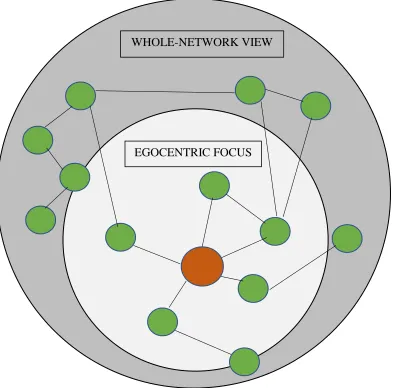
8 2007). Figure 1 illustrates the different levels of analysis and emphasis in egocentric versus whole-network studies.
Networks as a phenomenon can be examined as social structures and governance forms. This dissertation focuses on networks as a form of governance, aligning with commonly held definitions of community-based networks that engage in collective resource management (Emerson, Nabatchi, & Balogh, 2012), are cross-boundary, and focused on complex social problems that cannot be solved by one organization or agency alone (Agranoff & McGuire, 2001; Morçöl, 2014). Additionally, networks as a form of governance are distinguished by their self-organizing nature, which also features interdependencies between organizational and individual actors (Koliba, Meek, & Zia, 2010). As noted by Provan, Fish, and Sydow (2007), networks as a form of governance have focused on two levels of analysis: 1) the micro or egocentric level, in which individuals and organizations are the center of attention, or 2) the macro or whole-network level.
9 EGO
the influence that the external environment can have on networks, such as the existence of shared members across networks, instead studying these factors as if they existed in isolation (Nowell et al., in press).
EGOCENTRIC FOCUS Figure 1: External view
of networks' network domainEGOCENTRIC
FOCUS
WHOLE-NETWORK VIEW WHOLE-NETWORK VIEW
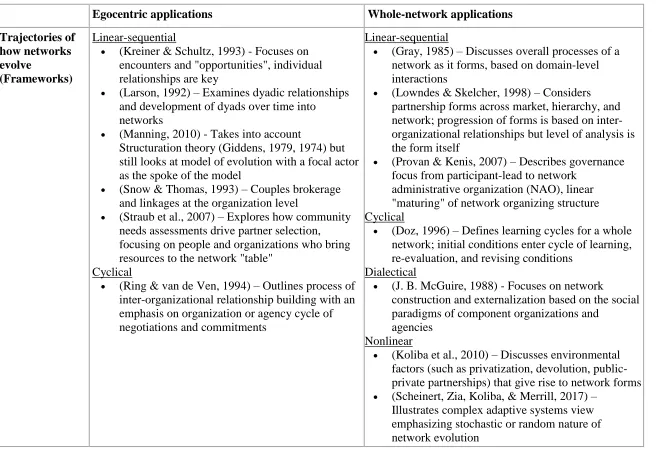
10 Table 1: Traditions of egocentric and whole-network evolutionary theories.
Egocentric applications Whole-network applications
Trajectories of how networks evolve
(Frameworks)
Linear-sequential
• (Kreiner & Schultz, 1993) - Focuses on encounters and "opportunities", individual relationships are key
• (Larson, 1992) – Examines dyadic relationships and development of dyads over time into networks
• (Manning, 2010) - Takes into account
Structuration theory (Giddens, 1979, 1974) but still looks at model of evolution with a focal actor as the spoke of the model
• (Snow & Thomas, 1993) – Couples brokerage and linkages at the organization level
• (Straub et al., 2007) – Explores how community needs assessments drive partner selection, focusing on people and organizations who bring resources to the network "table"
Cyclical
• (Ring & van de Ven, 1994) – Outlines process of inter-organizational relationship building with an emphasis on organization or agency cycle of negotiations and commitments
Linear-sequential
• (Gray, 1985) – Discusses overall processes of a network as it forms, based on domain-level interactions
• (Lowndes & Skelcher, 1998) – Considers partnership forms across market, hierarchy, and network; progression of forms is based on inter-organizational relationships but level of analysis is the form itself
• (Provan & Kenis, 2007) – Describes governance focus from participant-lead to network
administrative organization (NAO), linear "maturing" of network organizing structure Cyclical
• (Doz, 1996) – Defines learning cycles for a whole network; initial conditions enter cycle of learning, re-evaluation, and revising conditions
Dialectical
• (J. B. McGuire, 1988) - Focuses on network
construction and externalization based on the social paradigms of component organizations and
agencies Nonlinear
• (Koliba et al., 2010) – Discusses environmental factors (such as privatization, devolution, public-private partnerships) that give rise to network forms • (Scheinert, Zia, Koliba, & Merrill, 2017) –
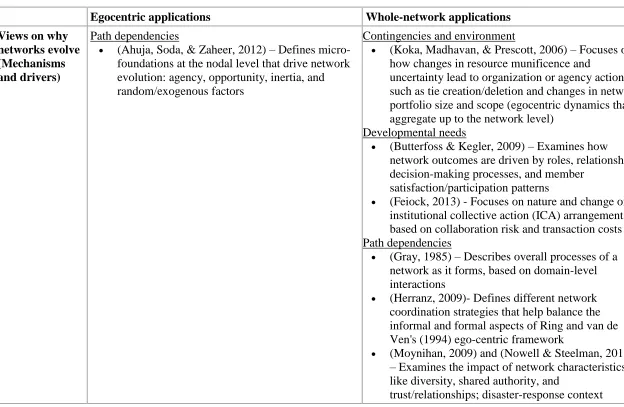
11 Table 1: Traditions of egocentric and whole-network evolutionary theories.
Egocentric applications Whole-network applications
Views on why networks evolve (Mechanisms and drivers)
Path dependencies
• (Ahuja, Soda, & Zaheer, 2012) – Defines micro-foundations at the nodal level that drive network evolution: agency, opportunity, inertia, and random/exogenous factors
Contingencies and environment
• (Koka, Madhavan, & Prescott, 2006) – Focuses on how changes in resource munificence and
uncertainty lead to organization or agency actions, such as tie creation/deletion and changes in network portfolio size and scope (egocentric dynamics that aggregate up to the network level)
Developmental needs
• (Butterfoss & Kegler, 2009) – Examines how network outcomes are driven by roles, relationships, decision-making processes, and member
satisfaction/participation patterns
• (Feiock, 2013) - Focuses on nature and change of institutional collective action (ICA) arrangements based on collaboration risk and transaction costs Path dependencies
• (Gray, 1985) – Describes overall processes of a network as it forms, based on domain-level interactions
• (Herranz, 2009)- Defines different network coordination strategies that help balance the informal and formal aspects of Ring and van de Ven's (1994) ego-centric framework
• (Moynihan, 2009) and (Nowell & Steelman, 2015) – Examines the impact of network characteristics like diversity, shared authority, and
12 Table 1: Traditions of egocentric and whole-network evolutionary theories.
Whole-network applications Components of
networks that evolve (Aspect definitions)
Governance and formality
• (Herranz, 2009) – Discussion of different coordination strategies that help balance the informal and formal aspects of Ring and van de Ven's (1994) ego-centric framework
• (Feiock, 2013) - Focuses change of ICA arrangements based on collaboration risk and transaction costs • (Provan & Kenis, 2007) - Governance focus from participant to NAO, linear "maturing" of network
organizing structure
• (Saz‐Carranza & Vernis, 2006) - Based on critique of past linear process studies; view of governance and formality as a more complex process
Size, composition, and structure
• (Koka et al., 2006) - Changes in resource munificence and uncertainty lead to organization or agency actions, such as tie creation/deletion and changes in collaboration portfolio size and scope, which aggregate up to the network level
• (Milward, Provan, Fish, Isett, & Huang, 2010) - Comparison of for-profit and nonprofit NAO-governed networks along the dimensions of structure, relationships/trust, and preliminary performance measures • (Nowell & Steelman, 2015) - Impact of network characteristics like trust and relational embeddedness;
disaster-response context
• (Provan & Kenis, 2007) - Governance focus from participant to NAO, linear "maturing" of network organizing structure
Group dynamics
• (Milward et al., 2010) - Comparison of for-profit and nonprofit NAO-governed networks along the dimensions of structure, relationships/trust, and preliminary performance measures
• (Provan & Kenis, 2007)- Governance focus from participant to NAO, linear "maturing" of network organizing structure
• (Saz‐Carranza & Vernis, 2006) - Based on critique of past linear process studies; view of governance and formality as a more complex process
Capacity
• (Milward et al., 2010) - Comparison of for-profit and nonprofit NAO-governed networks along the dimensions of structure, relationships/trust, and preliminary performance measures
13 Evolution in egocentric network studies
Egocentric studies are defined by the development of theories and frameworks that focus on the nodes within a network (often individuals or organizations) as the primary aspect of analysis. In these studies, the node and its associated connections are examined at a micro level. Most foundational knowledge of networks has been driven by this egocentric perspective (Provan et al., 2007). These studies leverage explanations of how an important individual or organization’s involvement affects the network’s actions and outcomes and is often referred to as the actor level of analysis (Kilduff & Tsai, 2003; Provan et al., 2007). Egocentric evolutionary studies have the ability to examine and answer research questions about the effects of an individual or organization’s ties through in-degree, out-degree, and betweenness measures, as well as the effects of groups of ties centered on a focal actor such as brokerage and cliques (Provan et al., 2007).
Trajectories and frameworks of evolution: Egocentric network evolution theory building has largely remained bounded within linear-sequential and circular or cyclical models (Saz‐ Carranza & Vernis, 2006). Linear-sequential models are the most common approach in public network literature overall, with substantial scholarship leveraging an egocentric perspective. The basis of these models is that networks develop in three main phases. Across scholars, these phases have different names, but there is still an overarching coherence to the concepts and emergent dynamics of each phase. Additionally, each of the scholars discussed below adds definitions for supporting or hindering conditions in an effort to provide predictions about network behavior and movement between phases (Nowell, Segato, Berthod, & Koliba, 2016).
14 orderly steps (Kreiner & Schultz, 1993; Manning, 2010; Straub et al., 2007). Throughout these frameworks, focal actor actions (Manning, 2010), encounters and opportunities for collaboration between organizations (Kreiner & Schultz, 1993; Larson, 1992), and the importance of
brokerage and partner selection behavior (Snow & Thomas, 1993; Straub et al., 2007) are key elements of linear processes of network change over time.
Circular or cyclical models of network evolution move away from linear approaches by considering opportunities for phases to repeat and mutually reinforce other phases via feedback loops (Ring & van de Ven, 1994). Ring and van de Ven’s (1994) model is the most well-known, emphasizing a cycle of negotiation, commitment, and execution centered around ongoing
assessments of efficiency and equity within the network. Ring and van de Ven’s (1994) model, although later utilized by other scholars at the whole-network level, was initially developed with an emphasis on individual organizations undergoing the processes of assessing equity and efficiency, demonstrating that those decisions drive other aspects of the network evolutionary cycle.
Mechanisms and drivers of evolution: From an egocentric perspective, there is a more limited application of theories that consider the node or micro-level as a driver of evolution. The main research is built upon considerations of path dependency. Ahuja et al.’s (2012) approach suggests that micro foundations are the drivers of network changes. These micro foundations are defined at the nodal, or individual/organizational level of analysis, and are considered the
15 definition of this driver is more of a vague “other” category that is meant to include anything external to an individual or organization, without explicitly examining the nature of the larger network domain.
Components that evolve: To date, there are no egocentric applications that explore the components of evolving networks. This deficit of theory is driven by the nature of research questions that would be inappropriate at the organizational level of analysis (Provan et al., 2007). As will be discussed below, whole-network studies have included aspects of organizational interactions, such as trust and reciprocity, as a dynamic of a network’s governance, structures, and capacity as a whole.
Evolution in whole-network studies
Scholars who have used a whole-network level of analysis have broadly been concerned with governance, structures, and how network outcomes are generated (Provan et al., 2007). Whole-network studies still recognize the importance of individual organizations or agencies but put more emphasis on the nature of the network’s behavior over time as a collective group. Whole-network research is defined by three or more organizations that are connected in meaningful ways to achieve a common goal (Provan et al., 2007). As opposed to egocentric research, this tradition of scholarship is focused on outcomes at the network level of analysis, even if dynamics might include the centrality of a particular organization in such a way that it is compared across networks over time (Kilduff & Tsai, 2003; Provan et al., 2007). Whole-network evolutionary studies have the ability to examine and answer questions about density,
16 frameworks of evolution. First introduced by Gray (1985), the problem setting, direction setting, and structuring phases of linear-sequential frameworks define distinct activities for a network to undertake that are based in a collective, domain-based perspective. This linear model emphasizes a first phase in which stakeholders are identified and a shared understanding of the goal is forged among network members. Subsequent scholars identified a pre-networking, pre-partnership (Lowndes & Skelcher, 1998), or formation stage in which pre-conditions for network members are set. Key to Lowndes and Skelcher’s (1998) view, evolution may be driven by
interorganizational relationships, but it must be considered at a higher level of analysis that allows for a group’s subsequent activities to be defined as market, hierarchy, or network forms.
Indeed, these linear-sequential models have had such a strong hold on scholars’
understanding of network evolution that they have even been combined with theories about other aspects of network structures. In Provan and Kenis’ (2007) exploration of governance forms, they argue that networks will inevitably evolve from shared governance to more formal types of lead-organization or network administrative governance (NAO), with no possibility of regressing or cycling backwards.
17 members make sense of their social paradigms and power relations, with a clear drive towards creating stability so that the work of the whole group can be formalized and externalized (J. B. McGuire, 1988).
More recent literature, while still nascent, has emerged with a nonlinear view of whole-network evolution. Within these theories, complex adaptive system (CAS) models have begun to view networks as systems themselves that are informed by path dependence (Pierson, 2004). Koliba et al. (2010) have suggested a framework in which evolution is a function of
environmental factors like privatization, devolution, and public-private partnerships that give rise to network forms. This is the one example within network evolution scholarship— and a very recent area of exploration—that has advanced the idea that networks can be part of larger system and susceptible to exogeneous pressures and shocks (Scheinert et al., 2017).
Mechanisms and drivers of evolution: Within Public Administration literature, a diverse collection of theories and frameworks about why networks evolve over time has emerged. While these theories do collectively focus on the drivers and conditions for evolution, the three
approaches have widely different assumptions. One of the earliest explorations of drivers of network evolution is rooted in contingency theories that were previously applied to organizations (Drazin & van de Ven, 1985). Using aspects of a network’s environment, specifically uncertainty and resource munificence, Koka, Madhavanm, and Prescott (2006) examine evolution with regard to size, composition of members, and level of integration. While a focus on contingencies does take the environment into account, Koka et al.’s (2006) theory of network evolution
18 function as a network in and-of-itself, whose structure can have unique effects on evolution over time.
Developmental perspectives on network evolution have different theoretical traditions, largely drawing upon the concept that networks will evolve through stages that build upon one another. In many ways, developmental models of the drivers of evolution can be overlaid with the linear/sequential models discussed above. Butterfoss and Kegler’s (2009) Community
Collective Action Theory (CCAT) is rooted in social psychology theory and uses the assumption that networks will evolve in the same ways as other kinds of groups. CCAT uses the foundations of group development stages, including forming, storming, norming, performing, and adjourning, and applies them to goal-directed networks.
The Institutional Collective Action (ICA) framework as developed by Feiock (2013) rests in the traditions of political economy by focusing on intergovernmental networks. Given this viewpoint, Feiock’s work assumes that interdependencies will drive the formation of a network and that, as these interdependencies shift over time, new drivers of evolution will emerge. Key to the ICA framework is also the assumption that as organizations and agencies navigate their interdependencies within a network, they will act rationally and strategically to adjust governance mechanisms that support their needs at the whole-network level.
Some scholars have expanded on the exogenous driver category by developing
19 Nowell & Steelman, 2015). Again, while pre-conditions are considered exogenous factors in these cases, less attention is given to the nature of other network groups also functioning in the network domain and the potential for the broader system to contribute to evolutionary outcomes.
Components that evolve: Whole-network studies have dominated research that is concerned with the components of evolving networks. Logically, the whole-network level of analysis does lend itself to more holistic examinations of what parts of a network can change over time, such as governance and formality, size and structure, and group dynamics. Across the traditions and viewpoints of how and why networks evolve, there are a wide variety of focal aspects of change (Nowell et al., 2016).
Within the area of governance and formality, Feiock’s (2013) ICA framework embraced a whole-network approach to address issues of coordination and change as network risk and transaction costs change over time. As discussed in other examples above, Provan and Kenis’ (2007) work made major strides in describing and defining three potential governance
arrangements, creating a spectrum spanning from shared participant responsibility to a formal network administrative organization (NAO). Another interesting contribution to this literature is Herranz’s (2009) whole-network research that leveraged Ring and van de Ven’s (1994) ego-centric framework by applying it to network coordination strategies of the whole group based on the balance of informal and formal needs. Governance processes in practice at the
whole-network level have also been cited as an example of why linear models of evolution are potentially too simplistic, given that the negotiations resulting in formality and governance arrangements have many cyclical, feedback loop characteristics (Saz‐Carranza & Vernis, 2006).
20 drawing propositions about the effects of resource munificence and environmental uncertainty on tie creation or deletion within a network. Structure was also examined in Milward et al.’s (2010) comparison of for-profit versus nonprofit NAO-governed networks. In the disaster response context, Nowell and Steelman’s (2015) research considered how trust and relational
embeddedness within a network lead to dynamic structures and ties between responders. Group dynamics are also unique to whole-network studies given the broader focus on network outcomes and the nature of network processes themselves. Again, Milward et al.’s (2010) and Provan and Kenis’ (2007) work explores changes in whole-network group dynamics over time. Closely associated with research questions regarding group dynamics have been explorations of whole-network capacities over time (Milward et al., 2010; Provan et al., 2007). In addition to establishing that a wide variety of potential aspects of networks may undergo evolution, many studies have theorized that multiple aspects of a network have a relationship with other aspects in such a way that these networks function as complex systems in and of themselves (Nowell et al., 2016). Overarchingly, this literature is concerned with components changing over time and is the most internally focused of all network evolution research.
Advancing an external view of networks
As discussed in the previous section, current studies analyzing the evolution of networks rest on traditional approaches that consider changes to structures of a single, independent
21 inward-facing research agendas is a contingency approach that defines the network’s context based on the characteristics of members only (Provan & Kenis, 2007), without also considering the broader community system in which the network must function due to the dynamics of shared members. Additionally, overarching rational-actor assumptions (Feiock, 2007) have driven definitions of networks and internal behaviors as a function of individuals’ strategic choices, without a fully defined recognition of external forces, such as competing initiatives, in the same community.
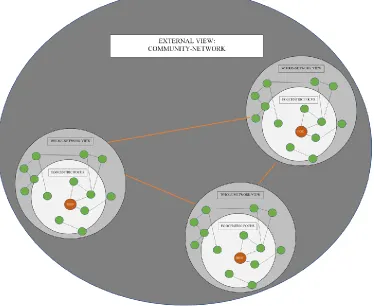
To date, network evolution theories have exclusively focused on how groups evolve internally, overlooking opportunities for networks themselves to transition into different forms. Additionally, current studies considering the evolution of networks rest on traditional approaches that focus on changes to the structures of a single, independent collection of actors. By offering this insular view of networks, studies to date have overlooked the network domain dynamics that contribute to a network’s changes over time in undifferentiated systems, with one notable
exception (Nowell et al., in press). As illustrated in Figure 2, this dissertation examines an external view which recognizes the network domain of undifferentiated networks whose boundaries are blurred by shared membership.
22 networks to connect to one another in meaningful ways within the larger network domain. By broadening the focus and moving up a level of analysis in their study, Nowell et al. (in press) offers the beginning stages of conceptualizing an important phenomenon at the network level of analysis.
Shared-membership establishing a network domain
In theory, networks could be meaningfully connected by any number of
interdependencies that might be represented as “ties,” including service coordination, financial resources, human resources, or client population, to name a few. While these dependencies have been considered broadly within Public Administration at the organizational level ( Hillman,
23 Withers, & Collins, 2009; Malatesta & Smith, 2014), recent applications within network theory have been limited. One perspective advanced by Carboni and Milward (2012) envisions groups of interconnected networks as susceptible to systemic risk if highly connected actors who provide contracted services to more than one government entity fail or struggle. The existence and potential challenges of interconnectedness has also been noted in practical management guidance offered to policymakers and network leaders (Popp & Casebeer, 2015).
This dissertation establishes human capital connections between networks through the existence of shared members. Shared membership among networks refers to instances when an organizational member in one network is also a member of another network in the same
community. A recent empirical study confirmed the existence of members engaged in more than one network that focuses on the same issue area in a community, while also highlighting the importance of how shared membership allows for networks to connect to each other in meaningful ways (Nowell et al., in press).
24 Recognizing shared-membership as a meaningful tie between networks, as well as a mechanism for justifying the network as the level of analysis, suggests the integration of the view that a network is a social structure and a governance form. The network itself is the governance form, while the ties that create the network domain are socially driven. This view aligns with a community-systems perspective in which a collection of autonomous actors shares common involvement in a problem domain, which creates interdependencies (Nowell, 2009). Shared-membership across networks then constitutes the network domain of formal and informal relationships that can evolve over time.
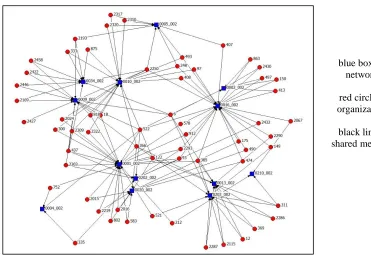
An empirically supported example of the presence of the phenomenon of shared
membership can be seen in Figure 3. Figure 3 is a visual map of the many connections existing between networks in one of the communities in the longitudinal dataset for this study. This systemwide map demonstrates how the networks are intertwined as well as potentially
co-Figure 3: Network domain of networks with shared membership.
blue boxes = networks
red circles = organizations
25 affected by changes within the networks themselves and the network domain as a whole. The visualization also demonstrates the need for a shift in levels of analysis in a direction that departs from past network studies.
The external perspective advanced through co-informing methods
To date, theory building and empirical research have focused on the nature of changes within a network over time by leveraging data from case studies focused on one or two networks alone (Milward, 2016). While there has been some discussion of analyzing the nature of the network as a whole to advance an exogenous theory of understanding performance (Kenis & Provan, 2009), little has been done to examine the evolution of the network itself. This research moves the level of analysis up to the whole network by examining its trajectory as an entity in a network domain over time. As will be discussed in more detail in Chapter Two, the dependent variable of interest in this dissertation is the evolution of the network as an entity, which can be defined as survival, death, or transformation in form over time.
This research embraces an external or exogenous view of networks, taking the
perspective that forces outside of a network can shape its trajectory and evolutionary outcomes. To date, little theory has been developed or applied to account for systemwide dynamics and their effects on networks over time. As is appropriate in the stages of developing new theories, this research first addresses the foundational step of both clarifying the phenomenon of interest and describing its components. Given the limited degree of empirical attention to the
embeddedness and shared membership of networks in general, and with no substantial
26 understanding of both endogenous and exogenous factors that shape a network’s evolution, including path dependency, capacity, and network domain dynamics.
Viewing networks as part of a larger network domain enables the application of different methodologies to explore the evolution of networks by calling for the consideration of both internal and external factors. Moreover, considering the network domain as a complex adaptive system (Miller & Page, 2007) comprised of networks with their own unique dynamics suggests that inductive phenomenology (i.e., providing description and clarification of the phenomenon), configurational approaches (i.e., highlighting multiple pathways to evolutionary outcomes), and main-effect methods (i.e., providing parameter estimates for distinct variables) can all be
appropriate and provide insightful analyses.
Qualitative comparative analysis (QCA) and stochastic agent-oriented models (SAOM) have come to the forefront of research in the last two decades as informative approaches for understanding network dynamics and some aspects of network evolution. However, less
attention has been paid to how these methods inform important, yet unique, aspects of similar or associated research questions. Additionally, QCA and SAOM are often discussed and applied as alternatives to each other—with limitations in their compatibility—rather than being used intentionally in parallel and combined analysis of the same data as a means to understand the important empirical nuances that each method is designed to address.
27 assumptions of homogeneous effects that encumber many quantitative approaches. Rather, it enables the researcher to consider multiple pathways and combinations that may lead to the same outcome. In the past, many scholars saw QCA and social network analysis (SNA) as compatible given that interpreting and analyzing qualitative data can lead to a deeper understanding of the mechanisms that produce the emergent patterns modeled as ties within network analysis (Schipper & Spekkink, 2015). Indeed, past studies have combined the quantitative aspects of SNA with qualitative observation and QCA as a way to leverage contextual details that are otherwise lost in the abstractions that SNA can produce (Morçöl, 2014).
That said, there has been limited work done to integrate QCA with other methods in the specific area of network evolution studies. Rather, QCA has been applied on its own to explore how networks are nested entities with outcomes that depend on factors across multiple levels, which also function within socio-political-economic and institutional environments (Raab, Lemaire, & Provan, 2013). While these studies address important research questions with regard to governance, structures, context, and effectiveness, there has yet to be a configurational
approach applied to both the internal and external conditions that support different outcomes of network evolution. Specifically, QCA has not yet been leveraged to consider combinations of endogenous and exogenous factors that may lead to network failure or discontinuation rather than success or transformation.
The innovation of SAOMs for analyzing longitudinal network data offers additional opportunities for understanding network dynamics in complex environments. This approach allows the researcher to investigate the relative contribution of both nodal and network attributes in explaining network change over time (Burk, Steglich, & Snijders, 2007). SAOMs are
28 structures over time, and one of the main assumptions is homogeneity of effect across all actors included in the model. For example, a severe reduction in funding for public health employee salaries may reduce the number of available network members from that sector across all groups in a community. Even with this assumption, these powerful models can account for the evolution of whole networks versus individual actor behaviors by representing each as a separate change probability between micro-steps of all of the possible configurations of the combined network and individual behaviors (Burk et al., 2007).
In SAOMs, causal mechanisms are modeled using micro-steps, creating output
parameters of network objective functions that include out degree, reciprocity, and transitivity (Burk et al., 2007). By combining random utility models, Markov processes, and simulation (van de Bunt & Groenewegen, 2007), SAOMs allow for the study of dynamic networks over time, providing benefits for many fields of social science. The modeling of the evolution of network structures in SAOM is based on underlying assumptions related to the fact that the evolution of network structures is represented as a time-continuous Markov chain, driven by the probability of choices at the actor level (Burk et al., 2007). This research focuses on SAOMs rather than exponential random graph models (ERGMs or TERGMs) because SAOMs assume that actors are changing ties based on probabilities of tie formation that are contingent on the state of the network itself at multiple points in time (Block, Stadtfeld, & Snijders, 2016; Lubell, Scholz, Berardo, & Robins, 2012).
29 structures over time (for example: Ingold & Leifeld, 2014). While SAOMs are gaining interest and application, less attention has been paid to the network domain level of analysis in which networks themselves may be embedded. For example, in the context of this study, a highly central network, with many members who are shared across other networks, may be more likely to struggle if funding is reduced because the members may choose to devote their time to a more highly-resourced network. To accomplish this higher level of systemwide analysis, the networks themselves will be modeled as nodes within a two-mode community network linked by shared membership.
Overview of dissertation chapters
30 CHAPTER TWO
Introduction
In practice, health and social services are commonly delivered through networks comprised of public agencies, nonprofit organizations, for-profit businesses, and consumer associations to address complex problems and implement public policy. These networks are often favored by government and philanthropic investment as an effective means for collectively solving complex social problems (Head & Alford, 2015; Morçöl, 2014; Weber & Khademian, 2008). Networks are multi-organizational governance arrangements that can form and evolve over time, yet the nature of these changes is only considered in the current literature under the assumption that the network itself maintains its form as a network.
To date, there has been little consideration of how and why a network may potentially move between forms, including markets, hierarchies, and other networks. Overall, research and scholarly advancements have focused on differentiating the forms of organizational interactions (e.g., Transaction Cost Economics) (Williamson, 1975, 1981) rather than considering how and why networks may evolve out of, and into, other forms. Indeed, prominent network scholars have called for network evolution theory to advance and include an exploration of the exogenous domain in which the network is changing (Milward, 2016). This chapter utilizes the network itself as the unit of analysis within a larger network domain, a collection of networks sharing an environmental niche defined by similar geographic and problem-area or mission. The results herein expand on what little theory has been developed by examining both longitudinal endogenous network characteristics and exogenous systemwide dynamics.
31 meaningful inter-network ties. Most past studies have overlooked the possibility for systemwide dynamics that could contribute to a network’s change over time within network domains with shared members (one recent exception is Nowell and Hano, 2018). This static view has
considered networks as insular and only comprehensible through process and structure theories that are driven by the assumption that the network form itself is stable over time. For example, network governance research has largely built on Provan and Kenis’ (2007) explication of three progressively centralized forms (shared-governance, lead organization, and network
administrative organization), without considering how and why these groups may evolve to function as markets or hierarchies over time (rather than remaining a network at all).
Our field’s theory building and empirical research has focused on the nature of changes within a network over time by leveraging data from case studies that focus on one or two networks alone (Milward, 2016). While there has been some discussion of looking at the nature of the network as a whole to advance an exogenous theory of understanding performance (Kenis & Provan, 2009; Raab & Kenis, 2009; Rethemeyer & Hatmaker, 2007), little has been done to examine the evolution of the network itself as the unit of analysis. This research aims to understand the nature of a network’s trajectory as an entity in and of itself within a network domain over time.
32 differentiate, merge, or spin-off new groups over time (Milward, 2017). By considering the network’s longitudinal trajectory, evolutionary outcomes can also be examined to determine what may remain after the network form disbands and why.
As is appropriate in the stages of developing new theories, this research addresses the foundational step of both clarifying the phenomenon of interest and describing its components. Two research questions are addressed in this chapter:
1. Do networks change form over time? If so, what are the ways in which networks can change?
2. What effects do the network domain and the network’s capacity have on changes in form over time?
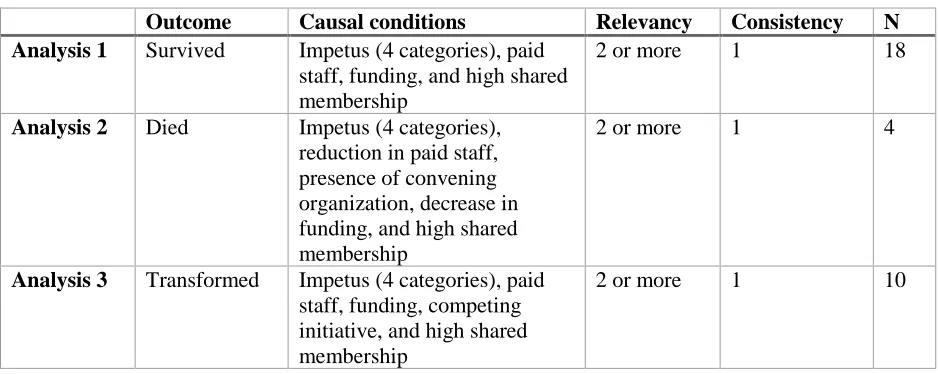
Exploring these questions first requires an understanding of a typology of network evolutionary outcomes. This typology encompasses a definition of survival, death, and transformation, with a particular focus on the variety and character of networks that have undergone transformations in form. Second, using the typology as a set of potential network outcomes, causal pathways are examined using Qualitative Comparative Analysis (QCA). Additionally, the causal pathways for a network’s survival, death, or transformation support a preliminary set of propositions that are offered about the dynamics of both endogenous and exogenous forces driving network change within network domains.
33 conclude, discussion and propositions are offered to examine the combined effects of a
network’s endogenous and exogenous characteristics on its trajectory over time. Network evolution: Structural and process change theories
Networks as a phenomenon can be examined both as social structures and governance forms. This chapter focuses on networks as a form of governance, or a way to collectively and strategically address issues that one organization cannot handle alone (Agranoff & McGuire, 2001). This view aligns with commonly held definitions of community-based networks which engage in collective resource management (Emerson, Nabatchi, & Balogh, 2012), are highly boundary-spanning, and focused on complex social problems that cannot be solved by one organization or agency alone (Agranoff & McGuire, 2001; Bryson, Crosby, & Stone, 2015; Morçöl, 2014). While the field has examined the phenomenon of the network itself, including its formation, processes, and internal characteristics, less is known about the nature of when, why, and how a network as an entity may change form over time. To begin to examine the possibilities of network form over time, there are some insights in returning to traditional organizational theory for a foundation and suggested paths forward. The literature reviewed below is offered as a jumping-off point and a means for understanding how far we have come regarding our
understanding of the network form and where we still need to go.
34 past a priori assumptions of network forms, it is important to discuss the nature of what our field currently focuses on.
Two important dimensions of network governance characterizations consider whether relationships between members are brokered or un-brokered, and whether interactions are formal or informal (Provan & Kenis, 2007). Shared governance only involves the members of a
network, and it can be formal or informal. This form of network governance can also be the most flexible in that it can be centralized or decentralized, and it is largely driven by the commitment of the members of the group because they are ultimately responsible for managing all internal relations and external connections (Milward et al., 2010; Provan & Kenis, 2007). In networks with shared governance, power is often evenly distributed regardless of the size of the member organizations or their resources. Governance by a lead organization is more centralized, with the designated organization often serving in a brokerage role (Provan & Kenis, 2007). In these arrangements, the lead organization itself often has large amounts of legitimacy and resources in the local community, which enable it to have the social capital to be seen as an appropriate governing body despite asymmetrical power dynamics (Milward et al., 2010; Provan & Kenis, 2007).
Lead organizations often also absorb some of the administrative costs of a network being able to conduct its work. In some cases, lead organizations are the same organization that
35 member interactions (Provan & Kenis, 2007). NAOs also fundamentally differ from lead
organizations because the NAO is not itself a member of the network, and an NAO’s only interests are those that the network establishes (Milward et al., 2010; Provan & Kenis, 2007).
While these designations of governance types have been widely accepted and studied in Public Administration (for an overview, see Bryson, Crosby, & Stone, 2015), they remain bounded to the network form. Since the establishment of Provan and Kenis’ (2007) three governance forms, little scholarship has moved beyond this frame to consider the form and function of a network in a more non-linear approach that makes space for the potential phenomenon of a network exiting or evolving out of the network form altogether. Indeed, the emphasis on the internal evolution of networks, as manifested by close study of changes in processes and structures (for an overview, see Nowell et al., 2016) has produced important insights—but at the detriment of considering what may drive a group of organizations to disband or move beyond a collective approach altogether.
Organizational theory has also offered some guidance on the nature of forms and functions in classic Transaction Cost Economics (TCE) approaches (Williamson, 1975, 1981). While TCE engages the nature of transactions as the level of analysis, it also suggests
organizational arrangements and forms to best suit the nature of these transactions. In the TCE context, these governance modes can be markets, networks (hybrids), or hierarchies
36 will not be directly tested here, the overarching organizational forms that are drawn from TCE provide a basic frame for the typology presented in this exploratory research.
Market governance arrangements have no dependencies between organizations, and all interactions are formal. In hierarchies, organizations organize themselves into arrangements where one is largely in power, while the others follow directions as needed to reduce uncertainty. In network (hybrid) forms, autonomy remains, but the organizations engaged in interactions are dependent upon each other. This form has largely come forward from the organizational theory literature to advance our understanding of the motivations for how and why inter-organizational networks form. As Williamson notes in his seminal works (1975, 1981), TCE fills an important gap here for examining governance forms and functions because it does not wholly assume maximization or satisficing; rather, it relies both on economic and institutional factors to examine the nature of change in networks over time.
To further examine possible dynamics involved in the shift of a network’s form over time, the Institutional Collective Action (ICA) framework as developed by Feiock (2013) offers additional insights. While ICA does rest in the traditions of political economy by focusing on intergovernmental networks specifically, the nature of their interactions may suggest important dynamics to be considered in the theory-building research presented here. Feiock’s (2013) work assumes that interdependencies will drive the formation of a network, and that as these
37 2013). The research presented here engages with these core assumptions and strives to examine how the actors within a network itself, when acting in unison such that the group is considered as a node of the whole-network domain, might make decisions to adjust and adapt their form and function.
Although network theories have engaged with the concept of evolution (for an overview, see (Nowell et al., 2016), again there is limited consideration of the possibilities of a network moving between forms. Indeed, as recently noted by a prominent network scholar (Milward, 2017), current theories have brought our field to an important intersection. Our current
understanding of network governance forms and structures assume a linear maturing, with the network form remaining an established entity. This research takes up this next step in theory development by pushing forward to examine the network as the unit of analysis and define the possible phenomena of changes in form and function like differentiation, integration, or spin-off groups (Milward, 2017).
As Milward (2017) discusses and this chapter will examine, differentiation is the extent to which network actors within a social system are structurally or functionally different from each other. As discussed below, this research recognizes that in many network domains,
38 Network evolutionary trajectories: Establishing a typology and causal pathways
To begin to examine the phenomena of networks themselves evolving within a network domain, the first phase of this research is to establish the nature of potential outcomes for a network over time. Using a qualitative analytical inductive approach, a typology of network evolutionary trajectories is discussed below. This typology emerged from the data, being established based on the presence of forms and functions of networks over time across three network domains. The second phase of this study examines causal pathways to evolutionary trajectories using Qualitative Comparative Analysis (QCA).
Study context and background
This research leverages a unique, longitudinal population-level dataset that includes all health‐oriented networks in three counties in a southeastern state from 2012-2017. The data for this analysis features a population of 74 networks and their members taken over two time points with a 100% response rate. Time 2 data collection achieved a 97% response rate, and Time 1 data collection was able to achieve a 100% response rate from all identified health-oriented networks in the counties included in the study. The list of networks was cross-validated by county informants as well as an exhaustive web search to ensure comprehensiveness.
39 stakeholders, and presence of members who serve as thought leaders, champions, or power brokers in the community.
To meet the needs of this research’s inductive approach, all network coordinators or leaders were asked to share details about the story of how their network began, with an emphasis on the motivations and impetus for the group to convene. Informants were also asked to explain the process of how the network was formed. Specific probing questions included whether there was an official event, specific grant, or formal signing of bylaws; what organizations and leaders were instrumental in convening the partnership; if there was funding available at the time of formation; and if the partnership was mandated in some way. Of critical importance, all network leaders were asked if the network was originally part of another group and could be considered as a spin-off or beginning as part of another network in the community.
Additionally, all coordinators of networks that were identified as no longer meeting regularly in 2017 were interviewed to determine the nature of the change to their network over time. Coordinators of discontinued networks confirmed that the group was no longer meeting regularly in its initial form. Next, coordinators were asked to discuss the nature of the changes with their group, what factors may have led to this change, and if any aspects of the network were still functioning in the community in a different capacity like a spin-off group or organization.
Typology methods
Qualitative data from the 2017 network leader interviews were analyzed using a
qualitative analytical inductive approach to create a codebook of characteristics and definitions of a network’s survival, death, or transformation. This codebook was established from the
40 trajectory was described within an interview, it was defined and added to the codebook. Over the course of the interview process, the cases of evolutionary trajectories coalesced into three main categories: survival, death, and transformation. The category of transformation also included three subsets that are described below.
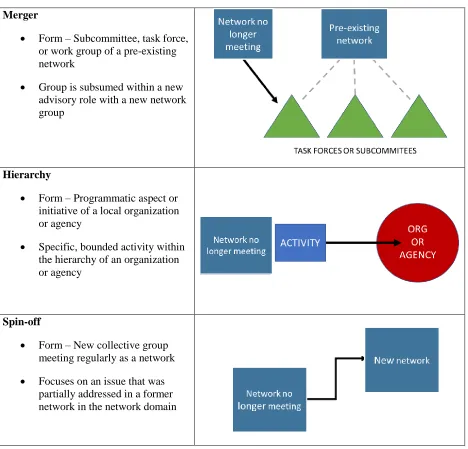
Within the category of transformation, possible distinctions include networks that have merged within another existing network; networks that have discontinued partnership work to become a program, service, or stand-alone organization in hierarchy forms; and networks that have spun off in a new direction by redefining their mission and approach while retaining many of their original members in a hybrid form. This codebook was then applied to all networks in the dataset to create a typology that includes definitions for survival, death, and, most
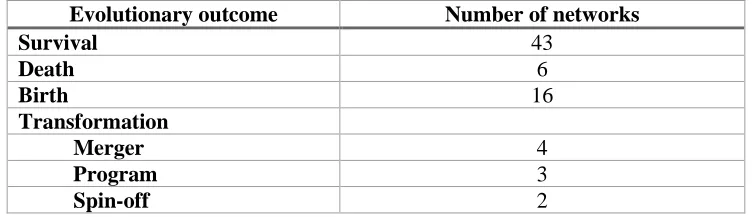
importantly, transformation. Table 2 below illustrates this study’s sample and the number of evolutionary outcomes assigned based on the codebook that was developed.
Table 2: Network evolutionary trajectories. Evolutionary outcome Number of networks
Survival 43
Death 6
Birth 16
Transformation
Merger 4
Program 3
Spin-off 2
Qualitative Comparative Analysis methods