MUTATION AND PARAMUTATION A T THE R LOCUS IN MAIZE1
R. A. BRAY2 AND R. A. BRINK
Department of Genetics, University of Wiscom'n, Madison
Received February 9, 1966
HE
R locus in maize exhibits two different kinds of genetic variability, muta- tion and paramutation (BRINK 1960). Mutation is a rare event, not pre- dictable in an individual gamete, and produces a limited number of visually dis- tinct mutant phenotypes. I n contrast, paramutation is a directed change in thepigmenting ability of a n R allele which invariably occurs in certain genotypes, and results in a continuous array of genetically different forms. Presumably mu- tation is concerned with changes in the basic genetic material of the locus, while paramutation affects expression of the basic material during development of the individual. On this basis, the ability of an R' allele to undergo paramutation should not be related to the ability of the allele to mutate. Alternatively, if para- mutation affects the basic structure or composition of the locus, the abilities to mutate and to undergo paramutation might be interrelated.
The paramutability of a n R allele is readily measured by passing the factor through a heterozygote with a n overtly paramutagenic allele, and mutation of
R
to colorless or near-colorless forms provides one measure of mutability. Quanti- tative data on mutation and paramutation for a series of R alleles provide a basis for determining whether any general relationship exists between the levels of expression of the two processes. Another approach is to examine the sequential effect of one process on the other (i.e., paramutation of mutant R alleles, and mu- tation of paramutant R alleles). BROWN (1963) has shown that the paramuta- tional capacity of an Rr allele may or may not be changed by mutation, depend- ing on the class of mutant, and BRINK (1958) made a preliminary study on mutation of a paramutant R allele. Further data on the interrelationship between mutation and paramutation are presented in the present paper.MATERIALS A N D METHODS
Genetic stocks: An extensive series of naturally occurring R alleles provides numerous different genetic entities for a study of this kind. The 4 4 R stocks conditioning colored aleurone that were
used may be arranged in four groups:
(i) Standard Rr. Five lines of this so-called standard, red-anthered Wisconsin genetic stock were included; also, three lines carrying standard Rr in coupling with the T2-10a reciprocal translocation, and two lines carrying standard Rr in abnormal chromosome 10 (KiO, containing
Paper No. 1052 from the Department of Genetics, Agricultural Experiment Station, University of Wisconsin, Madison. Present Address: CSIRO Division of Tropical Pastures, The Cunningham Laboratory, Mill Road, St. Lucia, SW 6,
Queensland, Australia.
138 R. A. BRAY A N D R. A. BRINK
a large heterochromatic knob distal to the R locus). The Rr gene shows reduced sensitivity to paramutation in these chromosomally aberrant stocks (BRINK and WEYEXS 1960; BRINK and BLACKWOOD 1961; BRINK and VENKATESWARLU 1965).
(ii) Ten RQ (green anthered) mutants derived from standard Rf' by mutation.
(iii) Ten R S c m (self-colored aleurone) mutants derived from Rmb (marbled aleurone) by mutation.
(iv) An assemblage of R (colored aleurone) alleles of widely separated geographic origins (BRINK 1960). These alleles came mainly from maize varieties indigenous to North, Central, and South America. They are referred to throughout the paper as "geographic alleles," or by their country or area of origin. Four groups are recognizable i n terms of plant color: (a) Red roots, red coleoptile, and red anthers ( R r alleles designated as Argentina, Turkey, Ethiopia, North Dakota, Cornell, India, or Ecuador). (b) Red roots, red coleoptile, and green anthers ( R g alleles designated as Arizona, Oklahoma, South Dakota, Canada, Iowa, Washington, or New Mexico). (c) Green roots, red coleoptile, and green anthers ( R g alleles designated as Bolivia 1160, Bolivia 1520, Harvard, or Peru). (d) Green roots, green coleoptile, and green anthers (RQ alleles desig- nated as Argentina, Guatemala, or India).
BRINK (1958) has described groups i, ii, iii, and also the commonly used R"t, I", and r g alleles.
All the so-called geographic alleles that conditioned green anthers were designated as RQ. The phenotypes encompass the range of R alleles studied by S T A D L ~ (1948) and the collection is considered to be representative, with minor exceptions, of R alleles as a whole. Previous to testing all the alleles were incorporated into W22 inbred background by backcrossing for at lsast four generations.
Techniques. Mutatiom All mutation studies were carried out in detasseling plots, where, by suitable choice of the male parent, and subsequent testing of putative mutants, any event other than a n R locus mutation leading to the production of a mutant phenotype could be detected. Populations of gametes tested were estimated from the weight of shelled kernels, and corrected by a factor based on the proportion of putative mutants from which successful progeny tests were obtained.
Paramutation: Standard techniques involving testcrosses on colorless ( r r ) plants, (BRINK
1960) were used for determining aleurone pigmenting ability. Inbred W23 rgrQ plants served as pistillate parents in the testcrosses and a seven-class scoring scale was employed, ranging from 1 (colorless) to 6 (dark mottled) and 7 (self-colored). Fifty kernels were scored from each ear, and all ears were coded before scoring.
RESULTS
Rr and RQ alleles exhibit widely different mutation patterns (STADLER 1948) and studies on these two classes will be considered separately.
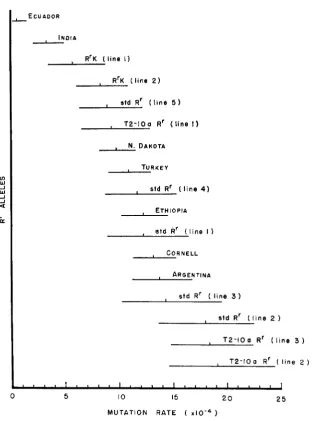
R' alleles. (i) Mutation: The data obtained for mutation of R r alleles to colorless forms are summarized in Figure 1. The populations of gametes tested ranged from 28,000 (standard R", line 3) to 136,000 (R" N. Dakota), with an average of about 56,000. All putative mutants were tested to determine their authenticity. Most mutants verified proved to be r+, (colorless aleurone, red anthers) although rare rg mutants and a few deficiencies for R also were found (Table 1 ) . The R" K10 stocks produced deficiencies at a higher rate than did structurally normal lines. Many kernels showing chromosome breakage events in the aleurone also were observed in the R'KIO lines.
and are within the range observed by STADLER (1948). The detailed results are given by
M U T A T I O N A N D P A R A M U T A T I O N 139
m
W
-1
W
-I
-I
a
a L
E C U A D O R
-
INDIA
I
, R'K ( l i n e I)
, R'K ( l i n e 2 )
,
rtd R' ( l i n e 5 ), ~ 2 - 1 0 a R' ( l i n e I )
, N. DAKOTA
, TURKEY
, std R' ( l i n e 4)
, ETHIOPIA
, std R' ( l i n e 1 )
, CORNELL
, ARGENTINA
, std R' ( l i n e 3 )
, std R' ( l i n e 2
, T 2 - I O o Rr ( l i n e 3 )
, ~ 2 - t o a R' ( l i n e 2 )
I O 15 2 0 2 5
0 5
M U T A T I O N R A T E ( x 1 0 - 4
FIGURE I.-Mutation rates and 95% Limits of Expectation for the series of RT alleles. Hori-
zontal lines indicate the extent of the Limits of Expectation; vertical marks show the observed mean mutation rates to r. The Limits of Expectation have been calculated by the method of
STEVENS (1942) from the tables of FISHER and YATFS (1957).
the same allele, as illustrated, for example, by the significant difference in R'
mutation rate between lines of T2-loa R' and also between lines of standard R'.
Subsequent tests confirmed the reality of these differences. Divergence with re- spect to one or another character between separately maintained lines of inbred maize stocks is known not to be uncommon (FLEMING, KOZELNICKY, and BROWNE
140
o x
R. A. BRAY A N D R. A. BRINK
TABLE 1
Nature of mutants from Rr alleles
No. verified as
No. of putative No. Not verified
Source r mutants tested rr r g Deficiency as colorless
R
' (normal chromosome) 1028 916 911 1 3 1
R
' T2-IOU 199 1 92 191 . . 1 . .
Rr KiO 'I10 a4 68 1 15 . .
(ii) Paramutation: The pigmenting abilities of all R' alleles in normal and paramutant form were tested over two years in matings of
R'R'
(or R'r) andR'Rst plants to rgrg 0 0 and the data pooled. The relationship of the color scores for the 17
R'
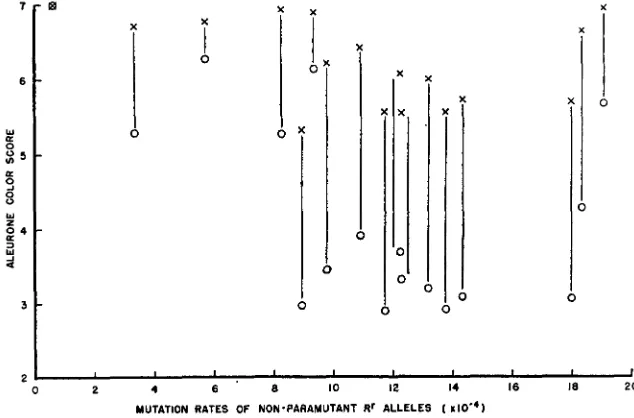
alleles to the respective mutation rates is shown in Figure 2. Alleles having a high (near 7.00) nonparamutant score occur at both extremes of the mutation rate scale, and weakly paramutable alleles (indicated by a small differ- ence between paramutant and non-paramutant scores) also have a considerable range of mutation rates. R' Ecuador, which is the only non-paramutable R' allelein the group, also has the lowest mutation rate, falling in the upper left hand part of the figure.
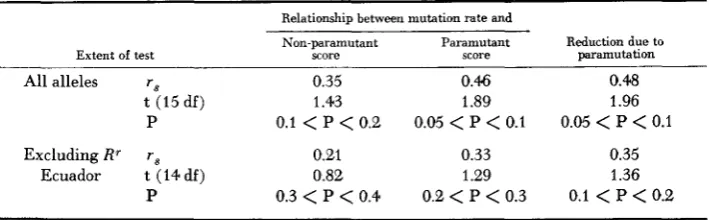
Three measurements of pigmenting ability of an allele may be examined in relation to mutability of the allele: non-paramutant score, paramutant score, and the reduction in score (difference) due to paramutation. Using Spearman's rank
181
X
0
i
0
X
X
0
0
2 1 I I I I t I t I
0 2 4 6 8 10 12 I4 16 18 20
MUTATION RATES OF NON-PARAMUTANT R' ALLELES ( :IO")
MUTATION AND PARAMUTATION 141
TABLE 2
Probabilities of randomness of retationship based on Spearman's rank correlation c w f i c k n t
~
Relationship between mutation rate and
Non-paramutant
Extent of test score
All alleles '6' 0.35
t (15df) 1.43
Excluding Rr r8 0.21
P 0.1
<
P<
0.2Ecuador t (14 df) 0.82
P 0.3
<
P<
0.4Paramutant Reduction due to
score paramutation
0.46 0.48
1.89 1.96
0.05
<
P<
0.1 0.05<
P<
0.10.33 0.35
1.29 1.36
0.2
<
P<
0.3 0.1<
P<
0.2correlation coefficient (STEEL and TORRIE 1960), the probability of the random- ness of such relationships may be established. Figures using data from all alleles are given in the upper part of Table 2. None of the probabilities is below the ac- cepted level of significance, although not far above it.
Because of its insensitivity to paramutation, Rr Ecuador may belong in a dif- ferent class of R' alleles than the paramutable R' alleles. If the figures from the tests of R' Ecuador are excluded, the probabilities rise to above 10% (see lower part of Table 2).
If the five standard Rr lines are considered independently of the other alleles, a test using Spearman's coefficient gives a probability of 6.7% for the randomness of the relationship between mutation rate and non-paramutant score. This rela- tionship, however, is in the opposite direction to any suggested by overall consid- eration of Figure 2, in that within the standard R' lines, the alleles with the higher aleurone scores have the higher mutation rates. In Figure 2, R' Ecuador has the highest aleurone score, and lowest mutation rate. No relationship is ap- parent between mutation rate and paramutant scores of the five standard R' lines, or beween their reduction in score and mutation rate.
Rg
alleles. (i) Mutation: Whereas R' alleles mutate almost exclusively to color- less aleurone forms, the 34 RF alleles studied produced, besides 355 colorless mu- tants, 107 mutants with intermediate levels of aleurone pigmentation. The ma- jority of such mutants were produced by RF Harvard (53) and Rg Peru (44), and were of near-colorless phenotype similar to that described by ASHMAN (1960). The other ten mutants were "pale," with aleurone pigmentation at a level dis- tinctly less than that of the parent allele. Many putative mutant kernels of the geographic RY alleles proved to be nonmutant at the R locus, the original aberrant phenotypes being the result of contamination by pollen from other sources. The colorless and pale mutants from the red-rooted, green anthered RY alleles were green rooted, having lost the ability to produce plant color concomitantly with the alteration in aleurone phenotype.R. A. BRAY A N D R. A. BRINK
- B O L I V I A 1160
-
R S c m i i-
R s c m 4-
_ _ _ _
R s c m 3-
R s C m 2 9-
R S C m 2 5-
B O L I V I A 1520-
R S c m i-
R s c m i o-
R s c m 2+-
-
WASH I NGTON-
INOIA-
R s c m 2 4ARIZONA
RsCm21
+--
S . DAKOTAR 9 4
-
R 9 3IOWA
---
OKLAHOMA-
N. MEXICOGUATEMALA
R g i o
ARGENTINA
R ~ I
--
R o e______
C A N A D A-R95
-
R 9 7--_-____---
1---
PERUR 9 2
HARVARD
_ _ - _ _ _ _
- -
- 1- - - _ _ - _ _ _ _ _
R g g )- 13 22
R 9 6 1431
I I I I I 1
0 I 2 3 4 5 6 7 8 9 I O I I 12
MUTATION R A T E ( X I O - 4
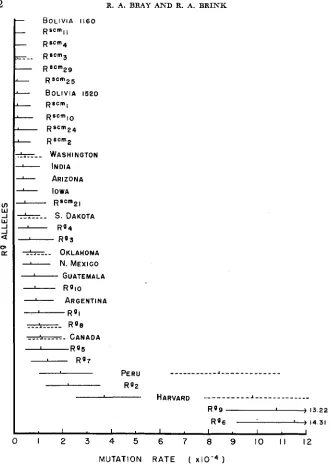
FIGURE 3.-Mutation rates and 95% Limits of Expectation for the series of R g alleles. Hori- zontal lines indicate the extent of the Limits of Expectation; vertical marks show the observed mean mutation rates. Solid lines represent mutation to r (colorless), and the dotted lines show total R-locus mutation rate. The observed mutation rates of the first five alleles entered at the
top of the figure are zero.
gametes (RSCm24) to 147,000 (Rg Oklahoma) with an average of about 87,000.
Considering total mutation rates as indicative of
R
locus mutability, it is clear that two distinct groups of alleles exist, one with low mutation rates (below 2 xM U T A T I O N A N D P A R A M U T A T I O N 143
(ii) Paramutation: The RQ alleles may be considered in three groups as follows: ( a ) Rsrnk alleles. By definition (and by experimental test) these alleles are all non-paramutable, and give aleurone color scores of 7.00 (self-color) both before and after passage through Rst heterozygotes.
(b) RQ 1-10: BROWN (1963) has shown that no differences exist in pigmenting ability between these ten mutants, either before or after they have undergone paramutation. This observation was confirmed in the present studies.
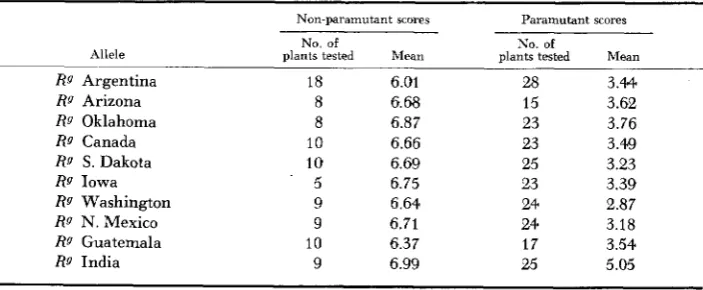
(c) Geographic RQ alleles: The scores obtained for the pigmenting abilities of these alleles are given in Table 3. Results for the four alleles Rg Bolivia 1160,
RQ
Bolivia 1520, RQ Peru, and Rg Harvard are not included, since these factors be- haved as R" alleles, scoring 7.00. All alleles listed in the table condition darkly mottled aleurone in non-paramutant form, and are highly paramutable, with the exception of RQ India, which is weakly paramutable. Thus, of 34 Rg (green an- thered) alleles tested, 14 were non-paramutable, 19 were highly paramutable, and one was weakly paramutable. These classifications were confirmed by F2data, based on testcrosses of the alleles after two generations of heterozygosity with R T t .
(iii) Paramutagenic action of non-paramutable Rs alleles: The alleles which were non-paramutable (or weakly paramutable) were tested to see if they them- selves were paramutagenic. Non-paramutable Rg alleles were crossed to standard (std.) R'. and the RgR' heterozygotes were testcrossed on rgrg 0 0 . The R'rQrQ kernel scores were then compared with those from ryrq P x std. R'/std. R' 8 con- trol matings. The results are summarized in Table 4. All four non-paramutable Rg alleles were paramutagenic, and showed differences between themselves in paramutagenic action.
The R'cm alleles were tested for paramutagenic activity by testcrossing Rscin/ std. R' heterozygotes on rQrQ P 0 . All ten alleles were found to be paramutagenic, and differences existed between alleles in the induced paramutant R score (F =
5.03, 9 and 47 df, P
<
.01). This result parallels the finding of MCWHIRTER andTABLE 3
Pigmenting ability of the geographic Rg alleles. Mean aleurone color scores from the crosses: ( a ) W23 e r g ? 0 x Rgrs or RgRg8 8 and ( b j W23 rgrg? 0 x R g R S t 8 8
Non-paramutant scores Paramutant scores
No. of No. of
Allele plants tested Mean plants tested Mean
Rg Argentina 18 6.01 28 3.44
RQ Arizona 8 6.68 15 3.62
RQ Oklahoma 8 6.87 23 3.76
RQ S. Dakota 10 6.69 25 3.23
Rg Washington 9 6.64 24 2.87
R g N. Mexico 9 6.71 24 3.18
Rg India 9 6.99 25 5.05
Rg Canada 10 6.66 23 3.49
Rg Iowa - 5 6.75 23 3.39
144 R. A. BRAY A N D R. A. BRINK
TABLE 4
Paramutagenic actioNn of non-paramutable R g alleles. Aleurone color scores of R'rgrg kernels from the cross W23 rgrg 0 0 x Rg/std. R' 6 8
Test allele
~~
No. of Mean R'rgro plants tested score
Std. R r (control)
Rg India
Rg Peru
R g Bolivia 1 1 6 0
Rg Harvard
Rg Bolivia 1520
10 5 6
5
6 7
5.73 a*
5.58 a
4.64 b
4.26 b
3.56 c
3.06 c
Means followed by the same letter are not significantly different at the 5% level, as determined by SCHEFFE'S (1953)
test.
BRINK
(1962) who showed that Rsc mutants from RSt may exhibit different levels of paramutagenic action.R' Ecuador and R' India were also tested for paramutagenic action. The mean scores of Rgflrg kernels from crosses of the type rgrg 0 0 X R' Ecuador/Rg3 6 6
and rgrg 0 0 X R' India/Rg3 6 8 were 5.72 and 5.52 respectively, and are not sig- nificantly different from the figure of 5.68 obtained from the r g r g x Rg3 Rg3 con- trols. R' Ecuador was also tested to see if it could acquire secondary paramu- tagenic action by crossing R' Ecuador/Rst plants with Rg3 Rg3, and comparing scores from Rg3 gametes from R" Ecuador/Rg3 heterozygotes with control R93 scores. The respective means were 5.82 and 5.51. R' Ecuador therefore cannot acquire secondary paramutagenic action. Thus it is inert with respect to all known paramutation phenomena.
Mutation of paramutant R alleles: The rate of mutation of a series of para- mutant R' alleles to r was measured in homozygous R'R' plants (obtained by self-pollinating R Rst individuals), and then compared with that of the respective non-paramutant R alleles. The alleles tested were standard R', Rg2, Rg4, Rg5, Rg6, and Rg8. The results are listed in Table 5. The figures for non-paramutant standard Rr were obtained by pooling the data from the five standard R' lines shown in Figure 1. In five out of the six pairs of rates shown in Table 5, the mu- tation rate of the paramutant allele is less than that of the non-paramutant form, and generally is about 60% of the higher rate. In the sixth case the rates are equal. Three of the differences are statistically significant, and it may be con- cluded that paramutant R alleles have lower mutation rates than the correspond- ing non-paramutant forms. BRINK (1958), working with small populations, did not detect this reduction in mutation rates. The larger population sizes in the present experiments establish it clearly.
M U T A T I O N A N D PARAMUTATION 145
TABLE 5
Mutation rates of paramutant R alleles
Putative No. Verified as Corrected Rate of mutation Probability of
Allele r mutants tested r mutants population ( x 10-4) equal rates
Standard R+
Paramutant std. R' RQ2
Paramutant RQ2 Rg4
Paramutant Rg4 RQ5
Paramutant RQ5 RQ6
Paramutant Rg6 R98
Paramutant R88
292 200 8 8 16 10 18 5 120 108 14 10 233 195 7 6 13 6 16 4 107 86 12 7
232 182,353 12.72
<
0.01192 258,325 7.43
6 75,526 0.79
>
0.2013 110,866 1.17
>
0.206 76,241 0.79
6 82,265 0.73
4 132,429 0.30
78 128,145 6.09
7 111,339 0.63
16 1 W,685 1.11 0.01
<
P<
0.05106 111,342 9.52
<
0.0112 159,354 0.75
>
0.20std. R'/std. R' plant was crossed with: (a) Homozygous R"; (b) a stock of r'r", derived as a mutant from standard R', and therefore isogenic with it, except for the R locus; (c) an isogenic rQrQ stock; and (d) the same standard R' plant (self- pollination).
Two sets of pollinations were made using two standard R' plants. Homozygous R'R' seed was then obtained by self-pollinating the various heterozygotes, and used to test the mutation rate to r. The results are shown in Table 6. Since only small populations were obtained, the figures represent pooled data from the two sets of crosses. It is clear that one generation of heterozygosity with r' or r g does not
alter the mutation rate of R' (entries 1 and 2 us. entry
4),
but heterozygosity with R S t causes a decrease in mutation rate (entry 3 us. entry 4, P (equal rates) is be- tween .05 and .lo). The reduction in mutation rate observed in Table5
therefore is due to an effect of the RSt gene as such.Preliminary experiments have been made on the mutation rates of other forms of paramutant alleles. The alleles studied and the observed mutation rates were: (a) std. Rr which had been heterozygous with Rst for two generations, and was then selfed: mutation rate 5.96 x (b) std. R' which had been heterozygous with RSt for one generation and was then selfed for two generations: mutation
TABLE 6
Mutation rates of homozygous standard Rr after extraction from heterozygotes
with different alleles
Entry History of R' No. of r mutants Population Mutation rate ( X 10-4)
1 rQR7 selfed 1 1 7362 14.9
2 r'R7 selfed 19 14276 13.3
3 RStRT selfed 5 8871 5.6
146 R. A. BRAY A N D R. A. B R I N K
rate 10.51 X (c) std. R' which had been heterozygous with Rat for one gen-
eration and was then selfed for seven generations: mutation rate 13.56 X
Since all the standard R' alleles did not come from the same line, the three re- sults are not directly comparable with each other. It is evident, however, that in advanced generations following heterozygosity with RSt the mutation rate of R"
increases towards that of the non-paramutant form of standard R'. This parallels the behavior of paramutant alleles with respect to aleurone pigmenting level as described by KERMICLE (1963). The reversion of mutation rate also provides strong evidence that the original depression of the mutation rate of paramutant R
is not due to the action of modifier genes derived from rhe RSt genome, since such modifiers would still be present in unselected descendants in which presumably they would continue to have a depressing effect. The number of mutants obtained in case ( a ) above was too small (15) to allow any conclusions to be drawn regard- ing a possible progressive reduction in mutation rate.
Genetic constitution of Rg4 and R%: It has been postulated (STADLER 1951; STADLER and EMMERLING 1956) that the R locus contains at least two synap- tically homologous units, P (the dominant form of which conditions plant color formation) and S (the dominant form of which conditions aleurone color forma- tion). An R allele producing colored aleurone and green plant color (i.e., Rg)
could then be either ( p S) or (- S) where (-) represents a deficiency for the P
component of the locus. EMMERLING ( 1 9 5 8 ) proposed a genetic test to distinguish between these two possibilities. In an R' Rg heterozygote, where R' is (P S )
,
if the Rg allele were ( p S), two types of colorless crossover mutants, ( P -) and ( p -), could result, due to oblique synapsis and subsequent exchange. If the Rgallele were (- S) only (P -) colorless crossover types could be produced.
Within the group of ten Rg mutants from standard Rr there exist two distinct orders of mutation rates to r, the rates of Rg6 and Rg9 being high, comparable to that of standard R', whereas those of the orher eight Rg mutants are low, being similar to those of many other RI alleles (Figure 3 ) . It might be expected that an
Rg allele of constitution ( p S) would, by virtue of more frequent oblique pairing and subsequent exchange, produce more colorless mutants than one of constitu- tion (- S)
,
assuming a common rate of production of noncrossover colorless types. One allele from each group (Rg6 and Rg4) was selected, and crosses made, following EMMERLING'S plan, to determine the status of the P component in each allele. Abnormal chromosome 10 ( K I O ) served as distal marker. Plants of geno- type Rgk/Rgk were crossed to R'K/R*K (i.e., P S K J P S K ) stoclrs, and the re- sulting Rgk/RrK (i.e., p ( ? ) S k/P S K ) heterozygotes were pollinated with rg+.Colorless kernels from this mating were selected and analyzed to determine their R-locus constitution and the presence or absence of KZO, The results are shown in Table 7.
The R94 k/R'K genotype produced only one type of colorless crossover mutant, and the 5:O ratio observed is significantly different (P
<
. O l ) from the expected1.5:3.5 (rgK crossovers should segregate preferentially, since they carry K I O )
.
M U T A T I O N A N D PARAMUTATION 147
TABLE 7
Mutation to r of Rg4k/R'K and Rg6k/RrK
Noncrossover types Crossover types
Overall
rgK mutation
Parent Rg Putative No. rTK rQk rrk
allele Population r mutants tested ( = P s K ) ( = p ( ? ) s k ) ( = P ( s ) k ) ( = P ( s ) K ) rate ( X lo-')
RP4 133,520 23 22 1 3 3 5 0 1.57
R96 133,192 27 24 13 2 1 7 1.73
the numbers of mutants are small, it is clear that Rg4 behaves as if it were defi- c:ent for the P component (- S) whereas Rg6 carries the recessive p ( p S ) .
DISCUSSION
It has been shown that no clear quantitative relationship exists between pig- menting ability and mutation rate for Rr alleles, or between paramutability and mutation rate (Figure 2 ) . The possibility of a qualitative relationship however, cannot be excluded, since the R' Ecuador allele, which is inert with respect to paramutation, also has the lowest mutation rate. There is a definite lack of en- tries in the lower left quadrant of Figure 2 (low mutation rate, low aleurone color score). It is uncertain whether this is merely a consequence of the particular sample of R' alleles studied, or is evidence that all R r alleles with low mutation rates are darkly pigmented and either weakly paramutable, or non-paramutable. Only further experiments on a wider range of Rr alleles can clarify this point.
Within the 34
Rg
alleles tested the evidence is clearer, There are two alleles in this group which are non-paramutable and have a high mutation rate, two which are paramutable and highly mutable, 18 which are paramutable and have a low mutation rate, and 12 which are non-paramutable and have a low mutation rate. The probability of independence in this 2 x 2 table is over 80%. No relationship is apparent therefore between paramutability and mutation rate of the Rg alleles. It is also clear that there is no association between non-paramutant pigmenting ability of the Rg alleles and mutation rate, since Rg6 and Rq9 have aleurone pig- ment producing potentials indentical with those of the other Rg mutants from standard R', but have distinctly different mutation rates, whereas Rg Harvard and Rg Peru are similar to Rg Bolivia 1160, RQ Bolivia 1520 and R""" alleles in pigment producing potential, but again have different mutation rates.Within the Rg group of alleles it is possible to examine the relationship between paramutagenic action of an R allele and its mutation rate. The data OI Table 4
demonstrate that alleles w;th similar high mutation rates (Rg Peru and Rg Har- vard) may possess different paramutagenic capacit'es. Also, alleles with widely differing mutation rates (e.g. RQ Bolivla 1160 and Rg Peru) may be similar in paramutagenic action. The spectrum of paramutagenic activities shown by the
R""" alleles, all of which have similar mutation rates, also suggests the absence of a clear-cut relationship between paramutagenic activity and mutation rate.
148 R. A. BRAY A N D R. A. B R I N K
and paramutation are not completely independent of each other. Many "muta- tions" at the R locus are ascribable to intralocus recombination (STADLER and
EMMERLING 1956). Any factor which influences or alters either the regularity of pairing or frequency of crossing over within the R locus therefore, would be expected to alter the mutation rate. Investigation of the nature of mutants from paramutant R alleles (crossover or noncrossover) would assist in determining the paramutational mechanism.
It has been shown that Rg6 is of constitution ( p S), and presumably many of the mutants from this allele are the products of crossing over within the locus. Rg
Peru and Rg Harvard have mutation rates that are similar to that of Rg6, but the mutants are mainly faintly pigmented, r (I) types. ASHMAN ( 1 9 6 5 ) has shown that from R'RSt heterozygotes, most r (I) products are associated with genetic recombination 'within the R locus. It is probable that the r (I) mutants from Rg
Peru and Rg Harvard also are recombination products, the parent alleles being two unit systems ( p S)
,
similar to Rg6, but not paramutable, and paramutagenic. The stable, paramutable Rg alleles are presumed to lack the P component (- S),while the nature of the stable, non-paramutable Rg alleles is still obscure.
The present data do not allow the formulation of a general statement regarding the relationship between mutation and paramutation. The levels of expression of the two processes in any one allele appear to be independent, but the mechanisms cannot be completely unrelated.
This study was aided by grants from the Research Committee of the Graduate School, Uni- versity of Wisconsin, of funds supplied by the Wisconsin Alumni Research Foundation, and by
grants to the second author from the National Science Foundation.
S U M M A R Y
NO clear relationship was found between mutation rate and pigmenting ability either before or after paramutation in a collection of R' alleles exhibiting a wide range of mutation rates. Within Rg alleles two distinct orders of mutation rates were observed, with paramutable and non-paramutable alleles occurring in both groups. Paramutagenic and non-paramutagenic alleles may or may not have similar mutation rates.-The mutation rate of a paramutant R allele is less than that of the corresponding non-paramutant allele. The reduction is not due to pre- vious heterozygosity per se, or to modifying genes. The mutation rate of para- mutant alleles appears to revert, in advanced generations, towards that of the non-paramutant form, simulating behavior in regard to aleurone color.-With respect to the plant color component of the R locus, P, two mutants from standard
R', Rg6 (high mutation rate) and R94 (low mutation rate) have been identified as carrying the recessive p, and as deficient for P, respectively.
LI T ER A TU RE CITED
ASHMAN, R. B., 1960 Stippled aleurone in maize. Genetics 45: 19-34.
-
1965 Mutants from maize plants heterozygous RrR3t and their association with crossing over. GeneticsMUTATION AND PARAMUTATION 149
BRAY, R. A., 1964 Mutation and paramutation at the R locus in maize. Ph.D. thesis, University of Wisconsin Library, Madison.
BRINK, R. A., 1958 Paramutation at the R locus in maize. Cold Spring Harbor Symp. Quant. Biol. 23: 379-391. - 1960 Paramutation and chromosome organization. Quart. Rev. Biol. 35: 120-137.
BRINK, R. A., and M. BLACKWOOD, 1961 Persistent enhancement of Rr action in maize by structural alterations of chromosome IO. Genetics 46: 1185-1205.
BRINK, R. A., and J. VENKATFSWARLU, 1965 Effect of a translocation in maize on sensitivity to
BRINK, R. A., and W. H. WEYERS, 19.60 Effect of an abnormal knob-carrying chromosome 10
BROWN, D. F., 1963 Paramutability of RQ and rr mutants from the standard Rr allele in maize. Ph.D. Thesis, University of Wisconsin Library, Madison.
EMMERLING, M., 1958 An analysis of intragenic and extragenic mutation of the plant color component of the Rr gene complex in Zea mays. Cold Spring Harbor Symp. Quant. Biol.
23: 393-407.
FISHER, R. A., and R. YATES, 1957 Statistical Tables for Biological, Agricultural and Medical Research. Fifth edition. Oliver and Boyd, London.
FLEMING, A. A., G. M. KOZFLNICKY, and E. B. BROWNE, 1964. Variations between stocks within long-time inbred lines of maize. Crop Sci. 4: 291-295.
KERMICLE, J. L., 1963 Metastability of paramutant forms of the R gene in maize. Ph.D. Thesis, Universiw of Wisconsin Library, Madison.
MCWHIRTER, K. S., and R. A. BRINK, 1962 Continuous variation in level of paramutation at the R locus in maize. Genetics 47: 1053-1074.
SCHEFF~, H., 1953 A method for judging all contrasts in the analysis of variance. Biometrika
40: 87-104.
STADLER, L. J., 1948 Spontaneous mutation at the R locus in maize. 11. Race differences in mutation rate. Am. Naturalist 8 2 : 289-314.
-
1951 Spontaneous mutation in maize. Cold Spring Harbor Symposia Quant. Biol. 16: 49-63.STADLER, L. J., and M. EMMERLING, 1956 Relation of unequal crossing over tom the inter- dependence of R r elements ( P ) and (S). Genetics 41: 124437.
STEEL, R. G. D., and J. H. TORRIE, 1960 Principles and Procedures of Statistics. McGraw-Hill, New York.
STEVENS, W. L., 1942
paramutation of Rr alleles from three geographic sources. Genetics 51: 585-591.
on paramutation of Rr in maize. Genetics 45: 1446-1465.