TABLE OF CONTENTS:
Vol. 42, No. 1, January 1989
ARTICLES
Plant-Animal Interactions
2
5
11
16
20
22
Sheep grazing as a silvicultural tool to suppress brush by S.H. Sharrow,
W.C. Leininger, and B. Rhodes
Effects of clipping and sheep grazing on dyers woad by Neil E. West and
Kassim 0. Farah
Animal performance and diet quality as influenced by burning on tallgrass
prairie by Tony J. Svejcar
Observations on vegetation responses to improved grazing in Somalia by
Thomas L. Thurow and Abdullahi J. Hussein
Standing crop patterns under short duration grazing in northern Mexico
by Sergio Soltero, Fred C. Bryant, and A. Melgoza
Cattle preferences for a hybrid grass: chemical and morphological rela-
tionships by Doreen R. Truscott and Pat 0. Currie
Animal Ecology
28
Nutrient utilization of acacia, haloxylon, and atriplex species by Najdi
sheep by Ashok N. Bhattacharya
31 Investigation of maternal and embryo/fetal toxicity of
Ephedra viridis
and Ephedra nevadensis
in sheep and cattle by Richard F. Keeler
Plant Physiology
36
Seed germination characteristics of selected native plants of the lower Rio
Grande Valley, Texas by Robin S. Vora
.41 Temperature responses and calculated heat units for germination of sev-
eral range grasses and shrubs by Gilbert L. Jordan and Marshall R.
Haferkamp
46 Growth regulators’ effect on crested wheatgrass forage yield and quality
by Larry M. White
Plant Ecology
51 Characterization and germination of chasmogamous and basal axillary
cleistogamous florets of Texas wintergrass by C.A. Call and B.O. Spoonts
Rehabilitation
56
Effects of organic amendments on soil biota on a degraded rangeland by
Walter G. Whitford, Earl F. Aldon, Diana W. Freckman, Yosef Stein-
berger, and Lawrence W. Parker
61 Revegetation of a salt water blowout site by Gary A. Halvorson and Kent
J. Lang
Soils
Published bimonthly-January, March, May, July, September, November Copyright 1969 by thesocietyfor Range Management
INDIVIDUALSUBSCRIPTION is by membership in the Society for Range Management.
LIBRARY or other INSTITUTIONAL SUBSCRIP- TIONS on a calendar year basis are $56.00 for the United States postpaid and $66.00 for other coun- tries, postpaid. Payment from outside the United States should be remitted in US dollars by interna- tional money order or draft on a New York bank. BUSINESS CORRESPONDENCE, concerning sub- scriptions, advertising, reprints, back issues, and related matters, should be addressed to the Manag- ing Editor, 1639 York Street, Denver, Colorado 60206.
EDITORIALCORRESPONDENCE, concerning manu- scriptsorothereditorial matters, should beaddressed to the Editor, 1639 York Street, Denver, Colorado 60206.
INSTRUCTIONS FOR AUTHORS appear on the inside back cover of most issues. A Style Manual is also available from the Society for Range Manage- ment attheaboveaddress@$2,OOforsinglecopies; $1.25 each for 2 or more.
THE JOURNALOF RANGE MANAGEMENT (ISSN 0022-409X) is published six times yearly for $56.00 per year by the Society for Range Management, 1639 York Street, Denver, Colorado 60206. SECONDCLASS POSTAGEpaidat Denver, Colorado. POSTMASTER: Return entlre Journal with address change-RETURN POSTAGE GUARANTEED-to Society for Range Management, 1639 York Street, Denver, Colorado 60206.
Measurement
71
Comparison of weight estimate and rising-plate meter methods to measure
herbage mass of a mountain meadow by Emilio A. Laca, Montague W.
Demment, Joy Winckel, and John G. Kie
75 Estimating production and utilization of jojoba by Bruce A. Roundy, G.B.
Ruyle, and Jane Ard
79 An enhanced wheel-point method for assessing cover, structure and hete-
rogeneity in plant communities by Graham F. Griffin
TECHNICAL NOTES
81 Comparison of hydrometer settling times in soil particle size analysis by
Carolyn C. Bohn and Karl Gebhardt
84 Viewpoint: Needed research on domestic and recreational livestock in
wilderness by David N. Cole
BOOK REVIEWS
86 Wildlife Recreation Policy, An Introduction by J. Douglas Wellman;
Social Science in Natural Resource Management Systems edited by Mart
L. Miller; The Last Grizzly, and Other Southwestern Bear Stories by
David E. Brown and John A. Murray; The Nutrition of Herbivores edited
by J.B. Hacker and J.H. Ternouth; Ecosystems of the World. 17B. Man-
aged Grasslands.
Analytical
Studies
edited
R.W. Snaydon.
Managing Edltor PETER V. JACKSON Ill
1639 York Street Denver, Colorado 60206 Edltor
PATRICIA G. SMITH
Society for Range Management 1639 York Street
Denver, Colorado 60206 (303) 355-7070 Book Review Editor GRANT A. HARRIS
Forestry and Range Management Washington State University Pullman, Washington 99164-6410
ASSOCIATE EDITORS WILL BLACKBURN
N.W. Watershed Res. Center 270 South Orchard Boise, Idaho 63705 CARLTON BRITTON
Range 8 Wildlife Mgmt Texas Tech University Lubbock, Texas 79409 THOMAS A. HANLEY
Forestry Sciences Lab. Box 20909
Juneau, Alaska 99602 RICHARD H. HART
USDA-ARS 6406 Hildreth Rd. Cheyenne, Wyoming 62009
RODNEY HEITSCHMIDT Box 1656
Vernon, Texas 76364 N. THOMPSON HOBBS
Colorado Div. of Wildlife 317 W. Prospect
Fort Collins, Colorado 60526 PETE W. JACOBY, JR.
P.O. Box 1656 Vernon, Texas 76364 HOWARD MORTON
2000 E. Allen Road Tucson, Arizona 65719
BRUCE ROUNDY 325 Biological Sciences East Building, Univ. Arizona Tucson, Arizona 65721 PAUL TUELLER
Range Wildlife 8 Forestry UNR 1000 Valley Road Rena. Nevada 69512 RICHARD S. WHITE
KSU Extension Center Colby, Kansas 67701 STEVE WHISENANT
Texas ABM Univesity Dept. of Range Science
Sheep grazing as a silvicultural tool to suppress brush
S.H. SHABROW, W.C. LEININGER, AND B. RHODESThe possibility of using livestock 8s 8 biologial agent to control unwanted ground vegetation in Picific Northwest coniltrous forests I188 been discu8sed for over SO ye8rs. However, little qu8n- titativt informrtion bat yet been pub&bed documenting the effi- c8cy of livestock in wppreaeing brueb 8nd other ground vcgctrtion in commtrci8l Dougl8s4ir (PseudWug8 mcnrksii) pl8nWions. Therefore, 8 study WM conducted in 19818nd 19112 to evaluate the pottntirl for using herded sheep to control competing vegetation in Dougl8sAir pbt8tions in P8cific Northwest coniferore foredts. Three 4- to 6-year-old plantations were grazed once e8cb yw during the M8y to September grazing se8son. Estim8&8 of current year’s growth present in October, both inside 8nd out8ide 8 live- stock excloeurt on e8cb study plrat8tion, were used to evaluate the effects of grazing. In general, utilizlition of brush by sheep ~8s moderate to heavy, except in tbt spring of 1982, when brush was lightly utilized. Sheep gr88ing effectively reduced (pCO.01) both tow understory pleat growth 8nd brush net current ycrv’s growth on 8U pl8nt8tions. Reduced brueb biomur on gr88ed 8re88 ~8s wsoci8ted with gre8W Doughs-fir dirmeter growth in 1981-82 8nd 1982-83. By 1985, trees in grazed 8re8s were 5% wler (pCO.05) 8nd 7% grerttr in diameter (pCO.01) compued to ungrrzed con- trols. Our d8t8 8nd observrtions suggest tbrt sheep may be tfftc- tively ustd aa 8 biologic81 control rgtnt for brueb control in co8st8l Doughs-fir foreats.
Key Words: biologiul control, Douglas fir, forest gmzing, rgro- forestry
A major problem in establishing and maintaining conifer planta- tions in the Pacific Northwest is the control of competing vegeta- tion (Newton 1964, Cleary 1978, Stewart et al. 1984). The main target species for brush suppression in Pacific Northwest conifer- ous forests include red alder (Ahus rubru), thimbleberry (Rubus parviforus), sahnonberry (Rubus spectabilis), and vine maple (Acer circinatum). Interest in controlling unwanted vegetation using biological agents has risen in recent years because of the economic and environmental benefits of such programs (Hedrick
1975). In the past, insects have generally received the most atten- tion as possible biological control agents. However, prescribed grazing with domestic livestock has recently gained considerable attention (Sharrow and Mosher 1982, Kosco and Bartolome 1983, Wood 1987, Brock 1988) as a method of suppressing unwanted vegetation. Sheep grazing has been proposed as a silvicultural tool to suppress brush in Douglas-fir plantations in Oregon’s Coast Range (Sharrow and Lcininger 1983).
An advantage of properly controlled livestock grazing over other mechanical or chemical control methods is that unwanted vegetation may be removed while simultaneously producing mar- ketable animal products (Sharrow and Leininger 1983). However, in order for livestock to be successful as biological agents, 2 condi-
Authors arc professor, Department of Rangeland Resources, Oregon State Univer- sity, Corvalliq, 97331; assistant
State University, Fort Collins, I
rofessor, Department of Range Science, Colorado 0523; and former graduate student, Department of Rangeland Resourcen, Oregon State University, Ckvallis 9733 I.
Research was funded by the USDA Forest Scrvi~, Alsea Ranpr District, Siuslaw National Forest and the Oregon Agricultural Expcrnnental Stauon. Authors wish to express particular thanks to Ned Davis, Gene Klingler, Steve Smith, and Ken McCall of the Alsca Ranpr District for their valuable support, advice, and assistance during the conduct of tins study.
Manwript accepted 8 August 1988.
2
tions must be met: (1) Livestock must utiliie unwanted target vegetation, but not significantly damage the commercially valua- ble crop, and (2) target species must not regrow substantially following defoliation.
The purpose of this study was to evaluate the potential for using herded sheep as a biological control agent to suppress brush in Douglas-fir plantations.
Methods
The study was conducted approximately 15 km west of Alsea, Oregon. The maritime climate is typified by cool, moist winters and warm, dry summers. Most of the approximately 250 cm of precipitation falls as low intensity rain from October through May (Corliis 1973). Elevation of the study areas ranges from 75 to 450 m. Soils are described by Corliss (1973) as slickrock gravelly loams (Pachic Haplumbrept).
Three 4- to 6-year-old Douglas-fir plantations in the Alsea Ranger District, Siuslaw National Forest, were selected for study. Study sites were restricted to plantations having the vine maple (Acer circinatum)-sword fern (Polystichum munitum) plant community because it is the most extensive plant community in the Alsea District (Corliss and Dymess 1965).
A band of 700 ewes with lambs and a band of 900 dry ewes grazed the forest in 198 1 and 1982, respectively. The grazing season was from May to September both years. Stocking rate averaged 5.8 ha/band day and 6.2 ha/band day in 1981 and 1982, respectively. Each year, a series of plantations, ranging in size from 10 to 40 ha, was grazed according to a predetermined schedule. Within this schedule, one study plantation was grazed in May, one in July, and one in August.
A 30 m by 30-m livestock exclosure was established on each study plantation prior to grazing. These exclosures served as refer- ence areas and allowed observations and comparisons to be made on adjacent areas which had been grazed and ungrazed by live- stock. Exclosures were constructed of 0.8 m high woven wire which allowed wildlife continued access to the exclosed areas. The effect of sheep-grazing on tree growth was evaluated by comparing mea- surements of tree height and diameter for 100 permanently “tagged” trees within the exclosure to those of 100 adjacent trees in the grazed region of each study plantation. Height and diameter measurements were taken using a graduated pole and caliper, respectively, each year immediately prior to sheep grazing in 1981 and 1982, in summer 1982, and in fall 1985.
Available phytomass and the amount utilized by sheep were determined using the “before and after”technique (Cassady 1941). Current year’s growth for all plant species, except vine maple, was estimated by plot-harvest of 10 pairs of randomly located 0.45-rn2 quadrats in each of three 0.05-ha macro-plots per plantation. One quadrat of each pair was randomly selected and clipped prior to grazing, while the other was marked and harvested immediately after sheep left the plantation. Ctirrent year’s growth was separated by species, oven-dried for 48 hrs at 50” C, then weighed.
Current year’s growth and utilization of vine maple were deter- mined using the following methods. Ten vine maple shrubs were randomly selected within each replication prior to grazing. Four branches from each plant were chosen and the available current
year’s growth on 2 randomly selected branches clipped, oven- dried, and weighed. The other 2 branches were marked and treated similarly following grazing. The number of branches on each defol- iated vine maple was determined along with the density of vine maple in each replication. Foliage more than 1.5 m above the soil surface was not sampled, as it was considered to be above the reach of sheep (Ingram 1931) and therefore not available for grazing.
Above-ground current year’s phytomass present at the end of the growing season on grazed and ungrazed areas was used as an estimate of net phytomass production each year. Sixteen 0.45-mz randomly selected quadrats were harvested both inside and outside the exclosure on each study plantation. These samples were oven- dried for 48 hr at 500 C and weighed.
The effect of grazing on net growth of vine maple was evaluated by collecting 20 randomly selected vine maple branches from inside and outside the exclosures in October each year. The current year’s growth below 1.5 m was removed from each branch, oven-dried, and weighed. Conversion to kg/ha was made by multiplying bio- mass per stem times corresponding estimates of the number of vine maple branches per hectare, calculated during the previous sampling.
Data were analyzed as a split plot in time, with grazing as main plots, year as subplots, and plantations as replications in a random- ized block design. Differences were tested for signiiicance at the 90% confidence level.
Results and Discussion
Utilization of brush by sheep varied between 1981 and 1982 (Table 1). In 1981, brush received relatively heavy utilization
Table 1. Current year’s growth (kg/h) of major brusk species avallablc to
(A) and uti&d by (U) skeep on the three study phtationsl.
Year S@cs
Plantation 1 Plantation 2 Plantation 3
A U A U A I!
198 1 Acer circinatum 112 75 55 44 286 120
Rubus parvzj7onrr 86 33 77 54 47 28
Rubus spectabilis 14 7 26 9 0 0
Rubus ursinus 19 17 59 38 14 0
Subtotal 231 132 217 145 347 148 1982 Acer circinatum 106 4 69 31 244 91
Rubus parvQ7orus 49 6 89 13 29 13
Rubus spectabilis 8 034 8 9 4
Rubus ursinus 14 0 77 10 23 10
Subtotal 117 10 269 62 305 118 ~Phntations I,2 and 3 wcn grazed in May, July and Augurt, reapcctively.
throughout the grazing season. In 1982, sheep browsed brush lightly in the spring, then increased their consumption of brush during July and August. A possible explanation is that sheep began grazing in 1982 when brush species were at an earlier phenological state than in 1981 due to cooler temperatures and more rainfall during the spring of 1982. Evidently, the earlier phenological state of brush in 1982 resulted in brush being less preferred by sheep than in 1981. In addition, the 2 different bands of sheep may have expressed different preferences for brush based on different past histories and experience in grazing species similar to those found in the study sites (Knowles et al. 1973, Gillingham et al. 1976).
The grazing-by-year interaction was not significant (p>o. 10) for any parameter tested. Therefore, discussion will be limited to the main effects of year and grazing. Neither total net phytomass production nor its components varied (PCO.10) between years (Table 2). Approximately 18,36, and 46% of the October phyto- mass standing crop was contributed by graminoids (predomi-
Table 2. Components of current year’s phytomus (kg/b) present on grazed (G) and ungrazed (U) plantations in October 1981 and 1982.
Item Total Biomass
Graminoids Forbs
Brush
Year Grazing
1981 1982 G U
1418 1600 1096 * 1922 242 316 299 260 566 510 374 + 702
610 772 422 + 960
l ~*Ycars or grazed and ungrazcd differ, pCO.10 and pCO.05, respectively.
nantly Agrostis spp. and Holcus lunutus), forbs (predominantly Senecio jacobaea and Anaphalis margaritacea), and brush, respec- tively. Sheep grazing reduced total net plant growth by approxi- mately 43% in grazed compared to ungrazed areas. While grazing reduced the annual net growth of forbs by 47% and brush by 56% on grazed compared to ungrazed areas, it had little impact upon graminoids. Presumably, this differential response to grazing reflects a higher ability of grasses to regrow following defoliation than was exhibited by either forbs or browse plants. Grasses on our plantations began to replace tissue lost to defoliation soon after sheep left the plantation. Forbs, which had to activate new buds to initiate growth, were noticeably slower to regrow than were the grasses. Interestingly, shrubs made little or no regrowth following sheep grazing. Many shrubs found in the Coastal Coniferous Forest contain tannins or other compounds which discourage herbivory (Li 1974). The growth strategy of these shrubs appears to be one of investment to avoid herbivory rather than in mechanisms
to tolerate herbivory through rapid regrowth following grazing. Our results are in general agreement with other studies which indicate that both cattle (Kosco and Bartolome 1983) and sheep (Hall et al. 1959, McKinnell 1975) may be effectively used to control ground vegetation in coniferous forest plantations.
The amount of annual net brush growth in the study plantations almost doubled during the 1981 to 1982 period, regardless of grazing treatment (Table 3). Vine maple and the early seral, erect-
Table 3. Mean October current year’s phytomass (kg/be) of major brosk species present in grazed (C)and ungrued (U) plaatatiom during 1981 and 1982.
Item
Acer circinatum Rubus parvijorus
Rubus spectabilis Rubus ursinur
Subtotal
Year Grazing
1981 1982 G U
88 + 165 86 +
147 218 88 + ::
13 * 88 44 57
68 * 133
285 l 637
+**Yurs or grazed ami ungmed diier, pCO.10 and pCO.05, respectively.
growing Rubus species, thimbleberry, and salmonberry each pro- duced approximately 70-80 kg/ ha more phytomass in 1982 than in 198 1. Nevertheless, total net brush growth on grazed areas was less than half that on ungrazed areas each year. Net growth of vine maple, thimbleberry, and trailing blackberry (Rubus ursinus) on grazed areas was only 5 1,32, and 5 1% of that on ungrazed areas.
Sheep grazing did not reduce net annual growth of salmonberry. However, due to the relatively small amount of salmonberry on the study sites, the effect of sheep grazing on this important brush species may not have been adequately assessed.
Tree growth is the best single silvicultural indicator of the eff- cacy of brush control for commercial timber production. Reduced brush biomass on grazed portions of plantations was consistently associated with greater (KO.05) diameter growth of Douglas-fir trees (Table 4). However, grazing had little impact on tree height
Table 4. Height end dhmetcr growth during 1981-82 end 1982-83 end absolute belgbt end diameter (DBH) in 1985 of Doughs-fir treee from grezed end uugrazed phtetion*
Height (cm) Grazed Ungrazed % Difference
1981-82 87.7 87.3 0.4
1982-83 96.4 95.3 1.1
1985 591 564 4.8’
Diameter (mm)
1981-82 15.7 14.2 10.6.
1982-83 16.6 14.3 16.1,.
1985 81.2 76.2 6.6**
++**Grazed and uagrazed diner. p<O.IO, p<O.OS and X0.01, respectively. during the first 2 years of the study. The immediate positive response of diameter growth to grazing compared to the apparent unresponsiveness of height growth may be related to differences in the nature and timing of cambial and leader growth in Douglas-fir. Leader growth is initiated early in the spring and its potential is related to the number of cells set in the bud which was formed the previous growing season. Cambial growth is indeterminant and occurs whenever growing conditions permit. Emmingham (1977) reported that Douglas-fir leader elongation ended by late July in areas similar to our study sites. In contrast, he observed that cambial growth continued on until October. Light, soil moisture, soil nutrients, and other site resources which may become available for tree growth as a result of our spring-summer grazing treatments would likely be concentrated in the post-spring period when cam- biil growth is predominant.
By 1985, three growing seasons after grazing treatments ceased, trees in grazed plantations were approximately 5% taller (KO.05) and 7% greater (X0.01) in diameter (DBH) than were trees in ungrazed controls.
Our data suggest that livestock can be effective in suppressing brush on Douglas-fir plantations in Oregon’s Coast Range. Prop- erly controlled sheep grazing can be a useful silvicultural tool in managing young plantations and merits serious consideration in the future.
Literature Cited
Brock, J.H. 1988. Livestock: biological control in brush/ weed manage- ment programs. Rangelands l&32-34.
Caeeady, J.T. 1941. A method of determining range forage utilization by sheep. J. Forest. 39667-671.
Cleary, B.D. 1978. Vegetation management and its importance in refores- tation. Orenon State Univ. Forest. Res. Lab. Res. Note 60.
Corliss, J.F. f673. Soil Survey-Alsea Area, Oregon. U.S. Gov. Print. off. Washington D.C.
Corliss, J.F., and C.T. Dymess. 1965. A detailed soil-vegetation survey of the Alsea area in the Oregon Coast Range. In: Forest Soil Relationships in North America. C.T. Youngberg. Ed. Oregon State Univ. Press, Corvallis.
Emminghem, W.H. 1977. Comparison of selected Douglas-fir seed sources for cambial and leader growth patterns in 4 western Oregon environ- ments. Can. J. Forest. RCS. 73154-164.
GiHngbam, A.G., B.K. Klomp, and S.E. Peterson. 1976. Stock and pasture management for establishment of radiata pine in farmland. Proc. N.Z. Grassl. Assoc. 37:38-5 1.
Hall, F.C., D.W. Hedrick, rod R.F. Keniston. 1959. Grazing and Douglas- fir establishment, J. Forest. 57-98-105.
Hedrfck, D.W. 1975. Grazing mixed confier clearcuts in northeastern Oregon. Rangeman’s J. 26-9.
Ingram, D.C. 1931. Vegetative changes and grazing use on Douglas-fir cut-over lands. J. Agr. Res. 43:387412.
Knowles, R.L., B.K. Klomp, and A. Gilllngkam. 1973. Trees and grass--an onnortunity for the hill country farmer. Proc. 25th Ruakura Farmer’s cbnf. p. 1 lb-121.
Kosco. B.H.. and J.W. Bartolome. 1983. Effects of cattle and deer on regehrating mixed conifer clearcuts. J. Range Manage. 36265-268.
Krauch, H. 1936. Some factors influencing Douglas-fir reproduction in the Southwest. J. Forest. 34:601-608.
Li, C.Y. 1974. Phenolic compounds in understory species of alder, conifer, and mixedconifer stands of coastal Oregon. Lloydia 37603-607.
McKinnell, F.H. 1975. Control of weeds in radiata pine plantations by sheep grazing. Aust. Forest. Res. 6:1-4.
Newton, M. 1964. The influence of herbaceous vegetation on coniferous seedling habitat in old field plantations. Ph.D. Diss., Oregon State Univ., Corvallis.
Sharrow, S.H., and W.D. Mosber. 1982. Sheep as a biological control agent for tansy ragwort. J. Range Manage. 35:480-482.
Sharrow, S.H., and W.C. Lehinger. 1983. Sheep as a silvicultural tool in coastal Douglas-fir forest. p. 219-232. In: D.D. Hannaway (ed.). Proc. Foothills for Food and Forests, Internat. Hill Lands Symp. Timber Press, Beaverton, Ore.
Stewart, R.E., L.L. Gross, and B.H. Honkala. 1984. Effects of competing vegetation on forest trees: a bibliography with abstracts. USDA Forest Serv. Gen. Tech. Rep. WG-43.
Wood, G.M. 1987. Animals for biological brush control. Agron. J. 79319-321.
SRM Election Results
The Elections Committee Chairman, Debra Sherman, along with several other Colorado Section members, counted the ballots for new officers on Friday, December 9,1988, at the Society for Range Management headquarters. Elected officers are:
Second Vice President-Stan Tixier
Directors (1989-1991)-Charles E. Jordan and Phillip L. SillIS
Directors Jordan and Sims will replace retiring Directors Donart and Welch in February 1989.
Ballots and tally sheets are retained in the Denver office for one year for review. Approximately 30% of the membership voted.
Effects of clipping and sheep grazing on dyers woad
NEIL E. WEST AND KASSIM 0. FARAH
AbSttWt
Dyers woad (Is&& tktoria L.) is an iatroduced crudferous forb that in rapidly expanding on intermountain rangelands and is apparently reducing production and regeneration of more desir- able forage plants. Mechanical end chemical controls are expen- sive as well as having deleterious effects on nontarget species. Limitations to controlling thie noxious weed by early spring graa- hag were investigated with clipping experiments at 1 site in the Wasatcb foothills of northern Utah. These results were compared with actual utilization of woad by sheep at a poor condition example of that site. Significant mortality 8nd reduction in repro- ductive performance occurred when at least 60% of the above- ground phytomass had been removed on or after 23 May. Clipping twice, to remove as much as 90% of aboveground tissue before 23 May, did not significantly affect word mortality, percent flower- ing, or fruit production. Sheep did not graze tti weed heavily enough at late enough dates to significantly affect mortality or seed production. Even on a poor condition range, these animals switched to other forages after about 15 May. Stocking rates rquired to restrict dyers word at our clipping site would likely result in further range deterioration. More host- specific biological control agents should be examined.
Key Words: Is&s iinctorio, clipping, biological control, utiliza- tion by sheep
Dyers woad (Isaris rincroriu L.) is an introduced cruciferous forb that has been rapidly spreading in the croplands and rangelands of northern Utah and surrounding states (Farah et al. 1988). Young and Evans (1977) and Evans and Chase (198 1) concur that dense infestations can substantially reduce forage production and regen- eration of more desirable species. Chemical and mechanical con- trols exist for croplands (Evans and Gunnel1 1982, King and Evans 1983). Damage to nontarget, desirable forage plants, steepness and rockiness of most range sites where woad occurs, and questionable economic feasibility limit use of these chemical and mechanical controls on rangelands. Development of a biological control would thus be desirable. Others have obtained some success with livestock as control agents of other noxious rangeland weeds (Sci- fres 1981, Brock 1988).
Limitations to controlling dyers woad by early spring grazing were investigated via clipping experiments. We sought combina- tions of intensity, frequency, and timing of clipping that could cause significant mortality and reduction in flowering and seed production of dyers woad. These results were compared with actual patterns of dyers woad utilization by sheep and correspond- ing impacts on its mortality, percent flowering, and seed produc- tion.
Authors are professor, Department of Ran Logan 84322423tk and lecturer, Dcpartmcnt o ff
Science, Utah State University, Range Management, University of Natrobi, Kabete campus, P.O. Box 29053, Nairobi, Kenya. At the time of the research, the ‘unior author was World Rank fellow and graduate
OfRa ngc Science, Utah State University. Logan.
researchassistant, Department Research was funded by the Utah Agncultural Ex rimental Station, of which thii is Journal Paper No. 3602. Authors wish to thank E mona Rukavina for technical assistance and Dr. J.H. Richards for suggestions toward improvement of the experi- mental design and its analysis. Mark Jensen and J.D. Norr kindly allowed us to conduct our investigations on their land.
Manuscript accepted 24 August 1988.
JOURNAL OF RANGE MANAGEMENT 42(l), January 1999
Materials and Methods study sites
Our experiments were conducted at 2 foothill locations on the western slope of the Wellsville Mountains, Box Elder Co., Utah. Elevations averaged about 1,500 m. Soils there belong to the Sterling Series, a well-drained loamy skeletal, mixed mesic Typic Calcixeroll (Soil Conservation Service 1975). Estimated average precipitation is about 40 cm/
yr.
Average annual air temperature is 9” C (Soil Conservation Service 1985). Potential natural vegeta- tion is dominated by big sagebrush (Arremisiu rridenruru Nutt.) and bluebunch wheatgrass [Agropyron spicurum (Pursh) Scribn. & Smith].Both clipping and utilization studies were located on a “moun- tain shallow” range site (Soil Conservation Service 1985). The clipping studies were located in an area that had not been grazed by livestock for at least 20 years. Vegetation there was in late seral or “good” condition for livestock use. Utilization studies of woad were conducted in a sheep pasture about 3 km to the north of the locale of the clipping studies. Although elevation, slope, exposure, soils and potential vegetation were similar at the sites used for clipping studies, a long history of early spring through fall grazing had caused retrogression to early seral or “poor” conditions for livestock use (Soil Conservation Service 1975). The major plant species there were big sagebrush, cheatgrass (Bromus rectorurn L.), bulbous bluegrass (2%~ bulbosu L.), broom snake weed [Gurieve-
ziu surorhrue (Pursh) Brit. & Rusby], gumweed [Grindelia squur-
rosu (Pursh) Dunal], and dyers woad. Clipping Study Procedures
A 30 by 50-m macroplot with a dense population of dyers woad was selected. The plot was divided into 30 rows, each 1 by 30 m, perpendicular to the contour. Ten random locations within each row were selected and the dyers woad plant nearest to this location was marked during October, 1983, and a 1 meter tall wooden stake placed 50 cm to the north. Selected plants had a basal rosette of at least 3 leaves that spanned at least 4 cm. Such plants (1): could be positively identified as dyers woad; (2) could be utilized by sheep; and (3) were likely to live to maturity (Farah et al. 1988).
The clipping regimes were of 2 intensities, 60% or 90% removal of aboveground tissue, found at the time of each clipping plus an unclipped control. The percent aboveground phytomass removed was based on rosette radius, collective leaf mid-rib lengths or stalk height, existing on the plant at the time of clipping. Concurrent studies (Farah 1987) showed strong relationships between these dimensional variables and aboveground biomass of dyers woad.
The plants were also subjected to varying frequencies of clipping at several dates during the growing season: (1) only once on 16 April 1984, (2) twice on 16 April and again on 7 May 1984; (3) three times on 16 April, 7 May, and 23 May 1984; and (4) four times on 16 April, 7 May, 23 May, and 11 June 1984. Each frequency- intensity treatment combination was replicated 30 times. Plants for eachtreatmentwerechosenatrandomfromtheentiremarkedpopulation. At each clipping date, a separate set of previously unclipped plants (intermingled with the other plants) was clipped only once at 90% intensity to determine if dyers woad was susceptible to a single, severe clipping at a certain time. Data from this treatment
also helped to separate the interactions of frequency of clipping with time of clipping.
Data taken just before clipping included phenophase (Farah et al. 1988), rosette diameter, number of rosette leaves, and basal diameter just beneath the rosette leaves. Other data collected at later dates were stalk height, number of stalks bearing flowers, and fruit number per plant. Since clipping often retarded development, plants clipped in 1984 were observed again during the 1985 grow- ing season. The effects observed during 1984 and cumulatively from 1984 and 1985 were analyzed separately.
The statistical design consisted of a (2 X 4) + 1 modified factorial with experimental units (individual plants) and treatments arranged completely at random.
A binomial chi-square analysis was used to test the effect of clipping on mortality and percent flowering of dyers woad (Coch- ran and Cox 1957). Ninety-five percent confidence intervals were used to detect differences in seed production and number of flower- ing stalks produced between treatments. A square root transforma- tion was required to homogenize variances among treatments. For purposes of presentation, means and confidence intervals were back-transformed to the original scale (Sokal and Rohlf 1981). The multiple and single time clipping treatments were analyzed together and separately. The latter analysis made it possible to determine how much a single clipping at a given time contributed to the total effect.
too
90
80 70 60 50 40 30 20 IO
0
(a)
I6-April 23-May IO-Aug
Utilization Study Procedures 7-May II-June 6-Ott
A site physically similar to the area of the clipping study was located in March of 1984 near the center of a sheep-grazed pad- dock. Ten transects, each 50 m long, were chosen so that they ran parallel to sheep trails (to minimize trampling impacts). These transects were marked with iron pins, driven in close to the ground surface at 5-m intervals.
Six hundred plants (rosette diameter >6 cm) were chosen in early April, 1985. Random distances along the transects were selected and then the nearest plant to that point located. Plants were further identified by colored toothpicks placed upright in the soil 5 cm to their north. Half the selected plants were protected from sheep grazing that season by l-m3 wire exclusion cages. These plants served as controls.
(b)
On 27 April about 150 sheep were turned into the pasture by the owner. The following observations were made biweekly (if appli- cable): (1) whether the woad plant was grazed; (2) lengths and widths of leaves remaining on the grazed plants (including peti- oles); (3) rosette diameter; (4) basal diameter; (5) number of rosette leaves; (6) number of fruits per plant; (7) fruit weight per 100 fruits; (8) mortality of individuals; and (9) phenophase.
With the exception of phenology, mortality, and reproductive variables (6 through 9), measurements of all other variables were discontinued after 20 May 1984 due to cessation of grazing by sheep on dyers woad.
A random set of 30 control plants was destructively sampled on 18 May 1984 to establish regression relationships between leaf area and leaf weight, and stalk height to stalk weight at the end of the utilization period. Regression analysis was also used to evaluate the relationship between degree of sheep utilization and various size characteristics of dyers woad. A chi-square test of independ- ence (Steel and Torrie 1980) was used to determine the effect of grazing on mortality and percent flowering of dyers woad.
27-April 15-June 12-act
18-May I3-Aug
Dm.- Dormancy L.G. -Leaf Growth S.G.-Stem Growth FI.- Flowering S.D.-Seed Development D.- Death
Phenology
Results
Fig. 1. Percentages of marked, unclipped dyers woadpopulations, at the site of the clipping study (a) and at the site of the utilization study (b), in variousphenological stages during spring, summer andfall of 1984. n = 30 in both cases.
Figure 1 shows that while overall phenological development of dyers woad during 1984 was similar at both the clipping and utilization study sites, unutilized controls began flowering earlier
in the sheep pasture. Since it required a week to record data at each site, data collection at the utilization study site lagged by 1 week. These phenological progressions were also similar to earlier multi- year responses presented in Farah et al. (1988). Dyers woad plants had started vegetative growth by 16 April 1984, less than 1 week
Table 1. Fruit production by dyers woad pbntr clipped during the spring of 1984 at varying intcmitia and freqncncia.
Treatment Intensity Control
60% 60% 609% 6% 90% 90% 90% 90%
Number of Clippings
0 1 2 3 4 : 3 4
Original Sample Number of Plants Mean Fruit (# o&nts)
that Production per Fruited Plant 30
31
; 237
223
31 18 128
31 9 97
30 5 139
zl 20 15 174 121
30 3 94
30 1 164
95% Confidence % of
Limits Control
175,318 100
1671286 83,184 40,179 39,301 123,234 72,181 2,436 -
104
49 18 15
:i 6 3
70
60
CT .E 50
b 8 40 ii E
8 30
2 20
IO
0
Control
(a)
C
a . . . . .: ’ :: . . .-
.L. . . . : :., ;I.
~
-:* : . -.:. . . ::
.* :-.’ . . .:: . . .:T .:’ _
Effects of Time of Clipping
1984
A set of previously unclipped plants was clipped only once at 90% intensity to determine if there was a time at which dyers woad was susceptible to a single, severe clipping. In order to achieve significant mortality over those of the controls, plants had to be clipped at 90% intensity no earlier than 23 May (Fig. 5). Single 90% clippings prior to this time did not significantly affect mortality of
a
q
Control2 3 4
100
90
80
2
70
.-
-
g
60
=
50
C
Number of Times Clipped
1984 t 1985
A
q
controlControl I 2 3 4 Number of Times Clipped
r
1984 +
1985
b
I I- June
I6-Apri I
23-May
Clipping
Date
Fig. 5. Effect of time of chppbtg on mean cumulative percent mortality of dyers wood during 1984 (a) and during 1984 and 1985 combined (b). Plants were clipped to remove 90% of abovegroundphytomoss. n = 30 plants. Bars with different letters are signafkantly different at an Q level
of 0.05.
dyers woad. A single heavy clipping also resulted in signifkant reductions in percent flowering only when plants were clipped on or after 23 May (Fig. 6). A contrast between Figures 6a and b shows that clipping after 7 May delayed flowering of some plants by 1 year.
Pig. 4. Effect of multiple clipping at 2 intensities (60% = low; 90% = high) Date of clipping affected total fruit production of treated plants. on mean comtdativepercentflowering of dyers woad during 1984 (c)and Fruit production of plants clipped on 7 May and those clipped on during 1984 and 1985 combined(b). n = 3Oplantsat the beginning of the
experiment. Bars with different letters are significantly dfferent at an a
23 May were, respectively, 42% and 23% of the controls. As in the
level of 0.05. multiple clipping treatment, fruit production did not significantly
90
T80
la)
I
90
80
70
.;
60
:
50
g
40
g
CL
30
20
1984
a
I,
b
b
Control
7-May
I I-June
16-April
23-May
Clipping
Date
1984 + 1985
(b)
a
b
Control
7-May
II-June
I6-April
23-May
Clipping
Date
Fig. 6. Effect of time of clipping on mean cumularivepercentji’owering of dyers woad during 1984 (a) and during 1984 and 198.5 combined. (b). Intensity of clipping and sample size are the same as in Fig. 5. Bars with di/ferenr letters are sign@anrly dgferent at an Q level of 0.05.
decline on a per plant basis (data not shown) and fruit weights were not affected by the time of clipping (data not shown). We have shown elsewhere (Farah et al. 1988) that achieving reductions in seed production of woad are crucial for its control since seed dormancy is minimal and only about 3% of the seedlings reach maturity.
A combined analysis (data not shown) of multiple and single clipping showed that a single late clipping at 90% intensity resulted in similar mortality and flowering responses as multiple clipping. Most importantly, the effects associated with clipping 4 times could not be distinguished from clipping once in mid June.
Utilization Study
To determine whether the timing and intensity of clippings were realistic, we monitored utilization of dyers woad by sheep on a nearby pasture. From 27 April until 18 May, only 48 out of 300 marked dyers woad plants (16%) showed signs of utilization. Utili- zation of individually grazed plants ranged from 18 to 2970, with an average of 39% of the above-ground tissue removed. This level of utilization did not significantly affect mortality, percent flowering, mean fruit production, or fruit weights (Table 2). The basal diame- ters and rosette diameters of grazed plants were greater than those of ungrazed plants (Table 2), which indicates that animals were selecting larger plants. The utilization study ended after 18 May, before the end of the growing season, because sheep switched their preferences to other forages entirely. Avoidance of dyers woad occurs at the time of maximum flowering stalk growth.
Discussion
As with many other cool-season range plant species in the tem- perate zones (Jameson 1963, Caldwell 1984), clipping damaged dyers woad more severely when it occurred later in the spring. In a single, aboveground clipping in a previous study conducted near our site (Fuller 1985), mortality increased and flowering decreased when a single above-ground clipping occurred on 25 June instead of 1 May 1982. Results from the treatments involving multiple and single clippings reported here indicate that clipping plants on or after 23 May (time of peak bloom) increased mortality and reduced flowering. Before this date, clipping 90% of aboveground phyto- mass twice, at bi-weekly intervals, did not affect survivorship or reproductive capacity. Fuller (1985) found that to significantly reduce flowering capacity and increase mortality before 23 May, dyers woads had to be clipped 5 cm below the ground surface. This suggests dyers woad damaged by clipping or grazing regenerates by activation of buds on the root crown and upper roots beyond the reach of sheep.
Casually managed sheep had little affect on mortality or seed production of dyers woad in the instance we monitored. Sheep there did not voluntarily utilize great amounts of dyers woad, even though the range was in poor condition.
The intensity and timing of grazing needed to significantly affect the mortality and reproductive capacity of dyers woad at our clipping site in good condition would probably result in substantial range deterioration because livestock prefer other, more desirable native forage species during the same period, and these other species are very susceptible to grazing damage at that time (West 1983).
More host-specific biological agents should be examined for use in controlling dyers woad. Unless there are some successes in using the rust (Puccinia rhluspeos) (Daines 1988), dyers woad will prob- ably continue to increase in density on infested sites and spread more widely in the Intermountain West.
Table 2. Percent mortality, percent flower& mean fruit production per plant, fruit wdghtr at the end of the 1984 vowing eeeeon (n40). Mean bwl
diuneter, mean roeette diemeter for grazed end ungrezed dym word plate on 18 May 1984 (~22). Stenderd errors or 9596 confidence limite, where 8pproprirte, ue rbown III p8renthes.
Treatments Ungraxed Grazed 95% confidence
intervals
Percent Mortality
25 19
Percent Flowering
49 51
Fruit Fruit Weight Number (g/ 100 fruits)
215 .334
240 .351
(143, 311) (.311, .391)
Basal Diameter Rosette Diameter
(cm) (cm)
.34(.02) 8.71(.42) .47(.04) 11.03(.52)
Literature Cited
Brock, J.H. 1988. Livestock: Biological control in brush/ weed manage- ment programs. Rangelands l&32-33.
Caldwell, M.M. 1984. Plant requirements for prudent grazing. p. 117-152. In: Nat. Acad. Sci./Nat. Res. Council Developing strategies for range- land management. Westview Press, Boulder, Cola.
Coehran, W.C., and G.M. Cox. 1957. Experimental designs. 2nd ed. Wiley, New York.
Dairies, R. 19118. Natural rust offers hope for biocontrol of dyers woad. Utah Farmer-%&man, August Issue, p. 6.
Evens, J.O., l nd R.L. Chue. 1981. Dyers woad control. EL199. Utah State Ext. Serv., Logan, Utah.
Evane, J.O., and R.W. GunneU. 1982. An evaluation of control strategies for dvers woad in cron and rangelands. Proc. West. Sot. Weed Sci.
35:32:33.
Fereb, K.L. 1987. Autecologicaland grazing control studies of dyers woad fZsutis tinctoria L.) on northern Utah rangelands. Ph.D. Diss.. Utah State Univ., Logan.
Fuel, K.O., A.F. Tanaka, and N.E. We& 1988. Autccology and popula- tion biology of dyers woad (154115 tinctoria). Weed Sci. 36:186-193.
Fuller, A.T. 1985. Anautecological study of dyers woad (Zsufis tinctoria L.) on Utah Rangelands. MS. Thesis, Utah State Univ., Logan.
Jemeeon, D.A. 1963. Responses of individual plants to harvesting. Bot. Rev. 29:532-594.
Ring, W.O., end J.O. Evans 1983. Effects of several foliar applied herbi- cides on the viability of dyers woad (Zsatis tinctoria L.) seed. Proc. West. Sot. Weed Sci. 36:9&101.
Scifrea, CJ. 1981. Selective grazing as a weed control method. p. 369-375.
In: CRC handbook of pest management in agriculture Vol. II, Chemical Rubber Publ., Co., Orlando, Florida.
Soil Coneervetion Servke. 1975. Soil survey of Box Elder Co. Utah: eastern part. USDA Soil Conserv. Serv., Salt Lake City, Utah. Soil Coneervatlon Service. 1985. Utah Range Site Guides. USDA Soil
Conserv. Serv., Salt Lake City, Utah.
Sokal, RR., and F.M. Rohif. 1981. Biometry: the principles and practices of statistics in biological research. 2nd cd. W.H. Freeman and Co., San Francisco.
Steel, R.G.D., and J.H. Tonic. 1980. Principles and procedures of statis- tics. McGraw-Hill Book Co., New York.
West, N.E. 1983. Western Intermountain sagebrush steppe, p. 351-374. In: N.E. West (cd.), Temperate deserts and semi-deserts. Elsevier Sci. Pnbl. Co., Amsterdam, Netherlands.
Young, J.A., and R.A. Evans. 1977. Dyers woad. Weeds Today (Fall. 1977): 1.
Moving?
K eep your publications
arriving by sending us your new
address as soon as you know it. Our address is 1839 York Street, Denver,
Colorado 80206.
Animal performance and diet quality as influenced by burn-
ing on tallgrass prairie
TONY J. SVEJCAR
AbStlWt
Burning on good to excellent condition t8llgr8sr pr8iric in ten- tr8l Okl8honu yielded reeulta which visu8lly 8ppe8red much gre8ter th8n would be expected from previous burning reaeuch. Therefore, 8 study WM daigned to qu8ntify the effect of burning on plurt md livestock responsea During 1984_1986,8venge d8ily g8Ins of stocker c8ttle were monitored from We May to mid- October in replierted burned lad unburned p8stures. Stocking r8tes vuied f’rom 0.8 to 1.5 h8 per 8nim8l depending on iniW 8IIim8l Weight& l%tul8ted c8ttle were used to monitor diet qu8lity
on the p88tUre& St8nding crop8 were me8sUred it the end Of the growing se8son (e8rly October) in exclosures, md rt the end of the gr88ing period (We October) in the p8etures. Animrl perfommnce wu improved by burning during the curly p8rt of the gwing se8son, 8nd over the se8eon 8nim8l prodUetiOa per h8 8ver8ged 11.2 kg higher on burned compued to unburned p8eturer. Dietuy crude protein tended to be higher on unburned comp8red to burned p8sture8, but the oppodte w8s true for In vitro org8nic m8tter digeetibillty. St8nding crop rem8ining 8fter the gwlng period 8veamged 4,304 8nd 2,539 kg/h8 for burned 8nd unburned putures, respectively. St8ruUng crop ~8s 57% higher in burned
COIIIpored to unburned ex&eures. Burning uuaed 8 shift in spe- cies composition to f8vor wlpur rpecia md lower production of
weedy forbe in both excloeuree 8nd gr8xed p8stures.
The wc of prescribed burning for manipulation of range vcgeta- tion has gained wider acceptance in recent years. Vegetation changes associated with burning have been documented in a number of ecosystems (Wright and Bailey 1982). Responses tend to be ecosystem-specific and are further influenced by timing of the bum, nature of the fire, environmental conditions (especially pre- cipitation) during the year of burning, management after burning, site, and species composition. Considerably less information exists on the influence of burning on livestock performance. However, research from the Flint Hills of Kansas (Launchbaugh and Owensby 1978), timbered range in the southeastern U.S. (Hilman and Hughes 1965), the Edwards Plateau in Texas (McGinty et al. 1983), and the Texas Coastal Prairie (Angel1 et al. 1986) all show that burning can improve livestock performance.
The majority of research on burning response of tallgrass prairie has been conducted in Kansas. Generally, late spring (about 1 May) burning has yielded the most desirable results compared to other bum dates in terms of forage production and species compo- sition. However, late spring burning has been shown to decrease (Aldous 1934), have no effect on (Launchbaugh and Owensby 1978), or increase (Towne and Owensby 1984; Knapp 1984,1985) production of tallgrass prairie species. Burning has been studied in Oklahoma; however, the bums were generally not timed to obtain
Author is range scientist, USDA/AR& 920 Valley Road, Rena, Nevada 89512. At the time of the research, he was research agronomist, USDA/ARS, Foragc and Livcatock Research Laboratory, El Reno. Oklahoma 73036.
The.author thankr Jim Brown& Bobby Handke, Wcs Jackson, Jii Trcnt, and Dr. Michael Zavy for assistance durmg the study. Dm. Robert Gi, Wayne Leinin- gcr, and an anonymous reviewer provldcd constructive comments on carber versions of the manuscript.
Manuscript aaqtcd 24 August 1988.
JOURNAL OF RANGE MANAGEMENT 42(l), January 1999
maximum forage production (e.g., Adams et al. 1982, Rice and Parenti 1978, Kelting 1957), or burning was intended to improve poor to fair condition tallgrass prairie (Graves and McMurphy 1969). Results from management burns conducted on good to excellent condition tallgrass prairie in central Oklahoma suggested that positive response to fire was greater than might be expected. Burning of tallgrass prairie is used as a management tool in some parts of Oklahoma, especially the northcentral portion of the state, but data detailing the response of livestock to these prescribed bums are not available in the literature. This study was conducted to assess the impact of burning on seasonal trends in diet quality and livestock performance on native tallgrass prairie in central Oklahoma.
Study Site
The study was conducted from 1984 to 1986 at the USDA/ ARS Forage and Livestock Research Laboratory near El Reno, Okla- homa. Vegetation on the study site was typical of good condition tallgrass prairie, with big bluestem (Andropogon gerardii Vitman var. gerardii), Indiangrass (Sorghastrum nutans L.), and little bluestem (Schizachyrium xoparium [Michx.] Nash) as domi- nants. Soils were silt loams classified as either Udic Paleustolls or Pachic Arguistolls, tended to be well drained, relatively deep (150 cm), and had high available water capacity (Fisher and Swafford
1976). Mean annual precipitation is 762 mm, of which 68% (520 mm) occurs during the April through September growing season. Precipitation was below average during 1984, when yearly and growing season totals were 724 and 349 mm, respectively. Precipi- tation was above average in 1985 (annual = 969 mm, growing season = 602 mm) and 1986 (annual = 1,108 mm, growing season = 8 17 mm). Mean annual temperature is 15.6” C. The site has had a history of moderate grazing, but had not been burned for at least 15 years prior to the initiation of the study.
M8terhlm 8nd Methods
Two adjacent pastures, 37 and 53 ha in size, were used in the study. Each pasture was split, and at random half was assigned to either burning or control treatments. Pastures were treated as blocks, and treatment/ block combinations will subsequently be referred to as paddocks. Burning was conducted on 23 April 1984; 10 April 1985; and 7 April 1986. Paddocks were burned when big bluestem had 2 to 4 cm of leaf growth. This criteria was selected because it ensured that ambient conditions would support growth of tallgrass species immediately following burning. At the begin- ning of the grazing period sward height was about 15 to 22 cm. Each paddock was stocked at 1.5 ha/animal from 13 June to 11 October 1984 and 19 May to 16 October 1985. Heifers with initial average weights of 425 and 460 kg were used in 1984 and 1985, respectively. Steers averaging 190 kg were stocked at 1.2 ha/ animal from 19 May to 1 July, and 0.8 ha/animal from 2 July to 18 September 1986. Average daily gain (ADG) was calculated on the steers initially placed in the paddocks; the additional animals were used to adjust the stocking rate to more nearly match available forage. Animals were penned during late afternoon and weighed
1984 1985 1988
Fig. 1. Average daily gains (kg)of stocker cattlegrazing burned (solid bar)or unburned (striped bar) tallgrassprairie. Weigh periods averaged 14 days in 1984, and 21 days in 1985 and 1986. Asterisks indicate treatments were diflerent at the p-CO.05 level.
the following morning to provide a 16hr shrink period. Weights were taken at 14day intervals in 1984 and about 21day intervals in
1985 and 1986. During the 30 days preceding the study period both heifers and steers grazed unburned native range and were supple- mented with Old World bluestem (Bothriochloa sp.) hay at about 0.7% of body weight per day.
Esophageally fistulated heifers were used to assess forage quality of the paddocks. Sampling was conducted in the early morning, with 4 heifers grazing one treatment and then the other within a block on a given sampling date. The second block was sampled in the same manner the following day. Order of sampling for treat- ments and blocks was random. Extrusa samples were frozen at -20” C, freeze-dried, and ground to pass through a 2-mm screen in a cyclone mill (U-D Corp., Ft. Collins, Colorado)‘. Samples were analyzed for crude protein (CP) with a micro-Kjeldahl system, and for in vitro organic matter digestibility (IVOMD) using a modified Tilley and Terry (1963) procedure. Incubation periods were 48 h in rumen fluid and 24 h in pepsin.
within each sampling date. Standing crop remaining after grazing was analyzed using one-way analysis of variance with 2 blocks, and data from the exclosures were analyzed with one-way analysis of variance using exclosures as blocks. All analyses were conducted using the Statistical Analysis System (SAS). Unless otherwise designated, statistical differences refer to the 60.05 level of probability.
Results
Paddocks were assessed for standing crop at the end of each grazing period. Forty randomly located .25-mr quadrats per pad- dock were clipped to ground level and samples grouped into the following categories: (1) tallgrasses, big bluestem and Indiangrass; (2) midgrasses, little bluestem and tall dropseed (S’orobolus usper [Michx.] Kunth); (3) weedy forbs, western ragweed (Ambrosiu psilostachya DC.) and Louisiana sagewort (Artemisia ludoviciana Nutt.); and (4) other species. Samples were dried at 55” C for 72 h and weighed. Three exclosures (10 X 60 m) were constructed along the burned/unburned fenceline within each block. Standing crop was also assessed in these exclosures. Four quadrats per treatment/ exclosure combination were sampled during 1984, and 6 quadrats per treatment/exclosure combination were sampled in 1985. Phy- tomass within each quadrat was clipped to ground level and separ- ated into big bluestem, little bluestem, Indiangrass, western rag- weed, sagewort, and other. Samples were dried at 55” C for 62 hr and weighed.
Average daily gain was generally higher on burned compared to unburned pastures during late-May to early-July, although treat- ments were statistically different for only 2 weigh periods (Fig. 1). From mid-July to the end of the grazing period, results were variable, but when averaged over this period, ADG for the 2 treatments was similar. Total gain per head and total gain per ha over the grazing season averaged 15.2 and 11.2 kg higher, respec- tively, on burned compared to unburned pastures (Table 1). There were significant treatment by year interactions for total gain per head. The interaction apparently resulted from the greater treat- ment response in 1985 compared to 1984 and 1986. Total gain per hectare was not analyzed statistically because only 1 value per pasture was generated, resulting in a very small actual sample size and no estimate of variation within a pasture.
There was a significant treatment by sampling date interaction Table 1. Total gain per head (kg) ad total grin per hectare (kg/ha) on
burned and unburned trllgrass pralrle. Total pin per head was analyzed statistically (n q 24 for 1984 end 1985; n = 43 for 1986), but total gain per hectare was not.
Data from the grazing study were analyzed using two-way (sam- pling date X treatment) analysis of variance with a randomized block design. Because treatment by time interactions are common in studies such as this, treatment comparisons were also made
lMention of tradename does not indicate endorsement by USDA.
3-Year
1984 1985 1986 Average
Total Gain/ Head
Unburned 67.7 109.5 76.2 84.6
Burned 17.7 136.0. 85.5 99.7
Total Gain/ Hectare
Unburned 45.1 73.0 76.2 64.8
Burned 51.8 90.6 85.5 76.0
*Indicates significance at thep-CO.05 level.
12.0 -I
2 9.0
2 8.0
p 7.0
f 8.0
w 5.0
5 4.0
g 3.0
+q_______:
,I
I I 1 I 1 II I I I 1
JUNE JULY AUG SEPT CCT JUNE JULY AUG SEPT
1984 1985 1986
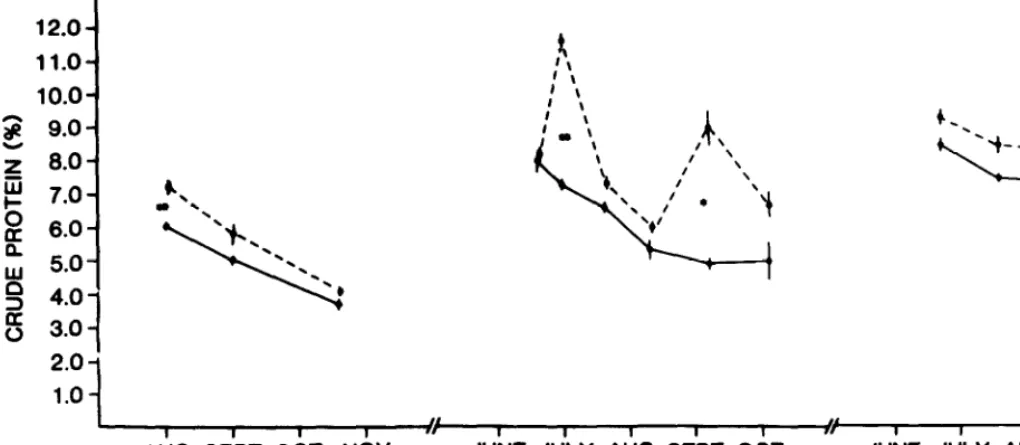
Fig. 2. Dietary crude orotein in burned (solid lines) and unburned (&shed 1ines)pastures. Vertical bars are f I standard error of the mean. Asterisks T&ate treitmentswere dzyferent at the pCO.05 @) or pCO.01 (‘@+) level.
for both CP and IVOMD during 1984 and 1985 (Fig. 2 and 3). Neither interaction with time nor treatment main effect were signif- icant for CP or IVOMD during 1986. The trend was for IVOMD to be slightly higher on burned compared to unburned pastures dur- ing the first half of the grazing period, but treatment values were similar during the second half. Crude protein, on the other hand, tended to be higher on unburned compared to burned pastures on most sampling dates.
standing crop was greater with burning, big bluestem increased and western ragweed and sagewort decreased in composition (Table 3). There was no treatment by year interaction for total standing crop and the treatment effect was significant @=O.OOS).
Discussion
The beneficial effect of burning on animal performance was most evident during the early portion of the grazing period (Fig. 1). This result is in agreement with Anderson et al. (1970) who found that late-spring burning of tallgrass prairie in Kansas increased ADG in May and June, but not in July, August, or September. Thus, the period of improved animal performance as a result of burning coincides with the time of active growth for the tallgrass species. The tallgrasses are generally active from April to mid-July There was a treatment by year interaction for total standing crop
remaining after grazing. The interaction resulted from the fact that treatments were not statistically different in 1984, but were differ- ent in 1985 and 1986 (Table 2). The most prominent impact of burning on individual species classes was an increase in the tall- grasses and decrease in weedy species relative to the unburned control. The same results were evident in the exclosures; i.e.,
70 -
60 -
AUG SEPT OCT NOV JUNE JULY AUG SEPT OCT JUNE JULY AUG SEPT
1984 1985 1986
Fig. 3. In vitro organic matter digestibility of diets in burned (solid 1ines)andunburned (dashed 1ines)pastures. Vertical bars are f 1 stadrderror of the mean. Asterisks indicate treatments were drerent at the p-CO.05 level.