THE
EVOLUTIONOF
MULTIPLE MATINGBEHAVIOR
BY
HONEY
BEE
QUEENS(APIS MELLIFERA
L.)
ROBERT E. PAGE, JR.
Department of Entomology, University of California, Dauis, C A 95616
Manuscript received September 21, 1979 Revised copy received June 30,1980
ABSTRACT
A model is presented showing that natural selection operating at the in- dividual level can adequately explain the evolution of multiple mating be- havior by honey bee queens. Group selection need not be invoked. The fitness of a given female genotype is a function of the number of sex alleles in the population, the number of matings by an individual female and the specific parameters that determine the relationship of brood viability to individual fitness. Even though the exact relationship is not known, it is almost certainly not Linear. A nonlinear relationship between worker brood viability and fit- ness and a significant genetic load associated with the sex-determination sys- tem in honey bees are the essential components of this model.
M U L T I P L E mating by reproductive female honey bees (queens) has been well documented. However, a satisfactory explanation for the evolution of this behavior has never been presented. Group selection favoring the evolu- tion of multiple mating for the maintenance of genetic variability in popu- lations has been invoked (WILSON 1963;
WOYKE
1973).In
this paper,I
will show how individual selection can account for the evolution of multiple mating when the genetic load associated with the sex determining system and colony population dynamics are considered.MACKENSEN
(1951) first advanced the hypothesis that sex in honey bees is determined by a single locus with multiple alleles. Estimations of the number of alleles in measured populations vary from six to 18 (MACKENSEN 1955;LAIDLAW,
GOMES and KERR 1956; KERR 1967;WOYKE
1976; ADAMS et al. 1977). Individuals homozygous at this locus become diploid males. These male larvae are eaten within 72 hrs of eclosion (WOYKE 1963); therefore, they are effec- tively lethal. Normal males are haploid; therefore, hemizygous at this locus. A queen that mates one time with a male having a sex allele identical to one of hers will have a 50% mortality of her diploid offspring.Mating in honey bees takes place at specific locations where drones and virgin queens from many colonies assemble (RUTTNER and RUTTNER 1966). Males in the area are attracted t o flying queens and copulate with them in flight (GARY 1963). GARY (personal communication) estimated that 25,000 drones from more than 200 colonies attended one of these sites. PEER (1957) reported matings tak- ing place between individuals hom colonies more than 16.7 km apart.
Virgin queens mate with several drones while flying at these drone-congre- gating areas, while males mate just once and die. Estimations of the number of matings by a virgin queen on a single flight vary from one to 17 (TRIASKO 1951, 1956; TABER and WENDEL 1958;
WOYKE
1960;KERR
et al. 1962). Queens fre- quently make subsequent flights within several days of the first. On these flights, they may again mate with several drones (WOYKE 1960, 1964). ADAMS et al. (1977) estimated the total number of times a queen mates on all flights to be 17.25. Queens do not mate again after these initial flights; the sperm stored in the spermatheca will last her egg-laying life.Honey bee colonies are comprised of one long-lived reproductive diploid fe-
male (queen), haploid males (drones) and diploid sterile workers (see WILSON 1971, pp. 94-98). The fitness of a queen is determined by her ability to repro- duce by the production of reproductively successful males and the production of fertile daughters with subsequent colony division (swarming). The number
of
males produced by the queen is correlated with the colony worker population size (FREE and WILLIAMS 1975), which is a function of the viability of the dip- loid brood. Colonies with small populations rear very few or no drones. A posi- tive correlation ( r = 0.54; P
<
0.05) exists between the amount of worker brood reared in a colony and the amount of drone brood produced (PAGE, unpublished).When a colony swarms, a new queen is reared in the parent nest and the old queen leaves with approximately half of the adult workers and establishes a new nest. The success of the daughter colonies after division is a function of the number and age distribution of workers at the time of colony division. The relevant parameters affecting fitness as a result of swarming are: (1) the rate at which a colony can increase its worker population and divide, (2) the size of the colony at the time of the division, and ( 3 ) the timing of colony division to best exploit the seasonal resources f o r colony growth and maintenance. The effect of brood production on the relevant fitness parameters in honey bees does not suggest a linear relationship.
THE MODEL
This model consists of 2 parts: the first examines individual fitness as a func- tion of diploid brood viability and the second looks at the probablistic effects of mating behavior on individual fitness.
MULTIPLE M A T I N G BEHAVIOR 265
tropical bees (WINSTON 1979). The size of a colony at the time of colony division can be estimated from the logistic growth equation:
where: N ( t , = colony size at time t ;
N,,
= maximum population possible = maximum viable egg laying capacity of the queen times the average life ex- pectancy of a worker; b = the rate of maximum potential increase in colony size; t = time; and c = the inflection point in units of time.Brood production data are useful for determining both the rate of increase in individual numbers ( d N / d t ) and the total colony size. NOLAN (1925), ALLEN
(1965), NELSON and
JAY
(1972), WINSTON (1979) and PAGE (1980) presented the seasonal brood-production data for Somerset, Maryland; Aberdeen, Scot- land; Winnipeg, Manitoba, Canada; Kourou, French Guinana; and Davis, Cali- fornia, respectively. Colony size increase begins at different times of the year in these different areas, but the curves themselves are similar. I n temperate regions, brood rearing is initiated following a winter lapse and undergoes a rapid expan- sion that peaks in about 100 days.In
tropical areas, this peak occurs about 50 to 90 days after the initiation of brood expansion (WINSTON 1979).Swarming is seasonal and occurs at or before the time peak worker brood pro- duction is reached. Consequently, colonies swarm during the period of rapid increase, not at the peak colony size (see Figure 1). Differences in colony size
%
cX
v) U w
Y
a
P
0
z
i I I 1 I 1 I 1 I
1
4IL
"I
2t
/ I
/
DAYS
I
I
I
I
I
I
I
98
-LL
_i
112 126the amount of brood reared through time as a result of homozygous lethal sex alleles can cause even greater differences in the number of adult workers at the time of colony division.
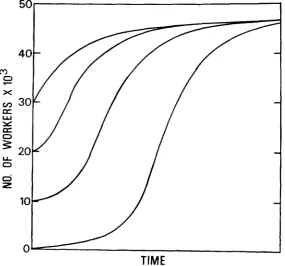
The size of the colony at the time of division is important in temperate areas with respect to the speed with which daughter colonies can increase and pro- vision the nest for overwintering, and for expansion and subsequent colony di- vision in the tropics. The size of a colony is dependent upon the viability of the brood produced by the queen. The time required for colony expansion to colony division is a function of the number of workers and their age composition
(WIN-
STON 1979). Figure 2 shows the relationship between colony size at the begin-ning of the growth cycle and the colony size attainable in a given time period. By transforming equation ( I ) , the equation relating N ( t , to the initial starting colonysize ( N o ) is:
The size of the colony at time ( t ) is not linearly proportional to the initial popu- lation ( N o ) . Larger starting colonies have disproportionately more adult work-
TIME
MULTIPLE MATING BEHAVIOR 267
ers throughout their development to the time of colony division, can produce more males and yield larger daughter colonies.
The amount of brood present in a colony is a nonlinear function of the number of adult workers present to care for it (NELSON and
JAY
1972; VILLUMSTAD 1977; GAROFALO 1977). Inviable brood occupies needed brood nest area in rapidly ex- panding colonies. The net result of brood mortality due to homozygous sex alleles is a decrease in N,, and a decrease in b. This will lead to a slower rate of colony expansion, with fewer colony divisions during a season in multivoltine popula- tions, a lower production of reproductive males, a lower seasonal food produc- tivity and decreased ability to survive unfavorable seasons.Colony food-hoarding behavior increases the fitness of a queen by increasing colony survival during unfavorable seasons and by providing the nutritional re- quirements for larger populations of workers and drones. FARRAR (1937) showed that the average quantity of honey stored by an individual worker increases with an increase in colony size. FARRAR (1931) also showed an 8- to 20-fold increase in colony foraging activity with an increase in colony size of about 3-fold. Colo- nies with greater stores of honey and pollen have a larger number of workers in the spring (FARRAR 1936). NELSON and
JAY
(1972) showed that larger initial spring colonies build up faster than smaller ones and store more honey in seasonally marginal years.Multiple mating model: Female honey bees are heterozygous at the sex- determining locus.
In
the population, there are 2 classes of sex-determining alleles with respect to an individual reproductive female: those that are identical and those that are nonidentical. If we assume that all alleles are at equal fre- quency in the population (WRIGHT 1939, 1965; ADAMS et al. 1977), then the proportion of alleles that are identical to an individual female( p )
is:p
= 2/K ( 3 )q = l - p 7 (4)
and the proportion that are nonidentical
(a)
is:where K = the number of alleles in the population.
If
we assume random mating and a very large male population, then the probability distribution f o r a queen mating with y males having alleles identical to her will approximate the binomial:where n = the total number of matings by an individual queen and y = the number of males with which she mated that have sex alleles identical to hers.
The proportion of viable diploid brood produced by a queen is dependent upon the total number of matings and the number of matings with males having matching sex alleles. For n matings, individual diploid (2N) brood viability
( V )
is:It
is interesting to note, however, that the mean viability of 2N brood( V )
f o r all reproductive females in the population is dependent only upon the number of alleles maintained:V =
(K-1)/K.
(7)If
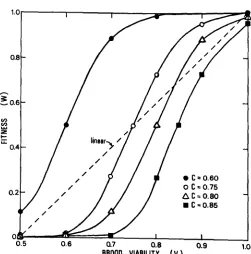
we assume no inbreeding or migration, then the number of alleles main- tained is dependent upon the effective population size and the rate of mutation KIMURA and CROW 1964; YOKOYAMA and NEI 1979). The effect of multiple mating is to decrease the variance in 2N brood viability between colonies in the population (SKASKOL'SKII 1968; ADAMS et al. 1977).The previous considerations strongly suggest that the fitness of the queen is not related in any simple way to the viability of diploid brood. Fitness increases as a functon of increasing brood viability, and almost certainly this relationship is not linear. Since this relationship is not linear, let us use a function that is geo- metrically versatile where we can examine the effects of concave, convex and sigmoid relationships of viability to fitness. The logistic function where fitness ( W ) is a function of viability
( V )
has the desired characteristics when the in- flection point is varied. This choice of the logistic function in no way implies that it was derived from the logistic growth of the colonies or that any apparent relationship exists between them. The form of the equation for this model is:a
1
+
exp-
b( V - c )W =
'
where: W = the fitness of an individual reproductive female; a = 1, the upper assymptote for fitness; b = 20, the slope of the curve; c = the inflection point in units of viability; and V = the proportion of viable 2N brood (see equation 6 and Figure 3 ) .
The fitness of an individual mating n times is considered to be zero when the 2N brood viability is 0.50. Colonies losing half of their brood do not build up sufficiently to swarm o r to rear drones and are likely to replace the queen with a new one; therefore, that queen will have a net reproductive success of zero.
The average fitness of a genotype that specifies mating
n
times ( W ) is equal to:-
-
1W = 2/=0
2
P(,=,,.w
y=0,1,...,
n (9)RESULTS A N D DISCUSSION
MULTIPLE MATING BEHAVIOR 269
FIGURE 3.-The logistic growth function provides a geometrically versatile fitness estimator when the inflection point ( c ) is varied.
inflection point (c) for this function can be varied to investigate the effect of variations in the fitness estimator for this model (see Figure 3). Table
1
shows fitness estimations( W )
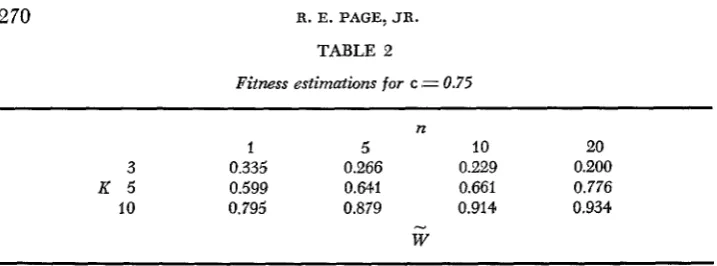
for the case c = 0.60 with one, five, 10 and 20 matings for populations with three, five and 10 sex alleles. I n all cases, selection will favor an increase in the number of matings.Table 2 shows W for the case c = 0.75. In this case: selection will favor geno- types that specify mating more times in populations with five or more alleles,
-
-
TABLE 1
Fitness estimaiions for c = 0.60 n
1 5 10 20
3 0.413 0.677 0.719 0.748
K 5 0.648 0.918 0.953 0.969
10 0.824 0.986
-
0.994 0.996 W-
n = the number of matings, K = the number of sex alleles in the population and W = t h e corresponding fitness estimation. e w s ( K ) o r columns (n) may be read. Selection on n and K
TABLE 2
Fitness estimations for c ,= 0.75
n
1 5 10 20
3 0.335 0.266 0.229 0.200
K 5 0.599 0.64.1 0.661 0.776
10 0.795 0.879 0.914 0.934
-
W
but will select for fewer matings in those populations with three or fewer sex alleles.
Table 3 shows
W
for c = 0.80. If we assume this estimator, then a population with five or fewer alleles will select for genotypes mating fewer times, while populations with ten or more sex alleles will be selected for more matings. Cal- culations with c 2 0.85 show that selection will always favor fewer matings (with a limit of one) regardless of the number of alleles in the population. For c Q 0.60 selection always favors more matings forK
>
3.If
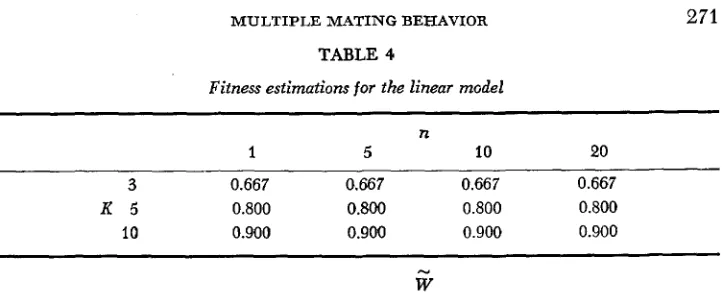
we assume that the relationship of V toW is a linear function, there is no
change in fitness with changes in the number of matings (Table4).
This shows the lack of robustness of the linear model since any departure from linearity will result in selection favoringmore or fewer matings per female.This model shows that natural selection operating at the level of the indi- vidual can adequately explain the evolution of multiple mating behavior by queen honey bees. Group selection need not be invoked. The fitness ( W ) of a given genotype is a function of the number of alleles in the population, the num- ber of matings by an individual female and the specific parameters that deter- mine the relationship of brood viability to individual fitness. Knowledge of the exact parameters determining this relationship is not necessary to show the potential for selection. All nonlinear relationships result in selection for either fewer or more matings.
This individual selection model may also be useful in explaining the wide- spread occurrence of multiple insemination in other social Hymenoptera.
If
we assume a multiple-locus model for sex determination (CROZIER 1977), then thec
-
TABLE 3
Fitness estimations for c '= 0.80
n
1 5 10 20
3 0.329 0.180 0.124 0.096
K 5 0.590 0.506 0.503 0.501
10 0.786 0.791 0.826 0.851
MULTIPLE MATING BEHAVIOR 271
TABLE 4
Fitness estimations for the linear "ode1
n
1 5 10 20
3 0.667 0.667 0.667 0.667
K 5 0.800 0.800 0.800 0.800
10 0.900 0.900 0.900 0.900
case for the honey bee is simply a variation where there is only one locus with multiple alleles segregating in the population. When two or more loci are segre- gating, an individual must be heterozygous at one or more of them to be a female. Selection will still favor multiple alleles at each locus and multiple mating; however, the associated genetic load will be reduced. In those cases where diploid males are very rare, one expects fewer matings by females. Single and multiple mating behaviors are common in females of different groups of Hymenoptera (WILSON 1971). Diploid males have been found in nine different genera of Hymenoptera, six of them social, of which only two clearly fit a single-locus sex determination model (CROZIER 1977). With variation in mating behavior and in the number of sex-determining loci segregating, it should be possible to test this hypothesis.
This model provides an evolutionary explanation for the mating behavior of queen honey bees that may be generalizable to other social Hymenoptera. A nonlinear relationship between worker brood viability and fitness, and a sig- nificant genetic load associated with the sex-determining system are the essential components of this model.
I wish to thank TIMOTHY PROUT for his guidance and encouragement during the preparation of this manuscript. I would also like to thank NORMAN E. GARY for the use of his unpublished data, and Ross H. CROZIER for providing many helpful comments.
LITERATURE CITED
ADAMS, J., E. D. ROTHMAN, W. E. KERR and Z. L. PAULINO, 1977 Estimation of the number of sex alleles and queen matings from diploid male frequencies in a population of Apis mellifera. Genetics 86: 583-596.
The production of queen cups and queen cells in relation to the general development of honey bee colonies and its connection with swarming and supercedure. J. Apic. Res. 4(3): 121-141.
Evolutionary genetics of the Hymenoptera. Ann. Rev. Entomol. 22: 263-
288.
The evaluation of bees for pollination. J. Econ. Entomol. 24: 622-627.
-
,
Influence of pollen reserves on the surviving populations of over-wintered colonies. Amer. Bee J. 76(9): 452-4454.-
, 1937 The influence of colony popula- tions on honey production. Journ. Agric. Res. 54 (12) : 945-954.ALLEN, M. D., 1965
URcizIm, R. H., 1977
FREE, J. B. and I. H. WILLIAMS, 1975 Factors determining the rearing and rejection of drones
GAROFALO, C. A., 1977 Brood viability in normal colonies of Apis melliferu. J. Apic. Res.
GARY, N. E., 1963 KERR, W. E., 1967
KCRR, W. E., R. ZUCCHI, J. T. NAKAKAIRA and J. E. BUTOLO, 1962 Reproduction in the social
KIMURA, M. and J. F. CROW, 1964 The number of alleles that can be maintained in a finite
LAIDLAW, H. H., JR., F. P. GOMES and W. E. KERR, 1956
MACKENSEN, O., 1951 1955
by the honey bee colony. Anim. Behav. 23 (3) : 650-675.
l(16): 3-13.
Observations of mating behavior i n the honey bee. J. Apic. Res. 2: 3-18.
Multiple alleles and genetic load i n bees. J. Apic. Res. 6: 61-64.
bees. J. New York Entom. Soc. 7 0 : 265-270.
population. Genetics 49: 725-738.
alleles in a panmictic population of Apis melliferu. Genetics 4 1: 179-188. 509.
-,
72-74.
Estimations of the number of lethal
Viability and sex determination in the honey bee. Genetics 36: 500- Further studies on a lethal series in the honey bee. J. Heredity 46:
MITCHENER, A. V., 1948 The swarming season for honey bees in Manitoba. J. Econ. Entomol.
NELSON, D. L. and S. C. JAY, 1972 Population growth and honey yield studies of package colonies in Manitoba. 11. Colonies initiated with four package sizes on one date. Manitoba Entomologist 6: 17-22.
The brood rearing cycle of the honey bee. U.S. Dept. of Agriculture Bull. No. 1349. --, 1928 Seasonal brood-rearing activity of the Cyprian honey bee. J. Econ. Entomol. 21: 392-403.
The dynamics of reproduction and the evolution of mating behavior in honey bees (Apis mellifera L.). Ph.D. Thesis, University of California, Davis.
Further studies on the mating range of the honey bee, Apis m l l i f e r a L. The Canadian Entomologist 89(3): 108-110.
Untersuchengen iiber die Flugaktivitat und das Paarungs- verhalten der Drohnen. Z. Bienenforsch. 8(9) : 332-354.
SAKAGAMI, S. F. and H. FUKUDA, 1968 Life tables for worker honey bees. Res. Popul. Ecol.
10: 127-139.
SKASKOL’SKII, D. V., 1968 The distribution of a series of multiple alleles in theoretical popu.
lations in connection with the biology of reproduction i n the honey bee. Soviet Genetics 4 (1 0) : 131 0-1 320.
TABER, S. and J. WENDEL, 1958 Concerning the number of times queen bees mate. J. Econ. Entomol. 51 : 786-789.
TRIASKO, V. V., 1951 Sign indicating the mating of queens. (In Russian.) Pchelovodstvo. 11: 25-31. (Abstracted i n Apicultural Abstracts 5/53.) --, 1956 Polyandy in honey bees. XVI Int. Beekeep. Congress Prelim. Sci. Meet. (Abstracted in Apicultural Abstracts 233/56.)
Bistyrkens innflytelse pb bifolkenes yngelproducksjon of utvikling. Norges landbrukshcrgskole. Institutt f o r biavl Meldinger nr, 60: 56 (22).
Intra-colony demography and reproductive rate of the Africanized honey bee in South America. Behav. Ecol. Sociobiol. 4: 279-292.
Social modifications related to rareness in ant species. Evolution. 17: 249-253. -- , 1971 The Insect Societies. Cambridge, Mass.: Harvard Univ. Press.
41 (4) : 646. NOLAN, W. J., 1925
PAGE, R. E., 1980
PEER, D. F., 1957
RUTTNER, F. and H. RUTTNER, 1966
VILLUMSTAD, E., 1977
WINSTON, M. L., 1979
MULTIPLE MATING BEHAVIOR 273
Natural and artificial insemination of honey bees. (In Polish.) Pszczd. Zes. Nauk. 4: 183-273. Summarized in Bee World 43: 21-25 (1962).
-,
1963 What happens to diploid drone larvae i n a honey bee colony. J. Apic. Res. 2: 73-75.-
, 1964 1973Reproduction i n Apis cerana 1. Mating behavior. J. Apic. Res. l l ( 3 ) : 141-146.
-,
1976 Population genetics studies on sex alleles on the honey bee using the example of the Kangaroo Island bee sanctuary. J. Apic. Res. 15: 105-123.The distribution of self-sterility alleles in populations. Genetics. 24: 538-
553.
-,
1965 The distribution of self-incompatability alleles in populations. Evolu- tion 18: 609-619.YOKOYAMA, S . and M. NEI, 1979 Population dynamics of sex-determining alleles in honey bees and self-incompatability alleles in plants. Genetics. 91 : 609-626.
Corresponding editor: W. W. ANDERSON WOYKE, J., 1960
Causes of repeated mating flights by queen honey bees. J. Apic. Res. 3: 17-23. -