TIME DEPENDENT DEFORMATIONS IN NORMAL AND HEAVY DENSITY
CONCRETE
D.Harinadha Reddy1,Ananth Ramaswamy2
1Research Scholar, Department of Civil Engineering, Indian Institute of Science, Bangalore, [email protected]
2Professor, Department of Civil Engineering, Indian Institute of Science, Bangalore. [email protected]
ABSTRACT
Time dependent deformations in concrete, both creep and shrinkage, play a critical role in prestressed concrete structures, such as bridge girders, nuclear containment vessels, etc. These strains result in lossess, through release of prestress, and thereby influence the safety of these structures. The present study comprises of an experimental and analytical program to assess the levels of creep and shrinkage in normal and heavy density concrete. The experimental program includes tests on creep using standard cylinder specimen, while shrinkage studies have been conducted using prism specimen, both under controlled environmental conditions. The experimental results suggest that creep and shrinkage strains are higher in heavy density concrete than in normal concrete. This may be attributed to the relatively smaller pore structure of heavy density concrete that results in larger availability of free water and a relatively slower hydration process in comparison to normal concrete. While there is some scatter in the results, creep strains decrease with age of loading and both creep and shrinkage strains are smaller when the relative humidity is higher. Statistical model reported in the literature for normal concrete is able to predict the test results for both normal and heavy density concrete quite well. Long term predictions of creep and shrinkage using this model, accounting for uncertainties, is also projected and shown to predict some long term measured results not used in the model calibration. The long term predictions are sensitive to the initial data used in model calibration.
INTRODUCTION
Predicting delayed strains in concrete proves to be critical to a large number of pre-stressed concrete structures, such as containment vessels of nuclear power plants, pre-stressed concrete bridge girder, etc. These delayed strains include:
• Autogeneous shrinkage, as deformation related to the water consumption during the hydration reaction in early-age concrete.
• Drying shrinkage, as deformation related to the moisture diffusion from the innercore to the outside of the concrete member during drying process.
• Basic creep strains, as time-dependent deformation of a loaded specimen, without drying.
• Drying creep strains, as additional deformation, which occurs in drying in a loaded specimen (Pickett effect)
Probably the most uncertain and most difficult aspect of the design of reinforced and prestressed concrete structures is the prediction of time-dependent behavior. However, realistic prediction of concrete creep and shrinkage is of crucial importance for durability and long-time serviceability of concrete structures. For some structures, for the long-term performance from the safety view point, prediction of time dependent deformations are critical. Creep and shrinkage cause increases in deflection and curvature, cracking of concrete, loss of prestress, redistribution of stresses and leakages.
concrete exhibiting high shrinkage also generally shows a high creep. This doesn’t mean that the two phenomena are due to the same cause, but they may both be linked to the same aspect of the structure of the hydrated cement paste. Concrete cured and loaded in a constant relative humidity condition exhibits creep and that creep produces no loss of water from the concrete to the surrounding medium, nor is there any gain in weight during creep recovery. Other observations emerging from the earlier studies are [5].
• Drying shrinkage and creep are also influenced by the modulus of elasticity of the aggregate and the aggregate content
• Drying shrinkage and creep are also influenced by the cement content. For constant cement content an incremental increase in W/C ratio increases both drying shrinkage and creep. For a constant W/C ratio an incremental increase in cement content reduces the creep but increase the drying shrinkage. This is the only instance in which an opposite effect exists.
• Humidity, geometry of the concrete element and the temperature has an important impact on the creep and shrinkage. Given the geometry of the concrete element having a thickness expressed as h = 2A/ P ; where A is the area of cross section, P is the perimeter, an incremental increase in the thickness h reduces the drying shrinkage and creep. Given the same curing history for two specimens, the one that is kept in a higher temperature will have more creep and drying shrinkage than the other one.
• There is a direct proportionality between the magnitude of sustained stress (loading at given age) and creep of concrete. Because of the effect of strength on creep at a given stress level, lower creep values were obtained for the longer period of curing before the application of the load. Shrinkage is not affected by this factor.
The on-going research project aims to obtain results for creep and shrinkage measurements for both normal (424KN/m3) and heavy (37KN/m3) density concrete of different grades under different conditions of humidity, operating temperatures, age at loading that are envisaged to represent the conditions experienced by concrete in Indian nuclear power plants and develop a predictive model thereafter.
EXPERIMENTAL PROGRAM Materials & Mix Proportions
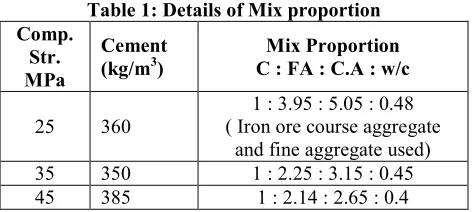
The experiments are carried out in a sustained environment with constant temperature (25 deg. Celsius) and relative humidity’s of 50 percent, 60 percent and 70 percent. In this study, cylinder specimen was used to study to measure creep, while prism specimen were used to measure shrinkage. The mix for 35 MPa and 45 Mpa normal concrete and 25 MPa heavy density concrete based on weight proportions is shown in Table 1. The mix proportions used represent typical mix designs employed in Indian Nuclear power plant containment structures.
Table 1: Details of Mix proportion Comp.
Str. MPa
Cement (kg/m3)
Mix Proportion C : FA : C.A : w/c
25 360 ( Iron ore course aggregate 1 : 3.95 : 5.05 : 0.48 and fine aggregate used) 35 350 1 : 2.25 : 3.15 : 0.45 45 385 1 : 2.14 : 2.65 : 0.4
Specimen Preparation for creep and shrinkage
each cylinder at a standard gage length(100mm), so that an average strain across each specimen could be reckoned from periodic measurements. The loading was applied through a jack and the load level measured by a load cell. Once the desired load level was reached, this was locked in using the locking nuts on each corner post of the frame. Different levels of loading is applied on these specimens. After application of desired load the instantaneous strain of the specimen is measured immediately by using Demec guage (Strain guage used for measuring the strains between two demec points). The strain measurements are taken at each day after jacking to ensure constant laod is maintained constant till the completion of the test.
Shrinkage test has been conducted for the same three mixes of concrete. The size of concrete prism specimens considered for this test is 100X100X500 mm. These specimens are cured under 50%, 60% and 70% of relative humidity in three different walk-in chambers under constant temperature of 250C. The specimens are demoulded after the 24hrs of casting. The top and bottom surfaces were sealed to prevent drying. The four lateral surfaces were allowed to dry in the controlled environment. The shrinkage strain measurements commenced immediately after demolding of the specimen by using Demmec strain measuring guage with Demmec pins pasted on each of the four lateral surfaces at standard gage length, for obtaining an average strain. The water loss is also measured each time simultaneously by weighing the specimens and computing the change in weight.
1.1 Results and Discussions
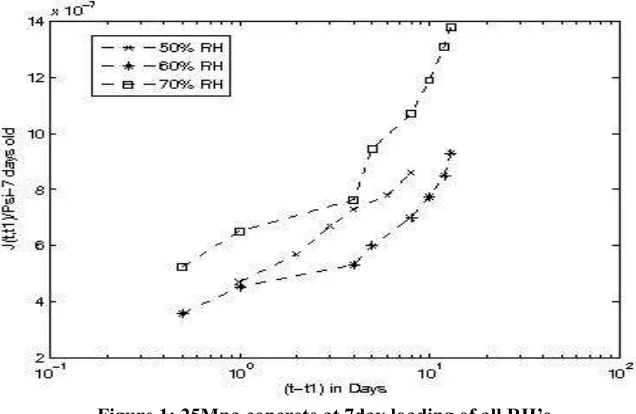
Creep tests have been conducted for two normal concretes and one heavy density concrete. Figure 1 show variation in creep strains for specimen at the same age of loading (7 days) across different relative humidities. It is observed that creep strains are smaller for specimen at the same age of loading but exposed to higher relative humidity.
Figure 1: 25Mpa concrete at 7day loading of all RH’s
Figure 2: 45Mpa concrete at 7day loading of all RH’s
Figure 4: Shrinkage strains at 70%RH for all three concretes
ANALYTICAL WORK Modelling details
For normal density concrete, large body of test data for creep and shrinkage exist and as discussed previously, a number of models that are based on regression of test data have been proposed. However uncertainty in the external influencing parameters, such as the environmental conditions and the mix proportions in the concrete used for the specimen, and the uncertainty in the internal creep and shrinkage mechanism lead to considerable variations in the predictions from the experimental measurements. In the present study, the model proposed by Bazant and Baweja [9], that includes to an extent the treatment of uncertainty in parameters in the prediction of creep and shrinkage, has been implemented. A few measurements of creep and shrinkage taken in the initial stages of the test program is used to improve the model regression parameters, so that predictions of creep and shrinkage in the long term are accurate. The essential features of the model are presented in this section, while other details may be obtained from the cited source.
For a constant applied stress at age t’, the strain є(t) as a function of time t is:
ε (t)=J (t, t’) σ + εsh (t) +α ∆T (t)
Here, J(t,t’) is the compliance function, i.e., the strain (creep and elastic) at time t caused by a unit axial load applied at age t’, ǫsh is the shrinkage strain (negative if volume decreases), ∆T(t) is the change in temperature from the
reference temperature at time t and α is the coefficient of thermal expansion. The compliance function may be further decomposed and expressed as:
J (t, t’) = q1+Co(t,t’)+Cd (t, t’, to)
In the above equation, q1 is the instantaneous strain due to unit stress, Co(t,t’) is the compliance function for basic creep (creep at constant moisture and no moisture movement through the material) and Cd(t,t’,to) is the additional compliance due to simultaneous drying). The compliance function for creep in the absence of moisture change Co(t,t’) and the compliance for creep accompanied by drying Cd(t,t’,to) can be further decomposed as:
Co(t,t’) = q2Q (t,t’) + q3ln[1+(t-t’)n] + q4ln(t/t’)
Cd (t, t′, to) = q5[exp(−8H(t)) − exp(−H(t′o)]^1/2 where t′o = max(t′, to)
H(t) = 1 − (1 − h)S(t)
And S(t) is expressed as:
S(t) = tanh(√((t − to)/τsh))
The quantities q2, q3, q4 and q5 are parameters that depend on material properties of the concrete specimen. The valueτsh is the half time for shrinkage that depends on the volume to surface ratio of the specimen and is given as kt(ksD)^2. The coefficients Ks and kt are parameters that depend on the material properties and geometry of the specimen. In order to obtain long term estimates of creep, Bazant and Baweja [11], obtain an estimate of the creep F(t,t’) directly from the model as:
F(t, t′) = Co(t, t′) + cd(t, t′, to)
Thereafter, considering two parameters p1 and p2 for updating the model predictions, a linear function has been proposed as:
J(t, t′) = p1 + p2F(t, t′)
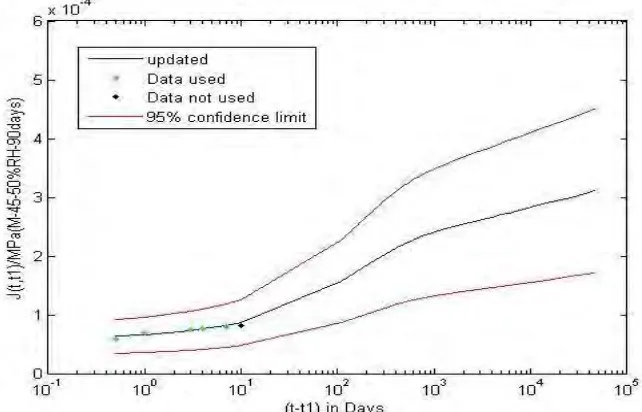
The first few measurements from the experiment are employed to obtain the values of p1 and p2 through a linear regression. Thereafter, the model is used to predict the measurements for longer time durations. However, uncertainties in model parameters cannot be treated properly with regression models. Thus, a Bayesian updating procedure with uncertainties in two parameters, as proposed by Bazant et[10] al has been implemented.
1.2 Results and Discussions
The RILEM databank of test data [5] for creep and shrinkage in normal concrete has been compared with the B3 model predictions (as shown in the original study by Bazant et al [9] to validate the model implementation in the present study.
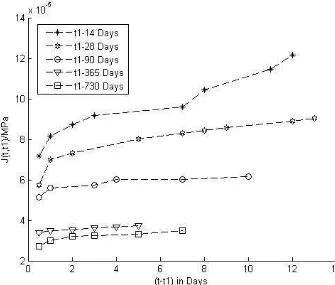
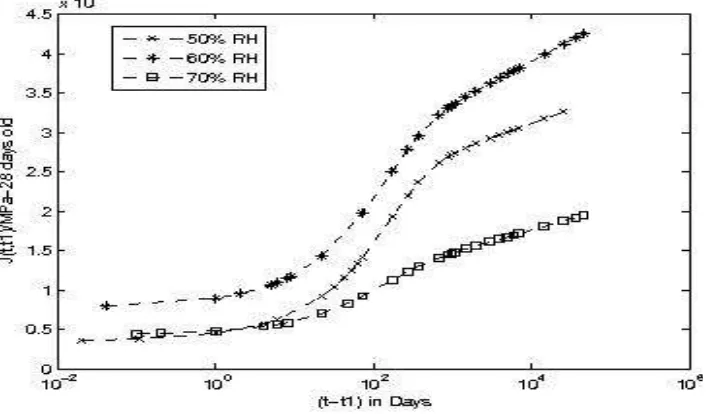
At different ages for the same humidity and concrete mix creep, compliance plots is shown in figures 6. The scatter in model predictions may be attributed to inaccuracies in the initial test data used in model calibration to which the model is seen to be sensitive. Further, it is seen that creep strains are lower for specimen conditioned at higher humidity levels.
Figure 6: Long time creep prediction using short time data by for 35Mpa concrete at 28day loading for different relative humidities
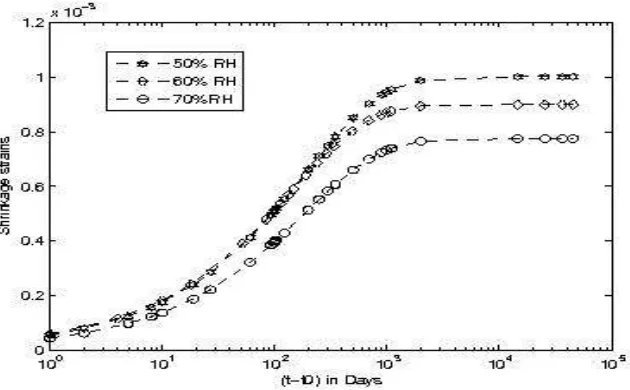
Figure 9 shows the comparison of the shrinkage test data for the 25 MPa heavy density concrete at 50 % 60% and 70% relative humidity. It may be noted, that water loss data from the experiment is used to correct the long term prediction. Figures 7 show similar predictions for shrinkage strains for both the normal density concrete. It is seen that the predictions for shrinkage are quite close to that observed in the tests.Further, a few points from present test has been used in model calibration while the remaining points are predicted. Results for long term shrinkage strain in concrete indicate that while some scatter is present, by and large shrinkage strains are lower for concrete conditioned at higher relative humidity for all mixes. The shrinkage strain levels are higher for heavy density concrete, in comparison to normal density concrete.
Figure 8: Long time shrinkage prediction using short time data by for 35Mpa concrete at 50% RH, 60% RH, 70% RH
CONCL USIONS
From the present study, following conclusions can be drawn:
(i) The creep compliance and shrinkage strains obtained for normal density concrete is of the order of 0.0004 and 0.00015, respectively. In contrast the creep compliance and shrinkage strains in heavy density concrete is 0.0015 and 0.0015, respectively. The higher delayed strains in heavy density concrete may be attributed to the denser pore structure that results in a larger amount of free water available that results in higher volume change during drying process.
(ii) The analytical model is able to accurately predict the test results for creep and shrinkage for all concretes and also predict long term delayed strains. It is seen that the long term predictions made by the analytical model is sensitive to the initial measured data used in the model calibration.
REFERENCES
1. RILEM1998 (1998). “Crack band theory for fracture of concrete.” RILEM Materialsstructural, 16, 155– 177.
2. Picket. (1942). “The effect of change in moisture content on the creep of concrete under a sustained load.” ACI journal, 38, 333–355.
3. Arutiunian, N. (1998). “on the theory of creep for nonuniformly aging media.” akademii Nauk SSSR, 229 N0.3.
4. Aleksandrovskii (1973). “Analysis of reinforced concrete structures for variations of temperature and humidity with account of creep.” 2nd ed.
5. Hansen and Mattock (July 1953). “a ten year study of creep properties of concrete.” Concrete Laboratory report U.S Department of interior, Bereau of reclemation Denver colorado.
6. Whittman, F.H., B. Z. A. F. K. J. . (1987). “Statistics of shrinkage test data.”Cem. Concr. Res.,, 92, 129– 253.
7. Bazant and Osman (1976). “Double power law for basic creep of concrete.” Materials and Structures, 9, 3– 11.