84
Canadian Family Physician•Le Médecin de famille canadien Vol 54: january • janVier 2008FP Watch
Surveillance médicale
T
he Preventive Care Checklist Form© is anevidenced-based tool for Canadian family physicians to use at complete health checkups of adults. The complete health checkup of adults is a time for family physicians to focus on preventive health care with their patients. In one study, 94% of primary care physicians felt that annual physical examinations provided an opportunity to counsel patients on preventive health services and improve the doctor-patient relationship.1 Two-thirds of
patients responded that the annual physical examina-tion was necessary in addiexamina-tion to regular primary care.2
The Preventive Care Checklist Form incorporates recommendations from the Canadian Task Force on Preventive Health Care (CTFPHC) and recommendations from other sources where the Task Force guidelines are not up-to-date or are lacking. Grade-A (good evidence to include) or grade-B (fair evidence to include) rec-ommendations are delineated by bold and italic text, respectively. Recommendations from other guidelines are in plain text. Practice-relevant components, such as functional inquiry and physical examination, are also included in the form. The form was validated in a prospective cluster randomized controlled trial. Results indicated that using the forms improved the number of evidence-based preventive maneuvers delivered per patient by a 22.8% absolute increase and 46.6% relative increase.3 This means that physicians who used the
forms provided almost 50% more recommended pre-ventive services to patients than those who did not use them. Seventy-seven percent of physicians who used the form in the trial indicated they would continue to use it in routine practice.4
The Preventive Care Checklist Form was endorsed by the College of Family Physicians of Canada (CFPC) in June 2004. It is available from the CFPC website,5 with
separate forms for men and women, in English and in French. There is also an accompanying explanation sheet. The forms are used in family physicians’ offices across the country in hard copy or as part of an elec-tronic medical record.
In order to keep the Preventive Care Checklist Form up-to-date, relevant, and evidence-based, it is necessary that it be periodically updated. In January 2007, the forms were updated with the most recent evidence and re-endorsed through a peer-review pro-cess by the CFPC.
Method
Articles were sought through an Ovid MEDLINE search using the key words mass screening, preven-tive medicine, adult complete health assessment, and screening guidelines. These results were then limited to Canadian articles published after 2003. As this yielded too few results, specific articles were sought using search terms pertinent to the adult complete health checkup, including colorectal cancer, breast cancer, hypertension, cardiovascular disease, and cer-vical cancer screening. We also used additional sec-ondary sources, such as articles from the CTFPHC, the Canadian Cancer Society, the National Advisory Committee on Immunization, and the Canadian Medical Association Infobase.
Result
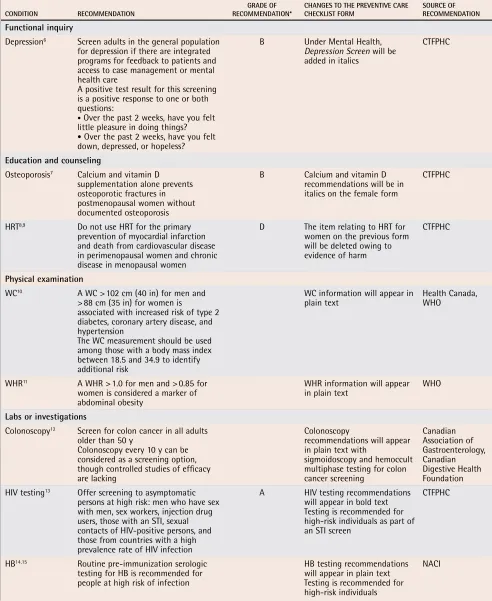
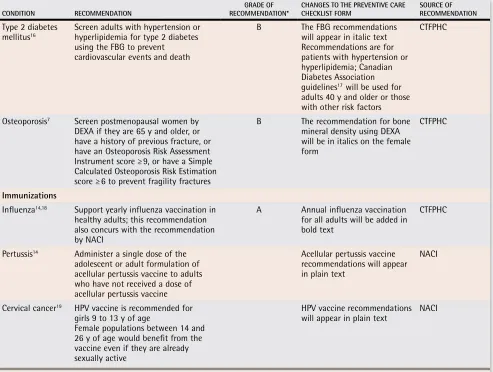
After reviewing all the aforementioned publications, the Preventive Care Checklist Form was updated to reflect current levels of evidence (Table 16-19). The changes
based on the CTFPHC recommendations include screen-ing for depression, universal influenza vaccination, screening for diabetes in individuals with hyperten-sion and hyperlipidemia, calcium and vitamin D supple-mentation for women, and bone density assessment for women 65 years of age and older and those at risk for osteoporosis. The HIV recommendation for high-risk individuals, omitted from the last iteration of the form, has been included. The hormone replacement therapy recommendation has been removed based on current recommendations.
Recommendations where the CTFPHC recommenda-tions were lacking or not up-to-date are also presented in Table 16-19 and explained below.
Acellular pertussis vaccine
Pertussis is the least well-controlled vaccine-preventable illness.20,21 The incidence of pertussis has increased
since 1990, with the highest rate of increase seen in adults and adolescents. The increase is attributed to
waning immunity.20 The National Advisory Committee
GO
CFPlus
The Preventive Care Checklist Forms are available at www.cfp.ca. Go to the full text article on-line, then click on CFPlus in the menu at the top right of the page.Complete health checkup for adults
Update on the Preventive Care Checklist Form©
Surveillance médicale
on Immunization recommends the administration of a single dose of tetanus, diphtheria, and acellular per-tussis vaccine to all adults in place of a tetanus-diph-theria booster.14,22Human papillomavirus vaccine
There is a well-established causal relationship between cervical cancer and infection by multiple types of human papillomavirus.23,24 The National Advisory Committee on
Table 1.
Updated 2007 recommendations included in the Preventive Care Checklist Form©
ConDItIon ReCoMMenDAtIon ReCoMMenDAtIon*GRADe oF CHAnGeS to tHe PReVentIVe CARe CHeCKlISt FoRM SoURCe oF ReCoMMenDAtIon
Functional inquiry
Depression6 Screen adults in the general population
for depression if there are integrated programs for feedback to patients and access to case management or mental health care
A positive test result for this screening is a positive response to one or both questions:
• Over the past 2 weeks, have you felt
little pleasure in doing things?
• Over the past 2 weeks, have you felt down, depressed, or hopeless?
B Under Mental Health,
Depression Screen will be added in italics
CTFPHC
education and counseling
Osteoporosis7 Calcium and vitamin D
supplementation alone prevents osteoporotic fractures in postmenopausal women without documented osteoporosis
B Calcium and vitamin D recommendations will be in italics on the female form
CTFPHC
HRT8,9 Do not use HRT for the primary
prevention of myocardial infarction and death from cardiovascular disease in perimenopausal women and chronic disease in menopausal women
D The item relating to HRT for women on the previous form will be deleted owing to evidence of harm
CTFPHC
Physical examination
WC10 A WC > 102 cm (40 in) for men and
> 88 cm (35 in) for women is
associated with increased risk of type 2 diabetes, coronary artery disease, and hypertension
The WC measurement should be used among those with a body mass index between 18.5 and 34.9 to identify additional risk
WC information will appear in
plain text Health Canada, WHO
WHR11 A WHR > 1.0 for men and > 0.85 for
women is considered a marker of abdominal obesity
WHR information will appear in plain text WHO
labs or investigations
Colonoscopy12 Screen for colon cancer in all adults
older than 50 y
Colonoscopy every 10 y can be considered as a screening option, though controlled studies of efficacy are lacking
Colonoscopy
recommendations will appear in plain text with
sigmoidoscopy and hemoccult multiphase testing for colon cancer screening
Canadian Association of Gastroenterology, Canadian Digestive Health Foundation HIV testing13 Offer screening to asymptomatic
persons at high risk: men who have sex with men, sex workers, injection drug users, those with an STI, sexual contacts of HIV-positive persons, and those from countries with a high prevalence rate of HIV infection
A HIV testing recommendations will appear in bold text Testing is recommended for high-risk individuals as part of an STI screen
CTFPHC
HB14,15 Routine pre-immunization serologic
testing for HB is recommended for people at high risk of infection
HB testing recommendations will appear in plain text Testing is recommended for high-risk individuals
NACI
86
Canadian Family Physician•Le Médecin de famille canadien Vol 54: january • janVier 2008FP Watch Surveillance médicale
Immunization has recommended the human papilloma-virus vaccine for girls aged 9 to 13 years.
The recommendation also states that female popula-tions between 14 and 26 years of age can benefit from the vaccine, even if they are or have been sexually active.19
Risk factor stratification for obesity
The body mass index is often used to indicate total fat content. The waist-to-hip ratio and the waist circum-ference, on the other hand, are considered measures of central or abdominal obesity, which can be a better indi-cator of obesity-related diseases.11 A high waist-to-hip
ratio is defined as greater than 1.0 in men and greater than 0.85 in women,11 and has been shown to be strongly
associated with the risk of myocardial infarction.25 Waist
circumference, defined as the circumference measured at the midpoint between the lower border of the rib cage and the iliac crest, is a more practical method to assess
abdominal obesity.11 Measurements greater than 102 cm
(40 in) for men and 88 cm (35 in) for women are con-sidered high-risk indicators for diabetes, coronary artery disease, and dyslipidemia.26 Health Canada has
recom-mended waist circumference as further stratification of risk in both men and women with a body mass index between 18.5 and 34.9.10,26
Colonoscopy for colorectal cancer screening
Colonoscopy has been advocated by some as an alter-nate screening modality for colorectal cancer27 and
some primary care practitioners appear to prefer it.28,29
Colonoscopy has been shown to detect advanced neo-plasia, which can be been missed with sigmoidos-copy alone in asymptomatic men and women.30,31 In
the Veterans Affairs Cooperative Study, asymptomatic adults from 50 to 75 years of age from 13 centres were screened.32 Participants were screened for advanced
neoplasia (defined as an adenoma 10 mm or greater,
ConDItIon ReCoMMenDAtIon ReCoMMenDAtIon*GRADe oF CHAnGeS to tHe PReVentIVe CARe CHeCKlISt FoRM SoURCe oF ReCoMMenDAtIon
Type 2 diabetes
mellitus16 Screen adults with hypertension or hyperlipidemia for type 2 diabetes
using the FBG to prevent cardiovascular events and death
B The FBG recommendations will appear in italic text Recommendations are for patients with hypertension or hyperlipidemia; Canadian Diabetes Association guidelines17 will be used for
adults 40 y and older or those with other risk factors
CTFPHC
Osteoporosis7 Screen postmenopausal women by
DEXA if they are 65 y and older, or have a history of previous fracture, or have an Osteoporosis Risk Assessment Instrument score ≥ 9, or have a Simple Calculated Osteoporosis Risk Estimation score ≥ 6 to prevent fragility fractures
B The recommendation for bone mineral density using DEXA will be in italics on the female form
CTFPHC
Immunizations
Influenza14,18 Support yearly influenza vaccination in
healthy adults; this recommendation also concurs with the recommendation by NACI
A Annual influenza vaccination for all adults will be added in bold text
CTFPHC
Pertussis14 Administer a single dose of the
adolescent or adult formulation of acellular pertussis vaccine to adults who have not received a dose of acellular pertussis vaccine
Acellular pertussis vaccine recommendations will appear in plain text
NACI
Cervical cancer19 HPV vaccine is recommended for
girls 9 to 13 y of age
Female populations between 14 and 26 y of age would benefit from the vaccine even if they are already sexually active
HPV vaccine recommendations will appear in plain text NACI
CTFPHC—Canadian Task Force on Preventive Health Care, DEXA—dual-energy x-ray absorptiometry, FBG—fasting blood glucose, HB—hepatitis B, HPV— human papillomavirus, HRT—hormone replacement therapy, NACI—National Advisory Committee on Immunization, STI—sexually transmitted infection, WC—waist circumference, WHO—World Health Organization, WHR—waist-to-hip ratio.
with high-grade dysplasia, or inva-sive cancer), with rehydrated stool specimens collected on 3 consec-utive days followed by a colonos-copy. Sigmoidoscopy was defined as the examination of the rectum and sigmoid during colonoscopy. A sub-group analysis of the 2885 partici-pants who returned the specimens for fecal occult blood testing showed that a colonoscopy can increase the detection rate of colorectal cancer by 24% when compared with the combination of one-time fecal occult blood testing and sigmoidoscopy.32
Both the CTFPHC and the United States Preventive Services Task Force state there is insufficient evidence to recommend for or against using colonoscopy as a screening test for colorectal cancer.33,34 The Canadian
Association of Gastroenterology rec-ommends having a colonoscopy every 10 years as a viable screen-ing option for individuals 50 years of age and older who are at average risk for colorectal cancer. In individ-uals with a family history of adeno-matous polyps or colorectal cancer (in a first-degree relative over the age of 60 or 2 or more second-degree relatives), colonoscopy is an option beginning at age 40. If those rela-tives are younger than 60, a colono-scopic screening is recommended every 5 years beginning either at age 40 or 10 years before the age of the youngest case.12
Hepatitis B screening
Hepatitis B virus infection has declined in incidence because of the increased use of the hepatitis B vac-cine. It has virtually disappeared in cohorts offered universal vaccina-tion; however, a substantial propor-tion of the populapropor-tion is still at high risk for acquiring the infection.14 This
88
Canadian Family Physician•Le Médecin de famille canadien Vol 54: january • janVier 2008transmitted infections, and men having sex with men. High-risk groups should be screened for hepatitis B infection15 as part of a sexually transmitted disease test,
which includes testing for chlamydia, gonorrhea, HIV, and syphilis.
Vitamin D to decrease cancer
When the 2007 updates were being finalized, the Canadian Cancer Society announced its recommenda-tion for increased vitamin D supplementarecommenda-tion for the prevention of cancer. This recommendation has not been included in the Preventive Care Checklist Form because the clinically important level of vitamin D, as it relates to cancer while preventing toxicity, requires fur-ther investigation.35
Conclusion
Before the Preventive Care Checklist Form there was no standardized evidence-based form that family physi-cians in Canada could use for a complete health checkup for adults. In order to remain relevant, the form must be regularly updated to incorporate new evidence for or against certain preventive health maneuvers. The Preventive Care Checklist Form was first endorsed by the CFPC in 2004 and was recently updated in 2007 using relevant literature. The 2007 form provides fam-ily physicians with an updated, user-friendly tool to implement best practices in preventive health care. It is meant to be used during complete health checkups for adults who are at average risk. Although the form is comprehensive, physicians should use their discretion and clinical knowledge to determine what maneuvers are required for individual patients.
Dr Iglar is an Assistant Professor in the Department of Family and Community Medicine at the University of Toronto and a staff physician in the Department of Family and Community Medicine at St Michael’s Hospital in Toronto, Ont. Dr Katyal currently practises adolescent and general family medicine in Ajax, Ont. Dr Matthew
is a family physician in Mississauga and Brampton, Ont.
Dr Dubey is an Associate Medical Officer of Health for Toronto Public Health in the Division of Communicable Diseases and an emergency medicine physician at Lakeridge Health in Bowmanville, Ont.
Competing interests
None declared
references
1. Prochazka AV, Lundah K, Pearson W, Oboler SK, Anderson RJ. Support of evidence-based guidelines for the annual physical examination: a survey of primary care pro-viders. Arch Intern Med 2006;166(13):1347-52.
2. Oboler SK, Prochazka AV, Gonzales R, Xu S, Anderson RJ. Public expecta-tions and attitudes for annual physical examinaexpecta-tions and testing. Ann Intern Med 2002;136(9):652-9.
3. Dubey V, Mathew R, Iglar K, Moineddin R, Glazier R. Improving preventive service delivery at adult complete health check-ups: the Preventive health Evidence-based Recommendation Form (PERFORM) cluster randomized controlled trial. BMC Fam Pract 2006;7:44.
4. Dubey V, Glazier R. Preventive Care Checklist Form. Evidence-based tool to improve preventive health care during complete health assessment of adults. Can Fam Physician 2006;52:48-55.
5. Dubey V, Mathew RGR, Iglar K. The evidence-based Preventive Care Checklist forms. Mississauga, ON: College of Family Physicians of Canada; 2007. Available from:
http://www.cfpc.ca/English/cfpc/communications/health%20policy/Preventive %20Care%20Checklist%20Forms/Intro/default.asp?s=1. Accessed 2007 Nov 8. 6. MacMillan HS, Patterson CJ, Wathen CN, Feightner JW, Bessette, P, Elford RW, et
al. Screening for depression in primary care: recommendation statement from the Canadian Task Force on Preventive Health Care. CMAJ 2005;172(1):33-5. 7. Cheung AM, Feig DS, Kapral M, Diaz-Granados N, Dodin S. Prevention of
osteoporo-sis and osteoporotic fractures in postmenopausal women: recommendation statement from the Canadian Task Force on Preventive Health Care. CMAJ 2004;160(11):1665-7. 8. Wathen CN, Feig DS, Feightner JS, Abramson BL, Cheung AM. Hormone replacement
therapy for the primary prevention of chronic diseases: recommendation statement from the Canadian Task Force on Preventive Health Care. CMAJ 2004;170(10):1535-7. 9. Abramson BL, Canadian Task Force on Preventive Health Care. Postmenopausal hor-mone replacement therapy for the primary prevention of cardiovascular and cerebrovas-cular disease. Systematic review and recommendations. Report No. 03-2. London, ON: Canadian Task Force on Preventive Health Care; 2003.
10. Office of Nutrition Promotion and Policy. Canadian guidelines for body weight clas-sification in adults. Ottawa, ON: Health Canada; 2003. Available from http://www. healthcanada.ca/nutrition. Accessed 2007 Nov 8.
11. WHO Technical Series. Obesity: preventing and managing the global epidemic. Report No. 894. Geneva, Switz: World Health Organization; 2004.
12. Leddin D, Hunt R, Champion M, Cockeram A, Flook N, Gould M, et al. Canadian Association of Gastroenterology and the Canadian Digestive Health Foundation: guidelines on colon cancer screening. Can J Gastroenterol 2004;18(2):93-9. 13. Wang E. Screening for HIV antibody. London, ON: Canadian Task Force on Preventive
Health Care; 1991. Available from: http://www.ctfphc.org/Full_Text/Ch58full.htm.
Accessed 2007 Nov 8.
14. National Advisory Committee on Immunization. Canadian immunization guide. 7th ed. Ottawa, ON: Minister of Public Works and Government Services Canada; 2006. 15. Expert Working Group on Canadian Guidelines for STIs. Canadian guidelines on
sexually transmitted infections: 2006 Edition. Ottawa, ON: Public Health Agency of Canada; 2006. Available from: http://www.phac-aspc.gc.ca/std-mts/sti_2006/sti_ intro2006_e.html. Accessed 2007 Nov 29.
16. Feig DS, Palda VA, Lipscombe L, Canadian Task Force on Preventive Health Care. Screening for type 2 diabetes mellitus to prevent vascular complications: updated recommendations from the Canadian Task Force on Preventive Health Care. CMAJ 2005;172(2):177-80.
17. Canadian Diabetes Association Clinical Practice Guidelines Expert Committee. Canadian Diabetes Association 2003 clinical practice guidelines for the prevention and management of diabetes in Canada. Can J Diabetes 2003:27(Suppl 2):S1-152. 18. Langley JM, Faughnan ME. Prevention of influenza in the general population. CMAJ
2004;171(10):1213-22.
19. National Advisory Committee on Immunization. Statement on human papillomavirus vaccine. An Advisory Committee statement. Can Comm Dis Rep 2007;33(ACS-2):1-31. 20. Galanis E, King AS, Varughese P, Halperin SA, IMPACT investigators. Changing
epi-demiology and emerging risk groups for pertussis. CMAJ 2006;174(4):451-2. 21. Brooks DA, Clover R. Pertussis infection in the United States: role for vaccination of
adolescents and adults. J Am Board Fam Med 2006;19(6):603-11.
22. National Advisory Committee on Immunization. Interval between administration of vaccines against diphtheria, tetanus, and pertussis. An Advisory Committee statement. Can Comm Dis Rep 2005;31(ACS-9):17.
23. Wallin KL, Wiklund F, Angstrom T, Bergman F, Stendahl U, Wadell G, et al. Type-specific persistence of human papillomavirus DNA before the development of invasive cervical cancer. N Engl J Med 1999;341(22):1633-8.
24. Bosch FX, Manos MM, Munoz N, Sherman M, Jansen AM, Peto J, et al. Prevalence of human papillomavirus in cervical cancer: a worldwide perspective. International biological study on cervical cancer (IBSCC) Study Group. J Natl Cancer Inst 1995;87(11):796-802.
25. Yusuf S, Hawken S, Ounpuu S, Bautista L, Franzosi MG, Commerford P, et al. Obesity and risk of myocardial infarction in 27 000 participants from 52 countries: a case-controlled study. Lancet 2005;366(9497):1640-9.
26. Janssen I, Katzmarzyk PT, Ross R. Body mass index, waist circumference, and health risk: evidence in support of current national institutes of health guidelines. Arch Intern Med 2002;162(18): 2074-9.
27. American Cancer Society. Can colorectal polyps and cancer be found early? Atlanta, GA: American Cancer Society; 2007. Available from www.cancer.org/docroot/ CRI/content/CRI_2_4_3x_can_colon_and_rectum_cancer_be_found_early.asp. Accessed 2007 Dec 13.
28. Lafata JE, Williams LK, Ben-Menachem T, Moon C, Divine G. Colorectal carcinoma screening procedure use among primary care patients. Cancer 2005;104(7):1356-61. 29. McGregor SE, Hilsden RJ, Murray A, Bryant HE. Colorectal cancer screening:
prac-tices and opinions of primary care physicians. Prev Med 2004;39(2):279-85. 30. Lieberman DA, Weiss DG, Bond JH, Ahnen DJ, Garewal H, Chejfec G. Use of
colonoscopy to screen asymptomatic adults for colorectal cancer. N Engl J Med 2000;343(3):162-8.
31. Schoenfeld P, Cash B, Flood A, Dobhan R, Eastone J, Coyle W, et al. Colonoscopic screening of average-risk women for colorectal neoplasia. N Engl J Med 2005;352:2061-8.
32. Lieberman DA, Weiss DG. One-time screening for colorectal cancer with fecal occult-blood testing and examination of the distal colon. Veterans Affairs Study Group. N Engl J Med 2001;345(8):555-60.
33. McLeod R, Canadian Task Force on Preventive Health Care. Screening Strategies for Colorectal Cancer: Systematic Review and Recommendations. Report No. 01-2. London, ON: Canadian Task force of Preventive Health Care; 2001.
34. US Preventive Services Task Force. Screening for colorectal cancer: recommenda-tions and rationale. Ann Intern Med 2002;137(2):129-31.