117 | P a g e
THE CHALLENGES OF SENTIMENT ANALYSIS ON
SOCIAL WEB COMMUNITIES
Osamah A.M Ghaleb
1,Anna Saro Vijendran
21
Ph.D Research Scholar, Department of Computer Science, Sri Ramakrishna College of Arts and Science,(India)
2
Dean, School of Computing, Sri Ramakrishna College of Arts and Science, (India)
ABSTRACT
With the explosive growth of social platforms on web including blogs, products review sites, forums, Twitter and
Facebook, millions of users daily share and exchange their opinions about different issues like products, events,
persons or organizations on these sites. Sentiment analysis on social users’ data considered as a valuable
analysis for automatically extract people opinions regarding some interested topic issues which enables to
provide important information for informed decision making in different domains. With the noticed importance
of sentiment analysis on social sites many applications and techniques are available. Although, performing such
analysis efficiently is not travail task which can be done easily. There are a number of challenges related to
sentiment analysis which needs to address and resolve. In this paper the most important challenges of sentiment
analysis on social sites were highlighted and discussed with the aim to provide new directions for the interested
researchers and industries by handling theses challenges and performing sentiment analysis efficiently.
Key Words: Natural Language Processing (NLP), Sentiment Analysis, Social Media, Opinion
Mining
I.INTRODUCTION
Sentiment analysis is an interdisciplinary research field which depends on techniques from Natural
Language Processing (NLP), text mining, machine learning, statistics, and information retrieval, the
main aim of sentiment analysis or opinion mining is study of people’s opinions, behaviors, emotions,
attitudes and beliefs about an entity such as product, event/topic, person or organization. The purpose of such analysis is to classify the polarity of user’s sentiment and extract his opinion regarding an
interested entity, which help in providing valuable information for decision making. Sentiment
analysis has been classified into different levels, such as document level which classifies the whole
document text into positive or negative polarity, sentence level which extract the polarity of each
sentence of a document into positive or negative polarity, and aspect/feature level which classify the sentiment polarity of each entity’s aspect or feature of a document. There are many numbers of
118 | P a g e
different related tasks such as polarity classification which classify the user’s sentiment or opinion
into positive, negative or natural polarity; subjectivity classification which classify the document as
objective document that describe real facts and not includes opinion words, or subjective document in
which opinion or sentiment words are shown in the document sentence(s); another task are called
features extraction which are essential task in sentiment analysis, features including Parts of Speech
(POS), Opinion words, unigram, bigram, n-gram, negations, etc. such task are basically considered as
NLP task which helps in extracting the important features of text and then classifying the sentiments
in text.
Sentiment classification can be done using either machine learning approach (supervised vs.
unsupervised techniques), or lexicon/knowledge-based approach in the need for domain knowledge
for building and annotating corpus and dictionary are required which consume more time efforts
comparing with machine learning approach. Large number of research studies is performed by the
two approaches [12].
Recently with the incremental growth of the users on social media sites where users daily share their
content on different blogs, review sites, Twitter and Facebook. The huge availability of users’
opinionated text online made sentiment analysis as one of interested topics either in academic
researches or in applications domain, which helps in providing important decision making information
for individuals and organizations in different domains. Although, sentiment analysis is a challenged
task and there are many challenges need to be highlights and handled efficiently. The reset of this
paper are structured as: section 2, survey the existing research studies on social users’ sentiment
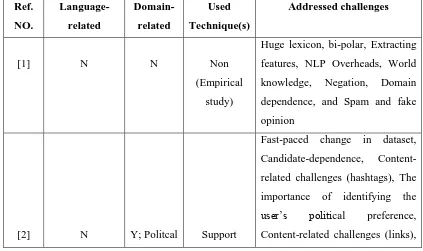
analysis and opinion mining challenges, then analyze it in coherent way (Table 1.) , in section 3, the
most important challenges are highlighted with discussion. Finally, section 4 is the conclusion of our
work
II.LITERATURE REVIEW
According to the importance of sentiment analysis in providing valuable decision making information
in different domains, sentiment analysis/opinion mining is an interested research field in text mining
and analytics domain, many numbers of sentiment analysis applications and academic research studies
are available today and continues in growth, among of those researches some researchers have
analyzed the sentiment analysis challenges of the existing researches [1] [6] [9], while others have
tries to identify and resolve the unaddressed issues that related to the sentiment analysis task. In [1],
author has survey a forty seven research articles, and based on two comparisons, first comparison was
addressed the relationship between review structure and sentiment challenges. Second comparison
119 | P a g e
sentiment analysis. Based on those two comparisons the most important sentiment challenges were
highlights.
The challenges of sentiment analysis on dynamic event have been discussed by [2], using multi-class
classifier they have conducting sentiment analysis on real time tweets for predicting election results,
the developed model achieve high level of accuracy in predicting the results by using deep
learning-based model. Other researches were addressed the challenges of multi language issues (non-English
languages) [3] [4] [5] [10] [11], among of those [3] have survey on opinion mining in Hindi language
and mentioned a number of challenges related to language issues when performing sentiment analysis.
Arabic language is the native language for hundreds of millions people in Middle East countries and
hundreds of, sentiment analysis of Arabic text also involves many challenges related to the language.
In [4], authors have addressed many challenges of sentiment analysis in Arabic language social
media, then they have conducting experimental study on Egyptian Arabic microblogs, they achieve
reasonable accuracy level of Arabic sentiment analysis taking into consideration handling of the
language based challenges. Using lexicon based model [5] have conducting a sentiment analysis on
topical Chinese microblogs posts, a Webo-lexicon with representative topic words and
Out-of-vacuolar (OOV) words have been constructed, and they have addressed the challenges related to post
text in Chinese language with better performance accuracy. Many other researchers [6] [7] [8] [9],
have been discussed the common challenges of sentiment analysis and opinion mining in general.
Table 1; summarize the survey of sentiment analysis challenges in previous studies and listing the
addressed challenges in each of them.
Table 1. Summary and Analysis of the Previous Studies on Sentiment Analysis & Opinion Mining
Ref. NO.
Language-related
Domain-related
Used Technique(s)
Addressed challenges
[1] N N Non
(Empirical
study)
Huge lexicon, bi-polar, Extracting
features, NLP Overheads, World
knowledge, Negation, Domain
dependence, and Spam and fake
opinion
[2] N Y; Politcal Support
Fast-paced change in dataset,
Candidate-dependence,
Content-related challenges (hashtags), The
importance of identifying the user’s political preference,
120 | P a g e
Domain vector
machine
Content-related challenges
(sarcasm), Interpretation-related
challenges (Sentiment Analysis
versus Emotion Analysis),
Interpretation-related challenges
(Vote counting versus engagement
counting), Location importance,
and Trustworthiness-related
challenges (Bots)
[3] Y;
Hindi language
N Non
Word order, Morphological
variations, Handling spelling
variations, lack of resources, and
co-reference resolution
[4] Y;
Arabic
language
N Sum polarity
&
Double
polarity
Unavailability of colloquial Arabic
parsers, Unavailability of
Sentiment Lexicons, The need for
person name recognition, and
Handling compound phrases and
idioms
[5] Y;
Chinese
language
N Weibo
Lexicon with
OOV &
Propagation
algorithm
Length of content in Chinese
character-based language (same
number of characters contain more
information than English
language), and Chinese word
Segmentation
[6] N N Non
Detection of spam and fake
reviews, Limitation of
classification filtering, Asymmetry
in availability of opinion mining
software, Incorporation of opinion
with implicit and behavior data,
121 | P a g e
Natural language processing
overheads
[7] N N Non
Key word selection, Sentiment is
domain Specific, Multiple
opinions in a sentence, Negation
handling, Sarcasm detection,
Implicit Opinion, Comparative
Sentences, and Opinion spam
[8] Y;
German
language
N
Support
Vector
Machine
&
Rule-based
approach
Relevance, Target identification,
Negation, Contextual information,
Volatility over time, and Opinion
aggregation and summarization
[9] N N Non
Object identification, Features
extraction, grouping synonyms,
Writing style, Opinions change
with time, Sarcastic and ironic
statements, and Spam opinions
[10] Y;
Arabic
language
N
Quantitative,
Qualitative
analysis
&
Smoothness
analysis
Limited number of research in
Arabic language, Morphological
complexities, and dialectal
varieties
11 Y;
Arabic
language
N Naïve Bayes
algorithm.
Different meaning for same word,
Variations in lexical category,
Morphological characteristics, and
Vowelization or diacritization
III.SENTIMENT ANALYSIS CHALLENGES
As we mentioned early in the previous sections sentiment analysis is nontrivial task, many challenges
still not addressed and resolve efficiently. In this section, based on holistic perspective view of
122 | P a g e
sentiment analysis as critical field for researchers and industries. Bellow these challenges are
discussed with some details.
1.1.Big Data-related Issues
The proliferation of web-enabled devices offers new mediums for people to create, communicate and
share contents on social web platforms including blogs, social networks, forums, etc., at the same time
enormous amount of heterogeneous data are generated by the users of these web communities, the
generated data or as it called ‘‘big data’’ offers an unprecedented opportunity for individuals or
organizations to mine and analytics big data content using advance technologies and analytics
techniques, which enable in providing valuable information for decision makers. Sentiment analysis is
one of the valuable text analytics techniques that extract the social web users’ opinions and classify
sentiment polarity which feasible and applicable in different domain. In general the analysis of big
data is a challenging task due to volume, variety, velocity, variability and veracity of data, which are
the main characterize the big data.
Sentiment analysis on big data are challenging by the common characteristics of big data. Following
are the common sentiment analysis challenges related to big data:
1.1.1. Data Collection
Data collection is a preliminary step for any sentiment analysis task but is one of the main challenges
for researchers. Benchmark data set are not available free for the interested researchers in sentiment analysis field; most of the available social user’s data are commercial. Some of social networks sites
including Twitter and Facebook provide APIs for enabling data collection from their sites. Although,
due to the volume, variety, velocity of big data the collection of data set through using APIs is still
challenging task, since the APIs like Twitter API enables user to retrieve only 100 tweets each time, comparing to the volume of data available online regarding the selected user’s keyword/target the
retrieval of relevant data from a very huge volume data using APIs is difficult task and the relevancy
of the collected data set is a major issues for researches in sentiment analysis.
1.1.2. Data Preprocessing
Preprocessing is another essential task for sentiment analysis and one of major challenges in big data
world. Data volume restricts the filtering of relevant data from non relevant data which may
compromise the sentiment analysis results. Big data variety and velocity limiting the feature
extractions which are one of critical task in preprocessing of sentiment analysis data set. Extraction of
opinion words and sentences, POS tagging challenge when the volume of dataset is so huge and the
data are diverse with
1.1.3. Data Storage and Analytics
Another of sentiment analysis issues in big data is the memory size required to the preprocessed
123 | P a g e
technical issues that addressed by some or advanced storage techniques. Another challenges is
velocity of big data since sentiment analysis on dynamic and real time events in big data world is
challenging task need to be addressed efficiently taking into consideration the people opinions are
changes over time
1.2.Language-oriented Issues
Performing sentiment analysis on Non-English languages such as Hindi, Arabic, Chinese, etc., is one
of the critical challenges in sentiment analysis due to the different characteristics of each language and
the limited number of available researches in other languages comparing to English language which
already have many number of corpus and dictionary lexicon available. Although performing
sentiment analysis on non-English languages is essential due to the large percent of people around the
world who are non native English speakers, for example hundreds of people in Middle East countries
are Arabic language native and sentiment analysis on Arabic social sites is critical for political and
economic events. Although some of researches try to handling the language related issues using cross
language sentiment classification in which non-English language are automatically translated into
English language and the sentiment is performed based on English corpuses and dictionaries but the
accuracy of automatic translation is still remarkable. Below are the common challenges for
non-English languages sentiment analysis.
1.2.1. Lack Of Corpuses And Dictionaries Lexicon
Due to the different characteristics of non-English languages the number of other languages corpuses
and dictionaries lexicons is limited comparing with English language building language-oriented
corpuses and dictionaries is difficult task based on the difficulty of each language morphologies,
characters but still required. More numbers of researches in other languages are needed.
1.2.2. Different Writing Style
Writing style is another issue of non-English languages when performing sentiment analysis, in some
of these languages like Arabic language writing style is from right-to-left and the same word is
written in different styles or format, this issue also applicable in other languages and need to be
addressed efficiently
1.2.3. Different Word Meaning
This is the case when the same word has different meaning in different contexts, this also another
important issue in sentiment analysis since it extends the efforts when building language-oriented
lexicons and dictionaries, and it may comprise the accuracy of translation when sentiment analysis is
performing by translating other languages into English language.
1.3. Domain-oriented Issues
Sentiment analysis is highly domain sensitive task in which the sentiment classification is highly
124 | P a g e
training dataset from one domain is usually performs poorly when testing on test dataset from another
domain. The challenge is that the opinion words and constructs used to describe an event in on
domain often different from one domain to another. Also the orientation of opinion word may be
revered from one domain to another. Existing researches are trying to overcome domain dependence
challenge using domain transfer [13] where small amount of training data are labeled from the new
domain which is called the target domain where it used for testing the original/source domain training
dataset
1.4.Spam and Fake Opinions on Social Sites
Social web communities are characterized by anonymity of their users, the anonymity of user’s
identity may be used to in fraud other users on web communities. Organizations may use opinion
spammers to post fake positive opinions or reviews to promote their products, or fake negative
opinions to discredit their competitors, this also true for individuals in political domain or any other
domains where the posted opinions about targeted events can influence the evaluation of events from
the reader. The challenge is that it is hard to differentiate the fake opinion from non spam opinions by
reading it manually. The issue for sentiment analysis is to develop the appropriate techniques and
advance algorithms for detecting and filtering out the faked opinions in the collected dataset.
Supervised and unsupervised methods for spam opinions detections methods [13] have been
discussed.
1.5.Opinionated Text Related Issues
Following are the common sentiment issues related to the opinionated text and should be addressed
efficiently:
Comparative opinion
Subjective words not expressed any opinion
Objective words implicitly expressed opinion
Negation handling
Sarcasm and ironic detection
IV.CONCLUSION
Many research studies and industries applications of sentiment analysis on social web users are available and
incrementally receive attention due to its importance in providing valuable decision making information in
different domains. Sentiment analysis task is involves many challenges need to be addressed to be performed
accurately. This paper review and analysis the existing work related to the sentiment analysis challenges, many
number of challenges need to be addressed, the most important challenges are highlighted and discussed. Big
data analytics is major challenges and advance technical and algorithms are required to handle the issues of
125 | P a g e other languages are needed. Domain transfer, fake and spam opinions detection, and issues related to
opinionated text are needed to be handled efficiently.
The highlighted challenges provide new directions in sentiment analysis both academic researchers and
application industries.
REFERENCES
[1] D. Hussein, A Survey on Sentiment Analysis Challenges, Journal of King Saud University - Engineering
Sciences, 2016. DOI: http://dx.doi.org/10.1016/j.jksues.2016.04.002
[2] M. Ebrahimi, A. Yazdavar, and A. Sheth, On the Challenges of Sentiment Analysis for Dynamic Events,
IEEE Intelligent Systems, 32(5), 2017
[3] R. Sharma, S. Nigma, and R. Jian, Opinion Mining In Hindi Language: A Survey, International Journal in
Foundations of Computer Science & Technology (IJFCST), 4(2), 2014
[4] S. El-Beltagy, and A. Ali, Open Issues in the Sentiment Analysis of Arabic Social Media: A Case Study, 9th
International Conference on Innovations in Information Technology (IIT), 2013
[5] C. Anqi, Z. Haochen, L. Yiqun, Z. Min, and MA. Shaoping, Lexicon-based Sentiment Analysis on
Topical Chinese Microblog Messages, Semantic Web and Web Science, Springer Proceedings in Complexity,
pp. 333–344, Springer, New York, NY, USA, 2013
[6] H. Rahamath, Opinion Mining and Sentiment Analysis -Challenges and Applications, International Journal
of Application or Innovation in Engineering & Management (IJAIEM), 3(5), 2014
[7] A. Kumar, and T. Sebastein, Sentiment Analysis: A Perspective on its Past, Present and Future, I.J.
Intelligent Systems and Applications, 10(1), 2012
[8] D. Maynard, K. Bontcheva, and D. Rout, Challenges in developing opinion mining tools for social media, In
Proceedings of the 24th ACM Conference on Hypertext and Social Media. ACM, 2013
[9] B. Seerat, and F. Azam, Opinion Mining: Issues and Challenges (A survey), International Journal of
Computer Applications, 49(9), 2012
[10] A. Assiri, A. Emam, and H. Aldossari, Arabic Sentiment Analysis: A Survey, International Journal of
Advanced Computer Science and Applications, 6(12), 2015
[11] S. AlOtaibi, and M. Khan, Sentiment Analysis Challenges of Informal Arabic Language, International
Journal of Advanced Computer Science and Applications, 8(2), 2017
[12] W. Medhat, A. Hassan, and H. Korashy, Sentiment analysis algorithms and applications: A survey, Ain
Shams Engineering Journal 5, 2014,1093–1113.