EFFICIENT MAC FOR LEACH PROTOCOL IN
WIRELESS SENSOR NETWORK
Vishal Gupta
1, M. N. Doja
21Research Scholar, 2Professor, Jamia Millia Islamia,
Faculty of Engineering, Department of Computer Science, Delhi (India)
ABSTRACT
The goal of the wireless sensor network is to deliver the desired QoS while supporting the long life the
network. LEACH is one of the important and most discussed protocols in this area. The LEACH
protocol works in phases wherein the set-up phase, the cluster head and the associated member nodes
are finalized. Then a TDMA schedule is prepared for data transfer.
In this paper, we have proposed two approaches to adjust the TDMA schedule depending upon the
current situation thereby enhancing the quality of the WSN. The results are supported through
simulation in Matlab.
Keywords:
Wireless Sensor Network/s, LEACH, MAC, TDMA, QoS
I. INTRODUCTION
A WSN consists of many autonomous units called sensor nodes that work in distributed fashion in an
unattended, highly resource constraint, and possibly hostile environment. Conveying the sensed information to
the base station is considered to be the most energy draining operation of the sensor node [1]. This paper suggests
the improvement of QoS issues of MAC layer in the case of LEACH protocol.
LEACH [2] is one of the important and most discussed hierarchical routing protocols in WSN. It works in
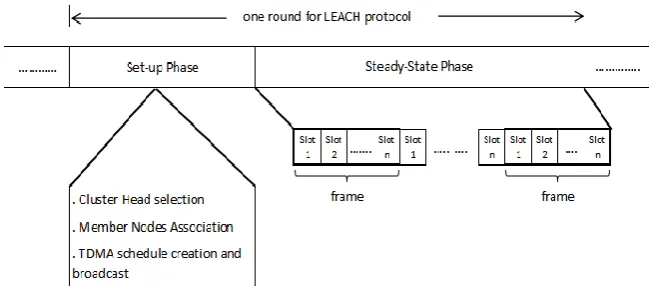
rounds. Each round consists of two phases, namely the setup phase and the steady-state phase. The functioning
of this protocol can be shown by the following Figure (1).
In the setup phase, the different clusters along with the TDMA schedules for data transfer are setup. This phase
is followed by steady-state phase in which the member nodes convey the sensed information to the cluster head
following the received TDMA schedule by the concerned CH.
The paper has been organized as follows: section 1 provides an introduction of the WSN and the LEACH
protocol. Section 2 explains the issues associated with MAC protocol in WSN. Section 3 presents a brief
overview of some of the MAC protocol in WSNs. Section 4 presents the proposed approaches with the
simulation results. The paper is concluded in section 5 followed by references.
II. BASIC ISSUES IN MAC PROTOCOL IN WSNS
MAC protocols affect the efficiency of the network in a great way. The waste of energy/issues in MAC
protocol can be summarized as follow: [3] [4]
Packet collision: Owing to the wireless media that is a shared channel by nature. The collided packets
require retransmission resulting in the wastage of energy.
Control/Protocol overhead: Most of the MAC protocols in WSN require control messages for data
transmission (e.g., request-to-send/clear-to-send messages), which consume precious & limited energy.
Overhearing and idle listening: Overhearing means that a node receives packets destined for other nodes.
Idle listening refers to keep open the radio even at idle time. This isa situation where nodes need to listen
on the channel to get its status.
III. OVERVIEW OF MAC PROTOCOLS
This section gives a brief overview of some of the MAC protocols defined for WSNs.
Self-organizing MAC for sensor networks (SMACS) [5] is one of the earliest attempts to develop MAC for
network startup and link layer organization in a static WSN networks. Sensor-MAC (S-MAC) [6] presents an
algorithm based on synchronization to let sensor nodes sleep at a certain time. TRAMA [7] is an adaptive
protocol that uses traffic-based information to decide on schedules for individual nodes. The average queuing
delay for TRAMA is relatively large due to overhead involved in scheduling.
Power-Efficient and Delay-Aware Medium Access Protocol for sensor networks (PEDAMACS) [8] combines
the characteristics of cellular network with the WSN. It is associated with a large overhead. T-MAC
(Timeout-MAC) [9] uses time-out windows to adjust the length of active states to remove the drawback of S-MAC
protocol.
D-MAC [10] is based on data gathering trees which achieves low latency but without compromising energy.
Wise-MAC [11] is an asynchronous protocol which uses the preamble sampling technology and it is based on
non-persistent CSMA protocol. This protocol selects few nodes that function as access points (APs) to collect
the node schedule.
Op-LEACH [12] presents a modification to MAC protocol of LEACH by using the free slots in the schedule by
the cooperation of the member nodes.
Along with the optimization of the issues at MAC level, a number of other approaches have also been proposed
IV. PROPOSED PROTOCOL
The normal steady state TDMA schedule for LEACH protocol can be shown by Figure (2). But suppose if all
the member nodes are not willing to send data as they don’t have any meaningful data to communicate to
cluster-head node. This will result into loss of throughput as well as wastage of resources (very precious in the
case of WSN).
Figure (2): Steady State TDMA Schedule for LEACH Protocol
Also, the unwilling member nodes will loose their radio power as they have to be in ON state during their slot
time, irrespective of whether they have data to send or not.
To remedy this problem, some form of adaptation is required. For this, we propose an additional step in the
set-up phase. In this step, along with the other required information, the member nodes also mark their willingness
for data transfer for the given round under consideration, so that the CH makes the TDMA schedule only for the
interested nodes. We have suggested two different approaches for the same.
If we take that it requires 1-bit to mark this willingness, then with this minimal increased overhead of n-bits
(where, n is the number of member nodes in the cluster), the latency of the network can be highly reduced, as
supported by the simulation results (Figure (5)).
Once, the CH has this information with it, it can use any one of the following two approaches to maximize the
data transfer:
1. Either increase the time for the time-slot keeping the total schedule time equal as before. This way, the
nodes with data can transmit for longer period of time
2. Or, we can increase the number of TDMA schedules within the original schedule time to serve our purpose.
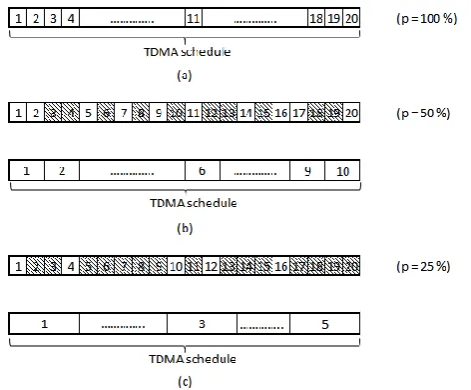
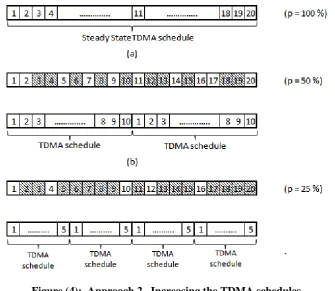
The respective approaches can be shown in Figure (3) and Figure (4). To explain the methodology, we have
assumed the number of member nodes to be 20, and p is the %age of nodes that have data to send.
Figure 3(a), 3(b) and 3(c) represent the scenario when the % age nodes willing to send data are 100%, 50% and
25% respectively for approach 1.
Similarly, figure 4(a), 4(b) and 4(c) represent the scenario when the %age nodes willing to send data are 100%,
50% and 25% respectively for approach 2.
Figure (4): Approach 2. Increasing the TDMA schedules
To support the claim, we have drawn a graph as shown in Figure (5) between the time taken to transmit some
fixed amount of data by the LEACH protocol and the proposed modification.
(We have assumed the case that there are 20 member nodes in the cluster. The total amount of data to be
transferred is 2000K. The per slot data transfer is 50K and the data to be transferred is equally contributed by the
different member nodes. Also we have ignored the impact of extra control information overhead as it is very
negligible.)
The above graph supports our claim. This approach is very useful when the data is of bursty nature. As the
number of active nodes increases, the proposed protocol approaches to the behavior of normal LEACH protocol.
V. CONCLUSION
MAC protocols play a very important role for the lifetime, throughput and the latency of the network. By this
work, we conclude that if the proposed enhancement to the existing LEACH protocol are incorporated, then the
throughput of the network can be greatly increased and the latency can be highly reduce especially in the case of
bursty nature of traffic.
REFERENCES
[1]. Cheng Chi-Tsun, C. K. Tse and F. C. M. Lau, “A Clustering Algorithm for Wireless Sensor Networks
Based on Social Insect Colonies”. Sensors Journal, IEEE, Vol.11, No.3, pp.711-721, March 2011.
[2]. W.R. Heinzelman, A.Chandrakasan and H.Balakrishnan, “Energy-Efficient Communication Protocol for Wireless Microsensor Networks”. Proceedings of the 33rd Hawaii International Conference on System
Sciences (HICSS '2000) IEEE, pp. 1-10, 2000.
[3]. I. Demirkol, C. Ersoy and F. Alagoz, “MAC Protocols for Wireless Sensor Networks: A Survey’’. IEEE
Communications Magazine, Vol. 44, No. 4, pp. 115 – 121, 2006.
[4]. K. Sohraby, D. Minoli and T. Znati, “Wireless Sensor Networks: Technology, Protocols, and
Applications” (Wiley Publications).
[5]. K. Sohrabi, J. Gao, V. Ailawadhi and G. Pottie, “Protocols for Self-Organization of a Wireless Sensor
Network”. IEEE Personal Communication Magazine, Vol. 7, No. 5, pp. 16–27, October 2000.
[6]. W. Ye, J. Heidemann and D. Estrin, “Medium Access Control with Coordinated Adaptive Sleeping for
Wireless Sensor Networks’’. IEEE/ACM Transactions on Networking, Vol. 12, No. 3, pp. 493–506,
June 2004.
[7]. V. Rajendran, K. Obraczka, and J.J. Garcia–Luna–Aceves, “Energy-Efficient, collision-Free Medium
Access Control for Wireless Sensor Networks”. In Proceedings of ACM 1st International Conference on
Embedded Networked Sensor Systems (SenSys’03), Vol. 1, pp. 181–192, Los Angeles, CA, November
2003.
[8]. S. Coleri, “PEDAMACS: Power Efficient and Delay Aware Medium Access Protocol for Sensor
Networks”. Department of Electrical Engineering and Computer Science, University of California,
Berkeley, December 2002.
[9]. T. Van Dam and K. Langendoen, “An Adaptive Energy-Efficient MAC Protocol for Wireless Sensor
Networks”. In Proceedings of ACM SENSYS’03, pp. 171-180, Los Angeles, CA, USA, 5-7 November
2003.
[10]. Lu Gang, Bhaskar Krishnamachari and Cauligi S. Raghavendra, “An Adaptive Energy-Efficient and
Low-Latency MAC for Data Gathering in Wireless Sensor Networks”. Proceedings of the 18th
International Parallel and Distributed Processing Symposium (IPDPS) Santa Fe, New Mexico, pp.
[11]. El-Hoiydi and J.-D. Decotignie, “WiseMAC: An Ultra Low Power MAC Protocol for the Downlink of
Infrastructure Wireless Sensor Networks”. In Proceedings of the IEEE 9th International Symposium on
Computers and Communications (ISCC’04), Vol. 1, pp. 244 - 251, Alexandria, Egypt, 28 June-1 July
2004.
[12]. Sapna Gambhir and Nida Fatima, “Op-LEACH: An Optimized LEACH Method for busty traffic in WSNs”. IEEE Fourth International Conference on Advanced Computing & Communication
Technologies, pp. 222-229, 2014.
[13]. W. Heinzelman, A. Chandrakasan and A. Balakrishnan, “An Application-specific Protocol Architecture
for Wireless Microsensor Networks". IEEE Transactions on Wireless Communications, Vol. 1, No.4, pp.
660-670, October 2002.
[14]. H. Yang and B. Sikdar, “Optimal Cluster Head Selection in the LEACH Architecture”. IEEE
International Conference on Performance, Computing, and Communications, pp. 93-100, 2007.
[15]. J. Hu, Y. Jin, and L. Dou, “A Time-based Cluster-Head Selection Algorithm for LEACH”. IEEE
Symposium on Computers and Communications, pp. 1172-1176, 2008.
[16]. Linlin Wang, Jie Liu, and Wei Wang, “An Improvement and Simulation of LEACH Protocol for Wireless
Sensor Network”. In Proceedings of the IEEE First International Conference on Pervasive Computing,
Signal Processing and Applications, pp. 444 – 447, Harbin, China, 17-19 September 2010.
[17]. Heydar Ghasemzadeh, Mehdi Rezaeian, Fatemeh Dehghan and Mohammad Mohsen, “BN-LEACH- An
Improvement on LEACH Protocol using Bayesian Networks for Energy Consumption Reduction in
Wireless Sensor Networks”. 7th International Symposium on Telecommunications (IST’2014), pp.