343 | P a g e
PARABOLIC TROUGH COLLECTOR BASED
SOLAR WATER HEATING SYSTEM USING
FORCED CIRCULATION
1
Patil Digvijay Tanaji,
2Patil Ashish Anand
1,2
Mechanical,Sou. Sushila Danchand Ghodawat Charitable Trust’s
Sanjay Ghodawat Group Of Institutions (India)
ABSTRACT
This paper concerned with an experimental study of parabolic trough collector using forced circulation system.
The collector used in this project is of parabolic shape with absorber tube at the focal point. Sunlight is
reflected from the trough surface and concentrated on the absorber tube. The trough is usually aligned to N-S
axis and can be rotated manually according to sun position from E-W.
The heat transfer fluid (water) runs through the tube and absorbs concentrated heat energy. For faster heat
transfer rate forced circulation system is utilized. For this solar operated motor is used to achieve forced
circulation. The thermal efficiency of parabolic trough collector ranges from 60-90%. This system can be
utilized for household applications as well as applications in food processing industries.
I INTRODUCTION
The global energy consumption in the last 50 years has increased drastically and will continue to do so for the
next 50 years. With the increasing population of the world and the demanding increase for a higher standard of
living, the energy requirements needed to sustain the world’s needs are steadily increasing. The reserves of
nonrenewable energy resources are shrinking; in order to avoid a worldwide energy crisis, renewable resources
must be implemented in every application possible. Of the various renewable forms of energy, solar energy
proves to be amongst the most diverse and effective renewable energies. One of the most successful applications
of solar energy has been in the use of heating water.
India, with its tropical climate, can tap solar energy for heating water for domestic & industrial purposes &
various non-heating purposes, like street lighting etc. The non-conventional water heating system based on solar
energy has a major advantage in that, once the initial installation is carried out, the consumer will have
minimum recurring expenditure.11% of the world’s power is supplied by biomass, while 85% is derived from
fossil fuels. For this reason, renewable energy resources must become more abundant in residential areas, such
as solar thermal energy. The average solar power incident on the earth is approximately 1000W/m2 or about
100,000 TW [2]. This energy source is much greater than the current world power consumption of
344 | P a g e
the power to fuel energy needs.Heating your water with solar energy can be a rewarding venture in more ways than one.
Energy Independence: Using solar energy can reduce your dependence upon the utility, as well as the fossil fuel companies that supply it. It helps reduce the nation’s reliance on foreign energy sources. Solar is as
reliable as getting your energy from the utility, as well. Many folks with solar hot water only need to use the
utility for backup, and sometimes not even that. Independence can be a very gratifying experience.
Environmental Impact: It is a fact that most of our energy comes from burning fossil fuels. This leads
to a wide array of environmental problems, including human-caused climate change, acid rain, mountaintop
removal for coal and tar sands, and health effects around power plants. The use of nuclear energy and its
long-lived, poisonous byproducts is an important issue to many.
Financial Benefits: When you choose to use solar to replace all or part of what you had been using the
utility for, that comes with financial savings on your utility bill. Solar-electric, as popular as it is, does not have
as high an energy and cash savings per amount spent as does solar water heating. It is easy to see 50% to 100%
savings on your bill, helping systems to recoup the original investment in 5 years, and as little as 3 years. The
time depends largely on your local solar resource and how much utility energy costs [1].
As with other energy technologies, there are often financial incentives to make the initial investment even more
attractive. For solar hot water they can include state and federal tax credits, and state, regional, and utility
rebates. Two basic solar heating systems are reviewed in this study, including thermo siphon solar water heating
system and a forced circulation water heating system. Furthermore, the basic types of solar collectors will be
reviewed and compared to determine which will be sufficient for the subject application [6].
II
LITERATURE SURVEY
In order to improve the performance of solar concentrator, different geometries and different types of reflectors
were evaluated with respect to their optical and energy conversion efficiency, proposed by Pradeep Kumar K ,
Srinath et al[1] .which clears that parabolic trough is a type of solar thermal energy collector. It can be
constructed as a long parabolic mirror with a Dewar tube running its length at the focal point. Sunlight is
reflected by the mirror and concentrated on the Dewar tube. The trough is usually aligned on a north-south axis,
and rotated to track the sun as it moves across the sky each day. The energy efficiency of system increases,
avoiding the need for tracking motors solar tracking mechanism.
Donald Jeremy Gaitan et al [2] gave one important factor in the analysis of solar concentrators that is the
concentration ratio in their studies. The concentration ratio is defined as the ratio of the area of the aperture of
the concentrator to the area of the receiver that is reflected upon by the concentrator. This is in essence the heart
of a solar concentrator. Solar tracking is also necessary for efficient use of concentrating collectors. Without
tracking the collector becomes almost useless except for a very short time period once a day. Large scale
concentrators today use automated tracking systems that can track the sun on a biaxial path. Due to cost
restrictions and complexity, and the small scale of this project, manual turning of the concentrator was chosen as
the preferred method of solar tracking.
Ricardo Vasquez Padilla et al[4] the performance of parabolic trough based solar power plants over the last 25
345 | P a g e
conventional power plants, parabolic trough solar power plants produce significantly lower levels of carbondioxide, although additional research is required to bring the cost of concentrator solar plants to a competitive
level. The cost reduction is focused on three areas: thermodynamic efficiency improvements by research and
development, scaling up of the unit size, and mass production of the equipment. The optimum design,
performance simulation and cost analysis of the parabolic trough solar plants are essential for the successful
implementation of this technology. The table bellow gives the clear idea about advantages and disadvantages
about both types of collectors dominantly used for the purpose.
Table 1 - Comparisons of Flat Plate Collector and Parabolic Trough Collector
From all above literature mentioned we come to a conclusion that in order to increase the heat received by
system one should choose parabolic trough collector. Also for greater efficiency the system should run on forced
circulation to minimize the time required to heat the water. And if the system is provide with solar tracking
mechanism then all remaining drawbacks will be eliminated.
According to the study of conventional solar water heating system available in market now a days we found the
scope for this project. Thermo siphon system is most commonly used for solar water heating purpose. But
thermo siphon system requires extra space for natural circulation, and due to bulky in nature its applications are
limited. Also it has lower efficiency. So that, it is necessary to develop a compact sized solar water heating
system (SWHS) with same capacity and having more efficiency than thermo siphon system. The available
solutions we found are, the compactness of SWHS can be achieved by using parabolic tough collector instead of
flat plate collector. The efficiency of the system is increased by forcing large amount of water in circulation
tubes. This is done with the help of forced circulation SWHS. To absorb maximum solar radiations solar
tracking system can be used. The shape memory alloy actuated (SMA) pump can be used instead of electrically
driven pump.
Flat Plate Collector Parabolic Trough Collector
Area required for flat plate collector than parabolic
collector is more comparative.
Area required for parabolic collector is less than
flat plate collector.
Flat plate collector uses more than one (For 100 lit.
11tubes). Parabolic trough collector uses single tube.
flat plate collector basically doesn’t require solar
tracking system. Parabolic collector needs solar tracking system.
Energy absorbed per unit area is less as compared
to parabolic trough collector. Energy absorbed per unit area is max.
346 | P a g e
III METHODOLOGY
The methodology for the proposed project work is as shown in flow chart below
Fig1.-flow chart
Comparative Study Of Flat Plate Collector And Parabolic Trough Collector
The flat plate collector includes an absorber, a transparent cover, a frame and insulation. Typically, a transparent
cover consisting of an iron-poor solar safety glass is used; this transmits a large amount of short wave light of
the solar spectrum. Due to the traditional greenhouse effect, minimal heat emitted by the absorber escapes the
cover. Furthermore, the transparent cover precludes heat transfer due to convection when the collector is Collection of data through literature available
Conclusion
Result & Data interpretation Assembly & Testing
Fabrication
Development of CAD model of the system Preparation of detailed design for proposed work
347 | P a g e
exposed to wind. The frame and cover protect the absorber from being exposed to potential damaging weatherconditions. The materials most commonly used in construction of the frame include aluminum, galvanized steel
and fiberglass reinforced plastic. A conduction heat loss through the side walls and back of the collector is
mitigated by lining the subject areas with polyurethane foam insulation. Parabolic trough power plants use a
curved, mirrored trough which reflects the direct solar radiation onto a glass tube containing a fluid (also called
a receiver, absorber or collector) running the length of the trough, positioned at the focal point of the reflectors.
The trough is parabolic along one axis and linear in the orthogonal axis. For change of the daily position of the
sun perpendicular to the receiver, the trough tilts east to west so that the direct radiation remains focused on the
receiver. However, seasonal changes in the in angle of sunlight parallel to the trough does not require
adjustment of the mirrors, since the light is simply concentrated elsewhere on the receiver. Thus the trough
design does not require tracking on a second axis. The receiver may be enclosed in a glass vacuum chamber.
The vacuum significantly reduces convective heat loss. A fluid (also called heat transfer fluid) passes through
the receiver and becomes very hot.
Reflecting surfaces require less material and are structurally simpler than flat plate collectors. The absorber area
of a concentrator system is smaller than that of flat plate system for same solar energy collection. Heat lost to
the surrounding per unit of solar energy collecting area is less than that of flat plate. Working fluid can attain
higher temperature in concentrating collector [2].
Basic Terminology:
1) Solar Concentration Ratio:
It is defined as ratio of averaged radiant solar flux integrated over the receiver area to the flux incident on the
2) Collector Aperture:
It directly relates the reflector quality. A higher concentration ratio allows the collector to reach a higher
working temperature with minimal thermal loss, but requires higher manufacturing precision too. A very
carefully constructed and adjusted collector may reach an effective concentration ratio as high as 100.
3) Tilt Angle:
Tilt angle is defined as the angle subtended by the focal line of trough collector with horizontal. Collectors
based on heat pipes can have a strong tilt dependency and this must be considered when testing such collectors.
Normally slopes below 20°-30° should be avoided but this cannot be taken as a general rule.
4) Rim angle (Ψ rim):
The rim angle is defined as the angle subtended by the edges of the reflector at the focus.
5) Collector Acceptance angle:
Collector acceptance angle is defined as the sensitivity of the solar parabolic trough collector to tracking
misalignment.
Design Parameters:
1) We took 2.5m2 as area of the collector because the normal solar water heating system
348 | P a g e
2) Tube Diameter is selected as 12.7mm cause above mentioned system uses this one [1].3) All other things are designed considering the collector area as base parameter.
Design details For Project Work
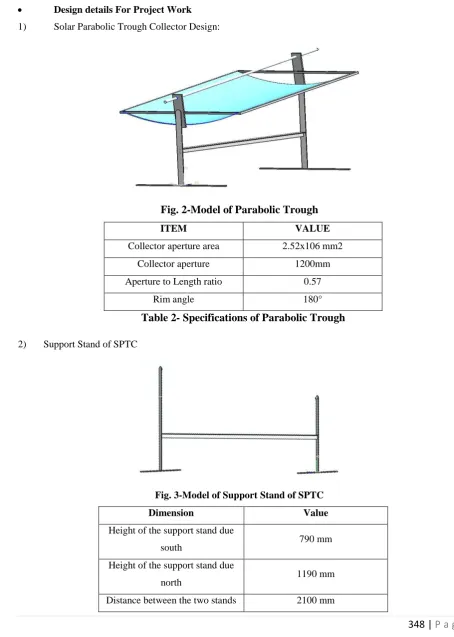
1) Solar Parabolic Trough Collector Design:
Fig. 2-Model of Parabolic Trough
ITEM VALUE
Collector aperture area 2.52x106 mm2
Collector aperture 1200mm
Aperture to Length ratio 0.57
Rim angle 180°
Table 2- Specifications of Parabolic Trough
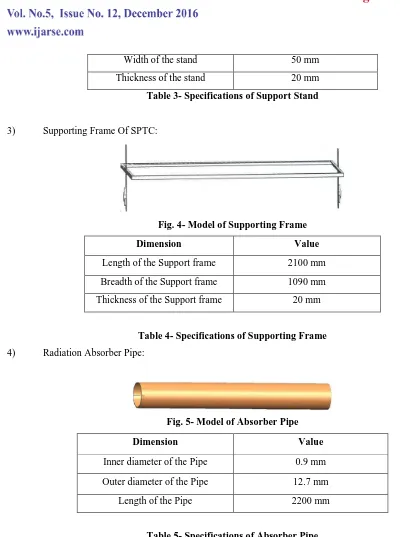
2) Support Stand of SPTC
Fig. 3-Model of Support Stand of SPTC
Dimension Value
Height of the support stand due
south 790 mm
Height of the support stand due
north 1190 mm
349 | P a g e
Width of the stand 50 mm
Thickness of the stand 20 mm
Table 3- Specifications of Support Stand
3) Supporting Frame Of SPTC:
Fig. 4- Model of Supporting Frame
Dimension Value
Length of the Support frame 2100 mm
Breadth of the Support frame 1090 mm
Thickness of the Support frame 20 mm
Table 4- Specifications of Supporting Frame
4) Radiation Absorber Pipe:
Fig. 5- Model of Absorber Pipe
Dimension Value
Inner diameter of the Pipe 0.9 mm
Outer diameter of the Pipe 12.7 mm
Length of the Pipe 2200 mm
Table 5- Specifications of Absorber Pipe
IV CALCULATIONS
The collector is designed with simple parabolic equation and merged of solar radiation method in order to
optimize the fabrication with local material. According to the size limitation of highly polished Stainless steel
sheet, 2100 mm long, 1200 mm wide and rim angle of 180°, makes the focal line in place with the cord line.
Simple parabolic equation can be applied to solve the above condition, where x is axial to parabolic curve, y is
350 | P a g e
Fig. 6- Geometry of Parabola
Consideration the simple parabolic equation:
X2 = 2RY
f = R/2
X² = 2 R Y
Radius (R) = X² / 2Y= 500² / 2*225 = 555.6 cm
Hence Focal length = R / 2= 555.6 /2= 277.2mm
2) Declination Angle ( )
23.45
= 23.45
= 14.75o
3) Slope (
tan = = 0.522
= 28.91
=
= 32.22
4) Tilt factor for beam radiation
Rb = = 0.82
5) Concentration Ratio (C)
C = =
= = 23.86
4.1
Calculations of efficiency:
Min Temp = 28
Max Temp = 75
Mass of Water
m = density ( ) * volume (v)
351 | P a g e
Net useful heat gained by fluidQu = mCp (Tfo - Tfi )= 10*4.217(75-28)= 1982w/m2
Collector Efficiency
= = 78.72 % [1]
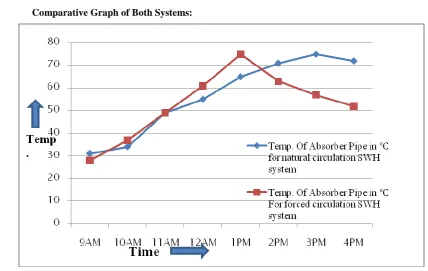
V EXPERIMENTAL RESULT
Time
Temp. Of Absorber Pipe in ℃ For forced circulation SWH
system
Temp. Of Absorber Pipe in ℃ for natural circulation SWH system
9 AM 28 31
10 AM 37 34
11 AM 49 49
12 AM 61 55
1 PM 75 65
2 PM 63 71
3 PM 57 75
4 PM 52 72
Table 6- Observation Table for Forced Circulation and natural circulation System
Comparative Graph of Both Systems:
352 | P a g e
VI CONCLUSION AND FUTURE SCOPE
In this project we developed a forced circulation solar water heating system which gives efficiency which is
greater than the system with natural circulation. It shows that time required for obtaining maximum temperature
is less for forced circulation as compare to natural circulation solar water heating system. The need of compact
sized solar water heating system is fulfilled by our system (Parabolic trough collector system).Our system costs
less than conventional flat plate collector system available in market. In future if the system has to develop
further we can replace our steel surface of collector by glass surface to achieve temperature of 125 0C and
aluminum surface to achieve 103 0C [5]. The system can be coupled with Savonius wind turbine to achieve
forced circulation. By using flow control valves different flow rates can be achieved for getting better heating
results.
ACKNOWLEDGEMENT
First of all we thank the almighty for providing me with the strength and courage to present the project report.
We avail this opportunity to express my sincere gratitude towards Dr. A. M. NAGARAJ head of mechanical
engineering department, for permitting me to do the project. We also at the outset thank and express my
profound gratitude to my project guide Mr. H. P. PORE, for their inspiring assistance, encouragement and useful
guidance.
REFERENCES
[1]S. P. Sukhatme et al. Solar Energy. New Delhi: McGraw Hill Education, 2008.
[2]Pradeep Kumar K, Srinath, Venkatesh Reddy. "Design, Fabrication and Experimental Testing of Solar Parabolic
Trough Collectors with Automated Tracking Mechanism." INTERNATIONAL JOURNAL OF RESEARCH IN
AERONAUTICAL AND MECHANICAL ENGINEERING (Vol.1 Issue.4, August 2013; Pgs: 37-55).
[3]Atul A Sagade, Satish Aher and Nilkanth N Shinde. "Performance evaluation of low-cost FRP parabolic trough
reflector with mild steel receiver." International Journal of Energy and Environmental Engineering (2013; Pgs: 4:5
)
[4]Donald Jeremy Gaitan. Design, Construction, and Test of a Miniature Parabolic Trough Solar Concentrator. Cal
Poly, San Luis Obispo, CA. Fall Quarter 2012.
[5]H. P. Garg And R. K. Agarwal, SOME ASPECTS OF A PV/T COLLECTOR/FORCED CIRCULATION FLAT
PLATE SOLAR WATER HEATER WITH SOLAR CELLS. Energy Studies, Indian Institute of Technology,
Hauz Khas, New Delhi 110 016, India, 1994.
[6]Ricardo Vasquez Padilla, Simplified Methodology for Designing Parabolic Trough Solar Power Plants. University
of South Florida, 2011.
[7]Pm Khanwalkar1, Prof .Vn Kapatkar2, Kv Mali3, Dumbre Av4, “Comparative Study Of Hybrid Solar Wind Domestic Water Heating System”, International Journal Of Engineering & Science Research.
[8]Bolaji BO. Flow Design and Collector Performance of a Natural Circulation Solar Water Heater. Journal of
Engineering and Applied Sciences 2006.