ISSN (Print) : 2320 – 3765 ISSN (Online): 2278 – 8875
I
nternational
J
ournal of
A
dvanced
R
esearch in
E
lectrical,
E
lectronics and
I
nstrumentation
E
ngineering
(An ISO 3297: 2007 Certified Organization)
Vol. 4, Issue 5, May 2015
An Optimization Engine to Enhance the
End-User Service
M. Jasmin, Nelson Pam, Pritam Roy, Dr. D.B.V. Jagannadham
Assistant Professor, Dept. of ECE, Jerusalem College of Engineering, Chennai, Tamil Nadu, India
Dept. of ECE, Jerusalem College of Engineering, Chennai, Tamil Nadu, India
Dept. of ECE, Jerusalem College of Engineering, Chennai, Tamil Nadu, India
ABSTRACT: Optimization of end user service is the major area of research that exist in the recent era.In this context user requirement on end user service with respect to session task is given less importance. Optimization process focuses mainly on certain specialized services and it does not taken into account the service experience. This paper mainly aims in developing a system for optimizing end us er service based on semantic components
It concentrates on the semantic algorithms such as monitoring, analyzing, planning and executing. The systems performance was examined by the set of users where they were using the file transferring by upload
limit and download limit. The limits are set by the administrator of the network provider. Priority for subsequent files will be set by the administrator based on the network connections. Priority sessions are main tained through the process.
KEYWORDS: end-user, semantic algorithm, priority.
I. INTRODUCTION
The Main objective of this project is to maintain an optimized end-user service through the Aesop Method. The use of syntactic approaches in solving modeling problems in telecommunications management has been proposed. A system for autonomic optimization of end-user service delivery must have a view of service expectations, experience, and context.[1]
In the proposed project User can upload a file in the server, and that they can request for the optimization. The optimization have been done through the Aesop engine which does following analysis, Knowledge Base Analysis Semantic Analysis Optimization devising and Execution analysis.
It will be converted to the stream bytes then it will be downloaded in the user side. Here the Semantic analysis performed based on Rationalizing, Querying, and application of rules to the each file. Optimization outlining and execution operations plan optimizations by ex-planning and execution operations plan optimizations by examining the compliance of the current running session set to determine if the expectations of high priority. Priority will be set to each file by the file properties, which have been analyzed through the basic analysis through the Aesop engine.
The Aesop Engine to model and optimize end-user service delivery in a network. The user and network owner agree the priority of each service a user runs. The present-day executing method is differ than the existing system. Resources minimizations are planned and executed that throttle the resource usage of low priority sessions with a view to releasing resources.[2]
ISSN (Print) : 2320 – 3765 ISSN (Online): 2278 – 8875
I
nternational
J
ournal of
A
dvanced
R
esearch in
E
lectrical,
E
lectronics and
I
nstrumentation
E
ngineering
(An ISO 3297: 2007 Certified Organization)
Vol. 4, Issue 5, May 2015
controls on infrastructure carrying those services can be applied.
The EUSAO snapshot and snapshot bucket concepts are fundamental for enabling efficient access to the knowledge Base and enable partitioning of the Knowledge Base into separate self-contained models at run time.[3]
Each individual set of user session metrics is a snapshot and all metrics reported in a time period are collected into a snapshot bucket. Each snapshot bucket is held as a distinct model instance in the Knowledge Base.
The concept of a snapshot is fundamental to the performance of the Aesop Knowledge Base. It retains a model for each snapshot bucket. All individuals with intense dynamicity and snapshot temporality for the time period of a snapshot bucket are stored in that snapshot bucket model.
Knowledge monitoring realizes the autonomic monitoring function. It takes end user service experience and context information from extraneous sources to alter that information into knowledge as individuals of the EUSAO ontology, and cache that knowledge in the knowledge Base.[4-6]
Knowledge monitoring has two phases: a knowledge lifting phase translates data from non- semantic sources into syntactic form, and a knowledge loading phase takes that knowledge, deduce new knowledge using reasoning and rules, and stores the cognitive ideas into the knowledge Base.
There are four snapshot concepts in the EUSAO ontology. Service Experience Snapshot Connection Experience Snapshot Optimization Snapshot Location Snapshot.
Service Experience Snapshot: session service experience metrics (e.g. quality scores, page load times)
Connection Experience Snapshot: network context metrics (e.g. packet loss, latency) Optimization Snapshot: optimization actions on a session (throttling actions executed)
Location Snapshot: models the location of a terminal.This is web based application and allows people from various corporations to exchange their works and ideas. In this application there are links which can be connected to other intranet resources including databases.[7]
II. SYSTEM ANALYSIS
After analyzing the requirements of the task to be performed, the next step is to evaluate the problem and understand its context. The first and foremost task in the phase is studying the existing system and other is to understand the requirements and domain of the new system. Both the activities are symmetrically important, but the first activity provide as a support of giving the functional specifications and then successful design of the proposed system. Understanding the resources and requirements of a new system is more difficult and requires creative thinking and understanding of existing running system is also difficult, inaccurate understanding of existing system can lead diversion from solution.[9]
Analysis Model:
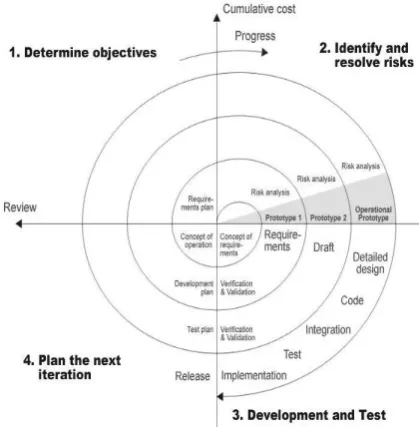
The model that is basically being followed is the SPIRAL MODEL, which states that the phases are organized in a continuous order. First of all the utility study is done. Once that part is over the fundamental inquiry and project outlining begins. If system prevail one and alteration and addition of new module is needed, analysis of contemporary system can be used as basic model.
The design starts after the requirement analysis is complete and the coding begins after the design is complete. Once the programming is compiled successfully, the testing is done. In this model the array of activities performed in a software development project are: -
ISSN (Print) : 2320 – 3765 ISSN (Online): 2278 – 8875
I
nternational
J
ournal of
A
dvanced
R
esearch in
E
lectrical,
E
lectronics and
I
nstrumentation
E
ngineering
(An ISO 3297: 2007 Certified Organization)
Vol. 4, Issue 5, May 2015
1) Project Planning 2) System design 3) Detail design 4) Coding 5) Unit testing
6) System integration & testing
Here the linear ordering of these activities is demanding. End of the phase and the output of one phase is the input of other phase. The output of each phase is to be persistent with the overall requirement of the system. SPIRAL MODEL was defined by Barry Boehm in his 1988 article, “A spiral Model of Software Development and Enhancement”. This model was not the first model to discuss monotonous development, but it was the first model to explain why the iteration models.
As originally envisioned, the iterations were typically 6 months to 2 years long. Each phase starts with a design objective and ends with a client reviewing the progress thus far. Analysis and engineering efforts are applied at each phase of the project, with an eye toward the end goal of the project.[8]
The following diagram shows how a spiral model acts like:
Fig 1.0: Spiral Model
III. THE AESOP SYSTEM
In the flexibility of uses concept of graphics has been developed for interfacing. The top level hierarchy takes into account Administrative User Interface Design The Operational and Generic User Interface Design.
The administrative user interface related to administrative purpose aims in supervising the information related to activities of organization and also it should authenticate the datas collected.This interface also focuses on main functions like data insertion, data deletion, and data updating along with data searching .[10]
ISSN (Print) : 2320 – 3765 ISSN (Online): 2278 – 8875
I
nternational
J
ournal of
A
dvanced
R
esearch in
E
lectrical,
E
lectronics and
I
nstrumentation
E
ngineering
(An ISO 3297: 2007 Certified Organization)
Vol. 4, Issue 5, May 2015
Number of Modules:
After careful analysis the system has been identified to have the following modules:
1. Administrative UI Module 2. Aesop Engine Analysis Module
3. Optimization Planning and Execution Module 4. User UI Module
5. User File Handling Module 6. User File Retrieve Module
EXPLANATIONS:
1. Administrative UI Module
In this module, the administrative side of this
system will be designed and developed. The administrative user interfaces have been deployed. Administrative Login will be authenticated.
2. Aesop Engine Analysis Module
In this module, Aesop Engine analysis has been developed by the following basis,
A. Knowledge Monitoring B. Knowledge Base analysis C. Semantic Analysis
D. Snapshot Bucket Analysis
3. Optimization Planning and Execution Module
In this module, a temporary reasoned model is created in this apply throttling to contain the meta- data, global knowledge, and a set of recent snapshot buckets that cover a configurable look- back interval.
4. User UI Module
In this module, the user interface will be designed and developed. The user side login will be authenticated and session maintained. User registration must be needed in this module.
5. User File Handling Module
In this module, user can upload and delete the files
which are user wants to share. User can report the administrative side based on the file queries. User File Retrieve Module
In this module, the user can download the files which have been uploaded by themselves and other users.
EXISTING SYSTEM
Existing System mainly having the method to optimize the end-user service based on the home network. The network owner can manage the usage of the services based on the user. Monitoring and analyzing operation only performed in this system. Analyzing part can be performed in the knowledge base and that is passed through the knowledge bus. The objective of this system to provide autonomic end-user service with the minimum optimization.
User priority will be analyzed only through the session concepts
Optimization of end-user service delivery must be highly experience of the user service sessions.
The administrator can perform actions only in the home network. End-user service optimization cannot be
overloaded in the knowledge base
Monitoring is performed in the knowledge base and analyzing is performed in the semantic analysis
By using the components. Database analysis is not performed in the high level contribution
ISSN (Print) : 2320 – 3765 ISSN (Online): 2278 – 8875
I
nternational
J
ournal of
A
dvanced
R
esearch in
E
lectrical,
E
lectronics and
I
nstrumentation
E
ngineering
(An ISO 3297: 2007 Certified Organization)
Vol. 4, Issue 5, May 2015
Advances in data collection, processing, and analysis, along with privacy concerns regarding the end user service optimization autonomically. The introduction of Aesop System processing is to make things easy because of the time it will save and also the accuracy of its output. [12]
The main objective of this application is to make it interactive and its ease of use.
The system helps to the administrative of this network operation made easy for the optimization
autonomically. Average monitoring times, analysis times, and optimization times are maintained cleary unlike the existing system.
Aesop‟s design has been addressed performance concerns, which have inhibited widespread adoption of
semantic techniques in systems. Semantic-Based autonomic management system that has the potential to be applied to address of the other problems.
Priority is the major advantage of this system, the priority based performance have been increased from the
existing System
SYSTEM ARCHITECTURE:
E – R DIAGRAMS
The relation upon the system is structure through a conceptual ER-Diagram, which not only specifics the existential entities but also the standard relations through which the system exists and the cardinalities that are necessary for the system state to continue.
The Entity Relationship Diagram (ERD) depicts the relationship between the data objects. The ERD is the
notation that is used to conduct the date modeling activity the attributes of each data object noted is the ERD can be described resign a data object descriptions.
The set of primary components that are identified by the ERD are
Data object
Relationships
Attributes
Various types of indicators.
ISSN (Print) : 2320 – 3765 ISSN (Online): 2278 – 8875
I
nternational
J
ournal of
A
dvanced
R
esearch in
E
lectrical,
E
lectronics and
I
nstrumentation
E
ngineering
(An ISO 3297: 2007 Certified Organization)
Vol. 4, Issue 5, May 2015
Flow Diagram:
IV. RESULTS
ISSN (Print) : 2320 – 3765 ISSN (Online): 2278 – 8875
I
nternational
J
ournal of
A
dvanced
R
esearch in
E
lectrical,
E
lectronics and
I
nstrumentation
E
ngineering
(An ISO 3297: 2007 Certified Organization)
Vol. 4, Issue 5, May 2015
V. CONCLUSION
The Management Systems that are monitors user service session context exist but approaches that estimate end-user service experience from session context does not analyze the compliance of that experience with end-user expectations.
Approaches that optimize end-user service delivery are not applicable to arbitrary services. Those services either optimize specific service types or use general mechanisms that do not consider service experience.
The proposed System uses the Aesop approach (i.e.,) Autonomic Optimization of End- User Service based on the semantic components. End-User Service Analysis and Optimization which is used to get the data from the knowledge base of the Aesop. The User sessions are maintained in the semantic components, and the data are taken as temporary backup in the snapshot bucket which used in the existing system.
VI. FUTURE ENHANCEMENT
Today the Smart phones usage is increasing day by day. So, to perform optimization in these networks, an Aesop application can be installed on a mobile and it can be performed through the algorithms followed on by the proposed system. Aesop monitors end-user service experience and context using the Monitoring function of the network manager. The Mobile Broad Band Access network architecture as a specified by the Aesop System. So that the Mobile Downloads can be faster than the direct download. Optimized Download will be quality of Experience based on the analysis which can be referred form the Knowledge base analysis, semantic analysis and Optimization based analysis.
REFERENCES
ISSN (Print) : 2320 – 3765 ISSN (Online): 2278 – 8875
I
nternational
J
ournal of
A
dvanced
R
esearch in
E
lectrical,
E
lectronics and
I
nstrumentation
E
ngineering
(An ISO 3297: 2007 Certified Organization)
Vol. 4, Issue 5, May 2015
[2]Saravanan, T., Srinivasan, V., Udayakumar, R., "A approach for visualization of atherosclerosis in coronary artery", Middle - East Journal of Scientific Research, ISSN : 1990-9233, 18(12) (2013) pp. 1713-1717.
[3] J. Sterle, M. Volk, U. Sedlar, J. Bester, and A. Kos, “Application-Based NGN QoE Controller,” IEEE Communications Magazine, vol. 49, no. 1,pp. 92–101, Jan. 2011.
[4]Srinivasan V., Saravanan T., "Analysis of harmonic at educational division using C.A. 8332", Middle - East Journal of Scientific Research, ISSN
: 16(12) (2013) pp.1768-1773
[5] Oyman, O. and Singh, S., “Quality of Experience for HTTP Adaptive Streaming Services,” IEEE Communications Magazine, vol. 50, no. 4, pp. 20–27, Apr 2012.
[6]Srinivasan V., Saravanan T., "Reformation and market design of power sector", Middle - East Journal of Scientific Research, ISSN : 16(12) (2013) pp. 1763-1767.
[7] J. O. Kephart and D. M. Chess, “The Vision of Autonomic Computing,”IEEE Computer Magazine, Jan 2003.
[8] Srinivasan V., Saravanan T., Udayakumar R., "Specific absorption rate in the cell phone user's head", Middle - East Journal of Scientific Research, ISSN : 1990-9233, 16(12) (2013) pp.1748-1750.
[9] L. Fallon and D. O’Sullivan, “Using a Semantic Knowledge Base for Communication Service Quality Management in Home Area Networks,”in Network Operations and Management Symposium (NOMS), Apr2012.
[10]Srivatsan P., Aravindha Babu N.,"Mesiodens with an unusual morphology and multiple impacted supernumerary teeth in a non-syndromic
patient", Indian Journal of Dental Research, ISSN : 0970-9290, 18(3) (2007) pp. 138-140
[11] J. Lopez de Vergara, A. Guerrero, V. Villagr ´ a, and J. Berrocal, ´“Ontology-Based Network Management: Study Cases and Lessons Learned,” Journal of Network and Systems Management, vol. 17, pp.234–254, 2009.
[11]. Agoulmine, N.: Autonomic Network Management Principles: from Concepts to Applications. Elsevier Academic Press (2010) . [12]. Fallon, L., O'Sullivan, D.: Using a Semantic Knowledge Base for Communication Service Quality Management in Home Area Networks. In: NOMS (Apr 2012)
[13] TVUK Kumar, B Karthik, EB Kumaran, Visual Secret Sharing Scheme for JPEG Compressed Images, Middle-East Journal of Scientific Research 12 (12), PP 1873-1880, 2012.
[14] B Karthik, TVUK Kumar, EMI Developed Test Methodologies for Short Duration Noises, Indian Journal of Science and Technology 6 (5S), PP 4615-4619, 2013.
[15] Mr.B.Karthik, Dr.T.V.U. Kiran Kumar, N. Gomathi, Immobilizer Implementation using Mutual Authentication with enhanced security using 802.15.4 protocol,International Journal of Advanced Research in Electrical, Electronics and Instrumentation Engineering ,ISSN 2278 - 8875, pp 142-151, Vol. 1, Issue 3, September 2012.
[16] M.Jasmin,Bus Matrix Synthesis Based On Steiner Graphs For Power Efficient System On Chip Communications ,International Journal of Advanced Research in Electrical, Electronics and Instrumentation Engineering, ISSN 2278 - 8875 , pp 98-104,Vol. 1, Issue 2, August 2012. [17] M. Jasmin, A Low Power Pipelined FFT/IFFT Processor for OFDM Applications,International Journal of Advanced Research in Electrical, Electronics and Instrumentation Engineering,ISSN (Print) : 2320 – 3765, pp 4712-4721, Vol. 2, Issue 10, October 2013.
[18] M Jasmin, Low Power Design of the Processer Based on Architecture Modifications,International Journal of Advanced Research in Electrical, Electronics and Instrumentation Engineering,ISSN: 2278 – 8875, pp 2922-2927, Vol. 2, Issue 7, July 2013.