AUTOMATIC ROOM LIGHT CONTROL SYSTEM
BHUPESH ANEJA
1, SHRUTI RAMACHANDRAN
2,
RICHA MAHESHWARI
3, ADITYA VERMA
41
Assistant Professor,
234Student, Instrumentation and Control Department, JSSATE Noida, (India)
ABSTRACT
Electricity is a major part in today’s world of advancing technologies and it has become impossible to imagine life without it. Conserving electricity is very important as it’s not an unlimited resource to have at our disposal. Many times, we forget to switch off the light/fan when we leave a room/hall. It is because of this recklessness that electricity is wasted. In this paper, different techniques of home automation like GSM, ZigBee, X10 and EnOcean are studied. PIR sensors are also studied because their strategic placements can tell us about the number of people and their locations in a room. Embedded systems with various appliances connected to them are studied which helps us to know about their control. Devices that can alter the intensity of light are also reviewed.
Keywords:
Automation, Detection of Movement, Embedded System
I.
INTRODUCTIONEnergy crisis is one of the main problems that we are facing nowadays. The conservation of energy is of great relevance in these days. It happens many a times that we forget to switch off an appliance when we leave a room. Also, the working of an appliance like a fan/light does not depend on the number of people in the room and their intensity. With advancements in technology, the demand for creating designs that would ease the complexity of life is increasing. Hence, the need for automation is increasing rapidly, which makes monitoring and control of appliances of the utmost importance. One of the biggest advantages of automation is that it reduces the probability of human error. Automation can be done in many ways.
Various papers were thoroughly read and examined to gain knowledge regarding the work related in automation. The literature review is divided into the following sections: Section I gives an overview of automation and its need. Section II describes some of the ways of doing home automation. Section III describes the detection of movement by using PIR sensors. Section IV gives an overview of changing the intensity of light.
II.
LITERATURE REVIEW
2.1 Automation
achieve the desired results. Automation lowers the errors caused by human judgment. Nowadays home automation systems are being used in a large scale to control devices around the home.
A variety of home appliances can be controlled with the help of a home automation system [2]. Home automation systems are being adopted by using the technology available for controlling of the devices. The systems that are being used in the home can also help in the process of automation. The systems used for those purposes are known as home automation systems. The home automation system is nothing, but the house itself, or the people inhabiting it. Various technologies associated with home automation, like GSM, ZigBee, X10 and EnOcean are reviewed in the next section.
2.2 Home automation and its types
There can be various technologies for designing home automation systems. Various communication platforms like [3] internet, cellular networks, satellite communications and radio networks can be used to control and monitor various appliances in a home remotely or in close proximity. In paper [4] a design called the HLCM (Home Light Control Module) was proposed which was installed in every light fixture of a house and consisted of various modules. It used PIR sensors for detection of movement and RF modules for communication. It focused on low power consumption.
GSM (global system for mobile communication) is also used for the purpose of home automation. It is digital standard has [5] many advantages: The wide spread coverage of GSM makes it possible for the system to be online for almost all the time. The GSM network also has a low cost compared to other mobile communication such as satellite communication. It also ensures network security and nobody can access it from the outside. In GSM network, there are a several options such as Dual Tone Multi Frequency (DTMF), Short Message Service (SMS), and General Packet Radio Service (GPRS). This makes it more flexible and user friendly. Paper [3] proposed the implementation of a home automation system where communication technologies like GSM, Internet and speech recognition were used. All of these techniques were clubbed to make a single wireless home automation system. This system was low cost, powerful and a user friendly way of monitoring and controlling of a house remotely.
Many wireless methods like Bluetooth and ZigBee [6] are also used in the field of home automation. A ZigBee network [7] is highly reliable, secure, has a low data-rate, low power consumption, low costs, and fast reaction, which is why it gets more attentions than others. ZigBee is a protocol for wireless sensor networks based on the IEEE 802.15.4 specification [8].
It has an open standard, low cost and low power characteristics [7], due it which it is gaining popularity very rapidly. In paper [7], to develop ZigBee-based end devices, it was integrated with an RF communication module which was designed by following up the rules for PHY and MAC layers from IEEE 802.15.4 [9] and NWK layer from ZigBee Alliance [8] for the purpose of interoperability. However, ZigBee-based approaches are [10] not efficient for realizing bidirectional communication in a multi-hop communication environment.
EnOcean is one of the latest [11] technologies that has been emerging in the field of automation. One of the most lucrative things about this technology is that it has zero energy consumption because it harvests energy. Hence, it can work without a battery. Despite of that, it can still communicate wirelessly. It is done with the help of micro energy converters. Initially, EnOcean used piezo electric generators for this purpose, but they have been replaced by electromagnetic energy sources now. They don’t require much maintenance as they are self-powered.
2.3 Detection of Movement
Pyroelectric Infrared (PIR) sensors have low cost, low power consumption and small form factors. Hence, they have been used in tracking movement [12] for a really long time. PIR sensors belong to the class of thermal IR detectors and use materials having a pyroelectric effect which are spontaneously polarized in the crystal structure. A polarized crystal is one that absorbs incident infrared radiation which leads to a change in the temperature of the crystal. That alters the spontaneous polarization of electrical dipoles in the crystal. Ions in the air neutralize the unbalanced charges sometime later. Accordingly, the unbalanced charge distribution in the crystals can be measured as electrical signals.
A passive infrared (PIR) based motion sensor [13] has a low-power design. A PIR sensor detects movement of a person based on the induced temperature changes. In paper [13], a Panasonic PIR motion sensor (PaPIR) was chosen. PaPIRs sensing circuits were enclosed in a metallic can to minimize adverse effects of external electromagnetic fields and to minimize sensitivity to false tripping under various operating environments. The PaPIR used a digital motion sensor and its output had two binary states which indicated the presence or absence of an occupant.
2.4 Changing the Intensity of Light
In paper [3], an analogue light sensor was used as they were low in cost and consumed less power since they were passive components. They were modelled by either a capacitor or resistor. A type of analogue light sensor is a light dependent resistor (LDR). An LDR has low current consumption (3 μA to 60 μA) and is inexpensive. It provides good output linearity across a wide illumination range and has an ultra-small package design, making it suitable for lighting control applications. Its supply voltage varies from 2.4 V to 5.5 V, and can be powered by the general purpose input/output (GPIO) pin of the MCU. Hence, the MCU could be programmed to power the light sensor only when it was necessary in order to lower the energy consumption. A 1k load resistor was connected to the light sensor output in order to convert photo-current to voltage.
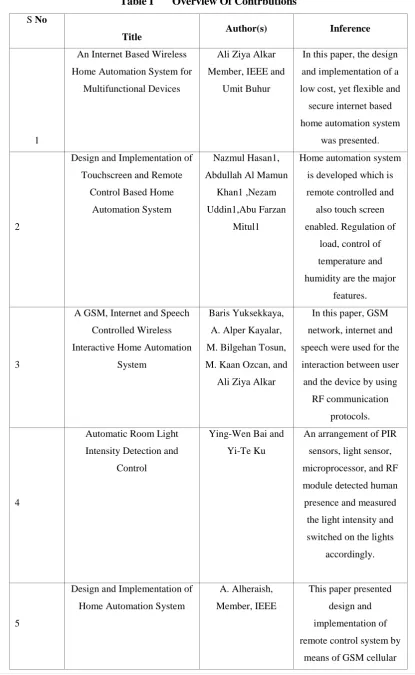
III. OVERVIEW OF CONTRIBUTIONS
Table I Overview Of Contrbutions
S NoTitle Author(s) Inference
1
An Internet Based Wireless Home Automation System for
Multifunctional Devices
Ali Ziya Alkar Member, IEEE and
Umit Buhur
In this paper, the design and implementation of a low cost, yet flexible and
secure internet based home automation system
was presented.
2
Design and Implementation of Touchscreen and Remote
Control Based Home Automation System
Nazmul Hasan1, Abdullah Al Mamun
Khan1 ,Nezam Uddin1,Abu Farzan
Mitul1
Home automation system is developed which is remote controlled and also touch screen enabled. Regulation of
load, control of temperature and humidity are the major
features.
3
A GSM, Internet and Speech Controlled Wireless Interactive Home Automation
System
Baris Yuksekkaya, A. Alper Kayalar, M. Bilgehan Tosun, M. Kaan Ozcan, and
Ali Ziya Alkar
In this paper, GSM network, internet and speech were used for the interaction between user and the device by using
RF communication protocols.
4
Automatic Room Light Intensity Detection and
Control
Ying-Wen Bai and Yi-Te Ku
An arrangement of PIR sensors, light sensor, microprocessor, and RF module detected human presence and measured the light intensity and switched on the lights
accordingly.
5
Design and Implementation of Home Automation System
A. Alheraish, Member, IEEE
S No
Title Author(s) Inference
communication network.
6
Home Network Configuring Scheme for All Electric Appliances Using
ZigBee-based Integrated Remote Controller
Il-Kyu Hwang, Member, IEEE and Dae-Sung Lee,
Jin-Wook Baek
The ZigBee protocol and infrared remote controller technology
were used to control electric appliances in the
home network with no extra attachment of communication device to
the appliances.
7
Building a Remote Supervisory Control Network
System for Smart Home Applications
Yu-Ping Tsou, Jun-Wei Hsieh, Cheng-Ting Lin, Chun-Yu
Chen
This paper showed us that the ZigBee technology represents high reliability, multi-hop network, secure, low power consumption, low costs, and fast reaction.
8
Interactive Remote Control of Legacy Home Appliances
Hyung-Bong Lee, Lae-Jeong Park, Sung-Wook Park,
Tae-Yun Chung, and Jung-Ho Moon
This paper proposed a bidirectional network
protocol for home automation which enabled the user to control appliances and to
receive feedback on the result of the action.
9
A Comparison of the Popular Home Automation Technologies Chathura Withanage, Rahul Ashok, Chau Yuen, Kevin Otto
Various protocols like Z-wave, Zigbee, X10 INSTEON EnOcean
were tested and compared.
10
Detecting Direction of Movement Using Pyroelectric
Infrared Sensors
Jaeseok Yun and Min-Hwan Song
Relative direction of human movement was detected by PIR sensors
whose dual sensing elements were aligned
S No
Title Author(s) Inference
Sensors for Indoor Lighting Control
Pandharipande and Shuai Li
by sensors which operate on photovoltaic cell
based on incident ambient light.
12
Cooperative and Progressive Design Experience for
Embedded Systems
J.W. Bruce, James C. Harden and R.B.
Reese
This paper gave an overview of microcontroller-based
projects composed of embedded systems and digital integrated circuits
and the methodology involved in their design.
13
An Integral and Networked Home Automation Solution
for Indoor Ambient Intelligence
Miguel A. Zamora-Izquierdo, José Santa, and Antonio F. Gómez-Skarmeta
University of Murcia
Home automation module (HAM) consists
of an embedded computer that’s connected with all appliances, sensors, and
actuators and this way intelligence is centralized. EIB and
Zig-bee are the main technologies used.
14
Learning Situation Models in a Smart Home
Oliver Brdiczka, James L. Crowley, and Patrick Reignier
With the help of a situation describing the environment, users and their activities, human
behavior can be modelled in accordance.
15
Component-Based Software Systems for Smart
Environments
Charles Herring and Simon Kaplan
A scenario was developed to illustrate how smart environments
S No
Title Author(s) Inference
a Modern
Home Automation System
Alessandro Gonella, Claudio E. Palazzi
automation system is made which is fully
customizable and scalable. For cost efficiency XBee is used with the microcontroller.
IV. CONCLUSION
In this paper, various techniques on home automation were reviewed. All of them have certain advantages and disadvantages. ZigBee is an open standard and is available to all. It also offers high data security and reliability. Hence, its demand has been growing rapidly. However, it is not compliable with all manufacturers, which is a disadvantage.
GSM is another way for doing home automation. It is an excellent choice if we want to cover an extensive area. It can cover up to 35 kilometers.
As EnOcean is self-powered, it has a very low energy usage. But its reliability is low. However, it has a lot of scope for improvement as it is a new technology and various research activities are going on in this field. X10 is one of the oldest home automation technologies and it has a very low cost. However, this advantage might not prevail if other newer technologies have comparable costs.
Home automation industry is expanding rapidly and there are many technologies to choose from based on the user’s requirements.
V. ACKNOWLEDGMENT
We would also like to thank Prof. O. N. Pandey (HOD, Instrumentation and Control Department) of JSSATE, Noida for always supporting us and encouraging us to do better.
We would also like to convey our sincere thanks to all the teachers of the ICE Department for their constant cooperation.
REFERENCE
[1] IEEE Transactions on Consumer Electronics, Vol. 51, No. 4, November 2005, “An Internet Based Wireless Home Automation System for Multifunctional Devices” by Ali Ziya Alkar Member, IEEE and Umit Buhur.
Home Automation System” by Nazmul Hasan, Abdullah Al Mamun Khan , Nezam Uddin, Abu Farzan Mitul.
[3] “A GSM, Internet and Speech Controlled Wireless Interactive Home Automation System” by Baris Yuksekkaya, A. Alper Kayalar, M. Bilgehan Tosun, M. Kaan Ozcan, and Ali Ziya Alkar, Member, IEEE. [4] Ying-Wen Bai and Yi-Te Ku, “Automatic Room Light Intensity Detection and Control Using a
Microprocessor and Light Sensors”, IEEE Transactions on Consumer Electronics, Vol. 54, No. 3, August 2008.
[5] “Design and Implementation of Home Automation System” by A. Alheraish, Member, IEEE.
[6] IEEE Transactions on Consumer Electronics, Vol. 55, No. 3, AUGUST 2009, “Home Network Configuring Scheme for All Electric Appliances Using ZigBee-based Integrated Remote Controller” by Il-Kyu Hwang, Member, IEEE and Dae-Sung Lee, Jin-Wook Baek.
[7] 2006 IEEE International Conference on Systems, Man, and Cybernetics, October 8-11, 2006, “Building a Remote Supervisory Control Network System for Smart Home Applications” by Yu-Ping Tsou, Jun-Wei Hsieh, Cheng-Ting Lin, Chun-Yu Chen.
[8] ZigBee Alliance, “ZigBee Specification”, Document 053474r17, Version 1.2, Nov. 2003. [9] IEEE Standard Association, Available: http://standards.ieee.org/getieee802/802.15.html
[10] “Interactive Remote Control of Legacy Home Appliances through a Virtually Wired Sensor Network” by Hyung-Bong Lee, Lae-Jeong Park, Sung-Wook Park, Tae-Yun Chung, and Jung-Ho Moon.
[11] 2014 IEEE Innovative Smart Grid Technologies, “A Comparison of the Popular Home Automation Technologies” by Chathura Withanage, Rahul Ashok, Chau Yuen, Kevin Otto.
[12] IEEE Sensors Journal, VOL. 14, NO. 5, MAY 2014, “Detecting Direction of Movement Using Pyroelectric Infrared Sensors” by Jaeseok Yun, Member, IEEE, and Min-Hwan Song.
[13] IEEE Sensors Journal, Vol. 13, No. 12, December 2013, “Light-Harvesting Wireless Sensors for Indoor Lighting Control” by Ashish Pandharipande and Shuai Li.
[14] Jalpa Shah, Lokesh Pathrabe, Brijesh Patel, “Wireless Smart Power Saving System For Home Automation”, 2012 1st International Conference on Emerging Technology Trends in Electronics, Communication and Networking, 2012.
[15] “Microcontroller based room automation”, Alex Joy, Athul S. Thoppil, Basil P Alias, Lekshmy S Kurup and Rini Varghese; IJAREEIE, Vol 4, Special issue 1, March 2015.
[16] Changseok Chia-Hung Lien, Chi-Hsiung Lin, Ying-Wen Bai, Ming-Fong Liu, and Ming-Bo Lin, “Remotely Controllable Outlet System for Home Power Management,” IEEE Tenth International Symposium on Consumer Electronics, 2006, ISCE/ 2006, pp. 7-12, June 28-July 1, 2006.
[17] D. Caicedo and A. Pandharipande, “Distributed illumination control with local sensing and actuation in networked lighting systems,” IEEE Sensors J., vol. 13, no. 3, pp. 1092–1104, Mar. 2013.
[18] V. Singhvi, A. Krause, C. Guestrin, J. H. Garret, Jr., and H. S. Matthews, “Intelligent light control using sensor networks,” in Proc. 3rd Int. Conf. Embedded Netw. Sensor Syst., 2005, pp. 218–229.
[20] “A Three-Terminal Silicon-PMOSFET-Like Light-Emitting Device (LED) for Optical Intensity Modulation” Volume 4, Number 6, December 2012, Kaikai Xu, Student Member, IEEE, G. P. Li, Member, IEEE.
[21] K. D. Hirschman, L. Tsybeskov, S. P. Duttagupta, and P. M. Fauchet, BSilicon-based visible light-emitting devices integrated into microelectronic circuits, Nature, vol. 384, no. 6607, pp. 338–341, Nov.1996. [22] IEEE Transactions on Industrial Informatics, Vol. 10, No. 1, February 2014 689, “Using Time-of-Flight
Measurements for Privacy-Preserving Tracking in a Smart Room”, Li Jia and Richard J. Radke.
[23] N. Sriskanthan and Tan Karande, “Bluetooth Based Home Automation Systems,” Journal of Microprocessors and Microsystems, Vol. 26, pp. 281-289, 2002.
[24] Neng-Shiang Liang; Li-Chen Fu; Chao-Lin Wu; “An integrated, flexible, and Internet-based control architecture for home automation System in the Internet era,” Proceedings ICRA 2002. IEEE International Conference on Robotics and Automation, Vol. 2, pp. 1101 –1106, 2002.