696 | P a g e
FAST AND EFFICIENT SEGMENTATION METHOD
USING MODIFIED CIRCULAR FUZZY SEGMENTOR
FOR IRIS RECOGNITION
Emmanvel Raj M. Chirchi
1, Dr. Ravindra D. Kharadkar
2 1Research Scholar, JNTUH, Kukatpally, Hyderabad-500085, Telangana State(India)
2
Principal, G. H. Raisoni Institute of Engineering & Technology, Pune, (India)
ABSTRACT
A novel approach is proposed in this paper is for iris segmentation and recognition in an iris based biometric
system. We used the modified circular fuzzy segmentor (MCFS) model to segment the pupil and iris inner
boundary. After accomplishing that, a binary encoder based feature extraction scheme Local Circular Encoder
(LCE) is proposed to exactly extract the significant features to do the iris recognition process. Once feature
extraction scheme is done by the LCE operator, the fuzzy logic classifier is used to achieve the recognition. For
our experiment we used three databases CASIA, MMU and UBIRIS to analyze the increase of the error rates
when the iris is inaccurately segmented. We selected 780 images of CASIA, MMU, UBIRIS databases to do the
segmentation by our proposed segmentation algorithm to achieve the accurate segment. From the
experimentation results, the proposed method of MCFS+LCE is outperformed than the existing methods.
Keywords-
Iris Recognition; MCFS; fuzzy logic classifier; Local Circular Encoder (LCE)
CASIA; MMU; UBIRIS
I. INTRODUCTION
697 | P a g e
slight ridges, grooves, furrows, vasculature, and other related features and marks. Comparing more features of the iris raises the likelihood of uniqueness. Therefore, for recognizing an individual, iris is declared to be the most accurate and dependable and has received widespread attentions over the last decade [12, 13, 14, 15, 16]. In this paper, our intention consists in the analysis of the relationship between the accuracy of the segmentation process and the error rates of typical recognition systems. In order to achieve this, we perform the following experimental procedure:
Selection of 780 images of the UBRIS (first version), CASIA and MMU databases. Manual verification that the used iris segmentation algorithm is able to accurately segment all the images.
A segmentation algorithm namely modified circular fuzzy segmentor (MCFS) is proposed to extract the region of interest (ROC) like pupil and iris identification.
Feature extraction on accurately segmented images: A binary texture feature called as local circular encoder (LCE) is proposed to extract significant iris features to do the recognition process.
Recognition: Recognition is done by the fuzzy logic classifier, which is divided the input iris image into whether recognize or not.
II. LITERATURE REVIEW
Using iris an abundant of researches has been suggested to attain personal identification and verification. A very few replicas utilize different iris segmentation algorithms for presenting more recognition among them. A robust iris recognition method has been offered by Y. Song et al [17] based on a sparse error correction model. In their method, all the training images are concatenated as a dictionary and the iris recognition task is cast to an optimization problem to look for a sparse representation of the test sample in terms of the dictionary. However, the overall complexities of their proposed algorithm become high. Moreover, an algorithm for iris recognition has been offered by K. Miyazawa et al [18] using phase-based image matching technique by means of phase components in 2D discrete Fourier transforms (DFTs) of specified images. But, it suffers to handle noisy conditions in illumination and camera to-face distances.
A method known as An Optimized Wavelength Band Selection for Heavily Pigmented Iris Recognition has been brought in by Y. Gong et al [17]. Commercial iris recognition systems usually obtain images of the eye in 850-nm band of the electromagnetic spectrum. The greatly pigmented iris images are incarcerated at 12 wavelengths, from 420 to 940 nm in their work. Their experimental effects proposed that there exists a most appropriate wavelength band for heavily pigmented iris recognition when employing a single band of wavelength as illumination. A possibility fuzzy matching approach with invariant properties has been suggested by C. C. Tsai et al [19], which can offer a robust and efficient matching scheme for two sets of iris feature points. In addition, they suggested an efficient iris segmentation method to process the identified inner and outer boundaries to soft curves. Nevertheless, the complexities of their iris pupil identification become high
698 | P a g e
of support vector machine and Hamming distance. Their approach as well employed parabola detection and trimmed median filter for the intention of eyelid and eyelash detection and removal, correspondingly. They showed that their method is computationally efficient and dependable. A weighted co-occurrence phase histogram (WCPH) has been offered by P. Lia et al [22] for symbolizing the local features of texture pattern and employs it to iris recognition. They assessed the performance of their technique on the UBIRIS.v2 database and assessed the vigor to noise of iris encoding and matching methods on the UBIRIS.v2 database. Nevertheless, their approach still suffers due to localization errors increase for the noisy for UBIRIS databases.
III. PROPOSED METHOD
An Intelligent Framework for Iris Recognition system is as shown in Fig.1.
The system starts with the segmentation stage, followed by feature extraction and lastly, recognition. First, pupil and irises are segmented and segmentations are evaluated.
Secondly, they are normalized by rubber sheet model to convert the rectangular conversion process. Then, a feature set is constructed based on LCE algorithm, which is newly designed operator for code generation process.
After getting the texture features, at last, fuzzy logic classifier is used for accurately and inaccurately segmented irises separately for recognition.
3.1
Segmentation through Modified Circular Fuzzy Segmentor (MCFS)
The proposed method of modified circular fuzzy segmentation (MCFCS) is explained with the following steps:
Step1: Binarization
At first, the input iris image is converted into binary image, which means it converts an image of up to 256 gray levels to a black and white image. The input image is given with a threshold value of 0.5. Threshold is selected based on the image contrast, apply the condition as in (1).
Otherwise Threshold y k grey B if y k Binary B , 1 ) , ( , 0 ) , ( …..(1)
Step2: Compute the horizontal & vertical run length quantization
After converting to binary image, the run length encoding (RLE) is applied for code representation as a pair representation based on its histogram. For example, if V=[1,1,1,1,0,0,1,1,1,1,1,1,1,1] is a vector to be encoded, then the run length encoding of V is H(V)=[(1,4),(0,2)(1,8)].
Subsequently, run length quantization is applied here as a procedure to replace all ones within a binary image with the corresponding run length coefficients re-quantized in unsigned 8-bit integer domain by some custom quantization function as follows:
rqf(V(n))min(255,max(1,round(255*V(n)/max(V(n))))).(2)
Where, V is the vector to be quantized and n is the index of its non-zero components. Above process is done by two directions like vertical and horizontal and corresponding quantized image is obtained.
699 | P a g e
Thereafter, modified Fast k-Means Image Quantization (MFKMQ) is applied on the horizontal and vertical run length quantized image to obtain pupil region. Commonly, Fast k-Means Image Quantization (FKMQ) is a variant of k-means algorithm designed for fast chromatic clustering in uint8 domain. It transforms the input image in an equipotential chromatic map [20] with k-levels by replacing each chromatic value with the closest centroid. A suboptimal (incomplete) variant of FKMQ [25] can be easily derived by imposing termination in a small number of iterations while resetting the first centroid to the minimum available value (or to zero). In this way, the input image is forced to reveal its own range of darkness (numerical meaning of darkness according to the image histogram) and to return a handler to that area covered by lower chromatic values. Due to the modification in the FKMQ, the pupil region is accurately extracted, which improves the performance of the FKMQ. This is particularly useful in detecting the pupil location.
Fig.1: Intelligent framework for iris recognition system
Step 4: Pupil identification
Based on the vertical and horizontal pupil quantized image, the common region is selected and this region is named as pupil cluster.
Step 5: Iris segmentation
Finally, a circle is drawn named as iris region using the pupil circle.
3.2
Iris Normalization
700 | P a g e
consistent value. Here, the iris area i.e. polar coordinate is converted Cartesian coordinates. Therefore, iris area is obtained as a normalized strip with regard to iris boundaries and pupillary center. The homogenous rubber sheet model is devised by Daugman in 1993 used for normalization process
Daugman’s Rubber Sheet Model
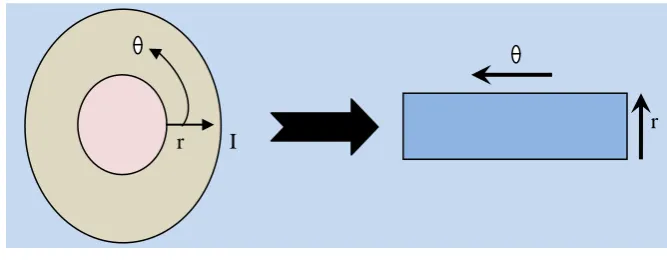
Once the iris image is efficiently localized, then the next step is to transform it into the rectangular sized fixed image. The transformation process is carried out using the Daugman’s Rubber Sheet Model [29] and is shown in Fig. 2.
Fig.2:Daugman’s Rubber Sheet Model
For every pixel in the iris, an equivalent position is found out on polar axes. The process comprises of two resolutions: Radial resolution, which is the number of data points in the radial direction and Angular resolution, which is the number of radial lines generated around iris region. Using the following equation, the iris region is transformed to a 2D array with horizontal dimensions of angular resolution and vertical dimension of radial resolution. ) , ( )] , ( ), , (
[xr yr I r
I
Where,
I
(
x
,
y
)
is the iris region,(
x
,
y
)
and(
r
,
)
are the Cartesian and normalized polar coordinates respectively. The range of
is[
0
2
]
andr
is[
0
1]
.x
(
r
,
)
andy
(
r
,
)
are defined as linear combinations set of pupil boundary points. The formulas given in the following equations perform the transformation, ) ( ) ( ) 1 ( ) ,(r r xp xi
x
) ( ) ( ) 1 ( ) ,
(r r yp yi
y
) ( )
( )
( x 0 r Cos
xp p p
) ( )
( )
( y 0 r Sin
yp p p
) ( ) ( )
( x0 rCos xi i i
) ( ) ( )
( y0 rSin
yi i i
Where, ( , )
p p y
x and (xi,yi)are the coordinates on the pupil and iris boundaries along the
direction.) ,
(xp0 yp0 ,(xi0,yi0)are the coordinates of pupil and iris centers [27].
0
701 | P a g e
IV. FEATURE EXTRACTION
Once the iris segmentation is over, eyelid and eyelash pixels are identified using MCFS method and then the feature extraction is performed using Local Circular Encoder (LCE) algorithm. To start this method, Daugman’s Rubber Sheet Model is used to convert circular to rectangular conversion (CTRC) operation. The main task of it is to generate a rectangular strip from segmented iris to form a rectangular matrix with a consistent value. Here, the iris area i.e. polar coordinate is converted Cartesian coordinates. Therefore, iris area is obtained as a normalized strip with regard to iris boundaries and pupillary centre. The homogenous rubber sheet model is devised by Daugman in 1993 used for normalization process. Then, the rectangular iris image is applied for the code generation process using LCE method. Once the rectangular conversion is over, the code generation is done through the Local Circular Encoder (LCE). In order to design, weighted-based neighbor computation process is presented to remove or process that corrupted iris parts based on the quality assumption. The weighted-based neighbor computation is done by three domain information like spatial, Gabor and wavelet. The detailed process of the LCE method described step by step:
Step1: Let the spatial domain image (rectangular array) be denoted as
I
(
i
,
j
)
, the wavelet domain image (via LL band) be denoted asI
w(
i
,
j
)
and the Gabor domain image (using Gabor filterI
w(
i
,
j
)
) be denoted as)
,
(
i
j
I
g , the resultant binary code through wavelet domainI
w(
i
,
j
)
be denoted ascode
A, the resultant binarycode through Gabor domain
I
g(
i
,
j
)
be denoted ascode
B, the resultant binary code through the original rectangular arrayI
(
i
,
j
)
be denoted ascode
C, the obtained single binary 8-bit code via OR operation can be denoted asB
s.Step2:Partition the rectangular array
I
(
i
,
j
)
into 3*3 sub blocks with centre blockX
C.Step3:Apply a Gabor filter to the resultant rectangular array image
I
(
i
,
j
)
(original) to extract texture information. Therefore, the texture of iris is encoded by 2D multi-directional Gabor filter. Typically, an input arrayI
(
i
,
j
),
(
i
,
j
)
(
- set of image points), is convolved with a 2-D Gabor function
)
,
(
),
,
(
i
j
i
j
g
to obtain a Gabor feature imager
(
i
,
j
)
and the resultant binary code as follows:
g
i
j
d
d
I
j
i
r
(
,
)
(
,
)
)
,
(
Finally,
Code
A
r
(
i
,
j
)
33Step4: On other hand, a wavelet transform is applied to extract low and high band information. Following that, it decomposes four sub bands like LL, LH, HL and HH. In this study, LL band is used to computation process. According to this, binary code is generated from each 3*3 block in LL sub band.
(
,
)
33
I
i
j
702 | P a g e
Step5: In addition, the resultant binary code is obtained through the original rectangular array
I
(
i
,
j
)
(spatial domain). Mathematically, this transformation can be represented as
(
,
)
33
I
i
j
Code
CBy combining these three domain information (i), (ii) and (iii) using OR operation, we obtain single 8-bit binary code, it can be represented as follows
)
,
,
(
A B Cs
OR
Code
Code
Code
B
Step6: The 8-bit binary code
B
sis converted as equal decimal numberD
sand it is replaced in same position ofI
(
i
,
j
)
. This process is repeated for all 3*3 blocks to obtainI
out(
i
,
j
)
.V. MATCHING OR RECOGNITION VIA FUZZY LOGIC SYSTEM
The testing iris image
N
is given to the fuzzy logic system, where the test iris data is converted to the fuzzified value based on the fuzzy membership function. Then, the fuzzified input is matched with the fuzzy rules defined in the rule base. Here, the rule inference procedure is used to obtain the linguistic value that is then converted to the fuzzy score using the average weighted method. From the fuzzy score obtained, the decision is generated whether the test iris image belongs to the recognition or not.VI. RESULTS AND DISSCUSSION
Proposed results are carried on MATLAB
-
2013b version- 8.1.0.604, using three dataset CASIA, MMU and UBIRIS. Performance evaluation is based on the parameter Accuracy, FAR and FRR.6.1
Effectiveness of the segmentation performance
The accuracy of iris recognition highly depends on the accuracy of segmenting the iris and pupil or region of interest. Fig.3 illustrates the segmentation performance of the proposed against existing approach namely circular fuzzy segmentation (CFS) [28].
703 | P a g e
The Fig.3 indicate that the proposed segmentation method of MCFS performs better accuracy than the CFS [28] method. From the Fig.3, our MCFS method achieves better accuracy value of 88%, which is higher than the CFS algorithm (78%). Overall, the given method reports a fact: some of the irises could not be segmented accurately using CFS algorithm. However, our proposed method of MCFS was segmented maximum number of iris images than the CFS algorithm.
6.2
Effectiveness of the recognition performance
The methods proposed by PBIM approach [27], SURF approach [28] are the best known among existing systems for iris recognition. In [27], phase based iris recognition is proposed using Fourier Phase Code (FPC) for representing iris information. A major problem of their approach is that the 2D FPC does not contain amplitude spectrum and the actual iris image cannot be reconstructed from the 2D FPC. In [28], the authors have developed an iris recognition system. However, their system is developed to localize the inner pupil boundary accurately for most samples from the CASIAV3 database but fails to localize the outer iris boundary. However, errors due to localization increase for the noisy and low resolution and UBIRIS databases. The proposed method of MCFS-LCE is performed on three benchmark datasets like CASIA, MMU and UBIRIS. Hybridization of modified k-means and fuzzy logic classifier is well suited to improve the recognition process. The performance of the proposed recognition method is analyzed by accuracy, false acceptance rate (FAR) and false rejection rate (FRR) and presented in Figures 3, 4 and 5. As seen in the figures, the proposed method of MCFC-LCE had the highest accuracy, FAR and FRR rate for all iris images compared to the existing methods. For example (for UBIRIS database), the proposed method (MCFC-LCE) gave 99.14% of accuracy and 0.0076 of FAR and 0.0051 of FRR, the PBIM approach [15] which gave 87% of accuracy and 45% of FAR and 7% of FRR, followed by the SURF approach [16] which gave 94% of accuracy and 39% of FAR and 6% of FRR. Overall, the proposed method of MCFC gives the better recognition results than the existing algorithms.
704 | P a g e
Fig. 5: Recognition performance of the proposed against existing systems [27] and [28] based FRR
Fig. 6: Recognition performance of the proposed against existing systems [27] and [28] based FAR measure
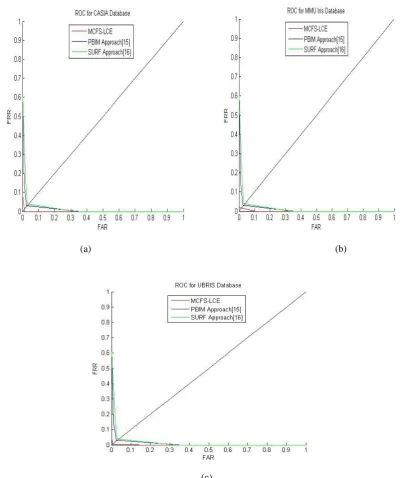
Detection Error Tradeoff (DET) performance
705 | P a g e
(a) (b)
(c)
Fig. 7: Detection Error Tradeoff (DET) curves obtained for the CASIA, MMU and UBRIS databases
VII. CONCLUSION
706 | P a g e
of segmentation is robust and achieved the gain in performance results. Our experimental results shown that, the proposed method of MCFS+LCE is outperformed than the existing methods. Our future work includes how to improve the robustness to segmentation error with different types of real-time and benchmark datasets found throughout the world.
REFERNCES
[1] E. Lupu and P. G. Pop, “Multimodal Biometric Systems Overview”, Acta Technica Napocensis, Electronics and Telecommunications, Vol. 49, No. 3, 2008.
[2] K. Jain, R. Bolle and S. Pankanti, eds., “Biometrics: Personal Identification in Networked Society”, Kluwer Academic Publishers, Vol. 479, 1999.
[3] D. Zhang, “Biometrics Technologies and Applications”, Proc. of International Conference on Image and Graphics, Tianjing, China, pp. 249-254, 2000.
[4] G. Lawton, “Biometrics: A New Era in Security”, IEEE Computer, pp. 16-18, Aug. 1998.
[5] H. Zhuang, T. Theerawong, X. Guan and S. Morgera, “A Method for Creating 3D Face from a 2D Face
Image”, Florida Conference on Recent Advances in Robotics (FCRAR 2006), Miami, Florida, May, 2006.
[6] V. S. Meenakshi and G. Padmavathi, “Securing Iris Templates using Combined User and Soft Biometric
based Password Hardened Fuzzy Vault”, (IJCSIS) International Journal of Computer Science and Information Security, Vol. 7, No. 2, 2010.
[7] M. Baca and K. Rabuzin, “Biometrics in Network Security”, The Proceedings of the XXVIII International Convention MIPRO 2005, Rijeka, pp. 205-210, 2005.
[8] K. Jain, A. Ross and S. Prabhakar, “An introduction to biometric recognition”, IEEE Trans. on Circuits and Systems for Video Technology, Vol. 14, No. 1, pp. 4-20, 2004.
[9] G. Chellin, J. Chandran and R. S. Rajesh, “Performance Analysis of Multimodal Biometric System
Authentication”, IJCSNS International Journal of Computer Science and Network Security, Vol. 9, No. 3, 2009.
[10] P. Manikandan and M. Sundararajan, “Discrete Wavelet Features Extraction for Iris Recognition Based
Bio Metric Security”, International Journal of Electronic Engineering Research, Vol. 2, No. 2, pp. 237-241, 2010.
[11] C. Y. Yam, M. S. Nixon and J. N. Carter, “Gait Recognition by Walking and Running: A Model-Based
Approach”, ACCV 2002: The 5th Asian Conference on Computer Vision, pp. 1-6, 2002.
[12] L. Ma, T. Tan, Y. Wang and D. Zhang, “Personal Recognition Based on Iris Texture Analysis”, IEEE Transactions on Pattern Analysis and Machine Intelligence, Vol. 25, No. 12, pp. 1519-1533, 2003.
[13] A. M. Sarhan, “Iris Recognition Using Discrete Cosine Transform and Artificial Neural Networks”, Journal of Computer Science, Vol. 5, No. 5, pp. 369-373, 2009.
[14] S. Dey and D. Samanta, “Improved Feature Processing for Iris Biometric Authentication System”, International Journal of Computer Systems Science and Engineering (IJCSSE), World Academy of Science, Vol. 4, No. 2, pp. 127-134, 2008.
[15] K. Miyazawa, K. Ito, T. Aoki, K. Kobayashi and H. Nakajima, “An Effective Approach for Iris
707 | P a g e
[16] H. Mehrotra, P. K. Sa and B. Majhi, “Fast segmentation and adaptive SURF descriptor for irisrecognition”, Mathematical and Computer Modelling, Vol. 58, No. 1, pp. 132-146, 2013.
[17] S. Dey and D. Samanta, “A Novel Approach To Iris Localization For Iris Biometric Processing”,
International Journal of Biological and Life Sciences, Vol. 3, No. 3, pp. 180-191, 2007.
[18] W. Boles and B. Boashash, “A human identification technique using images of the iris and wavelet
transform”, IEEE Transaction of Signal Processing, Vol. 46, No. 4, pp. 1185-1188, 1998.
[19] S. Lim, K. Lee, O. Byeon and T. Kim, “Efficient iris recognition through improvement of feature vector
and classifier”, Journal of Electrical Technical Research Institute, Vol. 23, No. 2, pp. 61-70, 2001.
[20] S. P. Narote, A. S. Narote and L. M. Waghmare, “Iris Based Recognition System using Wavelet
Transform”, International Journal of Computer Science and Network Security, Vol. 9, No. 11, pp. 101, November 2009.
[21] N. P. Bodorin, “Circular Fast Fuzzy Iris Segmentation & Fast k-Means Quantization Demo Programs”, June 2009,
[22] N. P. Bodorin, “Fast k-Means Image Quantization algorithm and its application to iris segmentation”, Scientific Bulletin, University of Pitesti, No. 14, 2008.
[23] J. Daugman, “How Iris Recognition Works”, In Proceedings of International Conference on Image Processing, Vol.1, pp. I-33- I-36, 2002.
[24] S. Chiu, “Fuzzy model identification based on cluster estimation,” Journal of Intelligent & Fuzzy Systems, Vol. 2, No. 3, pp. 267-278, 1994.
[25] H. Proença and L. A. Alexandre, “Ubiris: a noisy iris image database”, In International Conference on Image Analysis and Processing, Vol. 3617, pp. 970-977, 2005.
[26] J. Horst, “Iris Recognition: A General Overview”, Journal of Student Research, pp. 19-23, 2006.
[27] S. Uma Maheswari, P. Anbalagan and T. Priya, “Efficient Iris Recognition through Improvement in Iris
Segmentation Algorithm”, International Journal on Graphics, Vision and Image Processing, Vol. 8, No. 2, pp. 29-35, 2008.
[28] N. P. Bodorin, “Circular Fast Fuzzy Iris Segmentation”, Department of Mathematics and Computer Science, Spiru Haret University, 2009.
[29] H. Proença, S. Filipe, R. Santos, J. Oliveira and L. A. Alexandre, “The UBIRIS.v2: A database of visible
![Fig. 4: Recognition performance of the proposed against existing systems [27] and [28] based Accuracy](https://thumb-us.123doks.com/thumbv2/123dok_us/7773089.1280701/8.595.187.406.482.685/fig-recognition-performance-proposed-existing-systems-based-accuracy.webp)
![Fig. 5: Recognition performance of the proposed against existing systems [27] and [28] based FRR](https://thumb-us.123doks.com/thumbv2/123dok_us/7773089.1280701/9.595.188.409.90.304/fig-recognition-performance-proposed-existing-systems-based-frr.webp)