MODELING AND COMPENSATING MEMORY EFFECT IN HIGH POWER AMPLIFIER FOR OFDM SYSTEMS
H. Karkhaneh, A. Ghorbani, andH. Amindavar
Department of Electrical Engineering Amirkabir University of Technology Hafez Avenue, Tehran, Iran
Abstract—This paper is concerned with a new time-domain modeling topology for signals which is appliedto OFDM systems. This model is a more accurate based on Wiener approach. Also the memory effect will be shown using two-tone intermodulation distortion (IMD) measurement with different tone frequency spacing and power levels. Next adaptive predistorter to counterbalance the AM/AM andAM/PM nonlinear effects of the transmitter power amplifier is proposedby Hammerstein approach. Finally we consider the effectiveness of proposedmethodon performance of OFDM signal as the wideband system by reduction of distortion. It is confirmed by computer simulation that proposedapproach produces a faster convergence speed than the previous adaptive predistortion technique.
1. INTRODUCTION
Orthogonal frequency division multiplexing (OFDM) is currently under significant investigation due to a high spectral efficiency and immunity to multipath fading and impulse noise. Usage of an appropriate guard interval in OFDM can easily prevent intersymbol interference (ISI) andinterchannel interference (ICI), whereas powerful equalization techniques are requiredfor single carrier modulation. However, OFDM-basedsystems are subject to be significantly sensitive to nonlinear distortion, usually caused by a high power amplifier [1–3].
computationally efficient means to relate the input complex envelope to the output complex envelope without resorting to a physical level analysis of the PAs. Behavioral models for PAs can be classified into three categories depending on the existence of memory effects [7–9]: memoryless nonlinear systems, quasi-memoryless nonlinear systems, andnonlinear systems with memory. For the memoryless nonlinear system, the PA block is representedby the narrow-bandAM/AM transfer function. For the quasi-memoryless nonlinear system, with memory time constants on the order of the period of the RF carrier, the PA block is often representedby AM/AM andAM/PM functions. Usually, AM/AM andAM/PM are measuredby sweeping the power of a single tone in the center frequency of the passbandof the RF PA. For a nonlinear system with long-term memory effects, on the order of the period of the envelope signal, the system response depends not only on the input envelope amplitude, but also its frequency. An alternate view is that the AM/AM andAM/PM functions appear to change as a function of past input levels. Such effects may arise in high power amplifiers (HPAs) from thermal effects, as well as long time constants in dc-bias networks.
A nonlinear system with memory can be representedby Volterra series, which are characterizedby Volterra kernels [8]. However, the computation of the Volterra kernels for a nonlinear system is often difficult and time consuming for strongly nonlinear devices. In many applications that involve modeling of nonlinear systems, it is convenient to employ a simpler model. The Wiener model, which is cascade connection of linear time invariant (LTI) system andmemoryless nonlinear system, has been usedto model nonlinear PAs with memory [7, 10–16]. The Wiener model that is frequency-dependent memoryless nonlinear model yields identical shape, but only creates a shift with reference AM/AM andAM/PM curves [17].
In order to reduce performance degradation in OFDM systems, compensation of nonlinear distortion is required. Several prefiltering techniques for a memoryless nonlinear system, preceded by a linear system, have been reported[18, 19].
In this paper, we propose a more accurate model based on the Wiener model developed by Schetzen [8].
2. AM/AM AND AM/PM AND TWO TONE RESPONSE
A bandpass input signal of a PA can be represented as (1),
v(t) = Re{g(t)ejωct}=r(t) cos(ω
ct+θ(t)) (1) Whereg(t) is the input complex envelope signal,ωcis the carrier center frequency,r(t) is the amplitude of θ(t), andis the phase ofg(t).
The nonlinear device such as a PA is usually represented by Power series of input signal, the bandpass output signal of the PAw(t), which consists of (2n−1)th-order of power series, can be described as follows:
w(t) = Re{f(t)ejωct}
f(t) = n
k=1
α2k−1|g(t)|2(k−1)g(t) =
n
k=1
α2k−1r(t)2k−1ejθ(t). (2)
In (2), the odd order complex power series is defined as
F(r(t)) = n
k=1
α2k−1r(t)2k−1 (3)
AM/AM andAM/PM characteristic functions can then be jointly representedby F(r(t)) as follows:
w(t) =|F(r(t))|cos(ωct+θ(t) + F(r(t))) (4) Using the complex envelopef(t), AM/AM andAM/PM can be directly relatedwith the two-tone response andvice versa. The two-tone input, which has magnitude A/2 andphase ϕ(t) for each tone, which tone spacing 2ωm, can be described as:
v(t) = A
2[cos((ωc−ωm)t+ϕ(t)) + cos((ωc+ωm)t+ϕ(t))] = Acos(ωmt) cos(ωct+ϕ(t)) (5) For this two-tone input, the complex envelopeg(t) isAcos(ωmt)ejϕ(t). The output complex envelope f(t) can then be acquiredas follows:
f(t) = n
k=1
0 5
10 15
20
15 20 25 30
Tone-Spacing (MHz) Pin (dBm)
15 20 25 30 35
35
5
Figure 1. IMD3 versus tone spacing andpower input.
3. ADAPTIVE DEVELOPMENT OF PA IN AND OFDM SYSTEM
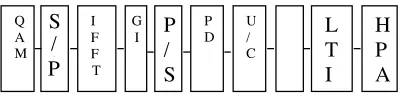
A primitive block diagram of the OFDM transmission system is shown in Fig. 2. The serial-to-parallel block converts a QAM input data stream to a block of N symbols, which modulates the corresponding subcarrier. To cancel the ISI andthe ICI after OFDM modulation which is done by the IFFT, the guard interval that is longer than the largest delay spread is inserted. The linear filter in Figure 2 represents the transmitter pulse shaping filter usually placedat the basebandor at the IF stage. From Fig. 2, it can be seen that a SolidState PA (SSPA) preceded by a linear filter can be well modeled by the Wiener system, which consists of a memoryless nonlinear subsystem preceded by a linear dynamic subsystem [21].
Q A M
I F F T
P / S
U / C P
D L
T I
H P A /
P S
/ P
I G
Figure 2. A simplifiedblock diagram of an OFDM transmitter.
) (k d
Memoryless
Nonlinearity LTI LTI HPA
Memoryless Nonlinearity LTI
δ −
Z
Adaptive Adaptive
Algorithm )
(k
x u(k) v(k) y(k)
) (k e
) (k eT
Algorithm
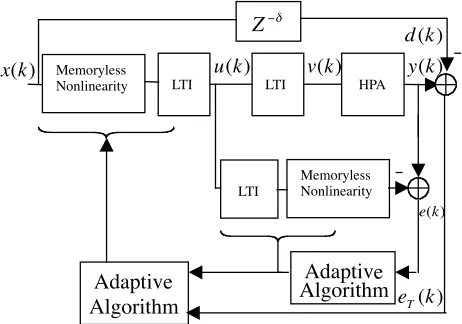
Figure 3. An adaptive predistorter for the HPA preceded by a linear filter.
If the SSPA can be approximatedby a polynomial form of finite order, the input and output relationship of the system is given by
y(k) = P
p=1
γp·v(k)p (7)
v(k) = N
n=0
βnx(n−k) (8) WhereN and P respectively, denote the memory length of the linear filter, andthe order of the nonlinear filter. Also,x(n) denotes the input signal of the linear filter. Using only the input andoutput signals of the system, the coefficients of the system estimator, γp and βn, are adjusted to minimize the mean square error,E{|e(k)|2}betweenyand
ymeas.
y(k) = P
p=1 γp·
N
n=0
βnx(n−k) p
(9)
function (polynomials) is invertible, andc) there is no noise in the system. Assuming this, it is possible to calculate the intermediate variable as described in eq. (10),
v(k) = N
n=0
βnx(n−k) = P
p=1
ξp·y(k)p (10) So then, eq. (10) describes an equation where the parameters come in linearly andthus can be estimatedby linear regression. The error that wants to be minimizedis describedin eq. (11), where to avoidthe trivial solution (γ, β = 0), it is possible to fix one parameter without loss of generality due to the over parameterization [13]. Since it can be usednormalizeddata we fix ξ1 = 1.
e(k) = y(k)− P
p=2
ξpy(k)p− N
n=0
βnx(k−n)
(11)
e(k) = y(k)−ηk·gk (12) Where,
ηk = [ξ2, . . . , ξP, β0, β1, . . . , βN]
g(k) = [y(k)2, . . . , y(k)P, x(k), x(k−1), . . . , x(k−N)] Once the quadrative criterion {min l
k=1
(e(k))2} is minimized, the
intermediate variablev(k) is available as follows
ηk+1=ηk−µη
∂|e(k)|2
∂ηk
(13)
Where µη represents the step-size constant of ηk andit controls stability andthe convergence speedof the algorithm. So the normalized updating equation as follows:
ηk+1 =ηk+µη
e(k)∗·gk
ε+|gk|2
(14)
Considering eq. (14) parameters which are needed for knowing the output data can be derived.
4. AN ADAPTIVE NONLINEAR PREDISTORTER IN AN OFDM SYSTEM
be designed. The usual inverse structure of the Wiener system is the Hammerstein model [23]. As it can be seen the predistorter in Figure 3 is constructedby a memoryless nonlinear inverse filter cascadedby a linear inverse filter. By using a polynomial form of finite order as the memoryless nonlinear inverse filter, the predistorter can be expressed as
u(k) = M
m=0 λm
Q
q=1
αqxq(k−m) (15) Where M denotes the memory length of the linear inverse filter λm, and Qdenotes the order of the nonlinear inverse filterαq.
v(k) = N
n=0 βn
M
m=1 λm
Q
q=1
αqxq(k−m−n)
(16)
v(k) = βk·CkT ·Rk (17) Where
Ck = [λ0α1, . . . , λ0αQ, λ1α1, . . . , λ1αQ, . . . , λmαQ]
Rk = [rk, rk−1, . . . , rk−N]
rk = [x(k), . . . , xQ(k), x(k−1), . . . , xQ(k−1), . . . , xQ(k−M)]
Rk =
x(k) x(k−1) · · · x(k−N)
..
. ... ... ...
xQ(k−M) xQ(k−1−M) · · · xQ(k−N −M)
The error of the total system is defined by
eT(k) =v(k)−βkCkTRk (18) To update the coefficients Ck we apply an adaptive method like the previous section as follows
Ck+1 = Ck−µc∇ck|e(k)|
2 (19)
Ck+1 = Ck+
µ ε+|Rk·βk|2
e∗(k)·Rk·βk (20) The error of the total system is defined by
eT(k) =d(k)−y(k) (21) where the desired signald(k) is the delayed version of the input signal
5. COMPUTER SIMULATION
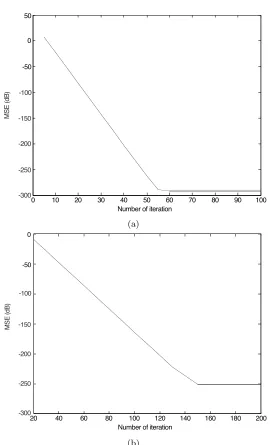
In this section, a computer simulation is usedto demonstrate the validity of the proposed PA model and the predistortion technique for compensation of a class-A PA designed with the Agilent ATF-34143 PHEMT transistor. The serial-to-parallel converter transfers a block of 1024 16-QAM symbols to the OFDM modulator. For close examination of the effectiveness of the predistorter in compensating the nonlinear distortion, it was assumed that the multipath fading effect is completely compensated, resulting in an additive white Gaussian noise (AWGN) channel. The parameters of the Wiener system, the SSPA precededby the linear filter, were first estimatedby the system estimator. The order of the memoryless nonlinear part of the PA, N, in the system estimator was set to five in the system estimator was set to five in order to model only significant nonlinear distortions of SSPA with a minimal number of parameters. The memory length of the linear filter, P, was set to three. Figure 4(a) shows the value of MSE for different iteration number that results a very fast convergence with proposedmethod. We choose 50 iteration number for investigating the performance of the OFDM system The PA parameters were updated simultaneously using the stochastic gradient method. Also the step-size constants, which determine convergence speed and MSE after convergence, were set to 0.09 for the linear filter and0.1 for the nonlinear filter. With zero initial condition, about 263.3 dB in the MSE was obtained, resulting in a fairly accurate estimation of filter coefficients for the Wiener system under test in comparing [24].
After having checkedthe convergence of the MSE in the system estimator, the proposedadaptive algorithm was appliedto obtain filter coefficients of the predistorter. The order of the nonlinear inverse filter, M, andthe memory length of the linear inverse filter, Q, in the predistorter were set to numbers large enough to model inverse functions, seven andten, respectively. Again Figure 4(b) shows the value of MSE for different iteration number for predistorter. The step-size constant for predistorter was set to 0.02. The consequence convergence of MSE to −67.13 for 50 numbers of iteration which was tradeoff between speed and accuracy, signifies that the proposed adaptive predistorter is effective in compensating the linear and nonlinear distortion present in the Wiener system even with a small number of filter taps. As it can be observedin Figure 5, the output spectrum of the OFDM signal provided by the wiener model resemble the real PA output power spectrum exactly.
0 10 20 30 40 50 60 70 80 90 100
MSE
(d
B
)
Number of iteration 50
0
-50
-100
-150
-200
-250
-300
(a)
20 40 60 80 100 120 140 160 180 200
Number of iteration
MSE
(d
B
)
0
-50
-100
-150
-200
-250
-300
(b)
5190 5200 5210 5220 5230 5240 5250 5260 frequency
Real PA
Wiener Model 0
-50
PSD
-60 -40 -30 -20 -10
Figure 5. Output power spectra of an OFDM signal for: a real PA, a wiener based PA model (Output backoff = 4 dB).
5180 5190 5200 5210 5220 5230 5240 5250 5260 Frequency
Output with PD Output without PD 0
-50
PSD
-60 -40 -30 -20 -10
-70
-80 -90
Figure 6. Output power spectra of an OFDM signal with andwithput PD.
REFERENCES
“Three-dimensional localization system for impulsive noise sources using ultra-wideband digital interferometer technique,” Journal of Electromagnetic Waves and Applicantions, Vol. 20, No. 4, 515– 530, 2006.
3. Hua, J., L. Meng, andZ. Xu, “A new methodfor SNR and Dippler shift estimation in wireless propagations,” Journal of Electromagnetic Waves and Applicantions, Vol. 21, No. 15, 2431– 2441, 2007.
4. Ghorbani, andM. Sheikhan, “The effect of solidstate power amplifiers (SSPAs) nonlinearities on MPSK andM-QAM signal transmission,” Sixth Int’l Conference on Digital Processing of Signals in Comm., 193–197, 1991.
5. Singh, G., “Analytical study of the interaction structure of vane-loaded gyro-traveling wave tube amplifier,” Progress In Electromagnetics Research B, Vol. 4, 41–66, 2008.
6. Xu, Y. H., Y. Guo, L. Xia, andY. Q. Wu, “An support vector regression basednonlinear modeling methodfor SIC mesfet,”
Progress In Electromagnetics Research Letters, Vol. 2, 103–114, 2008.
7. Vuong, T. and A. F. Guibord, “Modeling of nonlinear elements exhibiting frequency-dependent AM/AM and AM/PM transfer characteristics,”Can. Electr. Eng. J., Vol. 9, No. 3, 112–116, 1984. 8. Schetzen, M., “Nonlinear system modeling based on theWiener
theory,” Proc. IEEE, Vol. 69, 1557–1573, Dec. 1981.
9. Bosch, W. andG. Gatti, “Measurement andsimulation of memory effects in predistortion linearizers,” IEEE Trans. Microwave Theory Tech., Vol. 37, 1885–1890, Dec. 1989.
10. Poza, H. B., Z. A. Sarkozy, andH. L. Berger, “A wideband data link computer simulation model,”Proc. IEEE Nat. Aerospace Electron. Conf., 71–78, 1975.
11. Makeeva, G. S., O. A. Golovanov, andM. Pardavi-Horva “Mathematical modeling of nonlinear waves and oscillations in gyromagnetic structures by bifurcation theory methods,”Journal of Electromagnetic Waves and Applicantions, Vol. 20, No. 11, 1503–1510, 2006.
12. Guo, Y. andR. M. Xu, “Ultra-widebandpower split-ting/combining technique using zero-degree left-handed transmis-sion lines,”Journal of Electromagnetic Waves and Applicantions, Vol. 21, No. 8, 1109–1118, 2007.
Commun., Vol. COM 29, 1715–1720, Nov. 1981.
14. Fakoukakis, F. E., S. G. Diamantis, A. P. Orfanides, and G. A. Kyriacou, “Development of an adaptive and a switched beam smart antenna system for wireless communications,”
Journal of Electromagnetic Waves and Applicantions, Vol. 20, No. 3, 399–408, 2006.
15. Abuelma, M. T., “Frequency-dependent nonlinear quadrature model for TWT amplifiers,” IEEE Trans. Commun., Vol. COM-32, 982–986, Aug. 1984.
16. Muha, M. S., C. J. Clark, A. A. Moulthrop, andC. P. Silva, “Validation of power amplifier nonlinear block models,” IEEE MTT-S Int. Microwave Symp. Dig., 759–762, 1999.
17. Blum, R. andM. C. Jeruchim, “Modeling nonlinear amplifiers for communication simulations,” IEEE Int. Commun. Conf., 1468– 1472, Boston, MA, 1989.
18. Karam, G. and H. Sari, “A data predistortion technique with memory for QAM radio systems,”IEEE Trans. Commun., Vol. 39, 336–344, Feb. 1991.
19. Eun, C. S. andE. J. Powers, “A predistorter design for a memoryless nonlinearity preceded by a dynamic linear system,”
Proc. GLOBECOM, 152–156, 1995.
20. Mandeep, J., A. Lokesh, S. Hassan, M. n. Mahmud, and M. Ain, “Design of Cartesian feedback RF power amplifier for L-band frequency range,”Progress In Electromagnetics Research B, Vol. 2, 207–222, 2008.
21. Greblicki, W., “Nonparametric identification of Wiener systems,”
IEEE Trans. Inform. Theory, Vol. 38, 1487–1493, Sept. 1992. 22. Hagenblad, “Aspects of the identification of Wiener models,”
Ph.D. Thesis, Division of Automatic Control, Department of Electrical Engineering Link¨opings Universitet, Sweden, 1999. 23. Mao, S. Y. andP. X. Lin, “A test of nonlinear autoregressive
models,” Proc. Int. Conf. Acoustics, Speech, and Signal Processing, 2276–2279, New York, 1988.