Available online: https://edupediapublications.org/journals/index.php/IJR/ P a g e | 1503
Consumer’s Choice as a Function of Consumption
Practices for Indigenous Functional Foods
DR. MOOL CHAND Associate Professor in Commerce
Dronacharya Govt. College, Gurgaon (Haryana)
Abstract: Consumption practices of the various functional food products were assessed by
the Interviewing consumers with the structured questionnaire. Focus group discussion revealed various function foods commonly consumed in the research locale. There were different griopus of product found to be consumed like namely curries/dhals, sweets, drinks, medicinal foods, Chutneys and others. It appeared that under different circumstances food choices vary and are influenced significantly by consumer’s consumption patterns including socio-economic restrictions. Scenario analysis based on various consumer practices affecting the choice as the most promising food for innovation.
Keywords: Traditional Functional Foods, Health Foods, Dietary Practices, Consumption
Practices, Food Innovation & Convenience.
Introduction:
The functional foods market has been growing with a rapid pace as there has been increase in the non-communicable diseases. New products are continuously launched, making intense competition. Consumers have more choices available and thus, products need to be developed considering what consumers desire (Linnemann et al 2006). IN this row, consumer awareness of the functional foods or in general any food is also important as per the selection of the product is concerned (Brown et al 2011). Consumer acceptance has been referred to as the significant point in the success factor for functional foods and the top priority for further research. Therefore, studying and understanding consumer’s practices and consumption pattern related to functional foods is essential to develop products showing good consumer
acceptance. In order to develop successful functional food products, companies try to gain deeper understanding of how consumers interact with the products as various levels of the food network. Techniques like structured interview and focus group discussion are useful in this getting an in depth details of the consumers behaviors which is of intense use at stage of new product development.
Consumer choices for food are inclined by the perception of food characteristics, food preferences, food awareness, accessibility and affordability (Siró et al., 2008). Therefore, it is of utmost importance to know these factors that influence consumer’s choice. This study aims to identify these factors and their interrelation with each other.
Available online: https://edupediapublications.org/journals/index.php/IJR/ P a g e | 1504
India were used as they are an significant constituent in the diet, rich in health promoting components and culturally accepted. Function foods are known in many forms in terms of types of food product likes sweets, curries etc with diverse consumption and processing patterns. Diversity in function food products gives consumers a variety of choice to choose from depending on the sensory liking, accessibility and affordability. The diet and consumption pattern in Indian is very varied and undocumented (Vijayaraghavan et al, 2008). This kind of field interview based research (Agarwal, et al, 1999) is better then the literature based consumption pattern analysis (Gronowska-Senger et al
1998).
This research targets to reflect different aspects of functional food consumption practices and to conceptualise its marketing strategies taking into consideration the food consumption pattern with its associated influencing factors, to enable a critical evaluation of various issues pertaining to functional food industry in India. The results of this study will perhaps facilitate health professionals and policy makers to systematically inform the consumers about the positive effects of functional foods and its components. Furthermore, results will help out marketing professional and product developers (van Kleef et al, 2005) in preparing suitable model for the consumer’s practices of functional food and can interpret into suitable new functional food products.
2. Methods:
2.1 Research area:
Haryana, one of the states situated in northern India, which harbors a high level of local biodiversity, was selected as the locale for the research described in this research. The food consumption patterns of the local population include diverse foods based on cereals, milk, fruits, vegetables and legumes (Manu and Khetarpaul, 2006). Indigenous foods have traditionally provided nutritionally balanced food to the northern Indians. The traditional food system includes many indigenous functional foods like curd,
chavanprash, amla, tomato, gund ke laddu
and many more. People here come from varied age group, caste, race, literacy and financial background. Apart from being the traditional state there are many urbanized cities of world level which will provide consumer of varied advanced functional foods like breakfast cereals, functional drinks, medicated food. Due to availability of wide variety of consumer and involvement of various functional foods in the consumption pattern this state suited as the research locale for this research.
2.2 Demographic details of the
respondents:
Available online: https://edupediapublications.org/journals/index.php/IJR/ P a g e | 1505
and 50 % females of different ages and economic background. Amongst the respondents 25.0, 25.0, 33.0 and 17.0 % were aged from 8-19, 20-35, 36-50 and above 50 years, respectively. Out of these 71.1 % were married. In terms of education status uneducated, primary level school education, secondary level school education and high level school education were selected in equal percentages. Similarly equal percentages were taken for the occupations including farmers, house wives, civil servants, businessmen and school students. Apart from these factors included for keeping diversity in the respondents other factors like caste, origin, marital status etc were also considered depending on the results of focus group discussion.
2.3 Focus group discussions:
To take stock of the different functional food processed and consumed by rural and urban society, focus group deliberations with 15-20 test subjects were conducted in each rural and urban area. Focus groups consisted of at least one commercial and one household processor of each functional food, along with female, male, children and elderly people as consumers of functional foods. Group participants were informed about the purpose of the focus group discussion. Participants were asked to freely interact with each other on the given topic. Theme for the focus group discussions was the number and type of functional food, difference between functional foods and health foods, products commonly
processed and consumed. Participants were asked to sort products into groups and to identify the main characteristics of each group formed. The probes used for the discussion were household/commercial products, sweets and snacks. Key points commented about the functional food products were recorded. During the discussions many functional foods were identified. The outcome was also used to validate and develop the interview questionnaire.
2.4 Interviews with structured
questionnaire:
Available online: https://edupediapublications.org/journals/index.php/IJR/ P a g e | 1506 2.5 Statistical analysis:
Data were analyzed using descriptive statistics (mean, frequencies and percentages). All statistical analyses were performed with PASW Statistics (Version 18.0.2) IBM Co. USA.
3. Results:
3.1 Description of the functional food
products
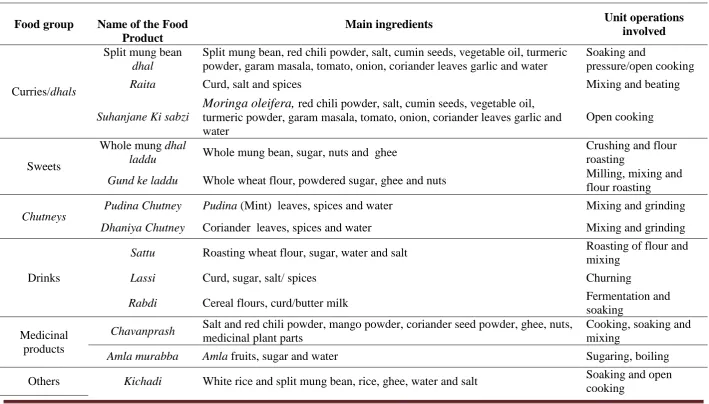
The focus group discussion with the consumer indicated various functional foods consumed with various intentions. Table 1 presents a brief description of the functional foods and their ingredients. They were classified into six groups, namely curries/dhals, sweets, drinks, medicinal foods, Chutneys and others. Curries and Dhals are spiced of vegetables or split legumes, with thick soup-like consistency, commonly consumed with cereal products like rice and chapattis (Indian flat bread). Sweets include two products like laddu, prepared with ghee (clarified butter oil) and sugar along with flour by shallow frying. Khichadi product each have distinctive characteristics and thus were combined as a category of other products. Sprouts are germinated mung bean grains eaten as such or fried to be used in salads. Khichadi is prepared by cooking split mung beans with white rice.
Sattu is a summer drink made with the
roasted cereal flour and mixed in cold water with sugar. Rabdi is a cereal-curd based fermented drink. Lassi is butter milk.
Chavanprash is a medicinal preparation
with thick paste like consistency consumed
in low amounts. Amla murabba is a fruit preserve with sugar syrup.
3.2 Consumer dietary practices:
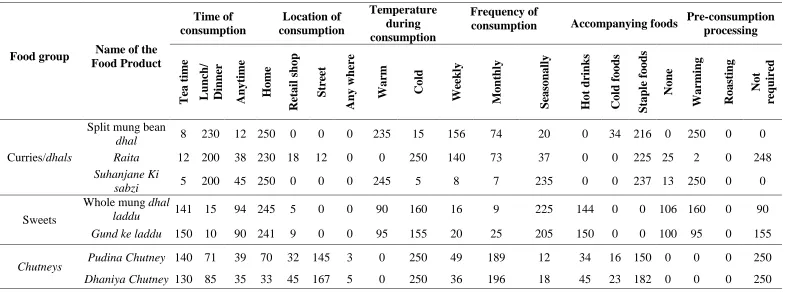
The interview data depicting consumer practices for consumption of function foods are given in Table 2. Dhals,
Suhanjane ki sabji, and khichadi were
consumed by the respondents mainly at lunch and dinner, whereas drinks like Sattu,
lassi and rabid were consumed mainly at
tea time. Dhals, sweets, khichadi, ankurit dhal and wadi were consumed any where and there is no specific time for their consumption. Chavanprash and amla
murabba are the medicinal products
consumed similarly with no specific time of consumption, These products are consumed with the perception of heath promoting properties. Sprouts are thought to consume at lunch, dinner mainly but many consumers alo showed there interest of consumption at any time. Thus sprouts proved to be a product of conveniences in this case. Pudina and Dahiya Chutney is surprisingly consumed at the tea and coffee time. Deeper cross questioning on the consumption pattern of the chutneys
Available online: https://edupediapublications.org/journals/index.php/IJR/ P a g e | 1507
As per the location of the consumption is concerned, Dhals,
Suhanjane ki sabji and Raita are consumed
primarily at home. Similary sweets like Whole mung dhal laddu and Gund ke
laddu are consumed at home. Deeper
analysis of the issue showed that these are the non-commercial products, primarily prepared at home with few exceptions, thus leading to their consumption at home. Howerever, in case of Pudina and Dahiya
Chutney results depicts that they are
consumed majority at streets, again as found that these are accompanied products, thus consumed with the street snacks like
pakore, samosa etc widely available with
the street vendors. In case of the drinks
sattu and radbi are consumed at home but
there is no specific place for consumption for the lassi. The main reason for the is that sattu and radbi are the non-commercial products and prepared at home, thus main location of consumption comes to be home. However, lassi is a house hold products which is equally famous at the commercial products and thus consumers enjoy the drinks at many places. Kichadi,
sprouts, Chavanprash and amla murabba
are the house hold names and consumed at home.
In case of the temperature of the products at the time of consumption, Split mung bean dhal and Suhanjane Ki sabzi
are consumed hot with the cereal products. Whereas, raita is a cold products consumed with the cereal products. In case of sweets both the laddus are consumed mainly hot but few consumers like them to consume cold as well. Pudina and Dahiya
Chutney are consumed cold with the warm
or hot snacks. In case of the functional drinks products like sattu and lassi both are relished by the consumers as cold products. Similarly, radbi is a cold products consumed with cut vegetable particularly onions. However, few consumers also like to consume it warm.
Chavanprash and amla murabba are
consumed cold by almost 100 to 98 % of the consumers. As per the Kichadi and
sprouts are concerned they are consumed
warm but in case of sprouts few consume it as cold products as well.
Frequency of consumption is another important factor for consideration for the marketing of the products. In case of the function foods under study, curries
and dhals have the highest frequency of
consumption in terms of amount and weekly consumption. Most of the other products are consumed as snacks which do not constitute to the relative amount of consumption. In case of Dhals, Suhanjane
ki sabji and Raita, Dhals and Raita are
consumed weekly. However, Suhanjane ki
sabji being seasonal product is consumed
only during the season of availability. Whole mung dhal laddu and Gund ke
laddu both are found to be seasonal
products that too in the winters. Similary, the frequency of consumption data for the products like sattu and rabid shows that they too are seasonal products particularly consumed in the summers. Lassi is a monthly consumed product. In case of
Kichadi, sprouts, Chavanprash and amla
Available online: https://edupediapublications.org/journals/index.php/IJR/ P a g e | 1508
consumed through out the year with the weekly consumptions.
Accompanied foods consumed with the functional foods also have a marketing opportunity. As the accompanied foods will have an impact on the nutritional properties of the functional foods and thus needs to be considered. In case of the products under study, Dhals,
Suhanjane ki sabji and Raita are consumed
with the staple products. Whole mung dhal
laddu and Gund ke laddu are consumed as
such as well with the drinks like tea and coffee. Pudina and Dahiya Chutney are consumed with the snacks like samosa,
pakore and kachories. In case of drinks
sattu is consumed as such. However, lassi
and rabdi both are consumed as such and
also with the stable foods. As per Kichadi,
sprouts, Chavanprash and amla murabba
are concerned, sprouts, Chavanprash and amla murabba are consumed as such and
Kichadi can be accompanied with various
hot, cold drinks as well as staple products. Pre-consumption
processing is another aspect which seems important in terms of the packaging of the products which indirectly affects the marketing potential of the products. Dhals
and Suhanjane ki sabji are required to be
warm before the consumption where as there is no such requirement in case of the
Raita. In case of the Sweets few
consumers like to warm the products but others consume laddus as such. Rabdi is warmed before consumption by few consumers. In cases of Pudina and Dahiya
Chutney no requirement of the
pre-processing. Similarly in case of the sattu
and lassi there is no pre-processing
required. Chavanprash and amla murabba
Available online: https://edupediapublications.org/journals/index.php/IJR/ P a g e | 1509
Table 1. Description of functional food products and summary of their preparations.
Food group Name of the Food
Product
Main ingredients Unit operations
involved
Curries/dhals
Split mung bean
dhal
Split mung bean, red chili powder, salt, cumin seeds, vegetable oil, turmeric powder, garam masala, tomato, onion, coriander leaves garlic and water
Soaking and
pressure/open cooking
Raita Curd, salt and spices Mixing and beating
Suhanjane Ki sabzi
Moringa oleifera, red chili powder, salt, cumin seeds, vegetable oil, turmeric powder, garam masala, tomato, onion, coriander leaves garlic and water
Open cooking
Sweets
Whole mung dhal
laddu Whole mung bean, sugar, nuts and ghee
Crushing and flour roasting
Gund ke laddu Whole wheat flour, powdered sugar, ghee and nuts Milling, mixing and
flour roasting
Chutneys
Pudina Chutney Pudina (Mint) leaves, spices and water Mixing and grinding
Dhaniya Chutney Coriander leaves, spices and water Mixing and grinding
Drinks
Sattu Roasting wheat flour, sugar, water and salt Roasting of flour and
mixing
Lassi Curd, sugar, salt/ spices Churning
Rabdi Cereal flours, curd/butter milk Fermentation and
soaking
Medicinal products
Chavanprash Salt and red chili powder, mango powder, coriander seed powder, ghee, nuts,
medicinal plant parts
Cooking, soaking and mixing
Amla murabba Amla fruits, sugar and water Sugaring, boiling
Available online: https://edupediapublications.org/journals/index.php/IJR/ P a g e | 1510
Sprouts Whole mung bean and water Soaking and
germination
Table 2. Consumer practices for consumption of functional food products.
Food group Name of the
Food Product
Time of consumption
Location of consumption
Temperature during consumption
Frequency of
consumption Accompanying foods Pre-consumption processing
T
ea tim
e
L
u
n
ch
/
Din
n
er
Anytime Home
Re
tail sh
op
S
tr
ee
t
Any wh
er
e
War
m
Cold
We
ek
ly
M
on
thly
S
eason
all
y
Hot d
rin
k
s
Cold
f
ood
s
S
tapl
e f
ood
s
None
War
m
in
g
Roast
in
g
Not
re
q
u
ire
d
Curries/dhals
Split mung bean
dhal 8 230 12 250 0 0 0 235 15 156 74 20 0 34 216 0 250 0 0
Raita 12 200 38 230 18 12 0 0 250 140 73 37 0 0 225 25 2 0 248
Suhanjane Ki
sabzi 5 200 45 250 0 0 0 245 5 8 7 235 0 0 237 13 250 0 0
Sweets
Whole mung dhal
laddu 141 15 94 245 5 0 0 90 160 16 9 225 144 0 0 106 160 0 90
Gund ke laddu 150 10 90 241 9 0 0 95 155 20 25 205 150 0 0 100 95 0 155
Chutneys Pudina Chutney 140 71 39 70 32 145 3 0 250 49 189 12 34 16 150 0 0 0 250
Available online: https://edupediapublications.org/journals/index.php/IJR/ P a g e | 1511 Drinks
Sattu 3 3 244 250 0 0 0 0 250 2 5 243 0 0 0 250 0 0 250
Lassi 5 8 237 78 48 79 45 0 250 23 187 40 0 0 199 51 0 0 250
Rabdi 78 67 105 216 0 0 34 57 193 5 78 167 0 0 163 87 78 0 172
Medicinal products
Chavanprash 30 34 186 250 0 0 0 0 250 45 98 107 0 0 0 250 0 0 250
Amla murabba 36 56 158 242 3 2 3 16 234 45 102 103 0 0 0 250 0 0 250
Available online: https://edupediapublications.org/journals/index.php/IJR/ P a g e | 1512 4. Discussion:
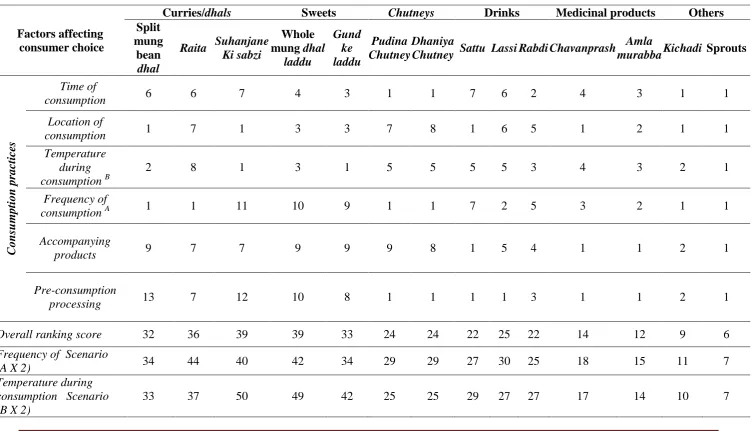
The various consumption practices affecting the consumer choice for that products indicates that the might be equally important but the importance of each factors is relative to the priority of the marketing and packaging strategies. To get the clear picture of the issue, the factors were ranked relative to each other and ranked were summed to get the relative rank considering all the factors. This indicates that in certain circumstances food choice is influenced more by social-economic restrictions.(Hoefling and Strack, 2010). Table 3. Shows the relative ranking for the various factors affecting the consumer’s choice for the functional foods.
Available online: https://edupediapublications.org/journals/index.php/IJR/ P a g e | 1513
Table 3. Product ranking for factors affecting consumer choices influencing the overall acceptance potential of the product
Factors affecting consumer choice
Curries/dhals Sweets Chutneys Drinks Medicinal products Others
Split mung
bean dhal
Raita Suhanjane
Ki sabzi
Whole
mung dhal
laddu
Gund ke laddu
Pudina Chutney
Dhaniya
Chutney Sattu LassiRabdiChavanprash
Amla
murabbaKichadi Sprouts
C
on
su
mp
ti
on
prac
ti
ce
s
Time of
consumption 6 6 7 4 3 1 1 7 6 2 4 3 1 1
Location of
consumption 1 7 1 3 3 7 8 1 6 5 1 2 1 1
Temperature during
consumption B
2 8 1 3 1 5 5 5 5 3 4 3 2 1
Frequency of
consumption A 1 1 11 10 9 1 1 7 2 5 3 2 1 1
Accompanying
products 9 7 7 9 9 9 8 1 5 4 1 1 2 1
Pre-consumption
processing 13 7 12 10 8 1 1 1 1 3 1 1 2 1
Overall ranking score 32 36 39 39 33 24 24 22 25 22 14 12 9 6
Frequency of Scenario
(A X 2) 34 44 40 42 34 29 29 27 30 25 18 15 11 7
Temperature during consumption Scenario (B X 2)
Available online: https://edupediapublications.org/journals/index.php/IJR/ P a g e | 1514 5. Conclusion:
In the end it can be concluded that there are many factors which contribute to the final consumer choice in case of the functional foods, however, the consumer practices pertaining to the functional foods are also important factors. Amongst the consumer practice factors frequency and consumption seems to have potential influencing nature.
References:
Agarwal, K., Kushwah, A., Kushwah, H.S., Agarwal, R., Rajput, L.D. (1999), "Dietary analysis and assessment of nutritional status of preschool children of urban and rural population", Ind. J. Nutr. Dietet., Vol. 38 pp.231-5.
Brown, K.A., Timotijevic, L., Barnett, J., Shepherd, R., Lahteenmaki, L. and Raats, M.M. (2011). A review of consumer awareness, understanding and use of food-based dietary guidelines.
British Journal of Nutrition, 106,
15–26.
Gronowska-Senger, A., Drywien, M., Hamulka, J. (1998), "Evaluation of food consumption and nutritional status of children at preschool and school age based on the literature in 1980-1995", Rocz
Panstw. Zakl. Hig., Vol. 49 No.3,
pp.377-83.
Hoefling, A. and Strack, F. (2010). Hunger induced changes in food choice. When beggars cannot be choosers even if they are allowed to choose. Appetite, 54, 603–606.
Linnemann, A.R., Benner, M., Verkerk, R. and van Boekel, M.A.J.S. (2006). Consumer-driven food product development. Trends
in Food Science & Technology, 17,
184-190.
Manu and Khetarpaul, N. (2006). Food consumption pattern of Indian rural preschool children (four to five years). British Food
Journal, 108 127-140.
Siró, I., Kápolna, E., Kápolna, B. and Lugasi, A. (2008). Functional food. Product development, marketing and consumer acceptance—A review. Appetite,
51, 456-467.
van Kleef, E., van Trijp, H.C.M. and Luning, P. (2005). Consumer research in the early stages of new product development: A critical review of methods and techniques.
Food Quality and Preference, 16,
181-201.
Vijayaraghavan, K., Rao, H.D. (1998), "Diet and nutrition situations in rural India", Ind. J.