ISSN (Print) : 2320 – 3765 ISSN (Online): 2278 – 8875
I
nternational
J
ournal of
A
dvanced
R
esearch in
E
lectrical,
E
lectronics and
I
nstrumentation
E
ngineering
(An ISO 3297: 2007 Certified Organization)
Website: www.ijareeie.com
Vol. 6, Issue 7, July 2017
Solution of Non-Convex Economic Load
Dispatch Problem using Moth-Flame
Optimizer
Davinder Kaur1, Harinder Pal Singh2
PG Student, Dept. of EE, Shaheed Bhagat Singh State Technical Campus, Ferozepur, Punjab, India1 Assistant Professor, Dept. of EE, Shaheed Bhagat Singh State Technical Campus, Ferozepur, Punjab, India2
ABSTRACT: This paper depicts Moth-Flame Optimization (MFO) to resolve the convex Economic Load Dispatch (ELD) problem. Moth-Flame Optimization (MFO) is a new meta-heuristic inspired from the navigation method of moths in nature called transverse orientation. The main objective of ELD problem is curtailing the total generation cost while meeting up the different constraints when the required load of the power system is being supplied. The proposed technique is implemented on three diverse test systems for solving the ELD with respective load demands. To show the effectiveness of MFO to solve ELD problem results were compared with other existing techniques.
KEYWORDS: Economic Load Dispatch, MFO
I.INTRODUCTION
In the present world, electrical power has a vital role to assure a variety of needs. It is so very significant that the electrical power generated is transmitted and distributed efficiently in order to satisfy the power requirement. The cost-effective scheduling of all generators in a system to meet most wanted demand is a significant problem in planning and operation of power system. The Economic Load Dispatch (ELD) problem is the most important optimization difficulty in scheduling the generation of thermal generators in power system. In ELD problem, the ultimate goal is to decrease the operation cost of the power generation system, while supplying the required power demanded. The economic load dispatch problem (ELD) means that the power utilities real and reactive powers are allowed to vary within certain limits so as to meet a particular load demand within lowest fuel cost. In addition to this, the various operational constraints of the system should also be satisfied.
ISSN (Print) : 2320 – 3765 ISSN (Online): 2278 – 8875
I
nternational
J
ournal of
A
dvanced
R
esearch in
E
lectrical,
E
lectronics and
I
nstrumentation
E
ngineering
(An ISO 3297: 2007 Certified Organization)
Website: www.ijareeie.com
Vol. 6, Issue 7, July 2017
II. PROBLEM FORMULATION
The main objective of the ELD problem is to curtail the total generation cost while gratifying the different constraints when the load of the power system is being supplied. The objective function to be minimized is given by the following equation:
2
1
(
)
(
)
n
g i gi i gi i i
F P
a P
b P
c
… (1)And objective function considering valve point loading effects is given by:
2 min
1
( )
(
)
sin( (
))
n
g i gi i gi i i i gi gi
i
F P
a P
b P
c
d
e P
P
…….. (2)The overall fuel cost has to be reduced with the following constraints: 1) Power balance constraint
The total generation by all the generators must be equal to the total power demand and system’s real power loss. ∑ − − ….. (3)
2) Generator limit constraint
The real power generation of each generator is to be controlled inside its particular upper and lower operating limits. ≤ ≤ i=1,2,...,ng ….. (4) Where
ai, bi, ci : coefficient of fuel cost of ith generator, Rs/MW2 h, Rs/MW h, Rs/h
di, ei : coefficient of fuel cost of ith generator for valve point loading
F(Pg ) : Total fuel cost, Rs/h
n : Number of generators
: Minimum limit of generation for ith generator, MW : Maximum limit of generation for ith generator, MW Pl: Transmission losses, MW
Pd: Power demand, MW
III. MOTH FLAME OPTIMIZATION (MFO)
Moth-Flame Optimization (MFO) is a fresh meta-heuristic stimulated from the direction-finding method of moths in nature called transverse orientation. They have been evolved to fly at night utilizing the moon light. They used a method called transverse orientation for direction-finding. In this method, a moth flies at night by sustaining a fixed angle in reference to the moon, a very effective mechanism for traveling long distances in a straight path. Despite the effectiveness of transverse orientation, we usually observe that moths fly spirally around the lights. In fact, moths are tricked by artificial lights and show such behaviors. This is due to the inefficiency of the transverse orientation, in which it is only helpful for moving in a straight line when the light source is very far.
Since the MFO algorithm is a population-based algorithm, we represent the set of moths in a matrix as follows:
=
… …
ISSN (Print) : 2320 – 3765 ISSN (Online): 2278 – 8875
I
nternational
J
ournal of
A
dvanced
R
esearch in
E
lectrical,
E
lectronics and
I
nstrumentation
E
ngineering
(An ISO 3297: 2007 Certified Organization)
Website: www.ijareeie.com
Vol. 6, Issue 7, July 2017
Where n is the number of moths and d is the number of variables.
For all the moths, we also assume that there is an array for storing the corresponding fitness values as follows:
= … … (6)
Other key components in the proposed algorithm are flames. We consider a matrix similar to the moth matrix as follows:
=
… …
… … … …
…
… (7)
For the flames, we also assume that there is an array for storing the corresponding fitness values as follows:
=
… … (8)
The MFO algorithm is three-tuple that helps the optimization problems to estimate the global optimal solution and can be defined as follows:
MFO = (I, P, T) … (9)
A random population of moths and corresponding fitness values are generated by the function I. This function can be mathematically represented as follows:
:∅ →{ , } … (10)
The P is the main function, the moths are moved around the search area by this function. The matrix M is received by this function and also returns its updated one eventually.
: → … (11)
The T function returns true if the termination criterion is satisfied and false if the termination criterion is not satisfied:
: →{ , } … (12)
After the initialization, the P function is iteratively run until the T function returns true. The P function is the main function that moves the moths around the search space. As mentioned above the inspiration of this algorithm is the transverse orientation. In order to mathematically model this behavior, we update the position of each moth with respect to a flame using the following equation:
= ( , ) … (13)
where Mi indicate the ith moth, Flj indicates the jth flame, and S is the spiral function. A logarithmic spiral is used as the main update mechanism of moths and is defined as follows:
( , ) = . . cos(2 ) + … (14)
where Di indicates the distance of the ith moth for the jth flame, b is a constant for identifying the shape of the logarithmic spiral, and t is a random number in [-1, 1]. D is calculated as follows:
ISSN (Print) : 2320 – 3765 ISSN (Online): 2278 – 8875
I
nternational
J
ournal of
A
dvanced
R
esearch in
E
lectrical,
E
lectronics and
I
nstrumentation
E
ngineering
(An ISO 3297: 2007 Certified Organization)
Website: www.ijareeie.com
Vol. 6, Issue 7, July 2017
Where Mi indicate the ith moth, Flj indicates the jth flame, and Di indicates the distance of the ith moth for the jth flame.
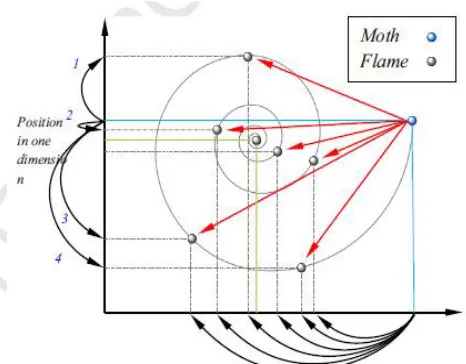
Fig. 1 shows a theoretical form of position updating of a moth to a flame. The possible positions (dashed black lines) that can be chosen as the next position of the moth (blue horizontal line) around the flame (green horizontal line) in Fig. 1 clearly shows that a moth can explore and exploit the search space around the flame in one dimension. Exploration occurs when the next position is outside the space between the moth and flame as can be seen in the arrows labeled by 1, 3, and 4. Exploitation happens when the next position lies inside the space between the moth and flame as can be observed in the arrow labeled by 2.
The number of flames is adaptively decreased over the course of iterations using following formula:
. = ( − × ) … (16)
Where l is the current number of iteration, N is the maximum number of flames, and T indicates the maximum number of iterations. The gradual decrement in a number of flames balances exploration and exploitation of the search space.
Fig.1. some of the possible positions that can be reached by a moth with respect to a flame using the logarithmic spiral.
IV. RESULT AND DISCUSSION
MFO has been used to solve the ELD problems in three diverse test cases for exploring its optimization potential, where the objective function was limited within power ranges of the generating units and transmission losses were also taken into account. The iterations performed for each test case are 500 and population size taken in the test cases is 30. 1) Test system I: Three generating units
The input data for three generators and loss coefficient matrix Bmn is derived from reference [11].The economic load
ISSN (Print) : 2320 – 3765 ISSN (Online): 2278 – 8875
I
nternational
J
ournal of
A
dvanced
R
esearch in
E
lectrical,
E
lectronics and
I
nstrumentation
E
ngineering
(An ISO 3297: 2007 Certified Organization)
Website: www.ijareeie.com
Vol. 6, Issue 7, July 2017
Table 4.1: MFO results for 3-unit system with demand 300 MW
Output QP[10] SA[11] GA[8] PSO[12] DE[12] FPA[13] Proposed
MFO
P1(MW) 207.6799 207.6336 208.99 209.001 207.637 207.6319 207.63
P2(MW) 87.4010 87.2867 86.0041 85.92 87.2833 87.2886 87.283
P3(MW) 15.00 15.00 15.4163 15.00 15.00 15.00 15.00
PL 10.0808 9.9203 10.4099 9.9833 9.9203 9.9202 9.9203
Cost 3621.50 3619.76 3624.28 3621.75 3619.8 3619.75 3619.7
2) Test system II: Six generating units
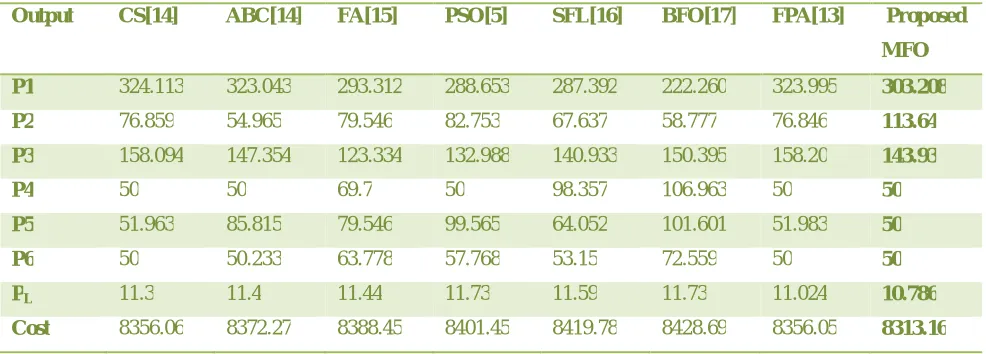
The input data for six generators and loss coefficient matrix Bmn is derived from reference [14]. The economic load
dispatch for 6 generators is solved with MFO and results are compared with particle swarm optimization, cuckoo
search, Flower Pollination, etc.
Table 4.2: MFO results for 6-unit system with demand 700MW
Output CS[14] ABC[14] FA[15] PSO[5] SFL[16] BFO[17] FPA[13] Proposed
MFO
P1 324.113 323.043 293.312 288.653 287.392 222.260 323.995 303.208
P2 76.859 54.965 79.546 82.753 67.637 58.777 76.846 113.64
P3 158.094 147.354 123.334 132.988 140.933 150.395 158.20 143.93
P4 50 50 69.7 50 98.357 106.963 50 50
P5 51.963 85.815 79.546 99.565 64.052 101.601 51.983 50
P6 50 50.233 63.778 57.768 53.15 72.559 50 50
PL 11.3 11.4 11.44 11.73 11.59 11.73 11.024 10.786
Cost 8356.06 8372.27 8388.45 8401.45 8419.78 8428.69 8356.05 8313.16
3) Test system III: Forty generating units
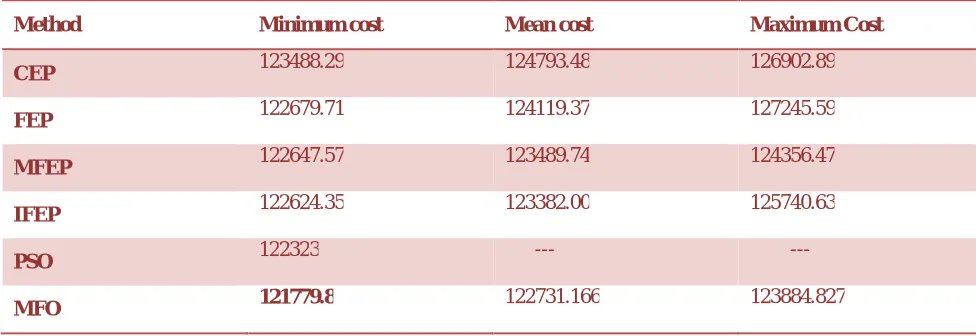
The input data for forty generators is derived from reference [9].The economic load dispatch for 40 generators is solved
with 10,500 MW power demand including valve point effects. The minimum cost, mean cost and maximum cost
ISSN (Print) : 2320 – 3765 ISSN (Online): 2278 – 8875
I
nternational
J
ournal of
A
dvanced
R
esearch in
E
lectrical,
E
lectronics and
I
nstrumentation
E
ngineering
(An ISO 3297: 2007 Certified Organization)
Website: www.ijareeie.com
Vol. 6, Issue 7, July 2017
Table 4.3: Comparison results of MFO for 40-Unit system
Method Minimum cost Mean cost Maximum Cost
CEP 123488.29 124793.48 126902.89
FEP 122679.71 124119.37 127245.59
MFEP 122647.57 123489.74 124356.47
IFEP 122624.35 123382.00 125740.63
PSO 122323 --- ---
MFO 121779.8 122731.166 123884.827
V.CONCLUSION
In this paper economic load dispatch problem has been solved by using MFO. The results of MFO are compared with other techniques. The algorithm is programmed in MATLAB (R2013a) software package. The results show the effectiveness of MFO for solving the economic load dispatch problem. The advantage of MFO algorithm is its simplicity, reliability, and efficiency for practical applications. In future, this algorithm can also be applied to the multi-objective problem.
REFERENCES
[1] A.J Wood, B.F. Wollenberg, “Power Generation, Operation, and Control’’, John Wiley and Sons, New York, 1984.
[2] Z. X. Liang and J. D. Glover, “A zoom feature for a dynamic programming solution to economic dispatch including transmission losses’’, IEEE
Trans. on Power Systems, Vol. 7, No. 2, pp. 544-550, May 1992.
[3] N. Sinha, R. Chakrabarti, and P. K. Chattopadhyay. ‘‘Evolutionary programming techniques for economic load dispatch.’’ Evolutionary
Computation, IEEE Transactions on 7, no. 1 (2003): 83-94
[4] Kumar C, Alwarsamy T, “Solution of economic dispatch problem using differential evolution algorithm’’. Int J Soft Comput Eng
2012;1(6):236–41
[5] ABS. Serapião, “Fundamentos de otimizaçãopor inteligência de enxames: uma visão geral’’. Revista SBA Controle and Automação
2009;20(3):271–304.
[6] J. Park, K. Lee and J. Shin. “A particle swarm optimization for economic dispatch with nonsmooth cost functions’’. IEEE Transactions on
Power Systems. 2005; 20: 34-42.
[7] P.H Chen and H.C Chang, “Large Scale Economic Dispatch by Genetic Algorithm”, IEEE transactions on power systems, vol. 10, no. 4,
November 1995.
[8] S. O. Orero and M. R. Irving, “Economic dispatch of generators with prohibited operating zones: a genetic algorithm approach”, IEE Pro.-
Gener. Transm. Distrib., vol. 143, no. 6, November 1996.
[9] C.C.Lung, “ Improved genetic algorithm for power economic dispatch of units with valve-point effects and multiple fuels’’. Power Syst IEEE
Trans(2005) 20(4):1690–1699.
[10] R.M.S Danaraj, F. Gajendran, “ Quadratic Programming Solution to Emission and Economic Dispatch Problems’’. Journal of the Institution of
Engineers (India). pt EL., 2005; 86: 129-132.
[11] Hardiansyah, Junaidi, Yohannes MS. “An efficient simulated annealing algorithm for economic load dispatch problems’’. Telkomnika
2013;11(1):37–46.
[12] C Kumar, T Alwarsamy. “Solution of economic dispatch problem using differential evolution algorithm’’. Int J Soft Comput Eng
2012;1(6):236-41.
[13] A.Y Abdelaziz, E.S Ali, S.M. Abd Elazim, “Combined economic and emission dispatch solution using Flower Pollination Algorithm’’.
Electrical Power and Energy Systems 80 (2016) 264–274.
[14] ABS. Serapiao, “Cuckoo search for solving economic dispatch load problem’’.Intelligent Control Automat 2013;4:385–90.
ISSN (Print) : 2320 – 3765 ISSN (Online): 2278 – 8875
I
nternational
J
ournal of
A
dvanced
R
esearch in
E
lectrical,
E
lectronics and
I
nstrumentation
E
ngineering
(An ISO 3297: 2007 Certified Organization)
Website: www.ijareeie.com
Vol. 6, Issue 7, July 2017
[16] M. Eusuff and K. Lansey, “Optimizing of Water Distribution Network Design Using the Shuffled Frog-Leaping Algorithm,” Journal of Water
Resources Planning and Management, Vol. 129, No. 3, 2003, pp. 210-225.
[17] K. M. Passino, “Biomimicry of Bacterial Foraging for Distributed Optimization and Control,” IEEE Control Systems Magazine, Vol. 22, No.
3, 2002, pp. 52-67.
[18] Chen CH, SN Yeh, “Particle swarm optimization for economic power dispatch with valve-point effects’’. In: IEEE PES transmission and
distribution conference and exposition Latin America, Venezuela; 2006. p. 1–5.
[19] V.K Kamboj, S. K Bath, J.S. Dhillon. “Solution of non-convex economic load dispatch problem using Grey Wolf Optimizer”, Neural Comput
& Applic.
[20] N.Chopra, G.Kumar, S.Mehta, “Multi-objective Economic Emission Load Dispatch using Grey Wolf Optimization” International Journal of
Advanced Engineering Research and Science (IJAERS), Vol-3, Issue-11, Nov- 2016.
[21] V.K Kamboj, A Bhadoria, S. K Bath., “Solution of non-convex economic load dispatch problem for small-scale power systems using ant lion
optimizer”, Neural Comput & Applic.
[22] N. Chopra and S. Mehta, “Multi-objective optimum generation scheduling using Ant Lion Optimization,”2015 Annual IEEE India Conference
(INDICON), New Delhi, 2015, pp. 1-6.doi: 10.1109/INDICON.2015.7443839
[23] S. Mirjalili, “Moth-flame optimization algorithm: A novel nature-inspired heuristic paradigm.” Knowledge-Based Systems,69 (2015): 46-61.
[24] H. P. Singh, Y.S. Brar, & D. P. Kothari, “Combined active and reactive power dispatch using particle swarm optimization”. Proceedings of
Informing Science & IT Education Conference (InSITE) 2014 (295-304).
[25] H. P. Singh, Y. S. Brar, & D. P. Kothari, “Multiobjective load dispatch using particle swarm optimization”. IEEE 2013.