A Study on Recruitment & Selection Process with
Reference
Sujeet Kumar & Ashish Kumar Gupta
Department of Information and technology Dronacharya College of Engineering, Dronacharya College of
Engineering,Gurgaon-122001, India
Email:[email protected]
;
Email:
[email protected]
Abstract:
Better recruitment and selection strategies result in improved organizational outcomes. With reference to this context, the research paper entitled Recruitment and Selection has been prepared to put a light on Recruitment and Selection process. The main objective is to identify general practices that organizations use to recruit and select employees and, to determine how the recruitment and selection practices affect organizational outcomes at Electronics Industry, In Krishna Dt Ap,India. Successful recruitment and selection practices are key components at the entry point of human resources in any organization . The main objective of this paper is to identify general practices that organizations use to recruit and select employees .The study also focus its attention to determine how the recruitment and selection practices affect the organizational outcomes and provide some suggestions that can help. Data analysis has been done with statistical tools like tables, graphs, pie charts, bar diagrams.
Keywords:
Recruitment; Selection; Reference; Interview; qualification; reference
I.INTRODUCTION
Successful human resource should identify human resource needs in the organization. Recruitment is the discovering of potential candidates for actual or anticipated organizational vacancies. Or, from another perspective, it is a linking activity bringing together those with jobs to fill and those seeking job. The ideal recruitment effort will attract a large number of qualified applicants who will take the job if it is offered. It should also provide information so that unqualified applicants can self select themselves out of job candidacy; this is, a good recruiting program should attract the qualified and not attract the unqualified. This dual objective will minimize the cost of processing unqualified candidates.
According to Edwin B Flippo
Recruitment as “the process of searching for prospective employees and stimulating them to apply for the jobs in the organization.”
According to Yoder
Recruitment is a process to discover the sources of manpower to meet the requirement of the staffing schedule and to employee effective measures to attracting that manpower in adequate number to facilitate effective selection of an effective workforce
1.1 Recruitment
•Recruitment is the process of attracting prospective employees and stimulating them forapplying job in an organization.
•Recruitment is the process of hiring the right kinds of candidates on the right job
Recruitment and selection activity is predominantly dealt with in two fields:
·A generally prescriptive human resource management or personnel managementviewpoint and
· A very technical psychology literature that focuses on the validity (absolute and relative) of different forms of recruitment techniques, such ascompetency modelling, interviews and various types of psychometrictesting
Methods of Recruitment
There are various methods of recruitment but for the sake of simplicity, they have been categorized under two broad headings.
•Internal Recruitment •External Recruitment
Benefits and Importance of Recruitment:
(1).Helps to create a talent pool of potential candidates for the benefits of the organization
.(2).To increases the pool of job seeking candidates at minimum cost.
(3).It helps to increase the success rate of selection process by decreasing the no of visits qualified orover qualified job applicants.
helps in increasing organization and individual effectiveness of
various recruiting
techniques and for all the types of job applicants.
1.2Selection:
Selection is the process of picking individuals who have relevant qualifications to fill jobs in anorganization. Selection is much more than just choosing the best candidate. It is an attempt to strike ahappy balance between what the applicant can and wants to do and what the organization requires.
Importance of Selection:
Selecting the right employees is important for three main reasons: performance, costs and legalobligations.
Performance:
Employees with right skills will do a better job for any company and for the owner. Employees without these requisiteskills or who are abrasive would not perform effectively and the company performance will suffer to agreat extent. So there is a time to screen out undesirables and to choose the better and perfect candidatethat can effectively contribute to company success.
Cost:
It is important because it is costly to recruit and hire employees so cost-benefit ratiohave to be considered while hiring of employees in order to avoid any unnecessary wastage of moneyand the valuable resources .The total cost of hiring a manager could easily be 10 times as high as onceone add search fees, interviewing time, reference checking, and travel and moving expenses.
1.2.1 Essentials and Prerequisites for Selection:
I. Picking individuals possessing relevant qualifications.
II. Matching job requirements with the profile of the candidates.
III. Using multiple tools and techniques to find the most suitable candidate suitableOf achieving success on the job.
1.2.2 The Process of Selection:
1. Reception
2. Screening Interview
3. Application Blank
4. Selection Tests
5. Selection Interview
6. Medical Examination
7. Reference Checks
1.3 The difference between recruitment and selection: Recruitment is identifying and encouraging prospective employees to apply for a job and
Selection is selecting the right candidate from the pool of applicants.
II.Objectives
1) The primary objective of the study is to analyze the process of Recruitment and Selection in the industries.
2) To observe the procedure to select the candidates from internal as well as from external sources in the industries
3) To find out the various recruitment sources used by the selected
industries.
4) To study the employee satisfactory level with the existing recruitment policy in the industry.
5) To study the stages of selection procedure in the industries 6) To find the reasons for accepting the offer in the respective
selected industries
III.Research Methodology
Research methodology is a method to solve the research problem systematically. It involves gathering data, use of statistical techniques, interpretations and drawing conclusions about research data. Keeping in view the objectives of the study, data is collected from different sources.
The purpose of this section is to describe the methodology carried out to complete the work. Themethodology plays a dominant role in any research work. The effectiveness of any research work depends upon the correctness and effectiveness of the research methodology.
IV.Data Collection
Data refers to a collection of organized information, usually the results of experience, observation or experiment, or a set of premises. This may consist of numbers, words, or images, particularly as measurements or observations of a set of variables.
V.Data Sources
There are two types of data sources available to the research processes. 1. Primary data. 2. Secondary data.
1. Primary Data
We know relatively little on a systematic basis about how or why organizationschoose to use different combinations of these strategies,though some of the results reported in the study of recruitment and selection and in large firms offers some pointers that are worthy of further exploratory research, particularly among small and medium sized organizations. Nowadays employees suggests that personality tests are now being routinely used for someoccupations in 19 per cent of workplaces, and performance tests are being used in Recruitment and selection in 46% of workplaces. Personality testing seems to be concentrated in larger workplaces and used upon professional, managerial, and sales staff; andperformance testing concentrated again in larger workplaces but used for professional and administrative staff. Among the sample of large employers the overall relative ranking of importance of different skill/suitability Assessment methods was as follows:
1. Interview 2. Work experience
3. Performance/competency test 4. Qualifications
5. Assessment center 6. Personality/aptitude test
2.Secondary Data:-
Secondary data is collected from various Journals, books, websites, Government reports, News papers, and other research reports.
TABLE NO.1
Particulars No.of Respondents
Newspaper sources 45
Journals& Periodicals 10
Campus recruitment 40
Employee referral 30
Consultancies 25
Total 150
VI.Analysis
Data analysis is very important aspect of project, as it basically involves the analysis of all theinformation that we collected. Dataanalysis is a body of methods that help to describe facts,
detect patterns, develop explanations and testhypothesis. After analysis of each of the question in a questionnaire the interpretation of the same is also beingprovided which includes the reason about the particular aspect of the organization.
VII.An alysis of Questio nnaire
1.Analysis about the source of recruitment followed in the selected industries
TABLE NO.2
Particular No. of Respondents
External 30
Internal 20
Both 100
Total 150
GRAPH NO .1
Interpretation:
From the above table and graph it is observed that, 30 respondents have accepted that the company is following external recruitment sources and 20 respondents have accepted their company is following internal recruitment sources and 100 respondents have expressed that their company is adopting both internal and external recruitment sources.
2.
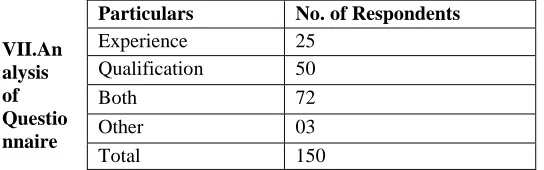
Analysis about the attributes taken in to preference forrecruitment and selection procedure TABLE NO.3
Interpretation:
It is observed that,25 members expressed that, their company gives preference to experienced candidates. 50 members expressed that, their company gives preference to qualified candidates. 72 members expressed that, their company is giving preference to both experience and qualification candidates and three members are accepted that their company gives preference to other criteria.
3. Analysis about the main sources of selection in three selected
industries
Particulars No. of Respondents
Experience 25
Qualification 50
Both 72
Other 03
Interpretation:
It is observed that 30 members of the total respondents have expressed that, their company is following written tests 25 members of the total respondents have expressed that, their company is following group discussions,50 members of the total respondents have expressed that, their company is following interview,45 members of the total respondents have expressed that, their company is following all the above tests as main source of selection.
PIE CHART NO.1 4.
5. 6. 7. 8. 9.
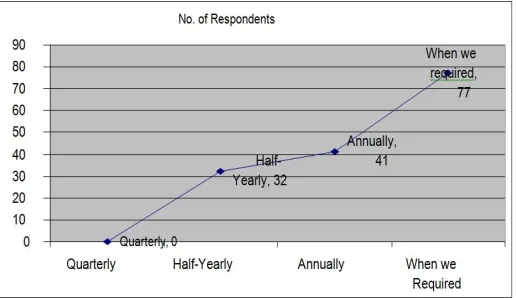
10. Analysis about the period of recruitment of your
organization
TABLE NO.4
Particulars No. of Respondents
Quarterly 0
Half-Yearly 32
Annually 41
When we
required
77
Total 150
Interpretation:
It is observed that.32members of total respondents have expressed that the company recruits employees half-yearly,41members of total respondents have expressed that the company recruit employees annually, and 77 members of total respondents have expressed that the company recruit employees whenever they required.
11. Analysis about the reason for accepting the offer in the
organization
TABLE NO.5
Particulars No. of Respondents
Relocation 20
Relation with employer 15
Decent salary 50
Opportunities for growth 20
Job security 25
Identification with the
company
20
Total 150
Interpretation:
From the above graph, we can understand that 20members of total respondents are selected this organization for relocation, 15members of total respondents are selected this organization for the reason of Relationship with employer ,50members of total respondents are selected this organization for decent salary,25members of total respondents are selected this organization for security, 20members of total respondents are selected this organization for growth,20members of total respondents are selected this organization for identification.
VIII.Findings
The findings from the analysis including charts, bars, and graphs are listed as follows:-
•The company considered portals as the most important medium of hiring employees and thenemployee references are also act as the important source of recruiting people.
provided there are need to be confirmed as I did during my training period.
•The most important feature in company’s recruitment &selection policy is that we need totake in consideration the ratio between the turn-up and line-up candidates, and after analysis I found itmost of the employees are also holding the same opinion.
•The existing recruitment process of company is good but it has some shortcomings that isbeing Covered in recommendations and on overall the recruitment department has pressure on it.
•After analysis of the company selection procedure I found out the company is using quiteeffective method of doing selection of candidates and they always take in consideration the cost-benefitratio which is quite important from the long perspective of hiring employees.
•The ratio of selected candidates to joining candidates is quite effective and highest in numberas the employees being selected are also of the view that they are analyzed properly and effectively.
CONCLUSION
The main thing that I want to conclude firstly is that with the help of analysis, feedback generatedthrough questionnaire I found that the company is following an effective Recruitment and Selectionprocess to maximum extent.
As per my study, out of the various methods of sourcing candidates, the best one is – getting referencesvia references and networking. In the process, I came across various experiences where the role of anHR and the relevant traits he finds in the candidates were displayed. Company should focus on long term consistent performance rather than short term.The emphasis towards training and enhancing skills of recruiters needs to be more and also consistent.Even though an HR manager has many challenges to face in order to ensure that the human resourcedepartment contributes to the bottom-line and emerges as a strategic partner in the business, it is“Talent acquisition”, that is the key determining factor in how well an Human resource departmentcontributes towards the achievement of the overall objective of the organization and therefore is a daunting task for any HR manager.
REFERENCES
1 Essential of human resource management and industrial
relations, subbarao Mumbai, Himalaya publishing house, 1996 Edward E. Lawler Iii; John W. Boudreau. Stanford Business Books, 2009
2 Reinventing Human Resources Management:
Challenges and New Directions,Ronald J. Burke; Cary L. Cooper. Routledge, 2005
3 Understanding Human ResourceManagement,Ken N.
Kamoche. Open University Press, 2001
4 Organizational Success through Effective Human
Resources ManagementRonald R. Sims. Quorum Books, 2002
5 How to Develop Essential HR Policies and
Procedures,John H. McConnell. AMACOM, 2005
6 Krishnan, Sandeep K.; Singh, Manjari. South Asian
Journal of Management, Vol. 18, No. 1, January-March 2011
7 A Balanced Approach to Understanding the Shaping of
Human Resource Management in
organisations**Boselie, Paul. Management Revue, Vol. 20, No. 1, January 1, 2009
8 Hargis, Michael B.; Bradley, Don B.,, III. Academy of
Strategic Management Journal, Vol. 10, No. 2, July 2011
9 Nehles, Anna C.; van Riemsdijk, Maarten; Kok, Irene; Looise, Jan Kees. Management Revue, Vol. 17, No. 3, July 1, 2006
10 Globalizing Human Resource ManagementPaul
Sparrow; Chris Brewster; Hilary Harris. Routledge, 2004
11 International Human Resource Management: A
Multinational Company PerspectiveMonir H. Tayeb. Oxford University Press, 2005
12 The Manager'sGuide to HR: Hiring, Firing,
Performance Evaluations, Documentation, Benefits, and Everything Else You Need to KnowMax Muller. AMACOM, 2009
13 Human Resources for the Non-HR ManagerCarol T.
Kulik. Lawrence Erlbaum Associates, 2004
[16]Human resource development, L.m.prasad New Delhi, sultan chand &sons, 2005.
14 HR from the Outside In: Six Competencies for the Future of Human Resources, Dave Ulrich,2012
15 The HR Scorecard: Linking People, Strategy, and
Performance, Brian E. Becker,2001
16 The Chief HR Officer: Defining the New Role of
Human Resource Leaders,Patrick M. Wright,2011
17 The Carrot Principle: How the Best Managers Use
Recognition to Engage Their People, Retain Talent, and Accelerate Performance, Adrian Gostick,2007
18 How to Measure Human Resource Management, Jac
Fitz-Enz
19 HR from the Heart: Inspiring Stories and Strategies for
Building the People Side of Great Business, Libby Sartain,2003
20 Personal Management, Text&Cases,
himalayapublications.,C B Memoria & SV
Gankar(2004)
21 Human Resource Management, Dr.P.C.Pardeshi,2005
22 Costing Human Resources: The Financial Impact Of
Behavior In Organizations, Wayne F. Cascio,1982
[27]Compensation, 8th Edition, George T.
23 Human Relations: The Art and Science of Building
Effective Relationships, Vivian McCann
Hamilton,2007
24 Personnel Management: The Utilization of Human
Resources, Herbert J. Chruden,,1980
[28] Human Resources Management: All the Information You Need
to Manage Your Staff and Meet Your