BARRIERS TO THE TEACHING-LEARNING OF MATHEMATICS IN ,
SECONDARY SCHOOLS IN MASABA SOUTH DISTRICT, KISII COUNTY, KENYA
BY
OISEBE MORARA VICTOi
t
E55/20140/2010
A RESEARCH PROJECT SUBMITTED TO TIlE SCHOOL OF
EDUCATioN,. DEPARTMENT OF EDUCATIONAL MANAGEMENT
' "
POLICY
ANn
CURRICULUM STUDIES IN PARTIAL FULFILMENTFOR THE AWARD OF MASTER OF EDUCATION DEGREE
-KENYATTA UNIVERSITY
DECLARATION
This is my original work and has not been submitted for a degree to any university .
... .~~ : Date
~1
.
7.1.
~~!?
.
OISEBE MORARA VICTOR
E55/20140/2010
The proposal has been submitted with our approval as university supervisors;
..
A.
.
:
..
~
.:
A;A!
)
..
>%
.
~
.Date ..~.
I.
(f
g/
..
~.{2.. .DR. LIBESE, L. I.
Senior Lecturer Department of Educational Management Policy and Curriculum Studies Kenyatta University.
;c~
Date3.p'.(08.'!2Q.{L
DR. KAMUNDE, F.
Head-Research, Resources and Development, Ministry of Education, Kenya .
DEDICATION
This work is dedicated to the Almighty God who is the source of knowledge and wisdom. His tendering mercies, love and strength he gives us day to day.
I also dedicate this work to my parents Richard Oisebe and Esther Nyang'ate who educated,
guided and counseled me. Finally, to my wife Ruth Nyaboke and my children Christine,
ACKNOWLEDGEMENT
Specialthanks go to my supervisors Dr. Libese Levi, senior lecturer department of Educational
Management Policy and Curriculum Studies, Kenyatta University and Dr. Fredrick Njeru
Kamunde, Head-Research, Resources and Development, Ministry of Education, for their enabling guidance given to me. Special gratitude also goes to the principal Kiamokama
Secondary School Mr. Tom Mayaka Omwoyo and his staff for the support they gave me while
on study leave. I wish also to thank the Teachers Service Commission for granting me a study
leave and the Ministry of Education for granting me permission to do research in Secondary
Schools in Masaba South district.
Finally,lam greatly indebted to my beloved wife Ruth Nyaboke, our dear children Christine,
TABLE OF CONTENTS Page
Declaration .ii
Dedication .iii
Acknowledgement .iv
Table of Contents ' v
List of Tables x
List of Figures - xi
List of Abbreviations xii
Abstract xiv
1.0 CHAPTER ONE: INTRODUCTION 1
1.1 Introduction to the Chapter 1
1.2 Background to the Study 1
I
1.3 Statement of the Problem 6
1.4 Purpose of the Study 6
1.5 Objectives of the Study 7
1.6 Research Questions 7
1.7 Significance of the Study 7
1.8 Limitations of the Study 8
1.9 Delimitations of the Study 8
1.10 Theoretical Framework 8·
1.11 Conceptual Framework 11
1.12 Definition of Operational Terms 13
2.0 CHAPTER TWO: LITERATURE REVIEW lS
2.1 Introduction ~ 15
2.1.1 Achievements in Mathematics Globally ; 15
2.2. Curriculum Factors 23
2.3 Teacher Knowledge Expectations and Attitudes .28
2.3.1 Teacher Knowledge 28
2.3.2 Teacher Expectations 30
2.3.3 Teacher Attitudes 30
2.4 Organizational and Social Climate Factors 31
2.5 Learners' Attitudes Towards Mathematics .33
2.6. Pedagogical Approach Factors ' .36
2.6.1 Small Group Instruction 38
2.6.2 Cooperative Learning 38
2.6.3 Formative Assessment 41
2.7 Other Barriers to the Teaching-Learning of Mathematics .41
2.7.1 Mathematics Vocabulary .41
2.7.2 Language
14
2.7.3 Syntax , 44
3.0 CHAPTER THREE: RESEARCH METHODOLOGY AND DESIGN 46
3.1 Introduction 46
3.2 Research Design 46
3.3 Location of the Study 46
3.4 Population : 47
3.5 Sampling ~ 47
3.6 Research Instruments 48
3.7 Piloting 48
3.7.1Validity 49
3.7.2 Reliability 49
3.8 Data Collection 50
3.9 Data Analysis 50
3.10 Ethical Issues of the Study 51
4.0 CHAPTER FOUR: DATA PRESENTATION, ANALYSIS AND DISCUSSION 52
4.1 Introduction 52
4.2 Background Information 52
4.2.1 Gender Distribution 52
4.2.2 Types of Schools Studied 54
4.2.3 Teaching Experiences of the Mathematics Teachers 56
4.2.4 Professional Qualifications of the Mathematics Teachers 58
4.3.1 Mathematics Vocabularly 60
4.3.2 Sitting Arrangement of students 61
4.4.0 Identification of the Main Methods of Teaching Mathematics 62
4.4.1. Student's View About Mathematics 67
4.4.2 Professional and Academic Preparation of Mathematics Teachers 68
4.4.3Mathematics Teachers' Expectations 71
5.0. CHAPTER FIVE: SUMMARY, CONCLUSIONS AND
RECOMMENDATIONS 74
5.1 Introduction 74
5.2 Summary of the Findings 74
5.3Conclusion 75
5.4 Recommendations 76
5.5 Suggestions for Further Study 77
BIBLI OG RAPHY to••••••••••••••••••••••••••••••••••••••••• 78
)l~J»~~])I<:ES 89
Appendix A: Research Permit and Authorization Letter 89
Appendix B: Consent Letter 91
Appendix C: Questionnaire for Mathematics Teachers 92
Appendix D: Questionnaire for Students ,98
Appendix F: Budget for the Study 104
LIST OF TABLES
Table Page
Table 1.1: Performance in KCSE Mathematics Paper 121. 3
Table 1.2: Percentage of Candidates in Grade A, A-. D, D- and Ein KCSE. .4
Table1.3: Candidates Performance by Gender in the Years 2008 and 2009
KCSE Examination in Mathematics Paper 121 .4
Table 1.4: Candidates Overall Performance in KCSE Mathematics for the last
Four years 5
Table2.1: Masaba District Joint Evaluation Tests (2009) .22
Table 2.2: Percentage of Candidates as per Grades in Mathematics
Paper 121 (2009) 22
Table 4.1: Teaching Experiences of Mathematics Teachers .57
Table 4.2: Professional Qualifications of Mathematic Teachers 58
Table 4.3: Teachers' Responses on Sitting Arrangement of Students in the Mathematics
Class 61
Table 4.4: Main Instruction Methods used by Teachers 63
Figure
Figure 1:
Figure2:
Figure 3:
Figure 4:
Figure 5:
LIST OF FIGURES
Page
Conceptual Framework: Five Dimensions of an Intervention to Low
Performing Schools 11
Gender Distribution of Teachers ; 53
School Status 55
Student's Responses on Barriers to Teaching-Learning of
Mathematics 59
Mathematics Teachers' Responses on their Expectation on the Student
Achievement. 72
LIST OF ABBREVIATIONS
ASEI Activity Student Experiment and Improvisation
CEMASTEA
EFA
Centre for Mathematics, Science and Technology Education in Africa
Education For All
FAWE Forum for African Women Educationalists
ICIAM International Congress on Industrial and Applied Mathematics
INSET In-Service Training
JICA Japan International Cooperation Agency
KCPE Kenya Certificate of Primary Education
KCSE Kenya Certificate of Secondary Education
KIE Kenya Institute of Education
KIRIMA Kiamokama, Rigoma and Masimba
KNEC Kenya National Examination Council
MDGs Millennium Development Goals
MoEST Ministry of Education Science and Technology
MSE Mathematics and Science Education
PDSI Plan, Do, See and Improve
R Response
S Stimulus
SMASSE Strengthening of Mathematics and Science in Secondary Education
TIMSS Trends in International Mathematics and Science Studies
TSC Teachers Service Commission
UK
UNESCO
US
United Kingdom
United Nations Educational, Social and Cultural Organization
United States
ABSTRACT
Mathematics is the key to Science and Technology. However, the teaching-learning of the subject encounters many barriers. This study was meant to help understand barriers to the teaching-learning of Mathematics in secondary schools in Masaba South district, Kisii County and how they impacted on the teaching-learning outcomes. The results from the study were to be beneficial to the teachers in terms of providing an understanding of what interventions lack in teaching and learning of Mathematics in order to realize an effective teaching-learning process. The study also was to help the planners for pre-service and in-service programs to be able to develop an appropriate curriculum for the courses. The study adopted a descriptive survey design. A simple lottery random sampling method was used to determine the sample population. Data was collected from 30% of the population. Questionnaires were used to collect data on barriers to teaching-learning of Mathematics from teachers and students, whereas, interview schedules were used to collect data from principals of schools. The research instruments were piloted in order to ensure validity and split-half technique was applied on the instruments in order to confirm their reliability. Upon using Spearman-Brown prophecy method, a reliability coefficient of 0.8 was arrived at. Data collected were organized and analyzed. Findings were presented using pie charts, bar graphs and percentages. Poor method of teaching that the Mathematics teacher uses was revealed by 60% of the Mathematics teachers, a barrier to teaching-learning of the subject. Other barriers revealed by the study included, low expectations of Mathematics teachers on the learners, lack of regular in-servicing of the Mathematics teachers, poor sitting arrangements of learners in the Mathematics class. The study further revealed Mathematics vocabulary and negative attitude of learners' to the subject as barriers. Mathematics vocabulary was reported by 80% of the teachers and confirmed by 71% of the learners. Negative attitude was reported by 94% of the learners and confirmed by 50% of the teachers. The study had the following main recommendations: Regular in-service training of the Mathematics teachers, some of the in-service training can be organized by the principals of schools in their respective schools or by the Ministry of Education at various centres. Mathematics teachers to monitor the sitting arrangement of their learners in every Mathematics lesson. The study proposes students to be sitting in mixed ability arrangement. These will promote the use of student centered methods of teaching like cooperative learning and peer tutoring. Kenya Institute of Education (KIE), to develop mathematics vocabulary instruction curriculum, which can be derived from dialogue with teachers. Secondary schools to set up mathematics clubs so as to aid in developing love for Mathematics in learners'. Barriers in teaching-learning Mathematics ought to be eliminated in order for our country to
~,4i
-
~v
visione
1.0 CHAPTER ONE
INTRODUCTION
1.1 Introduction to the Chapter
The chapter explains background to the study, statement of the problem, purpose of the study,
objectives of the study, research questions, significance of the study, theoretical framework,
conceptualframework and finally definition of operational terms.
1.2 Background to the Study
Mathematics is part of daily life; as such there is need for proper teaching and learning because
Mathematics is extremely essential.Mathematics is an excellent vehicle for the development and
improvement of a person's intellectual competence in logical reasoning, spatial visualization,
analysis and abstract thought. Students develop numeracy, reasoning, thinking skills, and problem solving skills through learning and application of Mathematics. These are valued not
only in science and technology, but also in everyday living and in the workplace. Increased
needs and demands have been placed on schools to educate students and make them
mathematically competent.The development of highly skilled scientists and technical manpower requires a strong grounding in Mathematics. An emphasis on Mathematics education will ensure
that we have an increasingly competitive workforce to meet the challenges of the 21st century
(Neunzert,2005).
According to International Congress on Industrial and Applied Mathematics (ICIAM) (2007),
held at Zurich, Switzerland, Science and technology were the driving force behind the industrial
key to science and technology is Mathematics, which has been treated as the mother of all
technologies in US and other industrialized nations.
It is well known that Galileo highlighted Mathematics as the language of nature. Commonwealth
countries understand it as the queen of all sciences. Behind each major achievements, may it be
landing at the moon, invention of television and fax machine, planning and designing of rockets
and satellites, planning and determining strategies of war, manufacturing of sophisticated
weapons and armors, invention of computers and their various variants, scanning of brain,
manufacturing of powerful telescope, weather forecast, prediction of stock markets, there is a
mathematical technology and a mathematical brain (Neunzert 2005).
ICIAM (2007) found there are many branches of Mathematics which can be applied to solve real
world problems. These branches are put under the umbrella of industrial and fmancial
Mathematics. Further, according to ICIAM (2007), emerging technologies and challenging real
world problems are: (i) Advanced materials (ii) Advanced semiconductor devices (iii) Artificial
vision and intelligence (iv) Bio-technology (v) Digital image technology (vi) Supper conductors
(vii)Nano-technology (viii) Simulation of processes and products (x) Optimization and control
(xi) Uncertainty and risk (x) Food and health related problems. Mathematics has been
successfully used in all these areas. Neunzert (2005), has emphasized teaching of Mathematics as
a technology. For example, by application of mathematical methods the exploration cost of oil,
and communication cost of images could be reduced.
According to Schloglmann (2002:143-144), Mathematics is a part of our culture and democratic
principles such as equality, justice and so on need an operational concretization. On the one
hand, democracy demands a means of community and discussing principles in rational way.
hand, democracy demands operations procedures for its concrete implementation. Mathematics
is again the tool that facilitates this. Kenya's Vision 2030 the country's new development
blueprint covering the period 2008 to 2030 aims at transforming Kenya into a newly
industrializing middle-income country providing a high quality life of all its citizens by the year
2030. Then as discussed above, Mathematics has a central role in the development of new
technologies to enable Kenya live to this dream. However, teaching-learning of Mathematics is
experiencing many hurdles. This can be clearly seen in the performance in national examinations
which is poor. According to the Kenya National Examinations Council (KNEC) (2010), 739,545
candidates sat for the KCPE Mathematics examination. These candidates registered a mean score
of26.90. This was an improvement when compared to the previous year 2009, which had a mean
score of 24.78. Further, KNEC (2010), reported that male candidates performed better with a
mean score of 28.03 compared to the female candidates who had a mean score of 25.67. Male
scores had a better spread than the female scores with a standard deviation of 10.52 and 9.82
respectively. Generally, the mean score for Mathematics is low compared to other subjects at
primary school level and slightly higher than that of the same subject at secondary school level.
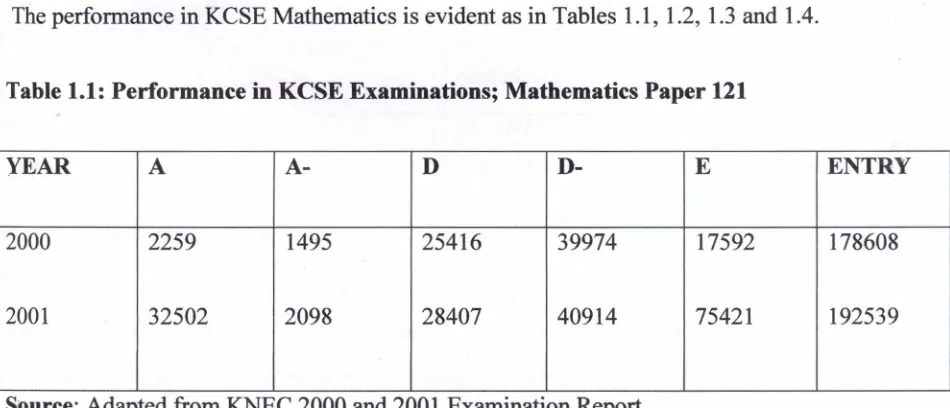
The performance in KCSE Mathematics is evident as in Tables 1.1, 1.2, 1.3 and 1.4.
Table 1.1: Performance in KCSE Examinations; Mathematics Paper 121
YEAR A A- D D- E ENTRY
2000 2259 1495 25416 39974 17592 178608
2001 32502 2098 28407 40914 75421 192539
Table 1.2: Percentage of Candidates in Grade A, A-, D, D- and E in KCSE
Grades Categories 2000 2001
A 1.26 1.68
A- 0.83 1.08
D 14.23 13.19
D- 22.38 21.24
E 40.08 39.16
Source: Adapted from KNEC 2000 and 2001 Examination Report.
Tables 1.1 and 1.2 indicate that a large percentage of candidates scored grade 'E' that is 40.08%
and 39.16% in the years 2000 and 2001 respectively as compared with 1.26% who scored grade
'A' in the year 2000 and 1.68% in the year 2001. The trend in performance in Mathematics
might have not changed seven years down the line. See, Table 1.3 which shows the performance
in Mathematics by gender.
Table 1.3: Candidates Performance by Gender in the years ,2008 and 2009 KCSE
Examinations in Mathematics Paper 121
All Girls Boys
Year No. of Mean % No. of Mean % No. of Mean%
Candidates candidates candidates
2009 335,014 21.13 151,091 18.11 183,099 23.63
2008 302,648 21.30 138,255 17.71 164,393 24.31
Source: The Kenya National Examination Council (2010)
Table 1.3,indicate girls score a lower mean grade than boys in the subject in 2008 and 2009. The
number of male candidates is large compared to the female candidates. Although this was not a
concern to the study, it is a point worth noting. Cumulatively, the performance of Mathematics i
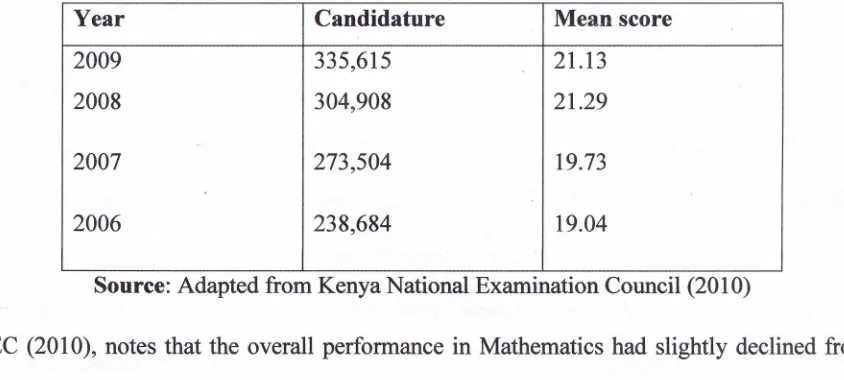
Table 1.4: Candidates Overall Performance in KCSE Mathematics for the last Four Years
Year Candidature Mean score
2009 335,615 21.13
2008 304,908 21.29
2007 273,504 19.73
2006 238,684 19.04
Source: Adapted from Kenya National Examination Council (2010)
KNEC (2010), notes that the overall performance in Mathematics had slightly declined from a
mean of 21.29 in the year 2008 to 21.13 in the year 2009 and there had been a significant
increase in the candidature from 302,648 in the year 2008 to 335,014 in the year 2009. Further
KNEC (2010) revealed 930 (0.27%) candidates obtained an overall grade A in 2009 KCSE examination compared to 817 (0.27%) candidates in 2008. 29,652 (8.87%) candidates obtained
grade B (plain) and above in the 2009 KCSE examination compared to 28,712 (9.51 %) in 2008.
The number of candidates with minimum university entry qualification of grade C+ and above '.
were 81,048 (24.7%) in 2009 compared to 72,649 (24.08%) in the year 2008 KCSE examination.
However, the mean score for the subject for the years between 2006 and 2009 is barely grade" D
minus". The same case applies to Masaba South district in which a large percentage of
candidates score grade 'E' as can be seen in Table 2.1 and Table 2.2. The tables testify
Mathematics is the worst performed subject with a large number of candidates scoring grade 'E'.
As the KNEC statistics reveal from above, a huge percentage of candidates in KCSE score either "
grade D- or E in Mathematics. This hinders form four school leavers from taking science
oriented courses in tertiary institutions even if they have better mean grades. Such candidates are
According to the Standard (2005), studies conducted at the University of London's Institute of
Education, show that private tuition does not add value to the pupils' performance.
1.3 Statement of the Problem
Despite the importance of Mathematics in industrialization, the teaching-learning of the subject
in Kenya Secondary Schools is faced with many obstacles as evidenced in the reports above. The
subject is compulsory both at Primary and Secondary level, but poorly performed. Mathematics
dictates the career a student is to pursue after secondary and almost all careers more so
competitive careers like Medicine and Engineering need a firm background of the subject. A
negligible percentage of candidates join these careers from Masaba South district. Hence the
crucial question is what challenges face the teaching-learning of Mathematics in secondary
schools in Masaba South District, Kisii County?
1.4 Purpose of the Study
The purpose of this study was to examine barriers to the teaching-Iea,ming of Mathematics in
secondary schools in Masaba South district and possible solutions to curb the barriers identified.
This could aid in strengthening and raising the performance of the subject as proposed by the
national plan; the Vision 2030 (Republic of Kenya, 2007).
1.5 Objectives of the Study
The specific objectives of the study were to:
1. Identify barriers to the teaching-learning of Mathematics in secondary schools.
11. Find out the main methods of teaching Mathematics
I iii. Determine the students' views about Mathematics.
v. To determine the effect of teachers' expectations towards learners in the learning of
Mathematics.
1.6 Research Questions
Thestudy was guided by the following research questions:
1. Which barriers were encountered in teaching-learning Mathematics?
11. Which methods were mainly used in teaching Mathematics?
iii. Were the Mathematics teachers professionally qualified?
iv. What were the Mathematics teachers' expectations on learners' achievement in
Mathematics?
v. What were the attitudes of learners towards Mathematics?
VI. What were the attitudes of learners towards the Mathematics teacher?
1.7 Significance ofthe Study
The knowledge generated by this study would assist Mathematics teachers understand and
appreciate various challenges facing them as they teach Mathematics and increase an
understanding of the barriers in teaching-learning Mathematics. Also the study was to assist
Mathematics teachers identify their deficiencies and limitations as regards teaching and learning
of Mathematics. The student will become alert on the negative effects of their attitudes.To the
Government of Kenya, the study would assist the Directorate of Quality Assurance and
Standards in the Ministry of Education organize relevant in-service courses for the mathematics
teachers also do a reform in teacher training. In addition both locally and internationally the
Mathematics and consequently, speed up technological development of these countries as
Mathematics is key to such development.
1.8 Limitation of the Study
The study was confined to secondary schools in Masaba South District, primary schools were not
included, as this would make the study cumbersome. The findings on barriers to
teaching-learning of Mathematics in primary schools were to be crucial for comparison purposes with
those of secondary schools. Some secondary schools in the district were in remote locations
which made traveling by car difficult.
1.9 Delimitations of the Study
The study was confined to secondary schools in Masaba South district where Mathematics
teachers, principals of schools and students were main respondents thus researcher didn't have a
chance to interview parents for the sampled schools. It is important to note that learning
Mathematics occurs both at home and in school and that the parents' attitudes towards
Mathematics have influence on their children's performance in Mathematics. The study had a
delimitation of administering interview schedules as many of the principals were preoccupied in
executing K.C.S.E examinations thus had little time to spare for the interviews.
1.10 Theoretical Framework
The study was based on Thorndike's (1922) Connectionism Theory of Learning. The theory .
represents the original Stimulus- Response (S-R) framework of behavioral psychology. It states
that learning is the result of associations forming between stimuli and responses. Such
associations or "habits" become strengthened or weakened by the nature and frequency of the
come to dominate others due to rewards. The hallmark of connectionism (like all behavioral
theory) was that learning could be adequately explained without referring to any unobservable
internal states. Thorndikes' (1922) theory consists of three primary laws. First, law of effect
which states that responses to a situation which are followed by a rewarding state of affairs will
be strengthen and become habitual responses to that situation.Second, law of readiness, which
states, a series of responses can be chained together to satisfy some goal which will result in
annoyance if blocked. Third, law of exercise, which states that connections become strengthened
with practice and weakened when practice is discontinued. A corollary of the law of effect was
that responses that reduce the likelihood of achieving a rewarding state (i.e., punishment,
failures) will decrease in strength. The theory suggests that the transfer of learning depends upon
the presence of identical elements in the original and new learning situations: i.e. transfer is
always specific, never general.In later versions of the theory the concept of "belongingness" was introduced: connections are more readily established if the person perceives that stimuli or
response go together. Another concept introduced was "polarity" which specifies that
,
connections occur more easily in the direction in which they were originally formed than the
opposite (Thorndike, 1922).
1.10.1 Application of Thorndikes' Connectionism Theory of Learning
Connectionism was meant to be general theory of learning for animals and human beings: \
Thorndike was especially interested in the application of his theory to education including
')
Mathematics (Thorndike, 1921) and measurement of intelligence (Thorndike 1927).'The cla'ssic
example of Thorndike's S-R theory was a cat learning to escape from a "puzzle box" by pressing
a lever inside the box.After much trial and error behavior, the cat learns to associate pressing the
satisfying state of affairs (escape from the box). The law of exercise specifies that the connection
was established because the S-R pairing occurred many times (the law of effect) as well as
forming a single sequence (law of readiness). Thorndike's (1922) theory of learning was
preferred for this study because of its principles listed
below:-• Learning requires both practice and rewards (laws ofeffect/exercise)
• A series of S-R connections can be chained together if they belong to the same sequence
(law of readiness)
• Transfer of learning occurs because of previously encountered situations.
• The most basic form of learning is trial and error learning.
Law of exercise emphasizes that we learn by doing and forget by not doing, although to a small
extent only. Connections between a stimulus and response are strengthened as they are used (law
of use) and also connections between a stimulus and response are weakened as they are not used
(law of disuse). Law of effect states if a response in a connection is followed by a satisfying state
of affairs, the strength of the connection is considerably increased whereas if followed by any
annoying state of affairs, then the strength of the connection is marginally decreased. The law of
readiness: interference with goal directed behavior causes frustration and causing someone to do
something they do not want to do is also frustrating.
.
All of these principles can be applied in the'
teaching-learning of Mathematics in secondary schools. In order to raise Mathematics
achievement, students require regular practice, motivation from their teachers, sequencing of the
mathematics topics according to how they are related, linkage of previously learnt experiences to
current lessons and trial and error attempts in solving mathematics problems. This made
1.11 Conceptual Framework
The conceptual framework in Figure1 below, presents five dimensions to .low performing
schools. It is related to Thorndike (1921) connectionism theory of learning as the theory can be applied in eliminating some of.the barriers in teaching-learning Mathematics. Educators are faced with challenges regarding how to improve the teaching-learning outcomes in Mathematics
which is a queen of all sciences. This may not be an easy task unless the barriers are identified and done away with. The study proposed the conceptual framework as illustrated in Figure 1.
Figure 1: Conceptual Model-Five Dimensions of an Intervention to Low Performing
Schools
Pedagogy Curriculum
/
Learners' Attitudes and
Initiatives
\
OrganizationalTeaching -learning
outcomes and Social
Atmosphere
/
Teachers'IExpectations/kno wledge,Attitudes
Key
• Pedagogy - the kind of instructions given to students.
• Curriculum- what students are expected to learn and its coherence.
• Organizational/social atmospheric factors- such as the way students are grouped for
mathematics instruction and support structures provided for learning.
• Teacher expectations/knowledge- teacher's attitudes regarding their students capabilities,
as well as their knowledge of Mathematics and how to teach it.
• Learner's initiative and attitudes- learners' attitudes regarding Mathematics and the
efforts they put in learning the subject.
The Figure! summarizes a research-based Conceptual Framework developed to help educators
and researchers comprehensively understand the factors involved in improving Mathematics
instruction.To develop the conceptual framework, a team of researchers examined two research
literatures: the cognitive Sciences research literature on how people learn and think about
Mathematics, and the international comparison literature examining approaches to teaching and
learning mathematics in different countries.
Teaching-learning outcomes (the dependent variable) are affected by pedagogy used to teach
Mathematics, the curriculum, organizational and social climate of the Mathematics class,
learner's attitudes and initiatives,teacher attitudes towards Mathematics,teacher knowledge and
expectations. All the variables listed above are interrelated and influence each other.'Fm
instance different teaching strategies used in different combinations with different groupings of
students will improve learning outcomes. Teacher knowledge, competencies, nature of learners
and curriculum dictate the teaching strategies used. Teachers playa significant role duringthe
Mathematics which in consequence can influence students' achievement. Teachers need not to
distance themselves from the students they teach. In the learner centered environment, they must
be prepared to learn about and from their students. A two way open dialogue needs to be part of
all learning activities. Kaplan (1998), argues that teachers must learn to create an environment in
which students feel free to openly express and share their ideas, therefore organizational and
social climate is crucial in teaching-learning of Mathematics.
1.12 Definition of Operational Terms
Some of the terms used in this were defined as below:
Barrier
The word barrier means any condition that makes it difficult to make progress or to achieve a set
objective. It may also be defined as something that prevents or obstructs passage, access or
progress. It is something that prevents action or slows progress. Therefore the word barrier in
this context means those things/issues that prevent/inhibit the smooth teaching-learning process
in Mathematics in order to achieve the set goals/objectives.
Learning
Learning can be defined as the relatively permanent change in an individual's behavior (or
capability) as a result of experience or practice.
Teaching
It is the purposeful direction and management of the learning process. For this study teaching is
opportunities to students so as to produce relatively permanent change through the engagement
in experiences provided by the teacher.
Teaching-learning
Teaching-learning refers to a process through which learners, the curriculum and other variables
are organized in order to attain some predetermined goals. The study treats teaching and learning
2.0 CHAPTER TWO
LITERATURE REVIEW
2.1 Introduction
The chapter explores literature on barriers in teaching-learning Mathematics. These were
categorized as pedagogy; curriculum; teacher's mastery of knowledge; expectations and
attitudes; organizational; and social climate factors.
2.1.1 Achievements in Mathematics Globally
According to the Standard, of 6th September 2007, one of the most disturbing trends in education
in Africa is low academic achievement in Mathematics and Sciences. Most countries have
adopted the 'chalk and talk education system' which has no practical teaching in Mathematics
and the subject has been introduced as a tough nut for less gifted students to crack.Subsequently
Africa has the least number of scientist and engineers per population in the world (Standard
2007). The situation is like so because many Science oriented courses depend on Mathematics
and performance in Mathematics in many countries is characterized by low academic
achievement. This, strongly indicated that there were barriers to the teaching-learning of
Mathematics and yet Mathematics is crucial for technological development and equipping of the
states with the required human personnel. Indeed recognition of Mathematics as a catalyst to
economic development is something that African countries can ignore at their own peril
'Standard, 2007). Unless Mathematics and Science.education is improved the continents' economies would fail to meet the Millennium Development Goals (MDGs) and the Kenya's
research on the causes leading to this. A study carried out by Sao (2008) in Eastern Cape
province of South Africa, revealed the following barriers to learning Mathematics in the rural
secondary schools:-(i) Learners exhibit attitudinal barriers towards learning mathematics- they
do not make serious attempts to solve problems once they encounter difficulty. (ii) The educators
seem to lack the mathematics competencies to handle their teaching -they still teach
instrumentally in the way they are taught which constitutes a barrier to learning. (iii) The
educators' interaction with the learners takes place only in the classroom time and is therefore
limited. (iv) Lack of reading culture among the learners is prominent; learners therefore
experience difficulties in comprehending mathematical texts because of inadequate vocabulary
and reading skills:(v) Learners experience lack of support in their home environments.(vi) Basic
and prerequisite numeracy skills do not seem to have been acquired at necessary levels; in earlier
grades. Goswami's (2008), research conducted in Cambridge University revealed the typical
barriers to learning, but specifically prevalent in the acquisition of math's skills. The barriers
include; high levels of anxiety, emotions such as panic, switching off and feeling stupid,being
teased by their peers, avoidance tactics and frustration when older pupils realize that their peers
are able to do what they cannot.
Studies conducted in Bostwana by Mapolelo (2009), reveal that students consider learning and
understanding Mathematics to mean being successful in getting the correct answers. Students
reported that in majority of the cases teaching of Mathematics was lecture-oriented. This has
become a barrier to teaching-learning of Mathematics in the country. In US, Lim (2006),
reported barriers in teaching-learning Mathematics which include limited mathematics content
knowledge. To counter this, a Conference Board of the Mathematical Sciences recommended a
teachin secondary level.Lim (2006), further noted that mathematics textbooks run hundreds of pages without a"coherent scope and sequence. Even though computers are common in US
schools many teachers feel unprepared to integrate technology into the subject they teach.
SimilarlyDawe (2001), reported that secondary teachers in the United Kingdom are reluctant in
integrating technology in teaching Mathematics. However, encouraging is that teachers in the
UK do not generally work alone; the subject departments acts as a 'community of practice',
sharing resources, approaches, cultural values and aims. They collaboratively develop schemes
of work (Lave and Wenger, 1991). What might be the barriers in teaching-learning Mathematics
in Kenya?
At independence in 1963, the Kenyan government inherited the then existing western system of
educationwhich was 8-4-2 system and changed to 7-4-2-3 system in 1966 (Eshiwani, 1993:
36-38). The current education system, (8-4-4 system) was introduced in Kenya early 1985 with an
important feature of curriculum as 'course of study' as opposed to the previous system where
national textbooks were interpreted to be the curriculum. In the current education system "
Mathematics is a compulsory subject up to secondary school level. Student performance in Mathematics in secondary schools is getting poorer and poorer year after year (KNEC, 2004).
o
KNEC identified inadequate coverage of syllabus and inability to master simple and basic
concepts as hindrances to good performance. Studies carried out on reasons for poor
performance in Mathematics by Thuo (1985) attribute it to factors such as: inappropriate
teaching methods; lack of learning resources and students' negative attitudes towards the
In an intervention to improve student's performance in Mathematics, the Ministry of Education,
Science'and Technology (MOEST) of Kenya and Japan International Cooperation Agency
(JICA) started a project called Strengthening of Mathematics and Science in Secondary
Education (SMASSE) (1998). This initiative was aimed at addressing the quality of teaching and
learning of secondary school Mathematics and Science subjects. The pilot study started in nine
Districts which included; Kakamega, Butere -Mumias, Lugari, Murang'a, Maragua, Makueni,
Kajiado, Gucha and Kisii District the mother District of Masaba South District. The nine
Districts are those which were performing poorly in Mathematics and Science subjects.
SMASSE (1998) conducted baseline studies in the nine districts and the fmdings were as
follows: Students perform poorly in the concepts of Mathematics, the quality of teaching is poor;
most students said that classroom environment is harsh and unfriendly; students do not
understand the basic Mathematics needed to function effectively in the society; students appear
to lose interest in the learning of Mathematics as they progress through the school system;
performance of students in Mathematics at the end of secondary school education is the lowest
compared with other subjects in the secondary curriculum. Studies conducted by KIE and
SMASSE (2003) found the following as the problems facing the education sector; inappropriate
...J .
teaching methods used by teachers, lack of integration of theory and practical by students, low
morale of learners and inadequate teaching/learning facilities and materials. Further, an
overloaded curriculum, high teacher-pupil ratios at secondary school level, understaffmg and
under-qualification of teachers in some areas of curriculum were also reported as problems
facing the education sector. These identified problems have an impact in the teaching-learning
of Mathematics. In an effort to curb some of the above problems SMASSE project has start
The overall goal of the INSET is to upgrade the capability of Kenyan teachers in Mathematics
and Sciences. The INSET advocates the use of Plan, Do, See and Improve (PDSI) and Activity,
Student Experiment and Improvisation (ASEI) pedagogical methods of instruction.
Also the Working Group on Mathematics and Science Education (WGMSE) was launched in
November 2004 to help Africans Mathematics and Science Education (MSE) programs improve
and adapt the challenges of 21st Century. WGMSE strives to promote regional cooperation by
sharing information among member countries regarding challenges and successful innovative
experience in MSE. WGMSE is hosted by Kenya's Ministry of Education. The Centre for
Mathematics, Science and Technology Education in Africa (CEMASTEA) based in Nairobi,
Kenya is the coordinating institution and JICA, as the overseer.
In an effort to sharing information a team of SMASSE participants from Kenya who visited
Malawi in May 2000 found out that Malawi and Kenya, like any developing countries, share
similar problems with regard to the teaching-learning of Mathematics at secondary schools.
"J Prominent issues raised amongst the problems included:
• High teacher-pupil ratios atsecondary school level.
• Backlog of untrained and under-qualified secondary school teachers.
• Inadequate teaching and learning materials and infrastructure.
• Lack of a well structured INSET programme in Mathematics and Sciences.
• Attitudinal, unprofessional, stereotyped and gender unfriendly approaches to the teaching
and learning of Mathematics and Sciences at secondary school level.
• Inadequate innovation in the teaching methodologies of Mathematics and science.
A study conducted by Wasiche (200q), on Teaching Techniques that enhances students
performance in Mathematics in selected public secondary schools in Butere-Mumias district
Kenya recommends:-Mathematics teachers to assist individual students and provide frequent
feed-back especially to low achievers in the subject. Teachers to be told the importance of
seminars and INSETs like SMASSE before they attend them. Once the teachers appreciate the
importance they are likely to practice what they learn in the mathematics seminars and
workshops and every mathematics teacher to ensure that all students are participating in class by
providing a conducive and supportive learning environment. This can be done by using various
teaching techniques and teaching/learning resources, well structured INSET programme in
Mathematics and Sciences and friendly approaches to the teaching and learning of Mathematics
and Sciences at secondary school level.
The Daily Nation of 26th February (2000), stated that the root cause of poor performance in
Mathematics is poor preparation of Mathematics teachers. The Daily Nation of 3rd March (2010)
also reported that performance in key curriculum subjects like Mathematics and Sciences at
KCSE examinations has not been satisfactory for quite a long time. According to Ramari (2004),
performance in Mathematics has been generally poor. Auma (2004) and Achieng (2007) looked
at the~relationship between teacher factors and student mathematical achievement as factors
affecting Mathematics performance and found that there is a positive relationship. Manoah,
Indoshi and Othuon (2011) studied on influence of attitude on performance of students in
Mathematics curriculum. All the above researchers although dealing with low achievements in
Mathematics didn't look at barriers to the teaching-learning process in mathematics curriculum
fqr secondary schools. The study was to explore into the barriers in teaching-learning
Masaba South district is a new district curved from Kisii Central district. The district had thirty
-~..~
nine secondary schools of which majority have been started recently through community
initiative projects. Teaching-learning of Mathematics in the secondary schools in Masaba South
experience obstacles as evidenced in Table 2.1 and Table 2.2 with very low achievements in Mathematics.
According to the Masaba District (2009) Joint Evaluation Tests involving three divisions i.e.
Kiamokama, Rigoma and Masimba (KIRlMA) , it was evident that Mathematics was poorly
performed with a mean of 1.872 (D-) with a shocking figure of 2611 out of 3444 scoring grade
Es. Mathematics comes at the bottom of all subjects apart from Building Construction which had
one candidate who scored grade 'E' with a mean of (1.00)'1:.he candidates who scored grades D, D..and E comprised 85.58%, meaning it was only less than 15% of the students that scored grade
D+ and above.
Fhe performance in Mathematics indicated strongly that there were barriers to teaching-learning
of Mathematics in the district. The KIRlMA Joint Evaluation Tests IPanel attributed the poor
performance to widespread lack of mastering of mathematical concepts such as: reading of
Mathematical tables, use of calculators and failure to interpret mathematical questions. Out of
the dismal performance in Mathematics the researcher was justified-to explore on the barriers to
"
the-teaching-learning of Mathematics in the district. Attached below, are Tables 2.1 and 7.2'
which show the performance students in various subjects including. Mathematics in KIRIMA test
TABLE 2.1: Masaba District Joint Evaluation Tests (2009)
Subject Code
.
Grades Mean MeanGrade
Entry A- B+ B B- c+' C c- D+ D D- E
Enalish 101 3477 1 13 58 142 253 286 4S1 453 429 463 927 3.5965 D+
Kiswahili 102 3500 7 76 144 225 311 370 418 455 465 370 639 4.3546 D+
Matbematta 121 3444 7 19 31 44 (j% 74 113 129 159 184 %599 1.877%
D-Biolozv 231 3009 2 43 74 127 174 191 287 314 365 420 11 3.4058 D
Physics 232 968 2 20 54 S9 89 128 152 119 126 98 1001 4.7872 C
Chemistry 233 3400 22 72 92 102 132 188 224 277 380 494 105 3.1832 D
History 311 1960 18 85 124 182 186 189 188 198 175 159 1380 4.8903
C-Geography 312 846 5 35 62 85 80 77 67 86 88 74 408 4.901
C-CRE 313 1916 1 56 97 150 204 215 214 221 195 166 167 4.5778
C-Home science 441 30 0 1 1 2 4 4 3 9 3 2 383 5.4000 C..
Woodwork 444 14 0 0 0 0 0 2 1 1 1 3 0 2.5714 D
Building 446 1 0 0 0 0 0 0 0 0 0 0 6 1.0000 E
canst
Electricity 448 0 2 0 0 0 0 1 0 1 0 0 1 5.0000
c-Computer 451 21 2 0 3 3 3 5 1 2 0 1 0 7.2381 C+
studies
ARriculture 443 1569 4 19 34 65 73 105 136 136 167 172 651 3.1899 D
Business 565 1321 0 51 11 50 83 70 105 129 113 275 424 3.3868 D
studies
Table %.2: Perceatage 01Caadldates 81per Grades 10Mathematles Paper 121 (2009)
GRADE % GRADE % GRADE %
A- 0.406 C 2.146 E 75.719
B+ 0.551 C- 3.277
B 0.899 D+ 3.741
B- 1.275 D 4.524
c+
1.798 D- 5.336In order to enhance the learners thinking skills and thinking habits, Yeap (2006) recommends
that teachers should create environment and opportunities to engage learners in developing good
thinking skills and habits. He further indentified characteristics of good practices in the
Mathematics classroom such as: providing students opportunities to develop competence and
attitude that put them in good state in the global, technological economy; develop good thinking
by enhancing students thinking skills and thinking habit; engage students inthe learning process
and still among students a belief that they are able to extend their own knowledge.The National
Council of Teachers of Mathematics (2006) proposed areas to be looked into in order to
comprehensively understand the factors involved in improving Mathematics instruction. If not
well addressed they constitute barriers to teaching-learning process of Mathematics. The
reseacher divided the factors into five
categories:-1. Curriculum factors.
11. Teacher knowledge, expectations and attitudes.
111. Organizational and social climate factors.
iv. Learner's attitudes;
.v. Pedagogical approach factors. Each category will be discussed as below:
2.2 Curriculum Factors
Curriculum is considered integral to any attempt to improve mathematics instruction.One often
discussed theme is curricular coherence. Within the school curriculum learning Mathematics is
uniquely challenging in that it is highly organized, sequential and progressive. Simple elements
must be learned successfully before moving to the others. It is a subject where one learns the
enables an understanding of the sequence and interactions of the parts and the way they support
each other so that getting there clarifies the stages of the journey (Chinn and Ashcroff, 1998:4).
This can be compared with "Systems Approach" developed by Kaufman (1984). He defines
Systems Thinking as an approach to problem solving, by viewing "problems" as parts of an
overall system, rather than reacting to specific part, outcomes or events and potentially
contributing to further development of unintended consequences. Kaufman (1984) further
suggests that component parts of a system can best be understood in the context of relationships
with each other and with other systems, rather than in isolation. The Mathematics curriculum
should embrace this approach in sense that concepts of Mathematics in one topic build from
concepts of yet another topic. According to Schickendanz (2008) an integrated Mathematics
curriculum is very essential. Integration is the blending together of two or more content areas in
one activity or learning experience. The purpose of integrated curriculum is to make content
meaningful and accessible to students. Integration also enables more content to be covered
during the limited school day.
Curriculum materials in Japan and China are commonly designed with significant content for
teachers. Japanese and Chinese teachers regularly turn to their mathematics curriculum materials
content, pedagogy, student thinking and the connections between mathematics ideas within and
acros~school years (Ma, 1999). Such materials may not be effective without additional
professional development. Ball and Feiman-Nemser (1988) reported pre-service teachers need
minimal guidance on how to use textbooks and contradictory messages about the value of using
text books for planning and instruction.
According to Lambdin and Preston (1995) teachers vary greatly in their acceptance of or
how curriculum developers or educational reformers intended (Ball, 1990). This variation in
curriculum may affect opportunities learners have to learn from the curriculum and learners may
not benefit a lot from the teaching-learning process. Cohen and Ball (1990) argue that teacher
beliefs and knowledge about the subject matter, pedagogy, and attitudes towards learners may
influence teachers' responses to curriculum materials including how they use materials and what
they learn from them. Because of the interrelated nature of the subject, learners who have
learning difficulties in Mathematics may sometimes appear to feel even more lost and disempowered than those who encounter problems in other subjects (Frederickson and Cline,
2009:387-388).
Schmidt and Wang (2005) found that in the United States, most of the curriculum covered an
enormous number of topics and lacked a core set of ideas linking concepts in the curriculum. Consequently, Schmidt and Wang (2005) reported American curriculum has being a milewide and an inch deep. The large number of topics and lack of coherence in US curriculum meant the topics were not presented in a meaningful way (Hiebert and Carpenter, 1992). By contrast in
countries that perform well on mathematics assessments- (like the Trends in International
Mathematics and Science Studies (TIMSS) (1999), there is often a standard, well, organized
curriculum that uses core concepts as a way to help students anchor their new knowledge and mathematics is presented as a coherent set of ideas related in logical ways (Charles, 2005).
Schmidt and Wang (2005) colleagues consider the disorganization in curriculum a primary reason for US students' poor performance on international mathematics assessments.
frame-work that the attainment of problem solving ability is dependent on five inter-related
components-concepts, skills, processes, attitudes and meta-cognition. For all pupils in school
irrespective of their abilities, mathematics education aims to enable pupils to: (i) Acquire and
.apply skills and knowledge relating to number, measurement and space in mathematical
situations that they will meet in life. (ii) Acquire further study in mathematical concepts and
skills necessary for further study in Mathematics and other disciplines. (iii) Use mathematical
ideas and arguments precisely, concisely and logically (iv) Develop positive attitudes towards
Mathematics including confidence,enjoyment and perseverance. (v) Develop the abilityto make
logical.deduction and induction as well as to explicate their mathematical thinking and reasoning
skills through solving of mathematical problems.
Ministry of Education Singapore (MES) (2006), indicate that, School mathematics curriculum as
part of the school curriculum has played a significant role in the economic development and
progress of the country in the last five decades. The Mathematics syllabus has undergone a
content reduction, learning in the subject is sequential and hierarchical in nature,topics which
were less fundamental and not connected to other topics in the syllabus; which placed heavy
emphasis on mechanical computation; which overlapped with those taught at other levels;that
were too abstract for the intended level and concepts/skills that were taught in other subjects,
were.removed from the syllabus. MES (2006), further argue that The Mathematics syllabus
undergoes periodic review to ensure that the content remain relevant so as to prepare the pupils
for the challenges and opportunities in future. Goh (2001),reported every child in school should
do Mathematics that is suited to his or her ability. This is yet to be borrowed by the Kenyan
According to KIE (2009), Kenya secondary mathematics aims at producing a person who willbe
numerate, orderly, logical, accurate and precise in thought. The person should be competent in
appraising and utilizing mathematical skills in playing a positive role in the development of a
modem society. Secondary curriculum is designed by KIE. Mathematics textbooks are
developed by publishers and evaluated by the KIE. The approved textbooks are procured by
schools for the appropriate classes at the beginning of each year of implementation.A total ofsix
titles,which are found to satisfy the needs of the curriculum are approved for each class. The list
of approved books is availed to all secondary schools and the mathematics teachers in each
school determine the title they prefer to use as class textbooks. The mathematics teachers also
prepare the schemes of work from the Mathematics syllabus which they use for teaching.
Kenyan mathematics teachers require INSETs on how to use mathematics textbooks, interpret
mathematics syllabus and write schemes for instructional teaching in class.
Eshiwani (1974) points out that one of the weakest points of the New Mathematics in Kenya was
the lack of evaluation to find out if valid progress was being made. He argues strongly for
research in area of antipathy towards Mathematics, especially among girls and in many other
areas. Ntarangwi (2003), reported the Kenya education system is one more about schooling,
than 'education'; it has failed to instill values, aesthetics and beliefs that are unique to peoples'
orientation. The education curriculum has been criticized for its lack of proper structure in the
learning items, whereas certain high level concepts have been taught in lower levels. High
teacher-learner ratios especially in Mathematics and Sciences thus overloading teachers. The
system is competitive, picks the best in competition and is highly elitist. Similarly, Shujaa
(1994), observed that Kenyas' system of education has been criticized for promoting rote
Shujaa (1994), further observed rote learning especially in Mathematic inhibits creativity and
innovativeness, making learning a passive affair for the students. The rote learning technique
produces individuals who can't think outside the 'box'.
2.3 Teacher Knowledge, Expectations and Attitudes
Teacher knowledge, expectations and attitudes can be critical barriers to teaching-learning of
Mathematics in Secondary schools.
2.3.1 Teacher Knowledge
Research suggests that greater teacher content knowledge is a contributing factor to increased
student learning (Ball, Hill and Bass, 2005). Teachers in Asian countries have stronger
Mathematics knowledge and more training, on average than teachers in the United States and
students in Asian countries typically perform better than students in the US on international
Mathematics Assessment (Stevenson 1998; Ball 2003; Siegel 2004). In addition to content
knowledge, a teacher also needs pedagogical content knowledge, or specialized Mathematics
I
knowledge for teaching that includes representing the subject to make it understandable to
others; knowing what topics will be easy or not; and insight about what preconceptions students
of different ages and backgrounds have (Shulman, 1986).
A successful Mathematics teacher needs a deep understanding of Mathematics content to create
mathematically rich task structures and to adapt to meet the needs of individual students (Ma,
1999). Professional development focused in increasing teacher knowledge of Mathematics may
increase students' performance. There have been assumptions by teacher employers that content
Mathematics know their subjects well. However, research on secondary teachers repeatedly
reveals the fallacy of the assumptions (Ball, 1988).
Stodolsky and Grossman (2000), argue that factors such as individual teachers' beliefs about
students, instructional repertoire, and knowledge and skill in the subject as keyfactors affecting
individual teachers' willingness and ability to change instructional practices.Teachers who feel
confident about their content and pedagogical content knowledge, and who have high
expectation for students' success, are also more likely to adapt than teachers with strong
commitment to the practices they currently use and no confidence of success with new
pedagogical approaches.
As Stodolsky and Grossman (2000) argue teachers need access to new knowledge and support as
they embark upon new instructional practices, hence the importance of the role of the local
school context, such as the subject department in facilitating teacher change.Departments with
strong collegial interaction and commitment in support of student learning help teachers gain
access to needed instructional approaches and resources, thereby increasing teachers' personal
and collective efficiency (the belief that they are capable) for responding to the learning needs of
strident populations. Thus teacher knowledge is crucial for removing teaching-learning barriers
to Mathematics by improving teacher delivery in class. Mathematics as a science requires diverse
skillsin delivery by the teachers and competency on the part of the teacher. However,teaching
load, in- availability of teaching resources, lack of INSETs can inhibit teachers from making
instructional changes in Mathematics. Otieno (2010), in a study looking at 'the effects of
teaching/learning resources on academic performance in secondary school Mathematics in
BondoDistrict of Kenya' recommends INSETs for trained Mathematics teachers and recruitment
2.3.2 Teacher Expectations
Another factor that affects student learning outcomes is teachers' expectations. Teachers with
low expectations of their students will most likely only teach remedial skills and not more on
advanced concepts or stress conceptual understanding (Romberg, 1984). Teachers too often
believe that attempting to teach higher-order thinking is inappropriate when students are
struggling (Zohar, Degani and Vaalknin, 2001) only if teachers consistently set high expectations
by engaging all students in challenging Mathematics can students be expected to learn more
challenging Mathematics. One method of raising teacher expectations is to involve teachers in
investigations of student work, when students do them.
2.3.3 Teacher Attitudes
Teachers' attitude towards the teaching of Mathematics plays a significant role in shaping the
attitude of students towards the learning of Mathematics. Studies conducted by Ogunniyi (1982),
in Nigeria reported that students' positive attitudes towards sciences could be enhanced by the
following teacher related factors: teachers' enthusiasm; teachers' resourcefulness and helpful
behavior; teachers' thorough knowledge of the subject-matter and their making science quite
interesting.
Bandura (1971), demonstrated that behaviors are acquired by watching another (the model
teacher, parent,mentor friend) that performs the behavior. The model displays it and the learner
observes and tries to imitate it.Teachers are, invariably role models whose behaviors are easily copied by student. What teachers like or dislike, appreciate and how they feel about their
learning or studies could have a significant effect on their students. Unfortunately, however
students can be more paramount than what they teach. In a nutshell,teachers' attitudes directly
affect students' attitudes.
Chako (1981), in a study of teacher and student characteristics as they correlate to learning
outcomes in Mathematics, found that teachers' attitude towards teaching significantly predict
students attitude as well as achievement in Mathematics. Also, Ogunniyi (2000), found
significant causal relationship between the teachers' attitude and students' achievement in
integrated science.
2.4 Organizational and Social Climate Factors
Organizational structure and social climate of the school have a profound effect on students
performance in Mathematics. Astudy conducted by Sullivan, Toblas and McDonough,(2006)of
University of Otago in Sydney on; "who a student sits near to in Mathematics": Tension
between social and mathematical identities,recommends that students need to be surrounded by
others whose behavior does not disrupt or distract them,and who they like and feel comfortable
with. The study suggests that adolescent students do not have the power or controlto stop other
people's behavior affecting them, nor do they have the power to sit where they want to ensure
their academic identities are being fulfilled. By instituting seating plans Mathematics teachers
can ensure students academic and social needs are met therefore improving students learning
through positive discussion and help-seeking.
Social environment is likely, however, to be particularly important to young adolescents of 13-15
years. Not only do they have increasingly strong social needs (Ryan, 2001), but they are also self
conscious and sensitive as "more so than at other ages, young adolescents doubt their abilities to
seeeeed, question the value of doing their school work, and decrease their effort towards
academics" (Ryan and Patrick, 2001:439) Relationship between students impact on the
adolescent social environment
The relationships between students in particular, are a resource and accessing this resource can
lead to better mathematical learning through Mathematics discussion, emotional support and the
sharing of Knowledge and skills. To harness this resource and to account for the students'
powerlessness to control can ensure the conditions for positive seating arrangements are met
every day through sensitive seating plans. Teachers might do this by getting to know the students
better in terms of both their social and mathematical identities and the students could be seated in
pairs with the pairs ready to turn to form a larger Cooperative learning group. The mathematics
teacher needs to give explicit messages regarding as: students are valuable resources to workto
increase learning; and a students' behavior affects others (Sullivan and McDonough,2007).
A study conducted by Parsons and Harding (2009), suggests that effective schools are led by
wise principals who build and support teacher leadership. When offered opportunities teachers
build good learning environments. Teachers can also be instrumental in identifyingkeyproblems
and when empowered and supported by principal, make significant to improve the lives of
children. The researcher further found that good schools were "positive" places- they largely
exorcise negativity. Teachers work hard; and are willing to work harder; and, are even energized
by hard work. What brings teachers to their knees is negativity- whether introduced from the
outside (where all manner of negative influence weigh upon teachers) or form wide-ranging
internalcriticism that cause teachers to dwell onfailures, self-critiques and difficulties.
The study further found that relationships are the key to every positive action within the school.
Relationships are everywhere-between teachers and students; between students and students; ,
between teacher and teachers; between teachers and principals and between teachers and
-principals and parents. When relationships are smooth schools are smooth and teaching-learning
also becomes smooth.
In my view the study is applicable to the teaching-learning of Mathematics. The mathematics
teachers have to ensure good relationships with the learners he/she teaches for maximum
enhancements in learning Mathematics. With the cordial relationships the students will freely
communicate their mathematical difficulties to the mathematics teacher who in response will
give direction on their solution. Also, according to Parsons and Harding (2009), principals who
believe that teachers would do a good job and gave them space to do it are always successful.
Therefore, principals should assume the best from their teachers and principals should give
teachers freedom to take innovative tasks in teaching-learning Mathematics. By so doing,
barriers such as students feeling shy, some not ready to communicate their Mathematics
?ifficulties will be done away with.
2.5 Learners' Attitudes Towards Mathematics
Two contrasting beliefs are often found. Some parents, teachers and students believe that
everyone can develop their ability to learn Mathematics. Others believe that Mathematics is an
innate skill or trait that some people are "good at Mathematics" and other people are not.Asian
countries tend to subscribe to the former belief, whereas in the United States, parents and
teachers are often willing to accept that a student is innately "not good at Mathematics".
Consequently students labeled as not good often do not try, since they feel their efforts will be
futile (Stevenson and Stigler, 1992).
A simple, but effective intervention taught students that the brain was like a "muscle" and if they
exercised- it-in-Mathematics, it would get stronger. Thorndike (1921), connectionist theory of
learning-law of use agrees with these. US students who were told this analogydid better than
students who were not told (Blackwell, Trzesniewski and Dweck,2007).
Negative effects on motivation and expectations can occur through "stereotype threats". For
example, the stereotype,that men are better in Mathematics than women.Research has failedto
show any difference between men and women in mathematical ability. However women aretoo
ready to admit inadequacy and say-, "1 just can't do Mathematics". Stereotype threats occur
when a group that is often stereotyped as poor in Mathematics is reminded of this stereotype
(Cohen, Garcia, Apfel and Master, 2006). Spillane (2002) found that many teachers have a
"deficiency" view of their "disadvantaged" students. Whether the negative belief systems are
about race or gender, teachers belief systems are about race or gender, teachers need to be
challenged typically through professional development. Parental beliefs and home support for
Mathematics performance also relate to student success (Cooper and Robinson 1991), so
outreach efforts to help parents understand what they do at home is important for Mathematics
learning as well.
Mathematics has been registering dismal performance over the years in Kenya and the trend
might continue so long as the negative mind-set towards the subject is not corrected. Some
students hold teachers accountable for poor performance and the general public believes that
Mathematics is an abstract subject meant for the intelligently-gifted ones (Kenya Times, 15
August 2006).
According to McGraw-Hill (2005), there are many myths about Mathematics. The myths dictate
the student attitudes towards Mathematics. Some of the myths are: Mathematics requires a
memory; Mathematics is not creative; there is a best way to do Mathematics problems and some