Western University Western University
Scholarship@Western
Scholarship@Western
Electronic Thesis and Dissertation Repository
8-22-2012 12:00 AM
A New Web Search Engine with Learning Hierarchy
A New Web Search Engine with Learning Hierarchy
Da Kuang
The University of Western Ontario
Supervisor Charles X. Ling
The University of Western Ontario Graduate Program in Computer Science
A thesis submitted in partial fulfillment of the requirements for the degree in Doctor of Philosophy
© Da Kuang 2012
Follow this and additional works at: https://ir.lib.uwo.ca/etd Part of the Artificial Intelligence and Robotics Commons
Recommended Citation Recommended Citation
Kuang, Da, "A New Web Search Engine with Learning Hierarchy" (2012). Electronic Thesis and Dissertation Repository. 750.
https://ir.lib.uwo.ca/etd/750
This Dissertation/Thesis is brought to you for free and open access by Scholarship@Western. It has been accepted for inclusion in Electronic Thesis and Dissertation Repository by an authorized administrator of
A NEW WEB SEARCH ENGINE WITH LEARNING HIERARCHY
(Thesis format: Monograph)
by
Da Kuang
Graduate Program in Computer Science
A thesis submitted in partial fulfillment
of the requirements for the degree of
Doctor of Philosophy
The School of Graduate and Postdoctoral Studies
The University of Western Ontario
London, Ontario, Canada
c
THE UNIVERSITY OF WESTERN ONTARIO
School of Graduate and Postdoctoral Studies
CERTIFICATE OF EXAMINATION
Supervisor:
. . . .
Dr. Charles X. Ling
Examiners:
. . . .
Dr. Jamie Andrews
. . . .
Dr. Kamran Sedig
. . . .
Dr. Luiz Capretz
. . . .
Dr. Yang Xiang
The thesis by
Da Kuang entitled:
A NEW WEB SEARCH ENGINE WITH LEARNING HIERARCHY is accepted in partial fulfillment of the
requirements for the degree of Doctor of Philosophy
. . . .
Date
. . . .
Chair of the Thesis Examination Board
Abstract
This thesis proposes our first attempts to build a novel web search engine, namedSEE(Search Engine with hiErarchy), with webpages classified into categories of a topic hierarchy. We also discuss how to improve SEE with minimal human supervision.
Most of the existing web search engines (such as Google and Bing) are in the form of keyword-based search. Typically, after the user issues a query with the keywords, the search engine will return a flat list of results. When the query issued by the user is related to a topic, only the keyword matching may not accurately retrieve the whole set of webpages in that topic. On the other hand, there exists another type of search system, particularly in e-Commerce web-sites, where the user can search in the categories of different faceted hierarchies (e.g., product types and price ranges). Since the total amount of data is relatively small, the categorization is often conducted by human efforts or based on the pre-defined labels. Is it possible to integrate the two types of search systems and build a web search engine with a topic hierarchy? Yahoo! in fact attempted to organize the Internet webpages into a hierarchical structure by labeling them using human effort. However, it failed eventually as the number of webpages increased dramatically on the Internet. Thus, to build such integrated web search engine, the main diffi -culty is how to classify the vast number of webpages on the Internet into the topic hierarchy. In this thesis, we will leverage machine learning techniques to automatically classify webpages into the categories in our hierarchy, and then utilize the classification results to build the new search engine SEE.
Firstly, we extract a reasonable hierarchy from the Open Directory Project (ODP), and use the webpages in ODP as our base training data to build the classifier. Then we utilize the top-down hierarchical classification approach to classify new Internet webpages into our hierarchy. By exploring different feature filtering methods, classifier parameters and calibration algorithms, we optimize the performance of our hierarchical predictive model. According to the evaluation results, the classification performance is satisfactory.
How to leverage the classification results to build the search engine SEE is the next step. Here, we face two major challenges: how to deal with the false positive classification errors and rank the results within each category, and how to handle the false negative errors introduced in the classification phase. Accordingly, we design a novel ranking function and a smart way to let user explore more results. We conduct a comprehensive evaluation by using a well-known data collection for information retrieval. The results demonstrate that the hierarchical version of SEE can achieve better search results than the flat version in most of the queries, particularly when the query is related to a topic.
In order for SEE to achieve better search performance, it is critical to improve the classifi-cation performance, which often requires human efforts to label more webpages as the training
data. Thus, it is worthwhile to study the problem on how to maximize the classification per-formance in the hierarchical setting with minimal human supervision. We propose a novel multi-oracle setting and a new active learning framework for the hierarchical classification. According to the experiment results, our methods can largely reduce the human labeling cost, and thus can be used to further improve the performance of SEE.
In summary, we implement a prototype of a novel search engine named SEE, where the user can do both keyword search and hierarchical browsing. Several challenges have been discussed and several novel solutions have also been proposed accordingly. According to the evaluation, SEE obtains promising results. More importantly, since the classifiers are built offline, this technology is scalable to be applied to any large-scale search engine.
The thesis is joint work with Xiao Li. We both contributed in designing the architecture of the entire system for SEE as well as the algorithms on how to improve SEE. I contributed more on Chapter 3 and Chapter 4, while Xiao contributed more on Chapter 5.
Keywords:search engine, hierarchy, faceted hierarchies, e-Commerce websites, classification, ranking, information retrieval, oracle, active learning
Acknowledgements
First, I would like to thank my supervisor, Dr. Charles Ling, who had the greatest role in my thesis research in the past four years. I will always be grateful for all his guidance and support for my research in the interesting topics of this thesis. Without his instruction, it’s hard to imagine that I can finish this thesis.
Thanks are also given to all the members of our Data Mining Lab at Western, specially, my partner, Xiao Li. We cooperated on the search engine SEE and jointly published two papers. He made great effort on our research. Besides, I would like to thank to Eileen Ni, who carefully read my thesis and gave a lot of suggestions. Also, thanks my former colleague, Jun Du, who kindly helped me solve lots of research problems during my 4-year PhD study.
Finally, I would like to give my deepest thanks to my wife Sizhe. She gave me uncondi-tional encouragement and support in helping me finish my thesis.
Contents
Certificate of Examination ii
ABSTRACT iv
ACKNOWLEDGEMENTS v
List of Figures ix
List of Tables 1
1 Introduction 2
1.1 Two Types of Search Systems . . . 4
1.1.1 Keyword-based Web Search Engine . . . 4
1.1.2 Faceted Search System . . . 7
1.2 Integrating Topic Facet into Web Search Engine . . . 8
1.2.1 Why Do We Need such a Search Engine? . . . 8
1.2.2 Difficulties to Build the Search Engine . . . 10
1.2.3 System Overview . . . 11
1.3 Contributions of the Thesis . . . 16
2 Review of Previous Work 18 2.1 Other Advanced Search Systems . . . 18
2.1.1 Web Clustering Engine . . . 18
2.1.2 Web Directory . . . 21
2.2 Popular Classification Algorithms . . . 23
2.2.1 Decision Tree . . . 24
2.2.2 Naive Bayes . . . 27
2.2.3 K Nearest Neighbor . . . 29
2.2.4 Support Vector Machine . . . 30
2.3 Hierarchical Classification Approaches . . . 33
2.3.1 Flat Classification Approach . . . 34
2.3.2 Local Classifier Approach . . . 35
2.3.3 Global Classifier Approach . . . 37
3 Classification System 39 3.1 Hierarchy and Training Data Generation . . . 39
3.2 Classification Methodology . . . 41
3.2.1 Data Preprocessing . . . 41
3.2.2 Parallel Classification Framework . . . 44
3.2.3 Model Construction . . . 46
3.2.3.1 Feature Filtering . . . 46
3.2.3.2 Classifier Tuning . . . 47
3.2.3.3 Probability Calibration . . . 47
3.2.3.4 Maximizing Performance . . . 48
3.2.4 Document Categorization . . . 49
3.3 Classification Evaluation . . . 49
3.3.1 Evaluation Measure . . . 50
3.3.2 Results and Analysis . . . 51
3.4 Summary . . . 54
4 Search Engine Prototype 56 4.1 Ranking Function Design . . . 56
4.2 Exploring Additional Results . . . 59
4.3 System Implementation . . . 62
4.3.1 Indexing and Search Server . . . 62
4.3.2 User Interface and Web Server . . . 64
4.4 Search Evaluation . . . 65
4.4.1 Data Collection . . . 65
4.4.2 Evaluation Metric . . . 67
4.4.3 Evaluation Results . . . 67
4.4.3.1 Comparison with keyword-based Search Engine . . . 68
4.4.3.2 Search for Additional Results . . . 74
4.5 Summary . . . 75
5 Improving SEE with Minimal Human Supervision 76 5.1 Multi-Oracle Setting . . . 77
5.2 A Novel Active Learning Framework for Hierarchical Classification . . . 77
5.2.1 Unlabeled Pool Building Policy . . . 79
5.2.2 Leveraging Oracle Answers . . . 79
5.3 Empirical Study . . . 79
5.3.1 Datasets . . . 79
5.3.2 Performance Measure . . . 80
5.3.3 Active Learning Setup . . . 80
5.3.4 Standard Hierarchical Active Learner . . . 81
5.3.5 Leveraging Positive Examples in Hierarchy . . . 82
5.3.6 Leveraging Negative Examples in Hierarchy . . . 83
5.4 Summary . . . 85
6 Conclusions and Future Work 87 6.1 Conclusions . . . 87
6.2 Future Work . . . 89
Bibliography 89
Curriculum Vitae 96
List of Figures
1.1 Keyword-based web search engine. . . 2
1.2 Faceted search system. . . 3
1.3 Simple illustration for boolean retrieval model. . . 5
1.4 Typical facets in Amazon.com. . . 7
1.5 User Interface for SEE. . . 11
1.6 Steps to find information about “worm” in “computer”→“security”→ “Hack-ing”: first locate category, then search keywords. . . 13
1.7 Alternative steps to find information about “worm” in “computer”→“security” →“Hacking”: first search keywords, and locate category. . . 14
1.8 Browsing “sports” category without any keyword. . . 15
1.9 Explore more results about worm in “computer”→ “security”→ “Hacking”: click “Additional Results” button. Right subgraph shows the results after the button is clicked. In this search case, only one more result is found. . . 15
1.10 System architecture for SEE. . . 16
2.1 User Interface for a web clustering engine named Yippy. . . 19
2.2 Interface of Open Directory Project. . . 23
2.3 Decision tree structure. . . 26
2.4 Demonstration of K Nearest Neighbor. . . 29
2.5 Demonstration of support vector machine. . . 31
2.6 Illustration of flat classification approach. . . 34
2.7 Illustration of local classifier approach. . . 35
3.1 The sequence of data preprocessing. . . 42
3.2 The process of the parallel framework. . . 45
3.3 The distribution of F1-score over different categories. . . 52
3.4 The distribution of best feature filter over different categories. . . 53
3.5 The distribution of best calibration method over different categories. . . 53
3.6 The distribution of best parameter C over different categories. . . 54
3.7 The distribution of best parameterw+over different categories. . . 55
4.1 Browsing “sports” category without any keywords. . . 58
4.2 Illustration on how probability intervals works as people click the “Addition Results” button. In this case, a user would like to find job information about “software engineer” in Boston. . . 61
4.3 Illustration why SEE works better than category-intended tasks. . . 74
5.1 The hierarchical active learning framework. The typical active learning steps are numbered 1, 2, 3 in the figure. . . 78 5.2 Comparison between AC and RD in terms of the hierarchical F-measure. X
axis is the number of queries consumed and Y axis is the hierarchical F-measure. 82 5.3 Comparison betweenAC+andACin terms of the hierarchical F-measure (first
row), recall (second row) and precision (third row). . . 83 5.4 Comparison between AC+P, AC+Q and AC+ in terms of the hierarchical
F-measure (upper row) and precision (bottom row). . . 84
List of Tables
1.1 Vector conversion. . . 6
2.1 Weather dataset. . . 25
3.1 The reason to skip five top categories. . . 41
3.2 The statistic information of the topic hierarchy at each level. . . 41
3.3 Illustration of TF-IDF format. In each cell, the left is the TF value while the right is the IDF value. . . 44
3.4 The average F1-Score over the categories at each level. . . 51
4.1 Common parameters for the search API in Apache Solr. . . 63
4.2 Five-point scale of relevance judgement in ClubWeb09. . . 66
4.3 Element values to calculate DCG. . . 67
4.4 Targets and suggested queries for 39 tasks. . . 69
4.5 Designed queries and the intended category for category-intended tasks. . . 70
4.6 Designed queries and the related category for category-unintended tasks. . . 71
4.7 The comparison of SEE with hierarchy and without hierarchy for category-intended tasks . . . 72
4.8 The comparison of SEE with hierarchy and without hierarchy for category-unintended tasks . . . 73
4.9 The document ranking of top 10 of the additional results when the button is clicked. . . 75
5.1 The statistic information of the four datasets. Cardinality is the average number of categories per example (i.e., multi-label datasets). . . 80
Chapter 1
Introduction
The development of the Web (World Wide Web [4]) and Internet technologies (e.g., HTTP [21], HTML [4], servers and browsers) makes users’ access to information much easier than before. Rather than going to the library to find information by reading books, Internet users only need to enter the URL of a webpage in the browser and the desired information will be displayed. Consequently, the Web became an ideal platform for the Internet users to supply and retrieve information on every aspect in their life.
As the amount of scientific information and the number of electronic journals on the Inter-net continue to increase [35], how to discover the desired information became a challenge for the Internet users. Therefore, a centralized organization is needed to manage and organize the web content on the Internet and provide convenience for the users to find useful information. It directly leads to the advent of the web search engines [10] such as Google and Bing. Typically, most of the modern web search engines are keyword-based. Specifically, they crawl the web-pages on the Internet and index the full text of each webpage. When the user issues a query containing several keywords, they compare the keywords with the indexed documents by using some similarity metrics, and return a flat list of the closest ones. Figure 1.1 demonstrates an example for the keyword-based web search engine1.
Figure 1.1: Keyword-based web search engine.
1Google recently introduced a few categories (e.g., images, maps, videos) as shown in the left subgraph of Figure 1.1
3
However, this keyword-based search engine may not work well on the ambiguous queries
andtopic-related queries, which are common when people search information. For example,
to search worm as the animal in the nature, if we search “worm” as the keyword of the query, it is an ambiguous query, since worm can also mean the computer virus. If we restrict the search in the area of animal, we can search “animal worm”. This is a topic-related query. However, the keyword “animal” may not match well the webpages that really talk about the animal worm but do not contain the keyword “animal”. Suppose we have a topic category named “animal” with all animal-related webpages classified into it; we can simply search the keyword “worm” in the topic category and the results will be much better.
In fact, the concept of integration of keyword search and categorization has been proposed and applied into some other search systems, particularly for the product (or item) search in the e-Commerce websites. Those search systems are often calledFaceted Search System[3]. For example, in Amazon and Kijiji as shown in Figure 1.2, on the left side, we have some category facets (hierarchical or flat) and we can search the keywords in the categories of the facets to narrow down the search domain. Since most of the products are pre-labeled by the users (when the products are uploaded), it is not difficult to integrate the categories into the search. However, it is difficult to implement this functionality in the general web search engine, since there exist a huge amount of webpages on the Internet and there is no predefined category label for each of the webpage. The task to manually categorize all the Internet webpages is impossible. Is it still possible to build a general web search engine integrating keyword search with categorization in topics?
Figure 1.2: Faceted search system.
4 Chapter1. Introduction
performance of SEE by using less human effort. We propose a novel active learning framework for hierarchical classification. The experimental results show that the human labeling cost can be greatly reduced by using our approach.
The rest of this chapter is organized as follows. We first review the two search systems (web search engine and hierarchical faceted search system) (Section 1.1). We then present the motivation for this new search engine (Section 1.2.1). We briefly discuss the difficulties in building SEE (Section 1.2.2). We also demonstrate the overall architecture and the user interface of SEE (Section 1.2.3). Finally, we list our major contributions in this thesis (Section 1.3).
1.1
Two Types of Search Systems
In this section, we will provide some preliminaries on the keyword-based web search engine as well as the faceted search system, so that people can have an intuition and basic idea on how roughly the keyword-based web search engines (such as Google and Bing) and the hierarchical faceted search engine work.
1.1.1
Keyword-based Web Search Engine
On the user interface of most keyword-based web search engines, the key component is a text box where the user can enter any combinations of keywords as the query. As the “search” button is clicked, a HTTP request containing the query is sent to the server. Then, the server processes the query, searches the indexed documents and returns a list of most relevant results back to the user. The most challenging problem for the search engine is how to retrieve the relevant ones from billions of indexed documents in a millisecond timescale based on the key-words. Webpages are usually semi-structured (e.g., most of HTML pages have title and body) or even unstructured data, which makes the searching more difficult, compared to searching the structured data such as the relational database. We will briefly introduce two typical models to retrieve documents based on keywords. The first model is called boolean retrieval model
[34, 68]. In this model, keywords in the query are in combinations with logic operators (and, or, not) and each document is treated as a set of words. In order to quickly locate the documents matching the query, aninverted index list [30] is built for each of the words appearing in all the indexed documents. It is actually a mapping from a word to a list of documents containing the word. The inverted index lists are constructed and sorted during the indexing phase after the search engine crawls the webpages from the Internet, and more importantly they can be incrementally built up rather than rebuilt as new webpages arrive. Since the inverted index has been constructed beforehand, when the user issues a query of several keywords as well as the operators, it is very efficient to map the keywords to the containing documents. By simply conducting intersection or union on the sorted lists, even the billion-scale search engine can return the results in hundreds of milliseconds. A simple illustration for the boolean retrieval model is presented in Figure 1.3.
1.1. TwoTypes ofSearchSystems 5
Machine learning is a branch of artificial intelligence.
He is learning knowledge like a machine.
Machine can not understand human knowledge. Document 1
Document 2
Document 3
machine Doc 1 Doc 2 Doc 3
learning Doc 1 Doc 2
is Doc 1 Doc 2 Doc 3
a Doc 1 Doc 2
branch Doc 1
of Doc 1
artificial Doc 1
intelligence Doc 1
he Doc 2
knowledge Doc 2 Doc 3
like Doc 2
can Doc 3
not Doc 3
understand Doc 3
human Doc 3
Indexed documents
Inverted index lists
machine learning
Query
machine Doc 1 Doc 2 Doc 3
learning Doc 1 Doc 2
Intersection
Returned documents Doc 1 Doc 2
6 Chapter1. Introduction
query vector document vector
data 1 2
mining 1 1
is 0 1
to 0 1
discover 0 1
the 0 1
rules 0 1
from 0 1
~
V V~(q)= {1,1,0,0,0,0,0,0} V~(d)={2,1,1,1,1,1,1,1}
|V~| 1.41 3.32
Table 1.1: Vector conversion.
information need (e.g., the operator ”or” and ”not”). Secondly, the number of retrieved results is difficult to control, since all the documents matching the query will be returned. Finally, it is difficult to rank the results (e.g., the documents containing all the keywords of the query cannot be distinguished).
The second model is calledvector space model[54] , which overcomes the problems of the boolean retrieval model. This model has been widely used in the modern web search engines as the basic function for information retrieval. The basic idea of vector space model is that both the query and the document are converted to word vectors, and similarity metrics are then applied on the two vectors to calculate a score on how similar the document is to the query. The score can be then used to truncate and rank the documents.
Cosine similarity [62] is a typical metric to calculate the score of two vectors. Given a
queryqand a documentd, the score can be computed as
score(d,q)= V~(q)·V~(d)
|V~(q)||V~(d)|,
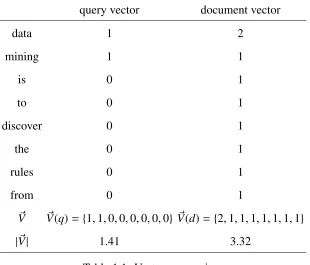
whereV~(q) andV~(d) represent the word vectors for the query and the document respectively. The larger the value of cosine similarity, the more similar the document to the query. From the formula above, we can see, the numerator represents the dot product of the two vectors, and the denominator is the product of their Euclidean lengths for the normalization purpose. Suppose we have a query “data mining” and a short document “Data mining is to discover the rules from data.” The conversion to the word vector can be conducted by usingbag of words
1.1. TwoTypes ofSearchSystems 7
According to the cosine similarity, the score of the query and the document can be calcu-lated as 11.×412+×13×.321 =0.64.
To return the relevant results to the user, the vector space model does not need to calculate the score for all the indexed documents. Instead, the inverted index list can still be used in vector space model and only the documents that contain the keywords in the query will be considered. Thus, the web search engine can still instantly locate the results. Based on the scores computed, the search engine can rank the documents and return the topK to the user.
Another important advantage of vector space model is that the score generated can be com-bined with other factor scores (e.g., importance score, time series score) to produce more so-phisticated ranking score.
1.1.2
Faceted Search System
Figure 1.4: Typical facets in Amazon.com.
Faceted search systems, such as in Amazon.com and Kijiji.ca, allow users to explore a collection of information by applying multiple filters in the facets. The search system can usually have more than one facet, and each facet can be either a flat list or a structured hierarchy of various categories. For example, in Amazon.com, the top facet is the department facet, where all the products are categorized into a hierarchy. If we search “iPad” in the category “tablets”, besides the department facet, additional facets (e.g., display size, hard drive size, brand, price, etc.) will be displayed to the user (shown in Figure 1.4).
The key part of faceted search system is the classification of various products or items into the multiple facets. As many modern e-Commerce websites adopt the customer-to-customer business model, the label of the categories in each facet can be easily obtained from the cus-tomers who are selling products. For example, a customer wants to sell a new product, say a tablet, he/she needs to provide a detailed list of the specifications, such as the category it belongs to, the display size, the brand name and the desired price, etc. Those information will be used to classify the product into various facets to assist the searching.
8 Chapter1. Introduction
results in “computer accessories” can be filtered out. For the second way, the user can first click into a desired category and all the products in the category will be shown to the user. Then by issuing a query of keywords, the user can restrict the results within the category. For the customer who is planning to buy a tablet but not sure which type to buy, he/she can click into the category “tablets”, have an overview and a comparison of different types, and then further search the keywords of the desired one.
The advantages of faceted search are twofold. First of all, users are able to view a summary of the search results and know how the returned results are organized by different criteria. Secondly, users can browse each of the categories in some facets and have an overview of what already exist. It is particularly useful when the user is not sure which keywords to search (or what products to buy).
1.2
Integrating Topic Facet into Web Search Engine
As the faceted search has tremendous benefits, why not introduce it to the keyword-based web search engine? In fact, Google has already embedded the faceted search into its original system. From Figure 1.1, besides the result list, on the left side there is a vertical bar listing some facets (e.g., result type and location). However, those facets are still limited compared to the diverse needs in search. The most intuitive way for users is to organize the documents into common sense topics, such as Arts, Science, Sports, which can further break down into sub-topics. In this case, diverse needs from different users can be covered better. Why does Google not include such a hierarchy into web search? It is probably due to the difficulty to classify the vast amount of webpages on the Internet into the hierarchical topics, since this task cannot be accomplished by human effort. In this thesis, we will report our first attempts to implement a new web search engine which integrates a hierarchical topic facet, by leveraging machine learning techniques to automatically classify webpages into our hierarchy. In the following parts, we will first explain the motivation of building this search engine in detail. Then we will briefly discuss the difficulties to construct it. Finally, we will present the user interface and the architecture of the new search engine SEE.
1.2.1
Why Do We Need such a Search Engine?
We already know some of the benefits that the facets will bring to the users in the e-Commerce websites as we mentioned in Section 1.1.2. Why would we need the hierarchical topic facet in the web search engine? Why not just use the keyword-based search? In what situations does this hierarchy benefit us most in search?
Simple keyword search may not work well when the user intends to search target informa-tion within a specific topic. In this scenario, usually the user will issue two types of queries,
ambiguous queryandtopic-related query. For example, if the user intends to find worm only
1.2. IntegratingTopicFacet intoWebSearchEngine 9
which is an ambiguous query, or “computer books” which is a topic-related query. In this case, although the word “books” itself is not ambiguous, the query “books” is still ambiguous with respect to the user intention, since it can mean any kinds of books rather than the computer books. In the query “computer books”, the keyword “computer” is intended to constrain the search domain. However, those two types of queries both have their limitations.
Ambiguous query may introduce many irrelevant results and leads to a low precision. In information retrieval, precision [1] is defined as the ratio of the number of relevant results retrieved over the total number of the retrieved results. Mathematically, it can be defined as
Precision= Nr
Nr+Nir,
whereNr is the number of relevant results retrieved andNir is the number of irrelevant results retrieved. Since the ambiguous query can match information in different domains, the number of relevant results Nr is supposed to be much smaller compared to the number of irrelevant resultsNir, which causes the low precision.
Topic-related query may truncate a lot of relevant results and lead to a low recall [1]. In information retrieval,recallis defined as
Recall= Nr
Ntr,
whereNris the number of relevant results retrieved andNtr is the total number of the relevant results in all the indexed documents. Since the keyword(s) used to represent the topic may not match the documents in that topic that do not contain the used keyword(s), a certain number of relevant results may be filtered out (in boolean retrieval model) or low-ranked (in space vector model). It is reasonable that the recall will be low.
Why is it that the documents in a topic may not contain the keyword(s) used to represent the topic? It is because a topic is generally an abstract concept covering a wide range of sub-topics, and the name for the topic is used to describe the entire topic, thus may not appear in some specific documents. For example, in the topic “animal”, a large part of the documents may talk about dog, bird, tiger or worm, without mentioning “animal”. Also, a lot of documents in the topic of “computer” may be specifically on programming, Internet or CPU, and thus they do not necessarily contain the keyword “computer”. Even they are talking about computer itself, the synonyms, such as PC, machine, can be used instead.
In order to find the desired documents in a topic, the user often needs to try a large number of queries with different keywords combinations. Sometimes, the user needs to guess what are the keywords that are likely to appear in the desired documents. For example, in order to find the animal worm, after the failure of the query “animal worm”, the user may try to issue another query, say “soil worm”, since worms used to live in the soil and the documents talking about worm are likely to contain the keyword “soil” too. If this query still fails to achieve the purpose, the use may consider to use “crawl worm”. It is because the way that worms move is to crawl. This tedious searching process can easily annoy the user and the user will end up with no findings.
10 Chapter1. Introduction
target information within the topic category. For the example to search computer book, if there exists a category “computer” containing all computer-related documents (e.g., programming, Internet or CPU, etc.), by using the keyword “books” as the query, all the relevant documents containing the keywords “programming books”, “Internet books” or “CPU books” will be returned to the user. The hierarchy can help the users save a lot of time in searching the desired results in the web search engine.
1.2.2
Di
ffi
culties to Build the Search Engine
Although it is obvious that the topic hierarchy is beneficial, it is non-trivial to introduce such functionality into the web search engine. There are several difficulties in building the web search engine with a hierarchical topic facet.
First of all, in contrast to the e-Commerce website, the Internet does not have a policy to force the web creators to tag the webpages with the topic labels when they are published. The free Internet environment makes the major part of the webpages on the Internet unlabeled. Without the topic labels, how can we classify them into the categories in the topic hierarchy? The simplest but the most infeasible approach is to ask human to label the Internet webpages. Let’s assume there are one billion webpages on the Internet. We can employ 1000 workers, and each of them labels 1000 webpages per day, then we need almost three years to finish the labeling for all the pages. To ensure the quality of the labels, one webpage may need to be labeled by multiple workers, which can cause even higher cost. In our work, we will leverage the power of machine learning techniques to automatically classify them into the categories of our topic hierarchy.
The second challenge is how to appropriately select topics for the hierarchy and how to accurately classify the webpages into the multi-level hierarchy. The common machine learn-ing algorithms are designed for binary or multi-class classification problems. In our case, a webpage may simultaneously belong to multiple categories which are in a tree structure. For example, a news webpage talking about a concert held for a soccer game should be catego-rized into “arts”→“music” as well as “sports”→“soccer”. In this thesis, we will utilize the data collection in Open directory Project as the training data and the hierarchical classification approaches to categorize the Internet webpages into the topic hierarchy.
Since the classification done by machine learning algorithms will not be 100% accurate, how would we build the web search engine SEE based on the imperfect classification? For each category, there are two types of errors (false positive errors and false negative errors).
False positive error[44] for a category is that a document has been classified into the category
but the document actually does not belong to the category. This type of errors may make the results noisy by introducing the documents from unrelated topics. False negative error [44] for a category is that a document has not been classified into the category but the document actually belongs to the category. This type of error may truncate some relevant results in a category. To handle the false positive errors, we propose a new ranking function. To deal with the false negative errors, we introduce a button on the user interface for users to explore additional results.
1.2. IntegratingTopicFacet intoWebSearchEngine 11
Figure 1.5: User Interface for SEE.
search engine with a hierarchy. Besides, in order to evaluate SEE, we need to know the relevant documents for each query. How can we get the query relevance is another problem. In our thesis, we will base our evaluation onTRECcollection2, and design an evaluation framework for SEE.
We also face the problem on how to further improve the performance of SEE. Introducing more training data will definitely improve the classification accuracy, but sometimes a huge number of training data may only slightly boost the accuracy, especially in the hierarchical setting. Besides, labeling a large number of documents requires a great amount of human efforts. How can we improve the classification accuracy while minimizing the human supervi-sion? In our thesis, a new framework of active learning [55] will be proposed for hierarchical classification to reduce the human labeling cost.
1.2.3
System Overview
In order to provide an overview of the whole system, we will demonstrate the user interface of SEE including some typical search operations on the UI, as well as the architecture chart, in the following part.
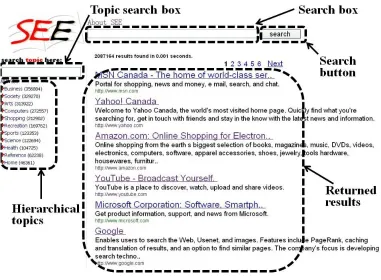
Figure 1.5 illustrates the main user interface of our search engine. On the left side of the interface, we have a hierarchical tree for all the topics (Initially, only top level topics are shown). Furthermore, we can expand the tree, click into any category and search with any query
12 Chapter1. Introduction
within that category. When users are not familiar with the categories (topics) in the hierarchy, they can search the desired topic in the topic search box. It should be noted that when we do not search anything (no keywords in the search box) without choosing any category, instead of the blank page as in Google, the most popular websites in the world (such as Yahoo!, Google, etc.) are returned.
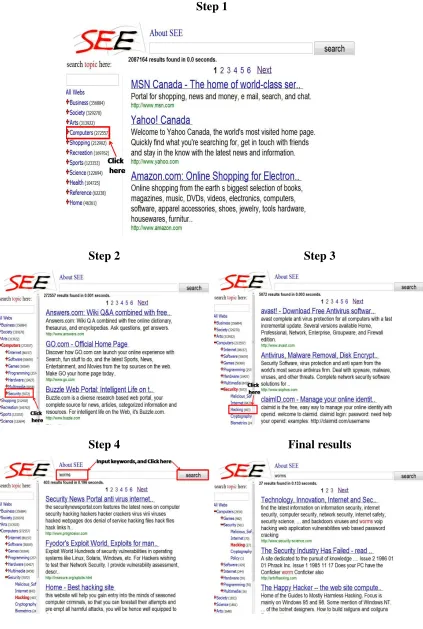
If we want to find specific information, say worm, a type of computer virus, how can
we search in SEE? We can simply search “worms” in the category, named “computer” →
“security” → “hacking”. In fact, there are two possible sequences of steps to complete the search. The first sequence (demonstrated in Figure 1.6) is to first locate the category “hacking” and then search with the keyword “worms” within “hacking”. Figure 1.7 demonstrates the second way, where we can first search with the keyword “worms” without clicking into any category, and then gradually narrow down the search domain to the category ‘hacking”. Both of the two step sequences can arrive at the same search results as we can see in the last subgraph of Figure 1.6 and Figure 1.7. However, there are only 27 results in the category. If we are unsatisfied with the 27 results, we can have the opportunity to explore more results by clicking a button called “Additional Results”, when coming to the last page (3rd page in this case) of the returned results. By doing so, the user may have more chance to find the desired results. Figure 1.9 illustrates this operation to search more results about “worms”. In this case, when we click the “Additional Results” button, one more result is found.
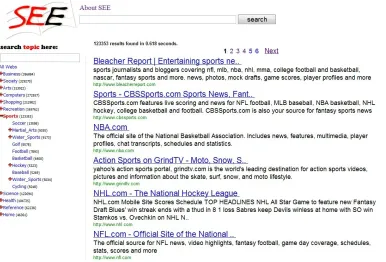
Another important feature of SEE is that people are able to browse any category without any keyword. In this case, the most popular webpages within the browsed category will be returned to the user. It offers a good way to help people know other unfamiliar areas (or domains). Figure 1.8 shows the results when the category “sports” is browsed. We can see that many popular sports websites are displayed, such aswww.nba.com,www.nfl.com, etc.
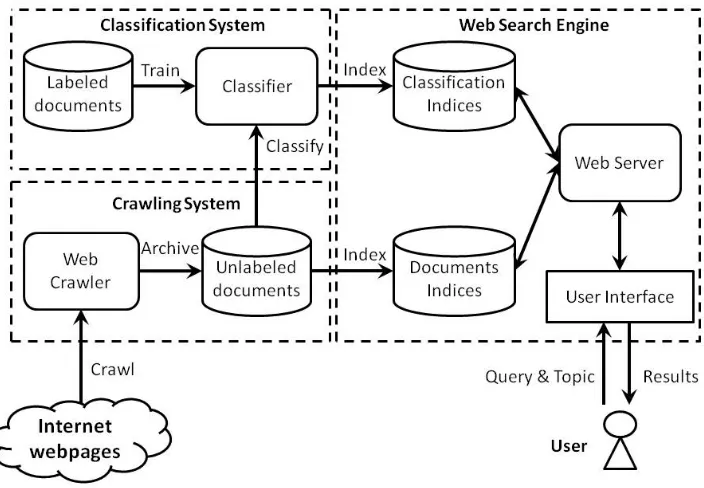
Figure 1.10 presents the overall architecture of the whole system. The entire system can be divided into three sub systems, classification system, crawling system and web search engine. The three systems are inter-connected. In the classification system, we train a classifier based on existing labeled data. Then after we start running the crawling system on the Internet, the web crawler [31] will crawl new webpages and index them into the web search engine. Since the category labels of those webpages are known, we will use the constructed classifier to categorize them into our hierarchy. Afterwards, those classification information will also be indexed into the web search engine. When the user issues a query within a topic on the user interface, the request will be sent to the web server. Then the web server will search the indexed documents as well as the indexed classification information, and return the final list of returned results back to the user.
1.2. IntegratingTopicFacet intoWebSearchEngine 13
Step 1
Step 2 Step 3
Step 4 Final results
14 Chapter1. Introduction
Step 1
Step 2 Step 3
Step 4 Final results
Figure 1.7: Alternative steps to find information about “worm” in “computer”→“security”→
1.2. IntegratingTopicFacet intoWebSearchEngine 15
Figure 1.8: Browsing “sports” category without any keyword.
16 Chapter1. Introduction
Figure 1.10: System architecture for SEE.
1.3
Contributions of the Thesis
Web search engine has been around for almost two decades, but keyword-based model has been always in the leading role. As we discussed earlier in this chapter a hierarchical topic structure will definitely benefit the search experience, why have those major web search engines still not implemented it? It is mainly because manually classifying vast number of Internet webpages is not realistic. In this thesis, we will leverage machine learning techniques to automatically complete this challenging task and build a web search engine with a topic hierarchy embedded. In Chapter 3, we extract a reasonable hierarchy from Open Directory Project (ODP) and use the webpages in ODP as our base training data. Then we utilize the top-down hierarchical classification approach to classify new Internet webpages into our hierarchy. By exploring dif-ferent feature selection methods, classifier parameters and calibration algorithms, we optimize the performance of our hierarchical predictive model. According to the evaluation results, the classification performance is satisfactory.
1.3. Contributions of theThesis 17
in Chapter 3 and 4 was published in theProceedings of the 22nd International Joint Conference
on Artificial Intelligence (IJCAI-11)[32].
In order for SEE to achieve better search performance, it is critical to improve the classi-fication performance, which often requires human efforts to label more webpages as the train-ing data. Thus, it is worthwhile to study the problem on how to maximize the classification performance in the hierarchical setting with minimal human supervision. We propose a novel multi-oracle setting and a new active learning framework for the hierarchical classification. Ac-cording to the experimental results, our methods can largely reduce the human labeling costs. The work was published in theThe 16th Pacific-Asia Conference on Knowledge Discovery and
Data Mining (PAKDD2012)[39].
We list our major contributions in the entire thesis as follows.
1. We propose the new idea of integrating a hierarchy into general web search engine and implement a prototype of this new search engine SEE.
2. We take advantage of machine learning and data mining techniques (e.g., SVM, hier-archical classification and data preprocessing) to categorize Internet webpages into our hierarchy. We design a parallel framework to improve the efficiency for the training and classification processes. Besides, we propose an algorithm to find the best param-eter combination that maximizes the classification performance. The evaluation results demonstrate that our classification performance is good.
3. To build the new search engine SEE, we propose a novel ranking function and design a new interface to explore additional results when returned results are limited. We also conduct a comprehensive evaluation on SEE, and the results show that the hierarchical version of SEE can achieve better search results than the flat version without hierarchy in most of the queries, particularly when the query is suitable to search within a topic.
Chapter 2
Review of Previous Work
Since we are building a new type of search engine with a topic hierarchy embedded, we would like to know what similar search engines are. We will review some existing web search engines and discuss the similarities and differences with our search engine SEE. Furthermore, because we will use machine learning techniques to classify the webpages, we will also review some popular classification learning algorithms, and discuss their characteristics. However, most of reviewed classification algorithms are designed to deal with binary problems, and can only be used to train the base classifier. In our case, webpages need to be classified into multiple cate-gories in the hierarchy. We will further leverage a technique calledhierarchical classification
to handle this task. In this chapter, we will also review three typical approaches for hierarchical classification.
2.1
Other Advanced Search Systems
Besides the keyword-based web search engines, such as Google and Bing, there exist several other forms of web search systems. They offer alternative ways to assist the users in searching on the Internet.
2.1.1
Web Clustering Engine
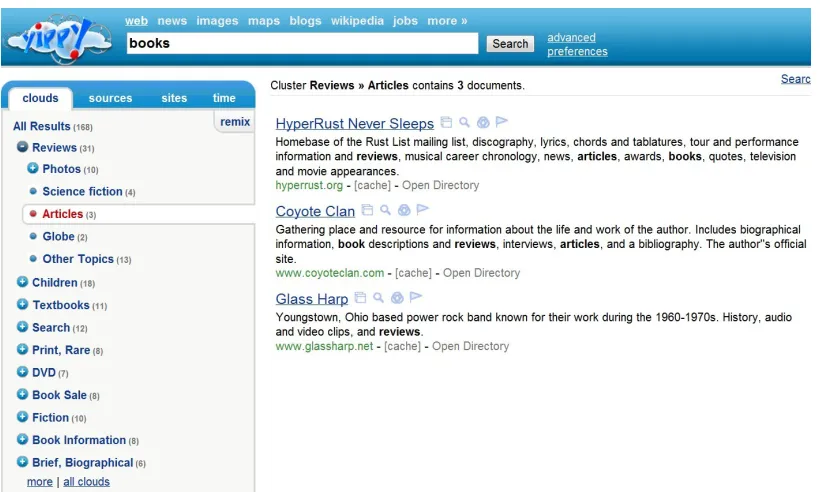
Web clustering engine [76, 7] is the most similar one to the search engine we are attempting to build. By grouping the results returned by a search engine into a hierarchy of labeled clusters, it provides a complementary way to explore the results in the flat list returned by the keyword-based web search engines. Figure 2.1 shows the user interface of a web clustering engine named Yippy. There are a number of web clustering engines in both research and commercial domains. The typical ones are AISearch [77], SnakeT [20], Carrot2 [60], CREDO [6], KartOO1
and Yippy2, etc.
Web clustering engines are helpful in the following aspects as mentioned in [7].
1. Fast subtopic retrieval. If the documents that pertain to the same subtopic have been
1www.Kartoo.com 2www.yippy.com
2.1. OtherAdvancedSearchSystems 19
Figure 2.1: User Interface for a web clustering engine named Yippy.
correctly placed within the same cluster and the user is able to choose the right path from the cluster label, such documents can be accessed in logarithmic rather than linear time.
2. Topic exploration. A cluster hierarchy provides a high-level view of the whole query top-ic including terms for query reformulation, whtop-ich is parttop-icularly useful for informational searches in unknown or dynamic domains.
3. Alleviating information overlook. Web searchers typically view only the first result page, thus overlooking most information. As a clustering engine summarizes the content of many search results in one single view on the first result page, the user may review hundreds of potentially relevant results without the need to download and scroll to sub-sequent pages.
It should be mentioned that most existing clustering engines do not construct the index for the documents, instead they aremeta search engines [42, 13]. They forward the user queries to some other public search engines (e.g., Google, Bing, ODP, etc.), and utilize clustering algorithms to group those returned results and visualize them in various forms. Thus, the clustering is actually a post-processing step after the retrieval of the query-relevant results from the web search engine. There are generally four key steps to implement such web clustering engine: raw results retrieval, feature generation, cluster construction, and cluster visualization. The main task of raw results retrieval is to repost the user query to one or multiple data sources, such as reputed web search engines, web directory and Wikipedia, and obtain about 100 to 1000 results3 relevant to the query. The content of those results normally contains the
title and URL of a webpage, snippets generated from the source system (e.g., search engine). Then all those information will be fed to the next step as the raw results.
20 Chapter2. Review ofPreviousWork
The next step is the feature generation, which is a preprocessing step for the actual clus-tering operation. The major task is to transform the raw results (title, URL, snippets) into text features accepted by the common clustering algorithms. Several techniques in natural language process can be utilized here, such as tokenization, stemming, n-grams, and feature extraction and selection.
Incluster construction, three types of clustering algorithms can be used to cluster the
doc-uments based on the features produced in the last step.
1. Data-centric algorithms. This type of algorithm clusters the documents by finding the data center of each cluster and emphasizes the quality on the closeness of the documents in the cluster. Those algorithms are usually modified versions of traditional clustering methods (e.g., hierarchical, optimization, spectral, etc.) with some additional textual description for each cluster.
2. Description-aware algorithms. A serious problem of data-centric algorithms is that the generated textual description for each cluster may not be accurate and friendly for the users to search desired results. This problem is what description-aware algorithms attempts to solve. This algorithm aims to improve the quality of the textual labels for the generated clusters and make them interpretable to human, while still pursuing the quality of the clustering.
3. Description-Centric Algorithms. This type of algorithms is designed to focus on guar-anteeing the quality of descriptions (labels) for each cluster, so that users can better un-derstand the meaning of the cluster and improve their search experience. If it is difficult to describe a cluster, then it is not useful to present the cluster to the users.
The last step is cluster visualization[36]. This step is to display the clusters produced in the client-side browser. The clusters can be demonstrated in various chart formats. The most common approach is the hierarchical tree structure where each cluster is represented by a folder icon, as shown previously in Figure 2.1.
Intuitively, web clustering engines are very similar to SEE, particularly in the following aspects.
1. Similar Goal. Both web clustering engines and SEE aim to categorize the search engine results and narrow down the search domain and improve the search performance.
2. Similar User Interface. As we can see in Figure 2.1, on the left hand side, there is also a tree structure similar to the hierarchical tree in SEE (Figure 1.5). Users can drill down along the path and search the results in an appropriate category.
However, they are dramatically different. We will list some key characteristics of the web clustering engines and do comparisons with SEE.
2.1. OtherAdvancedSearchSystems 21
2. No Index of Documents. The lack of indexed documents makes the clustering engines heavily dependent on other data sources. Furthermore, without index of documents, other than the returned results, users are not able to explore other possible results in each cluster. In SEE, we build our own index for all the documents as well as the classification information, so that the user can explore each topic category thoroughly. Without issuing any query, SEE becomes a web directory, users can browse the most popular webpages within any topic, by integrating the factor of page importance.
3. Unpredictable Clusters. An important feature of clustering is to explore unknown groups. However, this feature will inevitably lead to many unpredictable and unmeaning-ful clusters. For example, in Figure 2.1, by searching “books”, the user may expect to see books in different fields, such as in computer, arts, business. However, the resulting clus-ters somehow mix everything together, which may confuse the users. In contrast, SEE uses predefined common-sense categories (see Section 3.1) and the results will always be classified into the existing categories without creating new categories.
4. Insufficient Data Input. Most clustering engines simply rely on the snippets to conduct the clustering task. Since the snippets are relatively short, the accuracy and reliability of the constructed clusters may not be satisfactory. In contrast, SEE utilizes the full text of documents to build the classifier, which is more likely to produce better classification results.
5. Computational InefficiencyThe clustering process is often conducted on-the-fly after user posts the query. The high computational complexity of clustering (as high asO(n3)) will significantly affect the response time. It may work well when the number of results returned is small. However, if we would like to return more results to the users, the clus-tering engines may fail to deliver the results in a short time. Since all the classification information is indexed, SEE can response the users instantly.
2.1.2
Web Directory
Another type of similar system to SEE is the web directory. Rather than a keyword-based search engine, a web directory does not return a list of ranked search results as users post queries. Different from a web clustering engine, a web directory does not construct a hier-archical tree of categories on-the-fly. A web directory maintains a good number of websites by human effort, and those websites are organized in a hierarchical structure. The users can browse the websites in each category as well as search the keywords within each category. The typical web directories include theODP(Open Directory Project)4,Yahoo Directory5and
Google Directory6. In the following, we will give a brief introduction on the ODP7, since later
we will utilize it to build our search engine SEE.
The Open Directory Project, also known asDMOZ, is the largest and most comprehensive human-edited directory of the Web. There are a vast number of volunteer editors (usually
4www.dmoz.org 5dir.yahoo.com 6It has been shut down.
22 Chapter2. Review ofPreviousWork
domain experts), who participate in the construction and maintenance for the ODP. The ODP was originally named Newhoo which was founded in June of 1998. Then in the same year Netscape purchased the website and still continued to run the site in a free mode. Up until now, the ODP includes almost five million websites and becomes the largest web directory in size, and over 50, 000 volunteer editors over the world have been involved in contributing to its development.
Like other web directories, the ODP categorizes its websites into categories of various top-ics. There are over one million categories and the deepest one goes up to 14-level depth. How does the ODP collect those websites? In fact, the ODP allows Internet users or enterprisers to submit their websites without any charge. When submitting a website, the user needs to spec-ify the category that the website is most likely to belong to. After the submission, the website does not directly go to the chosen category; instead, the human editors will double check if the category is a good choice or not. There might be a good chance that the category needs to be changed or new categories need to be added. Once confirmed, the submitted website will be included in the corresponding categories.
The significant effect to submit the websites to the ODP is that it will increase the ranking of the website when searching in Google. When accepted by ODP, two significant links will link to the submitted website, one from ODP and the other from Google Directory. Both of them already have high PageRank [47]. The consequence will be that the PageRank of the submitted website will be significantly boosted. Thus, it is very beneficial to list the websites on ODP.
Besides, all the data in the ODP are publicly accessible and can be downloaded free, which is a reliable labeled data source for research purposes, particularly useful for machine learning and data mining research.
Figure 2.2 demonstrates the main interface for ODP. In the figure, the top level categories with some of their subcategories in ODP are displayed. By clicking into each of the categories, the corresponding subcategories will be expanded. The users can also input a query in the text box of any category, which searches the websites matching the keywords only within that category.
Intuitively, web directories are very similar to our search engine SEE. In fact, they are sig-nificantly distinguished from each other. We first present their similarities listed in following.
1. Predefined hierarchical categories. Both web directories and SEE utilize the prede-fined hierarchical categories to classify their documents (websites and webpages).
2. Supporting hierarchical browsing and keywords search. In both web directories and SEE, by clicking into each category, the user is able to browse the content within that category without any query. Furthermore, the user is able to input the keywords in any category and the matched results within that category will be listed to the user.
We will also list some features of web directories and discuss the differences with SEE.
2.2. PopularClassificationAlgorithms 23
Figure 2.2: Interface of Open Directory Project.
engine. Moreover, they do not rank results. In contrast, SEE is a fully functional search engine.
2. Limited scalability. An important reason that web directories cannot be developed into a real search engine is that the categorization of websites is managed by human. Originally, Yahoo! was attempting to build a search engine in a form of web directory, but it failed to work as the number of published webpages increased dramatically on the Internet and manually categorization became infeasible. However, SEE leverages machine learning techniques to automatically categorize the webpages, thus it can be scaled easily as long as the classifier has been built.
2.2
Popular Classification Algorithms
24 Chapter2. Review ofPreviousWork
Machine learningcan be defined as follows. A computer program is said tolearnfrom
ex-perienceEwith respect to some class of tasksTand performance measureP, if its performance at tasks inT, as measured byP, improves with experienceE[43].
Simply speaking, as a subdomain of artificial intelligence, machine learning empowers computers with the capability to learn from empirical data, without being programmed explic-itly. In general, machine learning can be divided into two major areas, unsupervised learning and supervised learning. Unsupervised learning solves problems where we need to discover the hidden structures in unlabeled data. For example, the clustering technique used in web clus-tering engines falls into the field of unsupervised learning, since it just tries to find the similar groups of webpages without knowing the category labels.Supervised learningattempts to infer a function based on a set of training examples with labels provided. The function, also called
model, can be used to predict the label values of new examples. If the label is numeric, the task
is aregressiontask. If the label is discrete, the task becomes aclassificationproblem, and the
constructed model can be calledclassifier. In the thesis, classifying webpages into hierarchical topics is actually a classification problem. There are several types of classification problems, such asbinary classification,multiclass classification[25],multilabel classification[64]. The task ofbinary classificationis to classify examples into one of two target classes (positive class
andnegative class8). Rather than only two classes, multiclass classificationcan classify new
examples into one of three or more classes. Inmultilabel classification, new examples can be classified into more than one classes.
In the following, we will introduce some classic learning algorithms for classification tasks and discuss their advantages and weaknesses, as well as which one is more suitable for our problem.
2.2.1
Decision Tree
Decision tree [49] is one of the most commonly used classification algorithms. Based on the training data, the decision tree algorithm builds a top-down tree structure to fit the data. Basically, the tree construction follows recursive steps starting from the root. Each time, the data is split by the current best attribute, until the distribution of examples on each node of the tree becomes pure (belonging to the same class) or satisfies a certain condition. When a new example is coming, its attributes will be tested from the root until the leaf node is reached, where the class of the example can be determined.
For example, suppose we would like to predict whether or not we will enjoy playing tennis today, according to some input attributes such as the outlook, windy or not, humidity, etc. Based on a training set consisting of previous playing records as shown in Table 2.1, we can build a decision tree as shown in Figure 2.3. We can see, each internal (including root) node of the tree is associated with an attribute, while each leaf node is connected to a class. For example, on the root node, according to the value of the attributeoutlook, the whole training data can be divided into three parts (outlook==rainy, outlook==overcast and outlook==sunny). Two of those three parts are further divided, while the other one (outlook==overcast) directly
2.2. PopularClassificationAlgorithms 25
outlook temperature humidity windy play or not
sunny hot high FALSE no
sunny hot high TRUE no
overcast hot high FALSE yes
rainy mild high FALSE yes
rainy cool normal FALSE yes
rainy cool normal TRUE no
overcast cool normal TRUE yes
sunny mild high FALSE no
sunny cool normal FALSE yes
rainy mild normal FALSE yes
sunny mild normal TRUE yes
overcast mild high TRUE yes
overcast hot normal FALSE yes
rainy mild high TRUE no
Table 2.1: Weather dataset.
leads to a leaf node (the class“YES”). It means, when the outlook is overcast, we always enjoyed playing tennis according to the previous data. After the decision tree is constructed, if today is sunny but too humid, the classifier will output “NO”, meaning that we will probably not enjoy the tennis playing today.
The key step in building a decision tree is to find the best attribute to split the data on each internal node. There are many proposed metrics [46, 41] to accomplish it. The most typical and commonly used metric isentropy, which is used to calculate the uncertainty associated with a random variable. In this case, the class attribute of each example can be the random variable. If the class attribute hasndifferent values, then the entropy of an example setXcan be defined as
Entropy(X)=
n
X
i=1
−pi×log2pi,
where piis the proportion ofXbelonging to classi.
26 Chapter2. Review ofPreviousWork
Figure 2.3: Decision tree structure.
Aon a set of examplesXcan be defined as
Gain(X,A)= Entropy(X)− X
v=v(A) |Xv|
|X|Entropy(Xv),
wherev(A) is the set of all possible values for the attribute Aand Xv is the subset of X such thatA= v. For all the attributes, we simply choose the one with maximumGain(X,A) for each internal node to split the current data on the node.
Another issue with decision tree is how to avoid overfitting in decision tree? Decision tree can always perfectly classify the training examples by building a large (deep) decision tree. However, this approach sometimes overfits the training examples when we have noise in the training data, or when the size of training data is too small. To tackle this problem, usually a pruning step is adopted. Pruning typically removes the small branches in the tree, which are likely to be unreliable. It can make the decision tree more robust to noise or more accurate for unseen examples. More specifically, it uses a post-pruning rule as follows:
1. Build a decision tree following the above algorithm described.
2. Convert the tree into an equivalent set of rules.
3. Prune each rule by removing any preconditions that result in improving its estimated accuracy.
4. Sort the pruned rules according to estimated accuracies.
The advantages of decision tree can be listed as follows.
2.2. PopularClassificationAlgorithms 27
2. Rules generation. The decision tree can be converted into simple and useful rules, where experts have difficulties to formalize their knowledge.
There are also some disadvantages of decision tree.
1. Hard to model complex concept. Normally, the rule-based decision tree has difficulties to model the complex target concepts with many relevant attributes. It is due to the fact that the reliability of the rules generated by decision tree strongly correlates with the number of observed data. On the deep level of the decision tree, the number of training data significantly decreases, thus the rules become unreliable.
2. High time complexity for large feature set. The decision tree can be very efficient when the attribute set is small. However, when there are millions of attributes, in order to find the best attribute on each node, the linear comparison for all the attributes is very costly. If f is the number of the features andpis the number of the nodes on the tree, the time complexity can reachO(f × p).
To build our search engine SEE, we need to classify the text contents in the webpages, which usually have millions of attributes (words). Thus, as we mentioned above, decision tree is not a good choice.
2.2.2
Naive Bayes
Naive Bayes [50] is another typical classification algorithm which is based on Bayes rules.
Given an examplex, if we want to classify it into one class in a class setC, we simply calculate
theposterior probabilityof xbelonging to each class, and the one with the largest probability
will be the predicted class. Mathematically, give an example x, the posterior probability of a classccan be calculated as,
Pr(c|x)= Pr(c)Pr(x|c)
Pr(x) ,
wherePr(c) is the prior probability of the classc. For each of other classes, we calculate the posterior probability probability the same way. We will findPr(x) is the same for all the classes, thus we only need to compare Pr(c)Pr(x|c) for different classes. Pr(c) can be computed by calculating the percentage of the examples belonging tocin the whole training data. However, it is more difficult to calculate Pr(x|c), since we do not know the true probability of x in the underlying distribution. By assuming that the attributes inxare independent, Naive Bayes uses an estimation to approximatePr(x|c) as follows:
Pr(x|c)≈ n
Y
i=1
Pr(x(Ai)|c),
where x(Ai) is the value of xon the attribute i. By decomposing the example into attributes, we can easily compute the Pr(x(Ai)|c) as the percentage of examples with attributeiequaling
x(Ai) in the examples belonging to classcin the training set. For example, by applying Naive Bayes to the same dataset as presented in Table 2.1, given the attributes oftodayas
28 Chapter2. Review ofPreviousWork
we can calculate the posterior probability probability Pr(yes|today) and Pr(no|today) as fol-lows.
Pr(yes|today)=Pr(yes)Pr(outlook =rainy|yes)Pr(temparature=hot|yes)
Pr(humidity= high|yes)Pr(windy= FALS E|yes)
= 9 14 × 2 9 × 1 9× 3 9× 6
9 = 0.0035
Pr(no|today)=Pr(no)Pr(outlook =rainy|no)Pr(temparature= hot|no)
Pr(humidity= high|no)Pr(windy= FALS E|no)
= 5 14× 2 5× 2 5× 4 5× 2
5 = 0.0183.
Thus, according to the prediction of Naive Bayes (Pr(no|today)> Pr(yes|today)), today is not a good day to play tennis. Furthermore, by normalizing the two probabilities above, we can obtain a probabilistic likelihood for each class (0.00350.0035+0.0183 = 0.161 and 0.00350.0183+0.0183 = 0.839). Those normalized probability can be useful in many practical problems (e.g., expected cost estimation).
There is a special case we should pay attention to. For example, if there is no examples
with temparature = hot in the class yes, then Pr(temparature = hot|yes) = 0, which will
cause thePr(yes|today) = 0. Apparently, in this case, the calculated posterior probability will be incorrect. In order to deal with this issue, a method calledlaplace correctionis introduced to Naive Bayes. Basically, laplace correction increments one to both denominator and numerator of the probability calculation for each attribute. For example, if originally Pr(temparature = hot|yes)= 09, after laplace correction,Pr(temparature=hot|yes)= 101.
Naive Bayes has some advantages for classification problems, which are listed as follows.
1. Efficient model construction. By simply scanning all the examples in the training set once, the probability for each attribute value as well as the prior probability of each class can be calculated.
2. Capability for large attribute set. No matter how large is the attribute set, given a new example, the product of them times the prior of the class produces the posterior probability of that class.
There are also some disadvantages with Naive Bayes.
1. Unrealistic independence assumption. Naive Bayes makes an unrealistic assumption on the attribute independence. It assumes that given the class of an example, the at-tributes of the example are independent. In fact, most of the real cases, the atat-tributes are correlated.
2.2. PopularClassificationAlgorithms 29
Figure 2.4: Demonstration of K Nearest Neighbor.
Since Naive Bayes can handle large attribute set, it has been already applied in text classifi-cation (e.g., spam filtering). However, according to some previous works [73, 27], in terms of text classification, the performance of Naive Bayes is not as good as some other learning methods such as K Nearest Neighbor and Support Vector Machine.
2.2.3
K Nearest Neighbor
K Nearest Neighbor (KNN) [15] is an instance-based classification algorithm. It belongs to
lazy learning methodsas opposed toeager learning methodssuch as Decision tree and Naive
Bayes. Lazy learning method does not build the model in advance, and until an unseen example is coming, it begins to explore the training data and attempts to classify it.
The general idea of KNN is to decide the class of a new example by considering the class of the similar examples in the training set. Specifically, KNN classifies the new example based on the majority vote of thektraining examples closest to this example, calledk nearest neighbors. For example, given a house dataset with two attributes price and size, we need to predict if a new house is worth buying. Figure 2.4 demonstrates how KNN basically works. The solid circles represent the positive examples (houses purchased), while the hollow circles represent the negative examples (houses not purchased). Supposek = 3, when a new example (dashed rectangle) is coming, it will be classified as positive examples, since 2 of the 3 closest examples (marked as 1,2 and 3) are positive.
An improved version of KNN, calleddistanced-weighted KNN [15], further takes the dis-tance of the neighbors into consideration. The weight can be calculated by using the inverse square of the distance from each neighbor to the new example. The short the distance, the higher weight it puts on the neighbor.