Proceedings of the
6
thInternational Conference on Appropriate Technology
“
Appropriate Technology for the 21
st
Century:
Technological Innovation to Empower Africa
”
Hosted at the
Kenyatta University Conference Center
Nairobi, Kenya, November 25 – 29, 2014
SECTION V: CONSTRUCTION AND INFRASTRUCTURE
Edited by
June Madete
SPONSORS
Northern California Council of Black Professional Engineers
(NCCBPE)
2
A. Bakhiet, Sudan
J. Bemley, USA
H. Carwell, USA
M. Castro, Puerto Rico
T. Dalgety, Guyana
J. Fortunak, USA
J. Gwamuri, Zimbabwe
G. Kadoda, Sudan
J. Kiplagat, Kenya
K. Madzima, RSA
M. Muchie, RSA
K. Ngige, Kenya
M. Poe, USA
D. Soumonni, RSA
T. Shurn, USA
J. Tharakan, USA
J. Thomas, India
J. Trimble, USA, Chair
C. Verharen, USA
Scientific Review Committee
M. Castro, Peurto Rico J. Gwamuri, Zimbabwe
S. Ismail, India
G. Kadoda, Sudan, Co-Chair, Knowledge and Technology Transfer J. Kiplagat, Kenya, Co-Chair, Energy
K. Madzima, RSA, Co-Chair, Policy and Standards M. Makokha, Kenya
J. Matede, Kenya, Co-Chair, Construction and Infrastructure K. Ngige, Kenya
L. Olang, Kenya, Co-Chair, Environment and Agriculture T. Shurn, USA
P. S. Hari, India V. Sivasubramanian, India
J. Tharakan, USA, Co-Chair, Green Economy and Innovation; Health; Water and Sanitation
J. Thomas, India J. Trimble, USA C. Verharen, USA
3
TABLE OF CONTENTS
Efficient Cement Production by Design Modification of Grinding
Circuits: Case Study of EAPCC Kunkur Quarry, Athi River,
Kenya…………
.
4
Jacob Mutua, Mutua Eric, Muchiri Githiria
Graduate student, Department of Mining and Mineral Processing
Engineering, Taita Taveta University College, Voi, Kenya
Cut-Off Grade Optimization to Maximize the Net Present Value Using
Lane’s Approach in Whittle 4X…………
13
Joseph Githiria
Department of Mining and Mineral Processing Engineering, Taita Taveta
University College, TTUC, Voi, Kenya
Forecasting Mineral Exports Quantities in Sudan Using Moving
Averages and Winter’s Three-Parameter Exponential Smoothed
Method………
20
Fayha Mohamed1, Majda Mohamed2
Al-Neelain University, 52nd St, Khartoum, Sudan
Impact of Technology Transfer on Energy Consumption in Industrial
Sector……….
26
Mélodie Mugeni
1, Oludolapo Akanni Olanrewaju
2, Josiah Munda
2and
Augustin Mpanda
11
French Graduate School of Engineering ESIEE-Amiens, Amiens, France.
Email: [email protected]
2
Centre for Energy and Electric Power, Tshwane University of Technology,
Private Bag X680, Pretoria 0001, South Africa
WEALTH: A community based platform for integrated basic rural
infrastructure………
3
34
Marwan Awad Ahmed Adam
4
EAPCC KUNKUR QUARRY, ATHI RIVER, KENYA
Jacob Mutua, Mutua Eric, Muchiri Githiria
Department of Mining and Mineral Processing Engineering, Taita Taveta University College, (TTUC) P.O. Box 635-80300, Voi, Kenya (phone: +254727905968; e-mail:
Abstract
The main objective of any cement manufacturing company is to maximize profits through efficient cement production. Effectiveness of production also helps a cement manufacturing company remain in the growing competitive market in the cement industry. To meet this objective, production costs must be minimized while maximizing the mill throughput and without compromising the cement quality. Production costs are minimized by ensuring power consumption is at the minimum while good cement quality is ensured by achieving the required particle size distribution (PSD) as well as avoiding overgrinding. Retention time in cement grinding which is the time taken by material to attain the required particle size before it reaches the mill outlet, can be reduced by the use of a closed mill grinding circuit arrangement, where cement raw materials undergo a two-stage processing; grinding and classification/ separation. This ensures that power consumption is reduced; mill throughput is increased as well as improving cement quality in terms of PSD and controlling the temperature effect on gypsum. This research is aimed at modifying an existing mill system from open to a closed circuit in the aim of achieving efficient production of cement. Analysis of both circuits is done by use of mathematical techniques relating various mill parameters to show the viability of the design modification..
Key words: grinding circuit, Power consumption, Retention time, Mill throughput, Particle size distribution, Overgrinding
INTRODUCTION
5 cement is optimized while minimizing the production cost. Previous research has shown that an open circuit grinding system is associated with little or no control of fineness, possibility of overgrinding and higher temperature of products. The characteristics of open grinding circuit translate to high specific power consumption, low production rate and poor quality of cement. A closed circuit has a high production rate, low specific power consumption and produces high quality cement as compared to an open circuit. Thus it can be used in place of an open circuit.
Design modification can be defined as structural changes made on a pre-existing system. For grinding circuits, an open grinding circuit can be modified to a closed circuit by installation of an air classifier (separator).
East African Portland Cement Company (EAPCC) has four mills (mill nos. 1, 3, 4 and 5). Three of these mills (mill nos. 1, 3 and 4) operate as open circuit mills while mill no. 5 operate as a closed circuit mill. The production for each of the mills 1, 3 and 4 is low as compared to mill no. 5 which operates in a closed circuit.
The increasing competition in the cement industry hence the need for efficiency
improvement, reinforces the need for grinding optimization. This paper seeks to address the challenges associated with an open circuit by modifying the design in EAPCC Ltd and installing separators to change the open grinding circuit to a closed one.
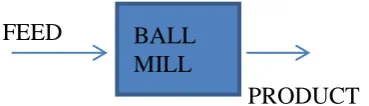
FEED
PRODUCT
Figure I: Arrangement of an open circuit system
The challenges associated with an open circuit grinding circuit are; Little or no control of fineness
Not adapted to high fineness Possibility of overgrinding Higher temperature of products Broad particles size distribution
6 Gypsum which is responsible for setting of cement has water of hydration. Stability of gypsum dehydration is very dependent on the stability of the grinding temperature. However, the problems of temperature instability and gypsum dehydration can be solved effectively by the use of a closed circuit milling system since retention time is minimized and mill temperatures are controlled.
Project Objectives
The main objectives in this case study are:
To reduce the specific power consumption To control particle size distribution (PSD) To increase mill throughput
METHODOLOGY
The study involves collection of relevant data such as: Mill throughputs, Mill capacities, Mill dimensions, Mill operational parameters; Mill temperatures, Mill speed, Mill power consumption, Mill feed rates. Appropriate techniques/methods are used to analyze the data to determine the expected increase in production, size of the separator, determine the specific power consumption for the closed circuit cement mills and calculate payback time.
Data analysis
7 A feasibility study done by S.S. Krishnan showed that cement grinding as a sub-process consumes the highest amount of time in cement manufacturing and thus it is the most power consuming stage. This is shown in the graph below.
Figure III: Running Hours of Major Sub process in a Cement Plant (Source: S.S. Krishnan)
Production costs is a factor emphasizing the need to use less energy and therefore the development of more energy efficient grinding circuits (Jankovic, et al. 2004). The consumption of electrical energy depends on the grindability of the cement constituents and the type of grinding system.
Bond’s equation describes the specific power required to reduce a feed from a specified feed F80 to a product with a specified P80:
𝑊𝑚 = 𝑊𝑖( 10
√𝑃80−
10
√𝐹80)……… (1)
Where:
Wm is mill specific motor output power (kWh/t),
Wi - is the Bond ball mill work index (kWh/t),
P80 - is sieve size passing 80% of the mill product (μm),
F80 - is the sieve size passing 80% of the mill feed (μm).
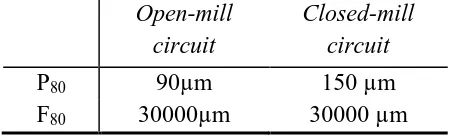
Theoretical case study in this paper will consider the following data:
Table I: Theoretical data used in the case study
Open-mill circuit
Closed-mill circuit
P80 90µm 150 µm
8
𝑊𝑚= 𝑊𝑖( 10 √𝑃80
− 10
√𝐹80 )
𝑊𝑚 = 10.18 (10
√90−
10
√30000)
= 10.1429 Kwh/t
ii. Proposed Closed circuit
𝑊𝑚= 𝑊𝑖( 10 √𝑃80
− 10
√𝐹80 )
𝑊𝑚 = 10.18 ( 10
√150−
10
√30000)
= 7.7242 Kwh/t
Mill throughput (Production vs. Blaine)
To calculate the target production, the following formula is adapted.
Where;
P1= current output P2= new (target) output B1 = current blaine B2 = new blaine
Calculation of mill throughput for mill 4, given the following data; the target output
(production, P2):
= 56.37 t/hr
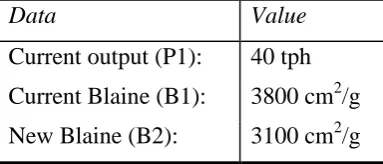
Table II: Data used for mill 4 throughput computations
Data Value
Current output (P1): 40 tph
Current Blaine (B1): 3800 cm2/g
9
Table III: Data used for mill 1 & 3 throughput computation
Data Value
Current output (P1): 30 tph Current Blaine (B1): 3800 cm2/g New Blaine (B2): 3100 cm2/g
Given the above data for mill 1 & 3, the target output (production, P2) can be calculated
as follows:
= 42.28 t/hr
A production of 42.28t/h for each of mills 1& 3 is expected. The above calculations show that decreasing the specific surface area (blaine) of cement without compromising the cement quality increases production by 40.9%.
Total production for mill 1 & 3:
= mill 1 production+ mill 3 production = 42.28 tons/hr + 42.28tons/hr
= 84.56 tons/hr
Closed circuit mill systems reduce the effect of cement overgrinding, hence reducing the blaine and thus increasing the mill production. The optimal production can be obtained with ease by varying the blaine within the required range.
Blaine control is achieved by varying separator motor speed (revolutions per minute). The higher the speed the higher the blaine and hence the higher the power consumption. It is seen from calculations above that a production of 56.37 tones per hour or even higher is possible by reducing blaine within the required range. This is only possible with a separator (closed circuit grinding system).
Mill feed rates for mill 4
For the closed circuit, the feed rates for mill four can be calculated as follows: with a target production of 56.37 tones per hour and assuming a condition where the mill feed per hour is equal to the mill output per hour and a separator course reject rate of 5 tones per hour.
Then the mill feed rate will be:
10 Mill feed rates for each of mills 1 & 3
The current mill feed rate for each of the mills is 30 tons/hr. The mill feed rates for the raw materials are as follows:
Table IV: Mill feed rates
Data Value Clinker 16.5 tons/hr Tuff: 12.0 tons/hr Gypsum: 1.5 tons/hr
For the closed circuit, the feed rates can be calculated as follows: With a target
production of 42.28 tons/hr and assuming a condition where the mill feed per hour is equal to the mill output per hour and assuming that the separator rejects are distributed equally to the two mills, separator coarse reject rate each mill will be 5 tons/hr;
Then the mill feed rate will be, (fresh feed +separator rejects). 84.56 ton/h +10 tons/h= 94.57tons/h
Fresh feed = 84.56 tons/hr
New feed rates = 55% of 42.28= 23.254tons/hr clinker = 40% of 42.28= 16.912 tons/hr tuff = 5% of 42.28= 2.114 tons/hr Gypsum
It is assumed that separator coarse rejects of 10 tons/hr is distributed equally to mills 1 and 3. Each has 5 tons/hr.
Separator sizing for Mill No.1 and No.3
The combined mill capacity for mills 1 and 3 is 100tph, but the current production for the two mills is 60tph. This production is 60% of the mill ratings. To improve the production to a target of 80% of the mill rating, an appropriate separator should be installed. The following calculations guide in the choosing of the appropriate separator.
Mill capacities (mill 1+mill 3) = 100tph Current mills production = 60tph (mill fines)
Target mills production = 84.56 tph (separator fines) Assumed Separator rejects is 10tph.
11
𝐶𝑖𝑟𝑐𝑢𝑙𝑎𝑡𝑖𝑜𝑛 𝑓𝑎𝑐𝑡𝑜𝑟 = [1 +𝐶𝑖𝑟𝑐𝑢𝑙𝑎𝑡𝑖𝑛𝑔 𝑙𝑜𝑎𝑑 , 𝐶. 𝐿 %
100% ] =
𝑆𝑒𝑝𝑎𝑟𝑎𝑡𝑜𝑟 𝑓𝑒𝑒𝑑 𝑃𝑟𝑜𝑑𝑢𝑐𝑡𝑖𝑜𝑛
𝐶𝑖𝑟𝑐𝑢𝑙𝑎𝑡𝑖𝑜𝑛 𝑓𝑎𝑐𝑡𝑜𝑟, 𝐶. 𝐹 = [1 +11.83 %
100% ] =
𝑆𝑒𝑝𝑎𝑟𝑎𝑡𝑜𝑟 𝑓𝑒𝑒𝑑 84.56
= 1.1183
The expected system production and feed rate to the separator was determined as follows: Separator feed = C.F x Production = 1.1183x 84.56 tph = 94.56tph
A separator with a minimum of feed rate 95tph is desirable for both mills 1 and 3 to achieve the target production. Similarly, Separator sizing for Mill No.4 is determined and a separator of a minimum feed rate of 62tph for mill 4 was found desirable to achieve the set target.
ECONOMIC ANALYSIS
Method of evaluation used in this project is; Payback time method. Pay-back time is the time required after the start of the project to pay off the initial investment from income. It is often used to judge small improvement projects on operating plant.
This involves calculation of the number of years required to return the original investment from the net cash flows. The decision rule is accepting the project with the shortest payback period. If the cash inflows are uniform the payback period can be calculated as: (= Initial
investment/Annual cash inflows). The rule is, select the project if the payback time is reasonable.
Production Hours in a year = 8760 hours Hours for maintenanceper year = 8×52 = 416 hours
Available working hours = 8760 – 416 = 8344 hours
Target mills production/ yr = (56.37tonnes/hr+42.28tonnes/hr+42.28tonnes/hr.) × 8344 hrs./yr. = 1,175, 919.92 tonnes/yr.
Selling price per tonnes of cement = Ksh13,000
Assuming that all that is produced is sold, then Annual cash inflows
=1,175,919.92 tonnes/yr. × Ksh13, 000 = Ksh15. 29 billion
Initial investment = Restructuring costs + purchase costs + Freight charges + taxes + Installation costs)
= Ksh200, 000,000
12
CONCLUSION
The installation of a separator to the existing open mill circuits solves the challenges of the open circuit grinding system. The benefits achieved due to the design modification of cement grinding system are;
Reduction in specific power consumption
Possibility to vary the product blaine hence the production.
Reduced retention time, improved control of PSD and mill temperature hence improved cement quality.
The adoption of closed circuit grinding system therefore addresses the key factors that define efficient cement production i.e. low power consumption, higher production rate (mill throughput) and improved cement quality. In conclusion this research paper illustrates the advantages of grinding circuit design modification as an optimization approach in obtaining efficient cement production.
RECOMMENDATIONS
Based on the analysis above, the following recommendations are made:
The use of a closed milling circuit system should be adapted due to its advantages over the open milling circuit.
Two separators to be installed, one for both mill 1 and mill 3 and the other separator for mill 4. Separators of feed rates of at least 95 tph for mills 1 and 3 and 62 tph for mill 4 should be installed so as to achieve the target mills production.
A blaine of utmost 3100 cm2/g should be targeted. Blaine is controlled in the separator by controlling the speed of the separator.
REFERENCES
Alsop, P. (2001). Cement plant operations handbook for dry process plants, Tradeship Publications Ltd., Portsmouth, United Kingdom.
Benzer, H., Ergun, L., Lynch, A., Oner, M., Gunlu, A., Celik, I., Aydogan, N. (2001). “Modeling cement grinding circuits.” Minerals Engineering, 14(11), 1469-1482.
Bond, F.C., 1961, “Crushing and Grinding Calculations,” British Chemical Engineering, June & Aug., pp 378-385 & 543-548.
Cement & Concrete Association of New Zealand. (1989). The Manufacture of Portland Cement. Information Bulletin. Cement & Concrete Association of New Zealand.
Jankovic, Alex, Walter Valery, and Eugene Davis. 2004. “Cement Grinding Optimisation.” Minerals Engineering 17 (11): 1075–81.J Rushworth, Bag filter basics
13
CUT-OFF GRADE OPTIMIZATION TO MAXIMIZE THE NET PRESENT
VALUE USING LANE’S APPROACH IN WHITTLE 4X
Joseph Githiria
Lecturer, Department of Mining and Mineral Processing Engineering, Taita Taveta University College, TTUCP.O. Box 635-80300, Voi, Kenya Phone: +254723161966; Email: [email protected]
Abstract
The maximization of NPV is primary objective in open pit mine planning processes. In an attempt to meet this objective, cut-off grade is considered in all the stages of mining. There are three stages involved in resource extraction which are; mining, processing and refining
(marketing) which are all defined in Lane’s approach. Using Lane’s approach, the economics involved in each stage are identified independently and interacted to provide an optimum cut-off grade. A block model from a hypothetical gold mine is used to illustrate how Whittle is used in optimization of cut-off grade and showing the feasibility of the project with respect to the current market conditions. In this paper Whittle 4X applies Lane’s approach to generate yearly profits and the NPV of the whole project in a production schedule. This paper analyses the application of Lane’s approach for a single element in cut-off grade optimization through discussing
economic and geological factors as applied in the calculation of the optimum cut-off grade. After optimizing the cut-off grade and generating a long term production schedule, an after cash analysis is carried out later in the project to validate its feasibility. Although the application of Lane’s approach is not complex, it is not however widely appreciated in maximizing the net present value of mining operations.
Keywords: cut-off grade, net present value, grade-tonnage distribution curve, mining, processing, refining, Whittle 4X
INTRODUCTION
Cut-off grade is traditionally defined as the grade that is normally used to discriminate between ore and waste within a given ore body. It also differentiates between various ore types before processing takes place for different metallurgical processing options (Asad, 2002). The main objective of mining companies is to maximize the NPV throughout the mine life. The NPV expected throughout the mine life from an operation is dependent on interrelated variables such as mining and milling capacities, extraction sequence, and cut-off grade. These
interdependent variables interact in a complex manner in defining the NPV of a project. Using the cut-off grade, ore is sent to the treatment plant for further processing while waste is either left in place or sent to waste dumps. Sequence of extraction is dependent on the rates of production, the grade distribution of the deposit, and the cut-off grades. Cut-off grade directly affects profits therefore there is need for its optimization depending on the extraction sequences and capacities of the mining operation. The determination of capacities is directly related to the cut-off grades and extraction sequences. The choice of a cut-off grade used in mine operations is based on cut-off grade optimization by the use of cut-off grade policies that
14 The cut-off grade policy used in this project is based on the Lane’s approach. The
approach uses cut-off grades higher than breakeven grades during early years of mining for faster recovery of the capital invested. This cut-off grade policy also satisfies the production constraints and accommodates the grade-tonnage distribution. Further the policy uses the dynamic cut-off grade whereby the NPV declines with depletion of the reserves. This outcome is because the policy tends to mine higher graded ore during the early years and lower graded ore in the later years (Lane, 1964, 1988).
The objective behind of maximizing NPV in the first years is to pay back the capital invested in the project as quickly as possible. This is referred to as the time value of money where the maximum economic return is achieved when the highest NPV of the future cash flows is generated (Dagdelen, 1992).Mine planning is the process that defines sets of values for each of these variables during life of the mine. This paper discusses the approach used to define the capacity of mining system that is in harmony with the grade distributions of the deposit through the planned extraction sequence and cut-off grade policy.
CUT-OFF GRADE OPTIMIZATION USING WHITTLE 4X
A block model of a hypothetical gold mine is imported into Whittle 4X prior to production scheduling being done. Production scheduling is done on the basis of real market conditions involving price, mining cost, milling cost, processing cost and other factors affecting the mine operation. In carrying out pit optimisation scenarios, many factors are considered in order to curb economical discrepancies due to changes in mining conditions. These factors include mining capacities, milling capacities, refining capacities and the costs associated with them.
A production plan with the largest NPV is selected whereby an optimal scenario is utilised to establish the production schedule that included ore and waste tonnage in each period. It is vital in mine planning to maximise NPV in all the stages of mine planning since it is directly related to the initial capital investment, discount rate and the life of the mine. Thus the mining and milling capacities are matched to maximise the NPV of the future discounted cash flows. The mining parameters used in this project are collected from other operational mines in the vicinity of the mine which formed the basis of the analysis.
15 Table V: Units of parameters used in Whittle
Parameters Value
Slope angle 45˚
Mining cost US$6 per tonne
Processing cost US$20 per tonne
Refining/selling cost US$2.4 per gram
Initial capital cost US$300,000,000
Replacement capital cost (10%of the capital cost each year)
US$30,000,000
Gold price US$48 per gram
Mining recovery 95%
Mining dilution 5%
Gold recovery 85%
Discount rate 10%
Mining capacity 45,000,000 tonnes
Milling capacity Period 1(4,000,000) Period 2(9,000,000)
Period 3(12,000,000)
Mining cost escalation (%/year) 2.50
Processing cost escalation (%/year) 2.50
Metal price escalation (%/year) 0.70
Table VI: Summary by rock type as shown in Whittle 4X
Rock type Total Tonnes Minimum grade Average grade Maximum grade
Ore 163,924,800 0.1049 2.228 6.5331
Waste 9,572,472,000
Total tonnage of both ore and waste = 9,736,396,800
Total Au= 365,226,487 grams
PIT OPTIMISATION
The pit optimisation yielded a nest of pits by calculating the optimal outline for a range of economic scenarios (price and mining cost). This process ensured that the smallest pit generated by the lowest price or cost will be the best pit to start mining.
16 revenues and/or deferring costs, even if that means that total net cash flow generated over the life of the project is less.
When generating pit phases using Whittle Four-X (Lersch – Grossman algorithm), inner high value pit shells which are mined early, will have low stripping ratio, and/or higher grades than the average of the ultimate economic pit. When scheduling a pit with phases generated through pit optimisation, (if higher grade is a component driving the optimisation) then average grade of ore mined will be higher in the early years than later.
Therefore using pit phases based on pit optimisation it is likely to raise the early average grade processed by focussing on high grade areas for early mining. Higher early grades mean more early cash flow, at the expense of lower later cash flows, but with an increase in NPV.
PUSHBACK SELECTION
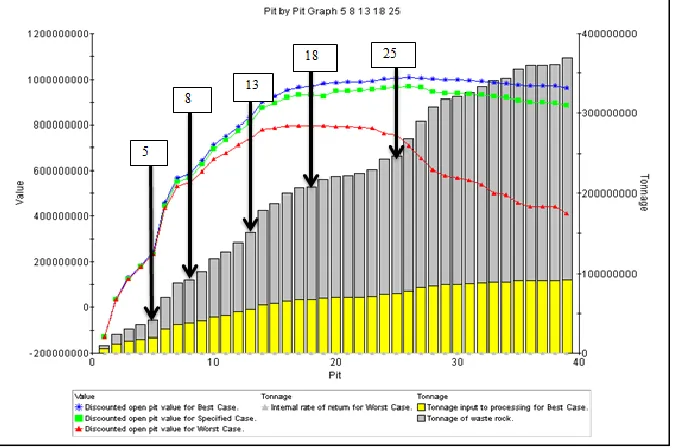
Whittle 4X creates a series of pit shells to make sequencing and scheduling easier by grouping all blocks on a bench. A series of pushbacks as indicated in the Pit by Pit graph are selected by analysis of discounted cash flows from the graph for each set of selected pushbacks. The criteria used involved identifying areas on the pit by pit graph where significant increases in material (ore and waste) are obvious as shown in figure 1 indicated by arrows. This indicated that for enough ore to be exposed, a pushback is required at a certain period prior to this increase. Each pushback is chosen by an iterative process that involved looking at how the output table (NPV in US$) behaved according to each pushback selected. The pushback that gave a higher net present value is chosen and in doing this process continually an optimal scenario is achieved.
Figure IV: Pit by pit showing the pushback selection
PRODUCTION SCHEDULING
Production scheduling in this project is done using a suitable set of selected mining and milling capacities as specified in table 2. Using the same set of pushbacks as used in pit
17 To start with, it is vital to appreciate the core factors that influence the NPV. In general, the present value of future discounted cash flow is considered Net Present Value (NPV) that is directly related to the initial capital investment, discount rate and the Life of mine (LOM). Among these factors, the initial capital investment has an influence on the truck fleet capacity, the larger the capacity required, the more capital intensive the project becomes.
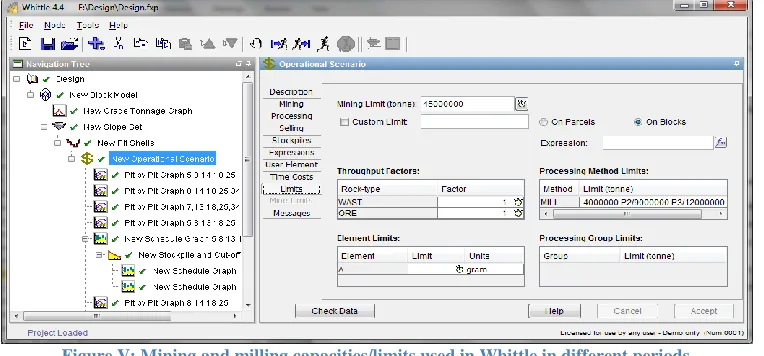
Figure V: Mining and milling capacities/limits used in Whittle in different periods
The mining and milling/processing capacities are matched to maximise the NPV. This is achieved by an iterative process that involved alternating economic variables, mining and milling capacities respectively until an optimal result is achieved.
In the case of pits, applying the Lerchs-Grossman (L-G) algorithm with varying revenue factors (say from 0.5 to 1.5) provided useful guidance for a value-based phasing strategy. The early mining pit shells are generated by high-grade and/or low stripping ratio. Once a set of optimal pit shapes have been generated the production schedule, subject to defined operational constraints, is optimized. The optimization analysis is performed properly resulting to a life-of-mine plan that maximized the net present value (NPV) of the project for specified set of assumptions (geological, geotechnical, metallurgical, market, environmental, etc.).
CUT-OFF GRADE POLICY AS REPORTED FROM WHITTLE 4X PER
PERIOD
The cut-off grade policy used in Whittle 4X is based on the Lane’s algorithm whereby the approach uses the concept of using cut-off grades higher than breakeven grades during early years for faster recovery of the capital invested.
The cut-off grade calculation satisfies the production constraints and accommodates the grade-tonnage distribution. The policy uses dynamic cut-off grade whereby the NPV declines with depletion of the reserves. This is because the policy tends to mine the higher cut-off grade during the early years and lower cut-off grade in the later years. Using the original data in the optimal scenario, optimization of the cut-off grade is done by adding a “New Stockpile and Cut-off Optimization (Type 2)” node to the optimized schedule graph node.
18 The cut-off grade optimization maximizes undiscounted profit for a given mining
operation thus increasing the return of investment. The discounted cash-flows increased in the early years significantly and then decreased later as the ore deposit got depleted.
Table VII: Cut-off grade policy as reported from Whittle 4X per period
Period Cut-off Grade
Quantity of ore
mined(tonnes)
Quantity of ore processed(tonnes)
Quantity of gold produced(tonnes)
Open-pit cash-flow (US$)
Open pit disc. cash-flow (US$)
1 1.519 6120977 5809534 4938104 22738110 20671009
2 1.804 16274288 15460573 13141487 312783982 258499159
3 1.762 21303702 20212259 17180420 308012976 231414708
4 1.858 22394827 21265616 18075774 374274193 255634310
5 1.689 20411775 19363974 16459378 245563846 152475828
6 1.791 21530732 20454195 17386066 288211499 162687878
7 1.786 21244060 20171329 17145630 280084774 143727775
8 1.654 8933988 8487289 7214195 86117105 42101738
1,917,786,485 1,267,212,405
AFTER-TAX CASH ANALYSIS
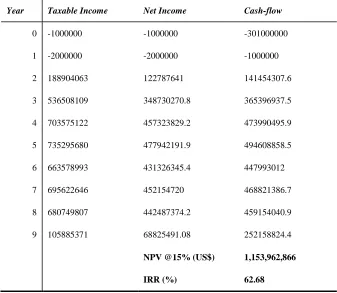
Financial technical models (in Microsoft Excel) are used to calculate after tax cash flows, NPV, and IRR for the mine project. Net present value (NPV) and internal rate of return (IRR) in the summary below is used in checking the feasibility of the project.
Table VIII: Summary of the after-tax cash analysis (US$)
Year Taxable Income Net Income Cash-flow
0 -1000000 -1000000 -301000000
1 -2000000 -2000000 -1000000
2 188904063 122787641 141454307.6
3 536508109 348730270.8 365396937.5
4 703575122 457323829.2 473990495.9
5 735295680 477942191.9 494608858.5
6 663578993 431326345.4 447993012
7 695622646 452154720 468821386.7
8 680749807 442487374.2 459154040.9
9 105885371 68825491.08 252158824.4
NPV @15% (US$) 1,153,962,866
19
Conclusions
In this paper a block model of a hypothetical gold deposit is used as input to Whittle 4X to generate a grade-tonnage distribution of the deposit. The grade tonnage distribution and current economic parameters are then used to create an optimum cut-off grade policy using Whittle 4X. Cut-off grade optimization is done to generate a production schedule which is used further for after-cash analysis.
Whittle 4X is used in optimization of cut-off grade for the open pit (disregarding the underground mine). Open pit mine has 138,214,349 tonnes of ore that is mineable over a period of 8 years. The underground mine has 21,499,245 tonnes of ore that is mineable over a period of 8 years. These tonnages and life of mine were derived from Vulcan software that can be used to design the underground pit to have an annually ore production of 2,500,000 tonnes.
Whittle 4X is concerned with designing open pits and had no direct relevance to
underground mining. It was found that if both open pit and underground methods are to be used, this can affect the design of the open pit, and Whittle 4X can take account of this. Although Whittle 4X takes account for the presence of the underground mine, it does not schedule
underground material or include underground material in any limits. This limits the usage of the software in mine planning of the entire project.
Further study is required to find how Whittle 4X applies all other complex mining situations into the cut-off grade optimization algorithm. For instance, an investigation into how Whittle 4X applies situations such as stockpiling, blending, and ore body with multiple minerals is necessary. In conclusion, this research paper provides an insight into Whittle 4X’s application in optimizing cut-off grade. The research identified how Whittle software can optimize cut-off grade and its applicability in daily mine planning of any given mine project.
References
Asad, M.W.A. (2002). Development of generalized cut-off grade optimization algorithm for open pit mining operations. Journal of Engineering andApplied Sciences, vol. 21, no. 2, pp. 119–127.
Asad, MWA and Topal, Erkan. (2011). "Net Present Value Maximization Model for Optimum Cut Off Grade Policy of Open Pit Mining Operations." Journal of the South African Institute of Mining and Metallurgy. 111.11: 741-750.
Dagdelen, K. (1993). An NPV optimization algorithm for open pit mine design, 24th Application of Computers and Operations Research in the Mineral Industry, Montreal, Quebec, Canada. pp. 257–263.
Dagdelen, K., (1992). Cut-off grade optimization. Proceedings of the 23rd International Symposium on Application of Computers and Operations Research in Minerals Industry, 157-165.
Lane, K.F. (1964). Choosing the optimum cut-off grade, Colorado School of Mines Quarterly, vol. 59, pp. 485– 492.
20
FORECASTING MINERAL EXPORTS QUANTITIES IN SUDAN USING
MOVING AVERAGES AND WINTER’S THREE-PARAMETER
EXPONENTIAL SMOOTHED METHOD
Fayha Mohamed1, Majda Mohamed2
Al-Neelain University, [email protected] , 52nd St, Khartoum, Sudan Abstract
The country of Sudan started to actively explore mineral deposits in the past century. However, the contribution of mineral industry to the national income still does not exceed 3% due to the limitation of the resource availability. This paper aims to find a mathematical model that is able to forecast mineral exports quantities since this is an essential component of industrial development. The key seasonal variables likely to affect the mineral export quantities at particular time scales were assessed and later analyzed to determine the most appropriate forecast model. Time series data collected in a sequential manner was employed to achieve this using two forecasting methods namely, the moving averages method and Winter’s three-parameter exponential smoothed method.
Keywords: Mineral forecasting, Time series analysis, Moving averages method, Exponential smoothed method.
INTRODUCTION
Archaeologist discoveries indicate that old Nubian land is rich with gold and gemstone and they exported different mineral to all world. The paper aims to find a mathematical model to forecast mineral exports quantities in Sudan since is an essential activity contributing to the industrial development. (Sudanese Ministry of Minerals, 2013). This is the first paper that attempts to forecast a quantity is mineral in Sudan.
Thus the objectives of this paper are:
(1) Find a mathematical model to forecast mineral exports quantities in Sudan. (2) Determine the most important variables that affect mineral exports quantities.
We have two hypotheses to test:
(1) Exponential smoothed method is able to produce better forecast than moving averages method.
(2) Minerals exports are affected by seasonal variations.
The authors used two forecasting methods: traditional moving averages method and three-parameter exponential smoothed method as a modern one.
The data has been used in the period from Jan 2009 to Dec 2012.
21 1. Descriptive approach: here we displayed the data by graphs and obtaining basic
measures.
2. Analytical approach: here statistical analytical methods have been used.
TIME SERIES METHODS
Time series analysis has been described as one of the most important methods that have been used for forecasting (Brui, 2002).
There are two types of time series:
Continuous: if measurements are taken at every time slot for example: ECG , in medicine
Discrete: if measurements are taken at specified periods for example: monthly rain rates (Bashir, 2310)
Time series has two domains: time domain and frequency domain (Khawaja, 2009).
It consists of: Secular Trend (T), Cyclical Variations (C), Seasonal Variations (S) and Irregular Variations (I) (Ibrahim, 2010).
Decomposition methods are used to analyze time series to determine its nature and aims to:
1. Isolate and measure the different variations that affect time series. (Mustafa, 1999). 2. Adjust time series by removing seasonal and irregular variations to enable analyzing of
the series behavior in the future without being obscured by random and seasonal variations. (Mustafa, 1999).
3. Improve forecasting by considering seasonal variations. (Mustafa, 1999).
As mentioned in the introduction there are two types:
a) Moving Average method: This method is a standard traditional known as technique. b) Winter’s three parameter exponential smoothed method: This method is used when there
is seasonal variation. Also it addresses Secular Trend problem. This method depends on
three constants α,𝛃 and 𝛄. (0 ≤ α,𝛃,𝛄 ≤ 1)(Bashir, 2310).
/ 1
1
1 1
t t t t t
S y I S b
St
≡
The equation of general smoothing
1
1
1t t t t
b S S b bt The equation of general trend
≡
/
1
1t t t t
I y S I It The equation of seasonal smoothing
≡
t m t tm t l m
22 Analysis of Mineral Exports Quantities
Year Month 2012 2011 2010 2009 Jul Jan Jul Jan Jul Jan Jul Jan 1600 1400 1200 1000 800 600 400 200 0 Q u a n ti ty
Time Series Plot of Quantity
Figure 3.1 Test time series changes of monthly mineral exports quantities.
In the above figure 3.1 we note that the result of test time series changes that illustrate the effect of seasonal variations, then these variations should be analyzed through isolation and measurements to get rid of the effect of seasonal variations so be able to forecast about future values of mineral exports quantities independently from seasonal variations effects.
Year Month 2013 2012 2011 2010 2009 Jan Jul Jan Jul Jan Jul Jan Jul Jan 1600 1400 1200 1000 800 600 400 200 0 Q u a n ti ty MAPE 132.8 MAD 107.3 MSD 55451.3 Accuracy Measures Actual Fits Trend Forecasts Variable
Time Series Decomposition Plot for Quantity
Multiplicative Model
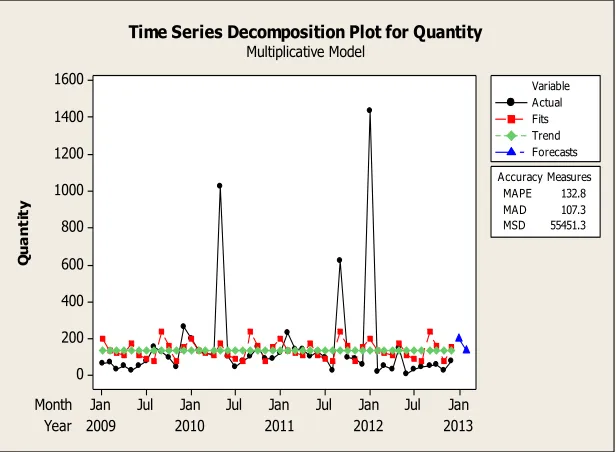
Figure 3.2 decomposition methods which used to isolate measurements of seasonal variations existing in time series and to determine seasonal Indices
23 Table 3.1 periods from Jan (2009, 2010, 2011, 2012) to Dec (2009, 2010, 2011, 2012), seasonal Indices and fits.
According to the Table 3.1, we notice that Seasonal Indices and fits are constant in the periods from Jan (2009, 2010, 2011, and 2012) to Dec (2009, 2010, 2011, and 2012).
Furthermore, we observe that seasonal indicator affects minerals export quantities to increase if the seasonal indicator is greater than integer 1 in periods :( Jan, May, Sep, Oct and Dec) while it affects it negatively if seasonal indicator is less than integer 1 in periods: (Feb, Mar, Apr, Jun, Jul, Aug and Nov) and when the seasonal indicator is equal to integer 1 it doesn’t affect the minerals export quantities. Fits are increased or decreased according to seasonal effects. Year Month 2012 2011 2010 2009 Jul Jan Jul Jan Jul Jan Jul Jan 1500 1000 500 0 Year Month 2012 2011 2010 2009 Jul Jan Jul Jan Jul Jan Jul Jan 1500 1000 500 0
Component Analysis for Quantity
Multiplicative Model
Original Data
Seasonally Adjusted Data
Figure 3.3 comparisons between time series for original data and seasonally adjusted series. According to the above Figure 3.3 shows original data series that contains seasonal variations, and isolate seasonal variations of seasonally adjusted data.
Fits Seasonal Indices Period 197.646 1.45640 Jan (2009,2010,2011,2012) 133.566 31208910 Feb (2009,2010,2011,2012) 122.933 31230030 Mar( 2009,2010,2011,2012) 108.100 31520709 Apr (2009,2010,2011,2012) 172.77 1195017 May( 2009,2010,2011,2012) 106.012 31501157 Jun (2009,2010,2011,2012) 90.813 31002100 Jul (2009,2010,2011,2012) 78.820 31703030 Aug (2009,2010,2011,2012) 234.865 1150305 Sep (2009,2010,2011,2012) 157.170 1117017 Oct (2009,2010,2011,2012) 75.741 31770110 Nov (2009,2010,2011,2012) 149.993 1113790
Dec (
24 Year Month 2013 2012 2011 2010 2009 Jan Jul Jan Jul Jan Jul Jan Jul Jan 1500 1000 500 0 -500 Q ua nt it y Length 12 Moving Average MAPE 277.6 MAD 169.6 MSD 89283.0 Accuracy Measures Actual Fits Forecasts 95.0% PI Variable
Moving Average Plot for Quantity
Figure 3.4 Moving Averages models results.
From the above Figure 3.4, we found that Mean Absolute Percentage Error (MAPE) = 277.6, Mean Absolute Deviation (MAD) = 169.6 and Mean Squared Error (MSD) = 89283.0.
Tables 3.2 represent the upper and lower limits and values of confidence with 95% level of significance for forecasting in moving average.
Lower Upper Forecast Period 8911019 -5821059 108130 Jan 2013 8911019 -5821059 108130 Feb 2013 Year Month 2013 2012 2011 2010 2009 Jan Jul Jan Jul Jan Jul Jan Jul Jan 1600 1400 1200 1000 800 600 400 200 0 Q ua nt it
y Alpha (level)Gamma (trend) 0.20.2
Delta (seasonal) 0.2 Smoothing Constants MAPE 1.5062 MAD 1.9866 MSD 16.8812 Accuracy Measures Actual Fits Forecasts 95.0% PI Variable
Winters' Method Plot for Quantity Multiplicative Method
Figure 3.5 shows Winter’s Exponential smoothing:
From the above Figure 3.5, we found that Mean Absolute Percentage Error (MAPE) =1.5062, Mean Absolute Deviation (MAD) = 1.9866 and Mean Squared Error (MSD) = 16.8812. Table 3.3 shows smoothing constants between (0-1) for Winter’s Method.
Smoothing Constants 0.2 Alpha(α)
25 0.2
Delta(δ)
Table 3.4 shows upper and lower limits and values of confidence with 95% level of significance for forecasting using Winter’s Exponential smoothing.
Lower Upper
Forecast Period
60.3460 70.0803
65.2131 Jan 2013
63.5257 73.4126
68.4691 Feb 2013
Results and Conclusion
The main results and conclusion of this paper can be summarized as:
Moving averages method and winter’s Exponential smoothing models are influenced by the pattern of input data.
Winter’s exponential smoothing models that depend on kicked weights of time series values provide more accurate and realistic forecasts than moving averages which depend on equal weights of time series values.
The degrees of seasonal variations affect a direct impact on the obtained result.
Winter’s Exponential smoothing model provides results that are better than the moving averages model.
Recommendations
According to our results the most important recommendations are:
Setting a clear strategies and plans for mineral exploration stages in Sudan.
Address the problem of random mining in Sudan by arranging it and benefits from the previous experiences.
Stability in conflict zones that rich with mineral enables to going on exploration attempts in these areas.
Fluctuation of companies’ production leads to instability in the average of mineral wealth production during months of this study.
Using of modern technology to create database that stores mineral wealth production areas and produced quantity from every mineral then use these data to perform an economic analysis.
References
Brui A. (2002), Statistical Prediction Methods, Saudi Arabia. Bashir Z. (2310), Statistical Prediction, Sudan.
FB (2010), ‘Forecasting Principles’. Available at: Ibrahim I. (2010), Forecasting Methods, Jordan. Khaswaja K. (2009), Time Series, Baghdad.
26
IMPACT OF TECHNOLOGY TRANSFER ON ENERGY CONSUMPTION
IN INDUSTRIAL SECTOR
Mélodie Mugeni1,2, Oludolapo Akanni Olanrewaju2, Josiah Munda2 and Augustin Mpanda1
1
French Graduate School of Engineering ESIEE-Amiens, Amiens, France. Email: [email protected]
2
Centre for Energy and Electric Power, Tshwane University of Technology, Private Bag X680, Pretoria 0001, South Africa
Abstract
The twin concepts of knowledge and technology transfer are not new to the third world nations. The role of technology in development has attracted increased attention in recent years, particularly around the question of how to bridge the technological gap between countries with different levels of industrial capacity. The industrial sector involves a range of activities, which is significant to energy consumption and a considerable source of both conventional pollutants and greenhouse gas emissions.
This paper focuses on technology transfer, how advantageous it is to enhance and promote a green economy with more emphasis on the industrial sector. Technology transfer definition, the need for transfer, methods of transfer and the barriers to overcome, which constitute an overview of technology transfer are addressed. This study shows the various areas in which most of the energy consumed in the industry could be saved through improved technology and technology transfer.
Keywords: energy consumption, technology transfer, industrial sector, emissions.
Introduction
Knowledge and technology transfer play a major role in international assistance to developing nations (UNCTAD, 2010). These twin concepts are nothing new to many third world nations. Since the middle of the twentieth century, these nations have been engaged in intense efforts to import the developed technologies of the northern industrialized countries and bridge the economic gap between the North and the South (David M. Haug, 1992).
Industry is the part of the economy that transforms raw materials into manufactured goods. This sector uses a large amount of energy to power a diverse range of manufacturing and resource extraction processes. Many industrial processes require large amounts of heat and mechanical power, most of which is delivered as natural gas, petroleum fuels and as electricity (Lawrence B. Evans, 2003).
27 country in many ways. Strategies and improved energy technologies can dramatically reduce industrial energy consumption.
The next section will provide a general overview of the technology transfer process, including technology transfer definition, the need for technology transfer, forms and methods of transferring technology and the barriers to technology transfer. The section after that focuses on energy consumption in the industrial sector. Finally, the last section deals with the measures implemented to reduce industrial energy consumption in relation to technology transfer.
OVERVIEW OF THE TECHNOLOGY TRANSFER PROCESS
The definitions and concepts of technology transfer have been discussed in many different ways based on the disciplines of research and according to the purpose of the research (Bozeman, 2000). All the definitions concur that the term technology transfer encompasses all the activities related to flows of applicable knowledge, skill, capability, expertise, equipment or facilities from one location to another within a specific time frame (Ramanathan, 2001). The transfer of technology requires a sustained relationship between two entities over a period of time to enable the receiving entity to produce the product with the desired level of quality standards and cost efficiency (Reddy and Zhoa, 1990).
Hoffman and Girvan (1990) argue that technology transfer needs to be perceived in terms of achieving three core objectives: The generation of new knowledge, the introduction of new techniques by means of investment of new plants, and the improvement of existing techniques.
There are many factors to be considered in transferring a technology and different theories and models have been addressing some of these factors. The failure to take these factors into account resulted in many unsatisfactory outcomes of technology transfer.
We develop a model below (Figure 1), which considers the technology transfer process as a sequence of steps. These steps are discussed further below.
Needs assessment: This is the first and the most crucial step. This involves identifying the needs of the recipient society.
Technology assessment: The aim of technology assessment is to inform decision makers, to provide an early warning signal for unintended consequences, to prepare stakeholders for possible technological changes, or to facilitate the participation of stakeholders in decision making (Smits/Leyten, 1988).
28
Figure 1. Technology transfer steps
Physical transfer: This includes all the procurement and transportation processes of the technology.
Implementation: The final process of technology transfer is implementing the technology. Absorption and further modification of the technology should be taken into account for developing countries as stated by Awny (2005).
Measure the success: Measuring the success or failure of the transfer process helps to learn from mistakes and leads to improving the next transfer processes.
Technological knowledge, experience and equipment can be transferred through various channels such as export, foreign direct investments (FDI), joint ventures, licensing and imitation.
Foreign direct investments: Foreign direct investment (FDI) is a direct investment into production or business in a country by an individual or company of another country (OECD Factbook 2013). Foreign direct investment (FDI) is a key element in international economic integration. FDI creates direct, stable and long-lasting links between economies. It encourages the transfer of technology and know-how between countries, and allows the host economy to promote its products more widely in international markets. FDI is also an additional source of funding for investment and, under the right policy environment, can be an important vehicle for development.
Joint ventures: Joint ventures are long-term relationships involving the pooling of assets, joint management, profit and risk sharing, joint marketing, servicing, and production. In a typical agreement, technology is transferred primarily through technical liaisons, training, and continuing operational support. Foreign investors have become increasingly willing to participate in joint ventures and partnerships with firms in developing countries.
Licensing: Since every patented technology is unique, every license agreement reflects the particular needs and expectations of the licensor and licensee. Technology licensing and transfer of technology are important factors in strategic alliances and international joint ventures in order to maintain a competitive edge in a market economy.
29 Technology transfer implies the movement of physical structure, knowledge, skills, organization, values, and capital from the site of generation to the receiving site (Mittelman & Pasha, 1997). Although technology transfer is often seen as a private interaction between two companies or trade partners, institutional barriers and policies influence the transaction process, as well as the efficiency of the transfer process.
Market and financial barriers: Market and financial barriers are frequently present due to a shortage of financial resources and a lack of developed markets for the technology. Shortage of financing is very common in developing countries and caused by poor macroeconomic conditions, which can include underdeveloped financial sectors, high import duties, high or uncertain inflation or interest rates, uncertain stability of tax and tariff policies and investment risks. Difficulties in accessing capital due to inadequate financial strength usually pose serious obstacles to the private sector, mainly to small and medium enterprises.
Institutional and informational barriers: These include: lack of supporting policies and frameworks, including codes and standards for the evaluation and implementation of environmentally sound technologies; lack of support for an open and transparent international banking and trading system; low, often subsidized conventional energy prices resulting in negative incentives to adopt energy-saving measures and renewable energy technologies; inadequate vision about and understanding of local need and demands; shortage of information that can be caused by limited access to media resulting in lack of data, knowledge and awareness, especially about emerging technologies; and lack of access to relevant and credible information on potential partners to allow for the timely formation of effective relationships, which can enhance the penetration of environmentally sound technologies.
Other barriers: Other important barriers are: lack of understanding the role of developed and developing countries and international institutions in the failures and successes of past technology cooperation arrangements; insufficient human and institutional capabilities; inability to access, select, import, develop and adapt appropriate technologies; lack of science, engineering and technical knowledge available to private industry; insufficient R&D because of lack of relevant investments and inadequate science and educational infrastructure (IPCC 2000).
Technology is a passive resource whose effectiveness depends on humans. Consequently, one of the most critical components for effective technology transfer is a person’s ability to learn new technology, which can be gained through extended education.
ENERGY CONSUMPTION IN THE INDUSTRIAL SECTOR
The industrial sector is extremely diverse and involves a range of activities. Aggregate energy use and emissions depend on the structure on industry and the energy and carbon intensity of each of the activities. According to EIA Data, industry is the major user of energy in modern society, accounting for roughly 51.7% of final energy use. Coal and oil are heavily used, especially by primary industry and manufacturing and refining. Gas is being used increasingly to replace coal because it is a cleaner fuel producing less impact on the environment. Electricity is only a minor component of industrial energy use, especially in its application in driving electric motors.
30 The mix and the intensity of fuels consumed in the industrial sector vary across regions and countries, depending on the level and mix of economic activity and technological development. Although electricity is used in virtually the entire sector, it is the pulp and paper and the smelting and refining industries that require the most electricity.
The International Energy Outlook 2013 projected that industrial world energy consumption will grow between 2010 and 2040. Much of the long-term growth in industrial sector delivered energy consumption takes place in countries outside the Organization for Economic Cooperation and Development (OECD).
In fact, it can be seen on the diagram below that the non-OECD countries, which accounted for 64% of world total delivered energy in the industrial sector in 2010, will grow to account for 72% of world total delivered energy consumption in the industrial sector in 2040.
Figure 2. OECD and non-OECD industrial sector delivered energy consumption
Source: IEO 2013
Industrial production is an important engine to increase the economic activity, generate employment, and build up the infrastructure in developing countries. Investment in industry seems to have a stronger relation with economic growth than investments in other sectors (UNIDO, 1997). Since the beginning of the industrial age, the growth in the world economy has been driven by the increased use of energy. Technologies developed for a special industrial infrastructure may not always be the right choice for another. Adaptation and development of technology to suit the needs is an essential step in successful transfer of technology. Technology transfer is a process involving the trade and investment in technology. The globalization of industries will impact technology transfer in such a way that transfer of technology within and between countries will meet similar barriers and challenges.
Technology transfer involves more than hardware supply, it can involve the complex processes of sharing knowledge and adapting technology to meeting local conditions. Domestic technical and managerial capacities, institutions and investments in technological learning all influence the effectiveness with which technology can be absorbed and adapted. These considerations complicate the measurement problem. Human resource and institutional development are crucial to facilitating technology utilization. Institutional development includes capacities for technology and business assessment, incubation, and technology testing and demonstration.
31 Industrial motor systems such as pumping systems, fan systems, compressed air systems, and materials processing systems account for 63% of the electricity consumed in the industrial sector. For example, electric motor-driven systems used for production processes consumed 679 billion kWh in 2010 (McKane et al., 2010). As shown on the chart in Fig. 3, pumping, fan, and compressed air systems represent over a half of the motor-driven system electricity consumption.
Figure 3. Motor system energy consumption by application. Source: A. McKane et al., 2010.
These systems, along with steam systems and process heating equipment, have been a particular focus on strategies to save energy.
Steam: Steam is used for a multitude of purposes in industrial plants. It can provide heat for chemical processing, hot water for cleaning purposes, steam for input to turbines for producing power and so on. Steam is generally produced by boilers.
In addition, a simple maintenance program to ensure that all components of the boiler are operating at peak performance can result in substantial savings. In the absence of a good maintenance system, the burners and condensate return systems can wear or get out of adjustment. These factors can end up costing a steam system up to 20-30% of initial efficiency over 2-3 years. An estimated 10% possible energy savings on average can be achieved through improved maintenance (DOE, 2001a), which may also reduce the emissions of critical air pollutants.
Compressed air systems: Compressed air systems can consume a large component of energy, and offer the potential for large financial savings from reduced energy consumption. The biggest component of a compressed air system is the compressor unit. Compressors can utilise a variety of fuel sources, including diesel, petrol and electricity. According to the US Department of Energy, optimizing compressed air systems by installing variable speed drives, along with preventive maintenance to detect and fix air leaks, can improve energy efficiency 20-50%.
32 Heat Recovery: In many cases, a heat recovery unit can recover 50-90% of the available thermal energy for space heating, industrial process heating, water heating, makeup air heating, boiler makeup water preheating, industrial drying, industrial cleaning processes, heat pumps, laundries or preheating aspirated air for oil burners. Implementing this measure recovers up to 20% of the energy used in compressed air systems annually for space heating (Price, A. and M.H. Ross, 1989).
CONCLUSION
This study looked at technology transfer in relation to reducing energy use in the industrial sector. The various ways of transferring various technologies without leaving out the barriers to be dealt with in seeing to the successful transfer were investigated. Maintenance was identified as a key factor in improving the ways technology can assist in the reduction of industrial energy use. The areas with big industrial energy saving potential were identified, together with the corresponding reduction means.
It is very important for governments, stakeholders and concerned industry managers and operatives to recognise the importance of technology transfer in improving the use of energy. Industrial energy reduction will constitute greener environment and the long-term benefits that come with it. It is advised that breaking the barriers to technology transfer will go a long way in achieving a present and future green environment.
REFERENCES
Awny, M.M., (2005), ‘Technology transfer and implementation processes in developing countries’, in International Journal of Technology Management, 32, pp. 213-220.
Bozeman, B. (2000), Technology Transfer and Public Policy: A Review of Research and Theory, Research Policy, 29, 627-655.
Chen, M. (1996), Managing International Technology Transfer. Thunderbird Series in International Management, International Thompson Press, London.
David M. Haug (1992), The international transfer of technology: Lessons that East Europe can learn from the failed third world experience, Volume 5, Spring Issue.
Farhang, M. (1997), Managing technology transfer to China: conceptual framework and operational guidelines, International Marketing Review, 14(2), 92 - 106.
Hoffman, K., & Girvan, N. (1990), Managing International Technology Transfer: A Strategic Approach for Developing, IDRC.
33 Jovanovic, B. (1997), Learningand growth. In: Kreps, D., Wallis, K. (Eds.), Advances in Economics and Econometrics: Theory and Applications, Vol. 2. Cambridge University Press, Cambridge, pp. 318–339
Lawrence B. Evans (2003), World Energy Vol. 6 No. 2, Saving energy in Manufacturing with Smart Technology.
McKane A. et al., (2010), Motor System Efficiency Supply Curves: Assessing the Energy Efficiency Potential of Industrial Motor Systems.
Mittelman, J. H., & Pasha, M. K. (1997), Out from under development revisited: Changing global structures and the remaking of the Third World. New York: St. Martin’s Press.
OECD (2011), ‘Foreign direct investment’, in OECD Factbook 2011-2012: Economic, Environmental and Social Statistics, OECD Publishing.
Pachauri, R. K., and P. Bhandari (1994), Climate Change in Asia and Brazil: The Role of Technology Transfer, Tata Energy Research Institute, New Delhi.
Price, A., and M.H. Ross. (1989), ‘Reducing Industrial Electricity Costs and Automotive Case Study’, in the Electricity Journal. July: 40-51.
Reddy, N. M., & Zhao, L. (1990), International Technology Transfer: A Review. Research Policy, 19, 285-307.
34
WEALTH: A community based platform for integrated basic rural
infrastructure
Marwan Awad Ahmed Adam
Sudanese Knowledge Society, Khartoum, Sudan [email protected]
Keywords: WEALTH; service learning; appropriate technology; community informatics;
humanitarian engineering
Abstract