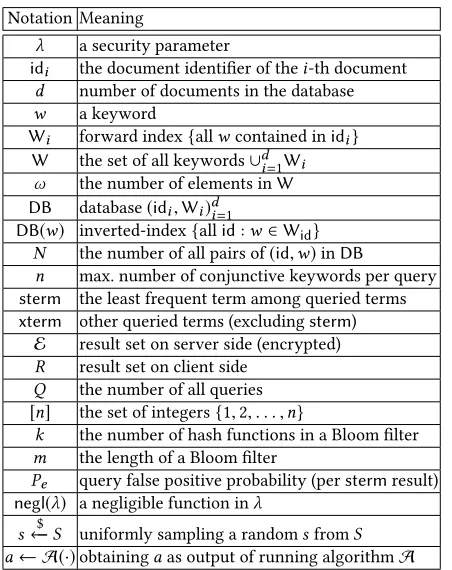
Result Pattern Hiding Searchable Encryption for Conjunctive
Queries
(Full Version)
Shangqi Lai
∗Monash University Melbourne, Australia [email protected]
Sikhar Patranabis
Indian Institute of Technology Kharagpur, India [email protected]
Amin Sakzad
Monash University Melbourne, Australia [email protected]
Joseph K. Liu
†Monash University Melbourne, Australia [email protected]
Debdeep Mukhopadhyay
Indian Institute of Technology Kharagpur, India [email protected]
Ron Steinfeld
Monash University Melbourne, Australia [email protected]
Shi-Feng Sun
∗ †Monash University Melbourne, Australia [email protected]
Dongxi Liu
Data61, CSIRO Syndey, Australia [email protected]
Cong Zuo
∗Monash University Melbourne, Australia [email protected]
ABSTRACT
The recently proposed Oblivious Cross-Tags (OXT) protocol (CRYP-TO 2013) has broken new ground in designing efficient searchable symmetric encryption (SSE) protocol with support for conjunctive keyword search in a single-writer single-reader framework. While the OXT protocol offers high performance by adopting a number of specialised data-structures, it also trades-off security by leaking ‘partial’ database information to the server. Recent attacks have exploited similar partial information leakage to breach database confidentiality. Consequently, it is an open problem to design SSE protocols that plug such leakages while retaining similar efficiency. In this paper, we propose a new SSE protocol, called Hidden Cross-Tags (HXT), that removes ‘Keyword Pair Result Pattern’ (KPRP) leakage for conjunctive keyword search. We avoid this leakage by adopting two additional cryptographic primitives - Hidden Vector Encryption (HVE) and probabilistic (Bloom filter) indexing into the HXT protocol. We propose a ‘lightweight’ HVE scheme that only uses efficient symmetric-key building blocks, and entirely avoids elliptic curve-based operations. At the same time, it affords selective simulation-security against an unbounded number of secret-key queries. Adopting this efficient HVE scheme, the overall practical storage and computational overheads of HXT over OXT are rela-tively small (no more than 10% for two keywords query, and 21% for six keywords query), while providing a higher level of security.
∗
Also withData61, CSIRO, Melbourne, Australia.
†
Corresponding authors.
Permission to make digital or hard copies of all or part of this work for personal or classroom use is granted without fee provided that copies are not made or distributed for profit or commercial advantage and that copies bear this notice and the full citation on the first page. Copyrights for components of this work owned by others than ACM must be honored. Abstracting with credit is permitted. To copy otherwise, or republish, to post on servers or to redistribute to lists, requires prior specific permission and /or a fee. Request permissions from [email protected].
CCS ’18, October 15–19, 2018, Toronto, ON, Canada
© 2018 Association for Computing Machinery.
CCS CONCEPTS
•Security and privacy→Privacy-preserving protocols;
Man-agement and querying of encrypted data;
KEYWORDS
Searchable Encryption, Hidden Vector Encryption, Leakage Profile
ACM Reference Format:
Shangqi Lai, Sikhar Patranabis, Amin Sakzad, Joseph K. Liu, Debdeep Mukhopadhyay, Ron Steinfeld, Shi-Feng Sun, Dongxi Liu, and Cong Zuo. 2018. Result Pattern Hiding Searchable Encryption for Conjunctive Queries: (Full Version). In2018 ACM SIGSAC Conference on Computer and
Communi-cations Security (CCS ’18), October 15–19, 2018, Toronto, ON, Canada.ACM, New York, NY, USA, 21 pages. https://doi.org/10.1145/3243734.3243753
1
INTRODUCTION
Privacy of stored data is important in many applications. Yet it is becoming increasingly common for data to be hosted off-site, especially with the rise of cloud computing. However, cloud storage providers often cannot be trusted to respect the privacy of the data they host [13], especially in the face of malicious insiders. A simple solution is to encrypt the data before uploading it to the cloud. However, this would prevent the data from being searched [28, 29]. For example, users may wish to use their mobile phone to search their email. The cloud server will not be able to identify which documents match the search query if the user’s email data is encrypted using standard encryption techniques.
SSE protocols that scale efficiently to large databases, by adapting data structures used in efficient unencrypted database search to the encrypted database setting. In particular, an efficient class of SSE protocols [11, 12, 16, 19, 36] preprocessing the database using an
inverted-indexto allow keyword searches to be performed in sub-linear time, with a careful choice of encryption techniques applied to the index to hide its contents and the queries from the server, while allowing a flexible range of search queries. The benchmark in this class of SSE protocols (supporting conjunctive queries) is ‘Oblivious Cross-Tags’ (OXT) [12]. Nevertheless, to achieve their high performance, these protocols do trade-off security. In partic-ular, they leak some ‘partial’ information to the server, both on the queries themselves, as well as on the database contents. Recent attacks [10, 25, 30, 39] have shown that such ‘partial’ leakages can sometimes be exploited in practical applications, especially when the attacker has available some auxiliary side information (which may be obtained publicly in many cases). This state of affairs moti-vates a re-examination of the security-efficiency trade-offs for SSE protocols and raises the question:
Is it possible to reduce the leakage in existing state-of-the-art effi-cient SSE protocols while preserving a practical level of performance?
In this paper, we make progress on this question. We focus, likeOXT, only on the setting of conjunctive keyword queries, since such queries tend to be the most common in many practical appli-cations. In this setting, queries consist of any number of keywords, and the result consists of all documents containing all those key-words.
Overview ofOXT.To explain the main technical ideas behind our construction, it is instructive to first briefly review the ‘TSet’ and ‘XSet’ data structures ofOXTand how they are used to effi-ciently process conjunction queries of the formw1∧ · · · ∧wn. In OXT,TSetis cryptographic data structure that associates a list of fixed-length data tuples to each keyword in a database. It is an en-crypted inverted index that enables the owner to issue correspond-ing tokens to retrieve these lists related to the queried keywords. In particular, the client sends the server a ‘search token’ (called an stag) related to the keywordw1(called the ‘s-term’ and denoted by sterm), which allows the server to retrieve from theTSet, the set DB(w1)of all database documents containingw1. In addition, the client sends ‘intersection tokens’ (called ‘xtraps’) related to then−1 keywordpairs(w1,wi)consisting of the ‘s-term’ paired with each of the remaining query keywordswi, 2≤i≤n(called ‘x-terms’). The intersection tokens allow the server tofilterthe setDB(w1)to determine then−1 subsets of documentsDB(w1) ∩DB(wi)that contains the pairs(w1,wi), returning only those documents that contain all{wi}1≤i≤n. The intersection subsetsDB(w1) ∩DB(wi) are efficiently computed by the server using the ‘XSet’ data struc-ture; the ‘XSet’ is in essence a list of hashed pairsh(id,w), over all database document identitiesidand keywordswcontained inid, wherehis a certain (public) cryptographic hash function. To fil-terDB(w1)to computeDB(w1) ∩DB(wi), the server runs through each documentidinDB(w1)and checks, using the xtrap token for(w1,wi), whetherh(id,wi)is in theXSet. Therefore, the server computation time is dominated by|DB(w1)|(n−1)evaluations of
h, which is proportional to just the number of database documents containing theleast frequent‘s-term’w1, even if other ‘xterm’ key-words are much more common. However, this method also reveals
to the server the Keyword Pair Result Pattern (KPRP, calledRP in [12]), i.e. the partial result setsDB(w1) ∩DB(wi)for each pair
(w1,wi).
Result Pattern (RP) Leakage in SSE protocols.Information leakage in SSE protocols can be classified into three types: storage leakage, query pattern leakage, and result pattern leakage. In this paper, we focus on the third type of leakage, namely result pattern leakage (RP), i.e. information leaked to the server on the query results.Ideally, in the conjunctive query SSE context, result pattern
leakage would reveal only the Whole Result Pattern (WRP), i.e. the number (and possibly also, identities) of documents matching all query keywords.Leaking theWRPis in most SSE settings unavoidable, as it would be leaked to the server via the document identities retrieved by the client after the query (unless an ORAM or PIR protocol is used, which currently seems impractical). But inOXT,RP leakage is larger than theWRPideally desired, and comes in three forms: single keyword result pattern (SP) leakage, Keyword-Pair Result Pattern (KPRP) leakage and multiple keyword cross-query intersection result pattern (IP) leakage.
TheKPRPleakage is a ‘non-ideal’ leakage related to multiple keywords in each query. This revealspartial query resultsto the database server; for annkeyword conjunction queryw1∧ · · · ∧wn, withw1designated as the ‘s-term’ keyword, theKPRPreveals to the server the setDB(w1) ∩DB(wi)of documents containing every
pairof query keywords of the form(w1,wi), 2≤i≤n. This may leak significantly more information on the inverted-index and/or the query than what is leaked byWRP, which is the set∩nj
=1DB(wj) of documents matching allnquery keywords.
The recent proposed file-injection attacks [39] have an adapted version which exploitsKPRPleakage inOXTto reveal all key-words of a conjunctive queries with 100% accuracy. Thus, finding an SSE protocol that eliminatesKPRPleakage may be a feasible way to mitigate such attack towards the conjunctive queries on the inverted-index.
Our Contributions.In this paper, we present the first efficient SSE protocol, called ‘Hidden Cross-Tags’ (HXT) that eliminates KPRPleakage presented in the state-of-the-artOXTprotocol [12]. Our protocol removes theKPRP‘partial query’ leakage component, leaving in its place only the minimal (in our SSE context) and significantly smallerWRP. Furthermore, it leaves other query and result pattern leakage components in existing SSE protocols (i.e. SPandIP) unchanged. Thus, in terms of security, our protocol offers strictly better guarantees thanOXTprotocol, and is likely to significantly reduce the rate of query pattern leakage to the database server, as discussed above.
The improved security of our protocol as compared toOXTmay be attributed to the adoption of two additional cryptographic prim-itives - namely, Hidden Vector Encryption (HVE) and probabilistic (Bloom filter) indexing [4]. HVE is a functional encryption prim-itive typically used in the public-key setting. All existing HVE schemes [6, 24, 27, 32] in the cryptographic literature use either prime order or composite order bilinear pairings over elliptic curve groups. In ourHVE-based scheme, a dataset owner can encrypt a set
S⊆T ={1, . . . ,n}, for some positive integern, into a ciphertextcS, which specifies a ‘policy’. Using a master secret keymsk, the owner can generate a search tokentkS′for any subsetS′={s′
1, . . . ,s
′
ofT. Using the tokentkS′forS′and the ciphertextcSforS, any-one can efficiently check whetherS′⊆Sor not, without leaking any partial information ifS′⊈S, e.g. whether any particular el-ementsi′ofS′is inS or not (note that in the scheme of [6], the setSis used to generate the token, while the setS′is encrypted in the ciphertext). Unfortunately, adopting such schemes into our protocol leads to a huge compromise in overall performance and efficiency. We address this issue by proposing a ‘lightweight’ HVE scheme that only uses efficient symmetric-key building blocks, and entirely avoids elliptic curve-based operations. At the same time, it affords selective simulation-security against an unbounded number of secret-key queries. Given this subset membership searchable encryption protocol, a natural idea to apply it to eliminateKPRP leakage inOXTwould be to use it toencrypt the ‘XSet’during set up: we letS ⊆T denote theXSetlist of hashed pairsh(id,w), over all documentsidand keywordswcontained inid, and we encrypt
Sinto a ciphertextcS stored on the server using ourHVE-based subset searchable encryption scheme. In the search phase with queryw1∧ · · · ∧wn, the client issues the server aHVEsearch token
tkS′forS′ ={h(id,wi)}in
=2,id∈ DB(w1). This allows the client to check whetherS′⊆S, i.e., whetheridcontains allnkeywords
{wi}1≤i≤n, without revealing theKPRPinformation on whether idcontains any particular pair(w1,wi).
To demonstrate the high performance of our protocols and assess the efficiency overhead of our security improvements, we report our experimental results on the implementation of our protocol and its performance evaluation, compared with the originalOXT protocol.
Security ofHXT.We prove the client privacy ofHXTagainst the “honest-but-curious” server in a natural extension of the secu-rity model used to prove the secusecu-rity ofOXT[12], assuming the security of the underlyingHVEscheme, theDDHassumption, and the security of the employed symmetric key primitives. The main difference from [12] is that the leakage function in our security model is weaker, as it eliminates theKPRPleakage component and replaces it with the smallerWRP.
Practicality ofHXT.We believeHXTis a practical, more secure alternative toOXTfor searching large databases. To support this statement, we discuss the practical storage, computation, and com-munication costs ofHXTversusOXT(see Sec. 6 and Sec. 7 for more details and experimental results). In terms of storage, we note that, likeHXT, practical implementations ofOXT[12] also use a Bloom filter for theXSet, and thus have a similar false positive probability
Peand overhead factor in number of array storage locations. One additional overhead in ourHXTprotocol is that each binary entry of our Bloom filter array is encrypted into 1 PRF generated value, i.e. typically 128 bits, whereas these bits are unencrypted inOXT, leading to up to 128 factor overhead (in bit length) inXSetstorage forHXToverOXT. While this factor is quite large, our theoretical analysis shows that for a fixedPe =10−6, theXSetBloom filter storage size inOXTis 35 times smaller than theTSethash table size (which is the same inHXTandOXT). Thus, theoverallstorage over-head factor ofHXToverOXTwithout Bloom filter will typically be only 1+128/35≈4.65, which we believe is quite practical.
In terms of computational cost, theHXThas additional costs compared toOXTdue to the use ofHVE(whereas the practical im-plementations ofOXTonly uses plain Bloom filter). However, our
proposedHVEis based on symmetric key primitives and bitwise operations. As a consequence, for typical parameters (e.g.n =1 orn=2 keyword queries with false positive ratePe =10−6), we estimate that theoverallserver computation time overhead forHXT overOXTin such practical applications is likely to be less than 1% and is fully overlapped by I/O costs. Our implementation results indeed show a server runtime overhead between 2%−8% for a two keywords query, and 21% for the six keywords query. TheHXT client computational cost overhead factor overOXTis higher at
≈0.06∗log
2(1/Pe) ≈1.19 forPe=10
−6
, but this is likely accept-able as the overall client search time may be dominated by ‘out of protocol’ costs such as the communication time for downloading result documents. In terms of communications,HXTadds one ex-tra round of communication over theOXTprotocol, in which the server communicates to the client the Bloom filter subset it needs to check, and the client returns aHVEtoken to allow this search. The communication length is still, as inOXT, only proportional to the number of results for theleast-frequentquery keyword.
Additional Related Work.In practice, efficient unencrypted search algorithms usually use a precomputed databaseindex. This allows keyword searches to be performed in essentially sublinear time with respect to the size of the database (or more precisely, in time proportional only to the number ofresultsmatching the query). A number of index based SSE protocols have been proposed, each more efficient than its predecessor. The first secure encrypted index was proposed in [22], based on the form offorwardindex, storing for each document a Bloom filter containing all the docu-ment’s keywords. This allows a single document to be searched inO(1)time but requires each document to be checked in turn, with complexity proportional to the number of documents in the database.
Curtmola et al. [16] were the first to propose using an
inverted-indexdata structure, storing in a hash table for each keyword, the encrypted IDs of the documents that contain it (while hiding the number of documents matching each keyword), resulting in com-plexity proportional to the number of matchingresults, even for searching the whole document collection. However, [16] does not support multiple keywordconjunctivequeries efficiently; it has complexity proportional to the number of documents matching themost frequentqueried keyword. Later, [12] presented theOXT protocol, extending [16] by adding a ‘Cross-Tag Set’ (XSet) data structure, which lists hashed pairs of keywords and IDs of doc-uments containing them, and reducing search complexity to be proportional to the number of results matching theleast frequent queried keyword. OurHXTprotocol is an improvement ofOXT, replacing theXSetby another encrypted data structure to eliminate KPRPleakage, while preserving a low search complexity.
Table 1: Notations and Terminologies
Notation Meaning
λ a security parameter
idi the document identifier of thei-th document
d number of documents in the database
w a keyword
Wi forward index{allwcontained inidi} W the set of all keywords∪di
=1Wi
ω the number of elements inW DB database(idi,Wi)d
i=1
DB(w) inverted-index{allid:w∈W id}
N the number of all pairs of(id,w)inDB
n max. number of conjunctive keywords per query sterm the least frequent term among queried terms xterm other queried terms (excludingsterm)
E result set on server side (encrypted)
R result set on client side
Q the number of all queries
[n] the set of integers{1,2, . . . ,n}
k the number of hash functions in a Bloom filter
m the length of a Bloom filter
Pe query false positive probability (perstermresult) negl(λ) a negligible function inλ
s $
←−S uniformly sampling a randomsfromS
a← A(·)obtainingaas output of running algorithmA
efficient SSE protocols for conjunctive keyword queries. Our HXT protocol fills this gap by proposing a symmetric-keyHVEwhich is significantly more efficient and suffices for symmetric-key setting of SSE.
2
PRELIMINARIES
We first give a list of notations and definitions needed in our construction and security analysis. A summary of notations and terminologies used in this paper is given in Table 1. All needed hardness assumptions and other necessary cryptographic primi-tives including symmetric encryption scheme and pseudo-random functions are given in Appendix A.
2.1
T-set
A T-set is an expanded inverted-index data structure [12] used for efficient SSE. It is a cryptographic data structure that associates a list of fixed-length data tuples to each keyword in a database. Later it enables the owner to issue corresponding tokens to retrieve these lists related to the queried keywords. A syntax, a correctness definition, a security model, and an instantiation of such a hash table is given in [12]. Throughout this paper, we identically adapt the notations, definitions and results (in particular, those of Appen-dix 2.2 and Sec. 6) of that paper regarding T-sets here. To summarise what we use in this work, we give an instantiation of a T-set along with a result regarding its security.
An instantiation of a T-set consists of three algorithms:
• TSet.Setup(T): The input to this algorithm is an arrayTand
the output isTSetwithbbuckets of sizeseach and a keyκT. This procedure places thei-th element ofT[w]into bucket TSet[b], wherebis obtained using two secure pseudorandom functions (PRFs)F and ¯Fand a hash functionH.
• TSet.GetTag(κT,w): The input to this procedure is the key
κT and a keywordw, it returns ¯F(w).
• TSet.Retrieve(TSet,F¯(w)): This procedure acceptsTSetand
the output ofTSet.GetTagas its inputs and retrieves the same bucketTSet(b)and recoverst=T[w].
The only leakage of T-set instantiation in [12] is
N = Õ
w∈W
|T[w]|= Õ w∈W
|DB(w)|, (1)
that is the number of all pairs of(id,w)inDB.
Theorem 1 (Th. 7 of [12]). For any keyword sequenceq, including
an empty sequence, defineLT(T,q)as(1). The T-set instantiationΓ
isLT-adaptively-secure assuming thatFandF¯are securePRFs and
thatHis a random oracle.
2.2
Searchable Encryption: Definition and
Security
In our single-writer single-reader setting, there are two parties: the data owner (calledclient) of the plaintext database and a cloud service provider (calledserver) that stores the encrypted database. The client can interactively perform search queries over the data-base. In more details, the client outsources her search service to the server. When she wants to perform a search query, she generates the search token by herself using her private key and forwards the token to the server. With the token, the server retrieves the encrypted identifier or documents for the client.
Formally, the syntax of our SSE protocol Π consists of the fol-lowing algorithms:
• SE.EDBSetup(1λ,DB) → (param,mk,EDB): Run by client,
takes 1λ andDBas inputs and returns the system public parametersparam, master keymkand encrypted database EDB.paramis publicly known.mkis kept by client andEDB is stored in the server.
• SE.Search(param,mk,ψ(w),EDB) → DB(ψ(w)): A
proto-col, runs between client and server interactively. Client’s inputs areparam,mkand queryψ(w), while server’s inputs areparamandEDB. At the end of the protocol, client out-puts document identifiersDB(ψ(w))matching queryψ(w), and server outputs nothing.
We say that Π iscomputationally correct with false positive ratePe if for any databaseDBof size poly(λ)and any conjunctive query
ψ(w)=w1∧· · ·∧wn, the following gameCor Π
A(λ)is won with
prob-ability at most|DB(w1)| ·Pe+negl(λ). In this game, the challenger runsSE.EDBSetupto getEDBfromDBand simulatesSE.Search onEDBand queryψ(w)to compute the client search resultS. The game is won (and returns 1) ifS,DB(ψ(w)). We remark that this relaxed correctness definition, allowing a ‘perstermresult’ false positive ratePe, is also required for the Bloom filter based practical implementation ofOXT(though not formalised in [12]).
revealWRPinstead of theKPRP(known asRP) in [12]. The model is parameterised by a leakage functionL, as described below, which captures information allowed to learn by an adversary from the interaction with a secure searchable encryption protocol. Loosely speaking, the security says that the server’s view during a non-adaptive attack can be properly simulated given only the output of the leakage functionL.
Let Π=(SE.EDBSetup,SE.Search)be a searchable encryption protocol andAandSbe two efficient algorithms. The security is formally defined via a real experimentRealΠ
A(λ)and an ideal
experimentIdealΠ
A,S(λ)as follows:
•RealΠ
A(λ): The adversaryA(1λ)chooses a databaseDBand
a query listq. Then the experiment runsSE.EDBSetup(1λ, DB)to get(param,mk,EDB)and returnsparamandEDB toA. After that, for eachi∈ |q|, the experiment runs the SE.Searchon inputq[i], and stores the resulted transcript and the client’s output intot[i]. Finally,EDBandtwill be given toA. Eventually, the experiment outputs the bit that
Areturns.
•IdealΠA,S(λ)The adversaryA(1λ)chooses a databaseDB
and a query listq. Then the experiment runsEDB← S(L( DB,q))and gives it toA. Eventually, the experiment outputs the bit thatAreturns.
Definition 1 (Security). The searchable encryption protocolΠ
is calledL-semantically secure against non-adaptive attacks if for all PPT adversariesAthere exists an efficient simulatorSsuch that
|Pr[RealΠ
A(λ)=1] −Pr[Ideal
Π
A,S(λ)=1]| ≤negl(λ).
An adaptive model can also be defined correspondingly as in [12]. In such a model, the query listqwill not be known to the challenger at the beginning of the real and ideal games. Instead, it selects repeatedly search queryqafter each experiment runsSE.EDBSetup. Note that in the real game, the input toSE.Searchis onlyEDBand to generateEDB, the simulatorShas only access to the leakage functionL(DB,q).
2.3
Bloom Filters
A Bloom filter (BF) is a probabilistic (indexing) data structure to represent a setV={s1,s2, . . . ,sN}ofNelements. Its main func-tionality is to support membership queries. The idea is to choosek independent hash functions,{Hi}1≤i≤k, each with domainVand range[m]. The Bloom filter consists of a binary vectorbofmbits, initially all 0. In order to set upBFforV, for each elements∈ V, the bits at positions{Hi(s)}1≤i≤kare changed to 1. To test mem-bership ofq, we check ifbhas 1’s in all positions{Hi(q)}1≤i≤k, and if so, we concludeq∈ Vwith high probability. Otherwise, we concludeq<Vwith probability 1. Ifq<Vyet the membership test returns 1, we call it a “false positive” event. Given aBFset up forV, andq <V, the false positive probability forqover a uniformly random choice of{Hi(q)}1≤i≤kis
Pe≤ (1−e−k·N/m)k. (2)
Parameters are chosen such thatPe is negligible. It can be seen from (2) that there is a trade-off betweenkand the probability of having a false positive: smallerkare preferred since they reduce the
computation cost, but it is also necessary to maintain the desired false positive rate. GivenN,Pe, the optimal choice ofkisk ≈ log
2(1/Pe), while the requiredm≈1.44·log2(1/Pe) ·N(i.e.k≈20,
m≈29·NforPe=10−6) [8].
2.4
Hidden Vector Encryption and its Security
Predicate encryption offers a new cryptographic mechanism that provides fine-grained access control over an encrypted database. In predicate encryption, decryption keys are associated with boolean predicatesf : Σ −→ {0,1}over a pre-defined set of attributes
Σ, while each ciphertext is associated with an attributeI ∈ Σ, and a payload messagesµ∈ M. A decryption key can be used to decrypt a ciphertext only if the attributeIsatisfiesf(I)=1. A major application of this encryption paradigm is to outsource encrypted data to a server, and yet retain the ability to make queries on the data without revealing more information than absolutely necessary. This is, in principle, similar to the concept of SSE described in the previous subsection. Hidden vector encryption (HVE) is one such predicate encryption scheme that supports conjunctive, equality, comparison, and subset queries on encrypted data. While HVE was formally defined in the public-key setting in [6], we adopt their definition to the symmetric-key setting in order for it to be applicable in the context of SSE.
A symmetric-keyHVEmay be defined as an ensemble of the following four PPT algorithms:
• HVE.Setup(λ): takes a security parameterλand outputs a
master secret keymsk. It also defines the message spaceM.
• HVE.KeyGen(msk,v∈Σm∗ ): takes a predicate vectorv, the
master secret keymskand outputs a decryption keys.
• HVE.Enc(msk,µ∈ M,x∈Σm): takes as input a messageµ,
an index vectorx, and the master secret keymskand outputs the ciphertextcassociated with(x,µ).
• HVE.Query(s,c): takes a ciphertextccorresponding to the
index vectorxand a decryption keyscorresponding to the predicate vectorv, and outputs the messageµifPHVE
v (x)=1.
We say that a symmetric-keyHVEis correct [6] if for all security pa-rametersλ, all(µ,x) ∈ M ×Σmand all predicate vectorsv, after se-quentially runningHVE.Setup(λ)to getmsk,HVE.KeyGen(msk,v∈
Σm
∗) to gets, and HVE.Enc(msk,µ ∈ M,x ∈ Σm)to getc, if
PHVE
v (x)=1, thenHVE.Query(s,c)=µ, otherwise
Pr[HVE.Query(s,c)=⊥]=1−negl(λ).
The next step is to formally define the notion of semantic se-curity for symmetric-keyHVEagainst PPT adversaries. The def-initions are presented in the simulation-setting, which naturally subsumes the traditional security definitions forHVEin the indis-tinguishability setting. Prior to presenting the formal definition, we present two auxiliary definitions that constitute the trivial leakage from any symmetric-keyHVEscheme. Given a predicate vector v=(v1, . . . ,vm) ∈Σm∗, itswildcard patternα(v)is a vector of the same size as the predicate vectorv, which is 1 ifvj,∗, and 0 oth-erwise. Also, given a predicate vectorv∈Σm∗ and an index vector x∈Σ, the decryption patternβ(v,x)is a boolean value such that
β(v,x)=1 ifPHVE
The Real Experiment.The real experiment for a symmetric-key HVEscheme involves a challenger and a stateful PPT adversaryA, who interact as follows:
•Setup phase:During this phase the adversaryAchooses
an attribute vectorx ∈ Σm and gives it to the challenger. In response, the challenger runsHVE.Setup(λ)and outputs
mskand message spaceM.Mis given to the adversary.
•Query phase 1:The adversaryAadaptively chooses
pred-icate vectorsvj, forj ∈ [q1]. The challenger then usesvj andmskto runHVE.KeyGen, and responds with the corre-sponding decryption keyssj.
•Challenge phase:The adversaryAoutputs a messageµ∈
M. The challenger runsHVE.Encusingmsk,xandµand
obtains the ciphertextc, which is given toA.
•Query phase 2:The adversary runs a protocol identical to
Query phase 1and receivessj forq1+1≤j ≤q2.
LetrAdenote the internal random bits used byAduring the real experiment. We use the term ViewA,Realto denote the ensemble
(M,c,{vj}j∈[q2],rA), which is essentially the view of the
adver-saryAin the real experiment described above.
The Simulation Experiment.The simulation experiment for a symmetric-keyHVEscheme involves a stateful PPT simulatorS and a stateful PPT adversaryA, who interact as follows:
•Setup phase:During this phase the adversaryAchooses
an attribute vectorx ∈ Σm. In response, the simulatorS providesAwith the message spaceM. Note thatSdoes not receive the actual attribute vectorx.
•Query phase 1:The adversary adaptively chooses predicate
vectorsvj, forj ∈ [q1]. For each such predicate, the simu-latorSonly receives as input the wildcard patternα(vj) and the decryption patternβ(vj,x). It responds with the corresponding decryption keyssj.
•Challenge phase:The adversaryAoutputs a messageµ∈
M. The simulatorSresponds with the challenge ciphertext ccorresponding tox,µ.
•Query phase 2:The adversary runs a protocol identical to
Query phase 1and receivessj forq1+1≤j ≤q2.
Again, letrA denote the internal random bits used byAduring the simulation experiment. We use the term ViewA,Simto denote the ensemble(M,c,{vj}j∈[q2],rA), which is essentially the view of the adversaryAin the simulation experiment described above. We define the advantage of a PPT distinguisherDin distin-guishing the real and simulation experiments described above as AdvHVE
D,A(λ)=|Pr[D(ViewA,Real)=1] −Pr[D(ViewA,Sim)=1]|. A symmetric-keyHVEscheme is said to be selectively simulation-secure if for all such PPT distinguishersDand PPT adversariesA, the function AdvHVE
D,A(λ)is a negligible inλ.
3
LIGHTWEIGHT SYMMETRIC-KEY HIDDEN
VECTOR ENCRYPTION
In this section, we propose a novelHVEscheme in the symmetric-key setting, referred to asSHVE, that entirely avoids the use of pair-ings. Our construction is predicate-only (implying that the payload message is “True” by default) and is amenable to parallel imple-mentations for high performance. At the same time, it guarantees
selective simulation-security against probabilistic polynomial-time adversaries for a single ciphertext query and an unbounded number of decryption key queries.
3.1
Detailed SHVE Construction
We now present the details of our proposedSHVEconstruction. LetΣbe a finite set of attributes and∗be a wildcard symbol (“don’t care” value) not inΣ. DefineΣ∗ = Σ∪ {∗}. In our framework,
Σis typically a finite fieldZp, wherepis a prime. We define a family of predicatesPSHVE :Σm −→ {0,1}as follows. For each v=(v1, . . . ,vm) ∈Σm∗, there exists a predicatePvSHVE ∈ PSHVE, such that forx=(x1, . . . ,xm) ∈Σm, we have:
PSHVE
v (x)=
1 ∀1≤i≤m(vi =xi orvi =∗), 0 otherwise.
In other words, the vectorxmatchesvin all the coordinates that are not the wildcard character∗. The parametermis referred to as thewidthof theSHVE.
Our construction uses a pseudorandom function (PRF)F0:{0,1}λ
×{0,1}λ+logλ−→ {0,1}λ+logλand anIND-CPAsecure symmetric encryption scheme(Sym.Enc,Sym.Dec)with both the key-space
and the plaintext-space being{0,1}λ+logλ, whereλis a security parameter. The details of the construction are as follows:
• SHVE.Setup(1λ): On input the security parameterλ, the
algorithm uniformly samplesmsk $
←− {0,1}λ. It then
de-fines the payload message spaceM={‘True’}, and outputs
(msk,M).
• SHVE.KeyGen(msk,v∈Σm∗): On input a predicate vector v=(v1, . . . ,vm)and the master secret keymsk, we denote byS={lj ∈ [m] |vl
j ,∗}the set of all locations invthat do
not contain wildcard characters. Let these locations bel1<
l2 < . . . <l|S|. The algorithm samplesK $
←− {0,1}λ+logλ and sets the following:
d0 = ⊕j∈[ |S|]
F0(msk,vlj||lj)
⊕K,
d1 = Sym.Enc
K,0λ+logλ
.
The algorithm finally outputs the decryption key:
s=(d0,d1,S).
• SHVE.Enc(msk,µ=‘True’,x∈Σm): On input a messageµ,
an index vectorx=(x1, . . . ,xm)and the master secret key
msk, this algorithm setscl =F0(msk,xl||l), for eachl∈ [m], and outputs the ciphertext:
c=({cl}l∈[m]).
• SHVE.Query(s,c): The query algorithm takes as input a
ciphertextcand a decryption keys, and parses them as:
c =
{cl}l∈[m]
,
s = (d0,d1,S).
whereS = {l1,l2, . . . ,l|S|}. The algorithm computes the following:
K′ = ⊕
j∈[ |S|]clj
Next the decryption algorithm computes:
µ′=
Sym.Dec K′,d1
.
Ifµ′=0λ+logλ, the decryption algorithm outputs ‘True’ else it outputs⊥.
The correctness of the aforementioned scheme may be verified as follows. Letc=({cl}l∈[m])be a ciphertext corresponding to an index vectorx=(x1, . . . ,xm), and lets=(d0,d1,S)be a decryption key corresponding to predicate vectorv=(v1, . . . ,vm). LetS =
{l1,l2, . . . ,l|S|}. We consider the following scenarios:
•IfPSHVE
v (x)=1, we must havevl
j=xljfor eachj∈ [|S|]. In
other words, we havecl
j=F0(msk,vlj||lj)for eachj ∈ [|S|]. This now immediately leads to the following relation:
K′ =
⊕j∈[ |S|]clj⊕d0=K,
µ′ =
Sym.Dec(K,d1)
= 0λ+logλ.
•IfPSHVE
v (x) = 0, we must havevl
j , xlj, for somej ∈ [|S|]. This in turn implies that for somej ∈ [|S|],cl
j , F0(msk,vlj||lj), and hence, during decryption,K
′
,K. This ensures that except with negligible probability, we have
µ′
, 0λ+logλ, and the decryption algorithm returns the failure symbol⊥.
This establishes the correctness of theSHVEscheme. Quite evi-dently, in our construction, the key-generation and query algo-rithms operate only on the secret-key/ciphertext components listed in the subsetS, which correspond to the non-wildcard entries in the predicate vector. The speed-up achieved as a result of this property is particularly evident in applications where a majority of the pred-icate vectors have only sparsely distributed non-wildcard entries. As it turns out, our SSE construction, presented in the following section, presents precisely such an application scenario.
3.2
Security of
SHVE
We now state the following theorem for the security of ourSHVE construction:
Theorem 2. Our predicate-onlySHVEconstruction is selectively
simulation-secure in the ideal cipher model as per the security defini-tions presented in Sec. 2.4.
Proof. The proof is given in Appendix B. □
4
HXT CONSTRUCTION
We now give the main construction of our SSE protocol and then prove its correctness and analyse its security.
4.1
Hidden Cross Tags (
HXT
) Protocol
Our SSE protocolHXTuses (for security parameterλ) (i) a cyclic groupGwith prime orderpand generatorg, for which theDDH assumption holds (Def. 2), (ii) a symmetric-keyHVE(see Sec. 2.4), for which we use (for the rest of the paper)SHVEpresented in previous section, (iii) a symmetric key encryption schemeSym with key space{0,1}λ(Def. 4), (iv) a Bloom filterBFwith lengthm
Algorithm 1:SE.EDBSetup
Input: 1λ,DB
Output: mk,param,EDB
1: functionSE.EDBSetup(1λ,DB)
2: InitialiseT← ∅indexed by keywordsW. 3: Select keyκSforPRFF.
4: Select keysκI, κZ, κX forPRFFp. 5: Select hash functions{Hj}1≤j≤kforBF.
6: RunHVE.Setup(1λ)to getmsk.
7: InitialiseEDB← {}. 8: forw∈Wdo 9: Initialiset← {}. 10: Computeκe←F(κS,w). 11: forid∈DB(w)do 12: Set a counterc←1. 13: Computexid←Fp(κI,id).
14: Computezw←Fp(κZ,w||c);yc←xid·zw−1. 15: Computeec ←Sym.Enc(κe,id).
16: Append(yc,ec)totand setc←c+1.
17: end for
18: SetT[w] ←t.
19: end for
20: Compute(TSet,κT) ←TSet.Setup(T). 21: LetEDB(1)=TSet.
22: InitializeBF←0m.
23: forw∈Wdo 24: forid∈DB(w)do
25: Computexid←Fp(κI,id).
26: forj=1 :kdo
27: Lethj(id,w)≜Hj
gFp(κX,w)·xid
.
28: SetBF[hj(id,w)] ←1.
29: end for
30: end for
31: end for
32: Computec←HVE.Enc(msk,µ=‘True’,BF).
33: LetEDB(2)=c.
34: returnparam=({Hj}kj
=1),mk=(msk,κS,κI,κZ,κX,
κT),EDB=(EDB(1),EDB(2)). 35: end function
andkhash functions{Hj}1≤j≤k(see Sec. 2.3), and finally (v) PRFs
Fwith range{0,1}λandFpwith rangeZ∗p(Def. 3).
TheHXTprotocol consists of two algorithms:SE.EDBSetupand SE.Search.
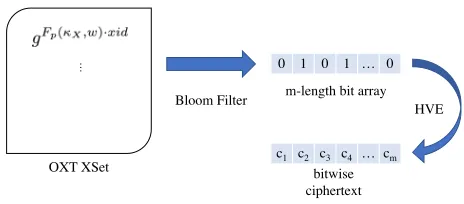
The setup algorithmSE.EDBSetup(Algorithm 1) gets the se-curity parameterλandDBand returns theparam,mkandEDB. The encrypted databaseEDBhas two components:EDB(1)isTSet generated exactly as inOXT, andEDB(2), which is shown as the blue part in Fig. 1: it is anHVEencryption of a carefully designed Bloom filterBF, which is set up forXSetelements of the form
h(id,w)=gFp(κX,w)·xid, for encrypted identifiersxid=Fp(κ
I,id)
over allid ∈ DB(w). The setup algorithm writes 1’s intoBFin positions in set
Algorithm 2: SE.Search
Input: param, mk, query ¯w=(w1∧ · · · ∧wn)withstermw1, EDB.
Output: ResultR.
1: functionSE.Search(param,mk,w¯,EDB)
2: Client’s inputs are(param,mk,w)¯ and server’s input is
(param,EDB).
3: Client initialisesR← {}.
4: Client computesstag← TSet.GetTag(κT,w1)and sends stagto the server.
5: Server letsTSet=EDB(1).
6: Server computest←TSet.Retrieve(TSet,stag), sends|t| to client, and starts acceptingxtokens computed by client as follows:
7: forc=1 :|t|do 8: Client computesηw
1←Fp(κZ,w1||c).
9: forℓ=2 :ndo
10: Client computesxtoken[c, ℓ] ←gηw1·Fp(κX,wℓ).
11: end for
12: Client setsxtoken[c] ← (xtoken[c,2], . . . ,xtoken[c,n]). 13: Client sendsxtoken[c]to server.
14: end for
15: Server initialisesE ← {}. 16: forc=1 :|t|do
17: Client initialisesvc← ∗m.
18: Server recovers(yc,ec)from thec-th component oft. 19: forℓ=2 :ndo
20: Server computesxtag=xtoken[c, ℓ]yc. 21: forj=1 :kdo
22: Server computesuj ←Hj(xtag).
23: Server sendsujto client.
24: Client setsvc[uj] ←1.
25: end for
26: end for
27: Client computestokenc←HVE.KeyGen(msk,vc).
28: Client sendstokencto server.
29: Server letsc=EDB(2).
30: Server computesresc←HVE.Query(tokenc,c).
31: ifresc=‘True’then
32: Server addsectoE(i.e.,E=E ∪ {ec})
33: end if
34: end for
35: Server sendsEto client. 36: Client computesκe ←F(κS,w1),
37: Client computesidc←Sym.Dec(κe,ec), and addsidctoR for allec∈ E.
38: returnR
39: end function
over all(id,w)pairs withid∈DB(w), and then encryptsBFwith HVE.Enc. The new parts of our protocol compared toOXTare coloured blue.
The search protocolSE.Searchis shown in Algorithm 2, where the first 14 lines generatestagandxtokens similar toOXT. The XSetmembership test for conjunctions inOXTis replaced by aHVE token generation and query. Namely, theHVEtokentokenc for
Bloom Filter
0 1 0 1 … 0
m-length bit array HVE
c1 c2 c3 c4 … cm bitwise ciphertext OXT XSet
Figure 1: An illustration of difference w.r.tXSetinHXT com-pare toOXT.
allidc ∈DB(w1)is generated for a predicate (BF) vectorvcwith 1’s in positions in setS′ = {Hj(h(idc,wi)}2≤i≤n
1≤j≤k
and wildcards
in other positions.1Consequently (as the message encrypted by HVEwas set to ‘True’ inSE.EDBSetup) theHVE.Queryreturns ‘True’ ifS′ ⊆S, i.e. ifalln−1xtermswi are in the document idc. Otherwise,HVE.Queryreturns⊥, without revealingKPRP information on whichwi are inidc. Importantly, in step 27 and 30, theHVE.KenGenandHVE.Queryalgorithm only uses components ofcin the non-wildcard positions ofvcandtokenc, so search run-time is only proportional to|DB(w1)| ·n·k(similar toOXT), and not to the sizemof theBF. We next show thatHXTis correct with the Bloom filter’s false positive ratePe.
Theorem 3. If the underlyingHVEscheme and T-set schemeΓ
are correct, and thePRFsFandFpare secure, thenHXTis computa-tionally correct with false positive ratePe ≤ (1−e−k·N/m)k.
Proof. The proof is given in Appendix B. □
5
SECURITY
A Searchable Symmetric Encryption (SSE) query consists of a Boolean formulaψ and a tuplew = (w1, . . . ,wn)of keywords. Throughout the paper, we only consider conjunctive queries with
ψ(w)=w1∧· · ·∧wn. Without loss of generality, we assume thatw1 isstermand(w2, . . . ,wn)aren−1xterms. For a vector of queries q=(s,x2, . . . ,xn), it consists of a vectorsofsterms, and a sequence of vectorsx2, . . . ,xnofxterms.
We define the leakage function of HXTL(DB,q)as a tuple(N,EP, SP,WRP,IP)formed as follows:
• N =Íd
i=1|Wi|is the total number of appearances of key-words in documents.
• EPis the equality pattern ofs∈WQindicating which queries
have the equalsterms. In particular,EP[i]=|{s[1], . . . ,s[j]}|, wherej is the least index for whichs[j] =s[i]. Note that EP∈ [ω]Qand it is leaked since the client sendsstag corre-sponding tosto server.
• SPis the size pattern of the queries, i.e. the number of
documents matching thestermin each query. Formally, SP∈ [ω]QandSP[i]=|DB(s[i])|.
1
•WRPis the whole result pattern, which is an array computed
as follows:WRP[i]=DB(s[i]) ∩n
j=2DB(xj[i]) 2
.
•IPis the conditional intersection pattern, which is a
4-dimen-sional tableIP[i,j,α,β]defined as follows:
=
DB(s[i]) ∩DB(s[j]) ifi,j,α,β, andxα[i]=xβ[j],
∅ otherwise,
for 1≤i,j≤Qand 1≤α,β≤n.
The overall leakage functionLconsists of the leakage from the HXTprotocolLHXTand the leakage function of T-setLT.
5.1
Leakage Function Comparison
Note thatWRPis a new component in our leakage function com-pared toOXT. In their leakage function, they actually hadKPRP[i]=
∪nj=2 DB(s[i]) ∩DB(xj[i])
, which is denoted byRPin [12] and ob-viously a lot more thanWRP. The following example illustrates the impact of updating leakage component fromKPRPtoWRP.
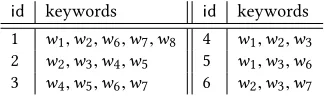
Suppose that a database consists of 6 documents labelled by
{idi}1≤i≤6. Let us assume the following database ‘forward index’, listing documentid’s and keywords contained in each:
id keywords id keywords
1 w1,w2,w6,w7,w8 4 w1,w2,w3 2 w2,w3,w4,w5 5 w1,w3,w6 3 w4,w5,w6,w7 6 w2,w3,w7
Consider the queryw1∧w2∧w3for some keywordsw1,w2, andw3. By convention, we letw1be the least frequent keyword amongst all queried words. The inverted-index listing the documentid’s containing each of the queried words areDB(w1)={id1,id4,id5}, DB(w2)={id1,id2,id4,id6}, andDB(w3)={id2,id4,id5,id6}.
Table 2: Leakage Comparison for queryw1∧w2∧w3between KPRPandWRP.
Leakage Component Leaked Entries
KPRP(fromOXT) {(id1,w2),(id4,w2),(id4,w3),(id5,w3)} WRP(fromHXT) {(id4,w2),(id4,w3)}
TheKPRPleakage component inOXTis computed as follows: RP=∪3
j=2 DB(w1) ∩DB(wj)
=
{id1,id4} ∪ {id4,id5}. As shown in Table 2, TheKPRPleakage thus reveals 4 entries of the inverted-index, underlined in the inverted-index above. However, in this paper, we eliminate the ‘partial query’ (KPRP) leakage induced by RP, leaving onlywhole result pattern(WRP) corresponding to the final query result. By definition, we haveWRP=∩3
j=1DB(wj) . In
our example,WRPreveals the exact result of the query, that is
{id4}. Table 2 shows that theWRPonly reveals two entries in the inverted-index above, in contrast to 4 entries revealed byKPRP above.
In fact, [12] has not noticed this leakage in their analysis and simply putRPto be the set of all identifiers matching thei-th query.
2
WRPis defined under the “no false positive” assumption, i.e. BothTSetand Bloom Filter do not have a false positive rate. Otherwise, the false positive should be taking into account to define a refined leakage profileFP-WRP.
Table 3: Notations for Comparison Analysis
Notation Meaning
m,mp number of multiplications overGandZp p,e number of pairings and exponentiations epre number of preprocessed exponentiations G,GT,Zpsize of an element fromG,GT, andZpresp.
m′
number of non-wildcard elements in aBF
TPRF time taken to compute aPRF
Thash time taken to compute ahashofBF
TXOR time taken to perform an exclusive-or operation overλ
TEnc time taken to compute a sym. ciphertext
TDec time taken to decrypt a sym. ciphertext
TTSet time taken to set-upTSet
5.2
Security Analysis of
HXT
Here, we show the security of our protocol against both a non-adaptive and an non-adaptive adversarial server which is assumed to be “honest-but-curious”. Similar to [12], we first give a theorem about the security against non-adaptive attacks, and later discuss the full security. For sake of simplicity, we assume in our proof that no false positive happens in our protocolHXT3(i.e., no false positive happening in bothTSetandBF).
Theorem 4. Our protocolHXTisL-semantically secure against
non-adaptive attacks whereL is the leakage function defined as before, assuming that theDDHassumption holds inG, thatFandFp are securePRFs, thatHVEis a selectively simulation-secure protocol, thatSym=(Sym.Enc,Sym.Dec)is anIND-CPAsecure symmetric
encryption scheme, thatΓis aLT-secure and computationally correct T-set instantiation, and that no false positive happens in ourHXT.
Proof. The proof is given in Appendix B. □
We now show that our theorem is also valid for adaptive models.
Theorem 5. Our protocolHXTisL-semantically secure against
adaptive attacks whereLis the leakage function defined as before, assuming that theDDHassumption holds inG, thatF andFpare securePRFs, thatHVEis a selectively simulation-secure scheme, that
Symis anIND-CPAsecure symmetric encryption scheme, and thatΓ is aLT-secure and computationally correct T-set instantiation.
Proof. The proof is given in Appendix B. □
6
PERFORMANCE COMPARISON
We first give a list of notations needed in this section for our comparison analysis in Table 3.
6.1
Comparison between HVE Schemes
The performance of the proposedHXTprotocol depends on the parameters of the underlying employedHVEscheme. Hence, we first give the comparison between the availableHVEschemes and ourSHVEscheme in terms of their performance parameters. After showing the performance advantage of proposedSHVE, we carry
3
Table 4: DifferentHVEschemes and their properties.
Ref. |G| Ciphertext Size Key Size Enc. Cost Query Cost KeyGen. Cost
BW [6] p1p2 (2m+1)G+(1)GT (2m+1)G (6m+2)m+(8m+2)e (2m+1)p (2m+1)p+(2)m
KSW [27]p1p2p32(2m+1)G+(1)GT (2m+1)G
(4m)m+(2m)mp
+(6m+1)e
(2m+1)p
(3m+1)m+(2m)mp
+(6m+2)e OT [32] p1 2(5m+1)G+(1)GT(11)G+(m)Zp (m+1)e+(m+1)m (11)p+5(m−1)e (12m+10)m
IP [24] p1 (2m+1)G+(1)GT (2m)G (2m+2)e+(1)m (2m)p+(2m+1)m (2m)e+(2m)m
SHVE N/A (m)λ O(m′)+2λ (m)TPRF (m′)TXoR+TDec
(m′)TPRF+(m′)TXoR +TEnc
Table 5: Execution Time Comparison between IP [24] and the proposedSHVE; The width ofHVE:m =10000, no
wild-card element.
Scheme KeyGen. Time (s) Enc. Time (s) Query Time (s) IP [24] 51.154 50.901 119.219
SHVE 0.172 0.162 0.004
on to derive and analyse the performance of ourHXTand compare it to that ofOXT.
In Table 4, we summarise 4 well-known paring-basedHVE con-structions as well as theSHVEscheme we proposed and compare them based on their properties including ciphertext and key (token) sizes as well as encryption, query and token generation computa-tional costs when we use them to encrypt a Bloom filter with the length ofm,mis also referred to as the width of the HVE here. Note that the second and third schemes were induced from Inner Prod-uct Encryption (IPE), while the first and the fourth constrProd-uctions were originally obtained forHVEmodel. All the presented schemes except ours are pairing-based constructions (over groupsGandGT as domain and range of a bilinear function) with different group orders ranging from just 1 prime to product of 3 primes, while our construction is based on symmetric key encryption.
It is clear that theHVEscheme with pairings in [24] can provide the most efficient construction with low complexity encryption, query, and key generation algorithms amongst the pairing-based HVEs. Therefore, the first evaluation aims to compare the runtime efficiency of ourSHVEscheme with the IP [24]. To evaluate our scheme, we implement ourSHVEwith Java, and we choose to use AES-CMAC as our PRF function while AES in CBC mode as the symmetric key encryption scheme. All above symmetric crypto-graphic primitives are from the Legion of Bouncy Castle [37]. We adopt 128-bit key length for symmetric key encryption scheme because symmetric encryption with 128-bit key offers better secu-rity than the Elliptic Curve Cryptography (ECC) over a curve with a 160-bit prime order group with a smaller key size according to RFC 4492 [3], and, it can perform encryption/decryption efficiently. For comparison, we use the open source implementation of IP [24] included in Java Pairing based Cryptograyphy ( JPBC) [9] library, which is also implemented by Java, and it is constructed on the curvey2=x3+xover the fieldFpfor some primep=3 mod 4, the group operations are based on and the 160-bit prime order groups which are generated from above curve. To make the performance of IP [24] consistent with the theoretical analysis from Table 4, we
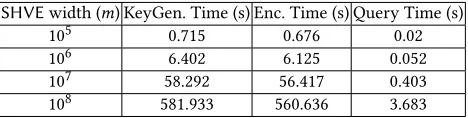
Table 6: The Execution Time ofSHVEwith different sizes of predicate vector. The width ofHVE:mis from105to108, no
wildcard element.
SHVEwidth (m) KeyGen. Time (s) Enc. Time (s) Query Time (s)
105 0.715 0.676 0.02
106 6.402 6.125 0.052
107 58.292 56.417 0.403
108 581.933 560.636 3.683
add a preprocessing code for Enc., as it has been implemented for KeyGen. and Query, but missed in Enc..
It is also critical to distinguish betweenm(the length of the en-tire Bloom filter which is at least as large as 36×N) andm′. In the HVEschemes based on inner product encryption, the complexity of key generation and query depends onm, while in theSHVE, the complexity depends only on the number of non-wildcard characters
m′
in the vector. This has a significant impact on the practicality of the scheme since a dependence ofmwould mean a query complex-ity that scales with the size of the database. However, our query complexity (e.g., number of pairings and exponentiations) grows with the size of the result set rather than the database.
All evaluations are performed on a server with Intel Xeon E5 2660 2.20 GHz CP U and 128 GB of DDR3 RAM. The width ofHVE
mis set to 10000, and the predicate vectorvwe used doesn’t have any wildcard element, which meansm=m′in our evaluations. We run IP [24] and proposedSHVEscheme three times respectively to obtain the average execution times of key generation, encryption, and query. The results are shown in Table 5. Compared with IP [24], the proposedSHVEscheme is 314x faster in Enc., 297x faster in KeyGen., and almost 30000x faster in Query.
We also evaluate the execution time ofSHVEwith largemto show the efficiency ofSHVE. In this evaluate, the width ofHVEis varied from 105to 108. The result is reported in Table 6, and it is consistent with our theoretical performance analysis.
We can see that theSHVEscheme is efficient even if it is running with a largem. For example, it is able to run KeyGen and Enc. algorithm within 10 minutes, and query algorithm within 3 s when
m=108(108elements for processing). Note that it needs several hours to run a pairing-basedHVEwith the same parameter (m) to encrypt and to generate the key, and several days to query.
6.2
Comparison between OXT and HXT
Table 7: Communication overhead between client and server and their computational costs.
Conjunctive queryq=(w1∧w2∧ · · · ∧wn).
OXT[12] cost HXTcost
Computation
set-up comp. cost NTTSet+Nepre+NkThash NTTSet+Nepre+NkThash+(m)TPRF
search common cost (server)
xtagcomp.&BF match |DB(w1)| ((n−
1)(kThash+e) )
search additional cost (server)
HVE Queries N
/A |DB(w1)|((m
′)T
XOR+TDec)
search common cost (client)
stag,xtokencomp. & index recover
|DB(w1)|(nTPRF+(n−1)epre)+TPRF+TDec
search additional cost (client)
HVE KeyGen N
/A |DB(w1)|((m
′)T
PRF+(m′)TXOR+TEnc)
Storage storage size (server) N λ+m N λ+(m)λ
Communication common comm. bandwidth |t|+|DB(w1)|(n−1)G+|E |O(λ)
additional comm. bandwidth
tokenctransmission N
/A |DB(w1)|(O(m
′)+
2λ)
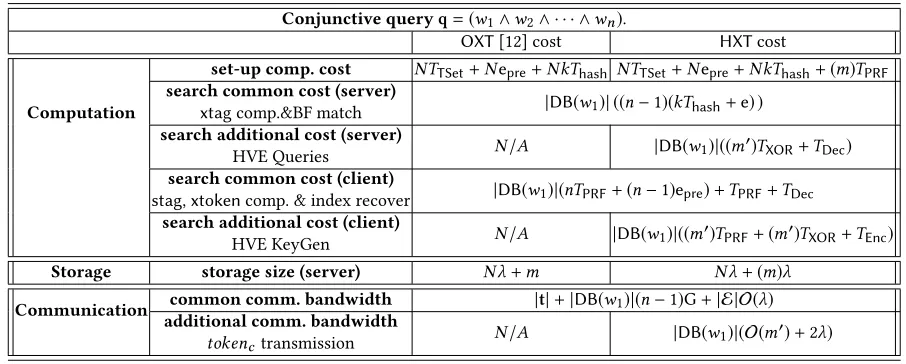
server), and the number of interaction runs and bandwidth for conjunctive query(w1∧w2∧· · ·∧wn)withstermw1. Note thate,m, andpare defined in Table 3. The overall comparison is summarized in Table 7.
6.2.1 Set-up computational costs.First, we focus on computa-tional cost spent during the set-up phase. Although both our pro-tocol and theOXTshare a lot of similarities, the time taken to generate the encrypted database inHXTis mainly contributed from the computation of thecin addition toTSet,XSetandBFvector computational costs. The computing ofcadds the computational cost of anHVE.Enc, that is(m)TPRFif we employ theSHVE. If we letTTSet=TPRF+TEnc, then computingTSetandXSetinOXTsums up toNTTSet+Nepre, where the first term is obtained sinceTSet hasN components each filled up using aPRFand an encryption of a symmetric encryption scheme. For theXSetcomputation, we makeNpreprocessed exponentiations, in total ofNepre. These are shown in the first row computation comparison of Table 7. Note that although we do not entirely generateXSetinHXT, we still com-pute its components to initiate aBFvector. Bloom filter is employed for keeping theXSetin a reasonably storage space for the practical implementation ofOXT[12] and generatingHVEforHXT, theBF generation has only the evaluations ofhashsHj, for 1≤j≤kand
kNelements.
6.2.2 Storage size.We now investigate the storage size ofHXT and compare it toOXT. The latter storesTSetand the Bloom filter ofXSetinEDB, whileHXTusesTSetand an encryption of anHVE system. Note that the latter is in fact anHVEciphertext replacing the Bloom filter ofXSetofOXT. The size ofTSetequalsN, where each component contains aGelement of sizeO(λ); and the size of Bloom filter ism. Note thatmis approximately 1.44kNto attain a negligible probability of false positives, which is 35 times smaller than anXSetwith 512-bit base field fork=20 (1024 bits for each element and 1024Nin total). Therefore, This in total givesO(N(λ+
k))as the storage size inOXT. The size ofcdepends on the size of the correspondingBF(used to generate it). Therefore, the ciphertext
size is(m)λ. Hence, the overall storage size ofHXTis of order
O(kN λ).
6.2.3 Search computational costs.During the search phase, the computational costs are divided between the client and the server. The client in bothHXTandOXThas to interact with the server once she wants to sendstagandxtokens, where she needs to use a preprocessed element to calculate(n−1)exponentiations for each recovered document inDB(w1). The overall computational cost till this stage isTPRF+|DB(w1)|TPRF+|DB(w1)|(n−1)(TPRF+ epre)=TPRF+|DB(w1)|(n)TPRF+|DB(w1)|(n−1)epre. InOXT, the server then performs|DB(w1)|(n−1)emanyxtaggeneration and
|DB(w1)|(n−1)kThashmembership test in theBFvector. 4
It fi-nally returns recovered encrypted indices to the client, when she has to perform a decryption of what was stored inTSet. The lat-ter costs clientTDec. InHXT, the server evaluates vectorsvc, for 1≤c ≤ |DB(w1)|, and sends it to client. The client consequently computestokenc usingHVE.KeyGen. The first one again is en-dowed by(n−1)kT
hashand(n−1)eevaluations, while the second component requires anHVEkey generation, ifm′denotes the num-ber of non-wildcard components ofvc, then the cost of generating tokencis(m′)TPRF+(m′)TXOR+TEnc. Finally at the server side, the determination ofresthrough anHVE.Queryand atokencis extra compared toOXT, which costs another(m′)TXOR+TDec, using the above defined notation. The search computational costs discussed above are presented in the second to fifth row of Table 7.
Finally, we determine the computational cost overhead on server and client side, respectively. For this purpose, we defineOsrvras:
|DB(w1)|((m
′)T
XOR+TDec)
|DB(w1)|((n−1)(kThash+e))
.
Based on a micro-benchmark, the computation time of ahashis insignificant, as the computation cost of an exponentiation is com-parable to 1300 evaluations ofhashs. In addition, the computation time of anxoroperation is 3 times faster thanhash, 50 times faster
4
thanSym.Decand 100 times faster thanSym.Enc. If we apply the typical settings from [12]: letPe =10−6andn=2, we will have
k =20, andm′is equal to the size ofvc, which is(n−1)k(kin above settings), we conclude thatHXTonly introduces 1% extra cost on server side; We further defineOclientas
|DB(w1)|((m′)TPRF+(m′)TXOR+TEnc)
|DB(w1)|(nTPRF+(n−1)epre)+TPRF+TDec
.
Because the preprocessed element performs exponentiation 17 times slower thanPRFandPRFis 43 times slower than exclusive-or operation, the overhead ofHXTis about 119% on client side. It is easy to deduce from the micro-benchmark that the above two ratios are inversely proportional ton, which means the computational overhead ofHXTis smaller when the query has a longer keyword list. However, our evaluations on subsection 7.3 show that such overhead can be masked by I/O cost on server side.
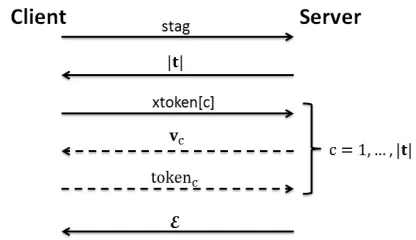
6.2.4 Interaction rounds and bandwidth.In our proposed query protocolSE.Searchshown in Algorithm 2 (on page 8), thestagand xtokengenerations are the same as that inOXT, which accounts for the first round of interaction between the client and server. The bandwidth of this round is|t|+|DB(w1)|(n−1)G. In the second and third rounds of interactions, the server computesvc(using the hashs from theBF) for each encrypted index in vectortretrieved usingstagandTSetand sends it to the client. This interaction costs|DB(w1)|O(m′) communication overhead. The client then uses the key generation algorithm of the correspondingHVEto formtokenc and lets server to use thesetokenc to check if the result of this query is “True” or not (using the query algorithm of the underlyingHVEscheme). This extra interaction round has
|DB(w1)|(O(m′)+2λ)bandwidth. It gathers all encrypted indices
ecthat passes theHVE.Queryinto a setE. This set will be sent to client with bandwidth|E |O(λ)as the final result and the client is further responsible to decrypt the recovered indices using her own secret key to the symmetric encryptionSym. Note that one round of interaction between client and server has been added in ourHXT compared toOXT, where the server only checks a set membership againstXSetrather than employingHVE. All these are summarized in Fig. 2.
7
EVALUATIONS
7.1
Prototype Implementation
We implement a prototype system for evaluating ourHXT proto-col. To build this prototype, we firstly implement anOXT proto-type, because there is no open source implementation ofOXT. Our implementation use the cryptographic primitives outlined in sub-section 6.1. Bloom filter is a essential part for bothOXTandHXT prototypes, we deploy the Bloom filter from Alexandr Nikitin as it is the fastest Bloom filter implementation for Java [31]. In ourOXT prototype, we set the false positive rate to 10−6and it enables the OXTprototype to keep the Bloom filter ofXSeton the RAM of our server.
TheOXTprototype consists of two main parts: one for encrypted database (EDB) generation and the other for database query. Based on theOXTprototype, we implement the proposedSHVEscheme to enable the prototype to performHXTprotocol. By replacing the Bloom filter ofXSetto aSHVEciphertext inEDBgeneration,
Figure 2: All interactions between a server and a client dur-ing a search inHXT(all arrows) andOXT(solid arrows only). Since the message flows corresponding to third, forth, and fifth lines are sent in parallel overc∈ [|t|], theHXTprotocol only has6message flows (or equivalently3rounds). This is
in contrast toOXT, which has4message flows (2rounds).
and the Bloom filter query toSHVEkey generation and query in database query, theOXTprototype is adapted to anHXTone. All above programs are implemented by a combination of Java and Scala code and it has roughly 2000 lines of code.
The implemented prototypes are designed to fulfil the scalability and the query efficiency characteristics of original protocols. To reach these goals, our prototypes are implemented on distributed platform (i.e. Hadoop [1]). Hadoop is a distributed platform in master-slave structure: It has a master node that manages the re-source and monitor the application execution while a group of slave nodes which dedicate their computational resources (e.g. CP U, RAM, disk) to execute the tasks from master node. Hadoop [1] of-fers a distributed file system HDFS [34], in addition to a distributed database HBase [2]. HDFS allows our prototypes to storeTSetand SHVEin multiple hard drives in different slave nodes, and reach them concurrently. As a result, it avoids the heavy I/O overhead on single hard drive; HBase provides efficient in-memory index mechanism over distributed dataset, which can highly reduce the TSetandSHVEaccess time.
Table 8: Statistics of the datasets used in the evaluation
Size # of documents Distinct keywords Distinct(id,w)pairs 2.93GB 7.8∗105 4.0∗106 6.2∗107 8.92GB 2.7∗106 1.0∗107 1.6∗108 60.2GB 1.6∗107 4.3∗107 1.4∗109
key ofHVE, because random keys help to distribute the data into different nodes, which enables the random access in parallel [21]. To accelerate the query phase, we make use of the distributed in-memory computing framework Spark [38]. Spark follows the same data processing flow as MapReduce [17], which distributes the computing tasks and execute them on different slave nodes in parallel. Spark inherits the scalability and fault tolerance of MapRe-duce [38], but it can execute tasks in-memory without keeping any intermediate data on disk, it means our prototypes don’t have any I/O operation during database query except theTSetandSHVE query.
We deploy our prototypes on a shared Hadoop cluster with 13 slave nodes and one master node. Each node has 2x Intel Xeon CP U E5-2660 2.2GHz (each CP U has 8 cores with dual-thread) and 128GB RAM, in addition, we have another node with the same specification above which is served as edge node and client of our prototypes. All nodes are connected by InfiniBand [23] network technique. The cluster installs CDH 5.2.6 [14], one of the most complete and popular distribution of Hadoop and its peripheral ecosystem (contains Hadoop Yarn 2.5.0, HBase 0.96.8 and Spark 2.0.2). Based on the setup configuration and scheduling policy, we can use at most 416 virtual cores (32 virtual cores in each slave node) and 1248GB RAM (96GB RAM in each slave node), in addition, each virtual core should have at least 2GB. In real world scenario, 1 virtual core and 2GB RAM are needed for running the monitor program of a distributed application on Hadoop. As a result, our prototypes can start 415 tasks with 1 virtual core and 3GB RAM concurrently at most. However, our following evaluations show that it is not necessary to use all resources to query the database: 100 concurrent tasks with 1 virtual core and 2GB RAM are sufficient to provide a satisfactory result.
7.2
Datasets
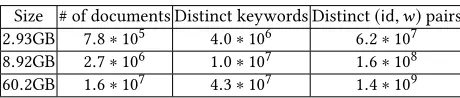
We test our implementation on three datasets from Wikimedia Downloads [20]: the original sizes of our datasets are 2.93GB5, 8.92GB6and 60.2GB7, respectively. A brief summary of the statisti-cal features of the datasets is given in Table 8.
The correspondingEDBand Bloom filter size for above three datasets are 9.3GB and 215MB, 33GB and 575MB, 256GB and 4.76GB. In addition, theHVEsize is 28GB, 76GB and 647GB. Fig 3 further gives the frequency of keywords according to the number of docu-ments to depict the keyword occurrence distribution of the gener-atedEDBs.
5enwiki-20161220-pages-articles22.xml 6
enwiki-20161220-pages-articles27.xml
7
enwiki-20171201-pages-articles.xml
>=100 >=101 >=102 >=103 >=104 >=105 >=106
Occurrence (keyword)
1 10 100 1000 10000 100000 1e+06 1e+07 1e+08
# of Documents
60.2GB Dataset 8.92GB Dataset 2.93GB Dataset
Figure 3: The keyword occurrence distribution of three datasets.
0 50 100 150 200
# of Task(s)
100 200 300 400 500 600
Time (sec)
60.2GB Dataset 8.92GB Dataset 2.93GB Dataset
Figure 4:HXTServer query time when # of parallel tasks in-creases.
7.3
Evaluation Results
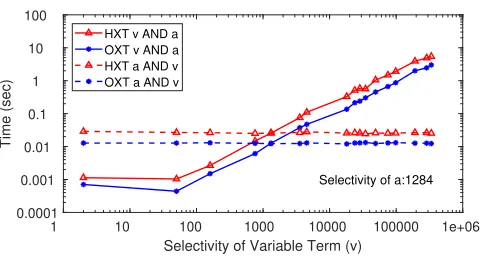
Our evaluation aims to verify the following: (i) our implementation in distributed platform can ensure the efficiency of queries; (ii) the additional query latency introduced inHXTis small; (iii)HXTkeeps the scalability property ofOXT.
7.3.1 The impact of parallelism.First, we study how distributed computing influences the query efficiency ofHXTprototype. We choose a keyword with about 330K matched documents respectively in three datasets, and we use the selected keyword as thesterm to perform a two-terms conjunctive query in ourHXTprototype. We vary the number of parallel tasks from 1 to 200 before the server start running the query to test the impact of parallelism. As shown in Fig 4, we observe that parallelism successfully improved the efficiency of query by a factor of 100 times on server side. In addition, we conclude the impact in three cases: (i) when increasing the number of parallel tasks from 1 to 10, parallelism can highly improved the server side performance; (ii) when the number of parallel tasks is between 10 to 100, parallelism only can slightly improve the query efficient on server; (iii) after the number of parallel tasks is larger than 100, parallelism doesn’t affect the query efficiency.