Research of Titanium Alloys Microstructure Evolution During
Rolling In The Longitudinal Wedge Mill
S.A. Mashekov, doctor of technical science, professor;
B.N. Absadykov, doctor of technical science, professor;
A.A. Tukibai, PhD student, A.S. Mashekova, PhD student
45T
Abstract
In the article the rational modes of workpiece deformation is defined by using computer simulation of the technological process in the combined and flat dies, and also by rolling in the longitudinal wedge mill, which allows to produce the sheets from titanium alloy with fine-grained structure.
45T
Keywords: 45Trolling, forging, dies, titanium alloys, sheets, structure.
Introduction
For significant amounts of titanium metal hot rolling is the final operation, defining quality and operating characteristics of the metal.
During the hot rolling number of high-temperature processes pass, which make the difference for the forming grain size during the various rolling steps [1]. The structure and properties of the metal products largely depend on the degree of development of aforementioned processes (hardening, softening, returns, recrystallization, a second allocation or multiple phases).
Implementation of the strain on the optimal or sub-optimal temperature-strain regimes can lead to the formation of a homogeneous or assorted structure, and also to obtain a stable and well-developed substructure [2].
Control of hardening (hammering harden) and softening (static, dynamic and meta-dynamic recrystallization) at hot deformation are the main mechanism of regulation of structure formation processes [3]. The study of the kinetics of these processes in titanium alloys, as well as their control is associated with serious difficulties, as when cooled to temperatures that allow the use of quantitative metallography passes polymorphic transformation. Therefore, for fixing the obtained intermediate structure, accelerated cooling structures are used in the hot rolling, which is possible only for small samples [3]. However, the method of accelerated cooling of the structures at a sufficiently high rate of cooling of hot-rolled sheets only considers dynamic recrystallization β or (α + β) - phases, but does not account for the static recrystallization, extending after deformation.
Specificity of the evolution of a titanium structure, unlike FCC of metals, are associated with the development of mechanical twinning deformation in the initial stage [4]. According to V.V. Rybin, interaction with counterparts boundaries, created during the deformation, results in "... the formation of a dispersed and strongly disoriented fragmented structure". [4]
Meanwhile, it can be assumed that since the twinning leads to a refinement of the microstructure of the metal, its effect on the formation of a titanium UFG structure is primarily due to a change with the size of the grains, and only subsequent deformation leads to the development of fragmentation [5,6]. Thus, we can assume the influence of grain size on the initial formation of the UFG structures. The starting grain size greatly affects the uniformity of the plastic flow that would affect the uniformity and completeness of the twinning pass and, respectively, on the development of the microstructure of fragmentation. Other important factors that have a significant impact on the development of twinning is the chemical composition of titanium and deformation temperature.
The chemical composition of titanium affects the critical shear stress for slip and twinning, and the deformation temperature - on the development of the return processes and therefore greatly affect the occurrence of fragmentation and, accordingly, on treatment regimens [6,7]. Obviously, the development of fragmentation in titanium depends on deformation scheme [5]. In accordance with the principle of Likhachev-Rybin the change of deformation direction destroys the previously created structure. Meanwhile, attention to this factor in the literature does not address, but it is important when choosing a mode of combined technologies.
Therefore, the theoretical or experimental evaluation of such factors as the initial grain size, chemical composition, temperature deformation of titanium processing and accounting schemes deformation will identify the role of each factor on the development of the microstructure of titanium during its plastic deformation and to determine the optimal conditions for the deformation processing to form ultrafine structure.
Determination of optimal conditions for milling of microstructure of the titanium during large plastic deformation allows eventually justify and develop cost-effective modes of producing ultrafine sheets and rods with high mechanical properties.
In works [8, 9], a model of predicting the size of the grain structure of metals and alloys under dynamic and static recrystallization is proposed. The underlying principle of these models is the physical resemblance of the static and dynamic recrystallization, the difference is in the conditions of the implementation of these processes: after the deformation ends or during the deformation at a monotonic increase of the deformation degree.
In this paper, based on mathematical modeling, calculation of parameters of the dynamic and static recrystallization was done during the processing of titanium alloys by the combined technology, as broaching in combined (upper – flat, bottom - engraved) and flat dies and rolling on the continuous longitudinal wedge mill [10].
Materials and experiment methodology
In this paper by the mathematical modeling the calculation of the dynamic and static recrystallization parameters was done during the processing of titanium alloys by the combined technology, as broaching in the combined and flat dies on the longitudinal-wedge mill at the temperatures 1100 0TP
о
P0T
С, 980 0TP
о
P0T
С, 1000 0TP
о
P0T
С and 20 0TP
о
P0T
С.
Special standard MSC.Super Forge software was used for the SSS calculation [11, 12]. A three-dimensional geometric model of the workpiece and of the tool was built in the CAD program and imported into Inventor CAE software MSC.SuperForge.
In order to research the combined process of production of transitional workpieces, as broaching in the combined and flat dies, the round billet of the size Ø 80×200 mm was used; and in order to research rolling of the sheets of the size 0.9×150×1800 mm, rectangularly shaped in the cross section sheets workpieces with the following geometric sizes 4×150×490 mm, 2.5×150×670 mm, 1.75×150×960 mm, 1.15×150×1120 mm was used. Combined process is modeled in a three-dimensional environment with the partition blanks on 4 key elements (CTETRA). Calculation time of the rolling and forging processes in each stand was 22 minutes on a computer of Pentium Duo with the clock frequency of 3.4 GHz and 2 GB RAM.
Workpiece material was titanium alloy VT3-1 with a temperature range of deformation of 20 ... 1200 °C. From MSC.SuperForge software system database the rheological properties was configurated. The workpiece material was taken as isotropic elastic-plastic with a non-linear hardening (BISO). On the surface of the tool with the workpiece the friction was taken to be 0.3. Tools regarded as absolutely rigid body.
The MSC.SuperForge software was set. Step-by-step movement U, the components of the deformation tensor ε, the components of the tensor of strain rate ξ, components of the tensor of tension σ, strain intensity Г, tension intensity σRi, Rthe
temperature distribution over the volume of the workpiece were calculated. For clarity of the calculation results presentation the data for the four (4) stages as a percentage of the total time of the deformation were took, i.e. the following intervals were took: the first stage 10, second stage 40, the third stage 70 and the fourth stage 100 percent of the full-time deformation.
Results and discussion
The deformation intensity distribution along the cross-section of the workpiece during broaching in the combined dies with relative batch of S=0.6 in the first drafting and during the deformation with the tilting angles of 30P
о
P
, 60P
о
P
, 90P
о
P
and 120P
о
P
are demonstrated on the Figure 1.
Based on the obtained results of the numerical simulation, it was established: - during the broaching of the round shape workpiece in the combined dies, the deformation intensity (Г) focuses in the initial stage of the first drafting in the surface zones of the workpiece. And with the increasing drafting, Г (deformation intensity) is redistributed and it has great importance in the areas adjacent to the site of contact of the tool with the workpiece. Whereas in the free from load surface zones of the workpiece, the minimum amount of deformation occurs (Figure 1, a, b, c);
- increasing the drafting unit leads to expansion of areas of localization rate of deformation during broaching in the combined dies;
- during broaching with the tilting angles of 30°, 60°, 90°, 120° the intensity of deformation centers focuses under the flat die (Figure 1, d, e, f);
- during broaching in the combined dies in the areas of deformation localization
the temperature of the workpiece increases.
а) b) c)
а – ε = 10%; b –ε = 15%; c – ε = 20%
d) e) f)
d – φ = 30P
о
P
;ε = 20% e – φ = 90P
о
P
; ε = 20% f – φ = 120P
о
P
; ε = 20% Figure 1. The picture of the deformation intensity distribution along the cross-section
of the workpiece during broaching in the combined dies, t = 1100 P
о
P
C
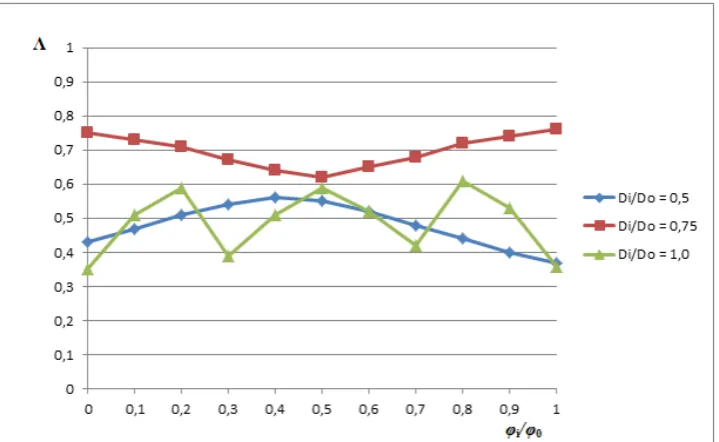
By summing the intensity of deformation, the degree of shear deformation Λ (accumulated strain) were calculated for a number of technological modes of forging in the combined dies.
Analysis of Λ changes diagrams, along the cross section of the workpiece during broaching in the combined dies, shows that for most rational mode of broaching, with the relative supply of 0.6 and with tilting angle of 30°, the degree of shear strain has large value in the areas, adjacent to the central zone of the workpiece (Figure 2, where φRiR - rotation angle till the study point along the cross section of the workpiece;
φR0R = 360P
0
P
- angle of the entire circumference of the workpiece; DRiR - distance till the
study point on the diameter of the workpiece; DR0R – diameter of the workpiece,
relatively)
Figure 3 shows a picture of the deformation intensity distribution over the cross section of the workpiece during broaching in the flat dies.
Based on the obtained results of numerical simulation it is established:
- during broaching of the round shape workpiece in the flat dies with the tilting angle 90P
о
P
and relative supply S = l/D = 0.6…1.0 (where l – the length of the deformation zone; D – diameter of the workpiece) the deformation intensity localizes in the initial stage of the drafting at the surface zones of the workpiece. And with the increasing drafting the intensity of deformation localizes along the forging cross
(Figure 3, a, b, c). In which case with increasing drafting the emphasis of deformation transit to the center of the workpiece (S = 1.0), or the maximum of the deformation, by the value, concentrate on the central portion of the workpiece (S = 0.8), or close to the surface zone (S = 0.6) of the workpiece;
Figure 2. Λ distribution over the cross-section of the workpiece during broaching in the combined dies with relative supply S = 0.6 (∆ - DRiR/ DR0R = 1.0; □ - DRiR/ DR0R = 0.75; ◊
- DRiR/ DR0R = 0.5)
а) b) c)
а – ε = 10%; b –ε = 15%; c – ε = 20%
Figure 3. The picture of deformation intensity distribution in the workpiece during broaching in the flat dies with relative supply S = 1.0, t = 980P
0
P
C
- Part of the volume of the geometric deformation zone appears in the zones of difficult deformation during broaching in the first and consequent passes with tilting angle 90P
0
P
, and with relative supply 1.0 and drafting 20%. It occurs because of the contact friction forces. Meanwhile during broaching with the relative supply 0.6…0.8
and drafting 20%, only small part of the geometric deformation zone appears in the zones of the difficult deformation;
- deformation localization in the zone of the forging cross and in the places of the transition from deformed to the not deformed part of the workpiece leads to increasing heat output and hazard of the metal damage in these zones on one hand, and lack of structure deformation in the rest of the workpiece and to uneven-grained structure over the cross-section, on the other hand;
- during broaching in the flat dies in the zones of deformation localization the temperature of the workpiece increases.
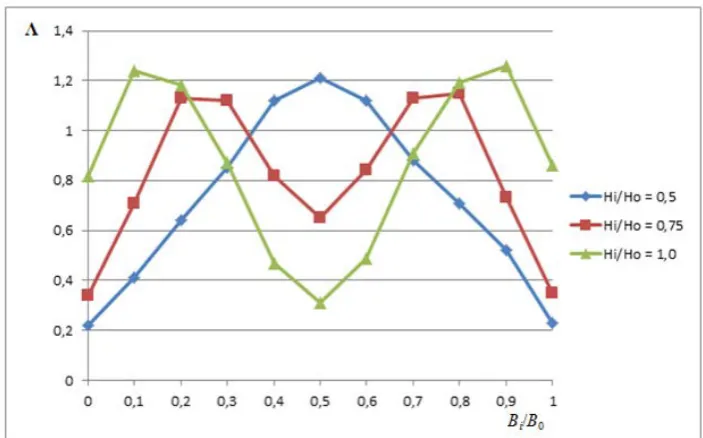
Analysis of the Λ change diagrams over the cross-section of the workpiece with the tilting angle 90P
0
P
and relative supply S = l/D = 0.8...1.0, shows that on the condition of the rational deformation regime the deformation degree has the highest value in the adjacent to the tool zones of the workpiece; also in the central layers of the workpiece. In addition in the surface regions the deformation degree has the lowest values (Figure 4, where BRiR and HRiR - distance of the point along the height and
width of the preform; and BR0R and HR0R - width and height of the workpiece,
respectively).
Figure 4. Λ distribution over the cross-section of the workpiece during broaching in the flat dies with the relative supply 1.0 (◊ -
В
RiR/
В
R0R = 0.5; □ - НRiR/НR0R = 0.75; ∆ - НRiR/НR0R= 0.9)
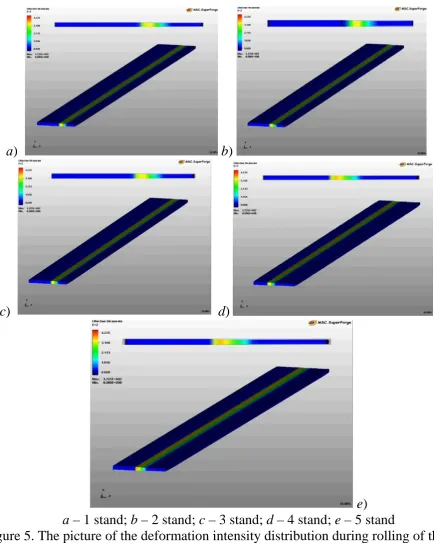
Figure 5 demonstrates the deformation intensity distribution during rolling of the rectangularly-shaped workpiece in the longitudinal wedge mill.
а) b)
c) d)
e)
а – 1 stand; b – 2 stand; c – 3 stand; d – 4 stand; e – 5 stand
Figure 5. The picture of the deformation intensity distribution during rolling of the workpiece in the longitudinal wedge mill, t = 20P
0
P
C
The results, obtained by the numerical modeling, allowed establishing:
1) 32TDuring rolling in the first stand mill of the proposed mill the deformation
intensity 32T(Г) and strain (σRiR) focused on the areas of the bitting metal by the rolls in
initial moment of the rolling. With increasing drafting, the emphases of Г and σRi Rtransferred from the surface to the center and the edges of the deformed blank.
2) Deformation in the following stands of the longitudinally wedge mill allows to gradually shift the concentration-intensity portion of the deformation from the surface zone to the central preform layers of the blank, and then uniformly deform the strip
along its entire length. Such strains and stress intensity distribution over the stands leads to a more uniform distribution of the total Г and σRiR along the deformation zone.
3)The uniform distribution of the total Г and σRiR along the height and length of the
rolled strip obtained during rolling with single compression in the first stand 20%, in the second stand 20%, in the third stand 20% to 15% in the fourth stand; in the fifth stand 10%.
To study the microstructure evolution, the model of titanium alloy VT3-1 globularization by Johnson-Maily-Avrami-Kolmogorov was used. The model described in [13]. According to this model, the volume fraction and the average size of globular grains of titanium alloy VT3-1 were calculated.
Critical deformation necessary for the formation of globular grains were determined by the formula:
εRсR = аR1RεRрR,
where aR1R = 1 – constant [13];
εRрR = 0.5 – deformation intensity at which the formation of globular grains starts.
The volume fraction of globular grains of α-phase was calculated using the Avrami equation [13]:
, exp 1 5 , 0 Λ Λ − − = k d rex X β
where βRdR and k – materials constant (the value of the materials constants are given in
[13]);
N
1 2 5 , 0 m
a ε
=
Λ - deformation degree at which 50% of recrystallization traverses in the metal structure;
аR2R and mR1R – an empirical parameters for determining the effect of strain rate on
the formation of globular grains [13];
ε - deformation velocity, сP
-1
P
.
To calculate the average size of globular grains the following formula used [13]: , 2 1 3 m n ср a
d = Λ ε
where aR3R, nR1R, mR2R - an empirical parameters which take into account the effect of the
rate and degree of deformation [13].
Figure 6 shows the change of proportion of globular grains in the structure of the transitions of metal forming. The picture demonstrates that the portion of the globular grains is 0.337…0.547 over the cross-section of the workpiece after the forging in the combined dies at the temperature 1100 P
о
P
С. The reason of the almost entire grains globularization is the high meaning of the deformation degree in the surface zones of the workpiece. However, because of the low value of the deformation degree the grains globularization runs incompletely in the central zones of the workpiece.
1- Forging in the combined dies; 2 – forging in the flat dies; 3 – forging in the flat dies; 4 – rolling in the first stand; 5 – rolling in the second stand; 6 – rolling in
the third stand; 7 – rolling in the fourth stand; 8 – rolling in the fifth stand
Figure 6. The graphic of the volume portion globular structure change during the production of the sheets by the combined process of metal forming (N – number of
operations)
After forging in the flat dies at the temperatures 980 and 1000 P
о
P
С the portion of the globular grains is 0.912…0.993 over the cross section of the workpiece. So because of the deformation degree accumulation over the cross-section of the workpiece the grains globularization runs almost entirely.
During rolling process in the longitude-wedge mill the deformation zones get enough information in order to transfer the structure from the lamellar in globular.
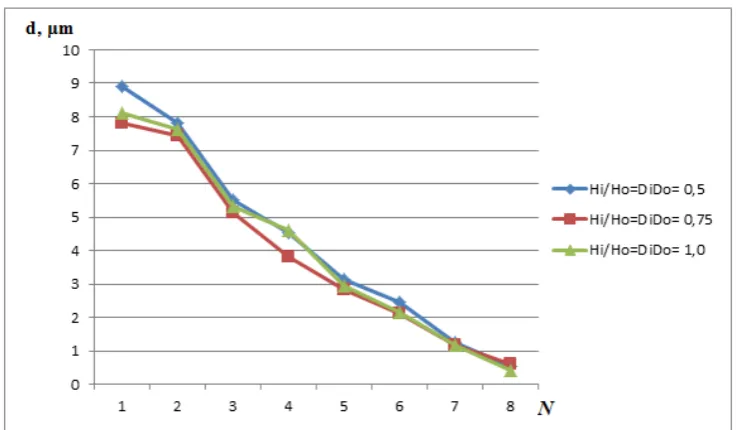
Figure 7 demonstrates the change of the average size of globular grain on transitions. The most intensive decrease in the average size of globular grains occurs during the pulling in the combined (up to 7.982 ... 8.931 µm) and flat dies (up to 5.128 ... 5.618 µm) on hydraulic press.After rolling in the longitudinal wedge mill, the fine-grained homogeneous structure is produced with a mean size of globular grain 0.417 ... 0.528 µm.
Thus, during the processing by the proposed technological process the grains globularization extends substantially throughout the volume of the rolling sheets. At the same time, homogeneous fine-grained microstructure can be get after rolling on the longitudinal wedge mill, which enhances the quality of titanium alloys. It follows that for sheets with fine-grained structure of the VT3-1 alloy, the rolling on the longitudinal wedge mill of the preliminary forged original blank can be recommended. Preliminary forging, such as a broach of initial round billet in the combined and flat dies, allows redistribute and uniformly distribute degree of shear deformation along the cross section of the workpiece. On one hand, increases the amount of shear deformations, causing crushing of the original structure, and on the
other hand – reduces the risk of hard-grained structure formation, which is indicative for the rolling in existing mills.
Figure 7. Diagram of changes in the average size of globular grains during manufacturing of the sheets with combined metal forming
Conclusions
1.It was found that a relatively uniform distribution of Λ over the cross section of the deformable workpiece can be achieved by broaching in the combined dies at the first stage, in the flat dies on the second and third stages and during rolling in the longitudinal wedge mill on the fourth stage;
2. In the process of deformation at temperatures above and below the polymorphous transformation temperature (TRptR) in the combined and flat dies, as well
as in longitudinal wedge mill below TRptR can be achieved a fine-grained structure;
3.Simplicity of the rolling in the longitudinal wedge mill, preliminary deformation in the combined and flat dies of the blank allows to produce high-quality titanium sheets with high performance;
4.Rolling in the longitudinal wedge mill, as well as pre-broaching in the combined and flat dies on hydraulic press produces fine uniform microstructure, with a volume fraction of 1.0 globular structure, which provides high mechanical properties.
List of literature
1. A.P. Gulyaev, A.A. Gulyaev. Metal Technology. Moscow: Alyans. 2011, pp. 644.
2. S.A. Mashekov, N.T. Biyakaeva, A.S. Mashekova. Monography. The problems of titanium alloys and their solutions. Part 1. Publisher: LAP LAMBERT Academic Publishing. 2013, pp 230.
3. S.A. Mashekov, N.T. Biyakaeva, A.S. Mashekova. Monography. The problems of titanium alloys and their solutions. Part 2. Publisher: LAP LAMBERT Academic Publishing. 2013, pp 251.
4. S.V. Zherebtsov, G.S. Dyakonov, A.A. Salem, S.P. Malysheva, G.A. Salishchev, and S.L. Semiatin. Evolution of Grain and Subgrain Structure during Cold Rolling of Commercial-Purity Titanium // Materials Science and Engineering A. 2011. V.528, № 9. Р. 3474–3479.
5. S.V. Zherebtsov, G.S. Dyakonov, G.A. Salishchev. Evolution of titanium structure at various schemes of severe plastic deformation // IV All-Russian Conference on nanomaterials Nano-2011: Collection of materials. 2011, pp. 366.
6. S.V. Zherebtsov, G.S. Dyakonov, S.P. Malysheva and G.A. Salishchev. Research of titanium microstructure evolution during cold rolling // perspective materials 2011, No. 12, pp. 311-315.
7. N. Lopatin, G. Dyakonov, O. Pleshakova. Effect of Combined Rolling Processes on Structure and Mechanical Properties of Pure Titanium Rods // Materials Science Forum. 2011. V. 667-669. P. 161-166.
8. M.E. Belov. The efficiency of mathematical modeling use during research, optimization and project of technological processes of metal forming. // Moscow: Moscow State Institute of Steel and Alloys, 1996, pp. 224-227
9. A.L. Genkin. Simulation and optimization of hot strip rolling process. Moscow: Lenand. 2012, pp.168.
10. Patent Republic of Kazakhstan № 27884. A.S. Mashekov, E.Z. Nugman, A.S. Mashekova etc. Longitudinal V-mill bands of steels and alloys. Published 25.1202013, bulletin №12, pp. 3.
11. S.A. Mashekov, N.T. Biyakaeva, A.S. Mashekova. Monography. Problems of forging of titanium alloys and their solutions. Part 1, 2. Publisher: LAP LAMBERT Academic Publishing. 2013, pp. 230 – 251.
12. K.M. Ivanov, V.S. Shevchenko, E. E. Yurgenson. The usage of finite element method in technological issues of metal processing. // Text edition. St. Petersburg: Institute of Mechanical Engineering, 2000, p. 217.
13. Lopatin N. V., Maradudina O. N., and. Dyakonov G. S. “Analysis of the Structure Formation and Properties of the VT6 Alloy during Upsetting of the Symmetrically Truncated Conical Billets”. Russian Journal of Non Ferrous Metals, 2011, Vol. 52, No. 1, pp. 33–38.