Security Against Related Randomness Attacks
via Reconstructive Extractors
?Kenneth G. Paterson1, Jacob C. N. Schuldt2, Dale L. Sibborn1, and Hoeteck Wee3
1 Royal Holloway, University of London, UK 2
National Institute of Advanced Industrial Science and Technology, Japan 3 Ecole Normale Sup´´ erieure, Paris, France
Abstract. This paper revisits related randomness attacks against public key encryption schemes as introduced by Paterson, Schuldt and Sibborn (PKC 2014). We present a general transform achieving security for pub-lic key encryption in the related randomness setting using as input any secure public key encryption scheme in combination with an auxiliary-input reconstructive extractor. Specifically, we achieve security in the function-vector model introduced by Patersonet al., obtaining the first constructions providing CCA security in this setting. We consider in-stantiations of our transform using the Goldreich-Levin extractor; these outperform the previous constructions in terms of public-key size and reduction tightness, as well as enjoying CCA security. Finally, we also point out that our approach leads to an elegant construction for Corre-lation Input Secure hash functions, which have proven to be a versatile tool in diverse areas of cryptography.
Keywords. public-key encryption, related randomness attacks, auxiliary-inputs, reconstructive extractors, CIS hash functions.
1
Introduction
In recent work, and motivated by numerous practical attacks involving diverse kinds of randomness failure, Paterson, Schuldt and Sibborn [22] introduced re-lated randomness attacks against public key encryption schemes. In such an attack, the adversary is able to control the randomness and public keys used during encryption; the security target is that messages encrypted under an hon-estly generated public key should still remain hidden from the adversary to the maximum extent that this is possible. In the model of Paterson et al.[22], the adversary is able to force the encryption scheme to use random values that are related to one another in ways that are specified by functions acting on the ran-domness space of the scheme. This modelling is inspired by practical attacks like
?The first and third authors were supported by EPSRC grant EP/L018543/1, the
those by Ristenpart and Yilek in [25], which exploit randomness generation in virtual machines, and extends theReset Attack (RA)setting considered by Yilek in [28]. As demonstrated in [22], it is also connected to other research topics such as security against related key (RKA) attacks and leakage resilience4.
1.1 The RRA Setting
In the Related Randomness Attack (RRA) setting, the adversary can not only force the reuse of existing random values as in the RA setting, but can also force the use offunctions of those random values. The extra adversarial power in the RRA setting allows the modelling of reset attacks in which the adversary does not have an exact reset capability, but where the randomness used after a reset is in some way related to that used on previous resets. Such behaviours were observed in the experimental work by Ristenpartet al.[25], for example. Via access to an Encoracle, the RRA adversary is able to get arbitrary messages encrypted under arbitrary public keys, using functionsφ of an initial set of well-distributed but unknown random values. The public keys can even be maliciously generated, and hence, the adversary might know the corresponding private keys. The adversary is tasked with winning an indistinguishability-style game defined via a left-or-right oracle,LR, which consistently returns the encryption of either the first or second message of message pairs submitted to the oracle. The encryptions are with respect to an honestly generated target public keypk∗, but again where the adversary can force the use of functionsφof the initial random values. When the functions φ are limited to coming from some set Φ, we speak of a Φ-restricted adversary.
Because the adversary may know all but one of the private keys, it can check that its challenger is behaving correctly with respect to its encryption queries. Moreover, these queries concern public keys that are outside the control of the challenger. This makes achieving security in the RRA setting technically quite challenging, while practically relevant.
1.2 Previous Results
Patersonet al.[22] gave a variety of security models and constructions for PKE secure under related randomness attacks (RRA) in the CPA and CCA settings. As a first contribution, they explored the use of the Random Oracle Model, obtaining necessary and sufficient conditions on the function set Φ that are required to obtain RRA security (these being collision-resistance and output-unpredictability of Φ). They also showed how to transform any PKE scheme
PKEinto a new PKE scheme Hash-PKEthat is RRA-secure for Φ-restricted ad-versaries, simply by hashing the random input together with the public key and
4 See also [22] for an extended discussion of the practical motivation for studying
message during encryption. This construction is closely related to approaches in [25] and [3].
In the standard model, Patersonet al.were able to show that anyΦ-restricted related key attack-secure PRF (RKA-PRF) can be used to build a RRA-secure PKE scheme for Φ-restricted adversaries, thus transferring security from the RKA setting for PRFs to the RRA setting for PKE. Using the RKA-PRFs cur-rently available in the literature [20, 4, 1] to instantiate this construction, schemes secure for function familiesΦconsisting of polynomials of bounded degree, can be achieved. However, providing security for function families Φ not enjoying such a convenient algebraic structure would be much more relevant to practical related randomness attacks. But this is a challenging task: in fact, the results by Wichs [27] imply that, for a large class of encryption schemes5, security for ar-bitrary function familiesΦcannot be shown via a black-box reduction, based on any cryptographic game involving a single-stage adversary (e.g. computational assumptions like DDH, IND-CCA security of a public key encryption scheme, etc.). To obtain further constructions, Patersonet al.considered weakened secu-rity models; the weakening taking place along two independent dimensions: the degree of control that the adversary enjoys over the public keys under which it can force encryptions for related random values, and the degree of adaptivity it has in the selection of functions φ ∈ Φ. More specifically, they considered the situations where:
– The public keys are all honestly generated at the start of the security game, the public keys and all but one of the private keys are then given to the adversary, and the adversary can adaptively specify the functions φ ∈ Φ involved in its queries. This is called the honest-key, related randomness attack (HK-RRA) setting in [22].
– There is no restriction on public keys, but instead of letting the adver-sary adaptively choose the functions φ ∈ Φ, the security game itself is parametrised by a vector of functions φ = (φ1, . . . , φq) that will be used in the attack, and security is required to hold for all choices ofφfrom some set Φ. This is called the function-vector, related randomness attack (FV-RRA) setting in [22]. The difference between this setting and the (adaptive) HK-RRA setting is subtle, but note that in the FV-RRA setting, the adver-sary’s choice ofφi cannot depend on the oracles’ outputs for the previously used functionsφ1, . . . , φi−1, whereas in the HK-RRA setting, it may.
In the first of these two settings, Patersonet al.obtained a generic construc-tion for a scheme achieving HK-RRA security based on combining any PKE scheme with a Correlated-Input Secure (CIS) hash function [14]. However, the then-known instantiations of CIS hash functions only enabled them to obtain se-lective, HK-RRA security forΦ-restricted adversaries whereΦis a large class of polynomial functions. In view of recent results on RKA-PRFs [1], this construc-tion now appears to be superseded by their earlier generic construcconstruc-tion using Φ-restricted RKA-PRFs.
5
In the second of the two settings, they gave a direct construction for a PKE scheme that is FV-RRA-CPA secure solely under the DDH assumption, assuming the component functionsφi ofφare simultaneously hard to invert on a random input. The scheme is based on a specific PKE scheme of Boneh et al. [8] that is secure in the so-called auxiliary input setting, wherein the adversary is given a hard-to-invert function of the secret key as part of its input. However, in this setting, only a CPA-secure scheme was given in [22].
1.3 Our Contributions
In this paper, we give a new, general transform for achieving FV-RRA-ATK security for hard-to-invert function families from standard IND-ATK security, where ATK∈ {CPA,CCA}. In fact, the transform works for a stronger notion of FV-RRA-ATK security than was originally introduced in [22]: we will allow an adversary to also manipulate the randomness used for the LRqueries, instead of being restricted to using only the identity function in such queries. Further-more, besides yielding schemes secure in the CCA setting, which was left as an open problem in [22], we show that this transform allows us to construct en-cryption schemes that have tighter security reductions (and are more efficient) than the single FV-RRA-CPA secure scheme that was presented in [22]. As mo-tivation for considering the class of hard-to-invert functions, note that achieving FV-RRA-ATK security for this class would be relevant in modelling the one-way state evolution of a PRNG which has exhausted its entropy pool but which doesn’t receive new entropy.
Auxiliary-input reconstructive extractors: Our transform makes use of a tech-nical tool called an auxiliary-input reconstructive extractor. Classically, an ex-tractor is a functionExt, which, given an input and a seed, produces an output that is statistically indistinguishable from elements chosen uniformly at random from some set Σ, provided the input is chosen from a distribution with suffi-cient min-entropy and the seed is chosen uniformly at random. Areconstructive
extractor is an extractor with the additional property that, roughly speaking, allows the efficient reconstruction of the inputxfrom any distinguisherDthat successfully distinguishes the output of the extractor from random. This is for-malised in terms of the existence of an oracle machine Recoutputtingx. Then anauxiliary-inputreconstructive extractor is a reconstructive extractor in which the output still remains indistinguishable when the distinguisherDis also given access to the output of a leakage functionh(·) on inputx. Our actual definition (Definition 6) extends this idea further still: the distinguisher Dis given either a set of uniformly random values or the set of outputs of the extractor when evaluated onφ(x) for allφ∈φ, whereφis a vector of functions defined by the game.
– We append a uniformly random extractor seedsto each public key, resulting in a new public key denoted ˆpk.
– The encryption algorithm consumes a random valuerfrom some set of bit strings; this is fed into the extractor to create a valueK ←Ext(r, s). This valueK used as a key for a Pseudorandom Function (PRF)F to compute r0←FK( ˆpk||m) wheremis the message to be encrypted. Finally,r0 is used as the actual randomness for encryption, and we simply encrypt with the original encryption algorithm.
– Decryption works exactly as in the original decryption algorithm.
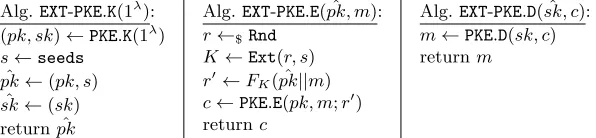
Details of the construction are given in Figure 4 in Section 4.
Intuitively, a challenge encryption constructed using randomness valueφ(r) remains secure, since the extractor guarantees an output indistinguishable from random, even when the adversary gains access to encryptions under the related randomness values φ0(r). Hence, the PRF, which uses the extractor output as a key, will guarantee that independent randomness values are used for different public key and message pairs. In turn, this implies that the adversary is forced to break the security of the underlying PKE scheme to learn anything about the encrypted challenge messages. That this approach attains FV-RRA-ATK security is formally proven in Theorem 1.
Instantiations In Section 5, we consider the instantiation of our transform using the Goldreich-Levin extractor. This provides a particularly neat construction of FV-RRA-ATK-secure PKE in which we start with an IND-ATK-secure scheme and augment it with a simple inner-product computation to prepare the key for the PRF. However, we stress that, given the limited strength of known results for the security of the Goldreich-Levin extractor in the auxiliary input setting [10], our results using this extractor are in turn limited to the original FV-RRA-ATK security model of [22] (i.e. in which the adversary is restricted to using the identity function in itsLRqueries). Still, the schemes obtained from using our transform with this extractor have significant benefits compared to the single concrete FV-RRA-CPA-secure scheme from [22]. For example, we obtain shorter public keys and a tighter security reduction compared to the scheme from [22]. Most importantly, we obtain FV-RRA-CCA security in a completely generic way.
more provides a construction for CIS hash functions that is exquisitely simple: given keyc∈Zn
p and inputr∈Hn (whereH is an arbitrary subset ofZp), the CIS hash function output is simply:
hc(r) :=hr, ci
where the inner product is evaluated overZp.
2
Preliminaries
Notation. Throughout the paper we will useλ∈Nto denote the security param-eter, which will sometimes be written in its unary representation, 1λ. We denote byy←xthe assignment ofy tox, and bys←$Swe denote the selection of an element suniformly at random from the setS. The notation [n] represents the set {1,2, . . . , n}. For an algorithm A, we denote by y ←A(x;r) that A is run with inputxand random coinsr, and that the output is assigned toy.
All our security games and proofs will utilise code-based games and the associated language. Here we briefly recall the basic definitions from Bellare et al.in [5]. A game consists of at least two procedures. We begin withInitialise, which assigns starting values to all variables and then gives outputs, if there are any, to the adversary. The adversary A may then submit queries to the oracle procedures, and whenAhalts (and possibly outputs a value) theFinalise procedure begins. Finalisewill take the output from A (if there is one) as its input and will output its own value. The value output byFinaliseis defined to be the output of the game. We writeP[GA⇒b] to denote the probability that game Goutputs bitb when run withA. For brevity, in what follows ATK will denote either CPA or CCA, where theorems or statements apply to both games. Any proofs or figures will refer to the CCA setting, but may be easily modified to the CPA case.
Public Key Encryption. We denote a specific PKE scheme by PKE = (PKE.K,
PKE.E,PKE.D). All three algorithms are polynomial-time. The randomised key generation algorithmPKE.Ktakes the security parameter as its input and outputs a key pair (pk, sk). The encryption algorithm, on input a messagem∈ M and a public keypkchooses random coins fromRndand uses these coins to output a ciphertextc. The decryption algorithm is deterministic. Its inputs are a private keyskand a ciphertextc. The algorithm either outputs a messagemor an error symbol⊥. We require the schemePKEto satisfy the correctness property. That is, for allλ ∈N, all all pairs (pk, sk) output by the key generation algorithm,
and all messagesm∈ M, we require thatPKE.D(sk,PKE.E(pk, m)) =m.
Definition 1. The advantage of an IND-ATK adversary A against a scheme
PKEis
AdvindPKE-,Aatk(λ) := 2·P[IND-ATKAPKE(λ)⇒1]−1
proc. Initialise(λ):
b←${0,1};
(pk, sk)←$PKE.K(1λ);
S ← ∅; returnpk
proc. LR(m0, m1):
c←$PKE.E(pk, mb) S ← S ∪ {c}
returnc
proc. Dec(c): ifc∈ S, return⊥
else returnPKE.D(sk, c)
proc. Finalise(b0): Ifb=b0, return 1
Fig. 1. Game IND-ATK for PKE. (If ATK = CPA, the adversary’s access to proc. Decis removed.)
proc. Initialise(λ):
K←$Keysλ
proc. Function(x): returnF(K, x)
proc. Finalise(b): returnb
proc. Initialise(λ): FunTab← ∅
proc. Function(x): if FunTab[x] =⊥,
FunTab[x]←$Rngλ
return FunTab[x]
proc. Finalise(b): returnb
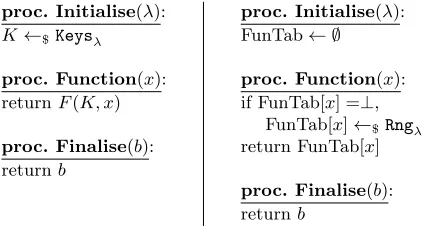
Fig. 2.Games for PRF security. Game PRFReal is on the left, PRFRand on the right.
Pseudorandom Functions. We recall the standard definition of pseudorandom functions:
Definition 2. Let F : Keysλ ×Domλ → Rngλ be a family of functions. The
advantage of a PRFadversaryAagainst F is
AdvprfF,A(λ) :=P[PRFRealAF(λ)⇒1]−P[PRFRand
A
$(λ)⇒1]
where the games PRFReal and PRFRand are defined in Figure 2. We say F
is a secure PRF family if the advantage of any polynomial-time adversary is negligible in the security parameterλ.
3
Function Vector Related Randomness Security
In this section we recall the FV-RRA-ATK notion of security from [22], and then slightly strengthen this definition to encompass a more general attack.
proc. Initialise(λ):
b←${0,1};
(pk∗, sk∗)←$PKE.K(1λ); CoinTab← ∅;S ← ∅; returnpk∗
proc. Dec(c):
ifc∈ S, then return⊥
else returnPKE.D(sk∗, c)
proc. LR(m0, m1, i, j): If CoinTab[i] =⊥,
CoinTab[i]←$Rnd
ri←CoinTab[i]
c←PKE.E(pk∗, mb;φj(ri)) S ← S ∪ {c}
returnc
proc. Enc(pk, m, i, j): if CoinTab[i] =⊥,
CoinTab[i]←$Rnd
ri←CoinTab[i] c←PKE.E(pk, m;φ0j(ri))
returnc
proc. Finalise(b0): ifb=b0, return 1
Fig. 3.Game (φ,φ0)-FV-RRA-ATK, whereφ= (φ1, . . . , φq) andφ0 = (φ01, . . . , φ 0
q0).
(If ATK = CPA, then the adversary’s access toproc. Decis removed.)
security parameterλ, and the adversary may request encryption queries by sub-mitting a tuple of the form (pk, m, i, j) to itsEnc oracle. This tuple consists of a public keypk, a messagem, an indexiselecting the random valueri with which to encrypt, and an index j that selects the function φj that modifies the randomness ri before encryption. Hence, the adversary will receive the re-sponse PKE.E(pk, m;φj(ri)), where the values ri are uniform and independent. The adversary may furthermore query a Left or Right (LR) oracle with a tuple (m0, m1, i). The response of this oracle will be PKE.E(pk∗, mb;ri), where pk∗ is the target public key and b is a bit, both of which are chosen uniformly and independently during the initialisation stage of the security game. Note that the randomness values ri used to respond toLR queries are uniformly chosen random values. In the CCA version of the game, an adversary can additionally submit ciphertextsc to a decryption oracleDec. The decryption oracle will re-turnPKE.D(sk∗, c) as long as the ciphertextcwas not returned by theLRoracle. When the adversary has made all its (polynomially many) queries, it will submit a bitb0 to aFinaliseprocedure, which represents the adversary’s guess for the bitb. TheFinaliseprocedure will output 1 (representing an adversarial win) if b=b0. The security game for this notion is given in Figure 3.
The following definition has been adapted from [22] for our purposes. The definition captures natural restrictions which must be placed on an adversary with the capability of controlling the randomness of the challenge encryptions in an IND-ATK style security game. This is reminiscent of the restrictions put in place in the security definition for deterministic encryption (e.g. see [24]).
Definition 3. LetAbe an adversary in Game(φ,φ0)-FV-RRA-ATKthat queries
rdifferent randomness indices to itsLRandEncoracles and makesqi,φqueries
to its LR oracle with index i and function φ ∈ φ. Let (mi,φ,0 1, mi,φ,1 1), . . . , (mi,φ,qi,φ0 , mi,φ,qi,φ1 ) be A’s LR queries for index i ∈ [r] and φ ∈ φ. Suppose that for all pairs (i, φ)∈[r]×φand for allj 6=k∈[qi,φ], we have:
mi,φ,j0 =mi,φ,k0 iffmi,φ,j1 =mi,φ,k1 .
Then we say thatAis equality-pattern respecting.
Note that any adversary that is not equality-pattern respecting can trivially win the game in Figure 3. More specifically, the adversary can simply query its LR oracle with the tuples (m0, m1, i, j) and (m0, m2, i, j), wherem0, m1andm2are all distinct. The valuesiand j can be an arbitrary values from the appropriate domain. If the bitbis equal to 0, the adversary will receive identical ciphertexts, whereas the ciphertexts will differ if b equals 1. This results in a trivial win for an adversary. In contrast, an equality-respecting adversary cannot exploit the available oracles in this particular way, and is forced to mount a non-trivial attack against the scheme to win the security game.
With the above definition in place, we can now formally define FV-RRA-ATK security.
Definition 4. Let φ = (φ1, . . . , φq) and φ0 = (φ01, . . . , φ0q0) be vectors of q :=
q(λ) and q0 := q0(λ) functions respectively. We define the advantage of an equality-pattern respecting, (φ,φ0)-FV-RRA-ATK adversary A against a PKE schemePKEto be:
Adv(φ,φ
0
)-fv-rra-atk
PKE,A (λ) := 2·Pr[(φ,φ
0)-FV-RRA-ATKA
PKE(λ)⇒1]−1.
If Φ and Φ0 are sets of vectors of functions, then a PKE scheme PKE is said to be (Φ,Φ0)-FV-RRA-ATK secure if, for all φ ∈ Φ and for all φ0 ∈ Φ0, the advantage of any equality-pattern respecting, (φ,φ0)-FV-RRA-ATK adversary against PKEthat runs in polynomial time is negligible in the security parameter
λ.
Similar to the notion defined in [22], it is possible to reduce the above defined FV-RRA-ATK security to a simpler notion in which the security game involves only a single uniformly chosen random value used in all oracle queries. The following lemma follows easily from Lemma 1 of [22] and is therefore presented without a proof.
LRqueries. Then there exists an equality-pattern respecting,(φ,φ0)-FV-RRA-ATK
adversary B that queries at most 1 randomness index and makes at most qLR
LR queries such that
Adv(φ,φ
0
)-fv-rra-atk
PKE,A (λ)≤qr·Adv
(φ,φ0)-fv-rra-atk
PKE,B (λ),
whereBruns in approximately the same time asA. In the CCA setting,Bmakes the same number of decryption queries as A.
4
Obtaining FV-RRA Security from Auxiliary-Input
Reconstructive Extractors
In this section we present the main result of the paper. Recall that this result improves upon the work of Paterson et al. [22] by proposing a transform that converts any IND-ATK scheme into an FV-RRA-ATK scheme via the use of an auxiliary-input reconstructive extractor. Recall also that the authors of [22] only provided a single concrete instantiation of a FV-RRA-CPA secure scheme. In the later sections we will provide instantiations of our transform that are not only able to meet the stronger FV-RRA-CCA notion, but also provide shorter public keys and a tighter security reduction compared to the scheme from [22].
Before introducing the extractors we utilise in our transform, we first need to define the notion of a vector of functions beingδ-hard-to-compute with respect to another vector of functions.
Definition 5. Let φ = (φ1, . . . , φq) and φ0 = (φ01, . . . , φ0q0) denote vectors of
functions on a set Rndλ, where q := q(λ) and q0 := q0(λ) are polynomial in
the security parameter λ. Let δ(λ) be a function. We say that φis δ(λ)-hard-to-compute with respect to φ0 if, for all polynomial time algorithmsA and all sufficiently large λ, we have:
Pr[φi(r)← A(φ01(r), . . . , φq0(r)) :r←$Rndλ]≤δ(λ),
for all i ∈ {1, . . . , q}. We say that a set of vectors of functions Φ is δ -hard-to-compute with respect toΦ0 if each vectorφ∈Φisδ-hard-to-compute with respect to every vector inΦ0 (note that the vectors in such a setΦ need not all be of the same dimension, but we assume they each have dimension that is polynomial in
λ). Ifδ= negl(λ), then we simply say that Φis hard-to-compute with respect to
Φ0.
input (for 0≤k≤n). No information is leaked about the firstkbits of the input, and hence no algorithm can invertφ0with probability greater than 2−kwhen the input string is uniformly random. Therefore, ifk≥ −log2δ, the functionφ0(and, consequently, Φ0) is δ-hard-to-invert. This example can naturally be extended to the case whereΦ0 contains multiple vectors of functions andΦ6={id}.
We now introduce our generalised definition of an auxiliary-input reconstruc-tive extractor.
Definition 6. An (, δ,Φ,Φ0)-auxiliary-input reconstructive extractoris a pair of functions (Ext,Rec) such that Extis an extractor that maps from {0,1}n× {0,1}d toΣ, and
Recis an oracle machine that on input(1n,1/)runs in time poly(n,1/,log(|Σ|)). Furthermore, for everyx∈ {0,1}n, everyφ= (φ
1, . . . , φq)∈ Φ, everyφ0∈Φ0, and every functionDsuch that
Pr s←${0,1}d
[D(s,{Ext(φi(x), s)}i∈{1,...,q},φ0(x)) = 1]
− Pr s←${0,1}d
σi←$Σ
[D(s,{σi}i∈{1,...,q},φ0(x)) = 1]
≥
we require that
Pr[RecD(1n,1/,φ0(x)) =φi(x)]≥δ
for some i ∈ {1, . . . , q}, where φ= (φ1, . . . , φq), q := q(λ) is polynomial, and
the probability is over the coin tosses of Rec. If, for every Dwith non-negligible
,Recreconstructsφi(x)with non-negligible probability, we may simply say that (Ext,Rec)is a(Φ,Φ0)-auxiliary-input reconstructive extractor.
Armed with this new definition of an auxiliary-input reconstructive extractor, we are ready to state and prove the main result of this paper. We show that any extractor satisfying Definition 6 can be used in conjunction with an IND-ATK secure PKE scheme and a PRF to meet the FV-RRA-ATK security notion in Figure 3. The encryption scheme that achieves this result is in Figure 4. The algorithm works by appending a uniformly random extractor seed to each public key, but leaving the private key unmodified. The encryption algorithm generates a uniformly randomr, which is then fed into the extractor (using the seed from the public key). The output of the extractor is used as a key for a PRF, and the input to the PRF is the public key appended with the message. Finally, the output of the PRF is used as the new randomness for encryption, and then we simply encrypt with the standard encryption algorithm.
Theorem 1. If Φ is hard-to-compute with respect to Φ0 and (Ext,Rec) is an
Alg.EXT-PKE.K(1λ):
(pk, sk)←PKE.K(1λ)
s←seeds
ˆ
pk←(pk, s) ˆ
sk←(sk) return ˆpk
Alg.EXT-PKE.E( ˆpk, m):
r←$Rnd
K←Ext(r, s)
r0←FK( ˆpk||m) c←PKE.E(pk, m;r0) returnc
Alg.EXT-PKE.D( ˆsk, c):
m←PKE.D(sk, c) returnm
Fig. 4.SchemeEXT-PKEbuilt from a reconstructive extractor, a PKE schemePKE, and a PRFF.
reconstructive extractor (Ext,Rec), and any equality-pattern respecting, (φ,φ0)
-FV-RRA-ATKadversaryAagainstEXT-PKE. SupposeAmakesqLRLRqueries
and uses qr randomness indices. Then, either Φ is not δ-hard-to-compute with
respect to Φ0, or there exists a PRF adversaryB, and an IND-ATK adversary
C, all running in polynomial time, such that:
Adv(φ,φ
0
)-fv-rra-atk
EXT-PKE,A (λ)<2qr·q·AdvprfF,B(λ) +qr·qLR·AdvindPKE-,Catk(λ) + 2qr.
Proof. See Appendix A.
5
Instantiation of an Auxiliary-Input Reconstructive
Extractor
Given Theorem 1, it now remains to see what extractors exist that satisfy Defini-tion 6. The strongest extractor we are aware of is the Goldreich-Levin extractor, whose properties are analysed in [10, Theorem 1]. That theorem states the fol-lowing (with the notation changed to remain consistent with ours):
Theorem 2. Let pbe a prime, and letH be an arbitrary subset ofZp. Letf : Hn → {0,1}∗ be any (possibly randomised) function. If there is a distinguisher
Dthat runs in timet such that
Pr[r←H
n, y←f(r),s←
Znp :D(y,s,hr,si) = 1]
−Pr[r←Hn, y←f(r),s←Zn
p, u←Zp:D(y,s, u) = 1]
=
then there is an inverterAthat runs in time t0=t·poly(n,|H|,1/)such that6
Pr[r←Hn, y←f(r) :A(y) =r]≥ 3
512·n·p3. (1)
6 The bound quoted in [10] had the denominator 512np2. However, we believe the
Alg.EXT-PKE.K(1λ):
(pk, sk)←PKE.K(1λ) s←Zλp
ˆ
pk←(pk, s) ˆ
sk←(sk) return ˆpk
Alg.EXT-PKE.E( ˆpk, m):
r←$Hλ
K← hr, si r0←FK( ˆpk||m) c←PKE.E(pk, m;r0) returnc
Alg.EXT-PKE.D( ˆsk, c):
m←PKE.D(sk, c) returnm
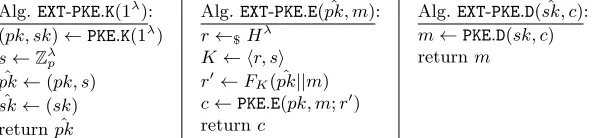
Fig. 5.SchemeEIP-PKE (Euclidean Inner Product) built from a PKE schemePKE, and a PRFF. Here,H denotes a subset ofZq.
This theorem can be used to obtain an auxiliary-input reconstructive extractor. Specifically, consider the extractor Extthat maps fromHn×Znp toZp (where H is a subset ofZp) defined as
Ext(r, s) =hr, si.
Matching the notation of Theorem 2 with Definition 6,Recis nowA,Φ={id}, Φ0is the set ofδ-hard-to-invert vectors of functions,φ0 is the functionf, and the extractor Ext is easily seen to be an (, δ,id,Φ0)-auxiliary-input reconstructive extractor, where
=p3 512δλp3.
Note that, in the proof of [10], the theorem is stated with one functionf. How-ever, we now use a vector of functions (φ01, . . . , φ0q) in our proof. Fortunately this is not problematic, since we can simply interpretf (whose output is in {0,1}∗)
as a vector of functions. That is, we can setf(r) = (φ01(r), . . . , φ0q(r)).
By combining Theorem 2 with Theorem 1, we easily obtain the following theorem.
Theorem 3. Let Φ0 be a set of hard-to-invert vectors of functions on {0,1}λ.
Then PKE scheme EIP-PKEin Figure 5 is (id,Φ0)-FV-RRA-ATK secure. More precisely, consider any polynomial-size vector of functions φ0 ∈ Φ0 which are
δ-hard-to-invert, and any equality-pattern respecting,(id,φ0)-FV-RRA-ATK ad-versary AagainstEIP-PKE. Suppose AmakesqLR LRqueries and usesqr
ran-domness indices. Then there exists a PRF adversaryBand an IND-ATK adver-sary C, all running in polynomial time, such that:
Adv(id,φ
0
)-fv-rra-atk
EIP-PKE,A (λ)<2qr·Adv prf
F,B(λ)+qr·qLR·AdvPKEind-,Catk(λ)+2qr3
p
512δλp3.
convert any IND-CCA scheme into an FV-RRA-CCA secure scheme. Further-more, the security bound of our theorem is tighter than that of [22], and our theorem facilitates the use of much smaller public keys. For comparison, when using our transform with the above Goldreich-Levin extractor, the public key of the underlying PKE scheme is modified to includeλadditional components from H ⊂Zq. Hence, transforming, for example, the PKE scheme by Kurosawa and Desmedt [18], yields a scheme with public keys consisting ofλ+4 group elements and a hash function key. In contrast, the modified BHHO scheme presented in [22] requires public keys consisting of 2·k(λ) group elements (wherekis polyno-mial). Furthermore, the loss of security in the security reduction of the modified BHHO scheme includes the component p3
512δkp4, which originates from the reduction to the δ-hard-to-invert functions. In comparison, the corresponding loss of security obtained from applying our transform is p3
512δλp3, which leads to a weaker requirement on theδ-hard-to-invert functions.
It remains an open question whether there exists extractors that will en-able stronger notions of FV-RRA-ATK security to be shown for schemes like
EXT-PKE (Figure 4), or alternative extractors that have, for example, shorter seeds. However, this seems difficult at present. A standard technique to obtain an (, δ)-auxiliary-input reconstructive extractor is to use complexity-leveraging with a standard reconstructive extractor [26]. Unfortunately, this technique does not appear to work in the FV-RRA-ATK setting. More specifically, if we wish to use complexity-leveraging, we require the range of the auxiliary function to be smaller than the domain. However, for our FV-RRA-ATK game to make sense, we require that for each φ we have D(φ) = R(φ) = Rnd. Hence, complexity-leveraging seems to be incompatible with the FV-RRA-ATK model.
6
Connections with CIS Hash Functions
proc. Initialise(λ):
b←${0,1};
hc←$H
r←$D(hc)
returnhc
proc. Challenge(j): ifb= 0,
z←$R(hc)
returnz
else,
returnhc(φj(r))
proc. Query(i): returnhc(φ0i(r))
proc. Finalise(b0): Ifb=b0, return 1
Fig. 6.The (φ,φ0)-CIS hash game, whereφ= (φ1, . . . , φq) andφ0= (φ01, . . . , φ 0
q0).
As noted in [14], CIS hash functions have applications to password-based login and efficient searches on encrypted data. Furthermore, they share interest-ing connections with Related-Key Attack secure primitives. However, the CIS hash function construction presented in [14] only achieves selective security for correlation functions φcorresponding to polynomials of bounded degree, which limits its usefulness in the above mentioned applications. Constructing adap-tive CIS hash functions for a wide class of functions is a challenging task, in particular for non-algebraic function classes. This is evidenced by the results of Wichs [27], which show that injective CIS hash functions cannot be proved secure for arbitrary correlation functions φvia a black-box reduction, based on any cryptographic game. However, here we show that auxiliary-input reconstruc-tive extractors can be used to construct a specific kind of CIS hash functions. To explore this connection, we must consider a variant of the CIS hash security game that was presented in [14]. The security game is shown in Figure 6, while our definition of security is given below.
Definition 7. The advantage of an adversary Aagainst a family of hash func-tionsHin the(φ,φ0)-CIS game (Figure 6) is defined to be
Adv(φ,φ
0
)-cis
H,A (λ) := 2·Pr[(φ,φ 0)-CISA
H(λ)⇒1]−1.
Definition 8. A family of hash functionsHis said to be(Φ,Φ0)-pseudorandom correlated-input secure if, for all φ ∈ Φ, all φ0 ∈ Φ0, and all polynomial time adversariesA, we have
Adv(φ,φ
0
)-cis
H,A (λ)≤negl(λ).
Notice that in our new definition, instead of letting the adversary adaptively choose the functions as in [14], the security game itself is parametrised with function vectors φ and φ0, and security is required to hold for all choices of φ∈Φandφ0∈Φ0. It is worth stressing that there is a subtle difference between the two approaches to defining security for CIS hash functions, and the definition used here implies that the function vectorsφandφ0 will be independent of the chosen hash function (i.e. the hash function key c).
With these definitions and notions in place we can define our hash function familyHfrom an extractor as follows:
The following theorem establishes the security of the hash function, based on the security of the underlying auxiliary-input reconstructive extractor.
Theorem 4. LetExtbe an(, δ,Φ,Φ0)-auxiliary-input reconstructive extractor, and let Φ be δ-hard-to-compute with respect to Φ0. Consider the hash function familyHdefined by the hash functionshc(r) :=Ext(c, r). Then, for anyφ∈Φ,
any φ0 ∈Φ0, and all polynomial time adversariesA, we have
Adv(φ,φ
0
)-cis
H,A (λ)< .
We will sketch the proof of the above theorem.
Proof (Sketch).If an adversaryAhas advantage greater than or equal to , we would be able to build an extractor adversaryDthat distinguishes the outputs of the extractor with probability. This in turn would allow us to build a function
Recthat recovers r with probability greater than δ (cf. Definition 6), which is not possible by assumption. Hence, we have a contradiction, so the advantage
of the adversaryAmust be less than. ut
A concrete instantiation of such a CIS hash is possible via Theorem 1 of [10]. If we define
hc(r) :=hr, ci, (2)
wherec∈Zλp andr∈Hλ forH⊂Zp, then the following corollary is obvious.
Corollary 1. Consider the hash function family H defined by Equation 2, and let Φ0 be a set of δ-hard-to-invert functions. Then, for all φ0 ∈ Φ0, and all polynomial time adversaries A, we have
Adv(id,φ
0
)-cis
H,A (λ)<
3
p
512δλp3.
As highlighted above, CIS hash functions share interesting connections with RKA-secure primitives. In fact, [14] proposed a general approach for obtain-ing RKA-security via a CIS hash function. For example, consider a standard signature scheme given by algorithms {KeyGen,Sign,Verify}, and a (id,Φ0 )-pseudorandom correlated-input secure hash function h for which we assume a key c is publicly available. To obtain a RKA-secure signature scheme for func-tionsΦ0, simply replace the random coinsrused byKeyGenwithhc(r), and the signing key withr. Furthermore, since the signing key of the original scheme is no longer stored, the algorithm Signmust regenerate this from rusing hc and
KeyGen. As shown in [14], the resulting signature scheme will be RKA-secure for functions Φ0.
which the above transformation applies. However, note that due to the properties of the above described security model for CIS hash functions, which implies that the functionsΦ0 are independent of the hash function key, we only obtain selective RKA-security.
References
1. Michel Abdalla, Fabrice Benhamouda, Alain Passel`egue, and Kenneth G. Paterson. Related-key security for pseudorandom functions beyond the linear barrier. In Juan A. Garay and Rosario Gennaro, editors,CRYPTO (1), volume 8616 ofLecture Notes in Computer Science, pages 77–94. Springer, 2014.
2. Andrew Becherer, Alex Stamos, and Nathan Wilcox. Cloud computing security: Raining on the trendy new parade. BlackHat USA, 2009.
3. Mihir Bellare, Zvika Brakerski, Moni Naor, Thomas Ristenpart, Gil Segev, Hovav Shacham, and Scott Yilek. Hedged public-key encryption: How to protect against bad randomness. In Mitsuru Matsui, editor,ASIACRYPT, volume 5912 ofLecture Notes in Computer Science, pages 232–249. Springer, 2009.
4. Mihir Bellare and David Cash. Pseudorandom functions and permutations prov-ably secure against related-key attacks. In Tal Rabin, editor, CRYPTO, volume 6223 ofLecture Notes in Computer Science, pages 666–684. Springer, 2010. 5. Mihir Bellare and Phillip Rogaway. The security of triple encryption and a
framework for code-based game-playing proofs. In Serge Vaudenay, editor, EU-ROCRYPT, volume 4004 of Lecture Notes in Computer Science, pages 409–426. Springer, 2006.
6. Mike Bendel. Hackers describe PS3 security as epic fail, gain unrestricted access, 2011. http://www.exophase.com/20540/
hackers-describe-ps3-security-as-epic-fail-gain-unrestricted-access/.
7. Daniel J. Bernstein, Yun-An Chang, Chen-Mou Cheng, Li-Ping Chou, Nadia Heninger, Tanja Lange, and Nicko van Someren. Factoring RSA keys from cer-tified smart cards: Coppersmith in the wild. Cryptology ePrint Archive, Report 2013/599, 2013. http://eprint.iacr.org/.
8. Dan Boneh, Shai Halevi, Michael Hamburg, and Rafail Ostrovsky. Circular-secure encryption from decision diffie-hellman. In David Wagner, editor,CRYPTO, vol-ume 5157 ofLecture Notes in Computer Science, pages 108–125. Springer, 2008. 9. Debian. Debian Security Advisory DSA-1571-1: OpenSSL – predictable random
number generator, 2008. http://www.debian.org/security/2008/dsa-1571. 10. Yevgeniy Dodis, Shafi Goldwasser, Yael Tauman Kalai, Chris Peikert, and Vinod
Vaikuntanathan. Public-key encryption schemes with auxiliary inputs. In Daniele Micciancio, editor,TCC, volume 5978 ofLecture Notes in Computer Science, pages 361–381. Springer, 2010.
11. Yevgeniy Dodis, David Pointcheval, Sylvain Ruhault, Damien Vergnaud, and Daniel Wichs. Security analysis of pseudo-random number generators with input: /dev/random is not robust. IACR Cryptology ePrint Archive, 2013:338, 2013. 12. Leo Dorrendorf, Zvi Gutterman, and Benny Pinkas. Cryptanalysis of the random
number generator of the Windows operating system.ACM Trans. Inf. Syst. Secur., 13(1), 2009.
13. Ian Goldberg and David Wagner. Randomness and the Netscape browser, 1996.
14. Vipul Goyal, Adam O’Neill, and Vanishree Rao. Correlated-input secure hash functions. In Yuval Ishai, editor,TCC, volume 6597 ofLecture Notes in Computer Science, pages 182–200. Springer, 2011.
15. Zvi Gutterman and Dahlia Malkhi. Hold your sessions: An attack on java session-id generation. In Alfred Menezes, editor, CT-RSA, volume 3376 ofLecture Notes in Computer Science, pages 44–57. Springer, 2005.
16. Zvi Gutterman, Benny Pinkas, and Tzachy Reinman. Analysis of the linux random number generator. InIEEE Symposium on Security and Privacy, pages 371–385. IEEE Computer Society, 2006.
17. Nadia Heninger, Zakir Durumeric, Eric Wustrow, and J. Alex Halderman. Mining your Ps and Qs: Detection of widespread weak keys in network devices. InUSENIX Security Symposium, August 2012.
18. Kaoru Kurosawa and Yvo Desmedt. A new paradigm of hybrid encryption scheme. In Matthew K. Franklin, editor,CRYPTO, volume 3152 ofLecture Notes in Com-puter Science, pages 426–442. Springer, 2004.
19. Arjen K. Lenstra, James P. Hughes, Maxime Augier, Joppe W. Bos, Thorsten Kleinjung, and Christophe Wachter. Public keys. In Reihaneh Safavi-Naini and Ran Canetti, editors,CRYPTO, volume 7417 of Lecture Notes in Computer Sci-ence, pages 626–642. Springer, 2012.
20. Stefan Lucks. Ciphers secure against related-key attacks. In Bimal K. Roy and Willi Meier, editors, FSE, volume 3017 of Lecture Notes in Computer Science, pages 359–370. Springer, 2004.
21. Kai Michaelis, Christopher Meyer, and J¨org Schwenk. Randomly failed! the state of randomness in current java implementations. In Ed Dawson, editor,CT-RSA, volume 7779 ofLecture Notes in Computer Science, pages 129–144. Springer, 2013.
22. Kenneth G. Paterson, Jacob C. N. Schuldt, and Dale L. Sibborn. Related random-ness attacks for public key encryption. In Hugo Krawczyk, editor,PKC, volume 8383 ofLecture Notes in Computer Science, pages 465–482. Springer, 2014.
23. Kenneth G. Paterson, Jacob C. N. Schuldt, and Dale L. Sibborn. Related random-ness attacks for public key encryption.IACR Cryptology ePrint Archive, 2014:337, 2014.
24. Ananth Raghunathan, Gil Segev, and Salil P. Vadhan. Deterministic public-key encryption for adaptively chosen plaintext distributions. In Thomas Johansson and Phong Q. Nguyen, editors,EUROCRYPT, volume 7881 ofLecture Notes in Computer Science, pages 93–110. Springer, 2013.
25. Thomas Ristenpart and Scott Yilek. When good randomness goes bad: Virtual machine reset vulnerabilities and hedging deployed cryptography. In NDSS. The Internet Society, 2010.
26. Hoeteck Wee. Public key encryption against related key attacks. In Marc Fischlin, Johannes Buchmann, and Mark Manulis, editors,Public Key Cryptography, volume 7293 ofLecture Notes in Computer Science, pages 262–279. Springer, 2012.
27. Daniel Wichs. Barriers in cryptography with weak, correlated and leaky sources. In Robert D. Kleinberg, editor,ITCS, pages 111–126. ACM, 2013.
Setup
(pk∗, sk∗)←PKE.K(1λ)
( ˆpk∗,skˆ∗)←(pk∗||s, sk∗)
b←${0,1}
Enc query( ˆpk, m, i)
returnEXT-PKE.E( ˆpk, m;φi(r))
LR query(m0, m1, i)
r0←Fzi( ˆpk ∗
||mb) c←PKE.E(pk∗, mb;r0)
returnc
Dec query c
returnPKE.D(sk∗, c)
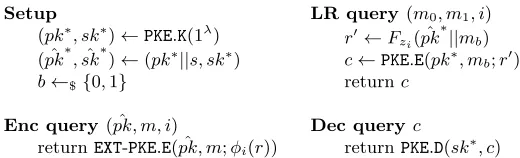
Fig. 7.Simulation used in the proof of Lemma 2
A
Proof of Theorem 1
Proof. First, we invoke Lemma 1, so that we now only have to prove the theorem for an adversary using just one randomness value. Furthermore, we assume that an adversary never repeats a query. Identical queries will result in identical outputs, hence any adversary that repeats a query may be replaced by a more efficient adversary with the same advantage. We proceed via a sequence of game hops. The games are as follows:
G0: G0 is the real game with the scheme defined in Figure 4.
G1: G1is the same asG0, except forLRqueries, where the output of the extrac-tor is replaced with a uniformly random value. If there existed an adversary that could distinguish between these two games, then we could use this ad-versary to reconstructφi(r).
G2: G2 is the same asG1, except forLRqueries, where the outputs of the PRF are replaced with uniformly random values. Finally, G2 may be simulated by a standard IND-ATK adversary.
G0– G1: We will prove the following:
Lemma 2. For any adversaryA, the difference in success probabilities in games
G0 andG1 is bounded by:
Pr[GA1 ⇒1]−Pr[GA0 ⇒1]< .
Proof. Consider a distinguisher D, attempting to distinguish whether the ex-tractor game has returned a real or random output. Adversary D is given a seed s, two vectors of functions φ = (φ1, . . . , φq) and φ0 = (φ01, . . . , φ0q0), and
the vector φ0 = (φ01(r), . . . , φ0q(r)), and a value z = (z1, . . . , zq) which is ei-ther {Ext(φi(r);s)}i∈{1,...,q} or (σ1, . . . , σq) where each σi is chosen uniformly at random from the range Σ of the extractor. The distinguisher Dsets up the simulation as shown in Setup in Figure 7, and forwards the public key ˆpk∗ to A. Then Danswers A’s queries as shown in Enc query, LR query, andDec queryin Figure 7.
WhenAhalts and outputsb0,Dhalts and outputs 1 if and only if b=b0. If z ={Ext(φi(r);s)}i∈{1,...,q} a perfect simulation of G0 is provided. Otherwise,
a perfect simulation ofG1 is provided. Hence,
Setup
b←${0,1}
s←$seeds
r←$ Rnd
Kj+2, . . . , Kq←$PRF.K(1λ) (pk∗, sk∗)←PKE.K(1λ)
( ˆpk∗,skˆ∗)←(pk∗||s, sk∗)
Enc query( ˆpk, m, i)
returnEXT-PKE.E( ˆpk, m;φi(r))
Dec queryc
returnPKE.D(sk, c)
LR query(m0, m1, i) ifi < j+ 1
r0←$Rnd ifi=j+ 1
forwardpk∗||mb to PRF oracle;
receive outputr0
ifi > j+ 1
r0←FKi(pk ∗||
mb) c←PKE.E( ˆpk∗, mb;r0)
returnc
Fig. 8.Simulation used in the proof of Lemma 3
If an adversary can distinguish outputs of the extractor from uniformly random values with probability greater than or equal toin polynomial time, then there exists an algorithm Rec that will recover φi(r) (for some i ∈ {1, . . . , q}) with probability greater than δ (cf. Definition 6). However, this is a contradiction since theφisδ-hard-to-compute with respect to φ0. Hence, we must have
Pr[GA1 ⇒1]−Pr[GA0 ⇒1]< .
u t
G1 –G2: If an adversary can distinguish games 1 and 2 with a certain proba-bility, then we may construct a PRF adversaryBthat wins the PRF game with the same probability. Specifically:
Lemma 3. The difference between gamesG1 andG2 is bounded by the advan-tage of a PRF adversary. More specifically,
|Pr[GA1 ⇒1]−Pr[GA2 ⇒1]| ≤AdvprfF,B(λ).
Proof. The proof uses a hybrid argument. Consider the hybrid gameG1,j, where the outputs of the PRF for functions {φi}i<j+1 are replaced with uniformly random values. Notice thatG1=G1,0 andG2=G1,q.Bsets up the simulation ofG1,jas shown inSetupin Figure 8, and returns the public key ˆpk
∗
toA. Then Banswers A’s queries as shown inEnc query,LR query, andDec queryin Figure 8.
WhenA halts and outputs b0, B halts and outputs 1 if and only if b =b0. WhenB’s outputs are from a PRF he simulatesG1,j perfectly. Otherwise, ifB’s outputs are uniformly random he simulatesG1,j+1 perfectly. Hence, we have
|Pr[GA1 ⇒1]−Pr[GA2 ⇒1]| ≤q·Adv prf F,B(λ).
Setup
r←$Rnd
s←$seeds
ctr←1
(pk∗, sk∗)←PKE.K(1λ) ( ˆpk∗,skˆ∗)←(pk∗||s, sk∗)
Enc query(pk, m, i)
returnEXT-PKE.E(pk, m;φi(r))
Dec queryc
returnPKE.D(sk, c)
LR query(m0, m1) If ctr< j,
r0←$Rnd
c←PKE.E(pk, m0;r0) Else if ctr> j,
r0←$Rnd
c←PKE.E(pk, m1;r0) Else submit (m0, m1) to C’s LRoracle, receivec
ctr←ctr + 1 returnctoA.
Fig. 9.Hybrid gameG2,jused in the proof of Lemma 4
Finally, the gameG2may be simulated by a standard IND-ATK PKE adversary, C. More formally,
Lemma 4. The success probability of an adversary attacking G2 can be bound
as follows:
2·Pr[GA2 ⇒1]−1≤qLR·AdvindPKE-,Catk(λ).
Proof. This proof uses a hybrid argument. Specifically, consider a hybrid game G2,jin which the firstjLRqueries are answered with encryptions ofm0, and the followingqLR−j LR queries are answered with encryptions ofm1. Specifically, gameG2,j is set up as shown inSetupin Figure 9, and the adversaries queries are answered as shown inEnc query,LR query, andDec queryin Figure 9. Note that the advantage of an adversary in game G2 is equivalent to the adversary’s ability to distinguishG2,0andG2,qLR. Furthermore, it is easily seen that, from an adversaryAwhich is able to distinguish gameG2,j andG2,j+1, we can construct an IND-ATK adversary C againstPKEwith the same advantage, by usingC’s challenge as the response to thejthLRquery. Hence, we conclude that
2·Pr[GA2 ⇒1]−1≤qLR·Advind-atkPKE,C (λ).
u t